9 Proven Pronghorn Antelope Hunting Tips for Western Plains Success
Pronghorn antelope are the fastest land animal in the Western Hemisphere, capable of sustaining speeds above 55 mph across open terrain, yet roughly 70 percent of first-time hunters who draw a tag return home empty-handed. That failure rate has nothing to do with luck. It comes down to underestimating an animal that can spot movement at distances exceeding half a mile and lives in country that offers almost no natural cover. The 9 proven pronghorn antelope hunting tips for western plains success outlined in this guide address every stage of the hunt, from pre-season scouting to shot placement, giving hunters of all experience levels a clear, practical roadmap for filling a tag.
Disclosure: This post contains affiliate links. As an Amazon Associate, we earn from qualifying purchases, and at no extra cost to you.
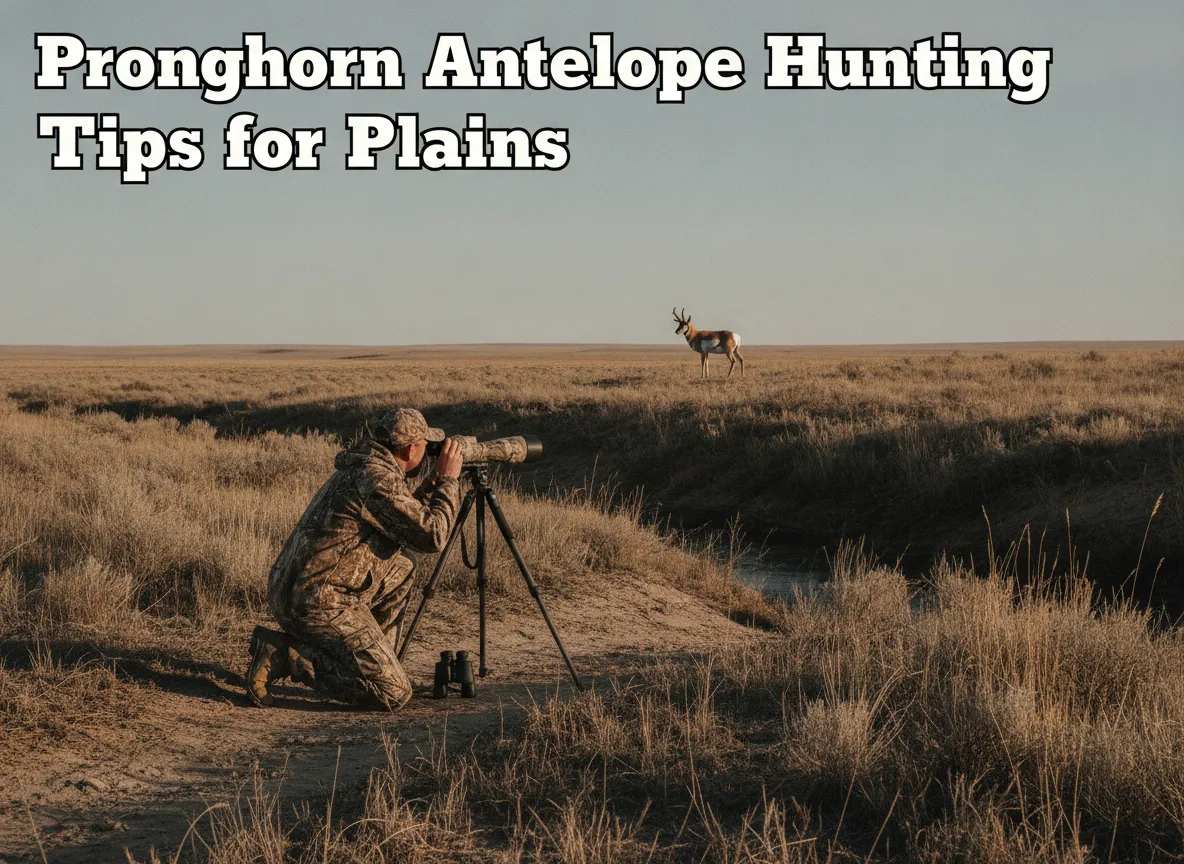
Key Takeaways
- Quality optics are non-negotiable; 10×42 binoculars and a 25-45x spotting scope form the foundation of every successful pronghorn hunt
- Long-range shooting proficiency at 400-500 yards separates consistent harvesters from those who watch bucks walk away
- Water source patterning over 24-48 hours is the single most reliable tactic for bowhunters and rifle hunters alike
- Decoy strategies and rut timing can dramatically shorten a hunt when applied correctly during mid-September
- Thorough pre-season scouting using mapping apps and satellite imagery saves days of wasted effort in the field
Understanding Pronghorn Biology Before Applying the 9 Proven Pronghorn Antelope Hunting Tips for Western Plains Success
Before any tactic makes sense, hunters need a working understanding of what makes pronghorn uniquely challenging. Pronghorn are not deer. They evolved alongside now-extinct North American predators, and their survival strategy relies almost entirely on vision and speed rather than cover and concealment. Their eyes are proportionally among the largest of any North American big-game animal, and researchers estimate their visual acuity at roughly three times that of a human [3]. That single biological fact reshapes every decision a hunter makes in the field.
Pronghorn also behave differently across seasons. During early archery seasons in late August and early September, bucks are often found in bachelor groups. As September progresses, bucks begin establishing territories and herding does. By mid-September, the rut is typically in full swing across most of Wyoming, Montana, and Colorado, creating aggressive territorial behavior that hunters can exploit [5]. Understanding this seasonal calendar allows hunters to match their tactics to the animal’s current behavioral state rather than applying a one-size-fits-all approach.
Key biological facts every hunter should know:
- Pronghorn lack dewclaws and are built for endurance running across flat terrain
- Their hollow hair provides exceptional insulation but also makes them buoyant, they prefer to swim around water obstacles rather than through them
- Pronghorn shed their horn sheaths annually, unlike deer antler cycles
- Mature bucks typically weigh 100-130 pounds, making meat care in warm early seasons a priority
1. Invest in Optics That Match the Terrain
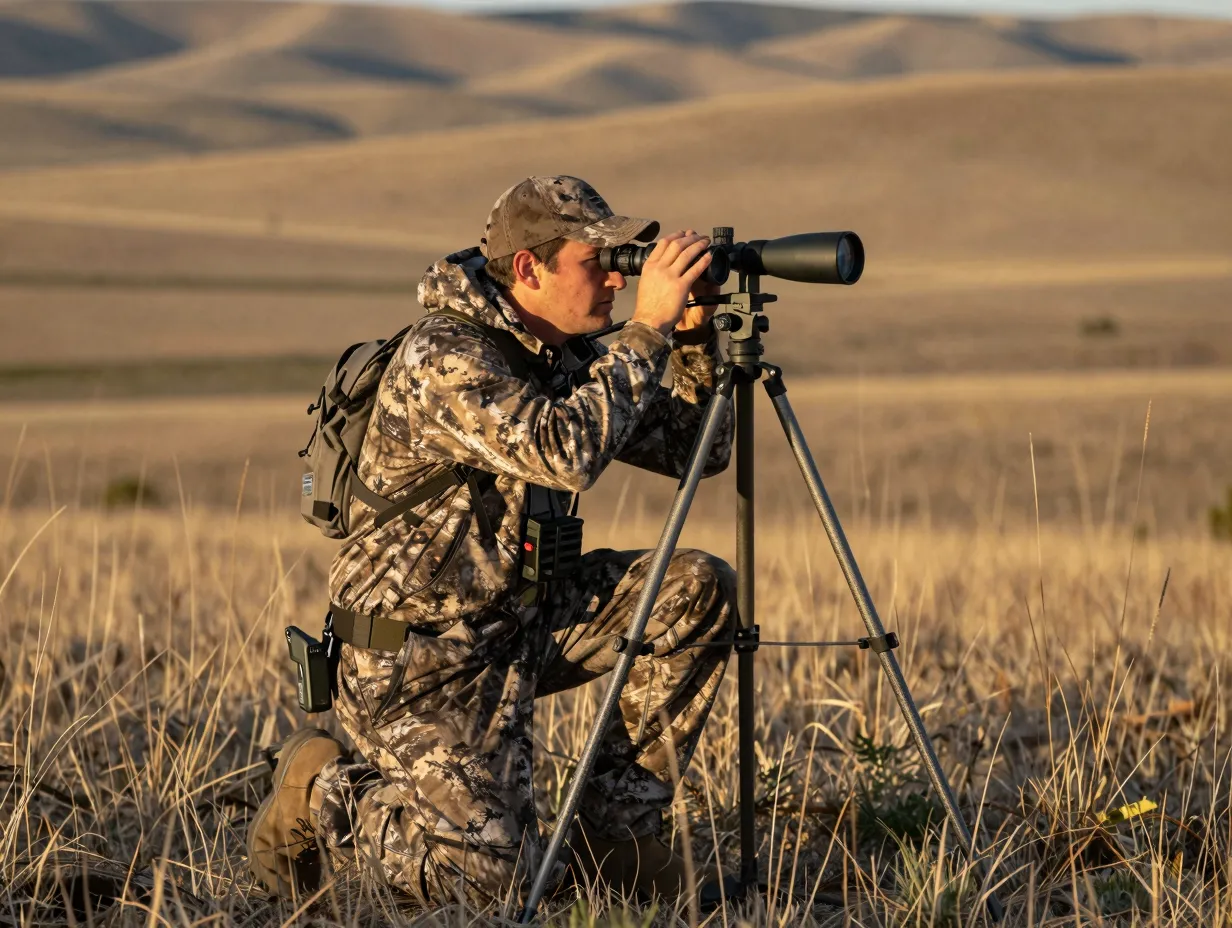
The single biggest equipment mistake pronghorn hunters make is bringing optics designed for timber hunting onto open plains. Compact 8x binoculars that work perfectly in a forest simply do not have the resolution or magnification to locate and evaluate pronghorn at the distances these animals routinely maintain from perceived threats.
The professional standard starts at 10x42mm binoculars [4]. Many experienced hunters carry 12x50mm glass for extended glassing sessions. More importantly, a quality spotting scope in the 25-45x range, mounted on a stable tripod, is not optional equipment, it is the primary tool for identifying trophy characteristics, counting prong length, and evaluating horn mass before committing to a stalk [4] [8]. Attempting to judge a buck at 600 yards without a spotting scope leads to either passing on shooter animals or burning a stalk on a buck that does not meet the hunter’s standards.
Recommended optics setup for Western plains pronghorn:
| Tool | Minimum Spec | Preferred Spec |
|---|---|---|
| Binoculars | 10x42mm | 12x50mm |
| Spotting Scope | 20-60x80mm | 25-45x fixed or zoom |
| Tripod | Lightweight aluminum | Carbon fiber with fluid head |
| Rangefinder | 800-yard capable | 1,200-yard with angle compensation |
Harness systems that keep binoculars accessible without neck strain matter on long glassing days. Hunters who glass from a vehicle legally on public land access roads cover far more terrain than those who glass only from fixed positions on foot [2].
2. Master the Spot-and-Stalk Approach Using Terrain
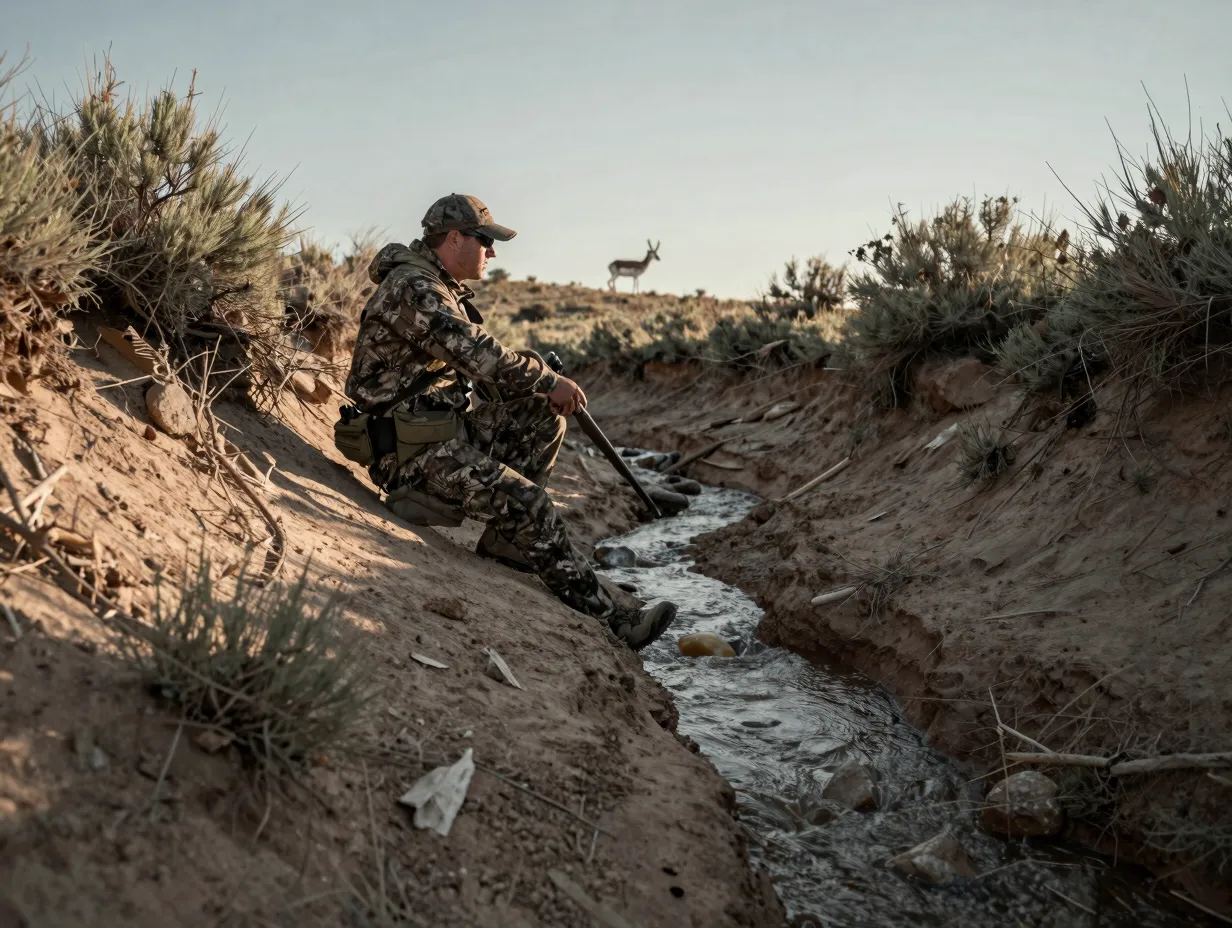
Pronghorn live in open country, but open country is rarely as flat as it looks on a map. Draws, creek drainages, slight ridgelines, and rolling terrain features provide the concealment necessary for a successful stalk, if hunters use them correctly [1].
The process begins with locating an animal from a distance, then studying the terrain between the hunter’s position and the buck. The goal is to identify a route that keeps the hunter below the animal’s line of sight for as long as possible. Pronghorn rarely look directly below them into drainages, which makes dry creek beds and shallow washes the most reliable stalk corridors on the plains [1].
Critical stalk principles:
- Always approach from downwind; pronghorn have a keen sense of smell despite relying primarily on vision
- Move slowly and deliberately; quick movements trigger flight responses at extreme distances
- Use the 10 percent rule, assume the buck will move 10 percent of the distance you expect during a stalk
- Identify a landmark near the animal before dropping below the ridgeline, as pronghorn are easy to lose track of once the hunter commits to a low route
- Plan an exit route before the stalk begins in case the animal moves or the wind shifts
A common error is attempting to close distance too aggressively. Stopping at 400 yards for a solid rifle shot is a better outcome than pushing to 200 yards and bumping the animal [3].
3. Develop 400-500 Yard Shooting Proficiency
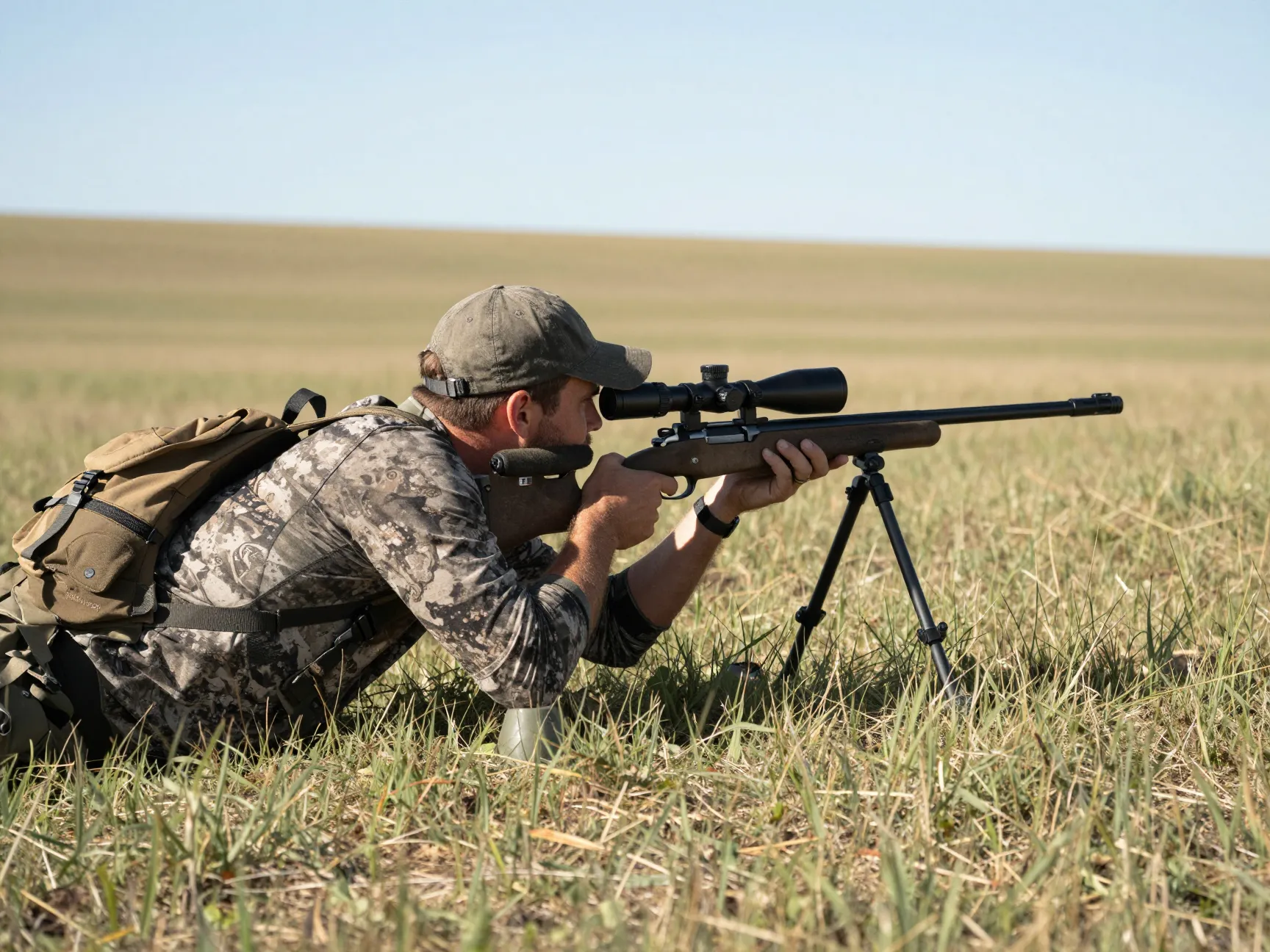
No list of pronghorn antelope hunting tips would be complete without addressing the reality of long-range shooting. Pronghorn’s exceptional eyesight means that closing to within 200 yards on a wary mature buck in open terrain is the exception rather than the rule [3]. Hunters who are not comfortable and accurate at 400-500 yards will either pass on legitimate opportunities or make poor shots at distances they have not practiced.
Preparation starts at the range months before the season. Hunters should practice from field positions, prone with a bipod, sitting with shooting sticks, and kneeling, rather than exclusively from a bench. Wind reading is equally critical on the plains, where a 15 mph crosswind can push a bullet several inches at 400 yards.
Practical pre-season shooting benchmarks:
- Consistent 3-shot groups of 1.5 inches or less at 200 yards from prone
- Demonstrated accuracy at 400 yards from field-improvised positions
- Familiarity with the bullet’s drop chart at 300, 400, and 500 yards
- Practice sessions in wind conditions above 10 mph
Flat-shooting cartridges in the .25-06, 6.5 Creedmoor, .270 Winchester, and .300 Winchester Magnum family are popular choices among experienced pronghorn hunters for their combination of flat trajectory and manageable recoil [3].
4. Pattern Water Sources with 24-48 Hour Observation
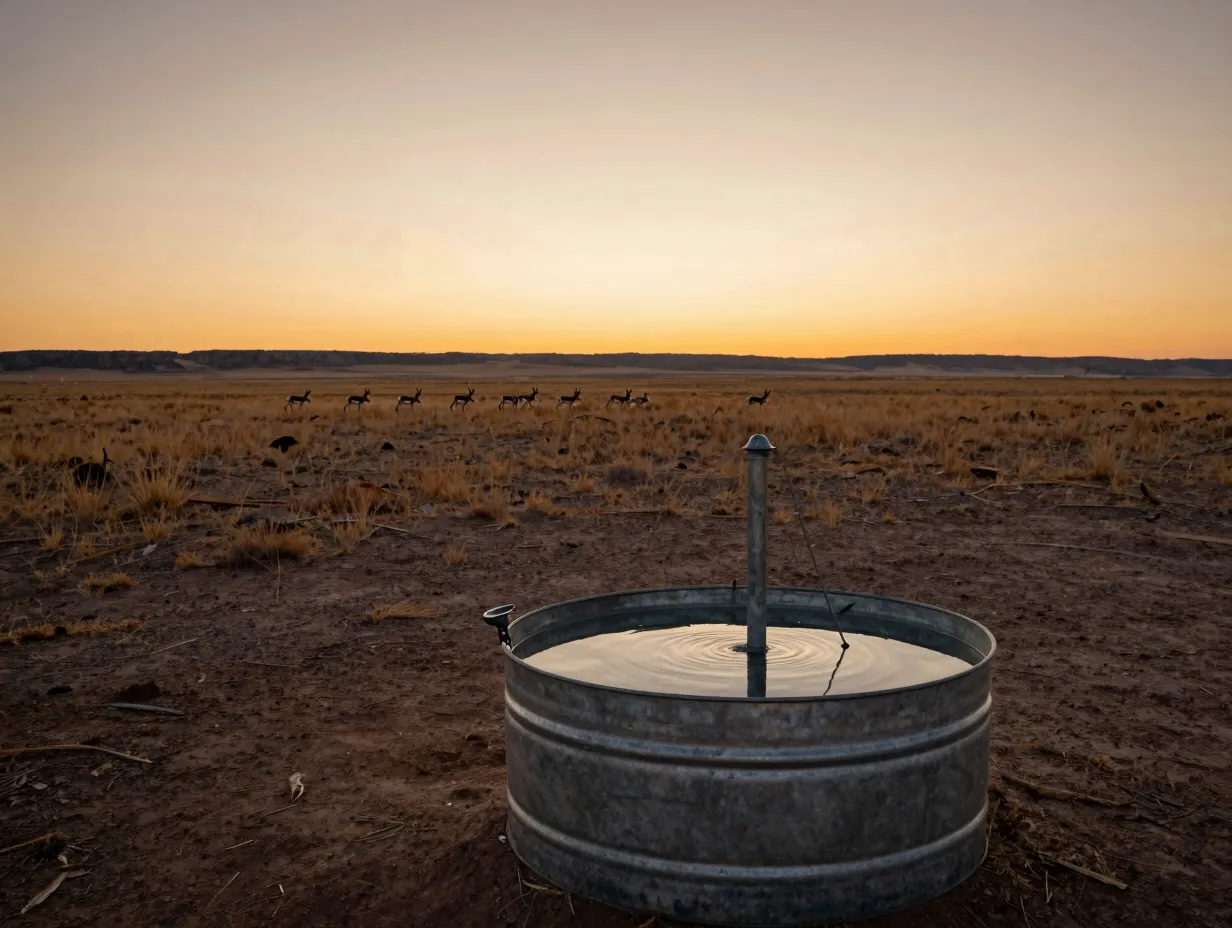
Water is the great equalizer on the Western plains, particularly during early archery and rifle seasons when temperatures regularly exceed 90 degrees Fahrenheit. Pronghorn must drink, and in arid country, water sources are finite and predictable [8].
Effective water patterning requires patience. Hunters should identify guzzlers, stock tanks, and natural seeps using satellite imagery before arriving, then observe each source for a minimum of 24-48 hours before committing to a blind setup [8] [10]. Pronghorn visit water primarily at dawn and dusk, but midday visits increase significantly during heat waves. Recording which bucks use which sources, at what times, and from which approach directions gives hunters the information needed to position a blind effectively.
“The hunter who understands where pronghorn drink and when they arrive holds a significant advantage over the hunter who simply wanders the plains hoping for a close encounter.”
Seasonal variation matters. Early-season hunts in August and September see the highest water dependency. Late-season rifle hunts in October may find pronghorn relying more on succulent vegetation for hydration, making water patterning less reliable [8].
5. Set Ground Blinds Correctly for Bowhunting Success
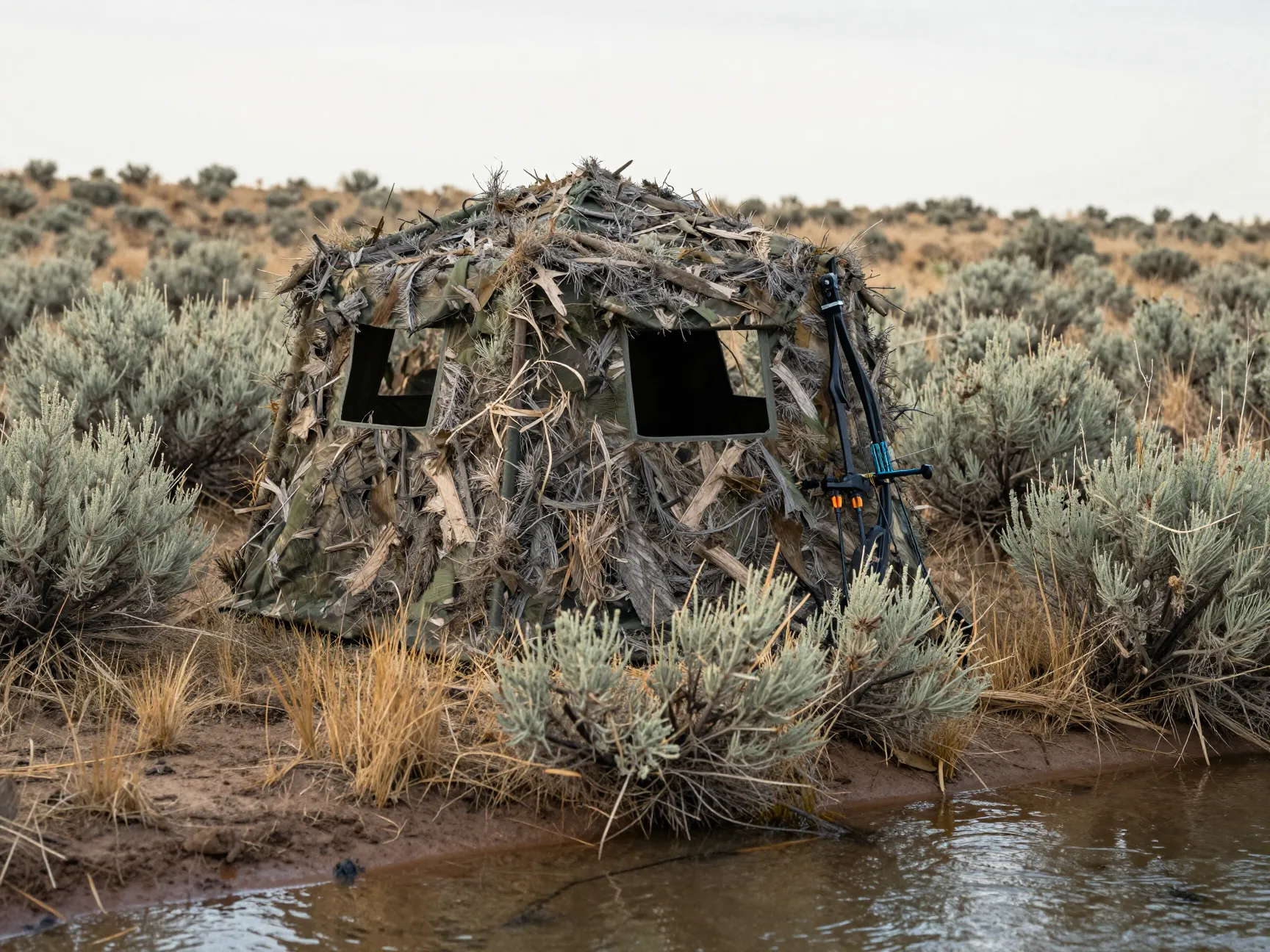
Ground blinds near water sources are the most reliable method for archery hunters seeking close-range shots on pronghorn. However, pronghorn are notoriously suspicious of any new object in their environment, and an improperly placed or camouflaged blind will be rejected immediately [8] [10].
Blinds should be positioned at least 30 yards from the water’s edge, ideally 35-40 yards, to provide a comfortable archery shot while keeping the structure outside the animal’s immediate alert zone [8]. The blind must be brushed in with native vegetation gathered from the immediate area. Sagebrush, dried grass, and local shrubs woven into the blind’s exterior dramatically reduce its unnatural appearance.
Ground blind setup checklist:
- Place the blind 3-5 days before hunting it to allow pronghorn to habituate to the structure
- Orient shooting windows downwind of the expected approach direction
- Dig out or flatten the ground inside to eliminate noise from shifting feet
- Use a dark interior liner to eliminate silhouette visibility through shooting windows
- Avoid disturbing the ground immediately around the water source during setup
Scent control is as important at a blind as it is during a stalk. Hunters should approach and leave the blind from the downwind side and avoid contaminating the area around the water source [10].
6. Use Decoys During the Rut for Aggressive Bucks
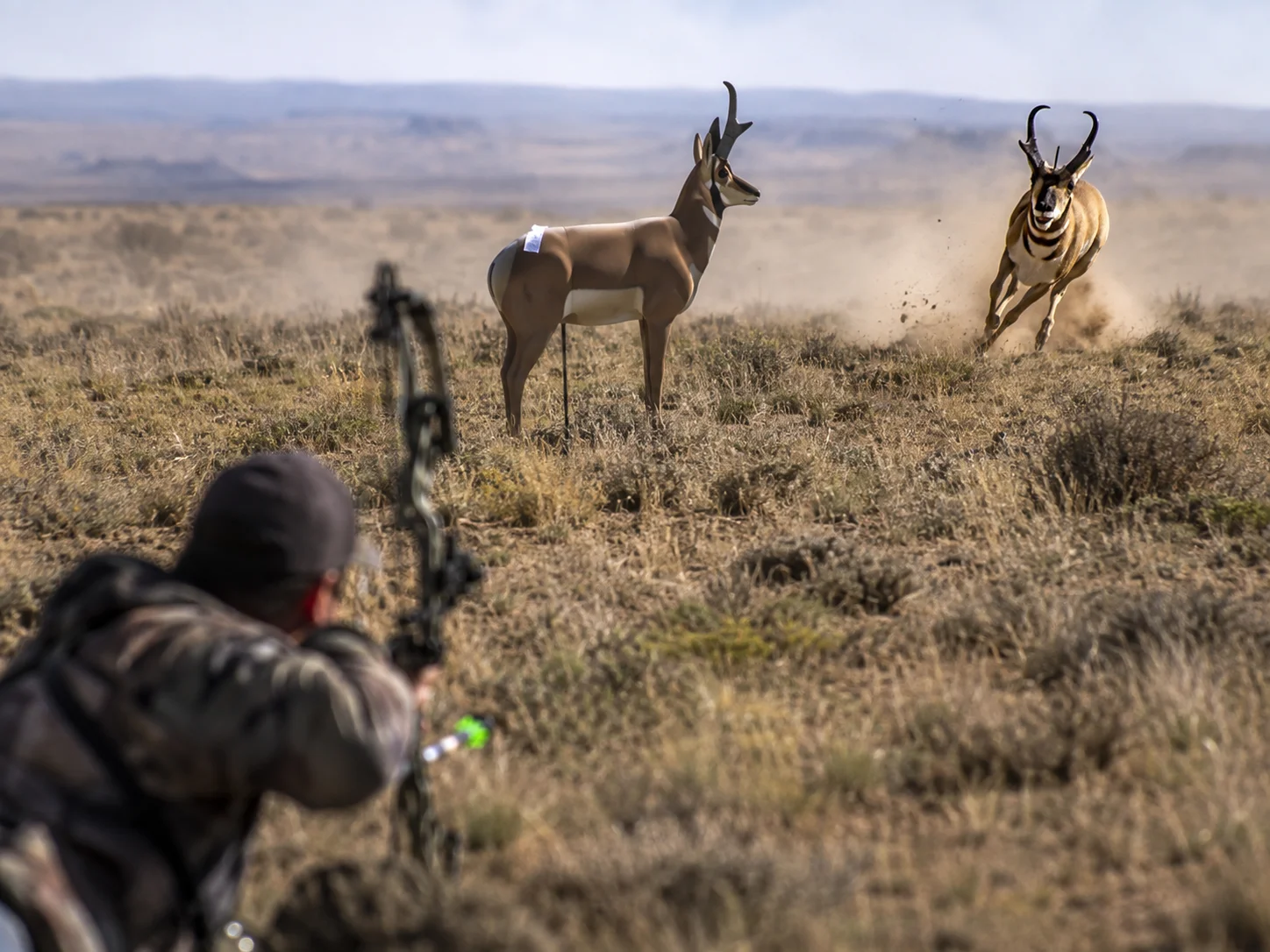
Decoy hunting for pronghorn is one of the most exciting tactics in Western big-game hunting, and it works because of the species’ extreme territorial behavior during the rut. Dominant bucks will charge and confront perceived rivals with minimal hesitation when the timing is right [5].
The rut window for most Western states runs from approximately September 10 through September 25, with peak activity typically occurring around mid-September [5]. During this period, a full-body pronghorn decoy, particularly one that resembles a smaller buck, can draw a dominant male from several hundred yards at a dead run.
Decoy tactics that increase success rates:
- Erect the decoy only when the target buck has his head down or is looking away; pronghorn that watch a decoy appear from nothing will often spook
- Position the decoy broadside or quartering away to present a natural posture
- Make subtle movements with the decoy by attaching a small piece of white cloth that flutters in the wind, mimicking the pronghorn’s white rump patch
- Stay low and ready; bucks can close 300 yards in seconds
- Have a clear shooting lane established before the buck commits to a charge
Combining a decoy with pronghorn vocalizations, specifically the snort-wheeze challenge call, increases response rates from territorial bucks [5].
7. Leverage Satellite Mapping and Pre-Season Scouting
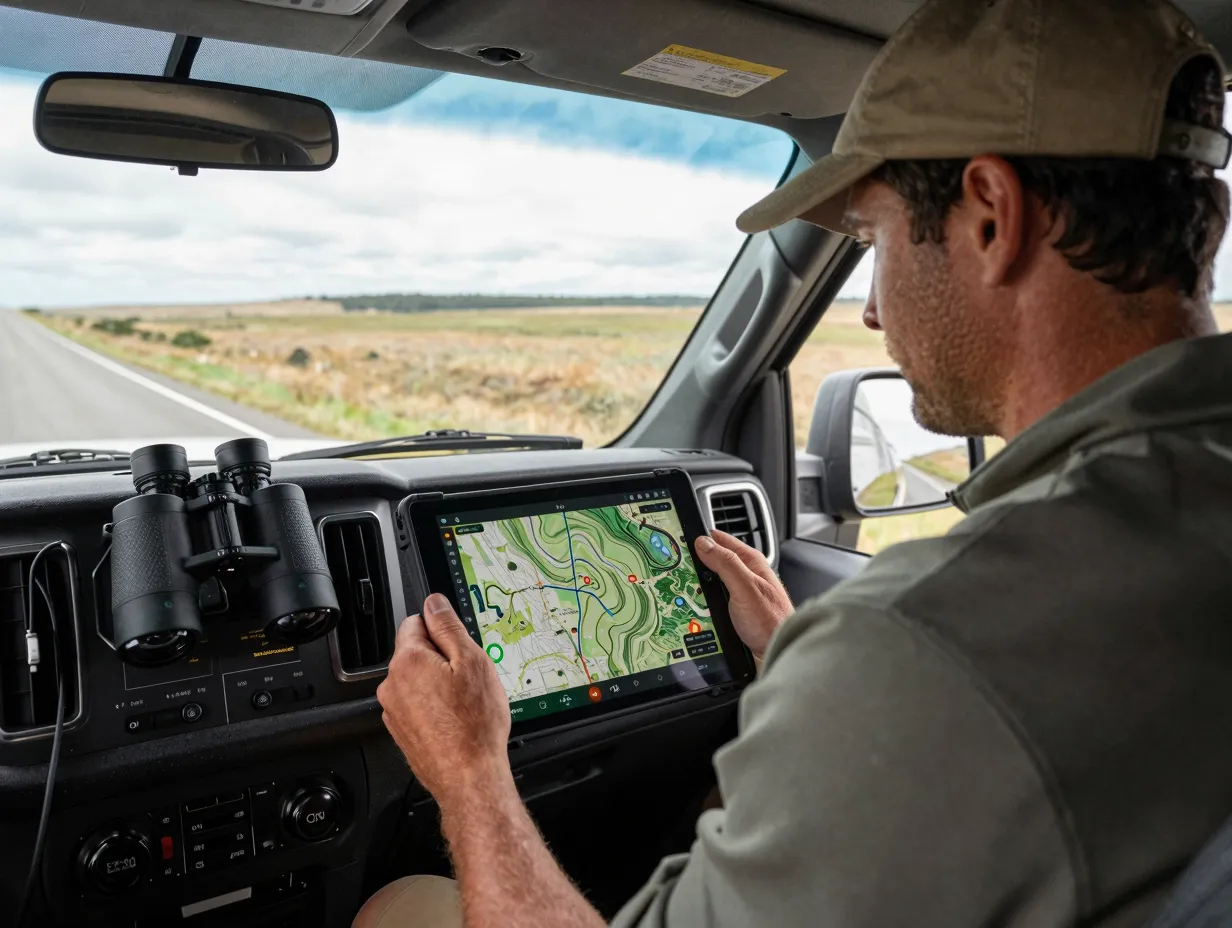
The 9 proven pronghorn antelope hunting tips for western plains success consistently referenced by experienced hunters all begin with thorough pre-season scouting. Hunters who arrive at a unit with no prior knowledge of terrain, water sources, or historical buck locations are gambling with limited tag opportunities [2] [4].
Satellite mapping applications such as onX Hunt, HuntStand, and BaseMap allow hunters to identify water sources, fence lines, terrain features, and land ownership boundaries before leaving home. Overlaying historical harvest data from state wildlife agency reports with satellite imagery creates a prioritized list of areas to investigate upon arrival [2].
Pre-season scouting timeline:
- 90 days out: Obtain maps, review state harvest reports, identify top 5 water sources in the unit
- 60 days out: Contact local biologists or game wardens for current population information
- 30 days out: Glass from roads and high points to locate bachelor groups and evaluate buck quality
- 1 week out: Confirm water source activity, set trail cameras if regulations allow, finalize blind locations
Trail cameras placed at water sources during the weeks before the season provide invaluable information about buck quality, visit timing, and approach routes without requiring the hunter’s physical presence [4].
8. Manage Wind and Thermals on Open Country Terrain
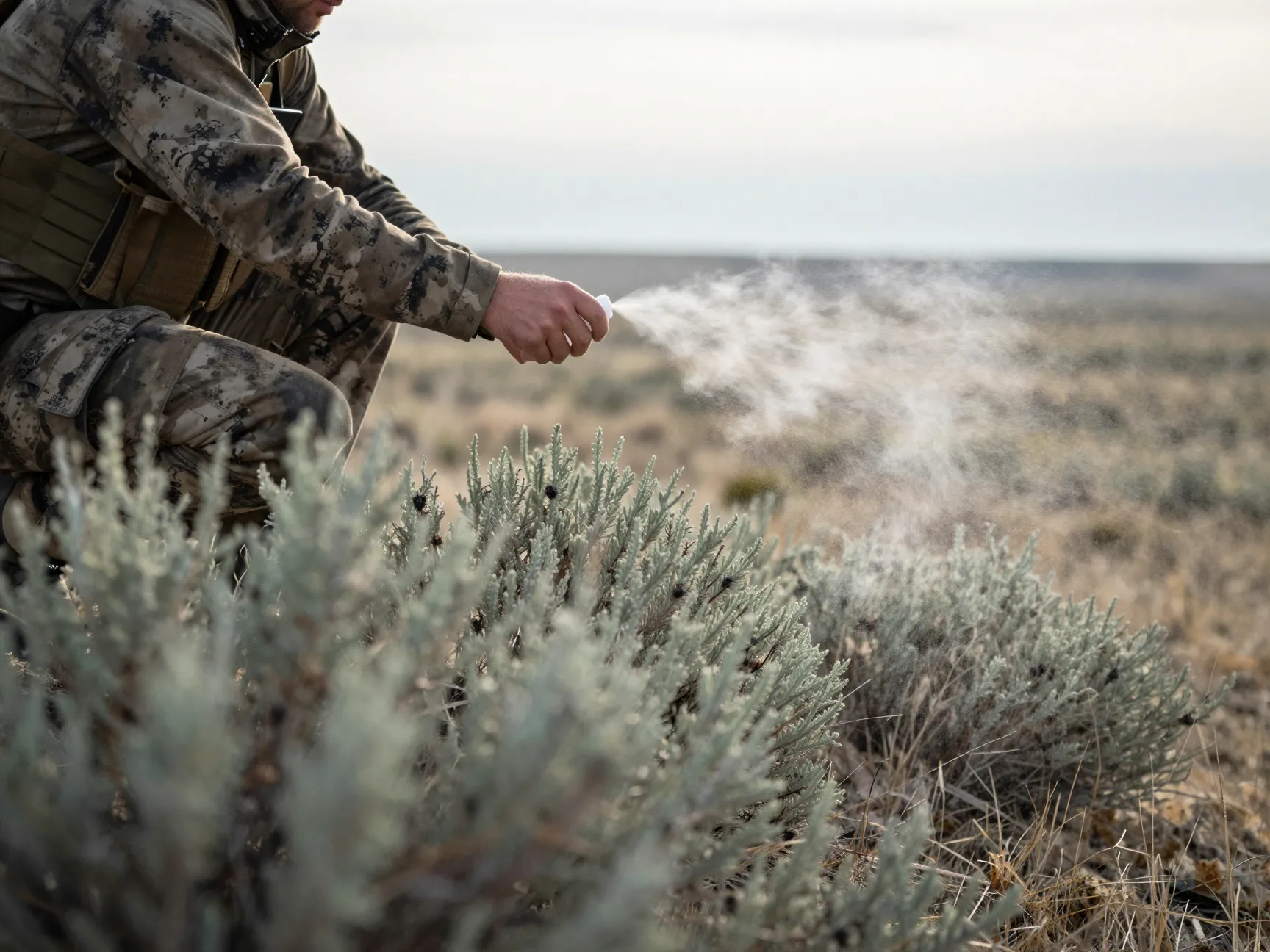
Wind management on the open plains is both more important and more complex than in forested environments. There are no trees to block or redirect wind currents, but thermals still behave predictably based on time of day and terrain features. Understanding these patterns prevents hunters from burning their best stalks by approaching from the wrong direction [1] [2].
Morning thermals typically flow downhill as cool air settles into drainages. As the sun warms the ground mid-morning, thermals reverse and begin rising. Hunters planning dawn stalks should approach from below and downwind, accounting for the downhill thermal flow. Midday and afternoon stalks require the opposite consideration as rising thermals carry scent upward and outward [1].
Wind management field techniques:
- Carry a small bottle of unscented powder to check wind direction continuously during a stalk
- Plan stalks with multiple wind checkpoints rather than assuming wind direction remains constant
- Use terrain features to block wind-borne scent from reaching the animal’s position
- Abort stalks when wind becomes variable or swirling, pronghorn will wind the hunter before visual contact is made
Pronghorn that have been winded do not simply move off slowly like pressured deer. They typically run 500-1,000 yards and then stop to look back, often making a second approach possible if the hunter resets quickly and approaches from a different angle [3].
9. Prioritize Field Meat Care in Warm Early Seasons
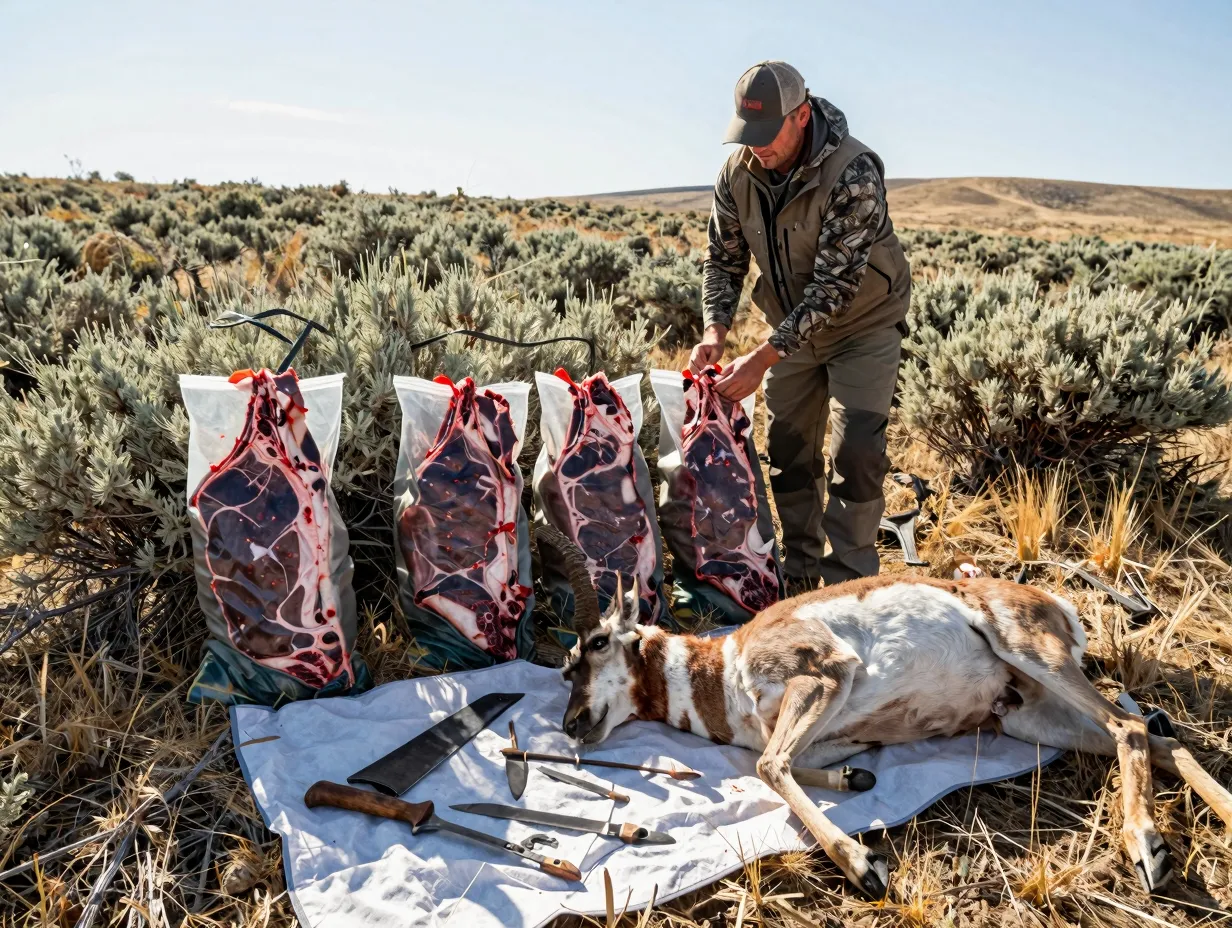
The final tip in this collection of 9 proven pronghorn antelope hunting tips for western plains success addresses what happens after a successful shot, and it matters as much as every tip that precedes it. Early archery and rifle seasons for pronghorn occur during some of the warmest hunting conditions in North America. Temperatures above 80 degrees Fahrenheit are common during September hunts, and pronghorn’s relatively thin hide and small body size mean that meat can spoil within hours if not handled properly [2].
The priority after recovery is cooling the carcass as quickly as possible. Hunters should carry a meat saw, sharp skinning knives, and breathable game bags in their pack on every hunt. Field dressing and quartering should begin within 30 minutes of recovery. Placing quarters in the shade and elevating them off the ground to allow airflow significantly extends the safe window before spoilage begins [2].
Field meat care protocol for warm-weather pronghorn hunts:
- Carry at least 4 large breathable game bags and a compact meat saw
- Field dress immediately and prop the body cavity open to release core heat
- Quarter the animal and hang or prop quarters in shade with maximum airflow
- Pack quarters to a cooler with ice within 4 hours when temperatures exceed 70 degrees Fahrenheit
- Consider hunting with a partner to speed the recovery and packing process
Pronghorn meat is among the finest table fare of any North American big-game species when handled correctly. Poor field care is the primary reason some hunters describe the flavor negatively, a problem that proper temperature management eliminates entirely.
Putting the 9 Proven Pronghorn Antelope Hunting Tips for Western Plains Success Into Practice
Success on a pronghorn hunt is not accidental. Every element, from the quality of glass in a hunter’s binoculars to the placement of a ground blind to the shooting position practiced at the range, contributes to the final outcome. The tips outlined here represent the accumulated experience of hunters who have spent years learning what works and what does not across the vast public lands of Wyoming, Montana, Colorado, New Mexico, and Arizona [1] [2] [3] [4] [5].
The most common thread connecting successful pronghorn hunters is preparation. Hunters who arrive at their unit knowing where the water sources are, which bucks are using them, and how the terrain allows for concealed approaches consistently outperform those who rely on improvisation. Pronghorn are not a forgiving species, they will expose every weakness in a hunter’s preparation and execution.
The hierarchy of pronghorn hunting priorities:
- Pre-season scouting and water source identification
- Optics quality and glassing discipline
- Wind and thermal management during stalks
- Shooting proficiency at realistic field distances
- Blind placement and habituation timing
- Rut timing for decoy and calling tactics
- Field meat care for quality table fare
Applying these principles consistently across a 5-7 day hunt gives even first-time pronghorn hunters a realistic chance at filling a tag on a mature buck.
Conclusion
Pronghorn antelope hunting on the Western plains demands a different skill set than virtually any other North American big-game pursuit. The combination of extreme visual acuity, open terrain with minimal cover, and warm early-season temperatures creates a set of challenges that reward preparation and punish shortcuts. The 9 proven pronghorn antelope hunting tips for western plains success covered in this guide, from investing in quality optics and mastering spot-and-stalk approaches to patterning water sources and managing field meat care, provide a complete framework for approaching a pronghorn hunt with confidence.
Actionable next steps for hunters preparing for a 2026 pronghorn season:
- Apply for tags immediately; most Western states use draw systems with limited allocations
- Download a mapping application and begin identifying water sources and terrain features in the target unit
- Schedule range sessions specifically focused on field positions at 300-500 yards
- Research state-specific regulations regarding trail cameras, decoy use, and public land access
- Contact the relevant state wildlife agency for current population and harvest trend data
The pronghorn is a remarkable animal and one of North America’s great hunting traditions. With the right preparation and the right tactics, the wide-open plains of the American West become an opportunity rather than an obstacle.
References
[1] A Guide To Hunting Pronghorn Antelope – https://www.themeateater.com/hunt/pronghorn-antelope/a-guide-to-hunting-pronghorn-antelope
[2] Mastering A Do It Yourself Pronghorn Hunting Trip – https://www.purehunting.com/mastering-a-do-it-yourself-pronghorn-hunting-trip/
[3] The Newbies Guide To Rifle Hunting Pronghorn – https://www.outdoorlife.com/story/hunting/the-newbies-guide-to-rifle-hunting-pronghorn/
[4] Plan A Diy Pronghorn Hunt – https://realtree.com/big-game/plan-a-diy-pronghorn-hunt
[5] Tips And Tactics How Hunt Pronghorn Antelope – https://www.outdoorlife.com/articles/hunting/2015/05/tips-and-tactics-how-hunt-pronghorn-antelope/
[8] Pronghorn Antelope Hunting – https://nabowhunter.com/pronghorn-antelope-hunting/
[10] Bowhunting Pronghorn 101 – https://www.themeateater.com/hunt/pronghorn-antelope/bowhunting-pronghorn-101