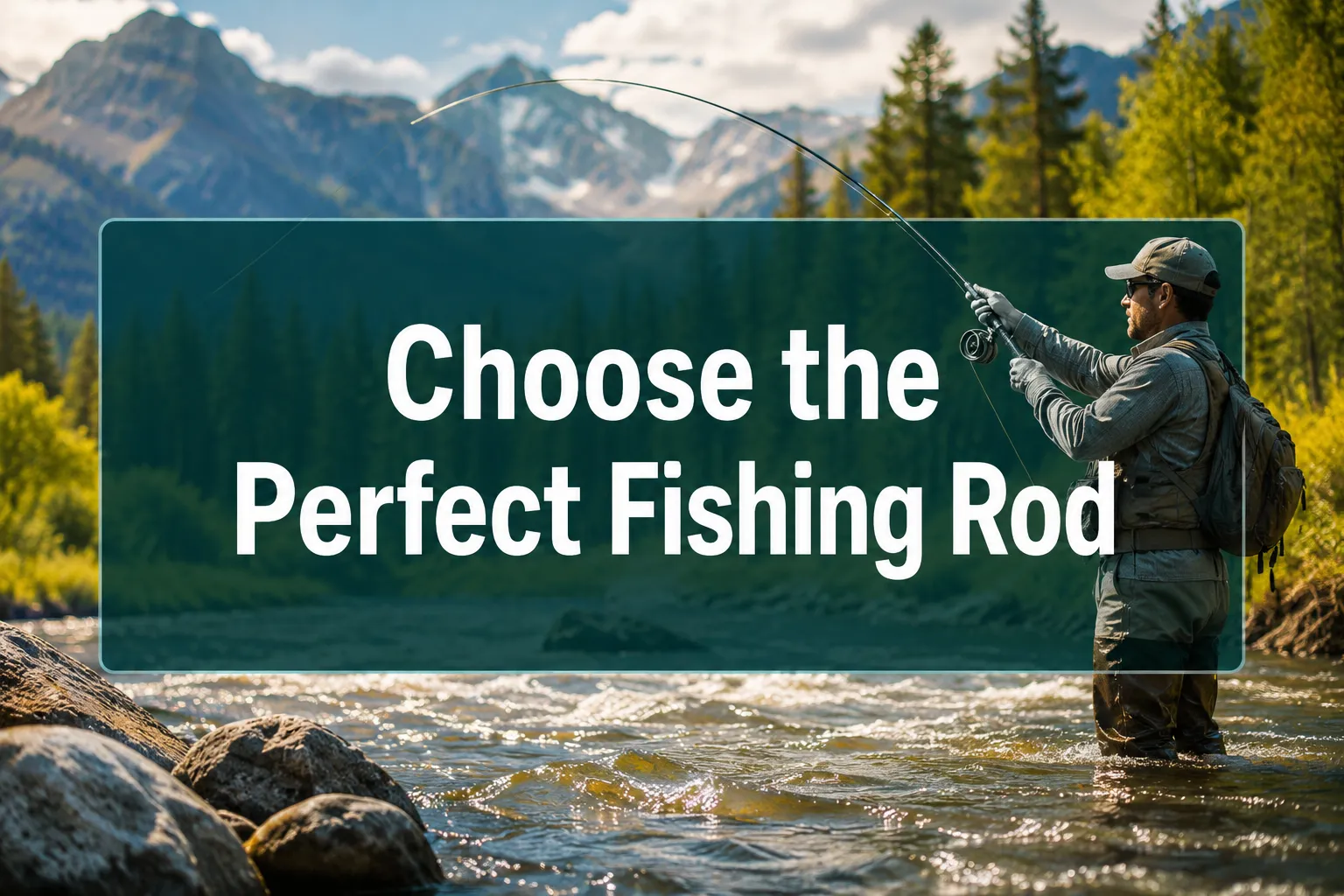
Only about 38 million Americans go fishing each year, yet walk into any tackle shop and you will find hundreds of rod options staring back at you from the wall. Most beginners grab whatever looks good or costs the least, and then spend their first season wondering why casting feels awkward and fish keep getting away. Learning how to choose the perfect fishing rod before you spend a single dollar is the single most important step you can take toward becoming a confident angler.
This guide cuts through the noise. Whether you are buying your first rod or upgrading after years on the water, I will walk you through every decision point, species, environment, rod type, power, action, material, and length, so you leave with a rod that actually fits the way you fish.
Key Takeaways
- Always start with your target species, fishing environment, and technique before looking at brand or price
- Rod power and action together determine what lures you can cast and how well you can feel and set a hook
- Graphite rods offer sensitivity and lightness; fiberglass rods offer durability and forgiveness, choose based on your fishing style
- A medium-power, moderate-fast action spinning rod in the 6-to-7-foot range is the best all-around starting point for most freshwater beginners [4]
- Spending $50 to $150 on a quality mid-range rod delivers far better performance than budget options without breaking the bank [2]
Start With Your Fishing Goals, Not the Price Tag
The single biggest mistake I see new anglers make is walking into a store and asking, “What is the best fishing rod?” That question has no answer without context. The best rod for chasing largemouth bass in a weedy lake is completely different from the best rod for surf fishing on a sandy beach or fly fishing a mountain stream.
Before you even look at a rod, answer three questions:
- What species are you targeting? A panfish like bluegill requires a very different setup than a striped bass or a muskie.
- Where are you fishing? A small creek, a large reservoir, a saltwater pier, and an ocean beach each demand different rod characteristics.
- What technique will you use? Casting lures, trolling, bottom fishing, and fly fishing all require specialized tools.
These three answers will eliminate 80% of the options on the wall immediately [4]. Only after you have those answers should you start comparing brands and prices.
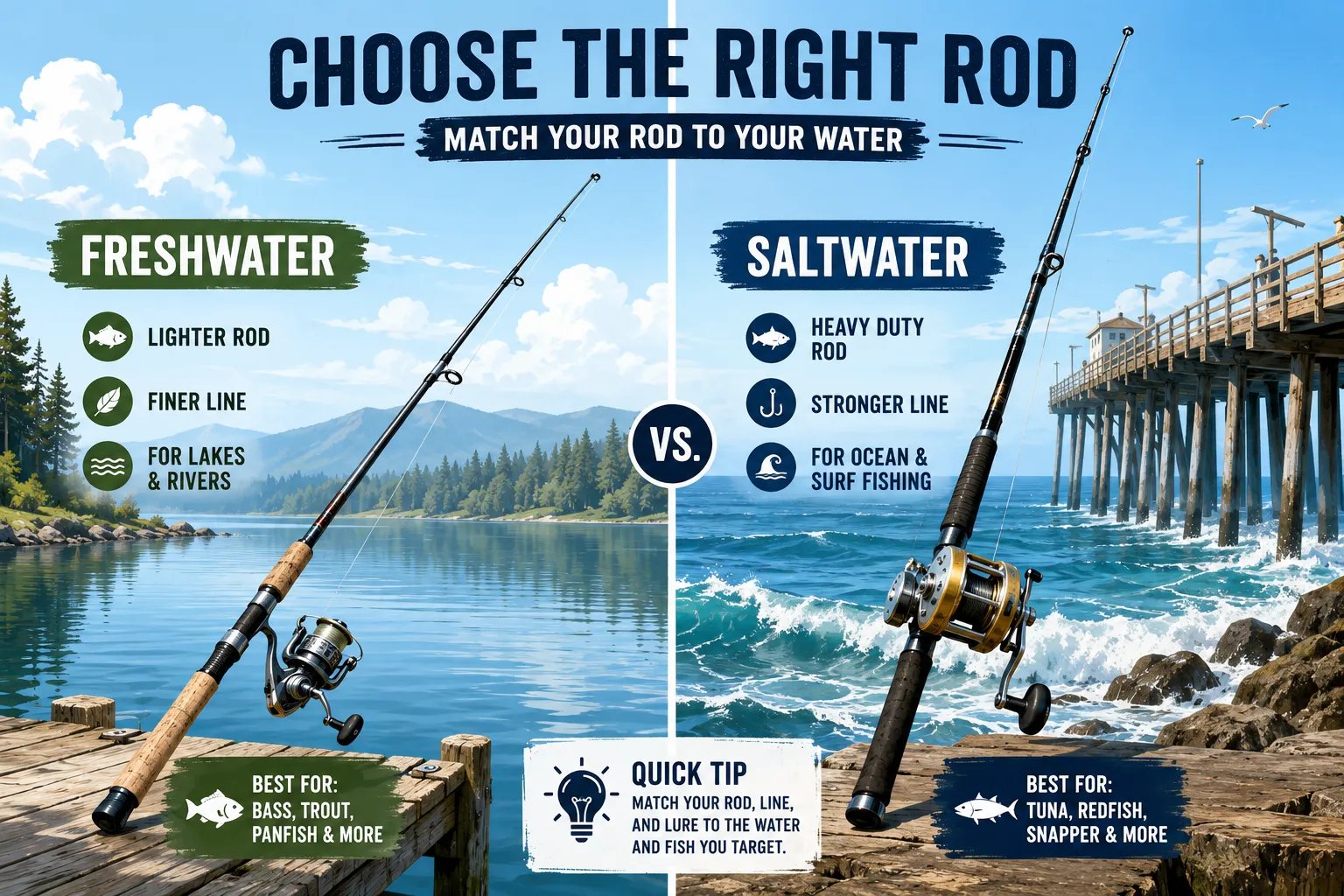
Freshwater vs. Saltwater Rods
Environment matters more than most people realize. Saltwater is corrosive. Rods built for ocean fishing use corrosion-resistant guides, reel seats, and hardware [1]. Using a freshwater rod in saltwater will degrade the components quickly, even if you rinse it after every use.
Freshwater rods are generally lighter, more sensitive, and optimized for smaller fish in calmer conditions. Saltwater rods are heavier, more durable, and built to handle larger fish and harsher conditions [1].
“The environment you fish in should drive every hardware decision on your rod, guides, reel seat, and blank material included.”
If you plan to fish both environments, buy separate rods. Trying to use one rod for everything will mean it does neither job particularly well.
Understanding Rod Types: Spinning, Baitcasting, and Beyond
Once you know your target species and environment, the next decision is rod type. The most common types are spinning rods, baitcasting rods, fly rods, and surf rods. Each is designed for a specific style of fishing.
Spinning Rods
Spinning rods are the most beginner-friendly option available. The reel hangs below the rod, and the guides face downward. This design makes casting easier and reduces the risk of backlash, the dreaded “bird’s nest” of tangled line that plagues new casters using baitcasting gear [9].
Spinning rods work well with lighter lures and lines, making them ideal for:
- Panfish, trout, and walleye
- Light bass fishing with finesse techniques
- Most freshwater applications under 15 pounds
For most beginners, a spinning rod is the right starting point [10].
Baitcasting Rods
Baitcasting rods are paired with baitcasting reels that sit on top of the rod. They offer greater casting accuracy and are better suited for heavier lures and lines. Experienced bass anglers, muskie hunters, and saltwater inshore fishermen often prefer baitcasting setups.
The trade-off is a steeper learning curve. Baitcasting reels require thumb control during the cast to prevent backlash. I would not recommend a baitcasting setup as a first rod unless you have someone experienced to teach you the technique.
Fly Rods
Fly rods are a category unto themselves. They are long, flexible, and designed to cast a weighted line rather than a weighted lure. Fly fishing is a distinct discipline with its own learning curve, rod sizing system (measured in “weights”), and techniques. If fly fishing is your goal, it deserves its own dedicated research.
Surf and Boat Rods
Surf rods are long, often 10 to 14 feet, and built to cast heavy sinkers and bait long distances from the beach. Boat rods are shorter and stouter, designed for vertical jigging or trolling from a vessel. Both are specialized tools for specific situations.
Rod Material: Graphite, Fiberglass, and Composite
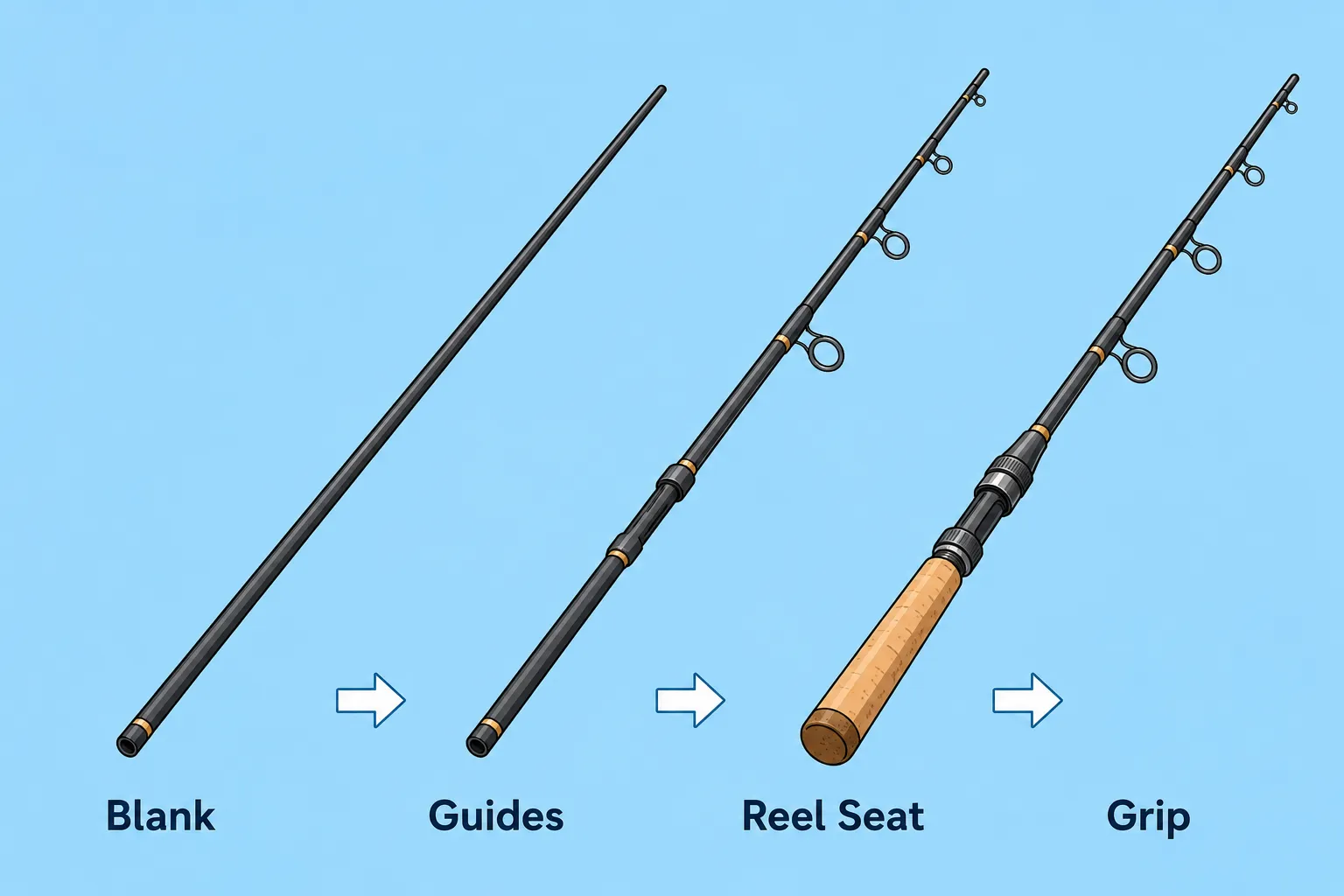
The blank, the long tapered tube that forms the body of the rod, is made from one of three primary materials. Each has real trade-offs that affect how the rod performs in your hands [2].
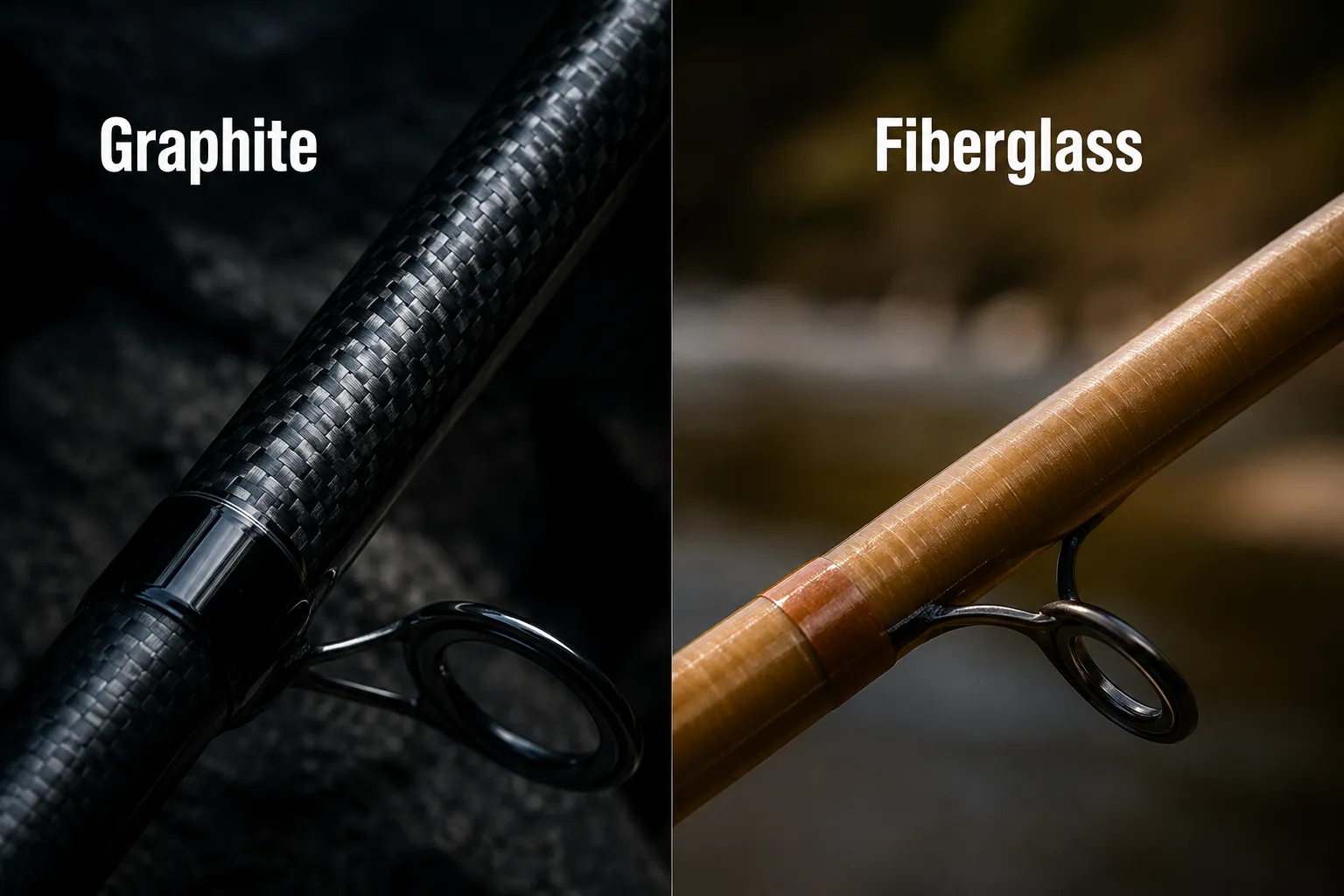
Graphite (Carbon Fiber)
Graphite rods are lightweight and highly sensitive. You can feel subtle bites and bottom changes through the rod tip, which is a major advantage when fishing with soft plastics or jigs. They are also stiffer for their weight, which helps with hook sets.
The downside is brittleness. Graphite rods can crack or snap if slammed in a car door, stepped on, or used to pry a hook out of a snag. They require more careful handling.
Best for: Experienced anglers, technique-specific fishing, sensitivity-dependent methods like finesse bass fishing or walleye jigging.
Fiberglass
Fiberglass rods are heavier and less sensitive than graphite, but they are nearly indestructible. They flex more deeply through the blank, which actually helps beginners, the slower, more forgiving action makes it harder to pull lures away from fish before they are fully hooked.
Best for: Beginners, crankbait fishing, trolling, and situations where durability matters more than sensitivity.
Composite
Composite rods blend graphite and fiberglass fibers to balance sensitivity and durability. Many mid-range rods in the $80 to $150 price range use composite construction. For most anglers who fish a variety of techniques, a quality composite rod is an excellent all-around choice [2].
Graphite: Lightweight, sensitive, less durable, best for experienced anglers
Fiberglass: Heavy, durable, forgiving, best for beginners and crankbait fishing
Composite: Balanced performance, best all-around choice for most anglers
Decoding Rod Power and Action
Power and action are the two most misunderstood specifications on any rod. Many beginners ignore them entirely and wonder why their rod does not perform the way they expected. Understanding these two numbers will transform how you shop for a rod [4].
Rod Power
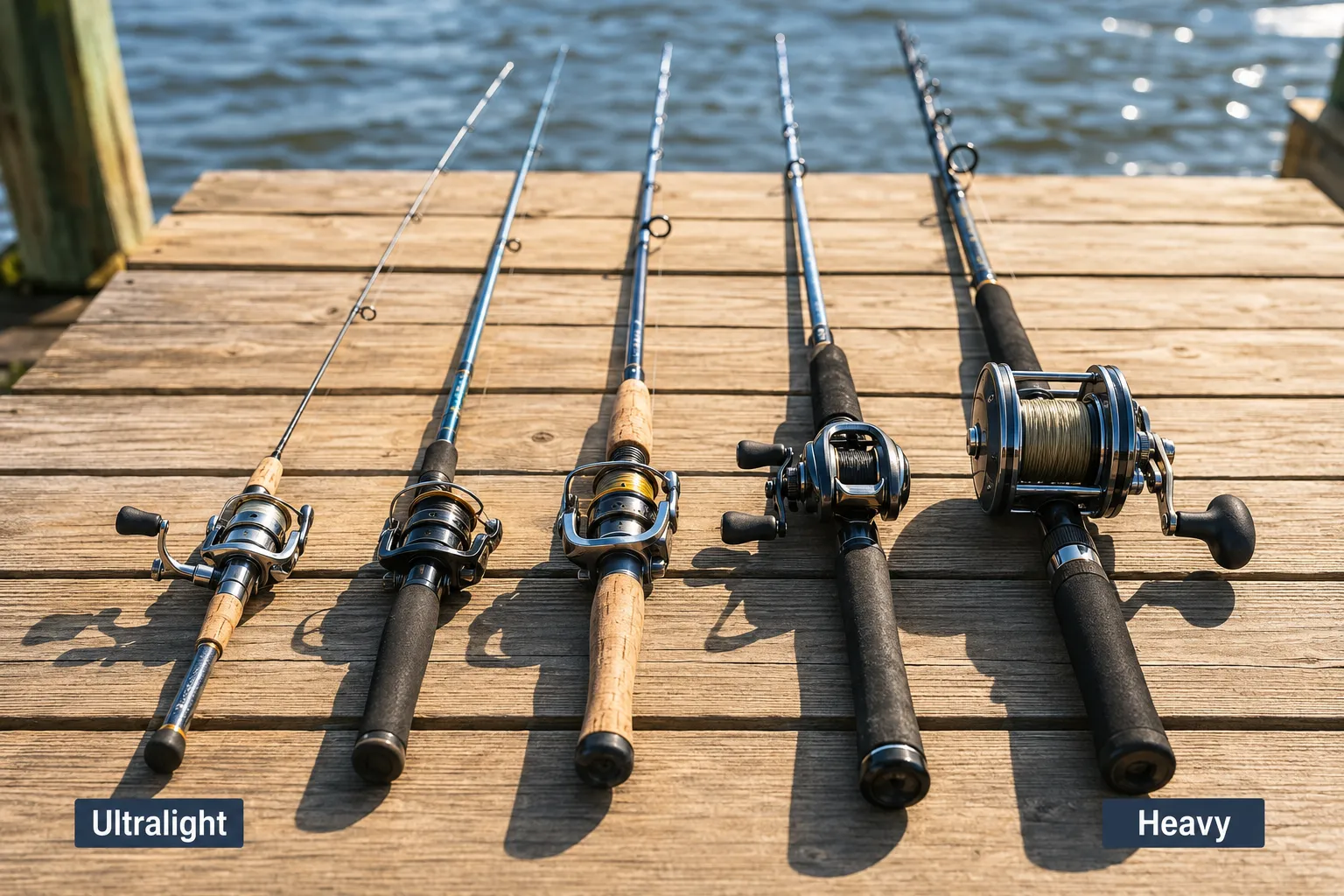
Power describes how much force it takes to bend the rod. It is typically rated on a scale from ultralight to extra-heavy:
- Ultralight: Best for small panfish and trout with light line (2 to 6 lb test)
- Light: Good for trout, small bass, and light lures
- Medium-light: Versatile for bass, walleye, and lighter spinning applications
- Medium: The most versatile rating, handles a wide range of lures and species
- Medium-heavy: Ideal for bass with heavier lures, pike, and inshore saltwater
- Heavy / Extra-heavy: Muskie, large catfish, offshore saltwater, heavy jigging
Power also determines the lure weight range and line weight range printed on the rod’s blank. Always match your lure and line to the rod’s recommended range. Using a lure that is too light will not load the rod properly during the cast. Using one that is too heavy can damage the blank.
Rod Action
Action describes where along the blank the rod bends when pressure is applied:
- Fast action: Bends primarily in the top third of the rod. More sensitive, better hook-setting power, preferred for single-hook lures like jigs and worms.
- Moderate action: Bends in the top half. Good balance of sensitivity and forgiveness. Works well with crankbaits and topwater lures.
- Slow action: Bends throughout most of the blank. Very forgiving, great for beginners and treble-hook lures, but less sensitive.
A fast-action rod with a medium-heavy power rating is the most popular combination for bass fishing. A moderate-action rod with medium power is arguably the best all-around choice for beginners who want to fish a variety of techniques [4].
The Beginner’s Sweet Spot
For most beginners fishing freshwater, here are the specs I recommend as a starting point [10]:
- Type: Spinning rod
- Length: 6 feet 6 inches to 7 feet
- Power: Medium
- Action: Moderate-fast
- Material: Composite or mid-grade graphite
- Line rating: 8 to 17 lb monofilament or 10 to 20 lb braid
This combination handles bass, walleye, pike, and most panfish. It casts a wide range of lures from 1/4 oz to 3/4 oz and gives you room to develop your technique before specializing.
Rod Length, Guides, and Handle Design
The final set of decisions involves the physical dimensions and components of the rod. These details have a real impact on casting distance, comfort, and long-term performance [2].
Choosing the Right Rod Length
Rod length affects casting distance and leverage. Longer rods cast farther because they create a wider arc during the cast. Shorter rods offer more precision and are easier to use in tight spaces like wooded banks or kayaks.
General guidelines:
- Under 6 feet: Tight quarters, small streams, kayak fishing, ultralight applications
- 6 to 7 feet: The most versatile range for freshwater spinning and baitcasting
- 7 to 8 feet: Long-distance casting, larger lures, flipping and pitching in bass fishing
- Over 8 feet: Surf fishing, salmon and steelhead fishing, specialized applications
For most freshwater anglers, a rod between 6 feet 6 inches and 7 feet hits the sweet spot between casting distance and control [4].
Guide Quality and Count
Guides are the rings along the rod that the fishing line passes through. Quality guides have ceramic or aluminum oxide inserts that reduce friction and prevent line wear. Cheap guides with rough or cracked inserts will damage your line over time and reduce casting distance.
Look for guides with smooth, polished inserts. On spinning rods, a larger first guide near the reel helps manage line coming off the spool, which improves casting performance. On saltwater rods, ensure all guides and their frames are corrosion-resistant [1].
Handle Material and Design
Rod handles come in two primary materials: cork and EVA foam.
- Cork: Traditional, lightweight, and excellent at transmitting vibration from the blank to your hand. High-quality cork improves sensitivity. It can wear over time but is easy to replace.
- EVA foam: More durable and resistant to water and oils. Slightly less sensitive than cork but more comfortable during long sessions and easier to maintain.
Handle design, specifically the split-grip versus full-grip debate, is mostly a matter of personal preference and technique. Split-grip handles are lighter and allow you to feel more of the blank. Full-grip handles offer more control for certain casting styles.
One-Piece vs. Two-Piece Rods
One-piece rods offer slightly better sensitivity and strength because there is no joint to interrupt the blank’s flex. Two-piece rods break down for easier transport and storage. For most recreational anglers, a quality two-piece rod performs nearly identically to a one-piece in real-world fishing conditions.
If you travel frequently or hike to fishing spots, a two-piece or even a multi-piece travel rod is a practical choice that does not require significant performance sacrifice [2].
How to Set a Budget Without Overspending
Rod prices range from under $20 to over $500. The good news is that the performance curve flattens out quickly. The jump from a $25 rod to a $75 rod is enormous. The jump from a $200 rod to a $400 rod is subtle, and mostly irrelevant for recreational anglers [2].
Here is a practical breakdown of what to expect at each price tier:
- Under $40: Entry-level rods with basic components. Acceptable for casual use but guides and blanks are often low quality. Fine for children or occasional fishing.
- $40 to $100: Mid-range rods where most of the value lives. Quality blanks, decent guides, and comfortable handles. This is where I recommend most beginners start [10].
- $100 to $200: High-performance rods with quality graphite blanks, premium guides, and refined action. A solid choice for anglers who fish regularly.
- Over $200: Professional-grade rods with premium materials and tight tolerances. Worth the investment only if you fish frequently and your technique can actually take advantage of the improvements.
I have caught more fish on a $70 spinning rod than on a $300 graphite stick. The rod matters less than knowing how to use it. Buy a quality mid-range rod, spend the rest of your budget on line and a quality reel, and invest your time in learning technique.
How to Choose the Perfect Fishing Rod: Common Mistakes to Avoid
Even with all the right information, a few common errors trip up buyers at the last moment. Here is what to watch for.
Buying a rod without a reel in mind. Rods and reels must be matched in size and weight class. A heavy saltwater reel on a light freshwater rod looks ridiculous and feels worse. Always buy them as a matched pair or at least verify compatibility before purchasing.
Ignoring the rod’s recommended line and lure weight. Every rod has a printed range on the blank. Fishing outside that range reduces performance and can damage the rod. Take 30 seconds to read those specs before you buy.
Choosing a rod based on aesthetics. A flashy color or a well-known brand name does not make a rod fish better. Focus on specs, power, action, length, and material, over looks.
Skipping the in-store feel test. If at all possible, hold the rod before buying. Flex it gently. Check the guide alignment. Feel the handle. A rod that feels awkward in the store will feel worse after three hours on the water.
Buying the wrong rod for your reel type. Spinning rods are designed for spinning reels. Baitcasting rods are designed for baitcasting reels. They are not interchangeable. The guide size, placement, and reel seat orientation are completely different between the two types [9].
How to Choose the Perfect Fishing Rod for Specific Techniques
Once you move past the basics, technique-specific rod selection becomes one of the most rewarding parts of the hobby. Here is a quick reference for common fishing scenarios.
Bass fishing with soft plastics (Texas rig, drop shot): Medium-heavy power, fast action, 7-foot spinning or baitcasting rod, graphite blank for maximum sensitivity.
Bass fishing with crankbaits: Medium power, moderate action, fiberglass or composite blank to prevent pulling the lure away from fish on the strike.
Trout fishing in streams: Light to ultralight power, fast action, 5 to 6 foot spinning rod, graphite blank.
Inshore saltwater (redfish, snook, striped bass): Medium-heavy to heavy power, fast action, 7 to 7.5 foot spinning or baitcasting rod, corrosion-resistant components [1].
Surf fishing: Heavy to extra-heavy power, moderate-fast action, 10 to 12 foot surf rod, durable guides and reel seat.
Walleye jigging: Medium-light to medium power, fast action, 6.5 to 7 foot spinning rod, high-sensitivity graphite blank.
Conclusion: Your Next Steps Toward the Perfect Rod
Choosing a fishing rod does not have to be overwhelming. The process becomes straightforward the moment you anchor every decision to three things: your target species, your fishing environment, and your primary technique. Everything else, power, action, material, length, and price, flows naturally from those three answers.
Here are your actionable next steps:
- Write down your three anchors before you shop: target species, environment, and technique.
- Start with a medium-power, moderate-fast action spinning rod in the 6.5 to 7-foot range if you are a freshwater beginner. It is the most forgiving, versatile starting point available [4].
- Set a budget of $50 to $150 for your first quality rod. You will get a blank, guides, and components that genuinely perform.
- Hold the rod in person if possible. Feel the weight, check the guide alignment, and make sure the handle fits your grip.
- Match your reel and line to the rod’s printed specifications before you leave the store.
- Plan to specialize later. Once you have 20 to 30 hours on the water, you will know exactly what technique you love most, and that is the right time to invest in a technique-specific rod.
The best fishing rod is the one that matches your fishing reality today, not the one a professional tournament angler uses on television. Start right, fish often, and the gear decisions will become second nature.
References
[1] Best Saltwater Fishing Rods – https://www.wired2fish.com/buyers-guides/best-saltwater-fishing-rods
[2] Smart Money The Fishing Rod Buying Guide – https://www.thefisherman.com/article/smart-money-the-fishing-rod-buying-guide/
[4] How To Choose The Right Fishing Rod A Step By Step Buyers Guide – https://fishingcritic.com/article/how-to-choose-the-right-fishing-rod-a-step-by-step-buyers-guide
[9] Best Spinning Rods For Fishing – https://www.wired2fish.com/buyers-guides/best-spinning-rods-for-fishing
[10] Fishing Rod Selection Beginners – https://handingfishing.com/blogs/news/fishing-rod-selection-beginners