8 Clever Fishing Rod Storage Solutions To Declutter Your Garage Or Shed
Broken rod tips, tangled lines, and a garage floor you can barely walk across, these are the real costs of poor fishing rod storage. According to industry surveys, the average angler owns between five and fifteen rods, yet fewer than one in three have a dedicated storage system. The result is damaged equipment, wasted money on replacements, and a space that feels more like a junk pile than a fishing headquarters. This guide to the 8 clever fishing rod storage solutions to declutter your garage or shed covers practical, affordable, and space-saving methods that work for every budget and garage size.
Disclosure: This post contains affiliate links. As an Amazon Associate, we earn from qualifying purchases, and at no extra cost to you.
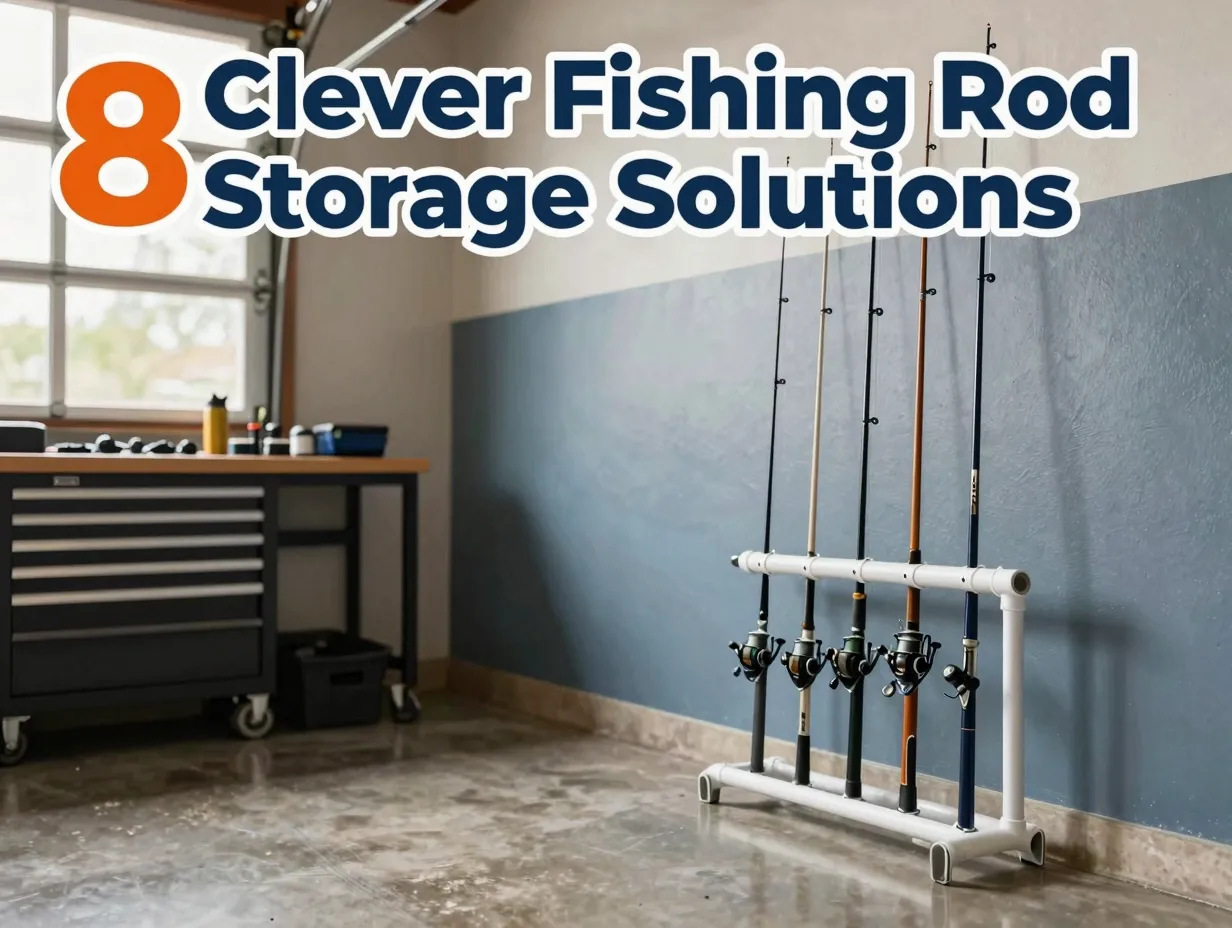
Whether you are storing two ultralight spinning rods or a full arsenal of surf-casting poles, the right system protects your investment and makes your next trip easier to prepare for.
Key Takeaways
- Vertical and ceiling-mounted storage solutions free up floor space and prevent rod damage caused by stacking.
- PVC pipe is one of the most affordable and customizable materials for DIY rod holders.
- Wall-mounted racks are ideal for garages with limited square footage.
- Proper storage extends rod and reel lifespan by preventing warping, tip breakage, and line tangling.
- Choosing the right solution depends on your rod count, available space, and whether you prefer DIY or ready-made products.
Why Proper Fishing Rod Storage Matters More Than You Think
Before diving into the 8 clever fishing rod storage solutions to declutter your garage or shed, it is worth understanding what poor storage actually costs you.
Fishing rods, especially graphite and fiberglass composite models, are precision instruments. Leaning them against a wall at an angle creates stress points along the blank. Stacking them on a shelf allows reels to grind against each other and tips to snap under the weight of other gear. Even a brief period of improper storage can result in micro-fractures that compromise casting performance and structural integrity.
Beyond equipment damage, cluttered storage creates a mental barrier. When gear is tangled and hard to access, trips get delayed or skipped entirely. A clean, organized system removes friction from the process of getting out on the water.
The financial case is also straightforward. A mid-range spinning rod costs between $80 and $300. A quality fly rod can exceed $600. Replacing even one rod per season due to preventable storage damage adds up quickly. A $30 wall rack or a weekend afternoon building a PVC holder pays for itself after a single prevented breakage.
What to Consider Before Choosing a Storage Solution
| Factor | What to Evaluate |
|---|---|
| Rod Count | How many rods need to be stored simultaneously |
| Rod Length | Longer surf rods require more ceiling height or wall length |
| Space Available | Wall space, floor space, or ceiling height |
| Budget | DIY options start under $20; premium racks can reach $150+ |
| Accessibility | How frequently rods are accessed |
| Reel-On or Reel-Off | Some systems work better with reels attached |
The 8 Clever Fishing Rod Storage Solutions To Declutter Your Garage Or Shed
The following solutions range from simple weekend DIY builds to ready-made commercial products. Each has been selected for practicality, cost-effectiveness, and real-world usability.
1. Wall-Mounted Horizontal Rod Racks
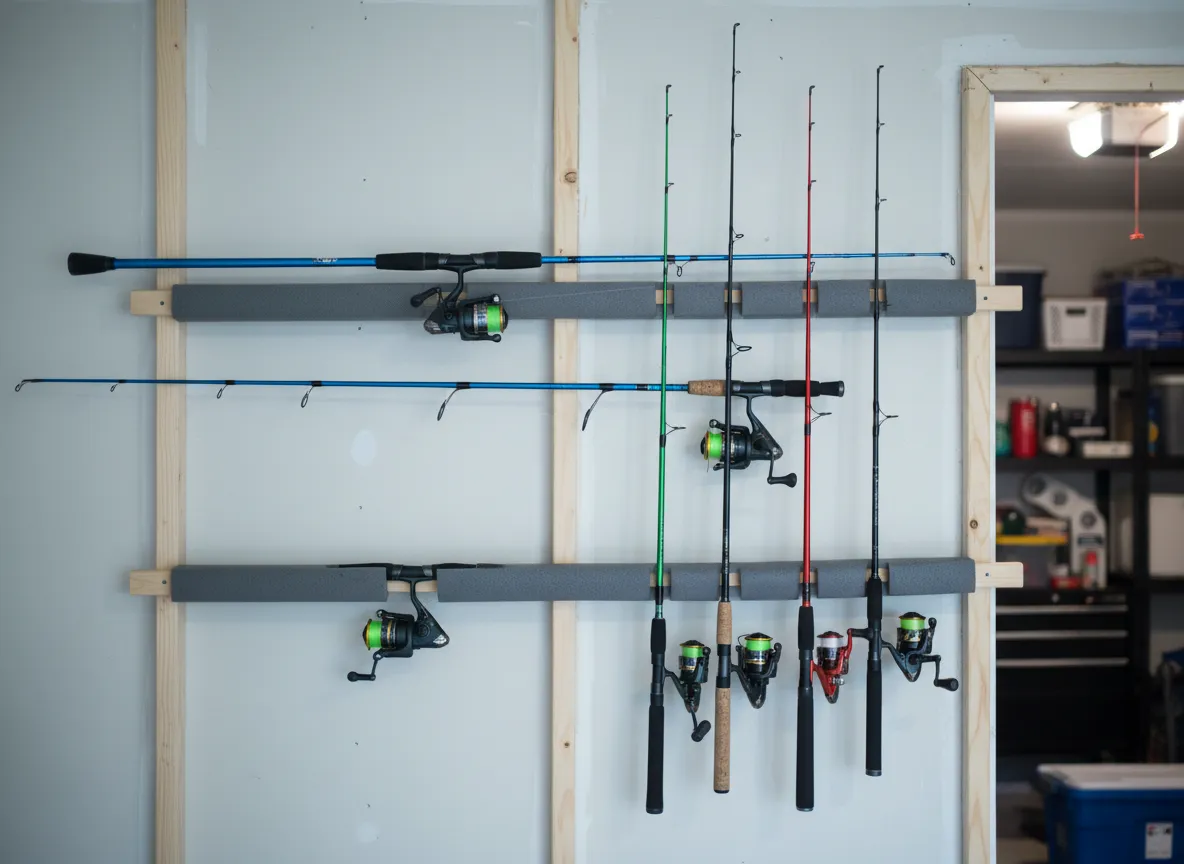
Wall-mounted horizontal racks are the most popular fishing rod storage solution for good reason. They keep rods parallel, prevent tip contact, and display your collection in a way that makes selection fast and easy.
How they work: Two or more horizontal supports, typically foam-lined or rubber-coated, are mounted to studs on the garage wall. Rods rest across the supports at two points along the blank, distributing weight evenly and eliminating stress on any single section.
Best for: Anglers with five or more rods who have at least six feet of unobstructed wall space.
Key advantages:
- Rods are visible and easy to grab
- Reels can remain attached
- Commercial versions hold between four and twenty rods
- Custom spacing accommodates different rod lengths
Pro tip: Mount the lower support at chest height and the upper support near the ceiling. This maximizes wall usage and keeps rods out of the way of foot traffic.
Commercial options from brands like Rush Creek Creations and Organized Fishing offer pre-drilled, wall-ready kits. DIY versions can be built with two wooden dowels, foam pipe insulation, and four lag screws for under $15.
2. Ceiling-Mounted Rod Storage Racks
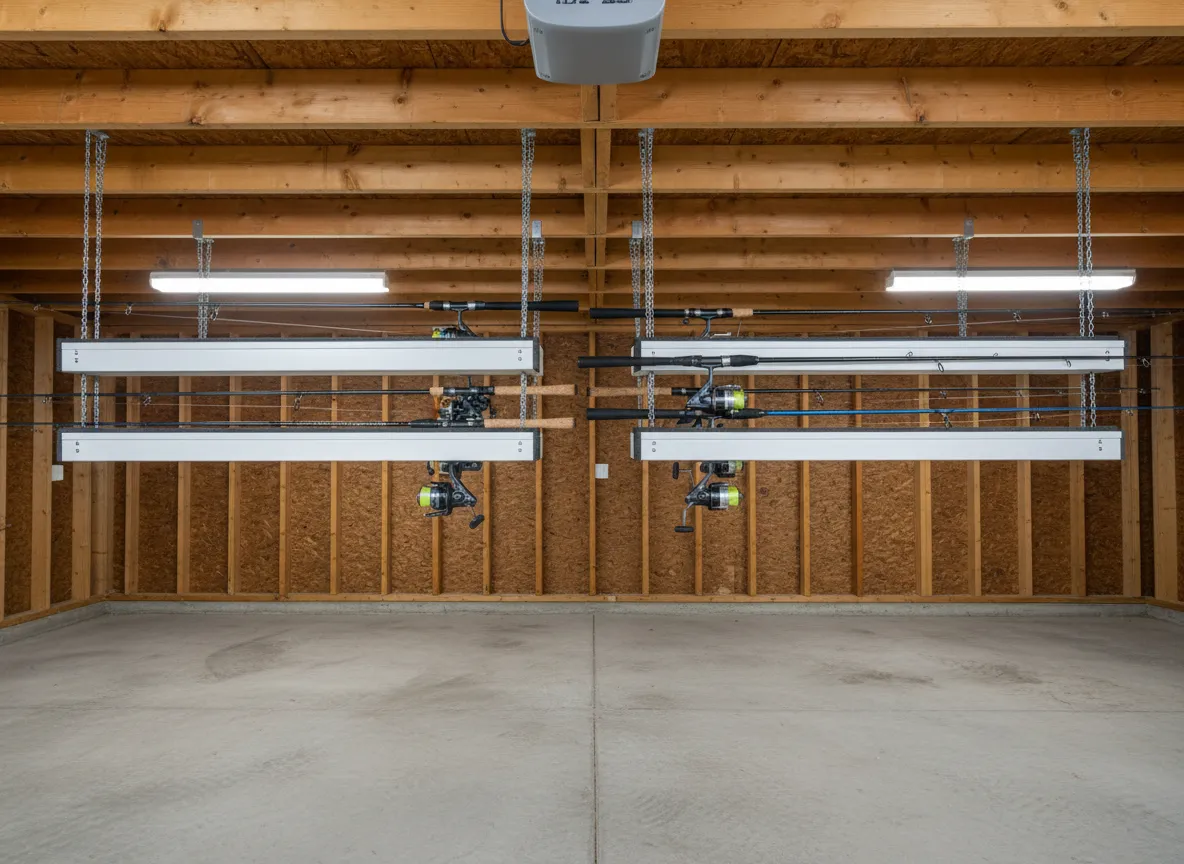
Ceiling storage is the single most underutilized space in the average garage. A ceiling-mounted rod rack takes advantage of this dead zone and keeps the floor and walls completely clear.
How they work: Parallel rails or channel-style holders are suspended from ceiling joists using threaded rod or heavy-duty hooks. Rods slide in horizontally and rest in foam-lined channels.
Best for: Garages with eight-foot or higher ceilings and limited wall space. Ideal for long surf rods and fly rods that exceed seven feet.
Key advantages:
- Zero floor or wall footprint
- Can store ten or more rods in a compact overhead area
- Rods are protected from accidental kicks and bumps
- Works well alongside ceiling-mounted kayak or canoe storage
Important consideration: Ceiling storage is less convenient for frequently accessed rods. It works best for seasonal rods or backups that are not used on every trip.
“The ceiling is the most overlooked storage real estate in any garage. A single eight-foot ceiling span can hold a full season’s worth of rods without touching a single wall.”
3. PVC Pipe Floor Stand Rod Holder
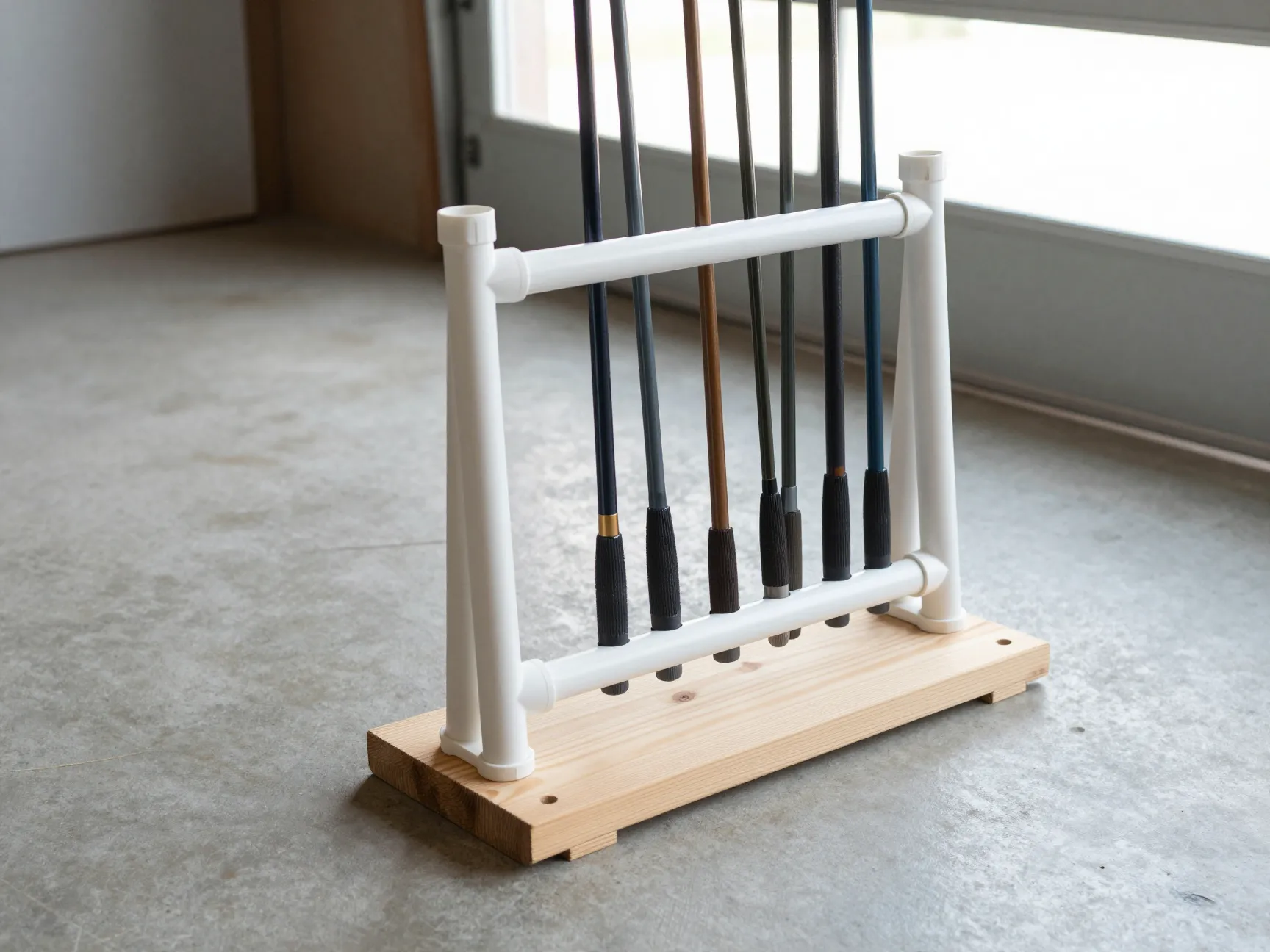
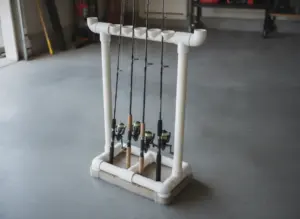
PVC pipe is the material of choice for budget-conscious anglers who want a fully customizable storage solution. A PVC floor stand can be built in an afternoon for under $25 and holds anywhere from six to twenty rods depending on the design.
How they work: Sections of PVC pipe, typically 1.5 to 2 inches in diameter, are cut to length and mounted vertically in a wooden or PVC base. Rods slide in tip-first or butt-first depending on the design. A dual-tier version uses a top rail with individual tube slots and a lower base to keep rods upright and separated.
Best for: Anglers who want maximum customization and are comfortable with basic tools. Great for sheds with concrete floors.
Basic materials list:
- 10-foot section of 1.5″ PVC pipe
- PVC end caps
- 2×6 lumber for the base
- PVC cement and primer
- Drill with hole saw bit
Design tip: Angle the tubes at 10 to 15 degrees rather than perfectly vertical. This prevents rods from tipping forward when one is removed from a neighboring slot.
The PVC floor stand is particularly useful for storing rods without reels, which is the preferred method for long-term storage to prevent reel seat corrosion.
4. Pegboard Wall Panel with Custom Rod Hooks
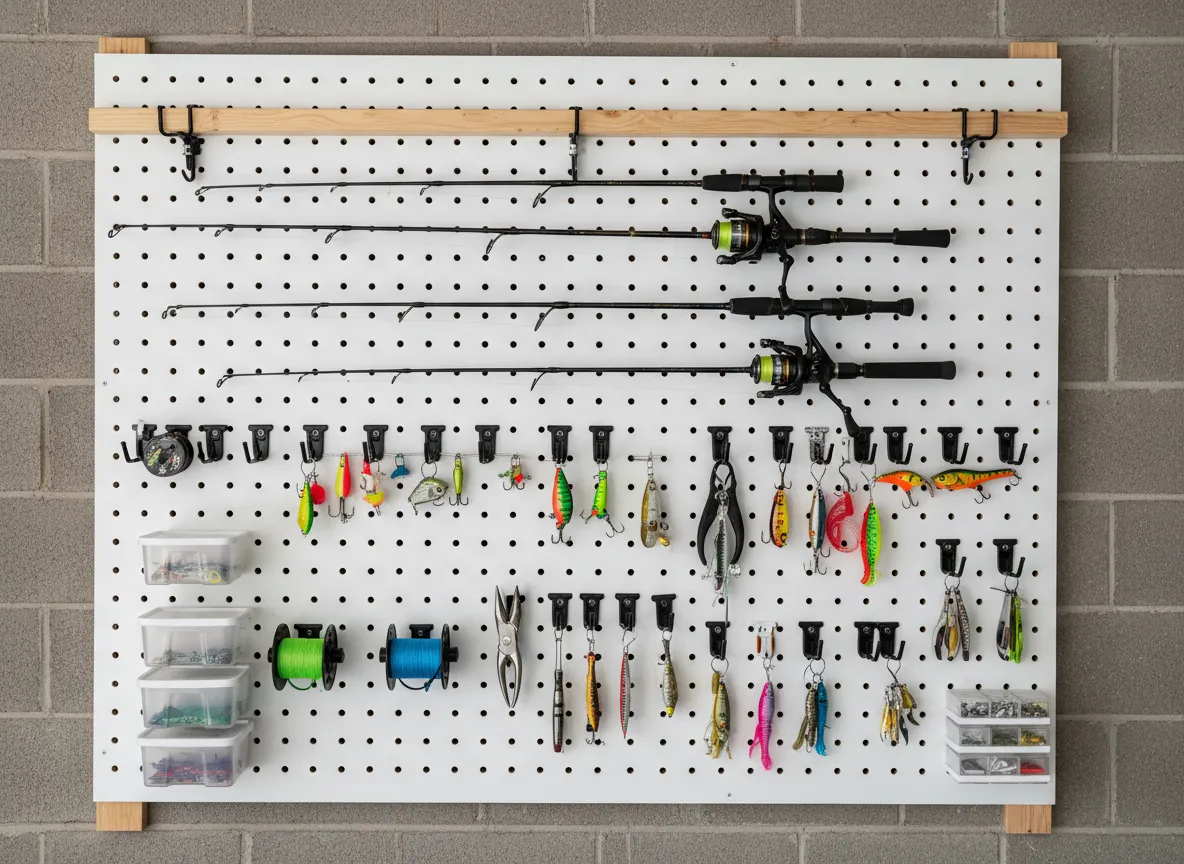
Pegboard is a versatile garage staple that most homeowners already have or can install for minimal cost. When fitted with the right hooks and accessories, it becomes a highly functional fishing rod storage system.
How they work: Standard 1/4-inch pegboard panels are mounted to the wall on spacers (to allow hook insertion from behind). Specialized fishing rod hooks, available in J-shape, V-shape, and loop configurations, hold rods horizontally or at a slight angle. Additional hooks and bins on the same panel can hold tackle, pliers, line spools, and accessories.
Best for: Anglers who want a single wall panel that organizes both rods and accessories in one unified system.
Key advantages:
- Fully reconfigurable, hooks move without tools
- Integrates rod storage with tackle organization
- Affordable: a 4×8 pegboard sheet costs approximately $30
- Works for spinning rods, casting rods, and fly rods
Limitation: Pegboard hooks can loosen over time if rods are heavy or frequently moved. Use locking pegboard hooks to prevent this.
5. Freestanding Rod Vault or Tube Storage Cabinet
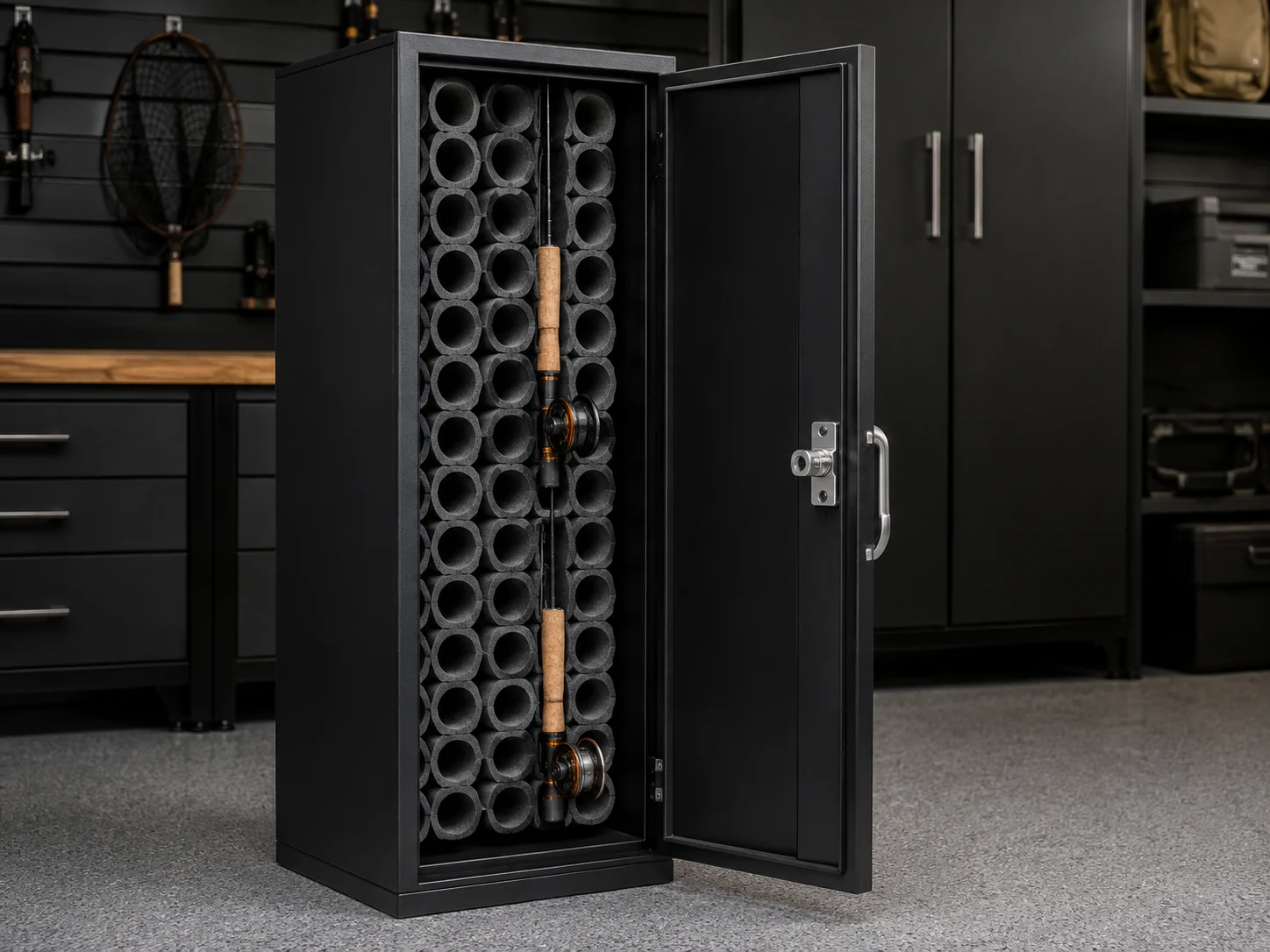
For anglers who want maximum protection, particularly for high-value fly rods, ice fishing combos, or travel rods, a freestanding rod vault or tube cabinet is the premium option.
How they work: These are enclosed cabinet-style units with individual tube slots for each rod. Rods slide into padded tubes that protect the blank, guides, and tip from dust, moisture, and impact. Some models include locking doors for security.
Best for: Collectors, tournament anglers, or anyone storing rods valued at $200 or more per piece.
Key advantages:
- Maximum protection from dust, humidity, and accidental damage
- Locking models deter theft
- Organized and visually clean appearance
- Some models accommodate rods up to nine feet in length
Trade-off: These units are the most expensive option, ranging from $80 to $400 depending on capacity and materials. They also require floor space, which may not be available in smaller garages or sheds.
6. Repurposed Wooden Ladder as a Rod Rack
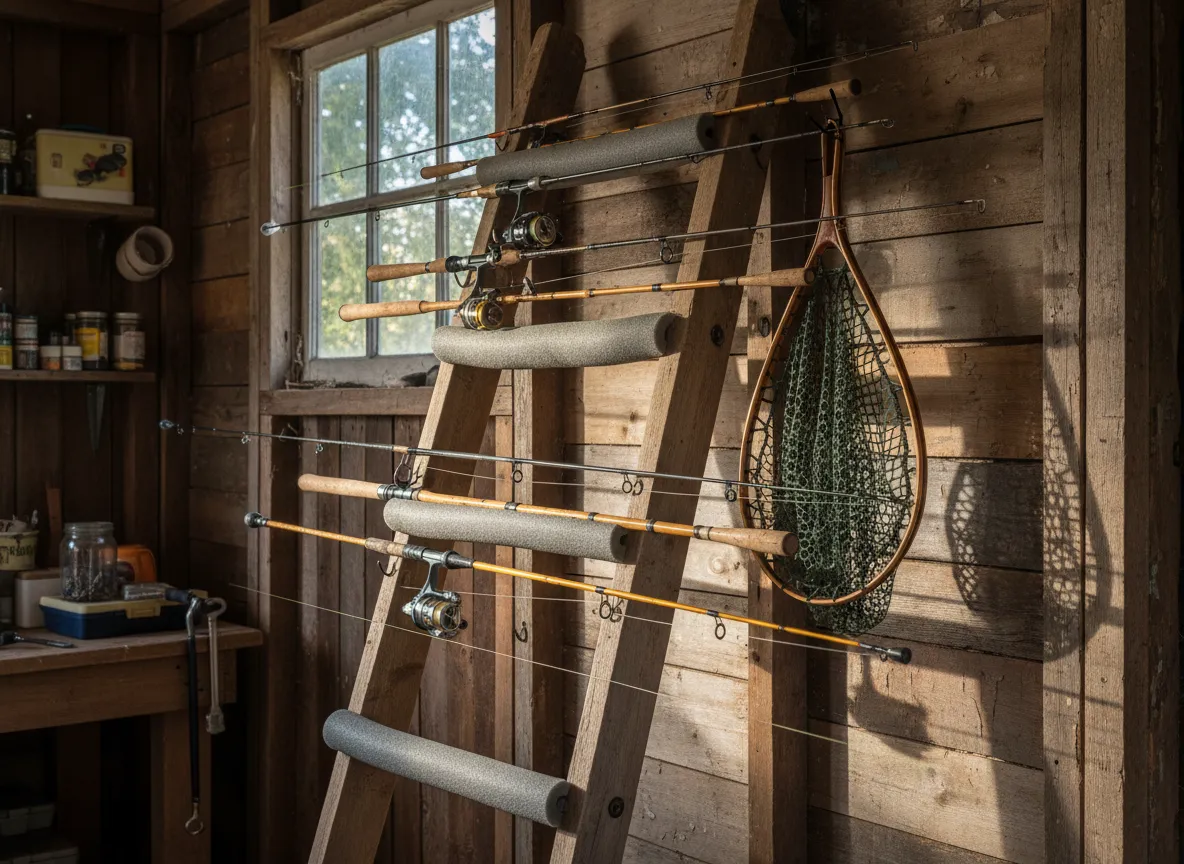
One of the most creative and cost-effective fishing rod storage ideas involves repurposing an old wooden ladder. This solution requires no drilling into walls and can be leaned against any flat surface.
How they work: A vintage or unused wooden ladder is leaned against the garage or shed wall at a slight angle. Fishing rods rest horizontally across the rungs, with each rung acting as a natural separator. The rungs can be wrapped in foam pipe insulation or rubber tubing to protect rod blanks from scratches.
Best for: Renters who cannot drill into walls, or anglers who want a portable solution that can be moved between locations.
Key advantages:
- Zero installation required
- Completely free if a spare ladder is available
- Rustic aesthetic that looks intentional in a workshop setting
- Can hold eight to twelve rods depending on ladder height
Enhancement tip: Attach small cup hooks to the sides of the ladder to hang tackle bags, landing nets, or rod cases alongside the rods themselves.
7. Overhead Garage Ceiling Pulley or Lift System
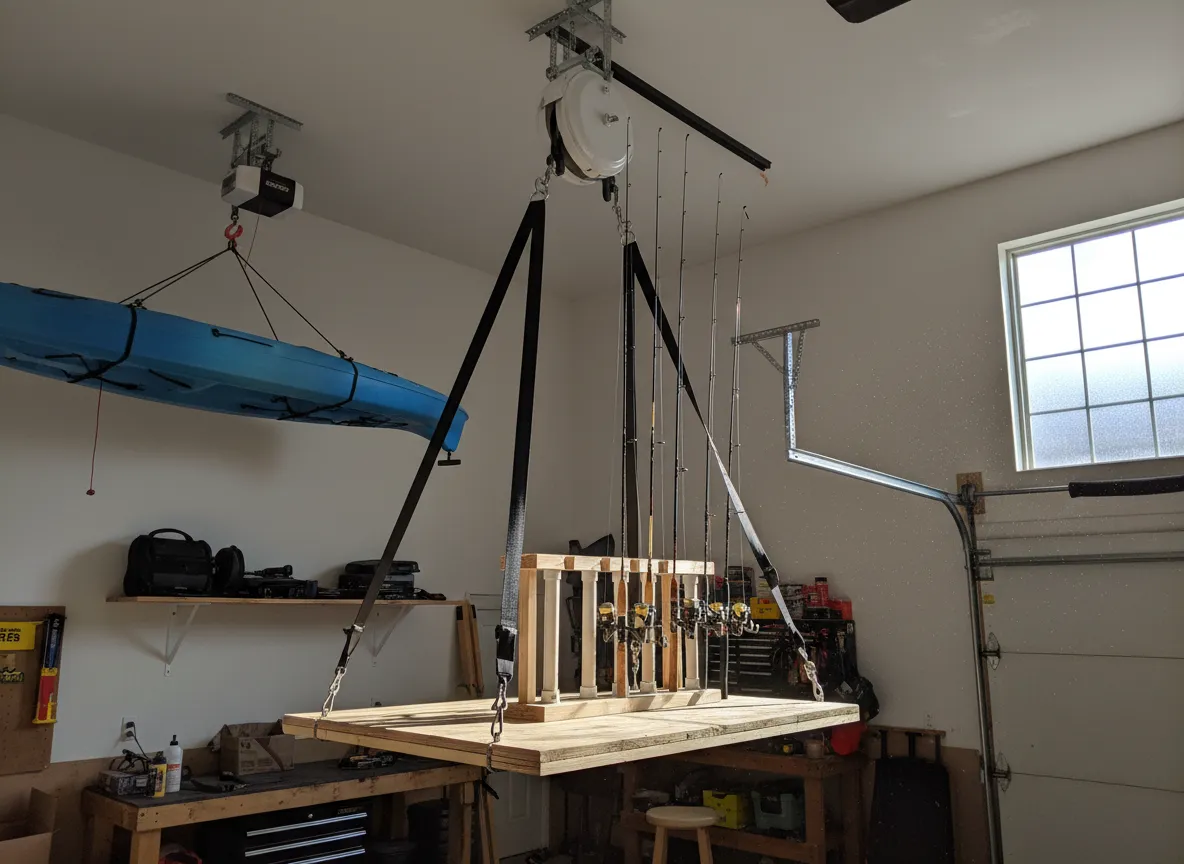
For anglers who also store kayaks, canoes, or paddleboards, a pulley-based ceiling lift system can be adapted to include fishing rod storage as part of a larger overhead organization setup.
How they work: Ceiling-mounted pulley systems, originally designed for bikes or kayaks, use ratcheting straps and hooks to raise and lower storage platforms. A custom rod cradle or PVC rack can be attached to the platform, allowing an entire rod collection to be raised to the ceiling when not in use and lowered when needed.
Best for: Garages with limited floor and wall space where ceiling storage is the only viable option. Also ideal for anglers who batch-prepare for trips rather than grabbing individual rods.
Key advantages:
- Maximizes vertical space in small garages
- The entire rod collection can be lowered in one motion
- Protects rods from floor-level moisture and pests
- Can be integrated with existing ceiling storage systems
Safety note: Always verify that ceiling joists can support the combined weight of the platform, rods, and any attached reels before installation. Most residential joists support 50 pounds per linear foot, but older construction may vary.
8. Rolling Rod Cart or Mobile Storage Tower
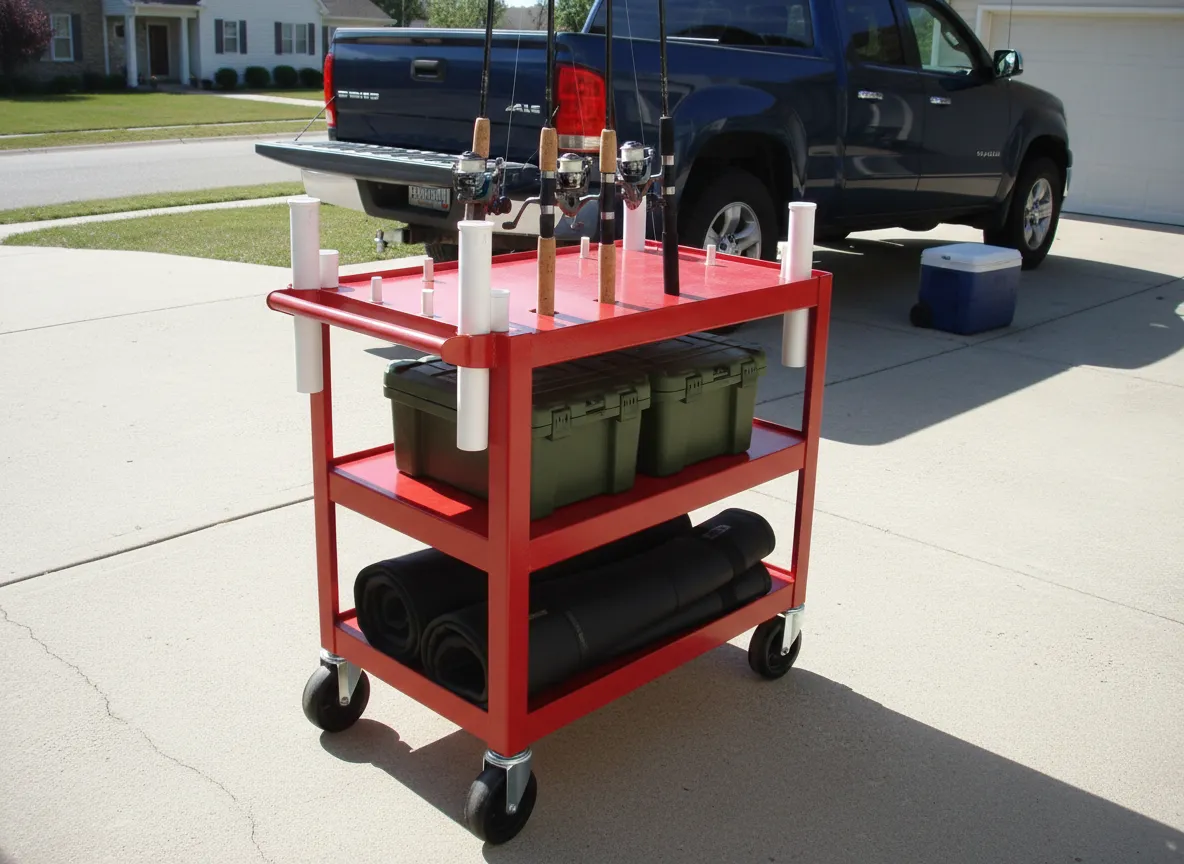
The final solution in this list of 8 clever fishing rod storage solutions to declutter your garage or shed is the rolling rod cart, a mobile unit that combines storage with portability.
How they work: A rolling cart, either purpose-built or adapted from a workshop tool cart, is fitted with vertical PVC tubes, horizontal foam-lined slots, or a combination of both. The cart rolls on locking casters, allowing it to be moved to the driveway for trip prep, rolled back into the garage, and locked in place for storage.
Best for: Anglers who load gear directly from the garage to the truck and want to minimize the number of trips carrying individual rods.
Key advantages:
- Portable and repositionable
- Can store rods with reels attached in padded vertical slots
- Lower shelves accommodate tackle boxes, waders, and accessories
- Consolidates an entire fishing kit into one movable unit
DIY version: A heavy-duty workshop cart from a hardware store (typically $60 to $100) can be modified with PVC tubes and foam padding in a single afternoon. The result is a custom mobile fishing station that rivals commercial products costing three times as much.
Comparing the 8 Solutions at a Glance
| Solution | Best For | Approx. Cost | DIY Friendly |
|---|---|---|---|
| 1. Wall-Mounted Horizontal Rack | Most anglers | $15 – $80 | Yes |
| 2. Ceiling-Mounted Rack | Long rods, high ceilings | $30 – $120 | Yes |
| 3. PVC Floor Stand | Budget builders | $15 – $30 | Yes |
| 4. Pegboard Panel | Full tackle organization | $30 – $60 | Yes |
| 5. Rod Vault Cabinet | High-value rods | $80 – $400 | No |
| 6. Repurposed Ladder | Renters, zero-cost | $0 – $10 | Yes |
| 7. Pulley Lift System | Small garages | $50 – $150 | Moderate |
| 8. Rolling Rod Cart | Mobile prep, portability | $60 – $200 | Yes |
Additional Tips for Long-Term Rod Storage Success
Choosing the right storage solution is only half the equation. How rods are stored matters just as much as where they are stored.
Remove reels for long-term storage. Leaving a reel attached to a rod for months creates pressure on the reel seat and can cause corrosion where metal contacts the blank. Store reels separately in a cool, dry location.
Store rods vertically or horizontally, never at an angle. Diagonal storage creates a consistent bend in the blank over time, which permanently affects casting performance. This is especially critical for fiberglass rods, which are more susceptible to memory deformation than graphite.
Rinse rods before storage. Salt, dirt, and biological matter from baitfish accelerate corrosion on guides and reel seats. A quick rinse with fresh water and a wipe-down with a soft cloth before storage extends the life of every component.
Inspect guides annually. Cracked or grooved guides damage fishing line and reduce casting distance. A quick inspection at the start of each season, running a cotton swab through each guide to check for snags, takes less than five minutes and can prevent frustrating line failures on the water.
Label rod slots. In a multi-rod storage system, labeling each slot with rod type, line weight, and intended use (bass, trout, surf, etc.) eliminates the guesswork of selecting the right rod in the pre-dawn hours before a trip.
Conclusion
A cluttered garage or shed is not just an aesthetic problem, it is a direct threat to the performance and lifespan of expensive fishing equipment. The 8 clever fishing rod storage solutions to declutter your garage or shed outlined in this guide cover every budget, space constraint, and skill level. From a zero-cost repurposed ladder to a premium locking rod vault, there is a practical solution for every angler.
Actionable next steps:
- Count your current rod collection and measure the available wall, floor, and ceiling space in your garage or shed.
- Select one primary storage solution from this list that matches your space and budget.
- If budget is a concern, start with the PVC floor stand or repurposed ladder, both can be implemented this weekend at minimal cost.
- Add a secondary solution (such as a pegboard panel) to handle tackle and accessories alongside rod storage.
- Commit to a pre-season and post-season maintenance routine: rinse, inspect, and store rods properly every time.
The best fishing rod storage system is the one that gets used consistently. Start simple, build the habit, and upgrade as the collection grows.