8 Hunter Gatherer Clothing Principles for Modern Wilderness Wear
Humans survived ice ages, monsoon seasons, and sub-zero tundra for roughly 300,000 years, without synthetic fabrics, Gore-Tex, or moisture-wicking technology. The clothing systems hunter-gatherers developed were not primitive accidents. They were refined, field-tested solutions to the same problems modern wilderness travelers face today. Applying the 8 Hunter Gatherer Clothing Principles for Modern Wilderness Wear bridges that ancient engineering wisdom with contemporary gear science, producing a clothing strategy that is both time-proven and technically sound.
Disclosure: This post contains affiliate links. As an Amazon Associate, we earn from qualifying purchases, and at no extra cost to you.
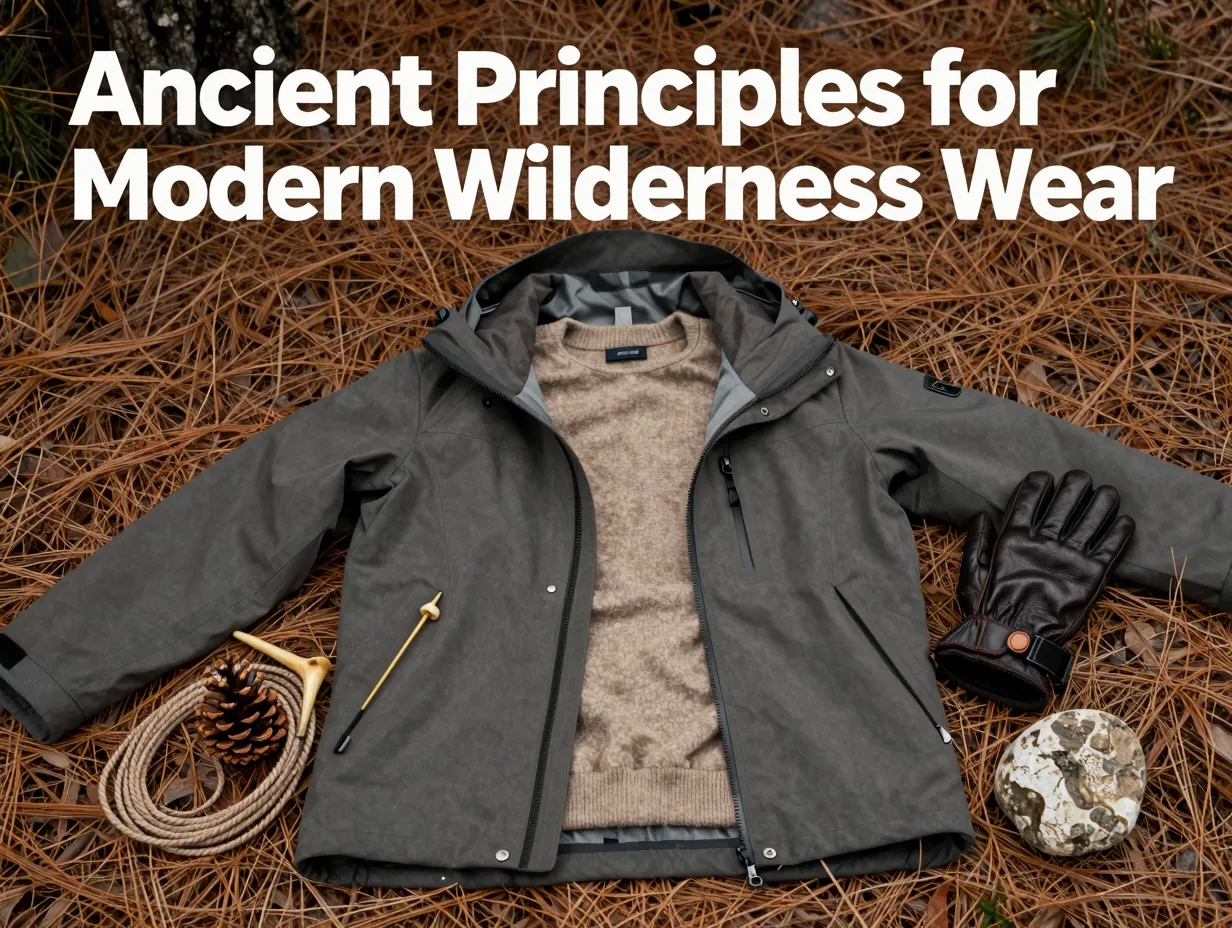
This guide breaks down each of those eight principles, explains the underlying logic, and shows how to translate each one into practical gear choices for 2026 wilderness adventures.
Key Takeaways
- Hunter-gatherer clothing was built around layering, natural insulation, and moisture management, the same foundations of modern wilderness wear.
- The “never cotton” rule has ancient roots: early peoples instinctively chose materials that retained warmth when wet.
- A complete wilderness clothing system mirrors an 8-piece or 8-layer approach that covers every environmental variable.
- Fit, mobility, and repairability were survival priorities for our ancestors and remain critical for backcountry travelers today.
- Modern technical fabrics fulfill the same functional roles as animal hides, plant fibers, and sinew, the principles, not the materials, are what matter.
The Ancient Blueprint Behind the 8 Hunter Gatherer Clothing Principles for Modern Wilderness Wear
Before examining each principle individually, it helps to understand where these ideas come from. Archaeological and ethnographic records show that hunter-gatherer groups across every climate zone developed clothing systems with remarkable structural similarities [4]. Whether in the Arctic, the African savanna, or temperate forests, the solutions converged on the same core ideas: trap warmth, shed moisture, protect extremities, and stay mobile.
Modern hunting and wilderness apparel manufacturers have independently arrived at nearly identical conclusions [5]. The parallel is not coincidence, it is the result of solving the same physical problems under the same environmental pressures. The 8 Hunter Gatherer Clothing Principles for Modern Wilderness Wear are the distilled overlap between ancestral practice and contemporary gear science.
1. Layering as the Foundation of All Wilderness Clothing Systems
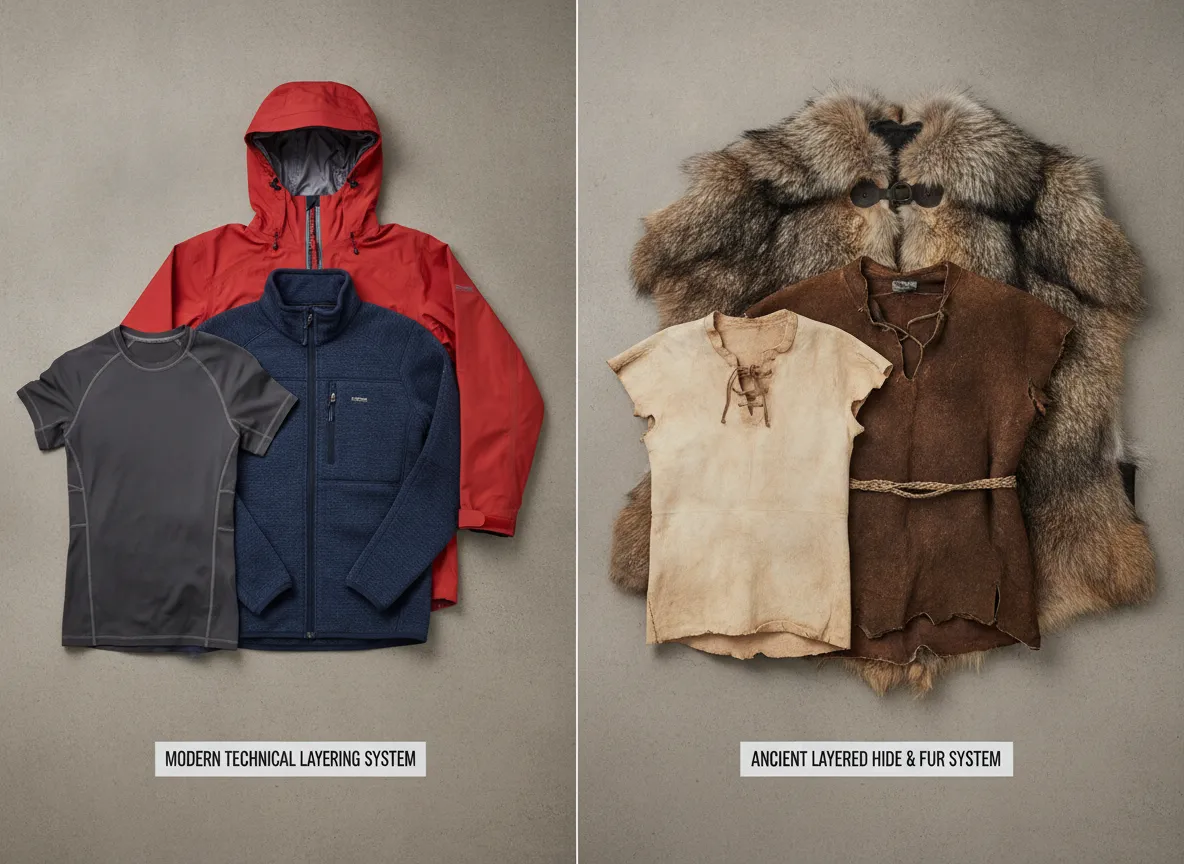
The layering principle is the single most important concept in both ancient and modern wilderness dressing. Hunter-gatherers did not wear one thick garment. They wore multiple lighter pieces that could be added or removed as activity level and temperature changed [4]. This gave them precise control over body temperature without the risk of overheating during exertion or freezing during rest.
Modern layering systems organize this into three functional zones:
- Base layer: Sits against the skin; primary job is moisture management.
- Mid layer: Provides insulation; traps warm air close to the body.
- Outer layer: Shields against wind, rain, and abrasion.
“The goal is to manage your microclimate, the thin layer of air between your skin and the environment, not simply to pile on warmth.” [5]
Hunter-gatherers achieved this same three-zone effect using combinations of light inner garments, heavier hide tunics, and outer cloaks or robes [4]. The materials differed; the architecture did not.
Practical application: Build every wilderness kit around at least three distinct layers. Resist the temptation to replace the system with a single heavy jacket. Versatility across changing conditions requires modularity.
2. Moisture Management: The “Never Cotton” Rule Has Ancient Roots
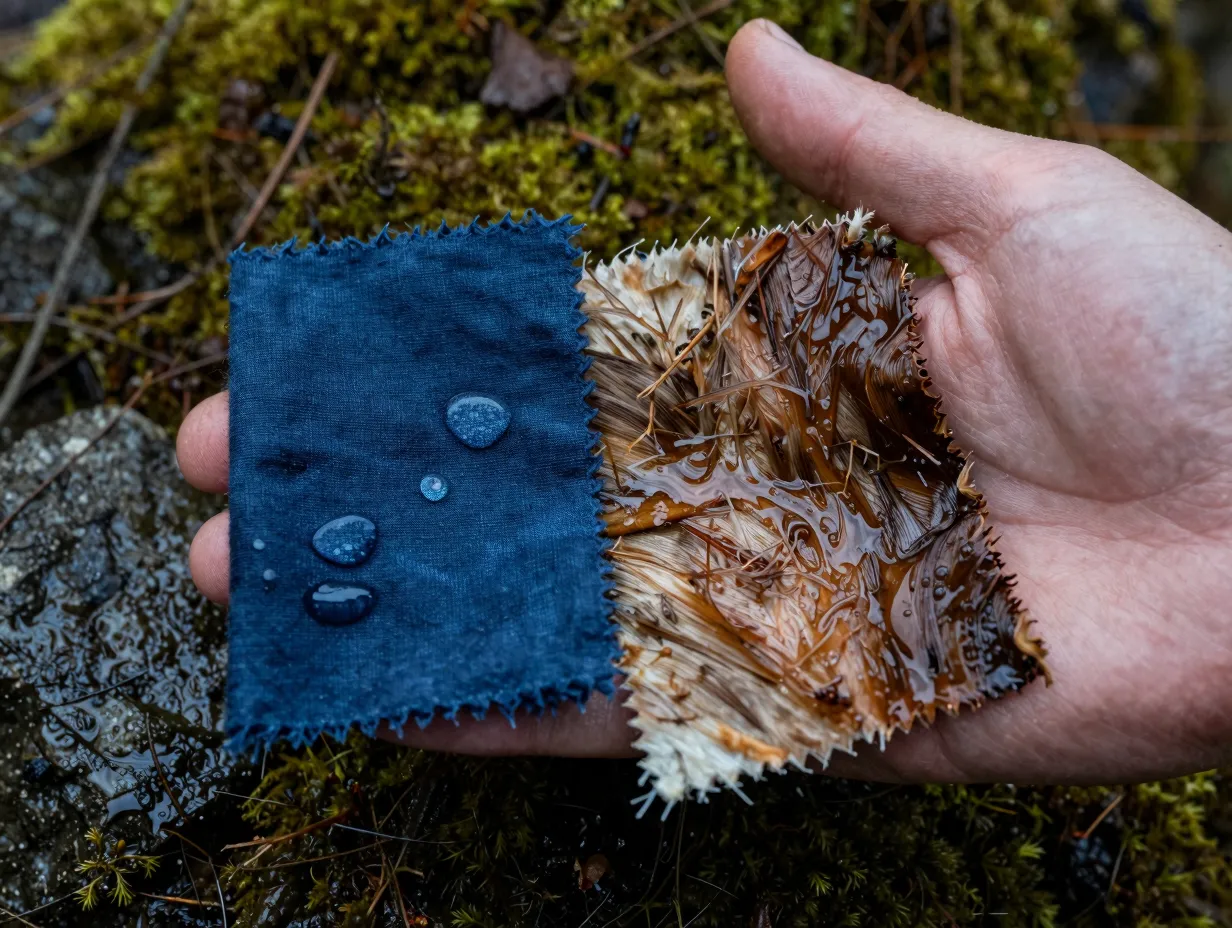
Cotton kills. That phrase is a staple of modern wilderness safety education [1], but the principle it describes is thousands of years old. Hunter-gatherers in cold and wet climates consistently chose animal hides, wool, and plant fibers over cotton-like materials because those alternatives retained insulating properties when wet [4].
Cotton absorbs moisture and holds it against the skin. When wet, it conducts heat away from the body up to 25 times faster than dry fabric. Early peoples learned this lesson through direct experience. Their base-layer equivalents, scraped and softened hides, felted wool, or woven plant fibers, managed moisture by wicking it away from the skin or by maintaining loft even when damp.
Modern equivalents of moisture-managing materials:
| Ancient Material | Modern Equivalent | Key Property |
|---|---|---|
| Scraped deer hide | Merino wool | Wicks moisture, warm when wet |
| Felted wool | Synthetic fleece | Retains loft, fast-drying |
| Treated seal skin | Waterproof shell fabric | Blocks external moisture |
| Woven plant fiber | Lightweight synthetic | Breathable, quick-dry |
Practical application: Never use cotton as a base layer in cold or wet wilderness conditions [1]. Choose merino wool or synthetic fabrics that move moisture away from the skin and maintain their insulating value when damp [6].
3. Protect the Extremities First
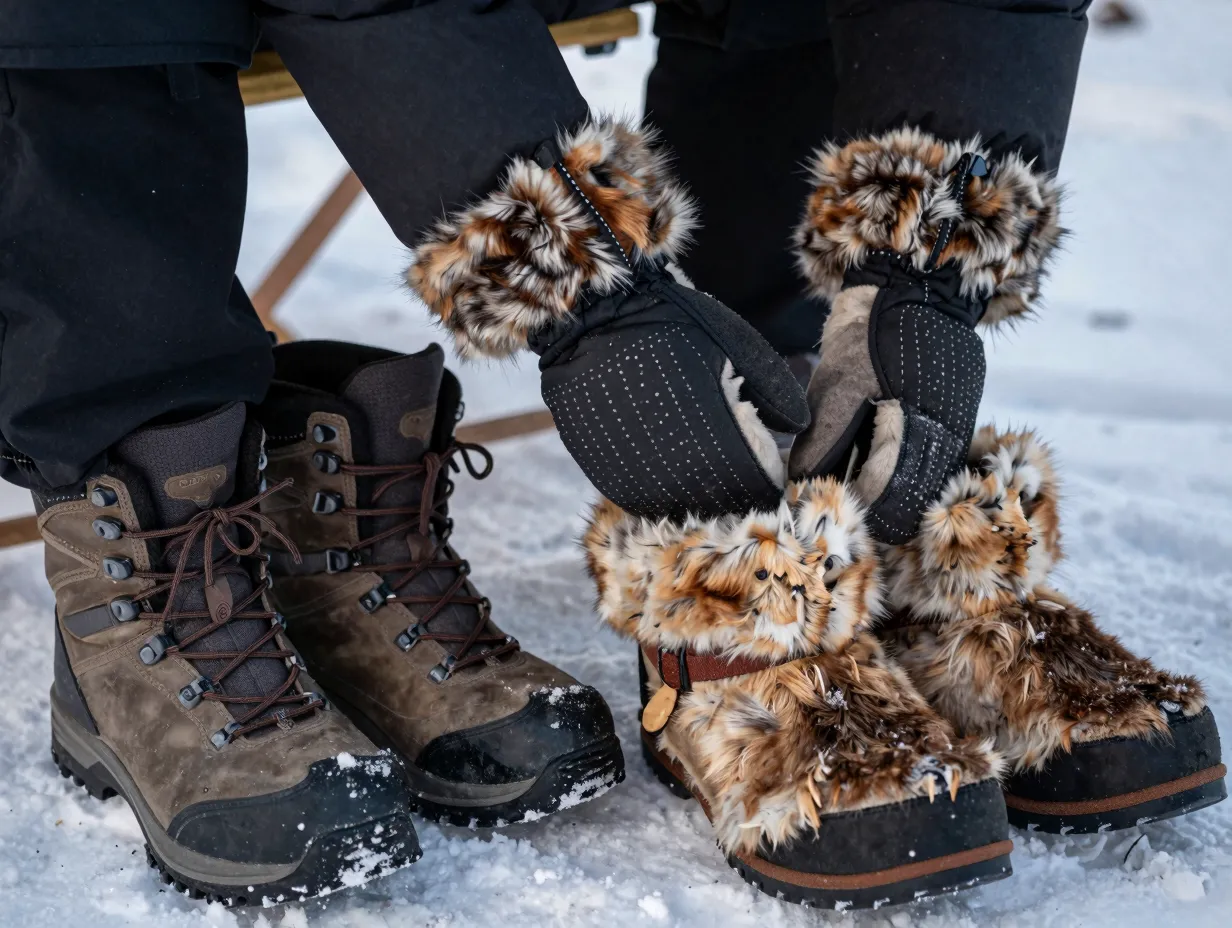
Examine the clothing artifacts and descriptions from hunter-gatherer cultures worldwide and one pattern emerges immediately: disproportionate attention to hands, feet, and head [4]. The Inuit developed some of the most sophisticated boot and mitten systems ever created. Indigenous peoples of the Pacific Northwest crafted elaborate rain hats. Desert hunter-gatherers prioritized foot protection above almost everything else.
The reason is physiological. The body sacrifices blood flow to the extremities first when core temperature drops. Hands and feet lose dexterity before the core feels cold. A hunter who cannot grip a tool or walk silently is a hunter who cannot hunt.
Modern wilderness medicine confirms this hierarchy. Frostbite and trench foot are far more common wilderness injuries than core hypothermia, precisely because extremity protection is underestimated [1].
Practical application: Invest proportionally more in footwear, gloves, and headwear than in torso layers. A high-quality boot system and a reliable hat can prevent the majority of cold-weather wilderness emergencies [7].
4. Fit and Mobility Are Non-Negotiable

Hunter-gatherer clothing was cut and constructed to allow full range of motion. Tight seams across the shoulders or binding at the knees were not merely uncomfortable, they were dangerous. A restricted stride could mean a missed step on a cliff edge. A shoulder seam that limited draw could mean a missed shot [4].
Modern wilderness gear has sometimes traded mobility for other features, producing jackets that are waterproof but restrict arm movement, or pants that are durable but stiffen in cold temperatures [6]. The ancestral principle cuts through this trade-off clearly: if a garment restricts movement, it is the wrong garment.
Key fit checkpoints for wilderness wear:
- Raise both arms fully overhead, no riding up at the waist.
- Squat fully, no binding at the knees or hips.
- Reach across the body, no pulling at the shoulders.
- Crouch into a shooting or climbing position, no gap at the lower back.
Practical application: Always test wilderness garments through a full range of motion before purchasing. Prioritize articulated knees, gusseted crotches, and underarm gussets in technical pieces [5].
5. Camouflage and Environmental Integration
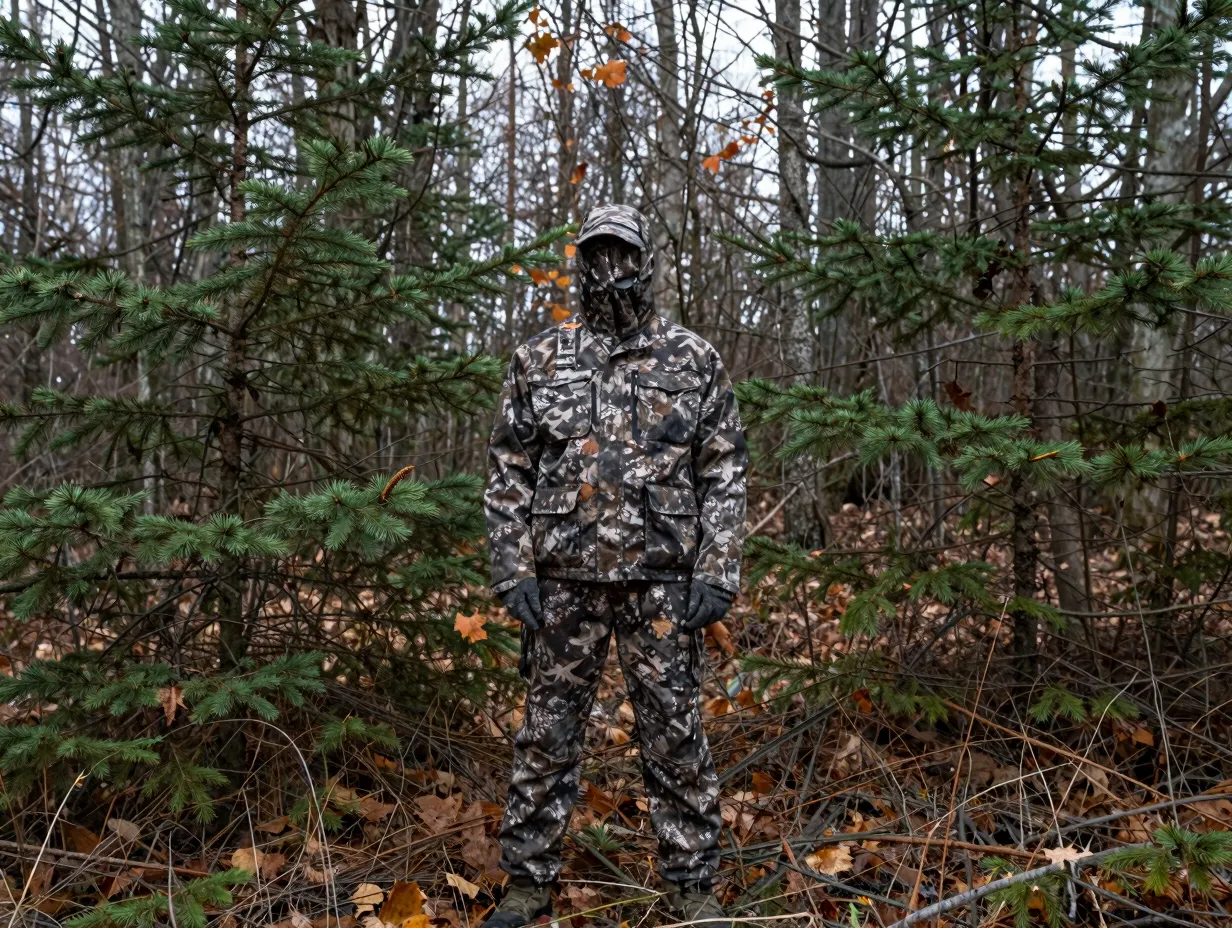
Hunter-gatherers did not choose earth-toned, textured clothing purely for aesthetic reasons. Blending into the environment was a functional survival strategy, both for approaching prey and for avoiding predators [3]. Hides, bark cloth, and plant-fiber garments naturally matched the colors and textures of their local ecosystems.
Modern hunting apparel has developed this principle into an entire science, with pattern systems designed for specific biomes: open prairie, dense timber, early-season green, late-season grey and brown [7]. The underlying logic is identical to what a Paleolithic hunter understood intuitively: the less you stand out, the more effective you become in the field.
“Effective camouflage is not about disappearing, it is about disrupting the outline and breaking up the silhouette so the eye does not register a human form.” [7]
Practical application: Match camouflage patterns to the specific environment and season being hunted or traveled. A pattern optimized for open sagebrush will underperform in dense spruce timber [5]. For non-hunting wilderness travel, neutral earth tones serve the same purpose of reducing visual impact on wildlife.
6. Thermal Regulation Through Head Coverage
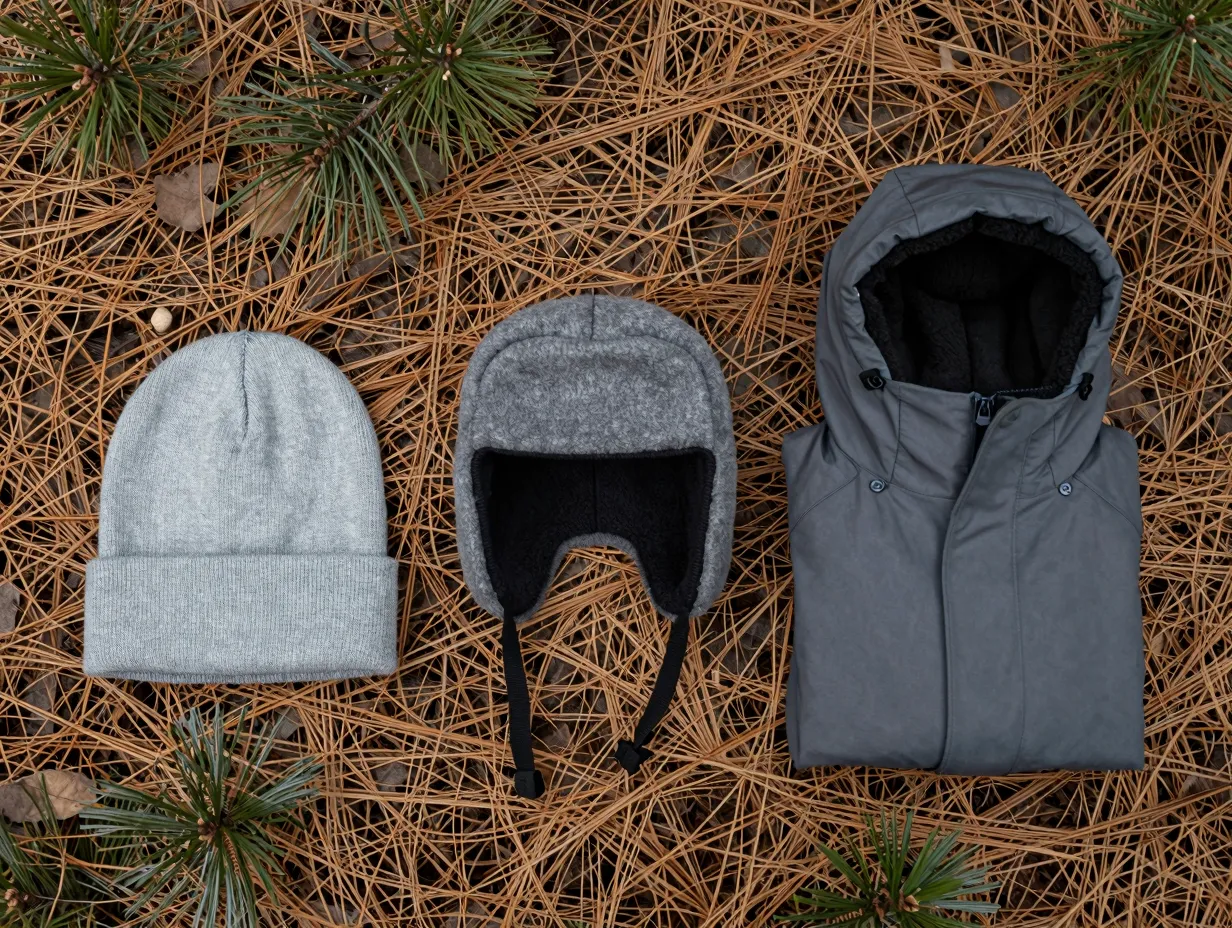
The head accounts for a significant portion of total body heat loss, particularly in cold and wind. Hunter-gatherers across cold climates developed sophisticated head coverings, from fitted fur caps to full hoods integrated into outer garments, specifically to control this heat loss [4].
The modern equivalent is the layered hat and hood system. A lightweight merino beanie handles mild cold. A heavier insulated hat manages serious cold. An integrated hood on a shell jacket adds wind and precipitation protection. The three-tier head-covering approach mirrors the broader layering principle applied specifically to the head.
Thermal regulation through head coverage, quick reference:
- Mild cold (40-55 F): Lightweight merino or synthetic beanie.
- Moderate cold (20-40 F): Midweight insulated hat, ear coverage.
- Severe cold (below 20 F): Heavy insulated hat plus integrated shell hood.
- Wind and rain: Brimmed hat or shell hood with cinch adjustment.
Practical application: Carry at minimum two head-covering options on any multi-day wilderness trip. The ability to add or remove head insulation quickly is one of the fastest ways to regulate core temperature without stopping to adjust torso layers [1].
7. Durability and Field Repairability
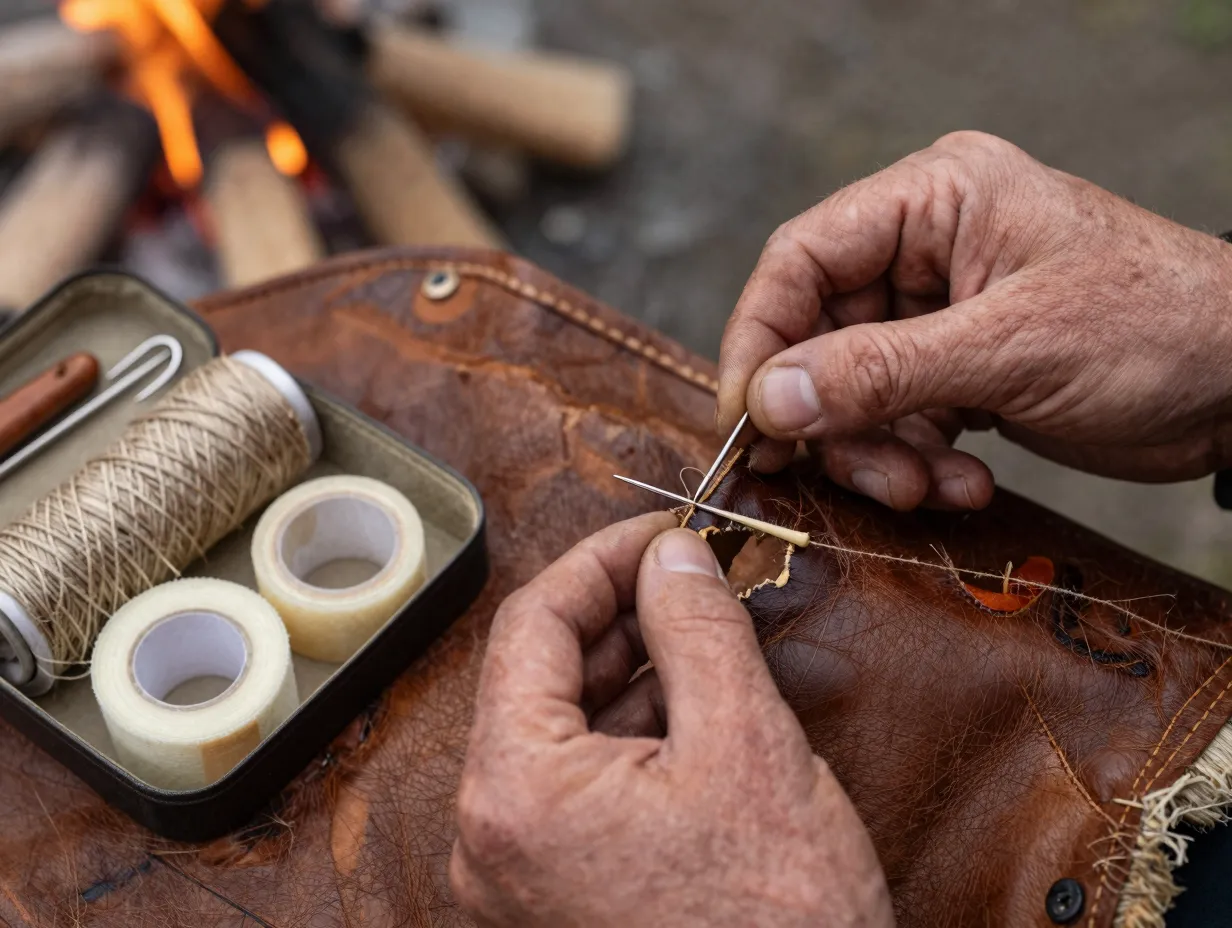
Hunter-gatherer clothing was built to last and designed to be repaired in the field. Sinew thread, bone needles, and hide patches were standard parts of a traveling kit [4]. A torn garment in a remote environment was not a fashion problem, it was a survival problem. The ability to repair clothing on the move was as important as the clothing itself.
Modern wilderness travelers often overlook this principle entirely, purchasing technically advanced garments that require specialized equipment or factory service to repair. This creates a critical vulnerability in remote settings [6].
Field repair essentials for modern wilderness wear:
- A small sewing kit with heavy-duty thread and a curved needle.
- Seam sealer for waterproof membrane repairs.
- Self-adhesive repair tape compatible with shell fabrics.
- Spare boot laces.
- Safety pins for emergency fastening.
Practical application: Before any multi-day wilderness trip, inspect all garments for weak seams, worn areas, and failing zippers. Carry a minimal repair kit and know how to use it [5]. Choose garments from manufacturers who offer repair programs or sell replacement parts.
8. Weight Efficiency and the Principle of Carrying Only What Is Necessary
Hunter-gatherers traveled light by necessity. Every item carried had to earn its place through demonstrated utility. Redundant or purely decorative clothing was weight that slowed travel, increased fatigue, and reduced the range of movement possible in a day [3].
Modern wilderness travelers frequently over-pack clothing, bringing items for hypothetical conditions rather than likely ones. The ancestral principle is a useful corrective: every garment in the pack should serve a specific, identified function. If two garments serve the same function, one of them should be left behind.
The weight-efficiency test for each garment:
- What specific condition does this garment address?
- Is there another item already in the kit that addresses the same condition?
- What is the weight cost versus the protection or comfort benefit?
- Can this garment serve multiple functions (e.g., insulated jacket that also serves as a pillow)?
“The best wilderness clothing system is the lightest one that fully addresses every environmental variable you will actually encounter.” [5]
Practical application: Lay out every garment before packing and justify each one against expected conditions. Use a layering system that allows each piece to serve multiple roles across a range of temperatures and weather scenarios [6].
Applying the 8 Hunter Gatherer Clothing Principles for Modern Wilderness Wear as a Complete System
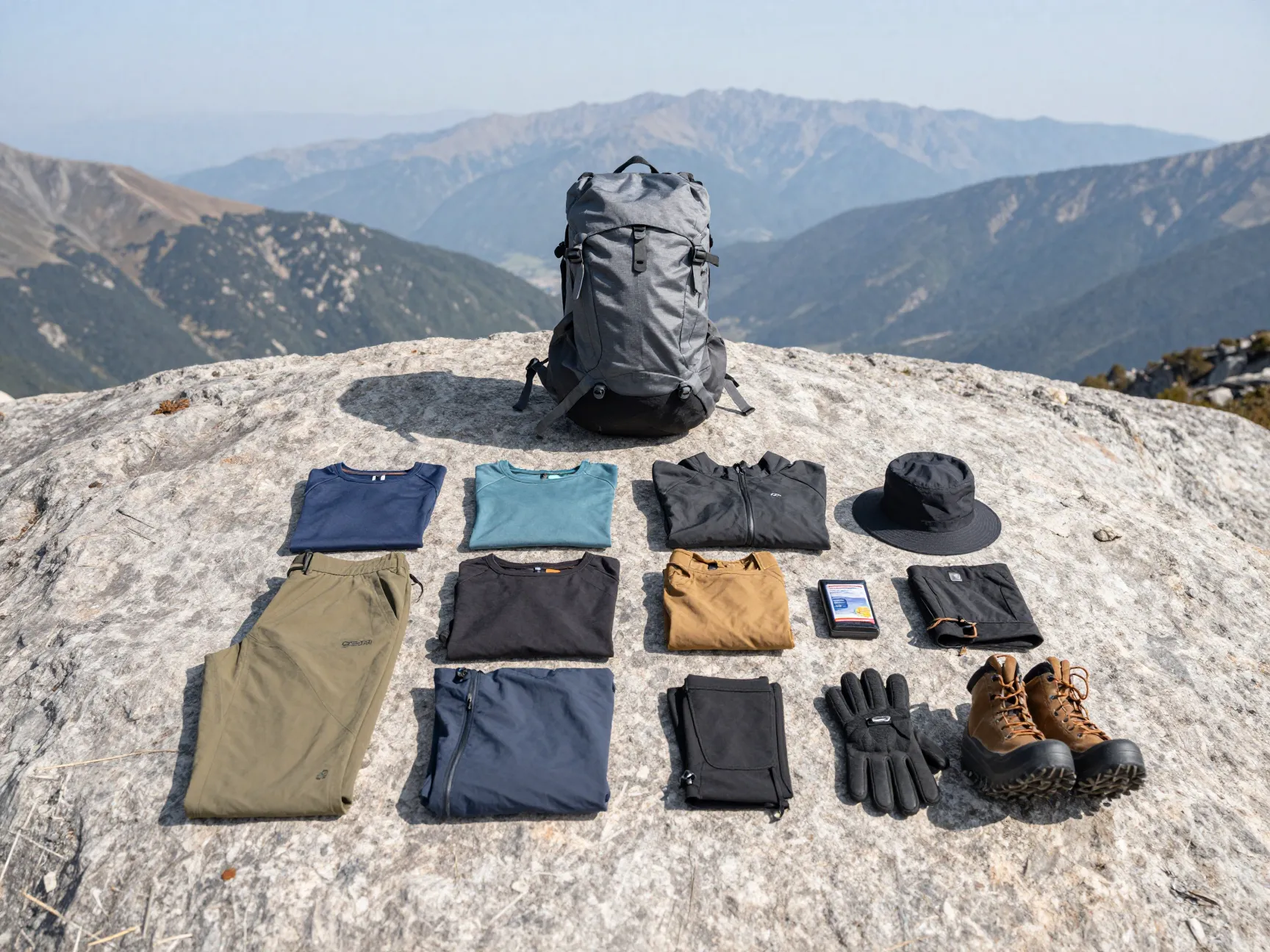
The real power of these principles emerges when they are applied together rather than in isolation. A complete wilderness clothing system built on all eight principles looks like this:
Complete 8-principle wilderness clothing system:
- Base layer (moisture management, fit), merino wool or synthetic, form-fitting, full range of motion.
- Mid layer (insulation, weight efficiency), fleece or down, packable, dual-purpose where possible.
- Outer shell (moisture management, durability), waterproof-breathable, field-repairable seams.
- Insulated pants (layering, mobility), articulated knees, gusseted crotch.
- Quality boots (extremity protection, durability), appropriate for terrain and season.
- Gaiters (moisture management, extremity protection), keeps debris and moisture out of boots.
- Layered head system (thermal regulation), at least two options for different temperatures.
- Glove system (extremity protection, weight efficiency), liner glove plus heavier outer mitt.
This eight-piece structure mirrors the ancestral approach of addressing every body zone with purpose-built coverage while maintaining the flexibility to add or remove pieces as conditions change [5] [7].
Common Mistakes That Violate These Principles
Even experienced wilderness travelers make clothing choices that contradict one or more of the eight principles. The most common errors include:
- Wearing cotton base layers in cold or wet conditions, violates the moisture management principle [1].
- Buying a single heavy jacket instead of a layered system, violates the layering and weight efficiency principles.
- Neglecting foot and hand protection until problems arise, violates the extremity protection principle [7].
- Choosing garments that restrict movement for the sake of other features, violates the fit and mobility principle.
- Packing no repair materials on multi-day trips, violates the durability and repairability principle.
- Over-packing redundant layers, violates the weight efficiency principle.
Each of these mistakes has a direct parallel in the failures that would have cost a hunter-gatherer their life. The principles are not arbitrary guidelines, they are the distilled lessons of human survival over hundreds of thousands of years [4].
Conclusion
The 8 Hunter Gatherer Clothing Principles for Modern Wilderness Wear are not a nostalgic exercise in primitive living. They are a practical framework for building clothing systems that work under real environmental pressure. Layering, moisture management, extremity protection, mobility, camouflage, thermal regulation, repairability, and weight efficiency, these eight principles address every major variable a wilderness traveler will encounter, from a day hike in changing weather to a multi-week backcountry expedition.
Actionable next steps:
- Audit your current wilderness clothing kit against all eight principles and identify gaps.
- Replace any cotton base layers with merino wool or synthetic alternatives before your next cold-weather trip.
- Build a minimal field repair kit and add it to your standard packing list.
- Test every new garment purchase through a full range of motion before committing to it for the field.
- Match your camouflage or color choices to the specific environment and season of your next outing.
The ancestors who developed these principles had no margin for error. Modern wilderness travelers have the advantage of technical materials and manufacturing precision. Combining that advantage with the structural wisdom of hunter-gatherer clothing design produces a system that is genuinely difficult to improve upon.
References
[1] 201099 93086 – https://www.hunter-ed.com/national/studyGuide/Clothing/201099_93086/
[3] Clothing Of Hunter Gatherers – https://historum.com/t/clothing-of-hunter-gatherers.128263/
[4] Historic Hunter Gatherer Clothing – https://traditionalivingproject.wordpress.com/2015/06/22/historic-hunter-gatherer-clothing/
[5] Building A Complete Hunting Clothing System – https://www.themeateater.com/hunt/general/building-a-complete-hunting-clothing-system
[6] Hunting Clothes 101 – https://www.gearexpert.com/2021/05/hunting-clothes-101.html
[7] Hunting Clothes – https://gripoutdoor.com/hunting-clothes/