8 Beautiful and Functional Wooden Fishing Rod Holder Designs for Your Gear
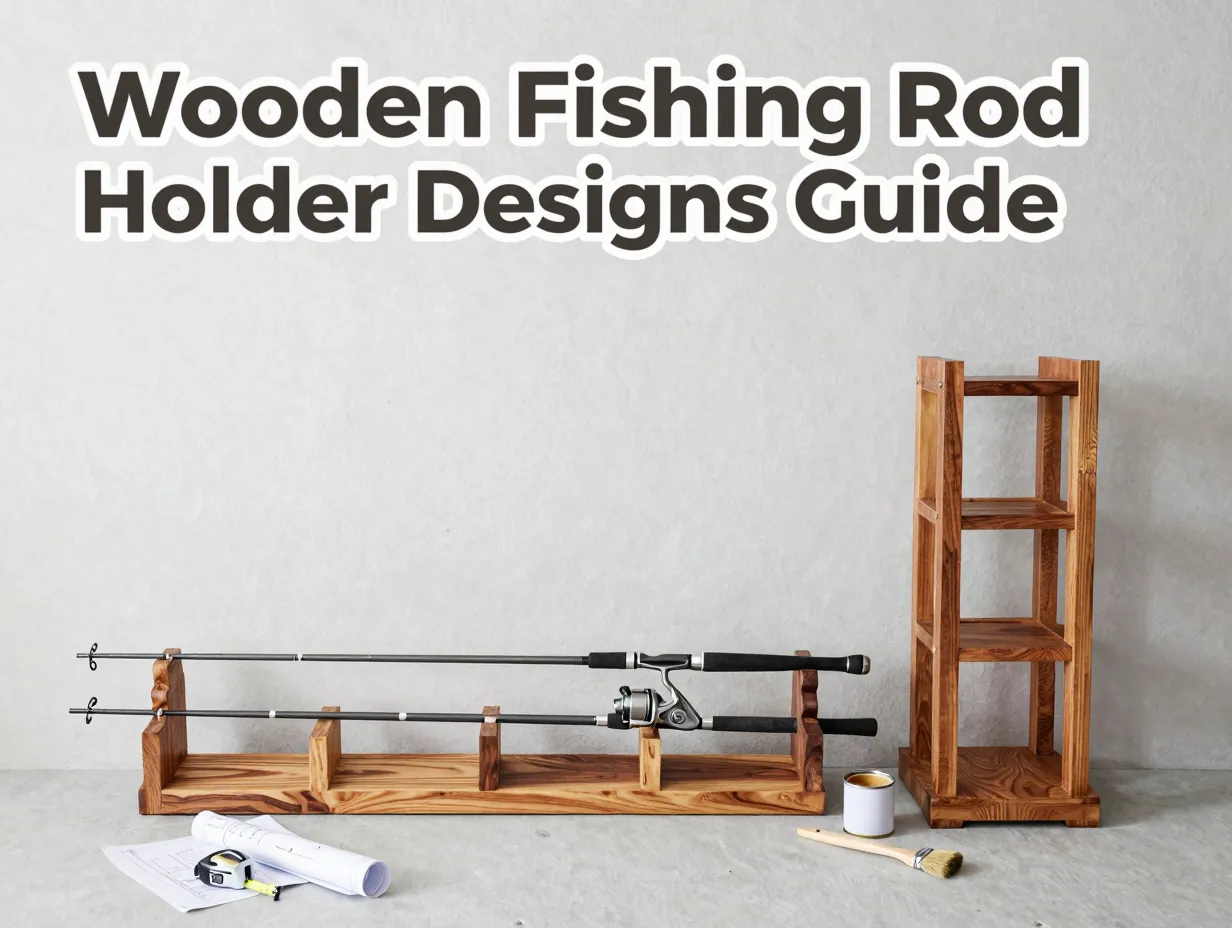
Roughly 54 million Americans fish at least once a year, yet most of them store their rods in a corner, leaning against a wall, where tips crack and reels tangle. A well-built wooden rod holder solves that problem while adding a piece of furniture-grade craftsmanship to any room, garage, or cabin. This guide to 8 beautiful and functional wooden fishing rod holder designs for your gear covers everything from beginner-friendly pine racks to hybrid wood-and-PVC ceiling mounts, with sourced plans, material tips, and finishing advice to help any angler get started.
Disclosure: This post contains affiliate links. As an Amazon Associate, we earn from qualifying purchases, and at no extra cost to you.
Key Takeaways
- Wood rod holders can function as attractive display furniture, not just utilitarian storage.
- Most DIY designs use common dimensional lumber (1×4, 1×6, 1×8) and basic tools, making them accessible to beginners.
- Hole spacing of roughly 4 inches center-to-center prevents reel handles from colliding and keeps rods organized.
- Finishing with stain, clear coat, or oil protects the wood and dramatically improves visual appeal.
- Designs range from simple six-board wall mounts to modular floor racks that hold 8 to 24 rods.
Why Wooden Rod Holders Stand Out Among Storage Options
Metal and plastic rod holders are widely available, but they rarely match the warmth and character of a handmade wooden rack. Wood is easy to cut, shape, sand, and finish with consumer-grade tools. It absorbs vibration, resists marring delicate rod blanks, and can be stained or painted to match any interior. According to aggregated DIY plan collections, most wooden rod rack projects now aim to store between 8 and 24 rods, with spacing templates provided to keep the layout consistent and visually neat [6].
Beyond aesthetics, wood allows complete customization. A builder can adjust the number of holes, change the board species, add decorative bevels, or route decorative edges, none of which are practical with off-the-shelf metal racks. The result is a holder that reflects the owner’s personality and fits the exact space available.
“A wooden rod rack built with care is not just storage, it is a statement about how seriously an angler takes the craft.”
The 8 Beautiful and Functional Wooden Fishing Rod Holder Designs for Your Gear
The following eight designs represent a range of skill levels, storage capacities, and aesthetic styles. Each one has been drawn from verified build guides and DIY plan sources, and each can be adapted to suit different rod collections and living spaces.
1. The Classic Six-Board Pine Rack
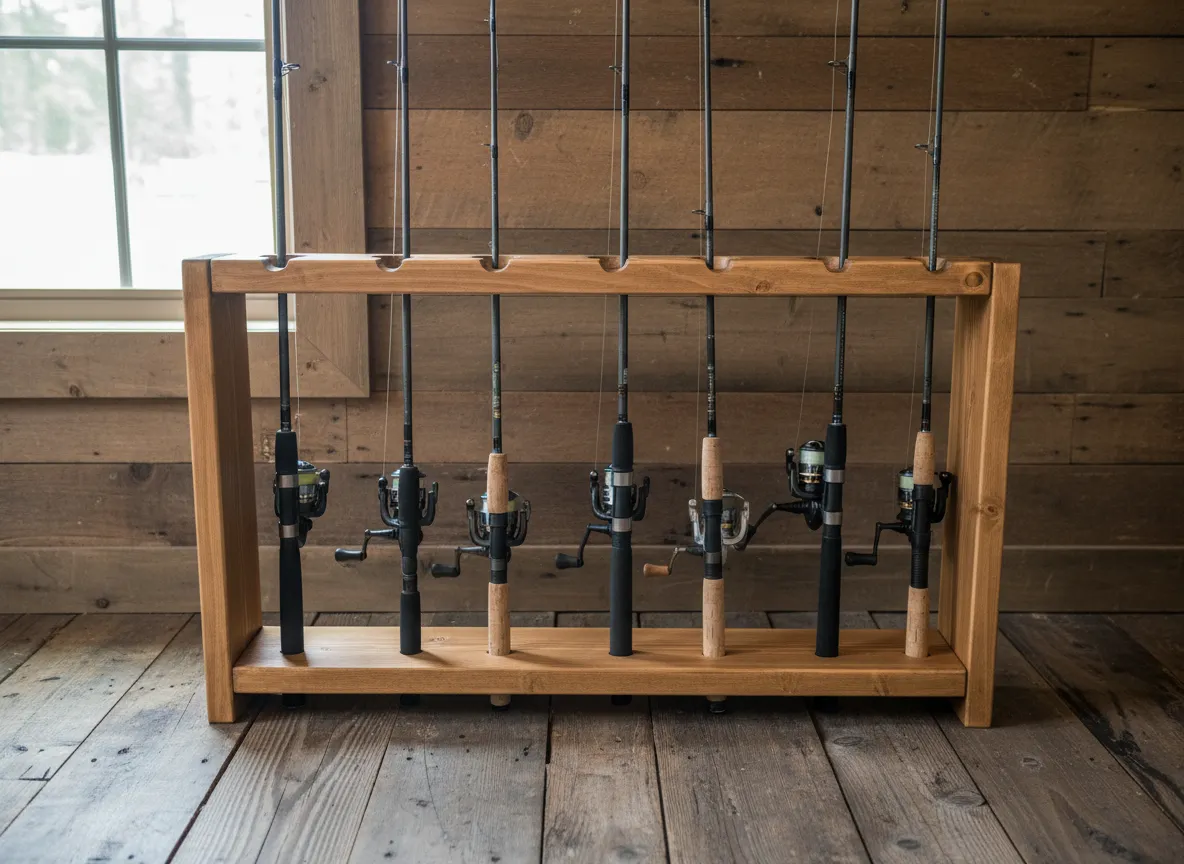
This design is the ideal starting point for anyone new to woodworking. Scout Life’s January 2026 project outlines a simple six-board pine rod rack that can be either free-standing or wall-mounted [1]. The build sequence is straightforward: cut six boards to length, drill 1.5-inch holes in the side pieces, cut rod slots along the top board, countersink screw holes, sand all surfaces, and apply a clear finish or stain.
Key specifications:
- Material: Standard pine boards (readily available at any home center)
- Capacity: 6 to 8 rods depending on spacing
- Skill level: Beginner
- Finish: Clear sealant or wood stain to showcase natural grain [1]
What makes this design stand out is its versatility. The same basic structure works mounted flat against a garage wall or sitting on a cabin floor. When stained with a honey-toned or walnut finish, the pine grain becomes a visual feature rather than an afterthought.
2. The Furniture-Grade Minwax Beveled Rack
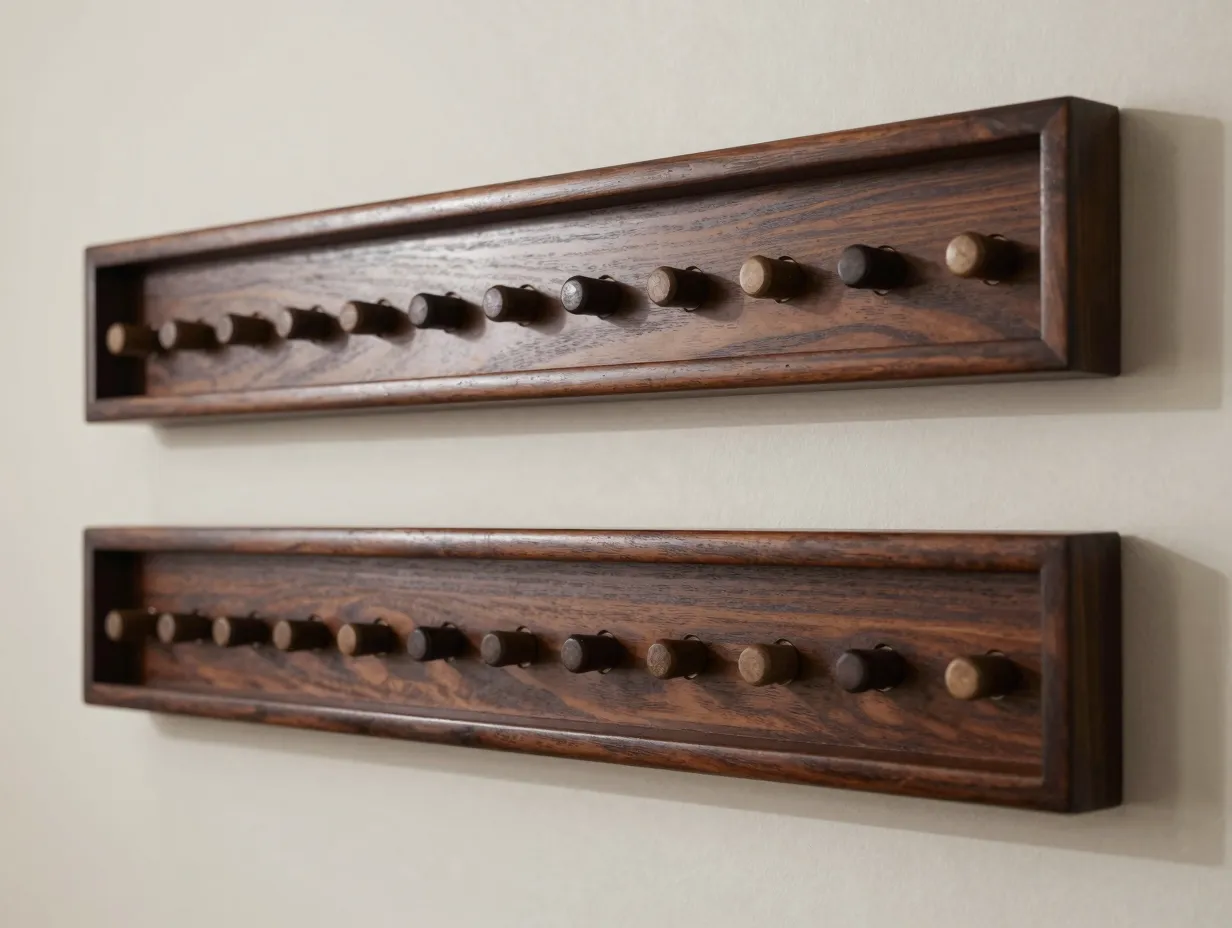
Minwax released updated DIY wooden fishing pole rack plans in February 2026, presenting a project that elevates the humble rod holder into something that belongs in a living room [5]. The design uses 1×6 boards with beveled tops, dedicated “feet,” and carefully matched upper and lower rod rails.
The construction method is clever: a 22-inch rail is drilled with evenly spaced holes, then ripped down the center on a table saw to create paired upper and lower supports that mirror each other perfectly [8]. Glued reel pegs and wooden plugs fill the gaps, delivering a clean, furniture-grade look with no exposed hardware.
Standout features:
- Beveled top edges add a refined, finished appearance
- Matching upper and lower supports create visual symmetry
- Reel pegs keep rods secure without straps or clamps
- Suitable for living areas, not just garages or sheds [8]
This design is best suited for anglers who want their rod storage to double as a display piece. Finished with Minwax stain and a polyurethane topcoat, it looks more like a piece of custom furniture than a fishing accessory.
3. The Floor-Standing Multi-Tier Lumber Rack
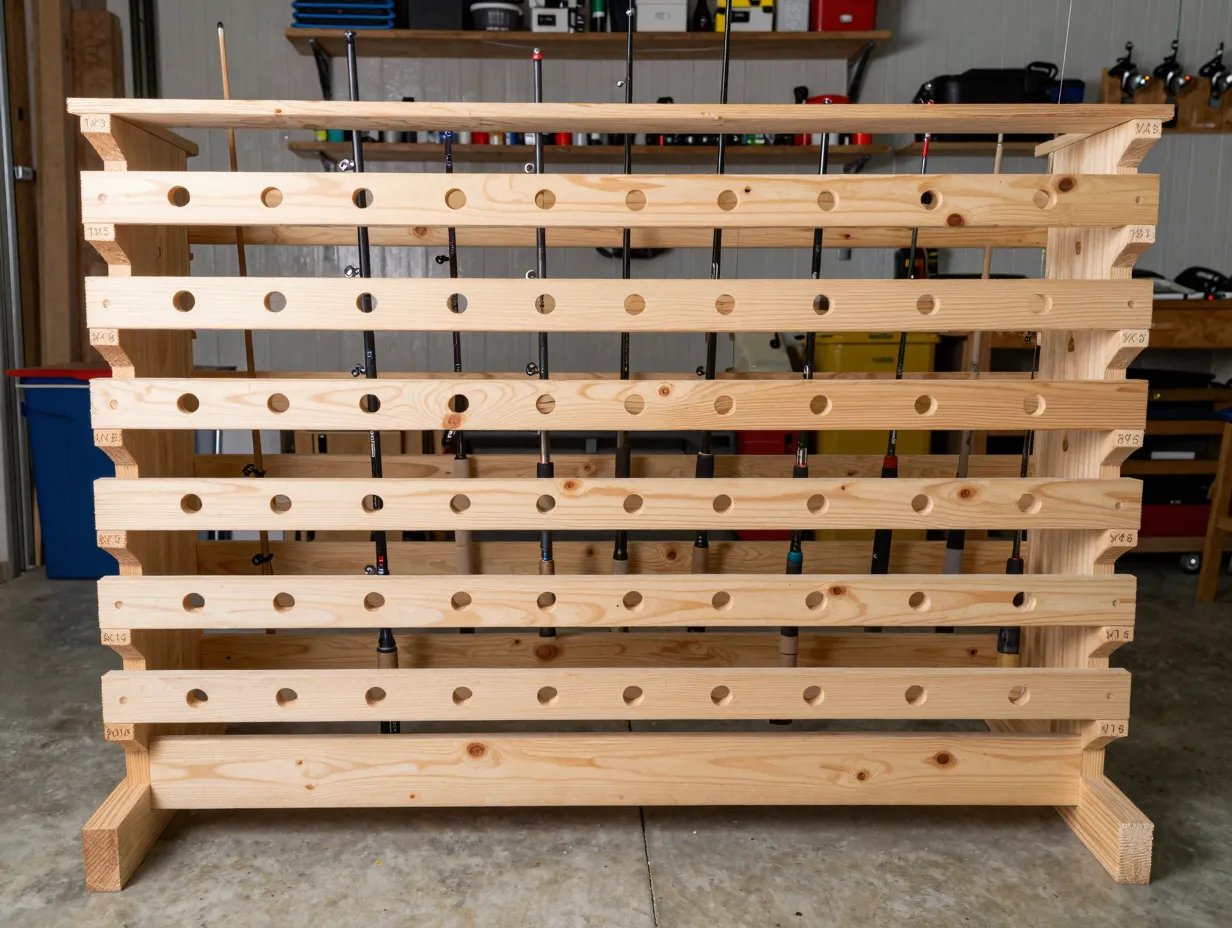
For anglers with large rod collections, a floor-standing multi-tier rack offers the highest storage capacity in the smallest footprint. A July 2026 build guide details a floor-standing wooden rod rack using common dimensional lumber, specifically 1×3, 1×4, 1×5, and 1×8 boards, cut to lengths of 30 to 34 inches to create a multi-tier structure [7].
The design uses 44 mm hole-saw openings spaced 4 inches apart center-to-center, which ensures reel handles do not collide even when the rack is fully loaded [7]. Sculpted 1-inch slots allow easy rod insertion from the top without having to thread the tip through a closed hole.
Capacity and dimensions:
| Tier Count | Approximate Rod Capacity | Recommended Board Width |
|---|---|---|
| 2 tiers | 8 to 10 rods | 1×4 or 1×5 |
| 3 tiers | 12 to 16 rods | 1×6 or 1×8 |
| 4 tiers | 18 to 24 rods | 1×8 |
The multi-tier format is especially practical for serious anglers who own rods rigged with different lures, keeping each setup ready to fish without re-rigging.
4. The Wall-Mounted Horizontal Slotted Rack
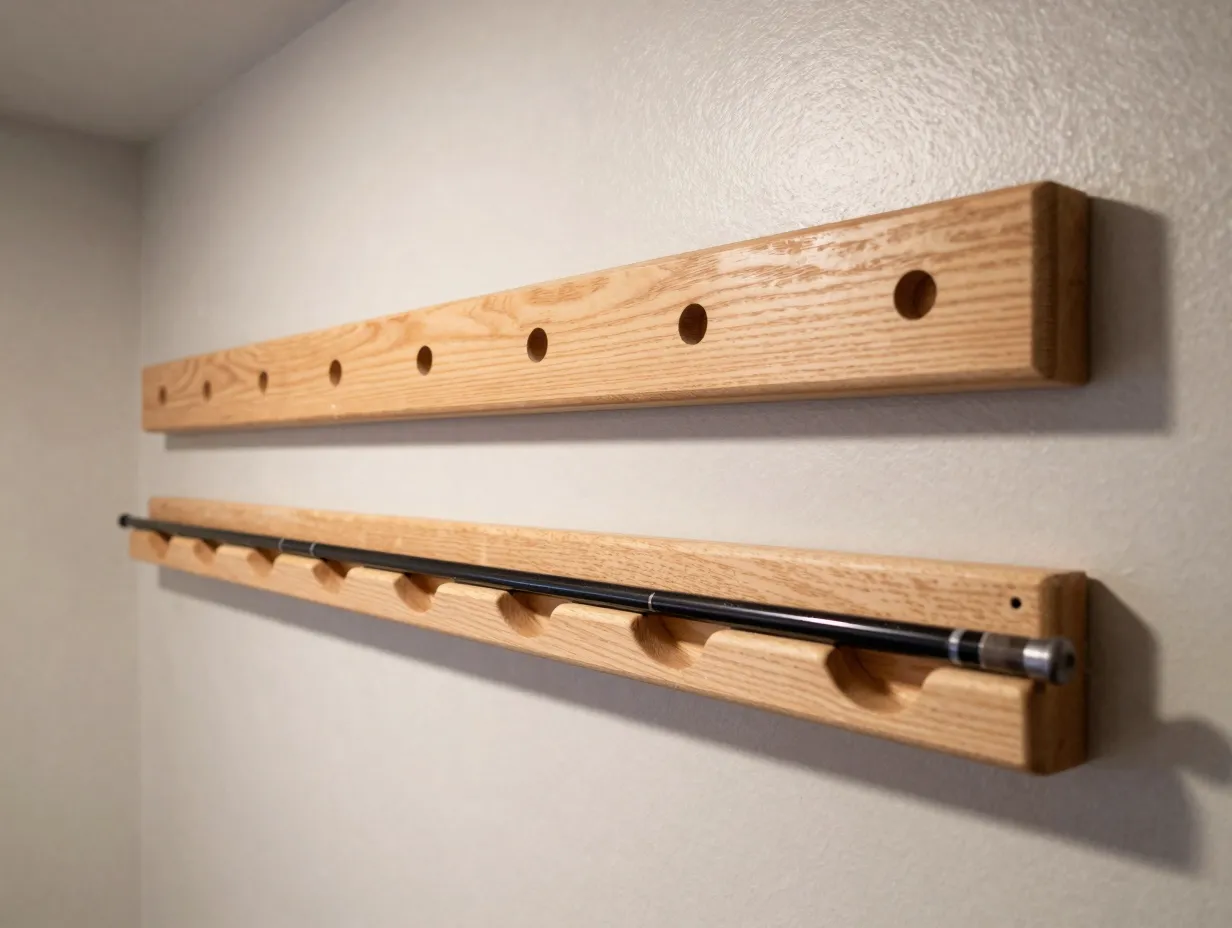
Wall-mounted designs are the most space-efficient option for small rooms, apartments, or workshops. DIY guides describe wall-mounted wooden rod holders where 1×4 boards are drilled and slotted to cradle rods horizontally along the wall [9]. The top holes typically start 3 inches from the edge and are spaced roughly 4 inches apart to prevent reels from touching [9].
The lower board features shallow routed dips or indents that support rod butts, keeping each rod at a slight downward angle so it stays in place without any additional fasteners. Careful sanding and a clear finish result in a slim, visually clean rack that keeps rods off the floor while highlighting the natural wood grain.
Why this design works well:
- Uses minimal floor space
- Keeps rods visible and accessible
- Easy to install with standard wall anchors or studs
- Can be extended by adding more boards side by side [9]
This is the go-to design for anyone who wants organized storage in a fishing room, mudroom, or garage without sacrificing square footage.
5. The Modular Plywood Rack
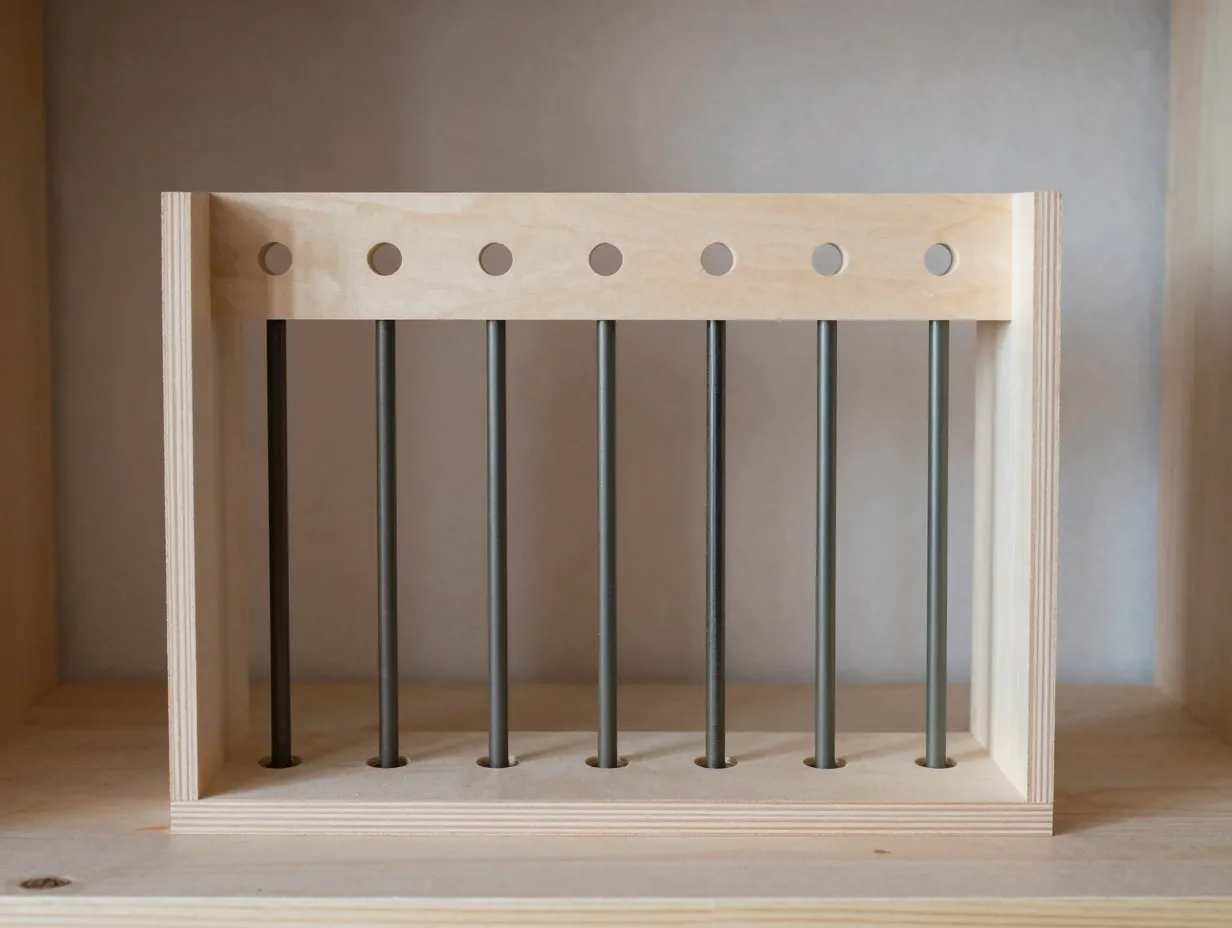
Instructables projects updated in March 2026 showcase multi-rod wooden storage racks built from plywood or dimensional lumber with carefully spaced holes and slots for up to a dozen rods [10]. The key advantage of plywood is its dimensional stability, it does not warp or twist the way solid pine can in humid environments like boathouses or lakeside cabins.
Modular plywood racks are designed to scale. Builders can adjust the length of each board and the number of holes to match their exact rod count [10]. The most popular configurations hold 8, 10, or 12 rods. Finishing with a sanded clear coat or a penetrating oil stain creates an attractive rack suitable for display in a fishing room or cabin.
Recommended plywood grades:
- Birch plywood (Baltic birch): Smooth face, minimal voids, takes stain evenly
- Oak plywood: Strong grain pattern, excellent for natural finishes
- Pine plywood (AC grade): Budget-friendly, works well with paint or solid-color stain
The modular nature of this design makes it one of the most practical on this list for anglers whose collections grow over time.
6. The Hybrid Wood-and-PVC Ceiling Mount
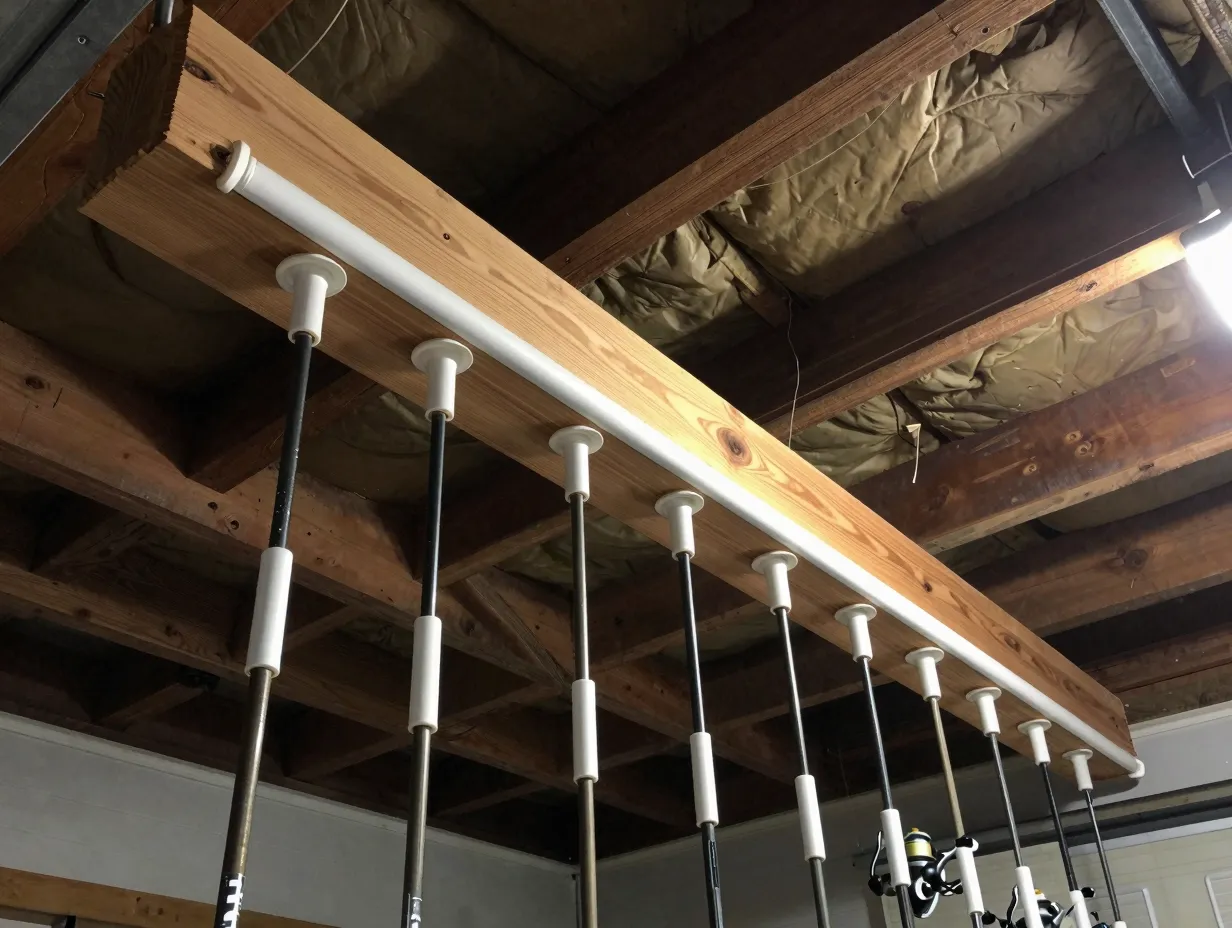
Ceiling-mounted rod storage is an underused solution that keeps rods completely out of the way while protecting them from accidental damage. Expert fishing outlets recommend wood-backed racks with PVC or pipe inserts as a hybrid solution that combines the warm look of wood rails with the durability of plastic tubes [4].
The Fisherman’s ceiling-mounted design uses wooden rails with evenly spaced PVC tubes cut to 4 to 5 inches in length [4]. The tubes are glued or screwed into drilled holes in the wooden rail, creating individual sleeves that hold rod tips or butts securely. The wooden rail is then screwed directly into ceiling joists.
Advantages of the hybrid approach:
- PVC tubes protect rod tips from abrasion
- Wood rails provide structural rigidity and visual warmth
- Ceiling placement frees up wall and floor space entirely
- Works well in garages, workshops, and boathouses
This design requires a ceiling height of at least 8 feet to allow comfortable rod insertion and removal, making it best suited for garages or dedicated fishing rooms.
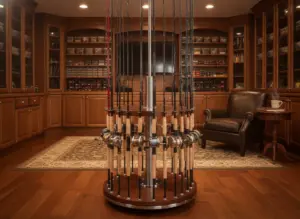
7. The Rotating Carousel Stand
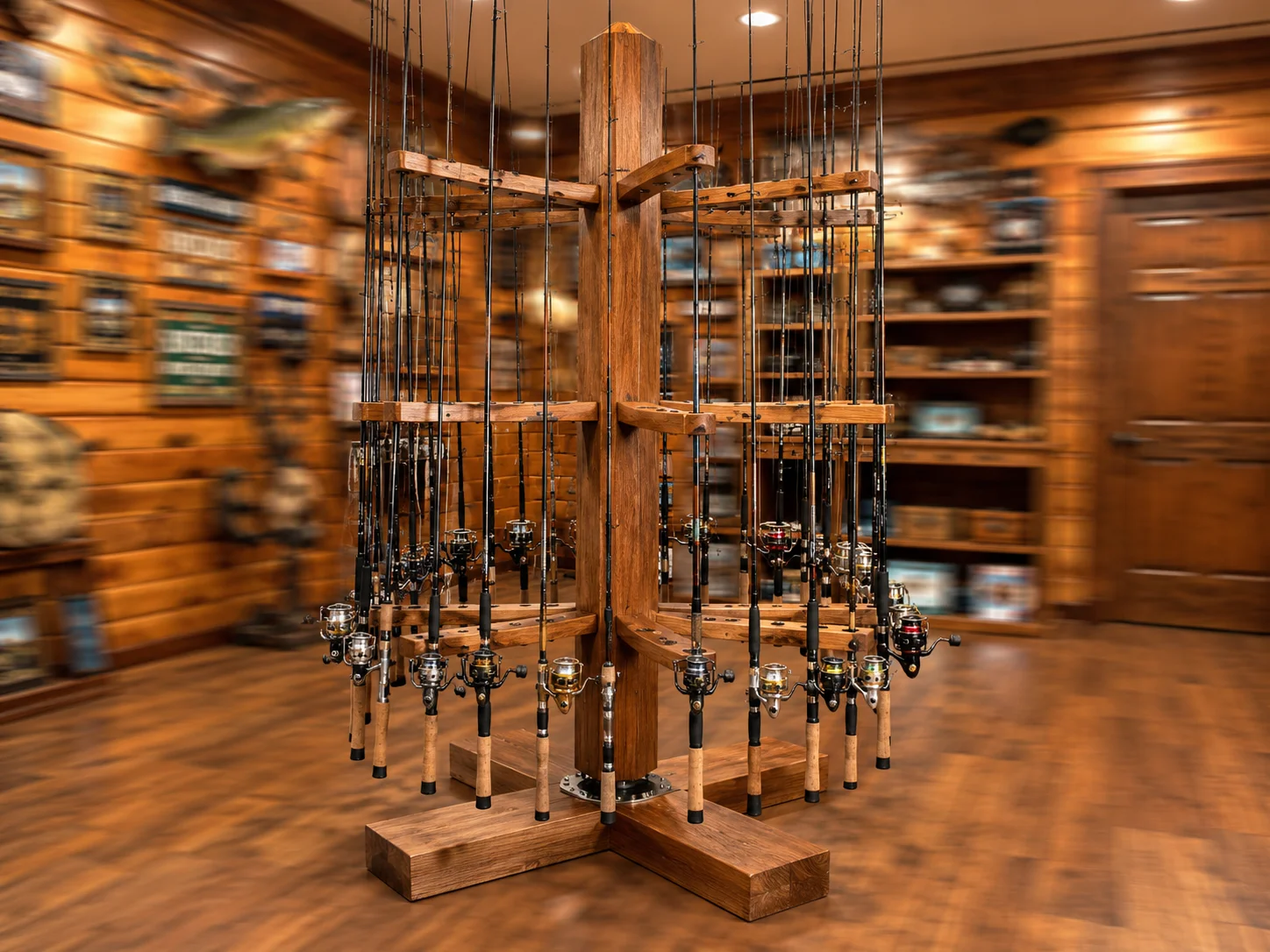
A rotating carousel stand brings a completely different approach to rod organization. Rather than fixed rails or wall mounts, this design uses a central vertical post with radiating wooden arms at two or three heights, allowing the entire unit to spin so any rod is reachable without moving others.
The construction uses a heavy base (often a thick cross of 2×6 boards) to prevent tipping, a central 4×4 post, and horizontal 1×4 or 1×6 arms drilled with rod holes at regular intervals. The post sits in a simple lazy-Susan bearing at the base, enabling smooth rotation.
Best materials for a carousel stand:
- Base: 2×6 pine or oak for stability
- Post: 4×4 cedar or pressure-treated pine
- Arms: 1×4 or 1×6 hardwood (oak or maple preferred for durability)
- Bearing: Standard 12-inch lazy-Susan hardware
This design suits collectors who own 16 or more rods and want every one accessible without digging through a rack. The visual impact is significant, a well-finished rotating carousel in a fishing cabin becomes a conversation piece as much as a storage solution.
8. The Ladder-Style Leaner Rack
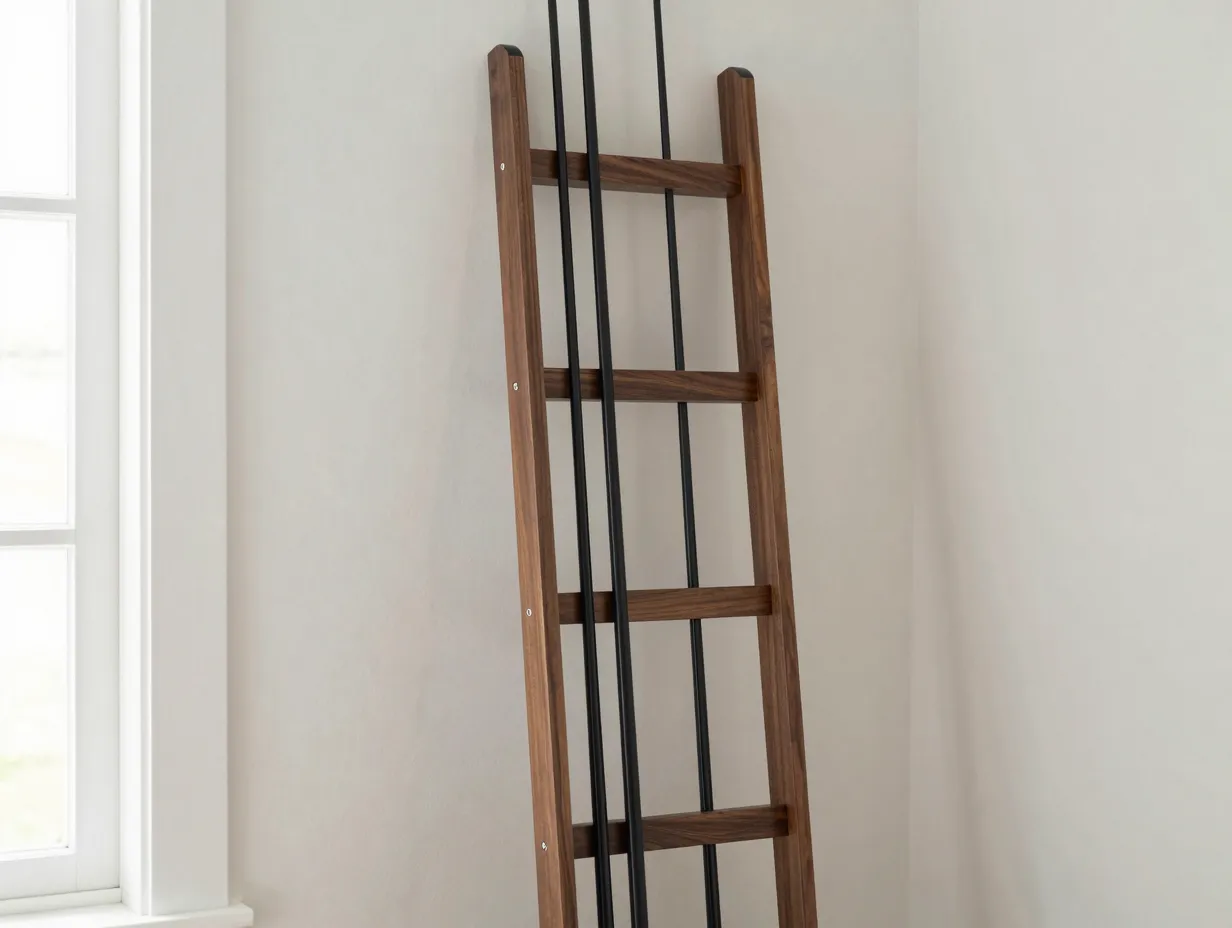
The ladder-style leaner is one of the most visually distinctive of the 8 beautiful and functional wooden fishing rod holder designs for your gear. It requires no wall anchors, no ceiling hardware, and no permanent installation, making it ideal for renters, vacation cabins, or anyone who wants a portable solution.
The design mimics a decorative ladder: two long vertical rails connected by four to six horizontal rungs, with each rung drilled or slotted to hold rods. The rack leans against a wall at a slight angle, held in place by gravity and the weight of the rods themselves.
Construction notes:
- Rails: 1×3 or 1×4 boards, 60 to 72 inches long
- Rungs: 1×3 boards, 18 to 24 inches wide
- Joinery: Pocket screws or mortise-and-tenon for a cleaner look
- Finish: Natural oil or wax finish to highlight wood grain
The ladder-style leaner holds 8 to 12 rods comfortably and can be moved from room to room or taken to a vacation property without tools. When finished in a dark walnut or ebony stain, it looks more like modern home decor than fishing gear storage.
Choosing the Right Wood Species for Your Rod Holder
The choice of wood species affects durability, appearance, workability, and cost. The table below summarizes the most commonly used options.
| Wood Species | Durability | Ease of Working | Best Finish | Relative Cost |
|---|---|---|---|---|
| Pine | Moderate | Very easy | Stain or paint | Low |
| Cedar | Good | Easy | Natural oil | Low-moderate |
| Oak | High | Moderate | Stain or poly | Moderate |
| Maple | Very high | Moderate | Clear coat | Moderate-high |
| Walnut | Very high | Moderate | Oil or wax | High |
| Birch plywood | High | Easy | Stain or paint | Low-moderate |
For most beginner projects, pine or cedar provides the best balance of cost, workability, and appearance. For a furniture-grade holder intended for a living area, oak or walnut delivers a premium result.
Finishing Techniques That Elevate Any Wooden Rod Holder
Finishing is where a good rod holder becomes a great one. The right finish protects the wood from moisture, rod oils, and handling wear, while also bringing out the natural beauty of the grain.
Common finishing options:
- Penetrating oil (tung oil or Danish oil): Soaks into the wood fibers, enhances grain depth, and provides moderate moisture resistance. Best for natural, low-sheen looks.
- Polyurethane varnish: Creates a hard, durable surface film. Available in matte, satin, and gloss sheens. Excellent for high-humidity environments like boathouses.
- Water-based clear coat: Fast-drying, low odor, and non-yellowing. Ideal for light-colored woods like maple or birch where an amber tone would be unwanted.
- Wood stain plus topcoat: Staining before applying a clear topcoat allows the builder to match the rack to existing furniture or cabinetry. Minwax’s beginner plan specifically recommends this two-step approach for a furniture-grade result [5].
- Wax finish: The softest option, offering minimal protection but a beautiful hand-rubbed luster. Best for indoor display racks in dry environments.
Always sand to at least 150 grit before finishing, and finish with 220 grit between coats for the smoothest possible surface.
Essential Tools and Safety Tips for Building Wooden Rod Holders
Most of the designs covered in this guide require only a modest set of tools. Here is what a builder needs to complete any of the eight designs above.
Basic tool list:
- Circular saw or miter saw for crosscuts
- Drill press or handheld drill with a drill guide
- Hole saw set (including 44 mm and 38 mm sizes)
- Jigsaw for cutting rod slots
- Random orbital sander
- Tape measure, square, and marking pencil
- Clamps (at least four)
Safety reminders:
- Always wear safety glasses when drilling or cutting
- Secure boards with clamps before drilling, never hold a board by hand under a drill press
- Sand in a well-ventilated area or wear a dust mask
- Apply finishes in ventilated spaces and away from open flames
Wood Projects for Beginners resources note that even simple rod rack plans benefit from a careful dry-fit before any glue or fasteners are applied, which catches spacing errors before they become permanent [2].
Comparing the 8 Designs at a Glance
| Design | Skill Level | Rod Capacity | Space Required | Best Setting |
|---|---|---|---|---|
| 1. Six-Board Pine Rack | Beginner | 6 to 8 | Small | Garage, cabin |
| 2. Minwax Beveled Rack | Beginner-Intermediate | 8 to 12 | Small | Living room, cabin |
| 3. Floor-Standing Multi-Tier | Intermediate | 12 to 24 | Medium | Garage, fishing room |
| 4. Wall-Mounted Horizontal | Beginner | 8 to 16 | Minimal (wall only) | Any room |
| 5. Modular Plywood Rack | Intermediate | 8 to 12 | Small-medium | Boathouse, cabin |
| 6. Hybrid Wood-and-PVC Ceiling | Intermediate | 10 to 20 | Ceiling space | Garage, workshop |
| 7. Rotating Carousel Stand | Advanced | 16 to 24 | Medium | Fishing room, cabin |
| 8. Ladder-Style Leaner | Beginner | 8 to 12 | Minimal | Any room, portable |
Conclusion
The 8 beautiful and functional wooden fishing rod holder designs for your gear covered in this guide prove that rod storage does not have to be an afterthought. From the beginner-friendly six-board pine rack to the rotating carousel stand built for serious collectors, each design offers a practical solution that also adds visual character to any space.
Actionable next steps:
- Assess the rod collection, count the rods and measure the available wall, floor, or ceiling space before choosing a design.
- Select a design from the eight options above that matches the available skill level, tools, and space.
- Download free or low-cost plans from verified sources such as Scout Life [1], Minwax [5], WoodworkersWorkshop [6], or Instructables [10].
- Choose a wood species based on the intended setting, pine for a garage, oak or walnut for a living area.
- Finish the project with at least two coats of the appropriate topcoat to protect the wood and showcase the grain.
- Mount or place the finished rack and organize rods by type, length, or intended use for maximum efficiency.
A handmade wooden rod holder is one of the most satisfying weekend projects an angler can undertake, it protects an expensive collection, looks far better than any commercial alternative, and takes only a few hours to build with basic tools.
References
[1] Build A Fishing Rod Rack – https://fishing.scoutlife.org/build-a-fishing-rod-rack/
[2] Wood Projects For Beginners Fishing Rod Rack Plans 003277 – https://www.wwgoa.com/video/wood-projects-for-beginners-fishing-rod-rack-plans-003277
[4] How To Build A Rod Rack – https://www.thefisherman.com/article/how-to-build-a-rod-rack/
[5] Diy Fishing Pole Rack Plans – https://www.minwax.com/en/woodworking-project-inspiration/woodworking-project-inspiration/accessories/diy-fishing-pole-rack-plans
[6] Fishing – https://woodworkersworkshop.com/ResourcesPage/fishing
[7] How To Make Fishing Rod Rack – https://rackreview.blog/how-to-make-fishing-rod-rack/
[8] Minwax Beginner Project Fishing Pole Rack – https://www.minwax.com/content/dam/cbg-minwax/woodworking-project-inspiration/pdfs/minwax-beginner-project-fishing-pole-rack.pdf
[9] Diy Fishing Rod Holder – https://www.diycraftsy.com/diy-fishing-rod-holder/
[10] The Fishing Rod Storage Rack – https://www.instructables.com/The-Fishing-Rod-Storage-Rack/