9 Life Hacks That Will Upgrade Your Core Survival Skills Instantly
Only 17 percent of adults can correctly perform basic wilderness first aid, yet the average person spends over 90 nights per year in environments where a single wrong decision could become life-threatening. Whether that is a remote hiking trail, a sudden urban blackout, or a vehicle breakdown on a desolate highway, the gap between safety and danger often comes down to a handful of practiced skills. This guide on 9 Life Hacks That Will Upgrade Your Core Survival Skills Instantly is designed to close that gap fast, using practical, science-backed techniques that anyone can learn and apply without expensive gear or years of training.
Disclosure: This post contains affiliate links. As an Amazon Associate, we earn from qualifying purchases, and at no extra cost to you.
Key Takeaways
- Mastering a small set of core survival skills dramatically increases your odds of staying safe in any emergency scenario.
- Most of these techniques require minimal or no specialized equipment and can be practiced at home.
- Mental discipline and situational awareness are just as important as physical tools.
- Prioritizing water, shelter, and signaling over all other concerns follows the proven survival rule of threes.
- Regular, deliberate practice of these hacks turns theoretical knowledge into reliable muscle memory.
Why These 9 Life Hacks That Will Upgrade Your Core Survival Skills Instantly Actually Work
Survival training has traditionally been locked behind military academies, expensive wilderness courses, or dense technical manuals. The reality is that most life-threatening situations share a predictable pattern: they escalate quickly, they exploit gaps in basic knowledge, and they punish panic. The nine hacks outlined here are drawn from wilderness survival doctrine, urban emergency preparedness research, and field-tested techniques used by search-and-rescue professionals.
Each hack targets a specific vulnerability in the average person’s survival readiness. Together, they form a layered defense system that addresses the body’s most urgent needs in any crisis: staying warm, finding water, signaling for help, navigating terrain, and maintaining the mental clarity to make good decisions under pressure.
“Survival is 90 percent mental and 10 percent equipment. The hacks that change outcomes fastest are the ones that rewire how you think under stress.”
The 9 Life Hacks That Will Upgrade Your Core Survival Skills Instantly
1. Master the Rule of Threes to Prioritize Correctly
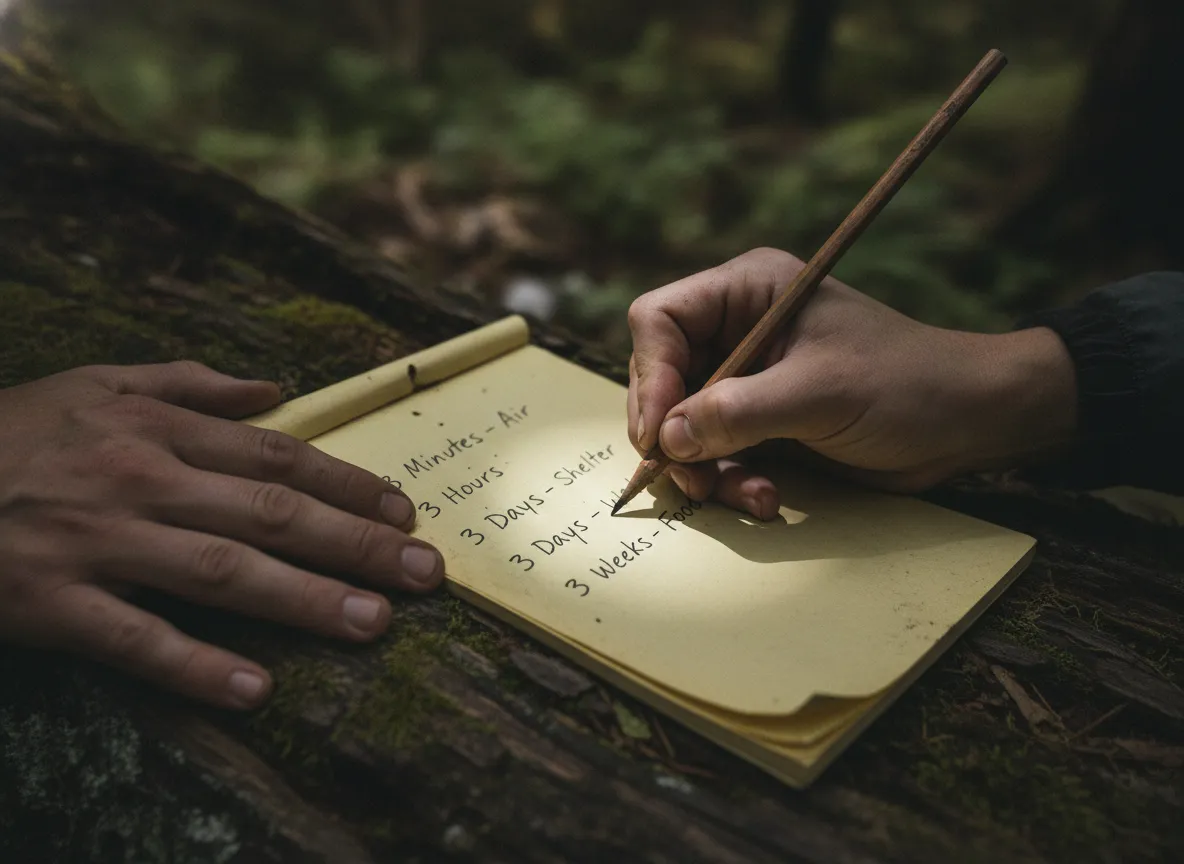
The single most dangerous mistake in a survival situation is spending energy on the wrong problem. The Rule of Threes is a decision-making framework used by military survival instructors worldwide:
- A person can survive approximately 3 minutes without air or in icy water.
- A person can survive approximately 3 hours without shelter in harsh weather.
- A person can survive approximately 3 days without water.
- A person can survive approximately 3 weeks without food.
The hack: Memorize this sequence and recite it the moment any emergency begins. It immediately tells you what to fix first. Most untrained people instinctively prioritize food, which is almost never the correct first move. Shelter and warmth consistently save more lives than any other single action in wilderness emergencies.
Practice tip: Run through the rule mentally during everyday commutes until the sequence becomes automatic. The goal is zero hesitation when stress is high.
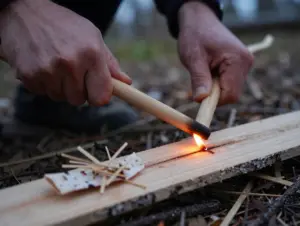
2. Build a Fire Using a Single Match with the Feather Stick Method
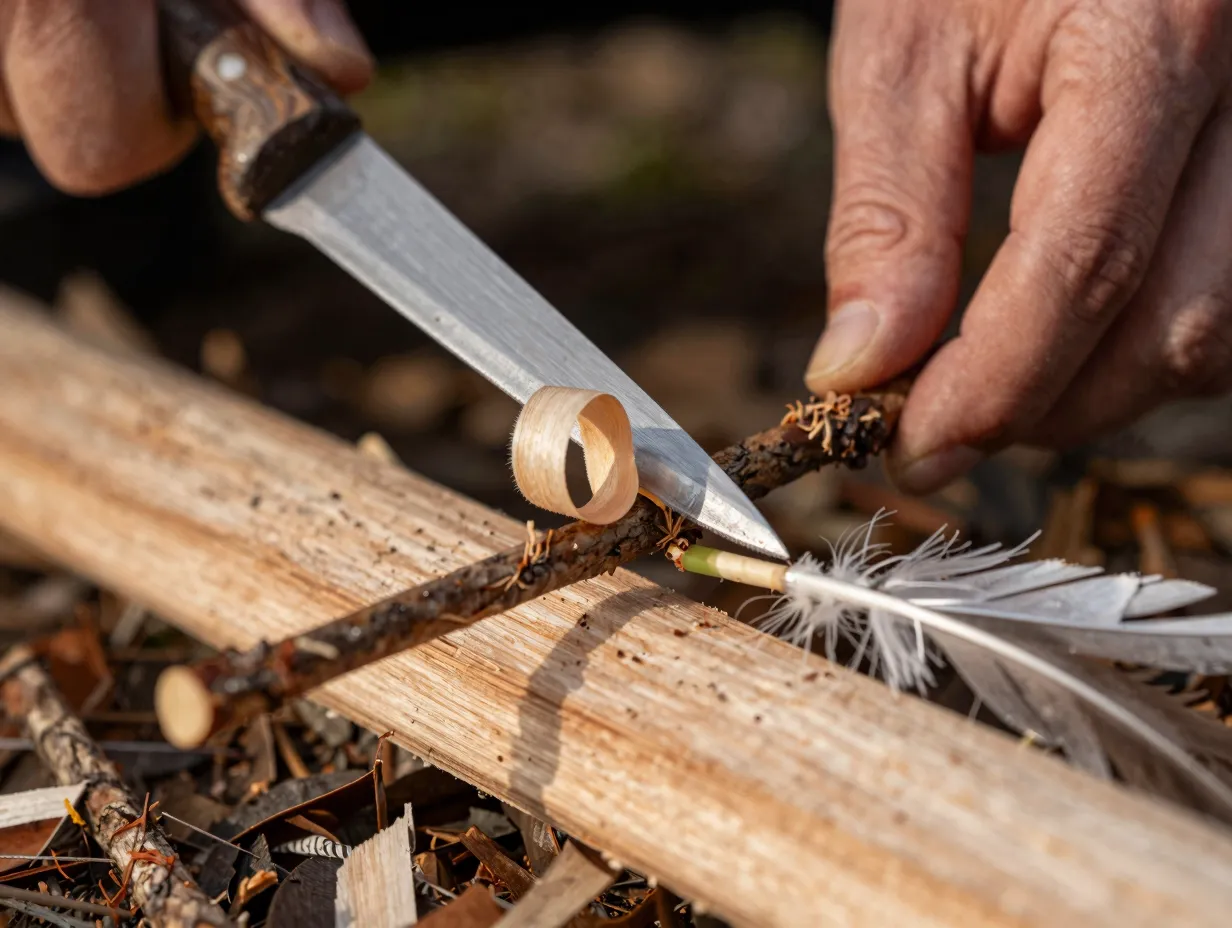
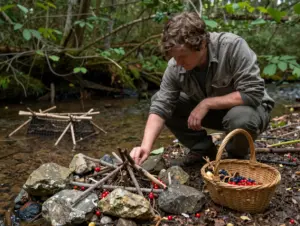
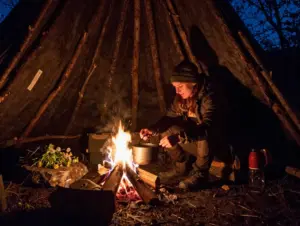
Fire provides warmth, water purification, signaling smoke, psychological comfort, and protection from insects and predators. The feather stick method dramatically increases fire-starting success in damp conditions.
How it works:
- Find a dry stick roughly the diameter of a thumb and 30 centimeters long.
- Use a knife or sharp rock to shave thin curls along the stick without fully detaching them, creating a “feathered” texture.
- Stack three to five feather sticks in a small teepee formation.
- Place a single lit match or spark at the base.
The curled wood shavings catch a flame far more reliably than flat tinder because they expose maximum surface area to the ignition source. This technique works even when surrounding wood is slightly damp because the inner wood of a stick is almost always drier than its exterior.
Upgrade: Carry a ferro rod instead of matches. A ferro rod produces sparks at approximately 3,000 degrees Celsius and functions when wet, making it far more reliable than standard lighters in cold or rainy conditions.
3. Locate Water Using Terrain Reading
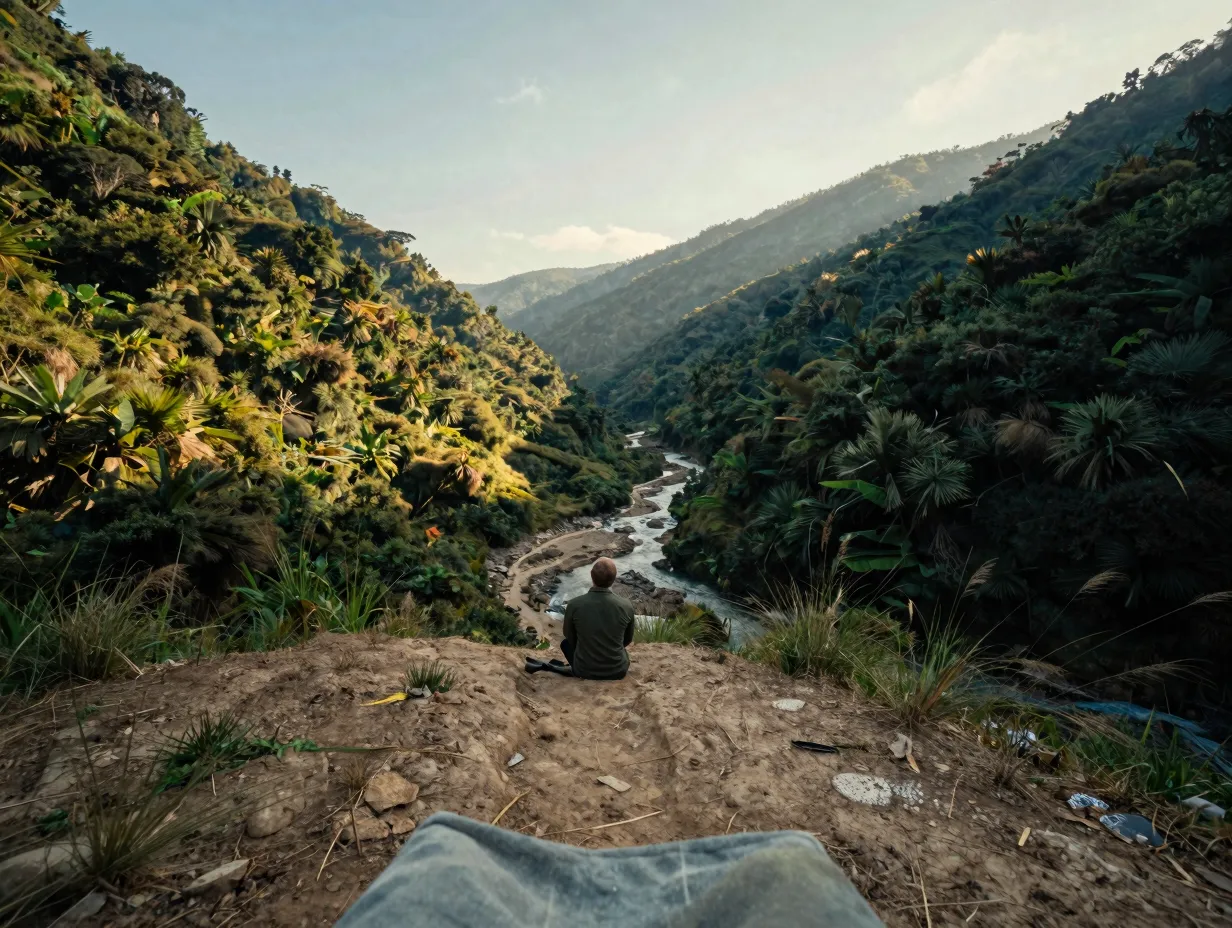
Dehydration impairs cognitive function within hours, making it one of the fastest-acting threats in a survival scenario. Knowing how to read terrain for water sources is a skill that requires no equipment.
Key terrain indicators of nearby water:
| Indicator | What It Means |
|---|---|
| Converging valleys | Water flows downhill and collects at low points |
| Dense green vegetation | Plants cluster around moisture-rich ground |
| Animal trails converging | Animals follow water sources consistently |
| Dry riverbeds | May have water just below the surface |
| Morning dew on leaves | Can be collected with a cloth or clothing |
The hack: Always move downhill when searching for water. Gravity does the work. Follow animal trails, especially those made by birds at dawn and dusk, as birds typically fly toward water sources in the morning and away from them in the evening.
Critical safety note: Always purify found water before drinking. Boiling for at least one minute kills the vast majority of biological contaminants. A portable water filter straw, which weighs under 60 grams, is one of the highest-value items anyone can carry in a day pack.
4. Construct an Emergency Debris Shelter in Under an Hour
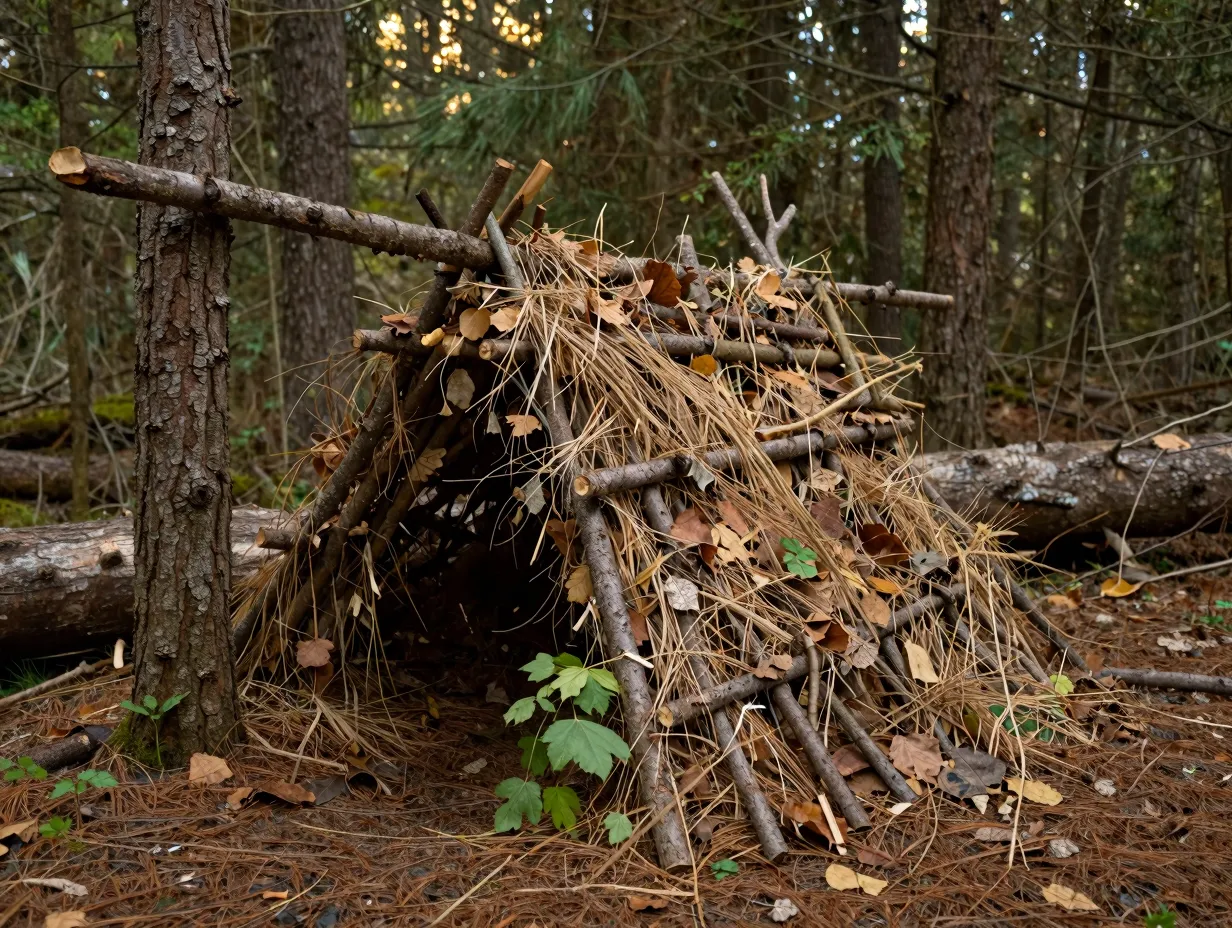
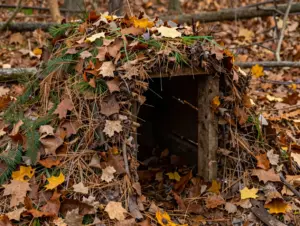
Hypothermia is responsible for more wilderness deaths than any other single cause. A well-built debris shelter can retain enough body heat to keep a person alive through a freezing night with no sleeping bag or blanket.
The debris hut method:
- Find a large fallen log or prop a sturdy branch against a tree fork to create a ridgepole roughly 2.5 meters long.
- Lean smaller branches along both sides to form a ribcage shape.
- Pile leaves, pine needles, bark, and dry grass over the frame until the layer is at least 60 centimeters thick on all sides.
- Stuff the interior with dry leaves for insulation.
- Block the entrance with a large bundle of leaves or a backpack.
The hack: The interior of a properly built debris hut should be just large enough to fit one body. A smaller space retains heat dramatically better than a larger one. Think of it as a sleeping bag made from the forest floor.
5. Use a Shadow Stick Compass for Navigation Without a Compass
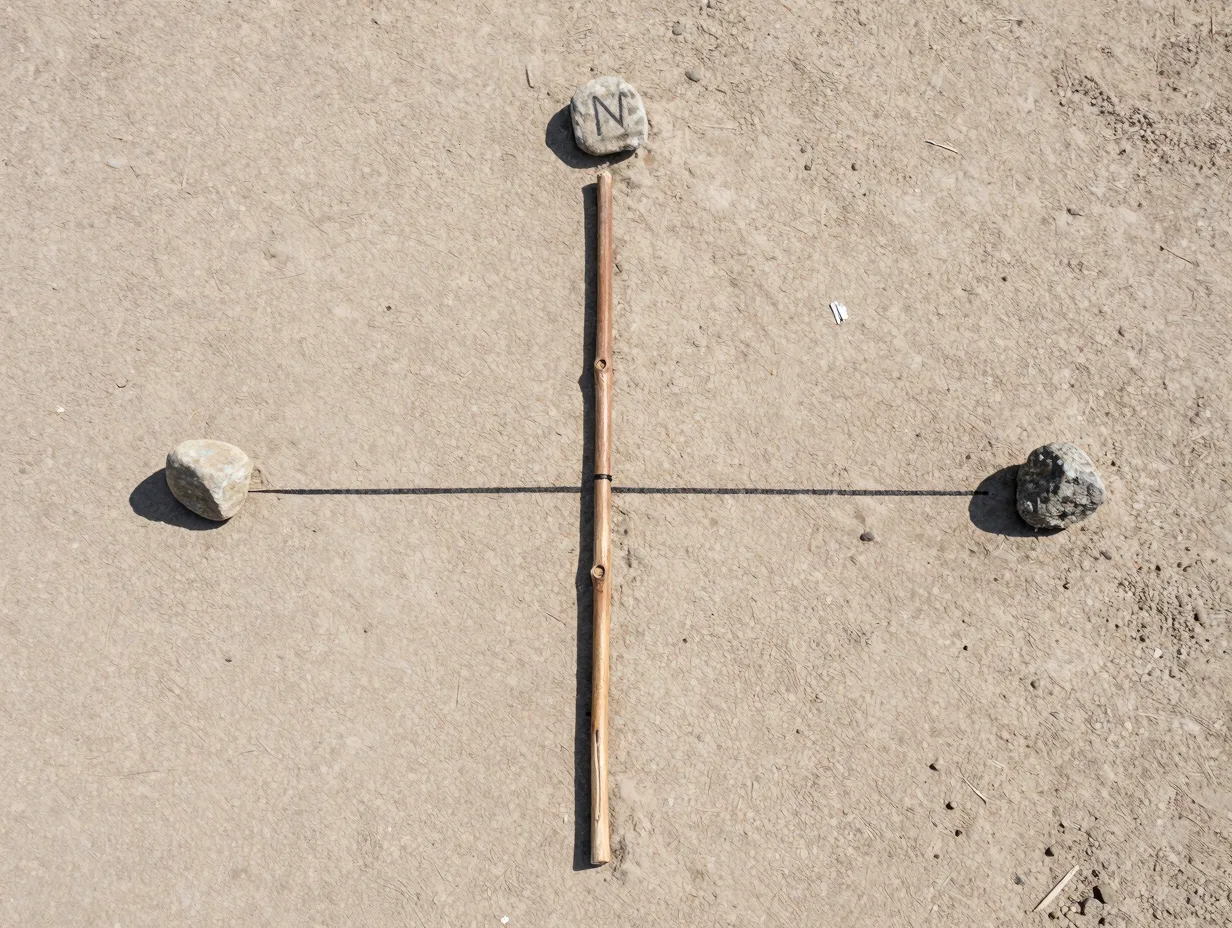
GPS devices fail. Phone batteries die. A shadow stick compass requires only sunlight and two small sticks.
Step-by-step method:
- Push a straight stick, roughly 30 centimeters long, vertically into flat ground.
- Mark the tip of the shadow with a small stone or stick. This is the West marker in the Northern Hemisphere.
- Wait 15 to 20 minutes. Mark the new shadow tip. This is the East marker.
- Draw a line between the two marks. This is your East-West line.
- Stand with the first mark (West) to your left. You are now facing North.
This method works because the sun moves from east to west, causing shadows to move in the opposite direction. It functions anywhere in the world with minor adjustments near the equator.
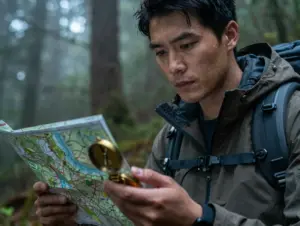
Upgrade: Combine this technique with basic map reading. Knowing cardinal directions allows navigation by landmark triangulation even without a detailed topographic map.
6. Signal for Rescue Using the Rule of Three
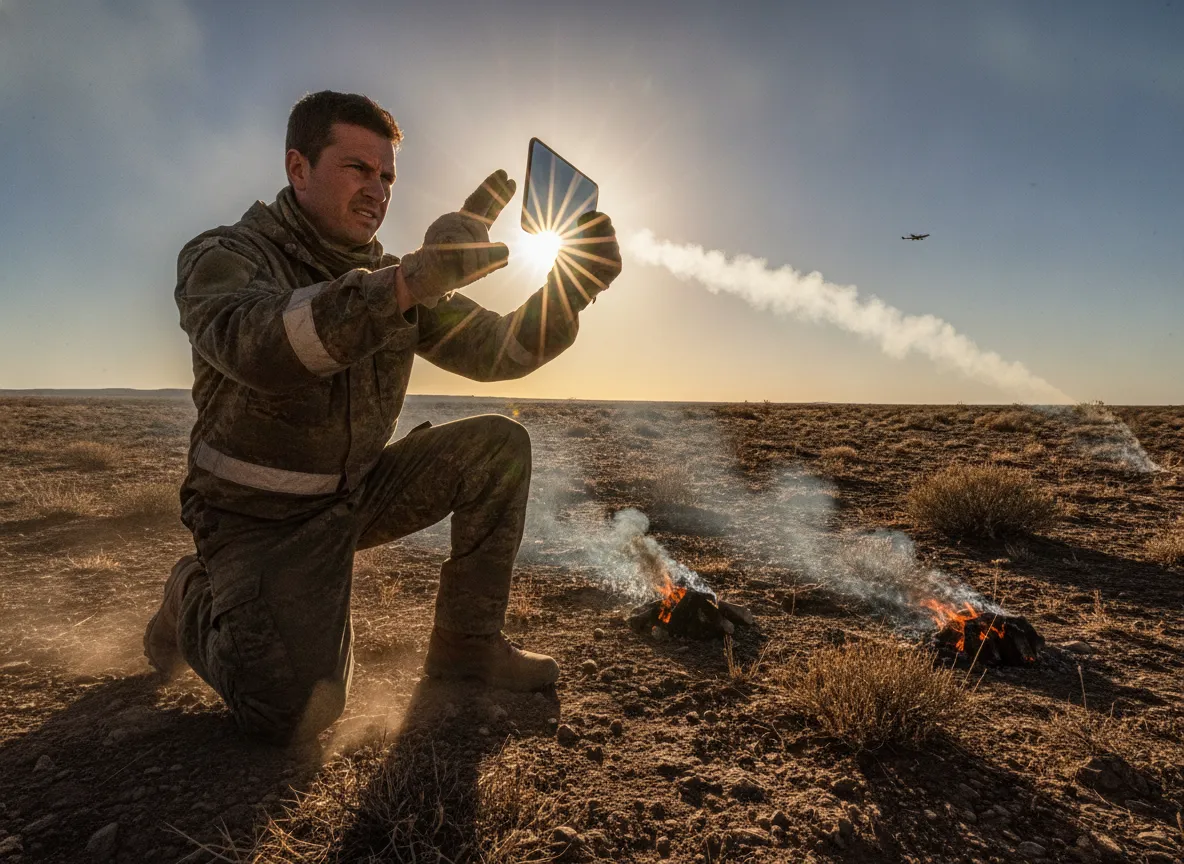
Rescuers are trained to look for patterns that do not occur naturally. Three of anything, three fires in a triangle, three whistle blasts, three gunshots, is the universally recognized distress signal.
High-visibility signaling hacks:
- Mirror signaling: A standard pocket mirror can reflect sunlight visible to aircraft up to 16 kilometers away. Aim the reflection by holding two fingers in a V-shape toward the target and flashing the light through the gap.
- Ground-to-air signals: Stamp large symbols in snow, sand, or clear ground. An X means “need medical assistance.” A V means “need help.” Use rocks, logs, or clothing to increase contrast.
- Whistle over voice: A whistle carries three to four times farther than a human shout and requires a fraction of the energy. Three short blasts, pause, repeat.
The hack: Always carry a signal mirror and a pealess whistle in any outdoor kit. Both weigh under 30 grams combined and have an indefinite shelf life.
7. Purify Water with Improvised Filtration
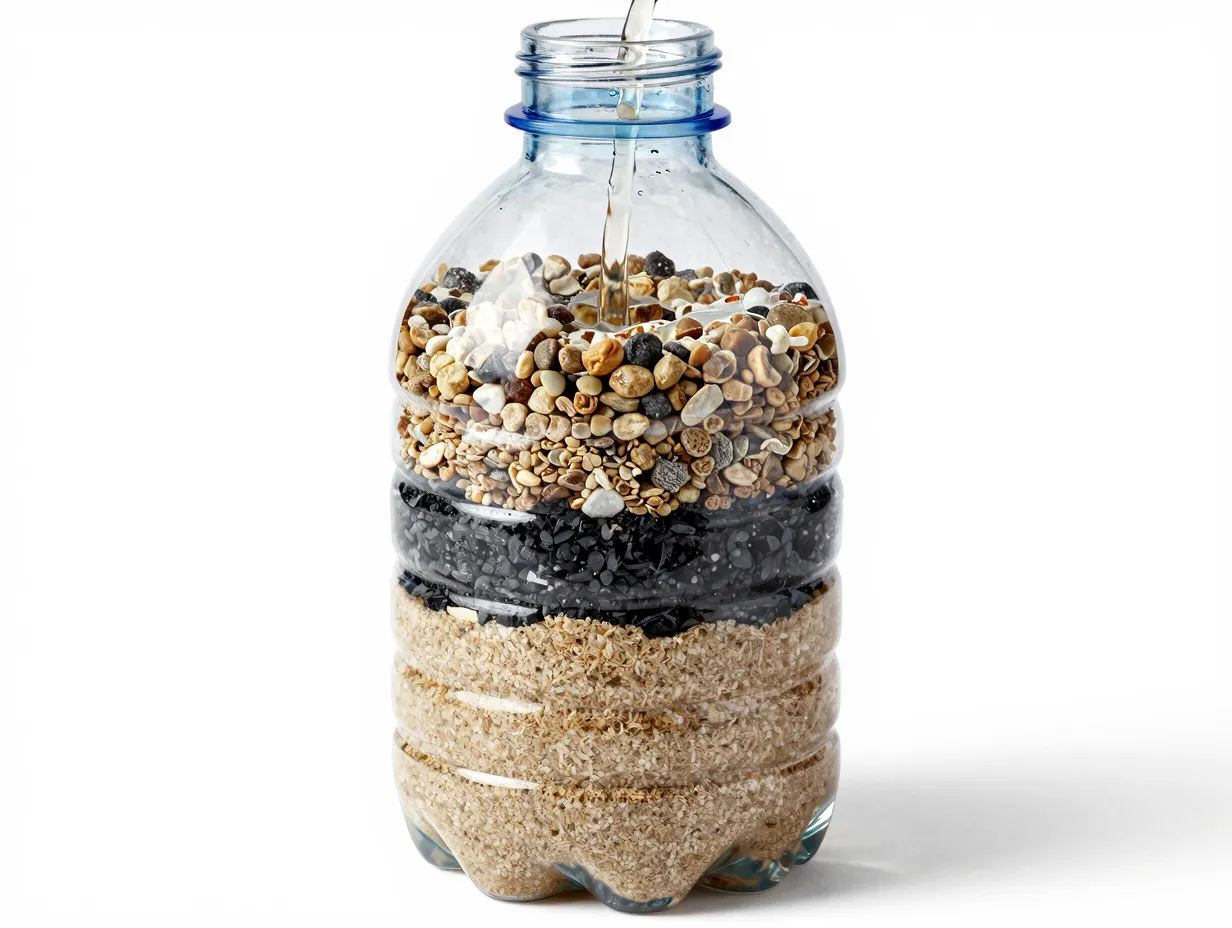
When boiling is not possible and no commercial filter is available, a multi-stage improvised filter significantly reduces contaminants and makes water safer to drink.
How to build a field filter:
- Cut the bottom off a plastic bottle or use a sock, bandana, or hollow bamboo segment as a container.
- Layer the following from top to bottom: coarse gravel, fine sand, crushed charcoal from a fire (not ash), fine sand again, and a cloth layer at the outlet.
- Pour water through slowly and collect the output.
Important: This method removes sediment and some biological material but does not eliminate all pathogens. Combine with boiling or chemical treatment (iodine tablets) whenever possible for maximum safety.
The hack: Charcoal from a campfire is a surprisingly effective natural filter medium. It adsorbs many organic compounds, improves taste, and reduces some chemical contaminants. It is not activated charcoal, but in a genuine emergency, it performs meaningfully better than no filtration at all.
8. Apply Pressure Bandaging for Wound Control Without a First Aid Kit
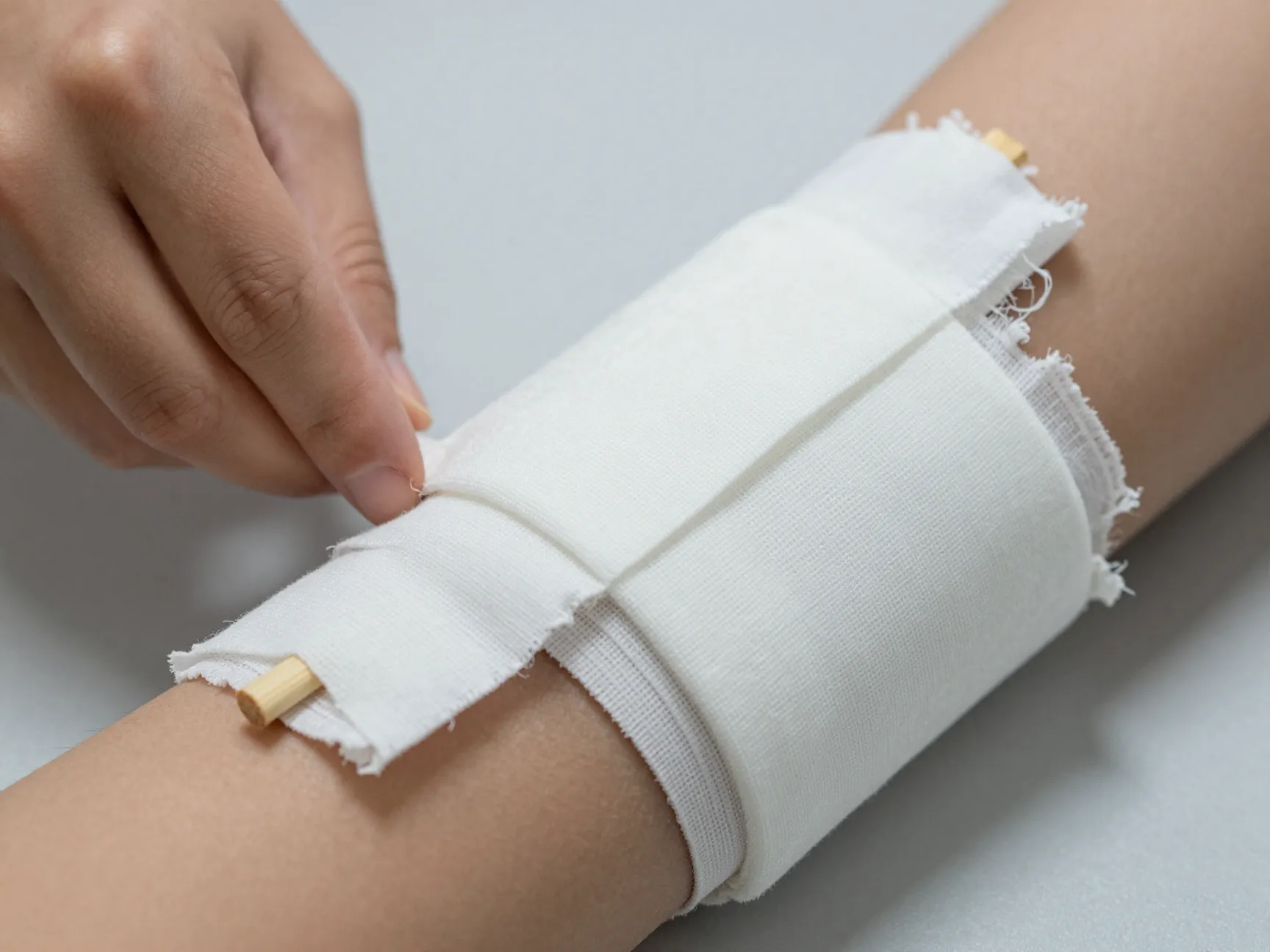
Uncontrolled bleeding is one of the leading causes of preventable death in trauma situations. Professional tourniquet and pressure bandaging techniques can be replicated with everyday clothing.
The improvised pressure bandage method:
- Use the cleanest available fabric, a shirt, scarf, or bandana.
- Fold it into a thick pad and press it firmly and directly onto the wound.
- Maintain continuous, firm pressure for a minimum of 10 minutes without lifting to check.
- Secure the pad with a second strip of fabric tied tightly around the limb or torso.
- For limb wounds with arterial bleeding, apply an improvised tourniquet two to three centimeters above the wound and tighten until bleeding stops, then mark the time of application.
The hack: Most people instinctively lift the bandage to check progress, which disrupts clot formation. Resist this impulse. Consistent pressure for a full 10 minutes is more effective than repeated checking. If blood soaks through, add more material on top rather than removing the original pad.
Critical reminder: Tourniquets save lives in severe limb bleeding scenarios. The old guidance against tourniquets has been revised by modern trauma medicine, which now recommends their use in life-threatening limb hemorrhage.
9. Build Mental Resilience with the STOP Protocol
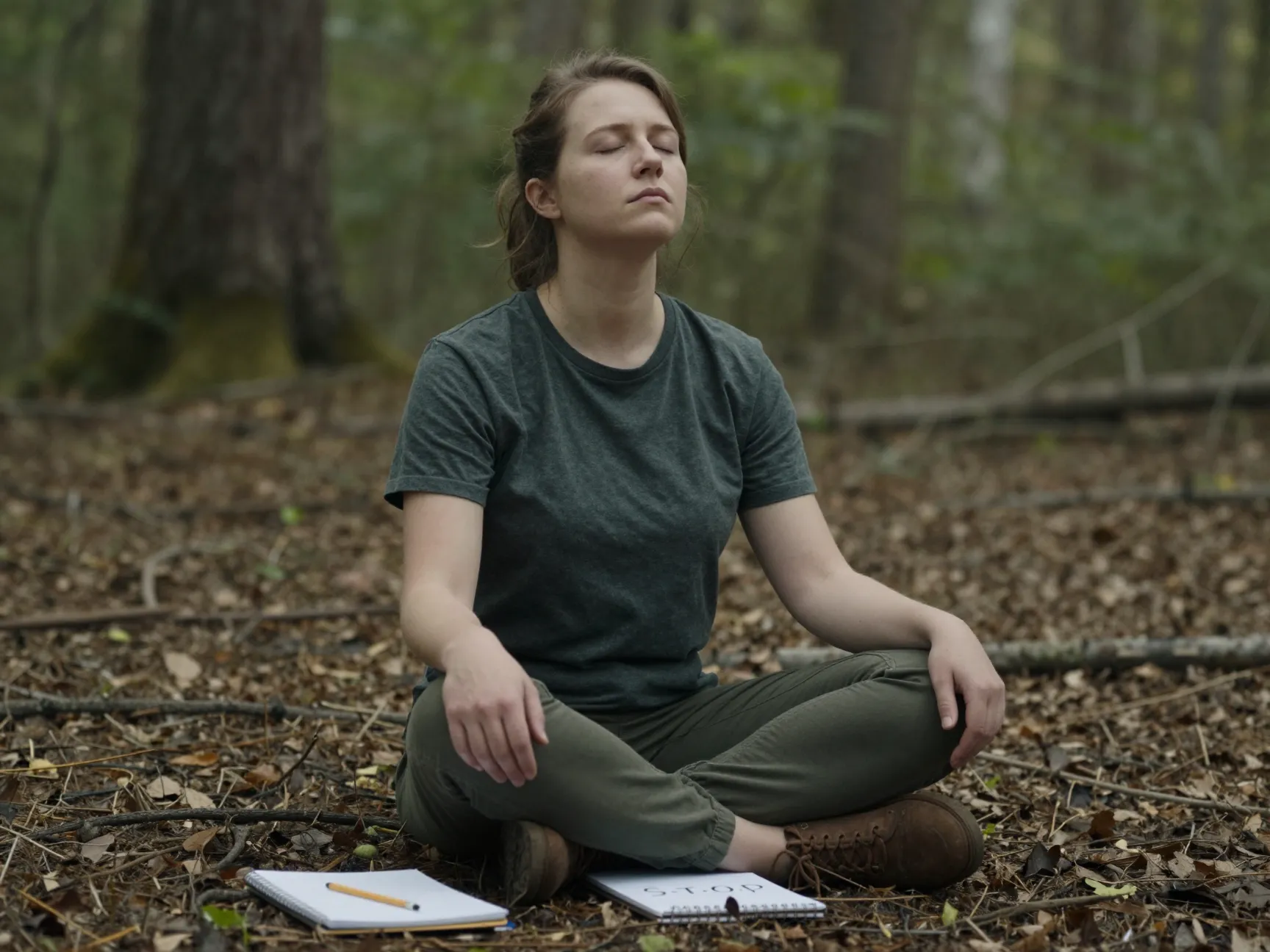
Every survival instructor agrees on one point: panic kills. The STOP protocol is a structured mental reset used by military personnel, search-and-rescue teams, and wilderness survival instructors to interrupt the panic response and restore rational decision-making.
STOP stands for:
- S – Stop: Physically halt all movement. Sit down if possible.
- T – Think: Assess the situation without acting. What is the immediate threat? What resources are available?
- O – Observe: Look at the environment carefully. Note terrain, weather, available materials, and time of day.
- P – Plan: Form a specific, step-by-step action plan before moving.
Why it works: The human stress response floods the body with adrenaline, which narrows focus and impairs complex reasoning. The STOP protocol forces a pause long enough for the prefrontal cortex, the brain’s rational decision-making center, to re-engage before action is taken.
The hack: Practice STOP in low-stakes situations, such as when running late or dealing with a minor frustration. The more the protocol is rehearsed, the more automatically it activates under genuine stress. This is the one survival skill that makes every other skill on this list more effective.
How to Practice These Skills Without Going Outdoors
Knowing a technique and being able to execute it under stress are two entirely different things. Research in motor learning consistently shows that skills practiced in low-pressure environments transfer more reliably to high-pressure situations than skills that are only read about.
A practical weekly training schedule:
| Day | Skill Practice |
|---|---|
| Monday | Recite the Rule of Threes from memory, timed |
| Tuesday | Practice feather stick carving on a scrap piece of wood |
| Wednesday | Build a shadow stick compass in the backyard |
| Thursday | Practice 10-minute pressure bandaging on a pillow |
| Friday | Run the STOP protocol during a stressful moment |
| Weekend | Combine multiple skills in a short outdoor drill |
The goal is not perfection on the first attempt. The goal is repetition until each technique feels familiar under mild stress. Even 10 minutes of deliberate practice per day compounds into genuine competence within 30 days.
Building a Minimal Survival Kit Around These Skills
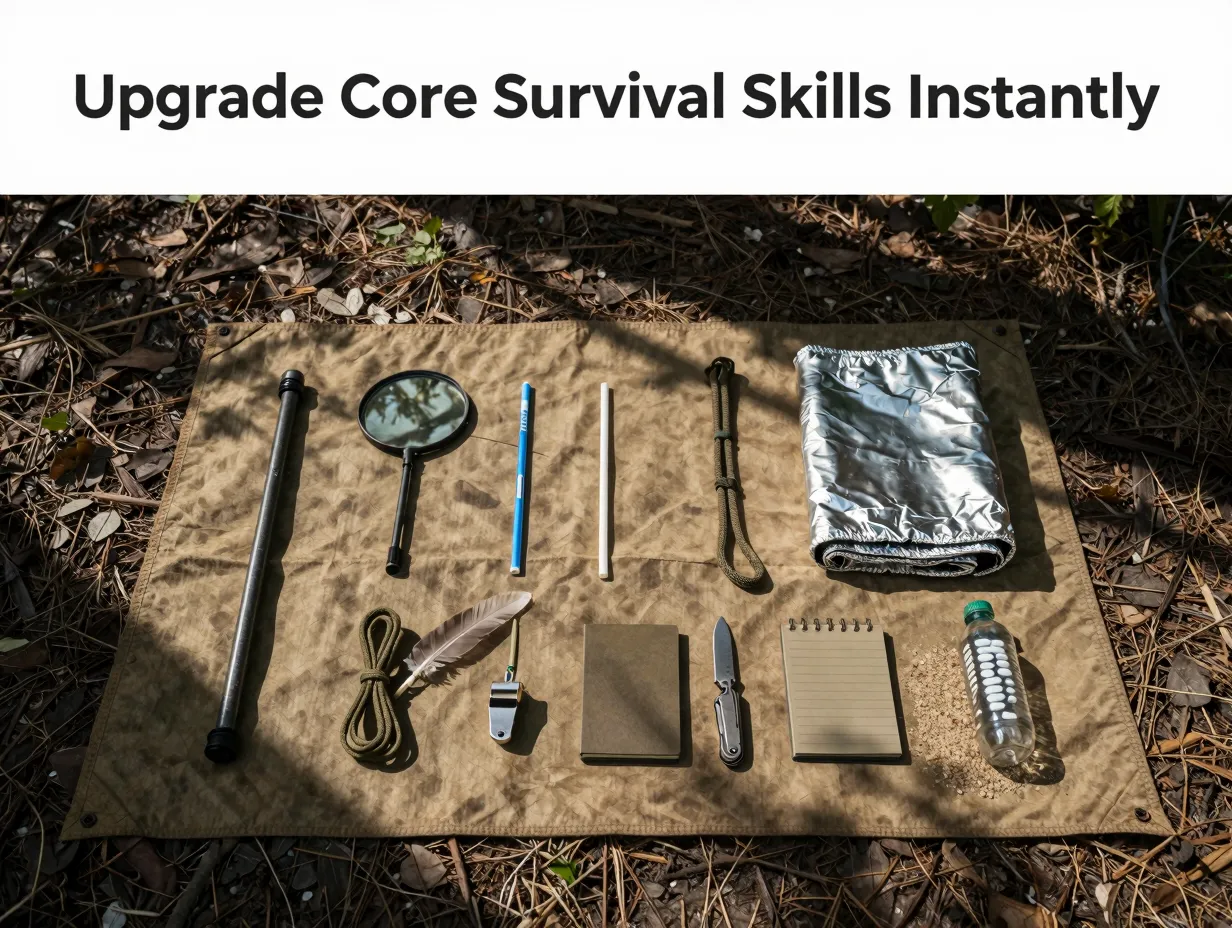
The 9 life hacks that will upgrade your core survival skills instantly become significantly more effective when supported by a minimal, purpose-built kit. The following items weigh under 500 grams combined and address every skill covered in this guide:
- Ferro rod and striker
- Signal mirror (glass, not plastic)
- Pealess whistle
- Water filter straw
- Iodine tablets (10-pack)
- Emergency foil blanket
- Paracord (5 meters)
- Small folding knife
- Waterproof notepad and pencil
This kit fits in a jacket pocket or a small pouch and costs less than most restaurant meals. The investment-to-impact ratio is among the highest of any preparedness purchase available in 2026.
Conclusion
The gap between someone who survives an emergency and someone who does not is rarely about physical strength or expensive gear. It is almost always about knowledge applied under pressure. The 9 life hacks that will upgrade your core survival skills instantly outlined in this guide represent the highest-leverage interventions available: they are learnable in hours, practicable at home, and applicable across a wide range of real-world scenarios.
Actionable next steps to take this week:
- Memorize the Rule of Threes today. Write it on a notepad and review it three times.
- Assemble the minimal survival kit listed above and keep it in a bag used daily.
- Practice the STOP protocol once per day for the next seven days during any minor stressful moment.
- Schedule one outdoor skill session per week for the next month, rotating through the nine techniques.
- Share at least two of these techniques with someone in the household so that survival knowledge is distributed, not siloed.
Survival readiness is not a destination, it is a habit. Start with one skill, build consistency, and let competence grow from there.