8 Classic Man Fishing Illustration Styles To Inspire Your Art
Fewer than 12% of working illustrators can name more than four distinct historical fishing art traditions, yet the man-fishing motif has appeared in human visual culture for over 4,000 years, from ancient Egyptian tomb paintings to 21st-century graphic novels. That gap between the richness of the tradition and the awareness of modern artists represents a genuine creative opportunity. This guide to the 8 Classic Man Fishing Illustration Styles To Inspire Your Art closes that gap by breaking down each style’s defining characteristics, historical roots, and practical techniques so artists at every level can put them to work immediately.
Disclosure: This post contains affiliate links. As an Amazon Associate, we earn from qualifying purchases, and at no extra cost to you.
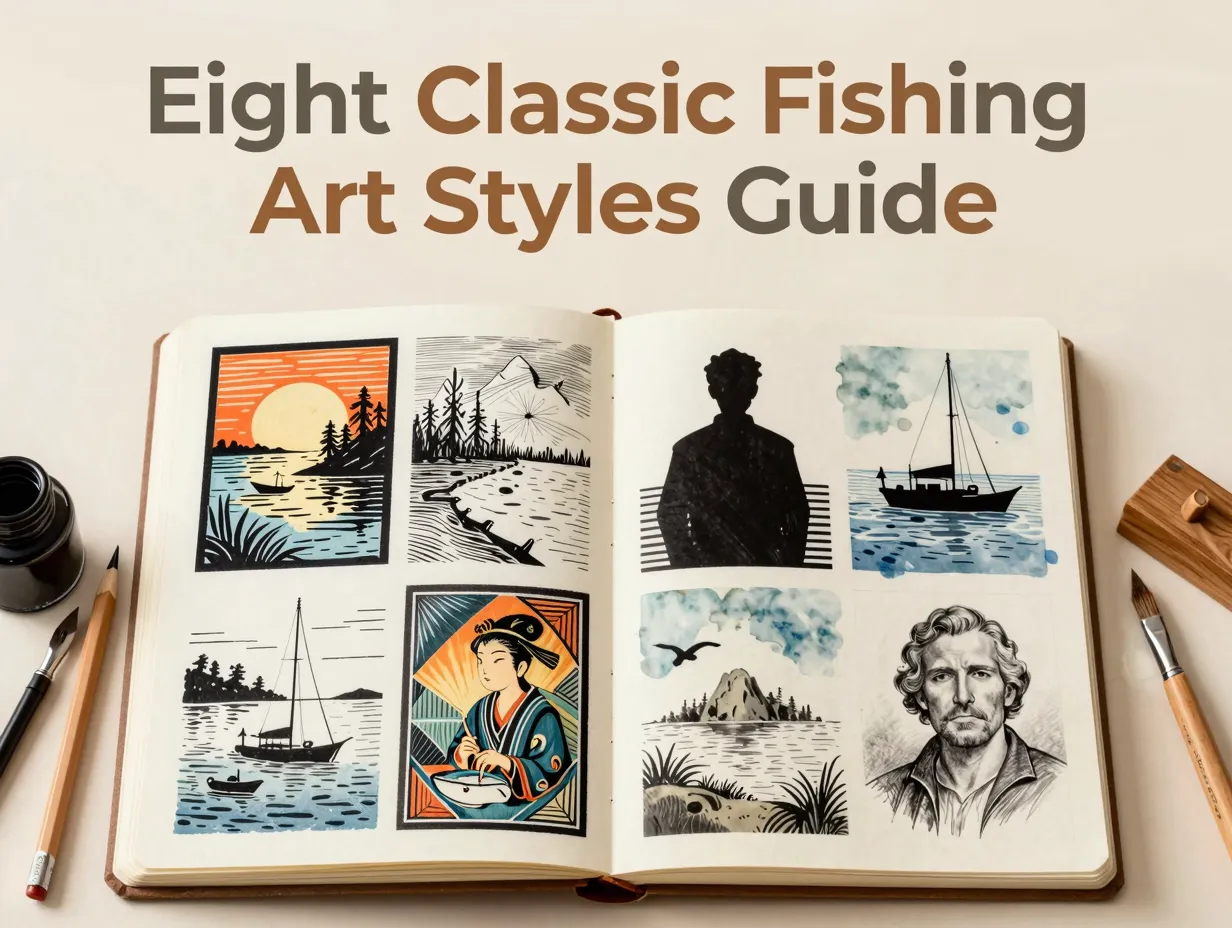
Whether the goal is to design a vintage-themed brand identity, create editorial illustrations, or simply expand a personal portfolio, understanding these classic angler illustration styles provides a strong foundation. Each of the eight styles explored here carries its own visual language, emotional tone, and technical demands.
Key Takeaways
- The 8 Classic Man Fishing Illustration Styles To Inspire Your Art span centuries of visual tradition, from woodcut prints to watercolor washes.
- Each style has distinct technical requirements, line weight, color palette, texture, and composition all vary significantly.
- Understanding the historical context of each style helps artists use it with authenticity and intention.
- These styles are highly adaptable for modern applications including branding, editorial work, apparel, and fine art prints.
- Mixing elements from multiple styles is a legitimate advanced technique, but mastering each one individually first produces stronger results.
Why the Man Fishing Motif Endures Across Art History
The lone angler standing at the water’s edge is one of the most durable images in visual storytelling. It communicates patience, solitude, connection to nature, and the tension between effort and reward, all without a single word. Across cultures, the figure of a man fishing has served as a metaphor for contemplation, hope, and the passage of time.
This universality is precisely why so many distinct illustration traditions have adopted and adapted the motif. From Japanese woodblock masters to American mid-century commercial artists, each era and culture has interpreted the fishing figure through its own aesthetic lens. Understanding those lenses is the core purpose of exploring the 8 Classic Man Fishing Illustration Styles To Inspire Your Art.
What makes a fishing illustration “classic”?
A style earns the label “classic” when it meets three criteria:
- It has a documented historical tradition spanning at least several decades.
- It employs a recognizable and reproducible set of visual conventions.
- It has influenced subsequent generations of artists in measurable ways.
All eight styles in this guide meet those criteria. Each one also remains actively relevant in 2026, either as a direct stylistic choice or as a foundational influence on contemporary illustration.
The 8 Classic Man Fishing Illustration Styles To Inspire Your Art
1. Woodcut and Relief Print Style
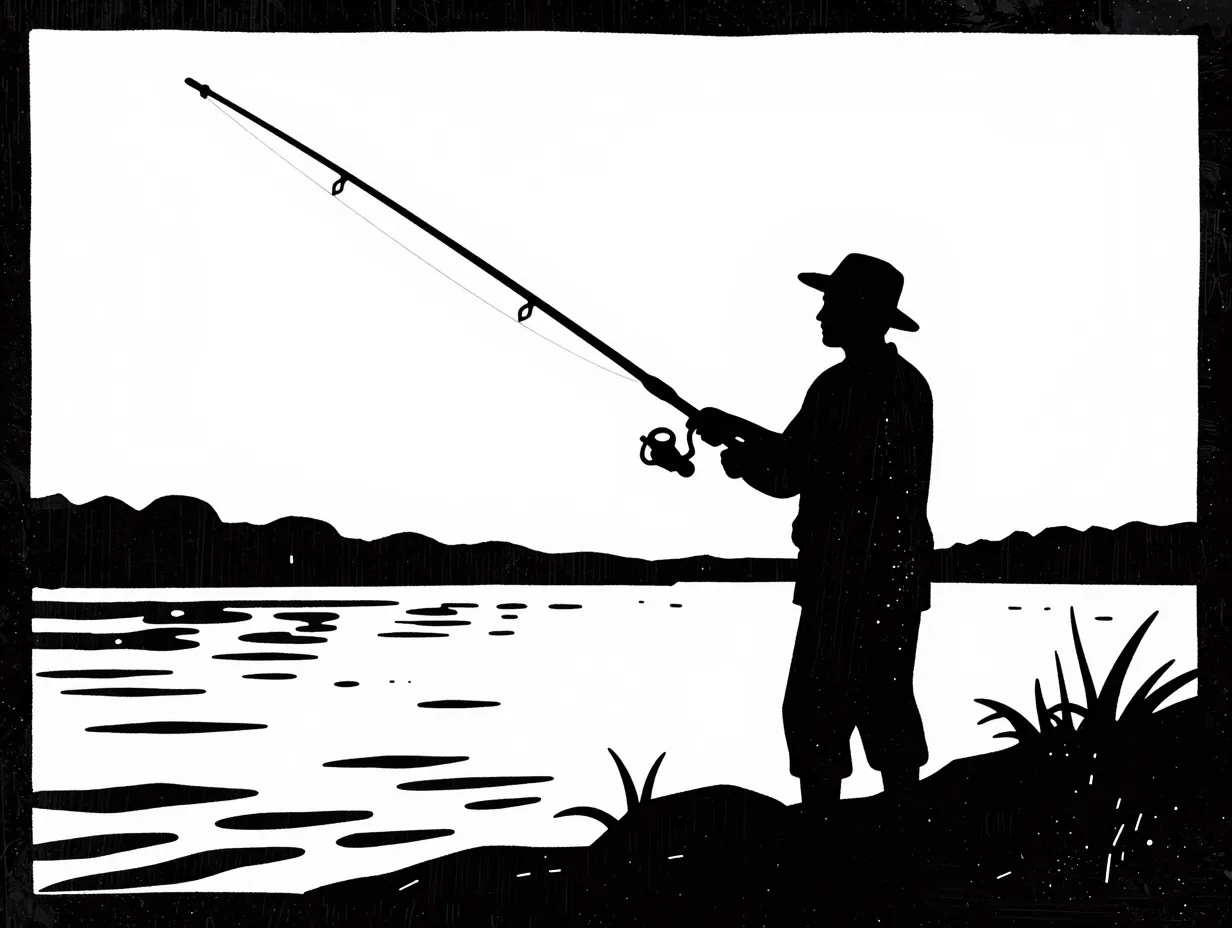
The woodcut tradition dates to at least the 15th century in Europe and even earlier in East Asia. In this style, an illustration of a man fishing is rendered through bold, high-contrast lines that mimic the physical act of carving into a wooden block. The result is an image with strong black outlines, limited tonal range, and a deliberately rough, handmade quality.
Defining characteristics:
- Heavy, uneven black outlines
- Flat areas of solid black or white with minimal mid-tones
- Visible grain texture suggesting the wood surface
- Simple, iconic compositions with reduced detail
Practical application: To achieve this look digitally, work with a limited two- or three-tone palette. Use a dry-media brush with slight roughness on the edges. Avoid smooth gradients entirely. The fisherman’s silhouette should read clearly at a distance, with internal detail kept to a minimum.
This style works exceptionally well for merchandise prints, book covers, and rustic brand identities. Its visual weight commands attention even at small sizes.
2. Pen-and-Ink Crosshatch Style
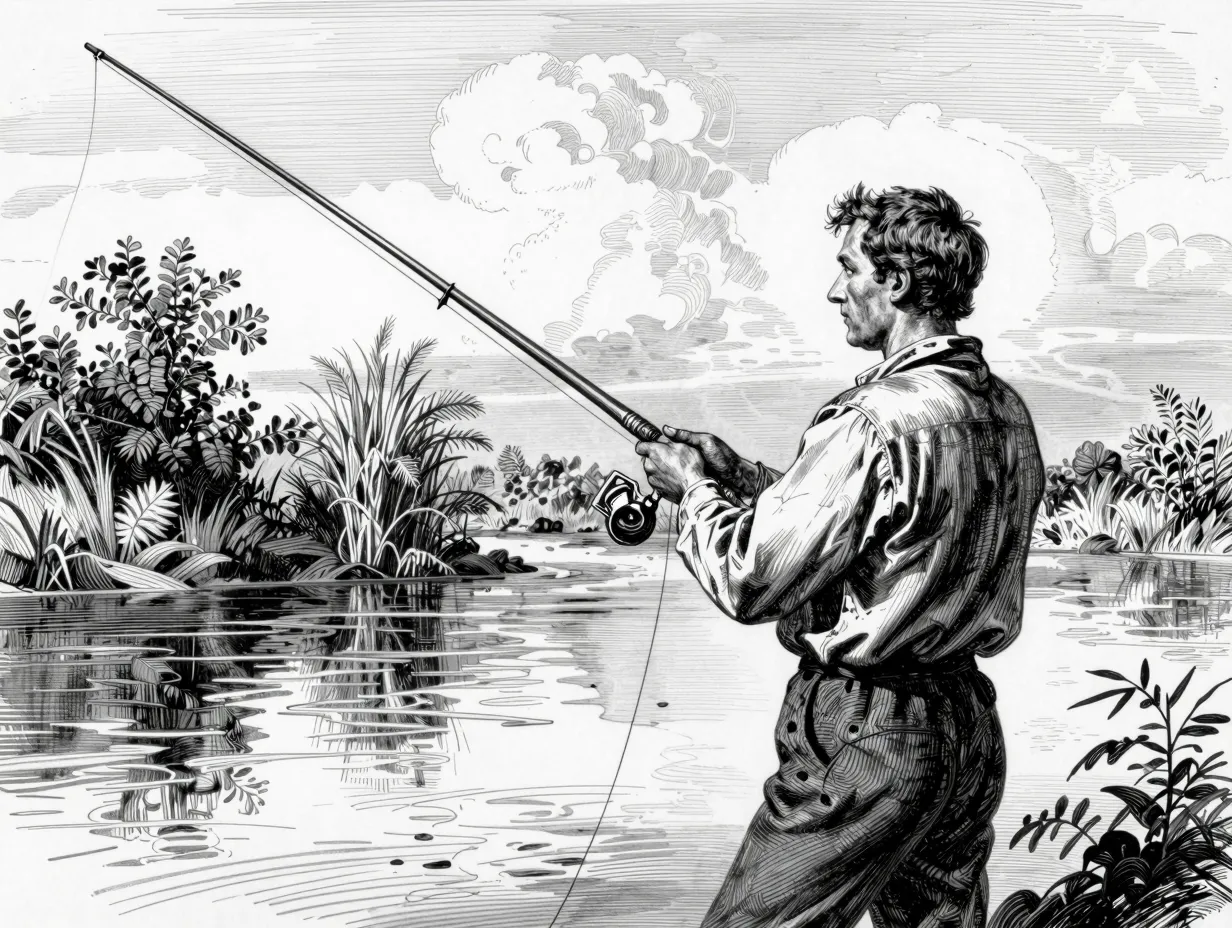
Pen-and-ink illustration reached its peak influence in the 19th century, particularly in editorial and book illustration. Artists like Gustave Doré elevated crosshatching, the technique of layering parallel and intersecting lines to create tonal depth, into a high art form. Applied to the man-fishing subject, this style produces images of extraordinary detail and atmospheric richness.
Defining characteristics:
- Dense networks of fine parallel lines for shadow areas
- Varying line weight to suggest depth and form
- High contrast between lit and shadowed areas
- Intricate environmental detail, water ripples, foliage, clouds
Practical application: Begin with the lightest areas and build shadow gradually through successive layers of hatching. The direction of lines should follow the form of the object, curved lines on rounded surfaces, horizontal lines on water. A good pen-and-ink fishing illustration rewards close inspection with layers of detail that are invisible at a glance.
“Crosshatching is not a technique, it is a discipline. Every line is a decision about light.”, A principle taught in classical illustration academies.
This style suits fine art prints, book illustration, and editorial contexts where a sense of historical gravitas is desired.
3. Watercolor Wash Style
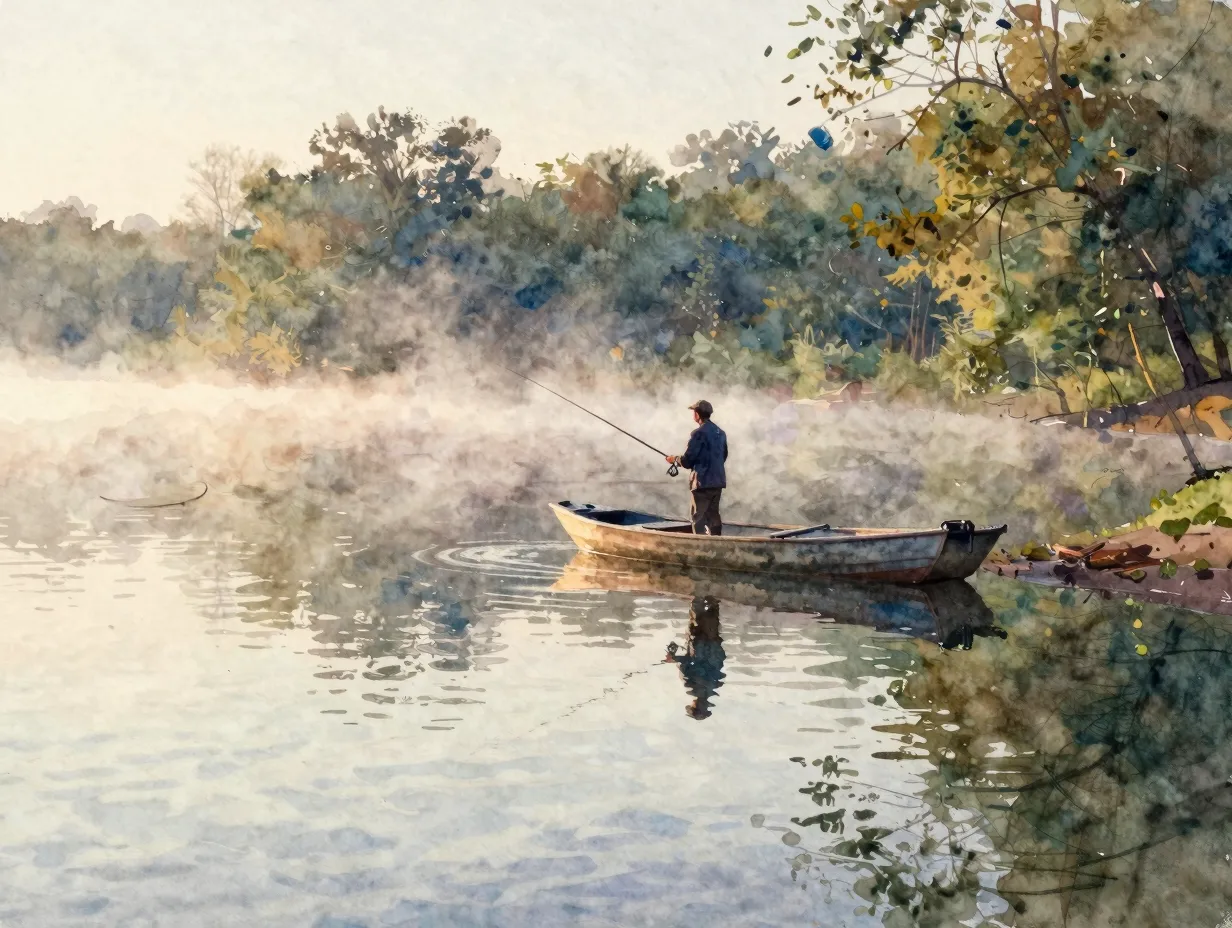
Watercolor illustration has a long association with naturalist art, travel journals, and landscape painting. When applied to the man-fishing subject, it produces images of luminous, atmospheric beauty. The style’s defining quality is its embrace of transparency and unpredictability, the medium itself contributes to the composition in ways the artist cannot fully control.
Defining characteristics:
- Soft, blended color transitions with visible paper texture
- Wet-on-wet blooms and bleeds that suggest mist and water
- Loose, gestural brushwork for foliage and water surfaces
- A limited, harmonious palette, often blues, greens, and earth tones
Practical application: Work from light to dark, preserving white paper for the brightest highlights. The fisherman figure is often rendered with more definition than the surrounding environment, creating a focal point within a soft, impressionistic background. Wet-on-wet technique in the water areas creates natural-looking reflections and movement.
This style is particularly effective for greeting cards, nature publications, and any application where warmth and emotional resonance are priorities.
4. Silhouette and Shadow Style
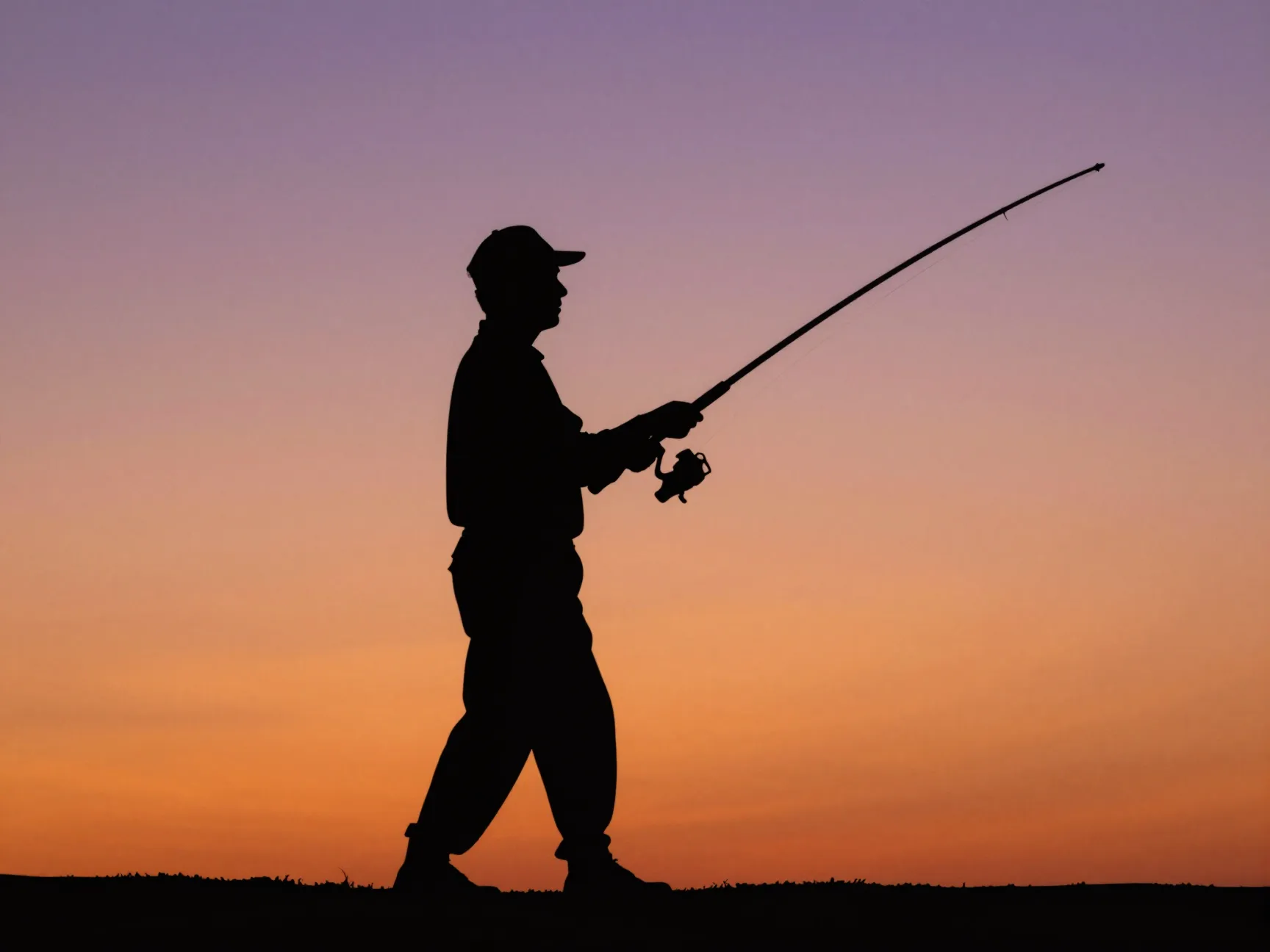
The silhouette tradition in illustration is ancient, shadow puppetry and profile portraiture both contributed to its development, but it reached a particularly refined form in 18th and 19th-century European decorative arts. In fishing illustration, the silhouette style reduces the angler and his environment to pure shape, relying entirely on outline and negative space to communicate the scene.
Defining characteristics:
- Pure black or single-color flat shapes with no internal detail
- Strong, expressive outlines that must carry all the compositional weight
- High contrast against a simple background, often a gradient sky or plain color field
- Careful attention to the silhouette’s readability and elegance
Practical application: The success of a silhouette fishing illustration depends entirely on the quality of the outline. Every element, the arc of the fishing rod, the posture of the figure, the suggestion of water, must be immediately legible as a shape. Spend more time on the contour drawing than on any other element.
This style is highly versatile for logo design, apparel graphics, and any context requiring a clean, bold visual statement.
5. Art Deco Poster Style
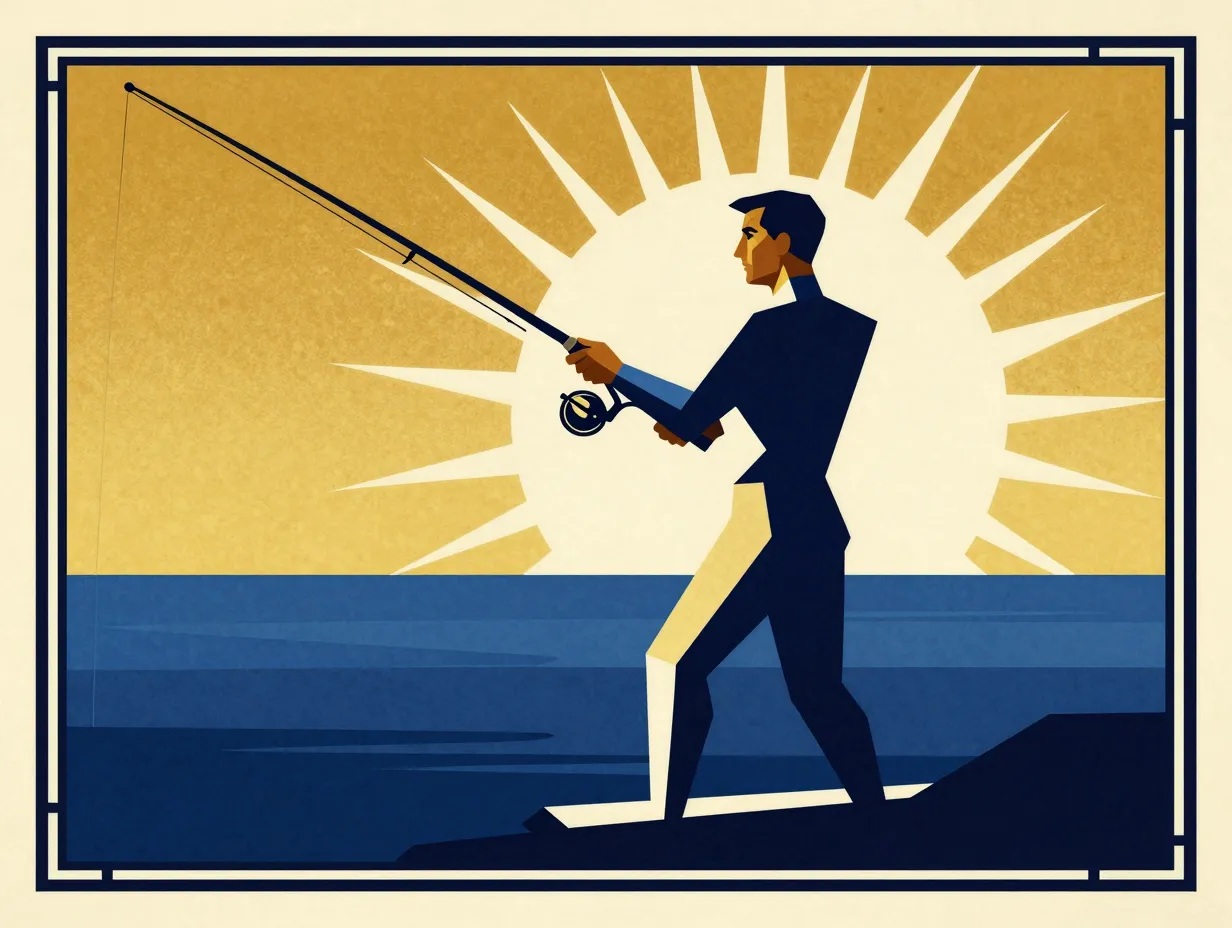
The Art Deco movement of the 1920s and 1930s produced some of the most visually striking commercial illustration in history. Travel posters, magazine covers, and product advertisements from this era feature bold geometric simplification, strong diagonal compositions, and a palette of rich, saturated colors offset by metallic gold or silver accents. The man-fishing subject translates beautifully into this vocabulary.
Defining characteristics:
- Geometric simplification of organic forms, the fisherman becomes angular and stylized
- Strong diagonal lines suggesting dynamism and modernity
- Rich, flat color fields with minimal shading
- Decorative borders, sunburst patterns, and geometric framing devices
- A palette built around deep blues, warm golds, and strong contrasts
Practical application: Begin by reducing the fishing figure to its most geometric essentials. Avoid curves where a straight line or gentle angle will serve. The environment, sky, water, shoreline, should be rendered in bold, flat bands of color. Typography, if included, should use a period-appropriate serif or geometric sans-serif face.
This style is ideal for vintage-inspired travel branding, art prints, and any project that benefits from a sense of glamour and period sophistication.
6. Japanese Ukiyo-e Woodblock Print Style
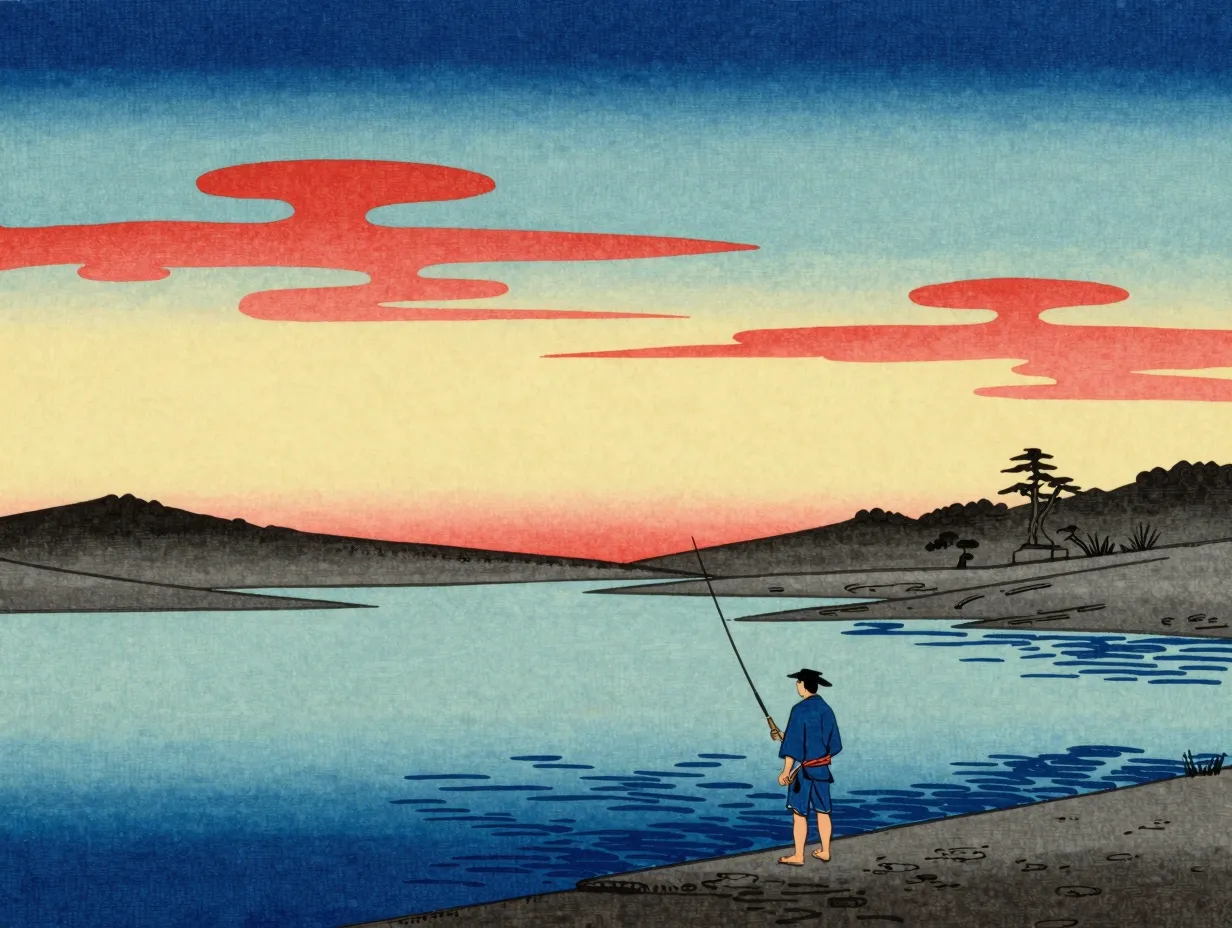
Ukiyo-e, the Japanese tradition of woodblock printing that flourished from the 17th through 19th centuries, produced some of the most recognizable images in world art history. Artists such as Hokusai and Hiroshige depicted fishermen, rivers, and coastal scenes with a visual language that combines flat color, bold outlines, stylized natural forms, and extraordinary compositional sophistication. This style is among the most demanding, and most rewarding, of the eight classic man fishing illustration styles.
Defining characteristics:
- Flat, unmodulated color fields separated by precise black outlines
- Highly stylized natural forms, waves become decorative patterns, clouds become graphic shapes
- Strong compositional asymmetry influenced by Zen aesthetic principles
- A distinctive palette including Prussian blue, vermillion, pale yellow, and black
- Fine parallel lines used to suggest water movement and sky gradation
Practical application: Study the compositional conventions of the tradition carefully before attempting this style. The placement of the fisherman figure within the frame is rarely centered, asymmetric balance is a core principle. Water is depicted through repeated pattern rather than realistic rendering. The horizon line is often placed high in the frame, maximizing the sense of depth.
This style carries significant cultural weight and should be approached with genuine knowledge of and respect for its origins. When executed with care, it produces illustrations of exceptional beauty and authority.
7. Mid-Century Modern Commercial Style

The period from roughly 1945 to 1970 produced a distinctive visual language in American and European commercial illustration. Influenced by modernist design principles, this style simplified natural forms into clean, friendly shapes, used a warm and optimistic color palette, and prioritized clarity and accessibility over technical complexity. Fishing-themed illustrations from this era appeared on tackle boxes, sporting goods catalogs, and outdoor magazine covers, and they retain enormous nostalgic appeal in 2026.
Defining characteristics:
- Simplified, rounded forms with a friendly, approachable quality
- A warm palette of ochre, teal, brick red, and forest green
- Flat or lightly textured color areas with minimal gradients
- Bold, confident linework that is neither as heavy as woodcut nor as fine as pen-and-ink
- Figures that are stylized but clearly legible and expressive
Practical application: The key to this style is warmth. Every design decision, color, line weight, figure proportions, should communicate friendliness and optimism. Avoid sharp angles or high-contrast drama. The fisherman in a mid-century commercial illustration is having a good time, and the illustration should feel that way.
This style is highly effective for outdoor brand identities, children’s book illustration, and any project targeting an audience with nostalgia for mid-20th-century Americana.
8. Realistic Pencil Sketch Style
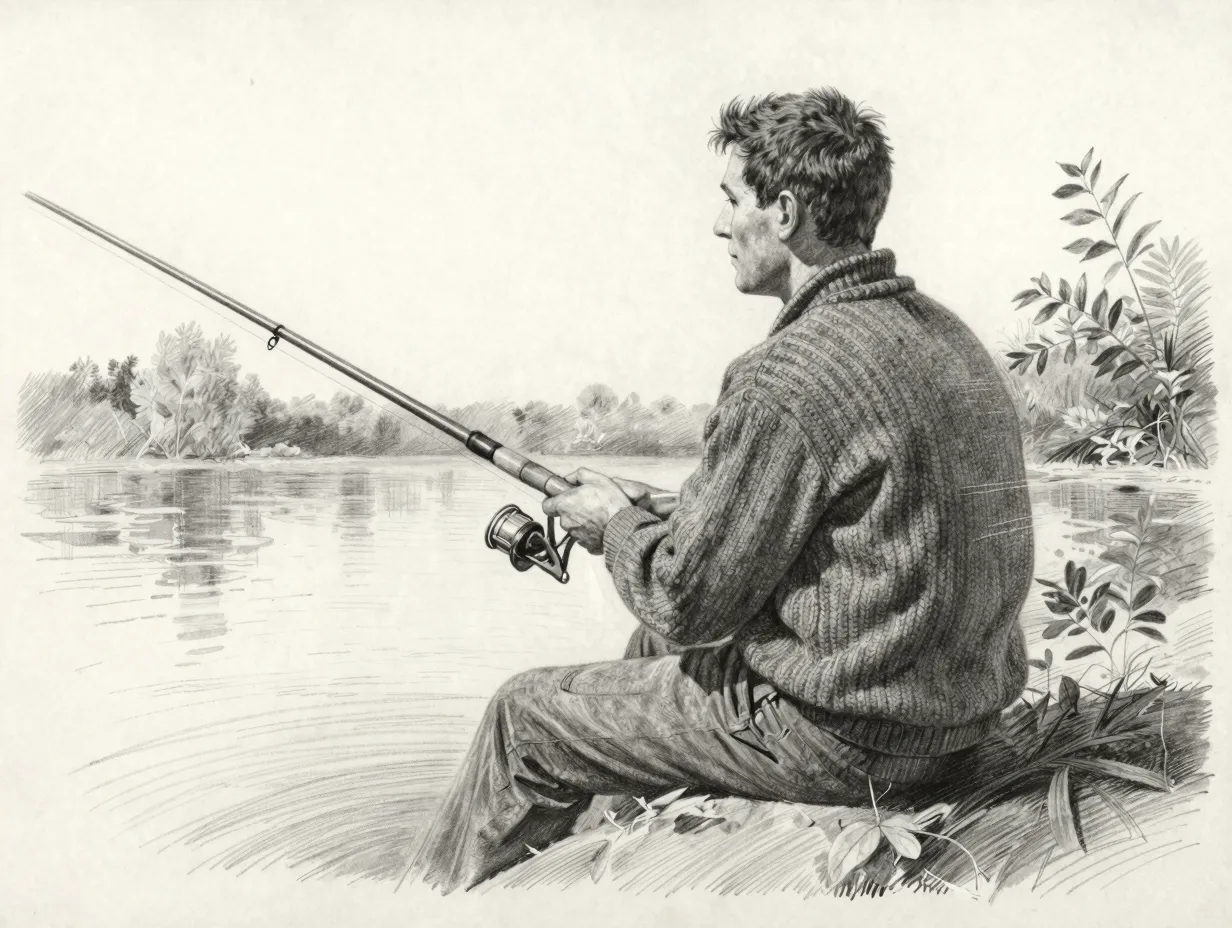
The pencil sketch tradition in illustration is perhaps the most technically demanding of the eight classic man fishing illustration styles, and also the most directly connected to fine art drawing practice. A realistic pencil sketch of a man fishing draws on the full range of academic drawing skills, proportion, perspective, value, texture, and gesture, to produce an image of genuine artistic depth.
Defining characteristics:
- A full tonal range from pure white to deep black, achieved through layered graphite
- Careful attention to the fall of light across the figure and environment
- Visible pencil texture that adds warmth and humanity to the image
- Detailed rendering of specific textures, water, fabric, wood, foliage
- A compositional approach drawn from classical fine art traditions
Practical application: Begin with a light gestural sketch to establish proportion and composition. Build tone gradually through layered strokes, working from light to dark. Use a blending stump or tortillon for smooth transitions in the sky and water, but preserve visible pencil texture in the figure and foreground elements. The quality of the paper matters significantly, a medium-tooth surface holds graphite well and contributes to the final texture.
This style suits fine art portfolios, editorial illustration, and any context where demonstrating technical mastery is a priority. It is also an excellent foundation style, artists who master realistic pencil sketching will find that every other style on this list becomes more accessible as a result.
How to Choose the Right Style for Your Project
With eight distinct options available, selecting the right classic fishing illustration style for a specific project requires a clear understanding of the project’s goals, audience, and context. The table below summarizes the key decision factors.
| Style | Best For | Difficulty Level | Emotional Tone |
|---|---|---|---|
| Woodcut | Branding, merchandise | Intermediate | Bold, rustic |
| Pen-and-Ink Crosshatch | Editorial, fine art prints | Advanced | Detailed, authoritative |
| Watercolor Wash | Greeting cards, nature pubs | Intermediate | Warm, atmospheric |
| Silhouette | Logos, apparel | Beginner-friendly | Clean, iconic |
| Art Deco Poster | Travel branding, art prints | Intermediate | Glamorous, dynamic |
| Ukiyo-e Woodblock | Fine art, cultural projects | Advanced | Refined, meditative |
| Mid-Century Modern | Outdoor brands, children’s books | Beginner-friendly | Warm, nostalgic |
| Realistic Pencil Sketch | Fine art portfolios, editorial | Advanced | Thoughtful, technical |
Combining Styles: Advanced Technique for Experienced Illustrators
Once an artist has genuine command of at least two or three of the eight classic man fishing illustration styles, combining elements from multiple traditions becomes a powerful creative option. Some combinations have proven particularly effective:
- Ukiyo-e outlines with watercolor fills, This pairing preserves the compositional sophistication of the Japanese woodblock tradition while adding the luminosity and atmospheric quality of watercolor. The result is a style that feels both ancient and fresh.
- Woodcut texture with mid-century color palette, Applying the bold linework and high contrast of the woodcut tradition to the warm, friendly color palette of mid-century commercial illustration produces images with strong visual impact and broad audience appeal.
- Silhouette composition with Art Deco decorative elements, A fishing silhouette placed within an Art Deco geometric frame or sunburst pattern creates a highly versatile graphic that works equally well as a logo, a poster, or a textile print.
The key principle when combining styles is intentionality. Every element should be a deliberate choice, not a default. Ask what each borrowed convention contributes to the overall image and whether it serves the project’s goals.
Building a Study Practice Around These Styles
Artistic mastery of any style requires systematic study, not casual exposure. A structured approach to learning the 8 Classic Man Fishing Illustration Styles To Inspire Your Art produces faster, more durable results than sporadic practice.
A recommended study sequence:
- Begin with the silhouette style to develop strong compositional instincts without the distraction of tonal complexity.
- Move to the mid-century modern style to practice simplified form-making with a limited color palette.
- Study the woodcut style to develop confidence with high-contrast, bold linework.
- Progress to watercolor wash to learn tonal control through a fluid, unpredictable medium.
- Tackle pen-and-ink crosshatch to build patience and precision with fine-line techniques.
- Study the Art Deco poster style to develop geometric thinking and decorative sensibility.
- Approach the realistic pencil sketch style to consolidate academic drawing skills.
- Reserve the ukiyo-e woodblock style for last, its compositional sophistication rewards the full range of skills developed in the preceding steps.
Dedicate a minimum of two focused practice sessions to each style before moving forward. Produce at least three complete fishing illustrations in each style, one study copy of a historical example, one original composition using the style’s conventions, and one experimental variation that pushes the boundaries of the tradition.
Conclusion
The man-fishing motif is not a narrow subject, it is a lens through which centuries of artistic tradition can be studied, practiced, and applied. The 8 Classic Man Fishing Illustration Styles To Inspire Your Art outlined in this guide represent eight distinct visual languages, each with its own history, technical requirements, and expressive possibilities.
Actionable next steps for artists:
- Select the one style from this list that most closely aligns with a current project or personal interest and commit to a two-week intensive study period.
- Gather reference material, historical examples of the chosen style applied to fishing or outdoor subjects, and analyze them for compositional, tonal, and technical conventions before drawing a single line.
- Complete the three-illustration practice sequence described above: study copy, original composition, experimental variation.
- Document the process in a sketchbook or digital journal, noting what worked, what failed, and what questions emerged for further study.
- After completing one style, use the study sequence recommended above to work systematically through the remaining seven.
The investment in understanding these classic traditions pays dividends across an entire artistic career. Every style mastered expands the range of problems an illustrator can solve and the range of clients and audiences they can serve. The fishing illustration, in all its quiet, timeless simplicity, turns out to be one of the richest subjects in the history of visual art.