DIY Survival Kits That Make the Perfect Gift for Outdoorsy Anglers
Roughly one in three fishing trips in North America takes anglers more than five miles from the nearest road, yet most carry no survival gear beyond a basic tackle box. That gap between exposure and preparation is exactly why the 6 DIY survival kits that make the perfect gift for outdoorsy anglers are worth your time and attention in 2026. Whether you’re shopping for someone else or building a kit for your own vest pocket, a hand-assembled kit beats a generic store-bought tin every time because you can match the contents to a real person’s real water.
Disclosure: This post contains affiliate links. As an Amazon Associate, we earn from qualifying purchases, and at no extra cost to you.
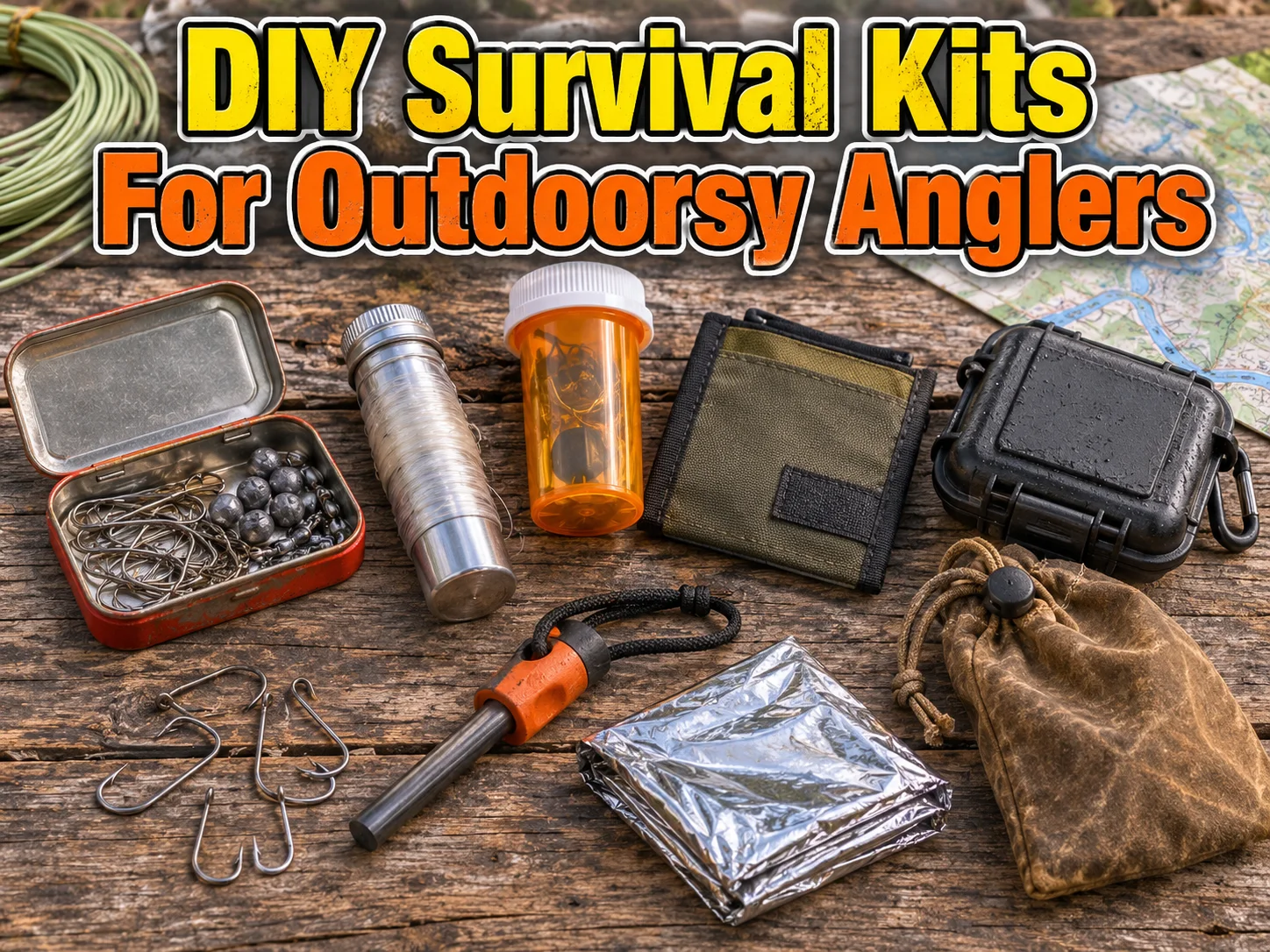
Each kit format below solves a different problem: size, budget, container type, or the specific survival priorities of a fly fisher versus a backcountry ice angler. All six are genuinely buildable in an afternoon.
Key Takeaways
- A DIY survival fishing kit can be tailored to a specific angler’s style and region in ways that commercial kits cannot match.
- Container choice determines portability; Altoids tins, cigar tubes, wallets, and waterproof micro-cases all serve different pockets and vest configurations.
- Survival fishing gear and standard survival gear overlap heavily: braided line, snare wire, and magnetized needles pull double duty.
- Even a kit costing under ten dollars can cover fire, shelter, water, and food essentials if the components are chosen carefully.
- The best kits include at least 40 feet of line, multiple hook sizes, a fire-starting tool, and a water purification method.
1. The Altoids Tin Pocket Survival Kit
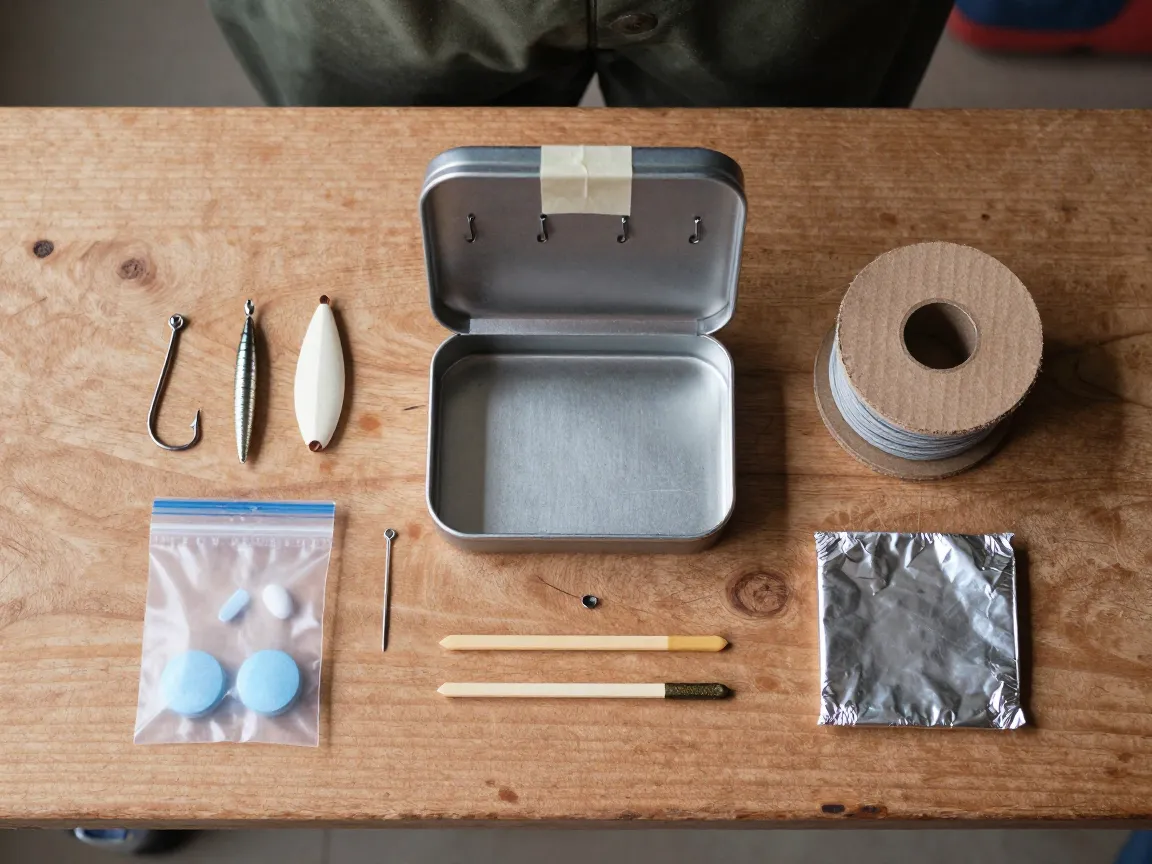
Altoids tins have been a fixture in survival circles for years, and they earn that reputation in the angler context because a standard tin fits in a shirt pocket, weighs almost nothing, and closes with enough friction to stay shut inside a wader. The metal construction also means you can boil a small amount of water in it over a fire, which is a capability a plastic container simply can’t offer.
To build this one, start with the container itself. Pack in four or five small J-hooks in sizes 8 and 10, a single size-4 treble for larger targets, ten or twelve small split-shot sinkers, and a compact bobber folded flat. Wrap 40 to 50 feet of 20-pound-test braided line around a small piece of cardboard that fits inside the lid. Add two water purification tablets sealed in a small zip-lock, a folded square of aluminum foil for signaling or cooking, two or three waterproof matches, and a small ferro rod striker if one will fit. A strip of duct tape wrapped around the outside of the lid frees up interior space while still making the tape accessible.
The fishing-specific addition that sets this kit apart from a generic survival tin is a magnetized needle. Rub a sewing needle along a magnet 30 to 40 times in one direction, float it on a leaf in calm water, and it points north reliably. That needle can also be bent into a rudimentary hook for very small fish when manufactured hooks are gone. The Altoids kit is the best starting point for someone who wants a proven format, a low parts cost, and something that fits in a breast pocket without printing through wader fabric.
2. The Cigar Tube Fishing Survival Kit
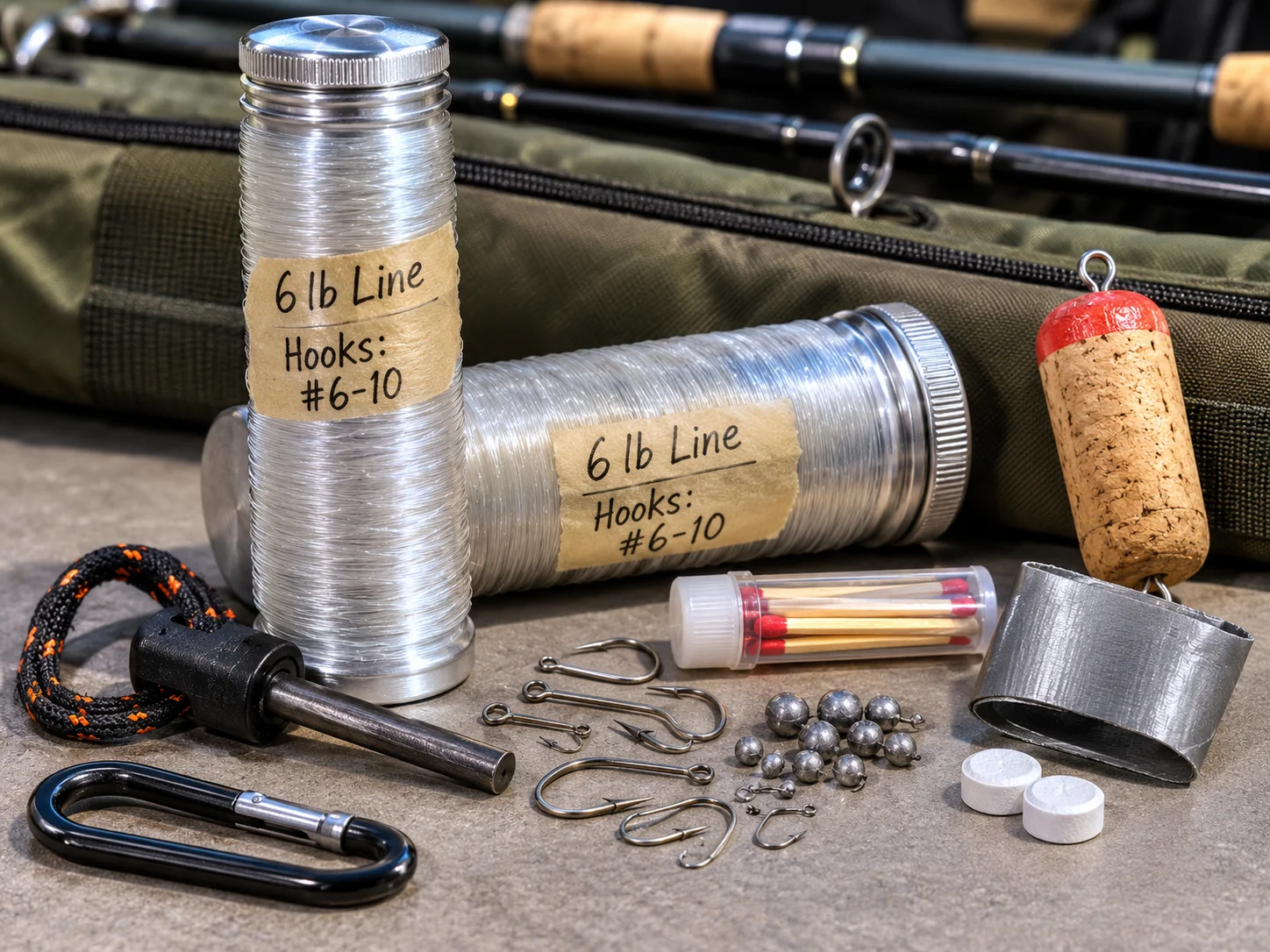
A plastic or aluminum cigar tube is longer and narrower than an Altoids tin, which makes it ideal for anglers who clip gear to a lanyard or store things in rod-tube side pockets. The cylindrical shape also allows hundreds of feet of thin monofilament to be wrapped directly around the outside of the tube before the cap goes on, putting usable line on the exterior and leaving the interior for hooks, sinkers, bobbers, matches, and a folded space blanket.
Inside the tube, fit a small ferro rod, four or five hooks in mixed sizes, a handful of micro split-shot sinkers, a couple of waterproof matches as backup, and two water purification tablets. A small strip of duct tape folded sticky-side-to-sticky-side and then rolled tight enough to fit in the tube gives you a repair material without losing interior space to a bulky roll. If the tube diameter allows, include a small bobber made from a wine cork, which compresses slightly for fitting and floats well once deployed.
What makes this format worth gifting specifically is the visual impact of the wrapped line. Seeing 200 feet of 6-pound mono coiled around a small tube communicates the kit’s capability immediately without opening it. Tie off both ends and label the tube with a piece of masking tape marked with line weight and hook sizes. That detail turns the kit from a novelty into a tool someone will actually trust.
3. The Waterproof Prescription Bottle Kit
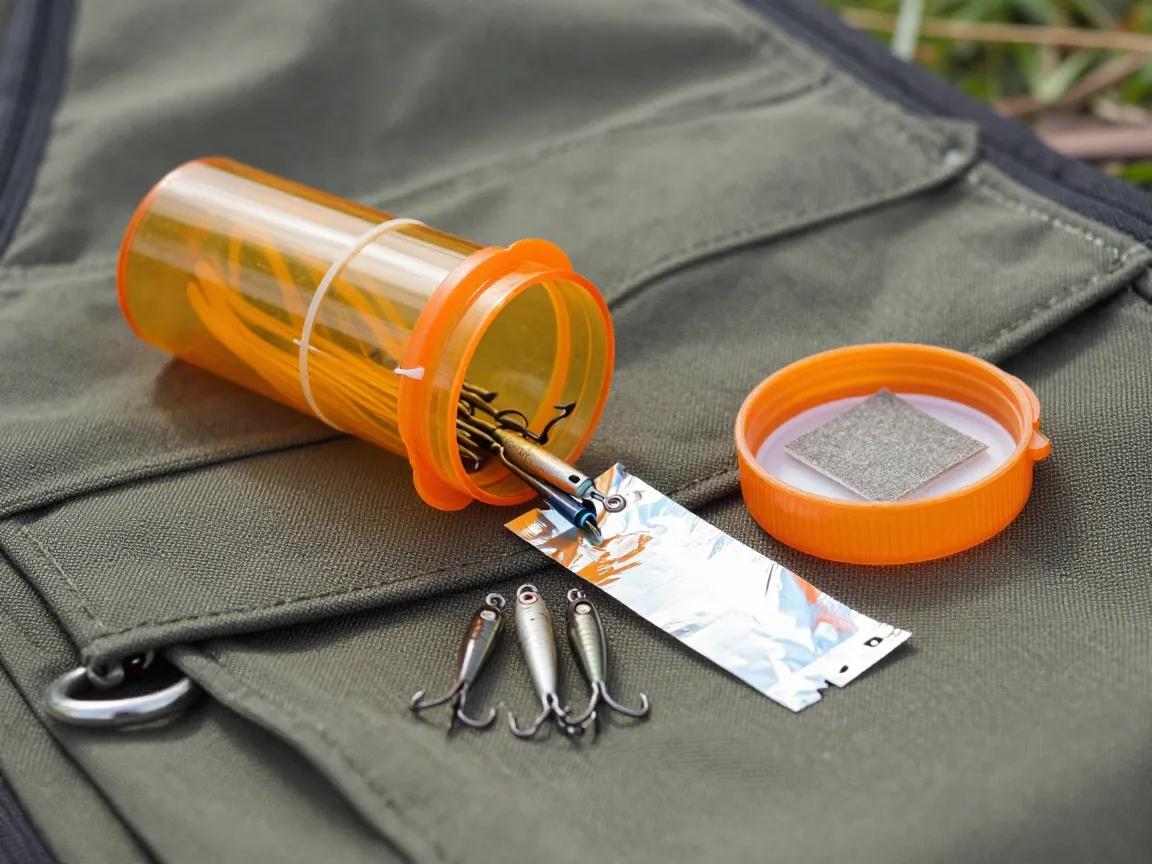
Small orange prescription bottles, the 30-dram or 40-dram size, are waterproof by design, free from any pharmacy, and narrow enough to fit in a fly-fishing vest’s smallest D-ring pocket. American Outdoor Guide recommends these explicitly for assembling compact fishing kits, and the rationale holds: the lid threads on securely, the bottle floats if dropped in moving water, and the orange color is easier to spot than a tin in dim light.
Fill the bottle with ten to twelve hooks in a range from size 14 up to size 4 to cover both small stream trout and larger panfish. Add a dozen micro split-shot sinkers, two small swivels, three or four tiny jig heads, and a folded strip of reflective Mylar for signaling. Wrap 30 feet of 10-pound monofilament around the outside of the bottle and secure it with two rubber bands. Inside the lid, glue a small square of sandpaper as an emergency match striker.
The key advantage here over the tin format is water resistance under submersion. An Altoids tin’s lid can admit water if the kit gets dunked. A prescription bottle’s threaded cap holds. For wade fishers and kayak anglers who regularly flip or fall in, that distinction matters more than the difference in internal volume.
4. The Flat Wallet Survival Fishing Kit
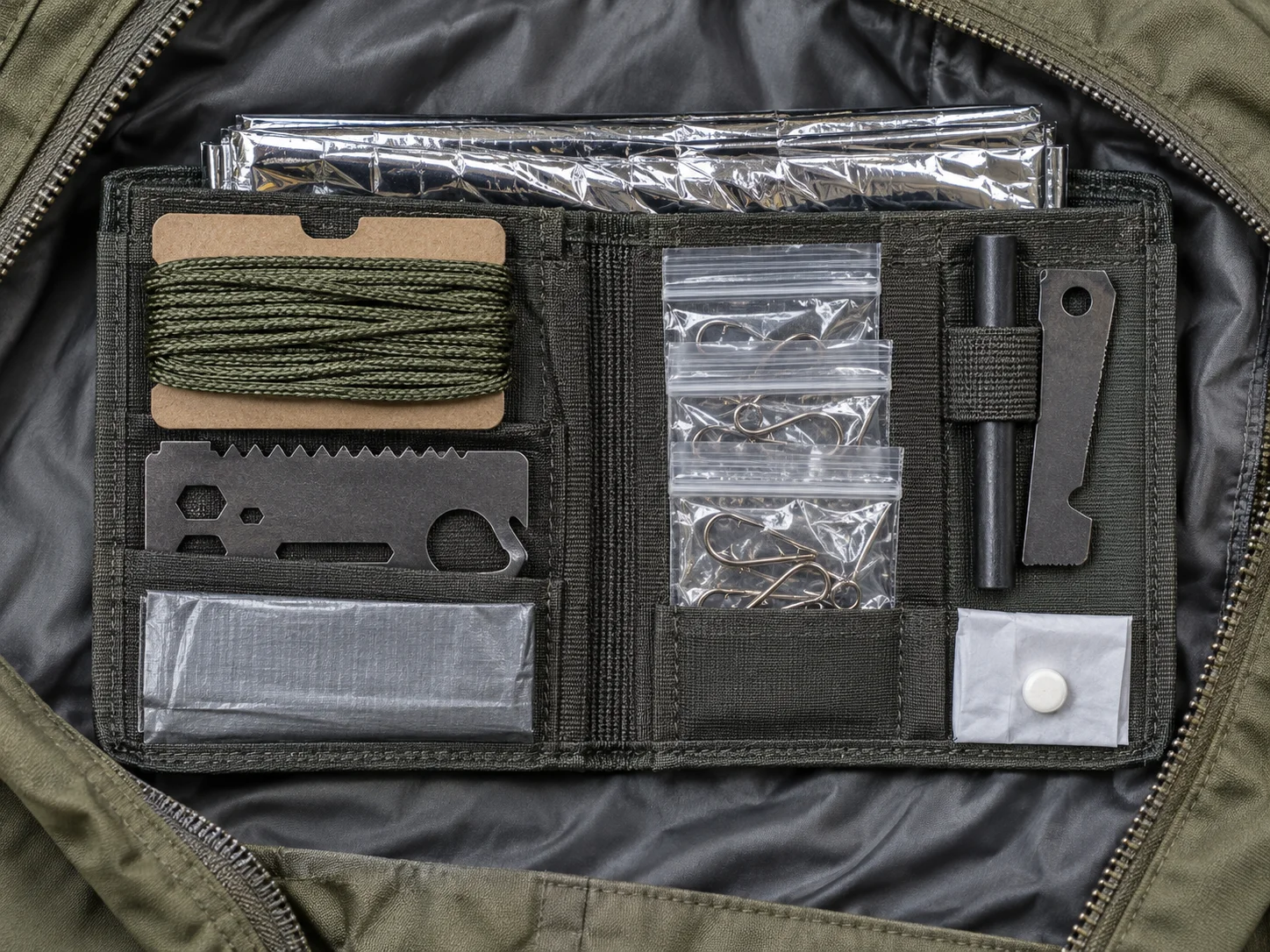
Grim Workshop popularized the wallet format for survival fishing gear, showing that braided line, hooks, weights, and small lures can be packed flat enough to slide into an unused card slot. The flat profile is the entire point: this kit lives in a fishing vest, a jacket lining pocket, or even a regular wallet alongside cards, adding almost no bulk.
Start with a used nylon or Tyvek wallet. In the bill compartment, fold a Mylar space blanket accordion-style until it fits flat. In the card slots, slot a folded credit-card-size piece of cardstock wrapped with 50 feet of 15-pound braided line. In the remaining slots, store a ferro rod scraper the size of a credit card (Exotac makes one at roughly business-card dimensions), a small serrated blade card, and a strip of duct tape folded flat. Hook packets, three or four of them in zip-sealed foil, go in the remaining space. Add a water purification tablet in a small pill fold.
The survival application most relevant to anglers here is the shelter piece. The Mylar blanket weighs about 1.5 ounces and reflects 90 percent of body heat. If a fisher is stranded overnight after a canoe capsize or a sudden storm, the blanket is the most important item in any kit. Including it in the wallet format means it’s always there even when the main pack is not. This kit is the best choice for anglers who already carry light and don’t want one more thing clipped to a vest.
5. The Waterproof Hard-Case Angler Survival Kit
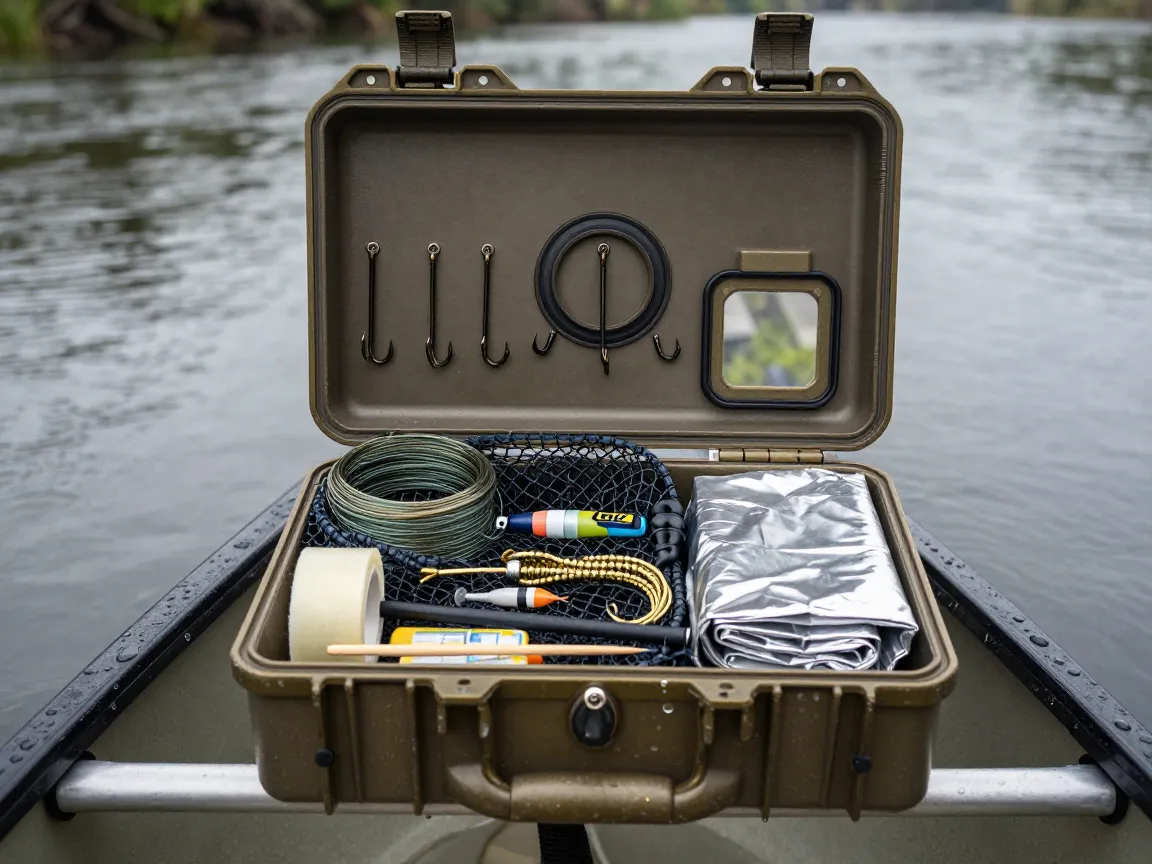
Where the previous formats trade capacity for compactness, this one trades a little size for significantly more capability. A small waterproof hard case, roughly the size of a deck of playing cards, can hold a gill net, full-size hooks and weighted rigs, a proper signal mirror, a compact first-aid strip, and enough cordage to build a basic shelter. Sigma 3 Survival School specifically recommends a waterproof Adventurer Survival Kit box for this type of build, and the reasoning is straightforward: when you have the pocket space, you should use it.
For the fishing layer, include an Adventurer Survival Gill Net or a comparable compact folded gill net, six to eight hooks across three sizes, 40 feet of 40-pound-test braided fishing line (which doubles as cordage for lashing), two feet of brass snare wire, and four to five split-shot sinkers. For fire and shelter, add a full-length ferro rod, a Bic lighter as a backup, ten feet of duct tape wrapped around a small dowel, a folded Mylar blanket, and two water purification tablets. The signal mirror is small and flat; it fits against the case wall without taking useful space from the other items.
A gill net changes what this kit can do overnight. Set one across a narrow stream channel and you’re catching fish passively while you build a fire or construct a shelter. No other kit format in this list has room for a gill net. That single item makes this case the right choice for backcountry canoe trips, wilderness river floats, or any multi-day outing where the angler could plausibly need to feed themselves with no other gear available. The case itself should have a rubber O-ring seal; check that before packing.
6. The Modular Drawstring Pouch Kit
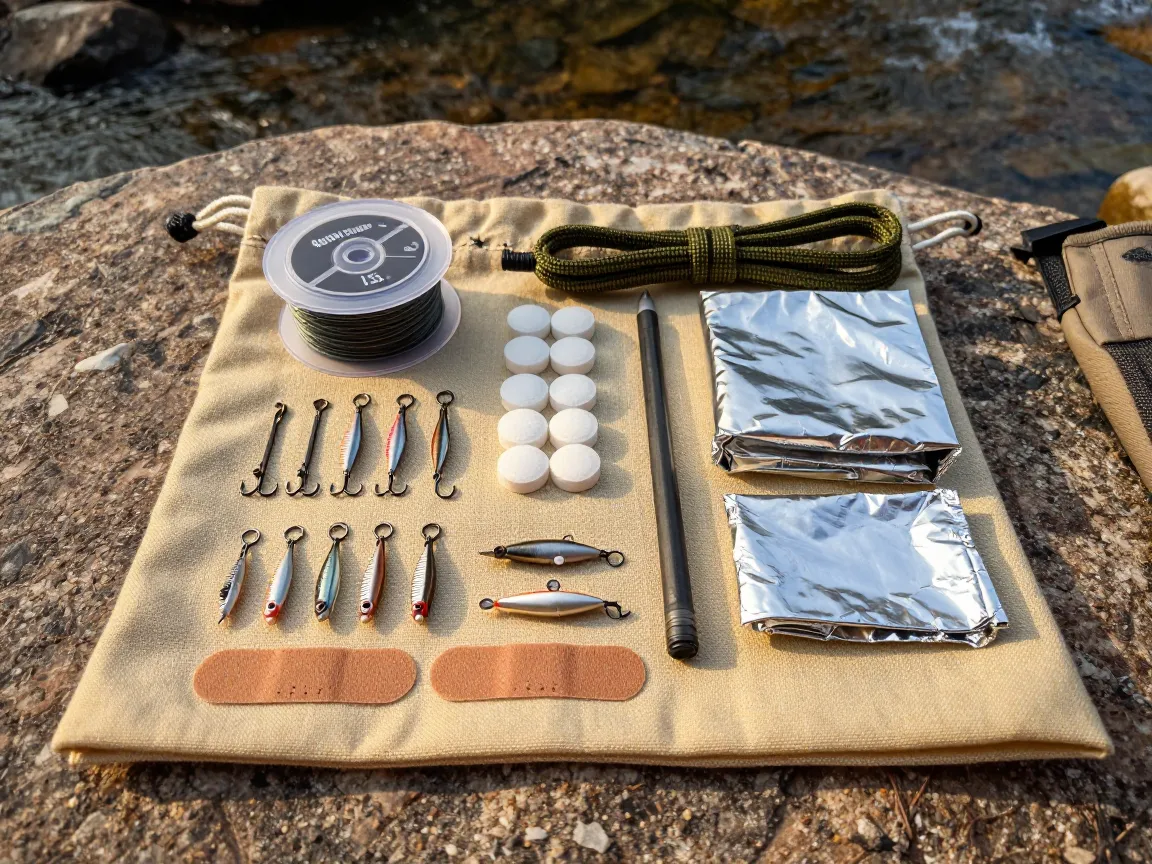
The drawstring pouch format, using a small canvas or waxed-cotton bag roughly four inches by five inches, is the least restricted by internal geometry. Unlike tins or tubes, a pouch can hold oddly shaped items without wasted air space, and it can be compressed flat when empty to stow inside a dry bag. This makes it the best container for anglers who also want to include non-flat items like a compact multi-tool, a small headlamp, or a folded rain poncho alongside the fishing and survival basics.
Build the survival fishing core with 40 feet of 20-pound braided line on a small plastic card winder, eight to ten hooks across sizes 2 through 12, six split-shot sinkers, two swivels, three small inline spinners (they’re flat enough to stack), and four water purification tablets. Add a full ferro rod, a folded Mylar blanket, two feet of paracord, and a folded sheet of aluminum foil. Then use the extra space the pouch format provides: include a Leatherman Squirt or a comparable micro multi-tool, a small strip of moleskin for blister management, and two butterfly bandage strips.
The first-aid additions reflect a real pattern in angler gift guides for 2026, where items like pocket first-aid kits and multi-tools consistently appear alongside survival fishing gear. Combining them into one pouch creates something a commercial kit never does: a single gift that an angler might actually open and use on a weekend trip. The drawstring pouch is the most gift-ready format of the six, because it looks intentional rather than improvised. Use a bag with a drawstring stopper and a small label sewn to the outside listing the contents. That label turns a bag of parts into a tool someone trusts on water.
Quick Comparison
| Kit Format | Best For | Water Resistance | Fishing Capacity | Approx. Size |
|---|---|---|---|---|
| Altoids Tin | Shirt pocket carry | Low (not sealed) | Moderate | 3.75 x 2.25 x 0.9 in |
| Cigar Tube | Lanyard or rod pocket | High (capped) | Moderate | 6 x 1 in |
| Prescription Bottle | Vest pocket, kayak anglers | High (threaded) | Moderate | 2.5 x 1.25 in |
| Flat Wallet | Ultralight carry | Low | Minimal-moderate | Credit card footprint |
| Waterproof Hard Case | Backcountry multi-day | Very high (O-ring) | High (gill net) | 4 x 3 x 1.5 in |
| Drawstring Pouch | Gift-ready, modular | Low (add dry bag) | High | 4 x 5 in |
Conclusion
Every format above starts from the same logic: a DIY kit built for a specific angler, using a container that fits their actual carry habit, will outperform any generic commercial kit at the same price point. The survival fishing kit category has matured enough in 2026 that there’s no shortage of off-the-shelf options, and they’re all adequate. Adequate isn’t the goal here.
If you’re building one of these as a gift, pick the format that matches how the recipient actually fishes. A fly fisher in a vest gets the prescription bottle or wallet. A canoe tripper gets the hard case with the gill net. Someone who wants everything in one place gets the drawstring pouch. Match the container to the person, check the contents against the fire-shelter-water-food framework, and label what’s inside. That last step is what separates a thoughtful gift from a pile of small parts.