Ancient Survival Skills Modern Anglers Can Still Use Today
Roughly 90% of recreational anglers depend entirely on manufactured gear, rods, reels, monofilament, and fish finders, yet the fish were there long before any of it existed, and so were the methods for catching them. The 6 ancient survival skills modern anglers can still use today are not museum pieces or bushcraft novelty acts. They are field-tested techniques that fed entire communities for thousands of years, and they remain fully functional right now, whether you’re stranded without gear or simply want a deeper connection to what fishing actually is.
Disclosure: This post contains affiliate links. As an Amazon Associate, we earn from qualifying purchases, and at no extra cost to you.
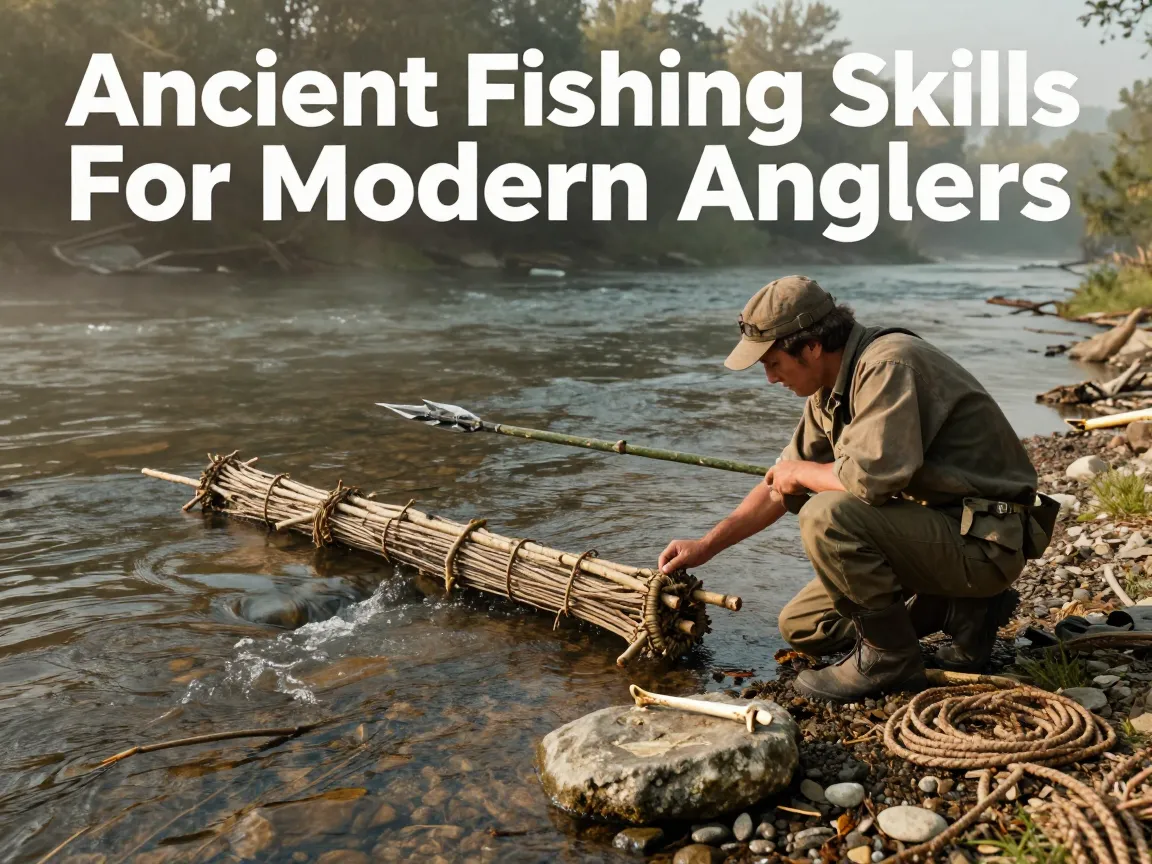
Knowing these skills also changes how you read water and think about fish behavior. Anglers who train with primitive methods tend to notice things electronics miss.
Key Takeaways
- Bare-hand fishing, fish traps, spearfishing, net-making, primitive hook-crafting, and water-reading are the six core ancient techniques most applicable to modern anglers.
- Each skill works as a backup when commercial tackle is unavailable, lost, or broken.
- Passive systems like weirs and trotlines continue producing food while you attend to other tasks, a principle as useful in a survival scenario as in a base-camp fishing setup.
- Primitive methods often produce less bycatch and lower environmental impact than high-tech alternatives.
- Practicing these techniques in normal conditions is the only reliable way to use them when conditions are not normal.
1. Bare-Hand Fishing and Noodling
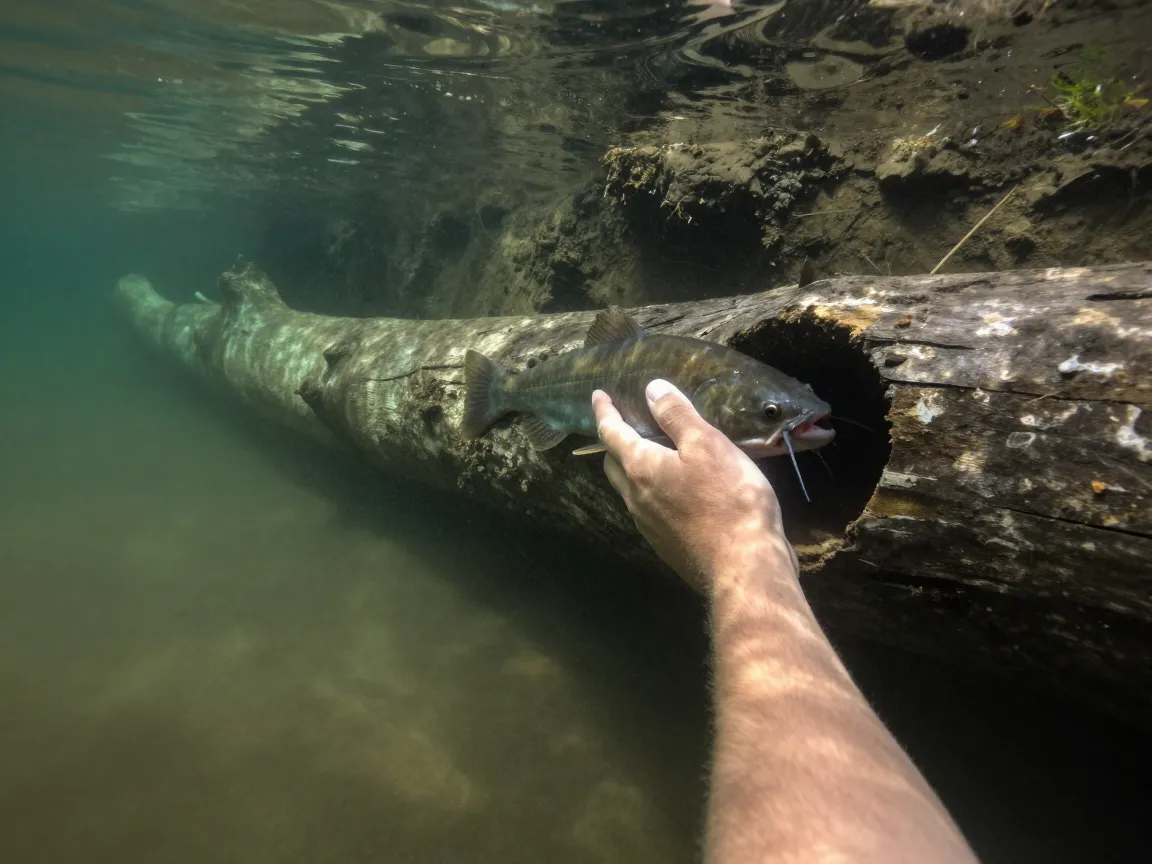
Few fishing methods are older or more direct than reaching into the water and pulling out a fish. Noodling, the practice of locating catfish resting in submerged holes or under undercut banks, then inserting a hand or arm to provoke a bite and extract the fish, has been practiced across North America, parts of Asia, and Europe for as long as there have been people near rivers. Flathead catfish and channel catfish are the primary targets in North American contexts because both species guard nest sites aggressively and will clamp onto an intruding hand, giving the angler a grip point.
The technique demands specific preparation. Catfish nest sites are typically located in hollow logs, undercut clay banks, or spaces beneath submerged rocks in slow or still water between late spring and midsummer. You probe slowly, feel for the fish’s body or the resistance of a guarding posture, then secure your grip around the lower jaw or through the gills before pulling. The main safety concerns are real: snapping turtles and water moccasins use the same types of shelter, and a submerged angler in murky water may not immediately identify what they’ve contacted. Working with a partner, moving slowly, and probing with a stick before inserting a hand reduces those risks significantly.
For modern anglers, noodling is most relevant in a gear-loss scenario, a capsized canoe, a flooded campsite, tackle lost to a snag. It requires no equipment whatsoever. Practicing it legally (noodling regulations vary by state and country) in normal conditions builds the tactile sense and spatial awareness that makes it viable under stress. It’s also a physical reminder that fish location knowledge matters more than tackle.
2. Building Fish Traps and Weirs
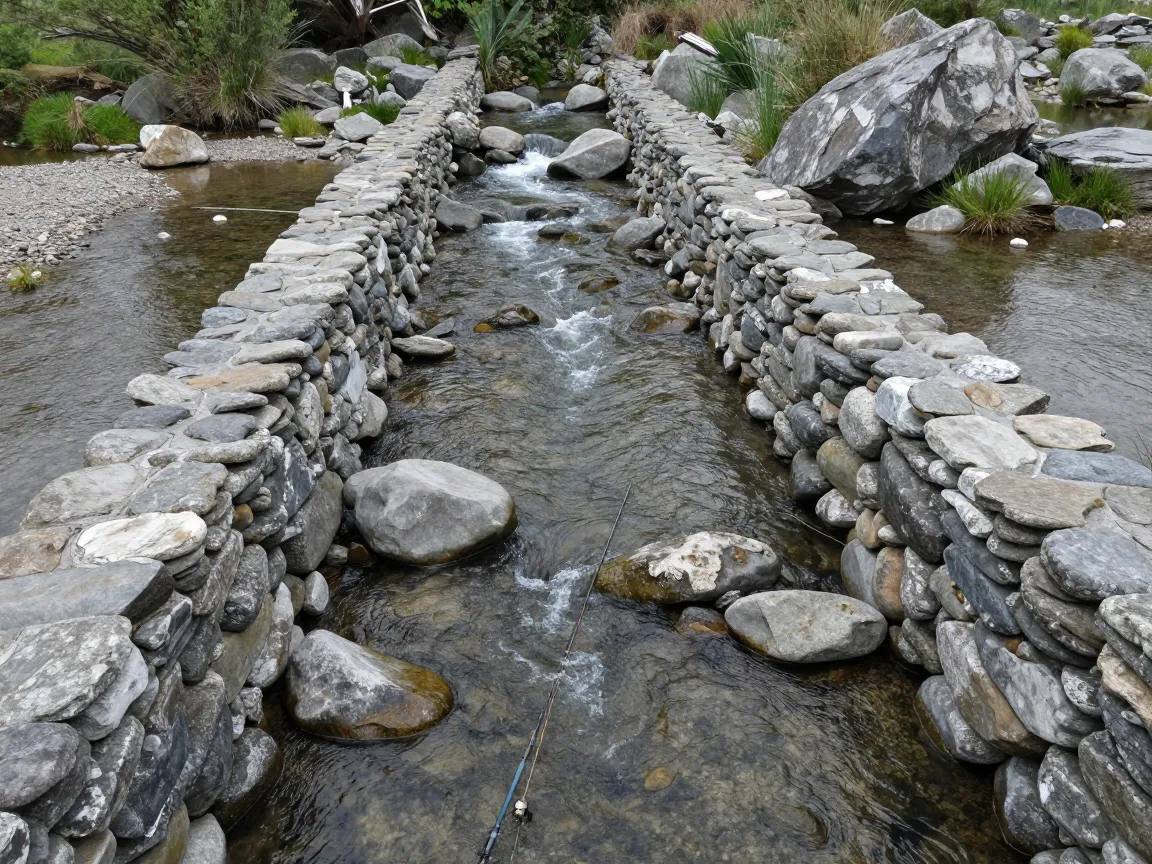
A fish weir is essentially a fixed funnel. Stone walls, woven branch fences, or combinations of both are arranged across a stream or along a shoreline to guide fish into an enclosed area from which escape is difficult. Archaeological weir sites in coastal Maine date back roughly 5,000 years. Similar structures appear in ancient Irish tidal zones, Hawaiian fishponds, and Southeast Asian river systems. The design principle is identical across all of them: use current and fish movement habits against the fish.
Construction follows the water. In a stream, you identify a natural narrowing, place two angled stone or branch walls that converge downstream, and leave a small opening at the apex where fish moving upstream get funneled in but struggle to find the exit moving back downstream. In tidal zones, the structure fills with fish on the incoming tide and strands them as the tide recedes. The investment is an hour or two of labor; the return is a passive harvest that continues while the builder does other things.
For a modern angler in a survival situation, even a rough approximation of this structure, rocks stacked into two rough lines in a knee-deep stream, with a narrowing gap, can trap small fish overnight. The key is reading flow direction correctly and placing the opening so that upstream-traveling fish swim directly into the funnel. In non-emergency backcountry trips, understanding weir logic sharpens your ability to identify natural fish funnels that exist without any construction: the gap between two boulders, the mouth of a tributary, the inside bend of a channel.
3. Spearfishing with a Primitive Spear
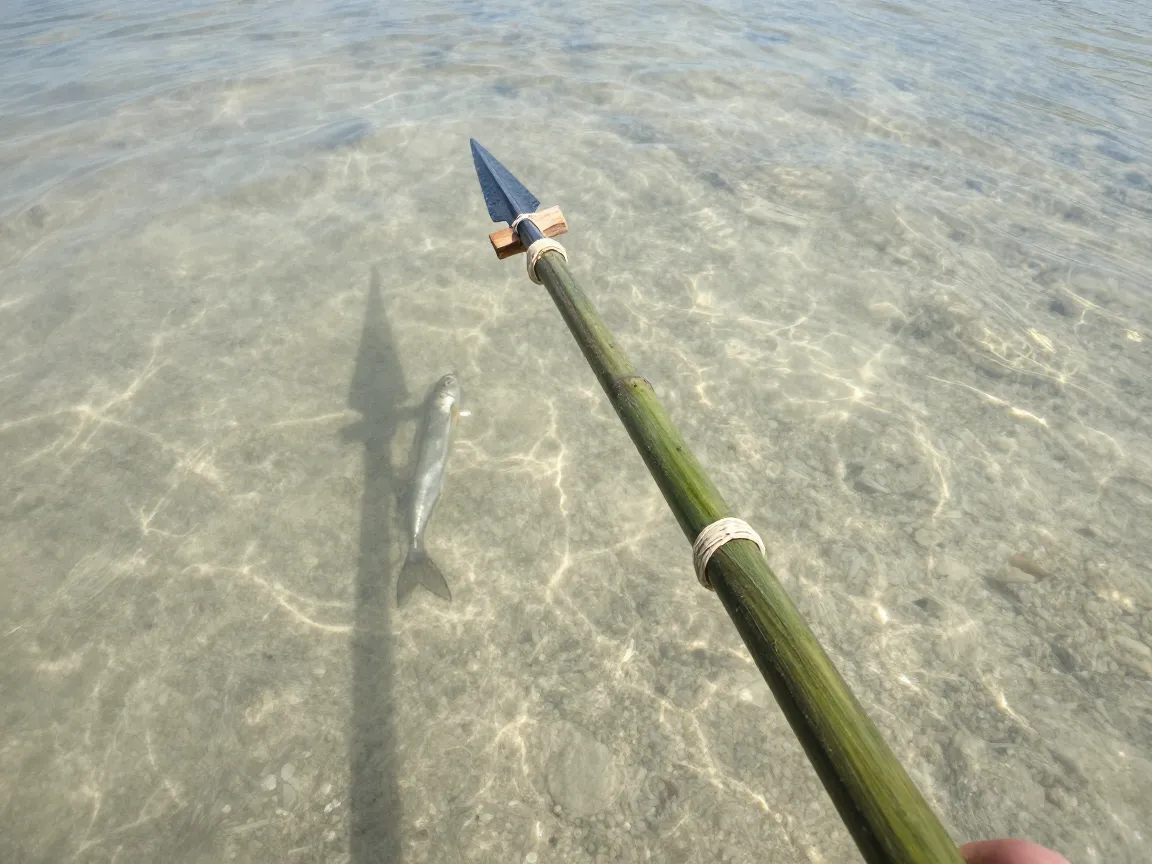
Spearfishing predates the hook by a significant margin. Bone and wooden spear tips used for fishing have been found at sites dating back over 16,000 years. The functional requirements of a fish spear haven’t changed: a straight, rigid shaft, a sharpened point (or multiple tines spread slightly apart to increase the strike zone), and enough mass to push through water resistance without deflecting off course.
In a survival context, a serviceable fish spear can be made from a straight green-wood sapling roughly six feet long and one inch in diameter. The working end is sharpened to a point with a knife or sharp rock, then hardened briefly in fire embers (not flames). A forked or multi-tine version is cut by splitting the tip four to six inches and spreading the tines with a small wedge of wood, lashing the base of the split to prevent it from traveling further up the shaft. Multi-tine spears increase the probability of a successful strike.
The critical physics issue is water refraction. Light bends as it crosses the air-water boundary, which means a fish appears to be slightly higher and closer to you than it actually is. The practical correction is to aim lower than the visual target by roughly one to two hand-widths at a depth of two to three feet, depending on your angle. This adjustment is learned through repetition, not formula. Clear, shallow water over a light-colored substrate, sandy shallows, light gravel bars, slow flats, gives the best conditions. Murky water, deep water, and bright overhead sun (which creates surface glare) all reduce effectiveness significantly.
4. Weaving and Casting Nets
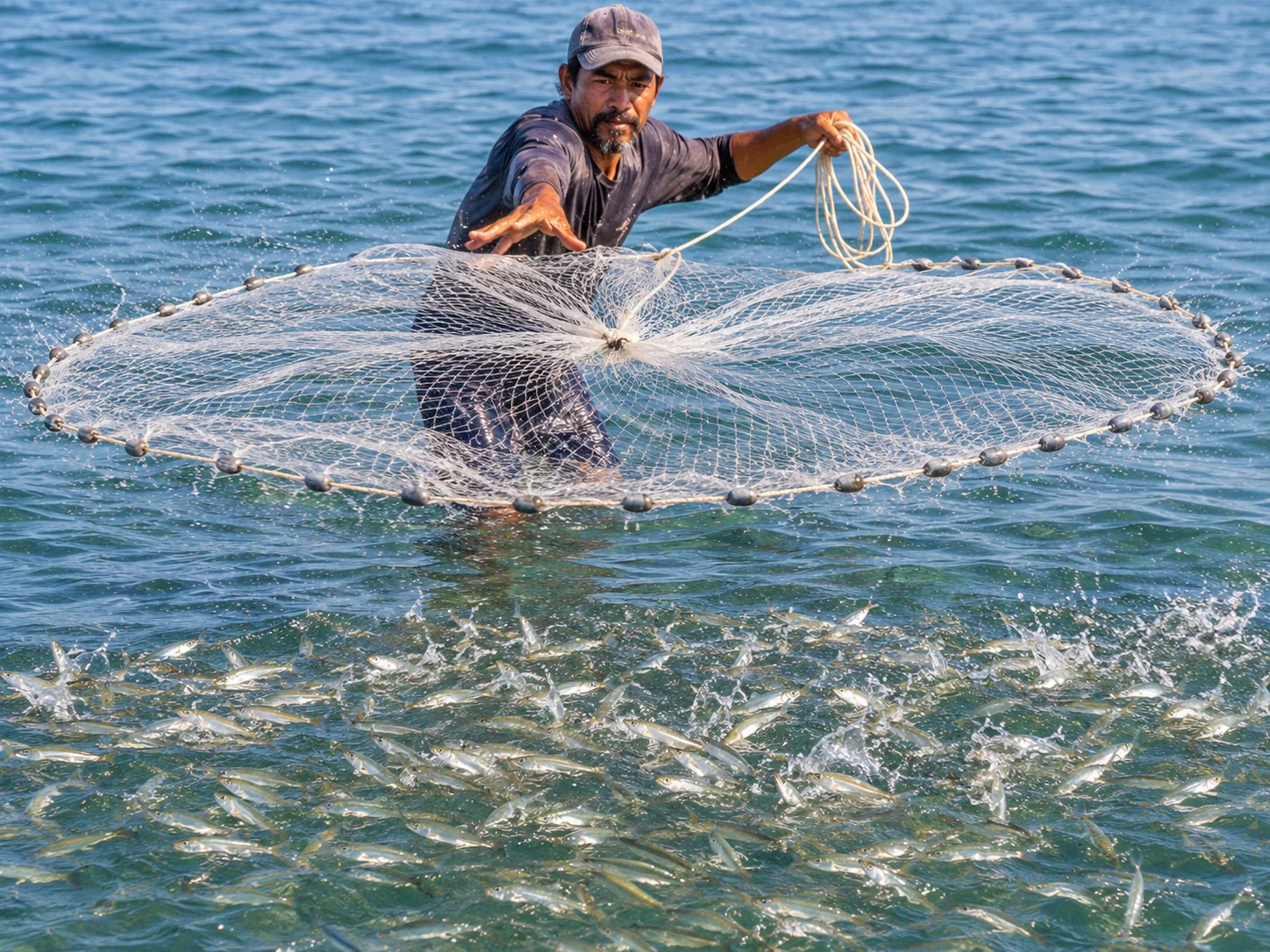
Net-making is a weaving skill, and the evidence for it goes back at least 10,000 years, with knotted fiber net fragments recovered from Neolithic sites across northern Europe. Cast nets, circular nets with weighted edges thrown to spread over a school of fish and then drawn closed, appear in ancient Egyptian tomb paintings and are still the primary small-scale fishing tool in large parts of Southeast Asia and Central America.
A basic cast net can be made from natural cordage or salvaged material in a survival scenario, though the geometry of the spacing, the weight distribution along the perimeter, and the draw-line configuration all affect how well it opens and closes. Commercially available cast nets range from four to twelve feet in radius and are measured by their throw diameter. Learning to throw one correctly takes practice: you hold the main line in one hand, drape a portion of the net over your throwing arm, and release with a rotational motion that spreads the net into a flat disc before the weighted edge hits the water. A poorly thrown net collapses into a tangled mass and catches nothing.
For modern anglers, cast netting is immediately useful for collecting live bait, shad, mullet, shiners, and similar schooling baitfish, in situations where rod-and-reel bait fishing is impractical or slow. It’s also a highly efficient food-gathering method in a survival scenario: one good throw over a visible school can yield five to twenty fish at once. Some freshwater regulations prohibit cast netting for game species but permit it for baitfish; checking local rules before practicing is necessary.
5. Crafting Primitive Hooks and Hand Lines from Natural Materials
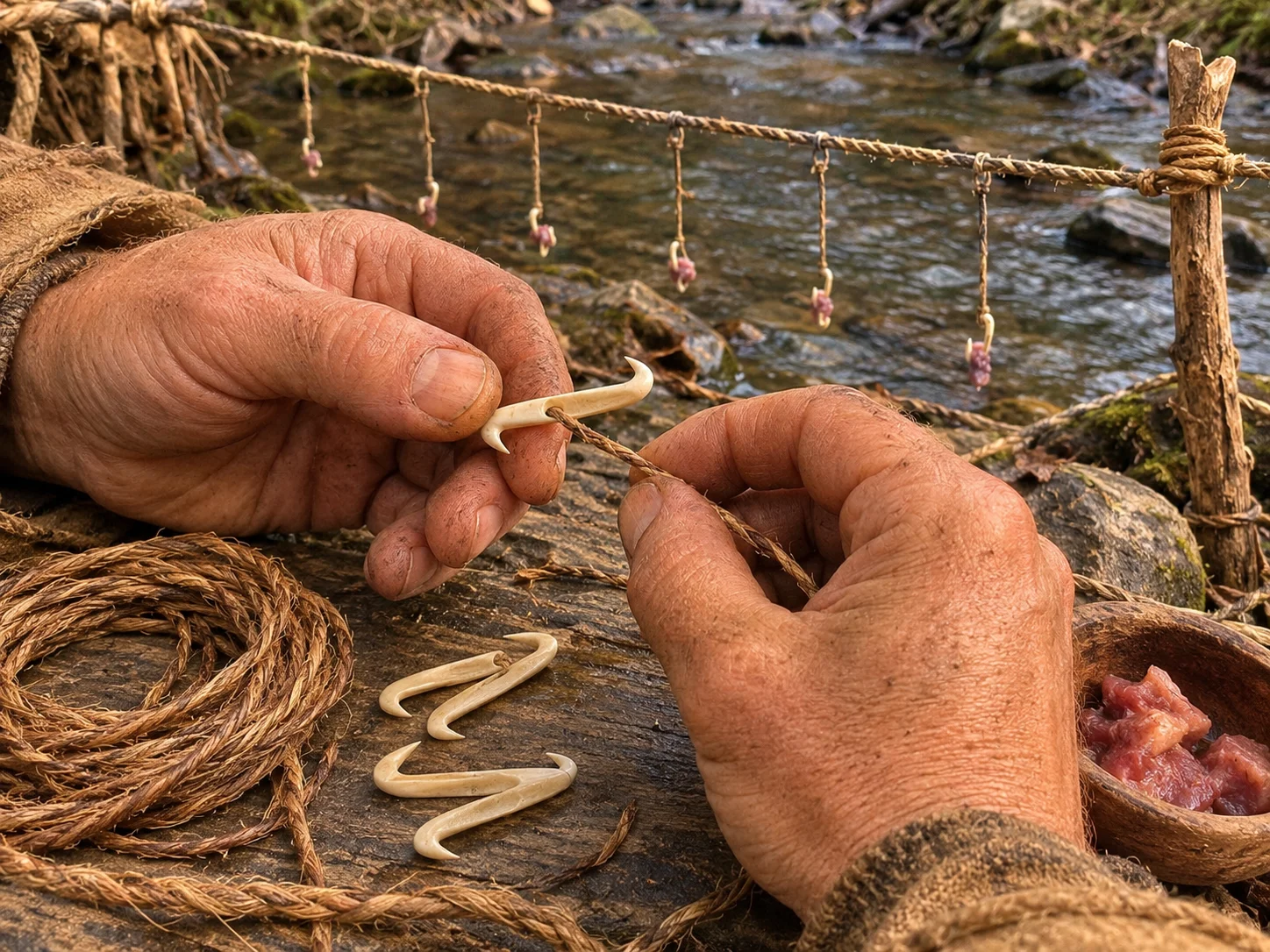
The gorge hook is older than the bent hook. It’s a straight or slightly tapered piece of bone, hardwood, or metal, sharpened at both ends and notched in the middle to accept cordage. Rather than catching on the inside of a fish’s mouth by its curve, it lodges sideways in the throat when the fish swallows it and the line is pulled taut. Gorge hooks made from bird bone, deer bone, and dense hardwoods appear at fishing sites dating back 23,000 years in what is now Timor in Southeast Asia.
Making a functional gorge hook requires a piece of hard material about one inch long and roughly an eighth of an inch in diameter. Both ends are sharpened to a point. A center groove is cut or notched to hold the cordage. The hook is baited, the line given a little slack, and the angler waits until the fish has fully taken the bait before pulling the line tight. Bent hooks can also be fashioned from thorns, bone shaped with a stone, bent wire, or hardwood carved with a knife.
The hand line itself, a length of cordage with a hook at one end and a weight to sink it, requires no rod, reel, or manufactured component. Inner bark fibers from basswood, stinging nettle stems, or dogbane yield serviceable cordage when twisted. For modern anglers, understanding this system is valuable for two reasons. First, it works as a backup when all manufactured tackle is gone. Second, working through the construction process teaches you which features of a hook actually matter for function versus which are design preferences, which makes you better at selecting and rigging commercial hooks too.
Trotlines and set-lines extend the same principle into passive fishing. A trotline is a long main line anchored at both ends across a channel or along a bank, with multiple shorter drop lines holding baited hooks at intervals. Ancient cultures across North America and Asia used trotline equivalents for consistent, unattended harvest. A trotline set overnight in a productive channel can be more effective than four hours of active rod fishing in the same location.
6. Reading Water and Ecosystems Without Electronics
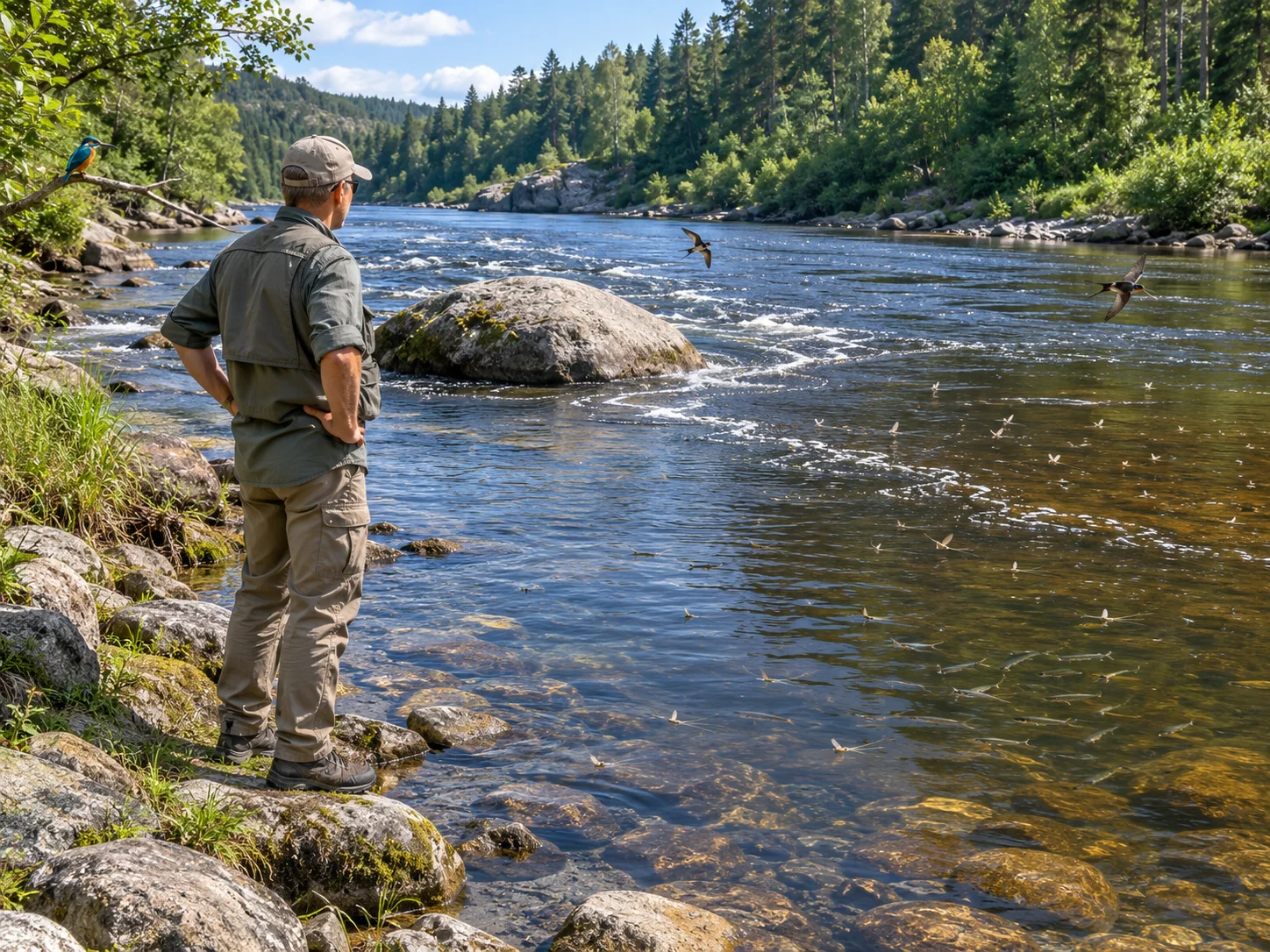
Before depth finders, thermometers, GPS waypoints, and satellite maps, anglers located fish by reading the water itself. The skills this required are still the most transferable of any entry on this list because they apply whether you have a modern bass boat or a stick.
Current breaks are the foundation. Fish conserve energy by holding in slow or still water directly adjacent to fast current, which delivers food to them. The downstream edge of a large boulder, the inside bend of a river curve, the calm pocket behind a logjam, these are holding lies that require no electronics to find. You read surface texture: smooth water behind an obstruction, the seam line where fast and slow water meet, foam lines that indicate subsurface current convergence. Baitfish and invertebrates concentrate along those same seams, and predators follow.
Insect activity is a reliable indicator of feeding behavior. A hatch of mayflies or caddisflies visible on the surface means trout and panfish are likely feeding at or near the top. Swallows and other aerial insect feeders working low over the water confirm insect activity even before you can see individual bugs. Amphibians at the water’s edge, kingfishers perched and watching a specific bank, the nervous scatter of small baitfish across a flat, each is data.
Water color and clarity tell you something about upstream conditions and bottom composition. Stained water from tannins in a swampy drainage holds different species in different zones than clear spring-fed water. Sudden turbidity after rain pushes fish to cleaner tributaries. Reading these indicators takes time to develop, but anglers who invest in that observation consistently find fish in unfamiliar water faster than those who rely exclusively on electronics, especially after technology fails or batteries die in a critical moment.
Quick Comparison
| Skill | Gear Required | Active or Passive | Best Emergency Use |
|---|---|---|---|
| Bare-hand / noodling | None | Active | Gear-loss survival |
| Fish traps and weirs | Stones, branches | Passive | Multi-day camp food |
| Primitive spearfishing | Sharpened stick | Active | Shallow clear water |
| Cast and hand nets | Cordage or salvaged line | Active / Passive | Baitfish or schooling fish |
| Gorge hooks and trotlines | Natural cordage, bone or wire | Passive | Overnight food production |
| Ecosystem reading | None | Active (observational) | Any unfamiliar water |
Conclusion
The most practical next step is to pick one skill from this list and practice it in a low-stakes setting before you need it. Build a rough weir across a shallow creek on a camping trip. Throw a cast net for bait before the next time you launch the boat. Spend one morning fishing a new stretch of river without looking at a sonar screen. Each session builds a capability that no gear purchase can replicate, and it sharpens the foundational observation skills that make every other method, ancient or modern, more effective.