9 Best Kayak Fishing Accessories Every Angler Should Own
Kayak fishing participation in North America has grown by more than 30 percent over the past decade, yet surveys consistently show that most anglers hit the water with fewer than half the accessories that would meaningfully improve their catch rate and safety. The difference between a frustrating outing and a productive one often comes down to gear, not the kayak itself, but the accessories mounted on it, stowed inside it, and clipped to it. This guide covers the 9 best kayak fishing accessories every angler should own, breaking down what each item does, why it matters, and what to look for when choosing one.
Disclosure: This post contains affiliate links. As an Amazon Associate, we earn from qualifying purchases, and at no extra cost to you.
Whether you fish calm reservoirs, tidal flats, or moving rivers, the right accessories transform a bare hull into a functional fishing platform. Every item on this list has been selected based on practical impact, safety value, and versatility across different kayak styles and fishing environments.
Key Takeaways
- Safety accessories, a properly fitted PFD and a paddle leash, are non-negotiable before any other gear purchase.
- A quality fish finder dramatically increases strike rates by eliminating guesswork about depth, structure, and fish location.
- Rod holders, anchor systems, and tackle storage are the three organizational pillars of an efficient kayak fishing setup.
- Waterproof protection for electronics and personal items prevents costly losses and keeps critical gear functional.
- Investing in the right accessories once is far more cost-effective than replacing damaged gear or losing fish due to poor rigging.
Why the Right Accessories Define Your Time on the Water
A kayak is a platform. On its own, it floats and moves, but it does not fish. The accessories an angler chooses determine how efficiently they can cast, how safely they can navigate, how long they can stay comfortable, and ultimately how many fish they land. Choosing the wrong accessories, or skipping them entirely, creates friction at every stage of a fishing trip.
The 9 best kayak fishing accessories every angler should own address three core categories:
- Safety and control (PFD, paddle leash, anchor system)
- Fish-finding and navigation (fish finder, GPS)
- Organization and efficiency (rod holders, tackle storage, landing net, dry bags)
Each category builds on the others. Safety gear keeps the angler on the water. Fish-finding tools put them over fish. Organization gear lets them act quickly when a fish strikes.
The 9 Best Kayak Fishing Accessories Every Angler Should Own
1. Personal Flotation Device (PFD)
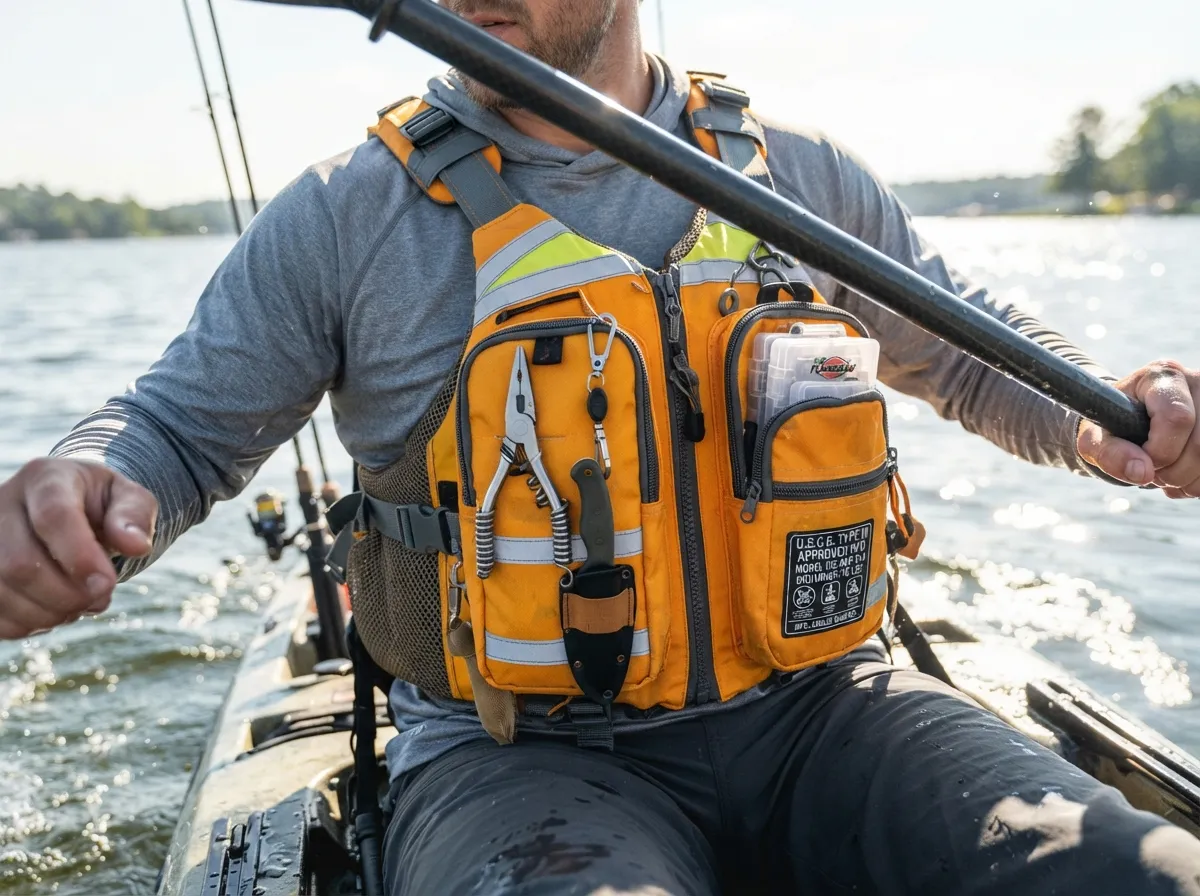
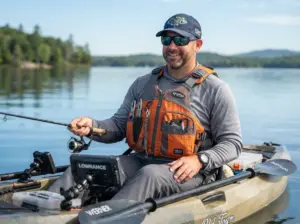
No accessory on this list matters more than a properly fitted personal flotation device. A PFD designed specifically for kayak fishing differs significantly from a standard life jacket. Fishing-specific PFDs feature low-profile foam panels that do not restrict paddling motion, multiple pockets for storing small tackle and tools, and attachment points for accessories like pliers holders and zingers.
What to look for:
- U.S. Coast Guard Type III or Type V certification
- Mesh back panel for ventilation during warm-weather paddling
- Front pockets sized for tackle boxes, pliers, and a knife
- Bright color or reflective strips for visibility
A PFD that fits poorly will not be worn consistently. Fit is as important as certification. Try on multiple models and paddle in them before purchasing. The best PFD is the one an angler actually wears on every trip.
“A PFD worn on the back seat of the kayak provides exactly zero protection. Fit, comfort, and habit are what make it effective.”
2. Fish Finder and Depth Sounder
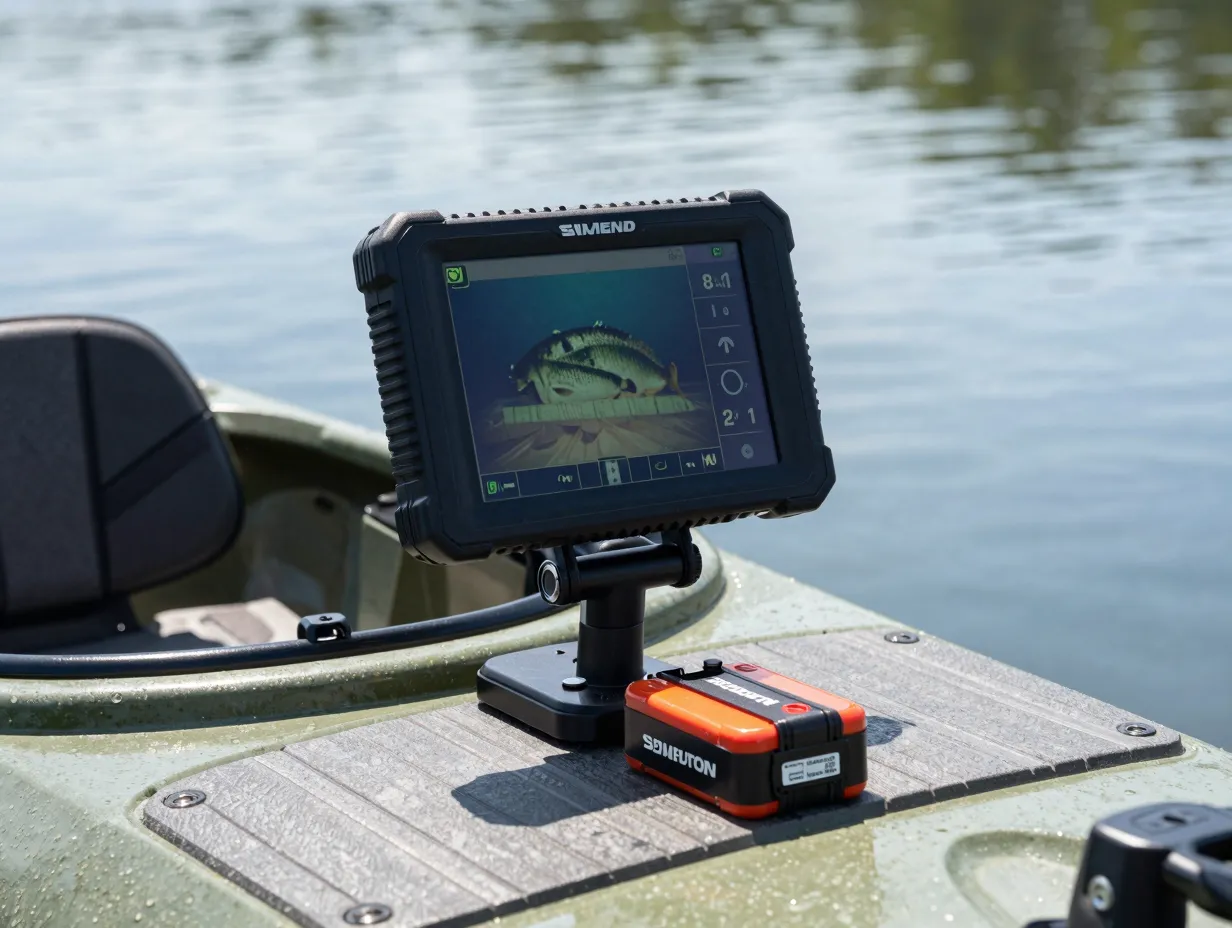
A fish finder is the single accessory that most dramatically changes catch rates for kayak anglers. Modern units designed for kayaks are compact, battery-efficient, and capable of displaying detailed sonar images of underwater structure, bottom composition, and fish arches.
Key features to evaluate:
| Feature | Why It Matters |
|---|---|
| Transducer type | Down imaging vs. side imaging vs. traditional 2D |
| Screen brightness | Readability in direct sunlight |
| Battery life | Longer sessions without recharging |
| GPS integration | Mark waypoints and navigate back to productive spots |
| Mountability | Compatible with standard RAM or track mounting systems |
Kayak-specific fish finders from brands like Garmin, Humminbird, and Lowrance offer models under 8 inches that run on small lithium batteries for 8 to 12 hours. For anglers targeting bass, crappie, walleye, or saltwater species over structure, a fish finder pays for itself in a single season of improved productivity.
Transducer placement is critical. Most kayak anglers mount the transducer inside the hull using a shoot-through installation, or externally on a scupper plug or transom mount. Each method has trade-offs in signal quality and drag.
3. Paddle Leash
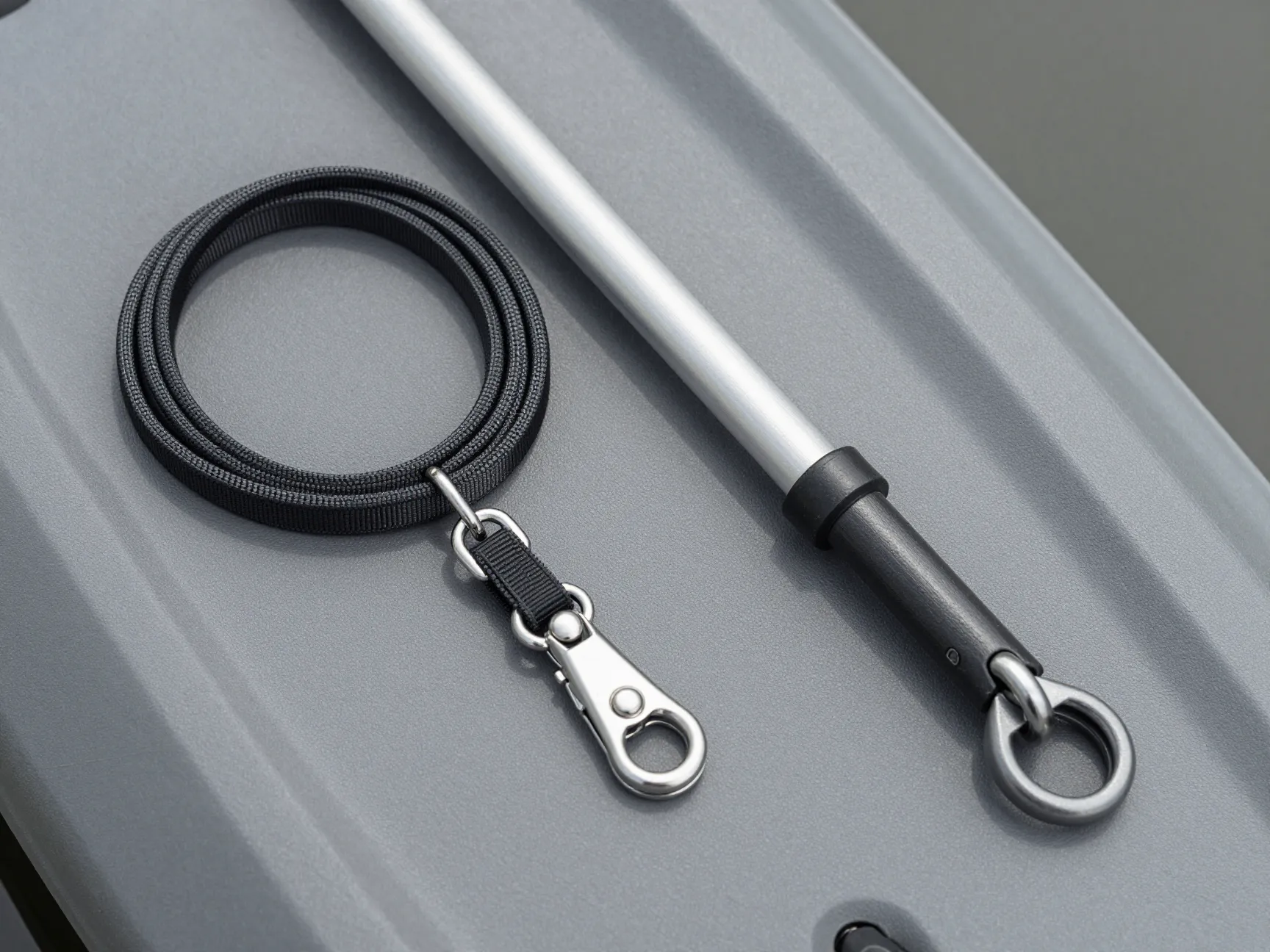
A paddle leash is a simple, inexpensive accessory that prevents one of the most common and dangerous situations in kayak fishing: a dropped paddle drifting away during a fight with a fish. Without a paddle, an angler is stranded, particularly in wind, current, or open water.
A quality paddle leash coils or retracts to stay out of the way when paddling, then extends fully when the paddle is set down to land a fish or rig a lure. Look for coiled designs with a secure clip on both ends, one for the paddle shaft and one for a D-ring or deck line on the kayak.
Features worth paying for:
- Coiled cord that does not tangle in gear
- Stainless or marine-grade clips that resist corrosion
- Length of at least 6 feet when extended
- Attachment points that do not interfere with the paddle stroke
At under $20 for most models, a paddle leash is the highest-value safety accessory per dollar on this list.
4. Rod Holders
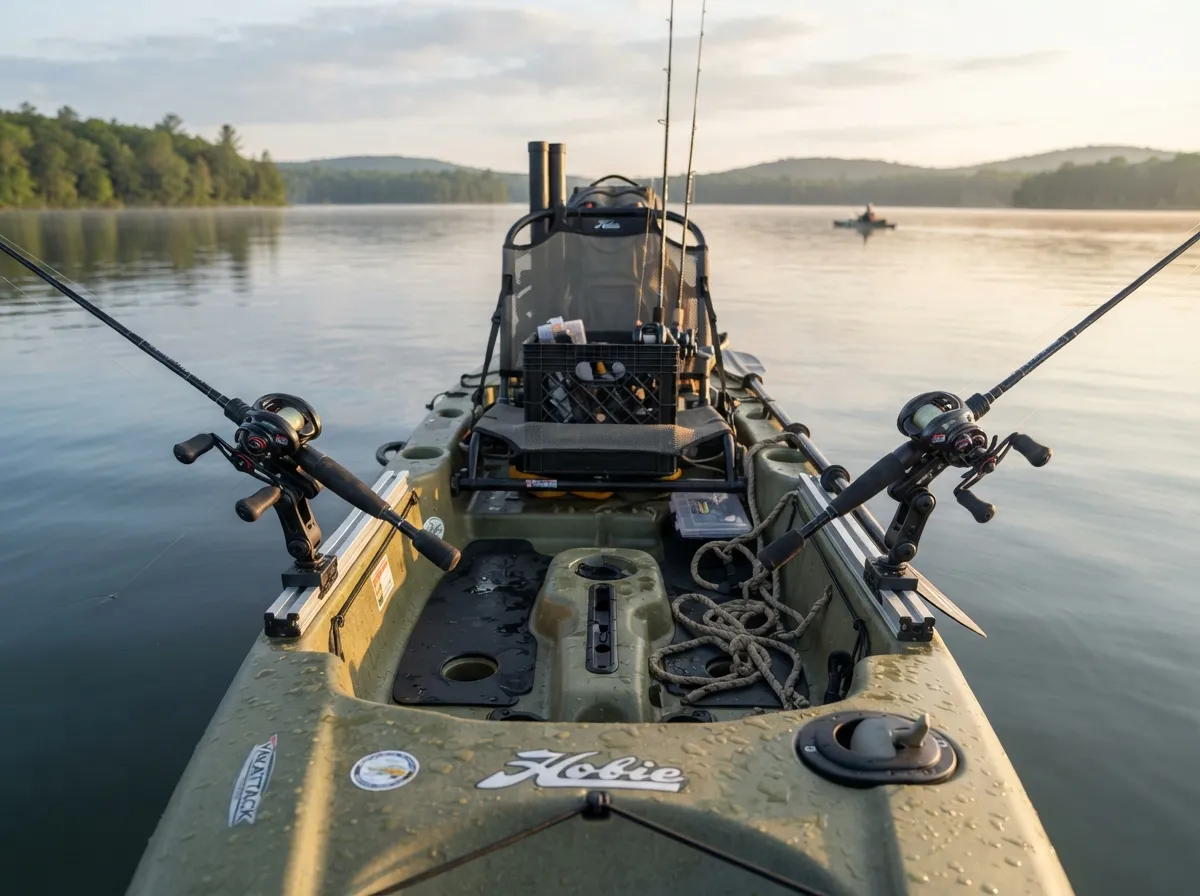
Rod holders are the organizational backbone of a kayak fishing setup. They keep rods secure during paddling, allow anglers to deploy multiple rods simultaneously for trolling or soaking bait, and free up hands for landing fish or managing the kayak.
There are two primary types:
Flush-mount rod holders are installed permanently into the kayak hull. They sit low and are hydrodynamically clean, but they require drilling and limit adjustability.
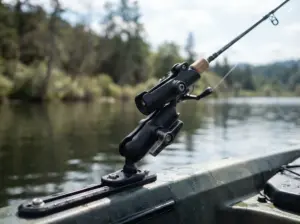
Adjustable track-mounted rod holders attach to Yakattack, YakGear, or similar accessory tracks and can be repositioned, angled, and removed without tools. These are preferred by most serious kayak anglers for their flexibility.
When selecting rod holders, consider:
- The rod types being used (spinning, baitcasting, fly)
- Whether trolling rods need to be angled outward
- The number of rods typically fished at once
- Compatibility with the kayak’s existing track or rail system
A minimum of two rod holders, one on each side, is a practical starting point. Serious multi-rod anglers often run four to six holders in various configurations.
5. Anchor Trolley System
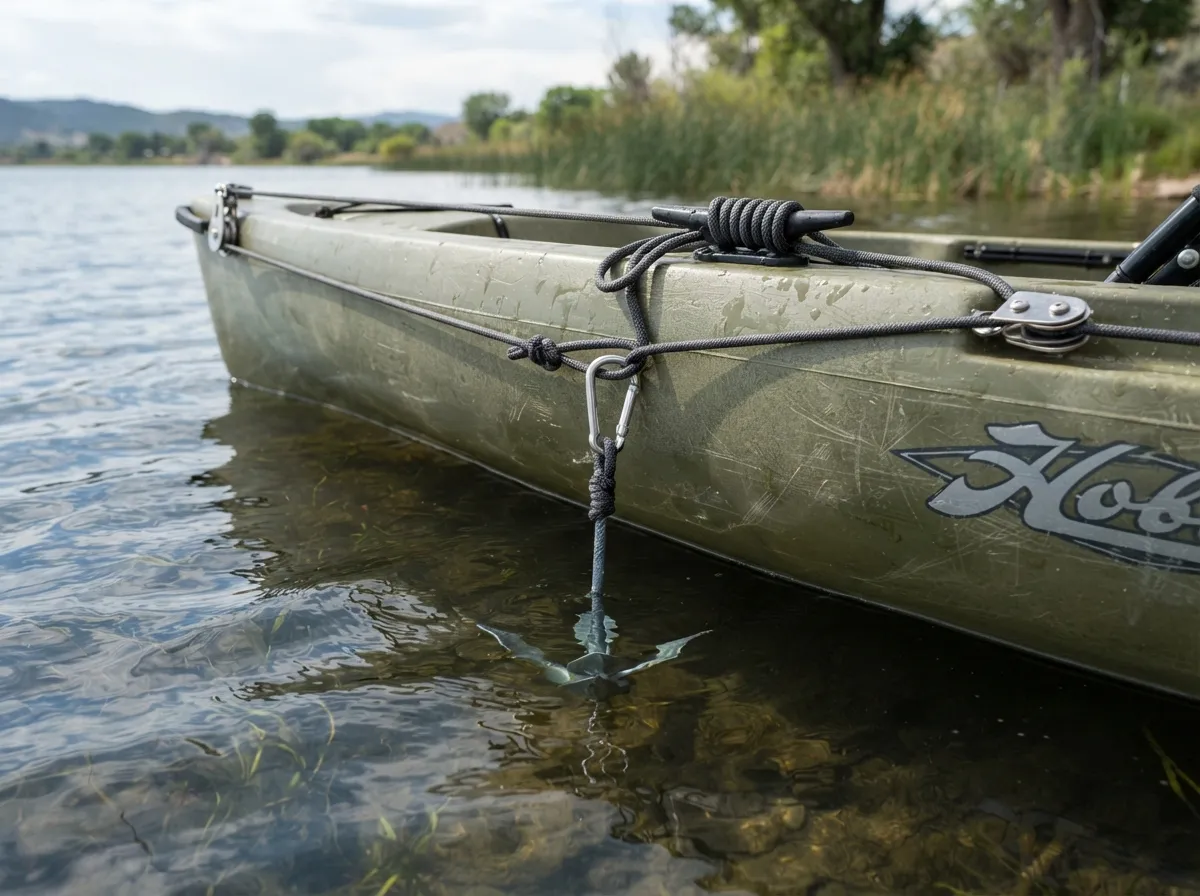
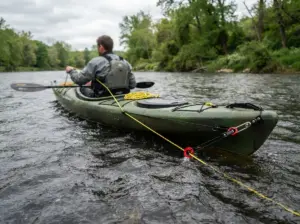
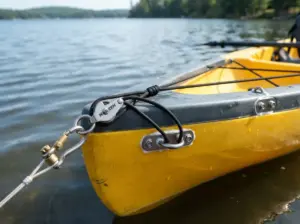
Holding position on a kayak without an anchor trolley is a constant battle against wind and current. An anchor trolley is a looped line running along the side of the kayak from bow to stern, threaded through a pulley at each end. A ring on the loop allows an angler to position the anchor point anywhere along the kayak’s length from the seat.
Why this matters: When the anchor is attached at the bow or stern, the kayak weathervanes into the wind and current, presenting the angler toward the structure or shoreline being fished. Moving the anchor point forward or aft changes the kayak’s angle without re-anchoring.
A complete anchor trolley kit includes:
- Two pulleys (bow and stern)
- Marine-grade line
- A carabiner or anchor ring
- A cleat or jam cleat for locking the position
Pair the trolley with a 1.5 to 3 lb folding grapnel anchor for most freshwater applications, or a heavier mushroom anchor for soft-bottom saltwater flats.
6. Tackle Storage System
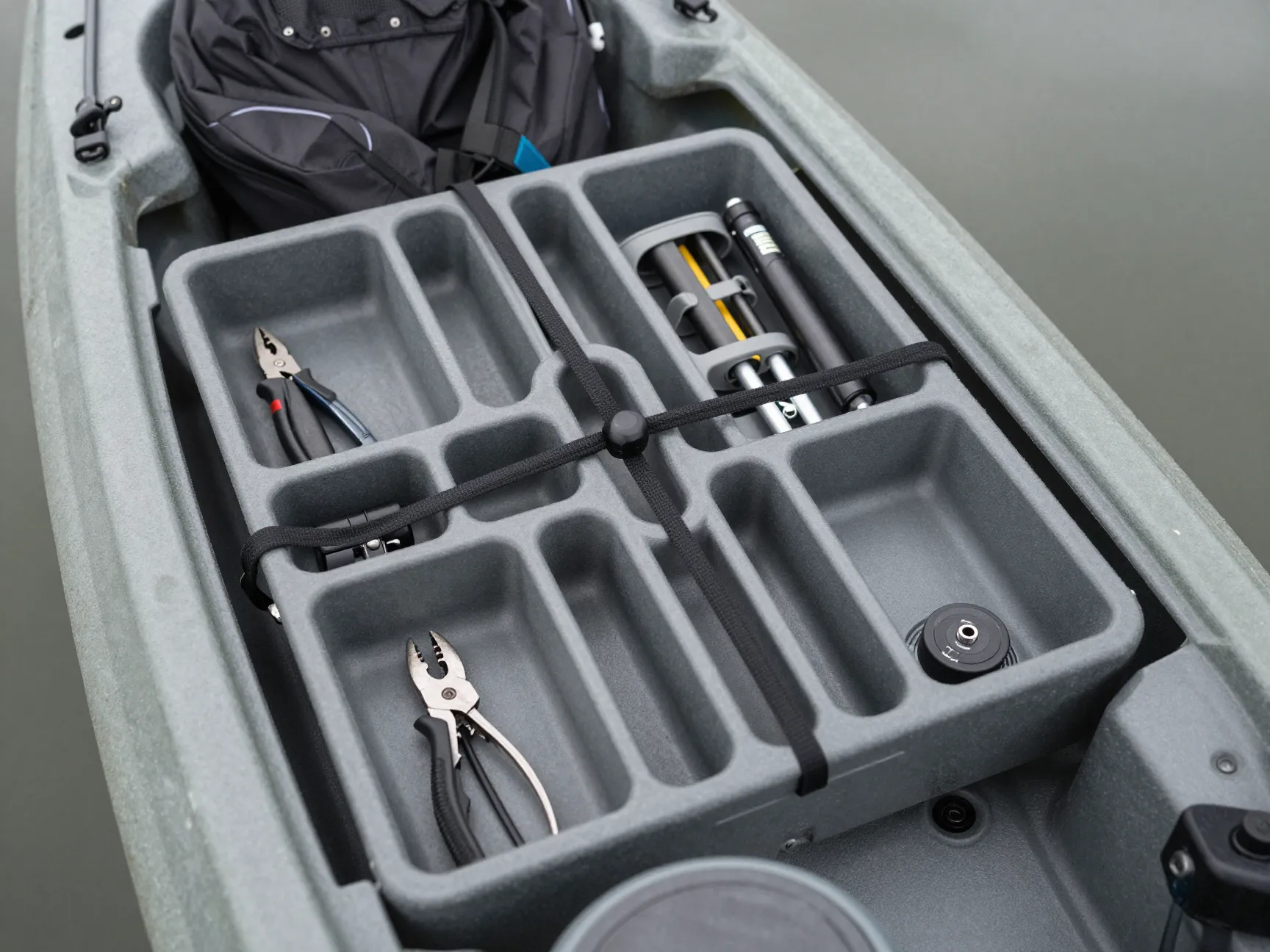
Efficient tackle storage is the difference between a productive fishing kayak and a cluttered, frustrating one. The confined space of a kayak demands a storage system that is organized, accessible, and secured against capsizing.
The most effective approach combines a crate system in the rear tank well with smaller tackle trays in front storage compartments.
Kayak crate systems (often made from milk crates or purpose-built polymer crates) sit in the rear tank well and hold rod tubes, tackle boxes, pliers, bait containers, and dry bags. They can be customized with rod holders, bag clips, and accessory mounts.
Waterproof tackle trays with adjustable dividers keep lures, hooks, weights, and terminal tackle organized and protected. Look for trays with gasket seals if they will be stored in wet compartments.
Key considerations:
- Weight distribution, keep heavier items low and centered
- Accessibility, frequently used items should be reachable without leaving the seat
- Security, bungee cords or straps prevent gear from floating away in a capsize
7. Waterproof Dry Bags and Cases
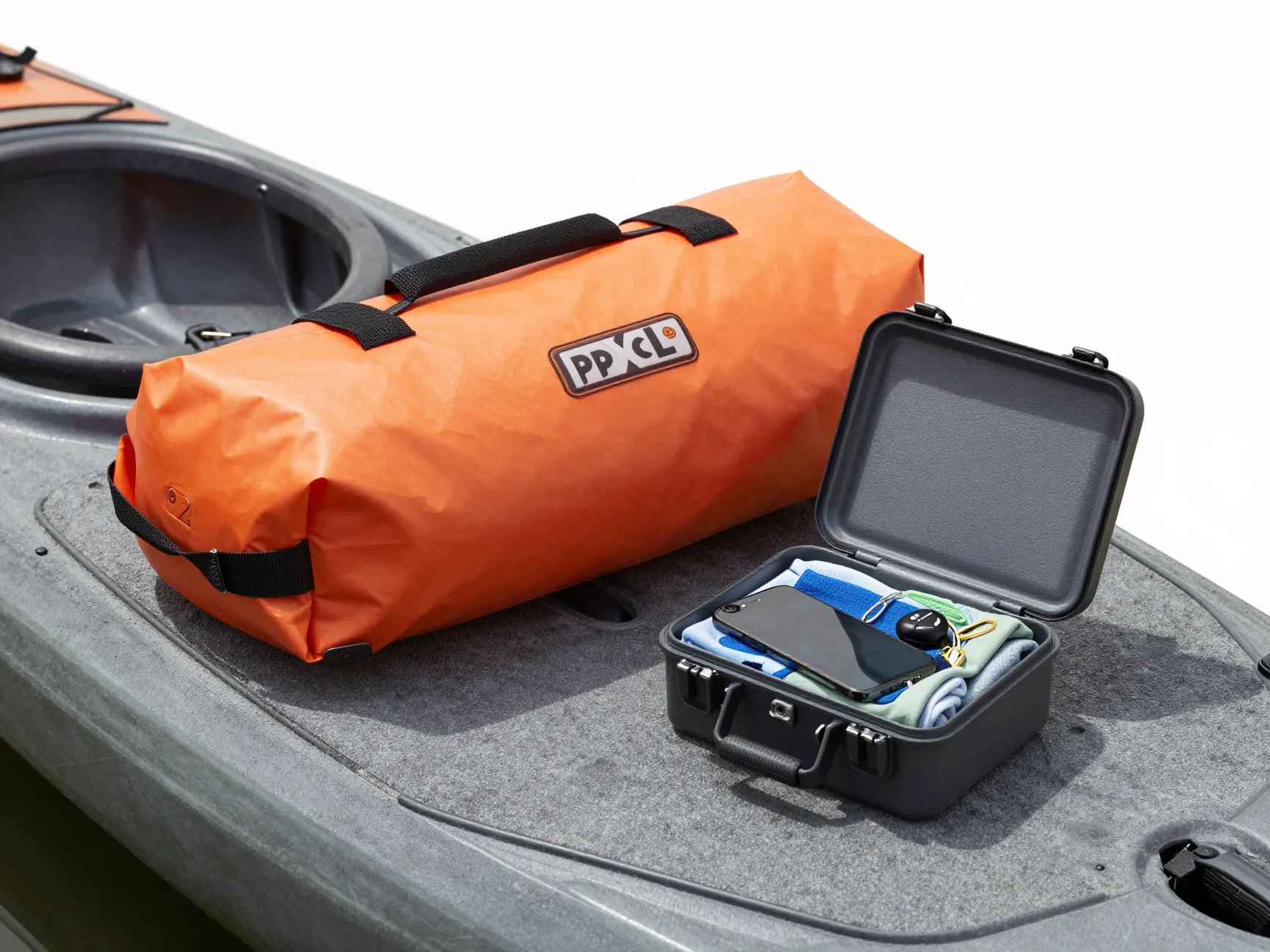
Electronics, keys, phones, wallets, and food all need protection from water on a kayak. Splash, rain, and the occasional capsize are realities of kayak fishing. Waterproof dry bags and hard cases are essential for protecting valuables and keeping gear functional.
Two-tier protection strategy:
- Soft dry bags (roll-top or zipper-seal) for clothing, food, and soft gear. Available in sizes from 2L to 30L. Look for IPX6 or IPX8 ratings for genuine waterproofing rather than water resistance.
- Hard waterproof cases (Pelican-style) for electronics, cameras, and documents. These offer crush resistance in addition to waterproofing.
For most kayak anglers, a 10L roll-top dry bag for personal items and a small hard case for a phone or backup GPS covers the essentials. Bright colors make dry bags easier to spot if they end up in the water.
“One capsize without a dry bag for a phone or car keys turns a great fishing trip into an expensive, stressful rescue operation.”
8. Kayak Landing Net
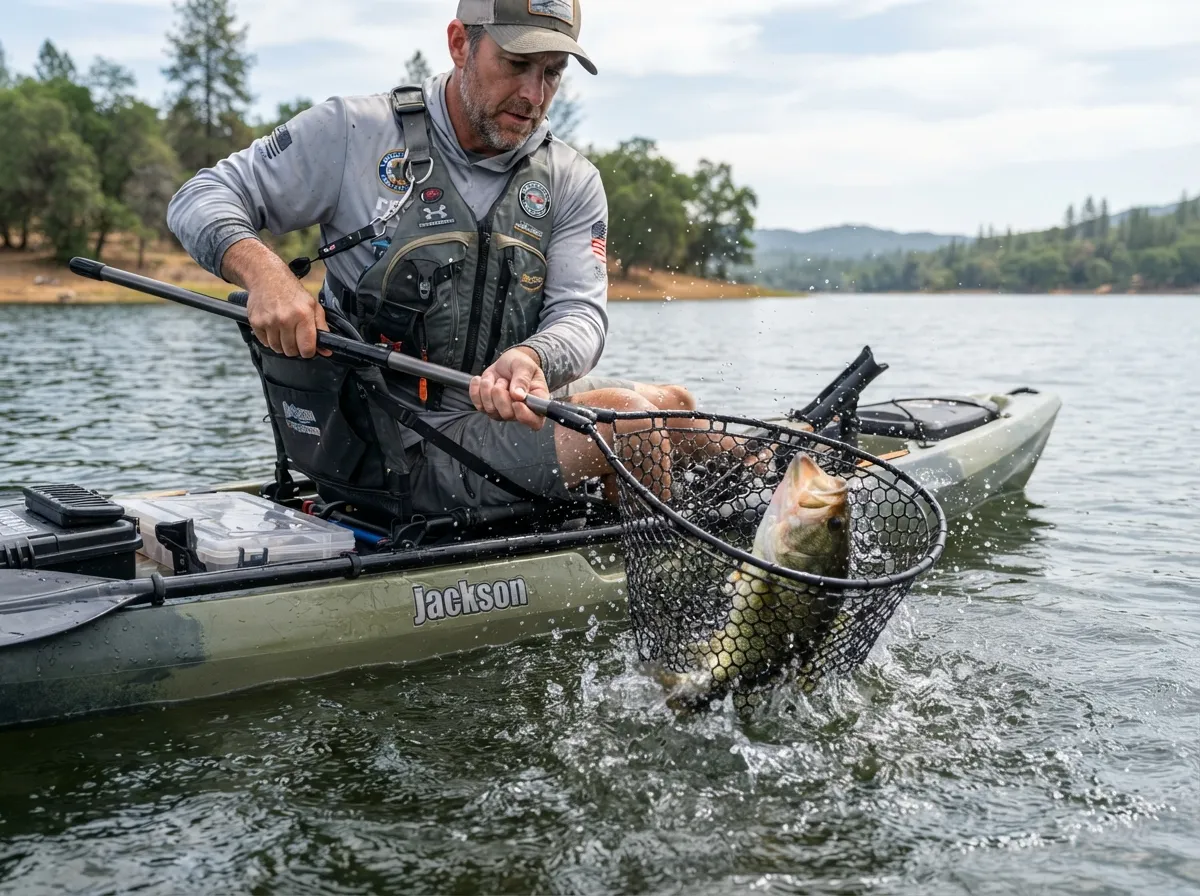
Landing fish from a kayak presents unique challenges. The angler is seated low to the water, the kayak is unstable when leaning to one side, and fish that are lip-grabbed can thrash and cause the angler to lose balance. A kayak-specific landing net solves all of these problems.
What makes a kayak net different from a standard net:
- Folding or telescoping handle that collapses for storage and extends for landing
- Rubber mesh that is gentle on fish slime coats and hook-friendly (hooks do not tangle in rubber mesh the way they do in nylon)
- Magnetic release system that clips the net to a D-ring on the PFD or kayak and releases with one hand when needed
Hoop size matters. For bass and walleye, a 18 to 22-inch hoop is adequate. For larger species like pike, muskie, or striped bass, a 24 to 30-inch hoop is more appropriate.
A landing net with a magnetic release on the PFD keeps the net accessible without cluttering the deck, and allows a one-handed release when both hands are occupied fighting a fish.
9. GPS Navigation Device or Mount
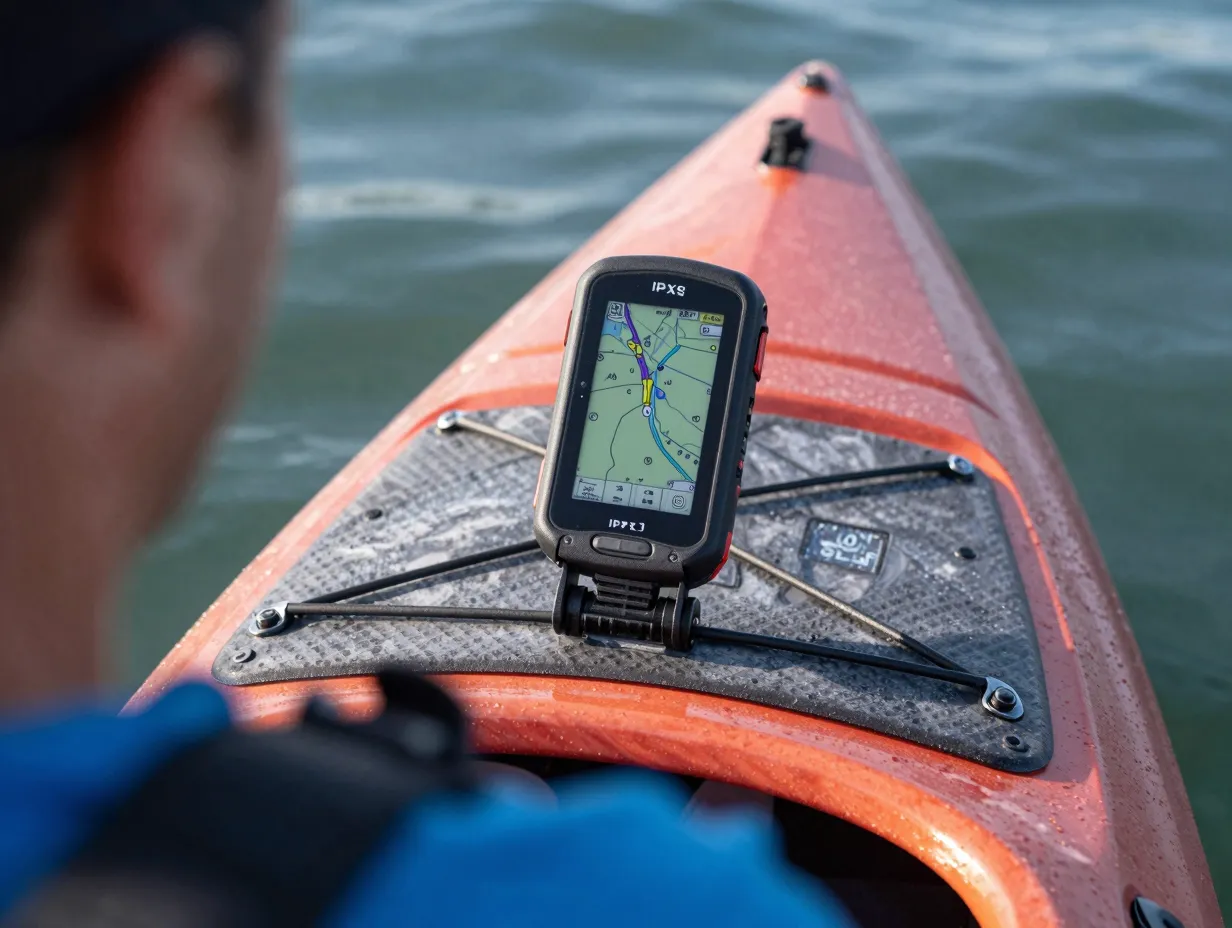
A dedicated GPS unit, or a secure mount for a GPS-capable smartphone, rounds out the 9 best kayak fishing accessories every angler should own. Navigation on open water, large reservoirs, coastal bays, or unfamiliar rivers requires reliable positioning that does not depend on cellular signal.
Dedicated GPS units offer advantages over smartphones:
- Waterproof construction (IPX7 or better)
- Preloaded topographic and nautical charts
- Longer battery life
- Sunlight-readable screens
Smartphone GPS mounts are a cost-effective alternative for anglers who fish in areas with reliable cell coverage and use apps like Navionics or onX Fish. A RAM mount or Scotty mount with a waterproof phone case provides a functional setup at a fraction of the cost of a dedicated unit.
Regardless of the device, marking waypoints for productive fishing spots, launch ramps, hazards, and return routes adds a layer of efficiency and safety that paper maps cannot match.
How to Prioritize These Accessories on a Budget
Not every angler can purchase all nine accessories at once. A practical purchasing sequence based on safety, impact, and cost:
Tier 1, Buy First (Safety and Core Function)
- PFD (fishing-specific)
- Paddle leash
- Rod holders (minimum two)
Tier 2, Buy Second (Productivity)
- Anchor trolley system
- Tackle storage system
- Waterproof dry bags
Tier 3, Buy Third (Advanced Capability)
- Fish finder
- Landing net
- GPS device or mount
This sequence ensures safety is never compromised while building toward a fully equipped fishing kayak over time.
Compatibility and Installation Considerations
Before purchasing accessories, verify compatibility with the specific kayak model. Key factors include:
- Track systems: Many accessories require Yakattack GearTrac, Railblaza StarPort, or similar track systems. Check whether the kayak has factory-installed tracks or whether aftermarket installation is needed.
- Scupper holes: Transducer mounts and anchor trolley hardware often use scupper holes as mounting points. Confirm scupper diameter and spacing.
- Hull material: Drilling into polyethylene requires different hardware and sealant than drilling into fiberglass or thermoformed ABS.
- Weight capacity: Accessories add weight. Keep total loaded weight, angler, gear, and accessories, at least 25 percent below the kayak’s rated capacity for safe performance.
When in doubt, consult the kayak manufacturer’s accessory compatibility guide or visit a specialty kayak fishing retailer for hands-on advice.
Maintenance Tips to Extend Accessory Life
Quality accessories last years when maintained properly. A few consistent habits make a significant difference:
- Rinse all hardware with fresh water after saltwater use. Salt accelerates corrosion on stainless steel, aluminum, and plastic hardware.
- Inspect bungee cords and leashes seasonally. UV exposure degrades elastic and nylon over time. Replace any cord that shows cracking or loss of elasticity.
- Lubricate moving parts on rod holders and pulleys. A light application of marine-grade lubricant prevents seizing and extends smooth operation.
- Check transducer connections before each trip. Loose connections cause signal loss and can allow water intrusion into electronics.
- Store dry bags partially inflated. This prevents the roll-top seams from creasing and cracking during off-season storage.
Conclusion
The 9 best kayak fishing accessories every angler should own are not luxury upgrades, they are functional tools that directly affect safety, efficiency, and catch rates. A well-equipped kayak fishing setup starts with non-negotiable safety gear (PFD and paddle leash), builds toward fish-finding capability (fish finder and GPS), and is organized by a system of rod holders, anchor trolley, tackle storage, dry bags, and a landing net.
Actionable next steps for anglers in 2026:
- Audit current gear against this list and identify the highest-priority gaps.
- Start with Tier 1 safety accessories if any are missing.
- Research track and mounting compatibility for the specific kayak model before purchasing electronics or rod holders.
- Visit a specialty kayak fishing retailer or demo day to test accessories before buying.
- Build the setup incrementally, each accessory added improves the experience meaningfully on its own.
A fully rigged kayak fishing platform does not happen overnight, but every accessory added brings the angler closer to a setup that is safe, organized, and productive on any water.