Tropical Fish Drawing Ideas That Bring Color to Your Sketchbook
Coral reefs cover less than one percent of the ocean floor yet support roughly twenty-five percent of all marine species, and that explosive biodiversity is exactly what makes tropical fish one of the richest subjects any sketchbook artist can tackle. Whether the goal is building color confidence, practicing complex symmetry, or simply filling a blank page with something alive and striking, these six tropical fish drawing ideas that bring color to your sketchbook offer a structured path from first pencil mark to finished, vivid illustration.
Disclosure: This post contains affiliate links. As an Amazon Associate, we earn from qualifying purchases, and at no extra cost to you.
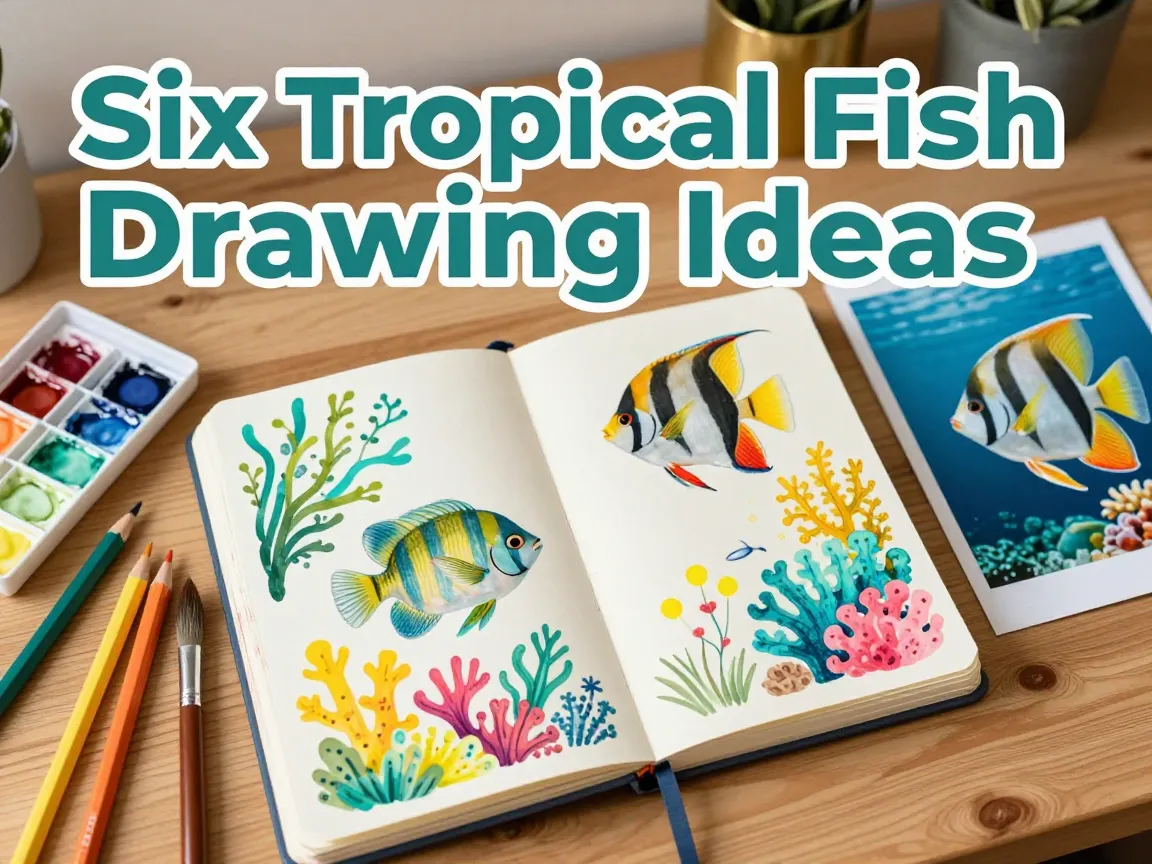
Each idea below is designed to build on a specific skill: bold color mixing, clean silhouette work, pattern repetition, compositional variety, imaginative design, and mixed-species storytelling. Work through them in order for a progressive challenge, or jump to the one that solves today’s creative problem.
1. Reef Fish Color Studies as Full-Page Palette Builders
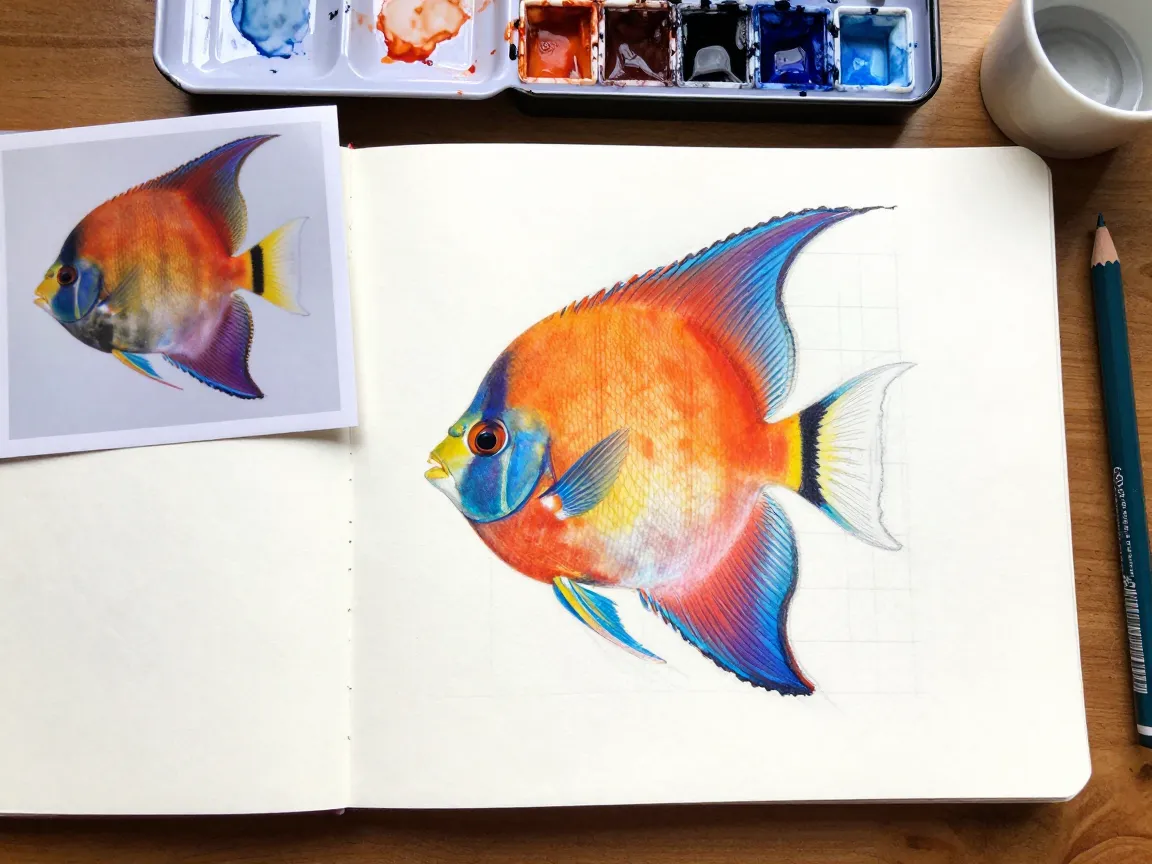
Bright reef fish are sometimes called the rainbows of the sea, and that description earns its keep when an artist sits down to draw them. Species like the mandarin dragonet, the royal gramma, or the flame angelfish carry color combinations that would look invented if they appeared in a fantasy illustration. Drawing them faithfully pushes color palettes far beyond the comfort zone of earth tones and muted hues.
The practical approach is to dedicate a full sketchbook page to one species and treat it as a color-mixing exercise first, a drawing exercise second. Lightly sketch the basic form in pencil, then work through every distinct hue on the fish before committing to line work. A flame angelfish, for example, requires a clean gradient from deep orange at the body to electric blue at the pectoral fins, with thin black vertical stripes that read as almost purple where they cross shadow areas. Getting those transitions right teaches more about color relationships in a single session than weeks of still-life work.
The useful constraint here is accuracy. It is easy to approximate a tropical fish and end up with something generic. Instead, source a clear reference photograph and identify every distinct color zone before touching paint or pencil to the page. Count the stripes. Note where the dorsal fin transitions from opaque to translucent. That discipline of observation is what transforms a color study into a genuinely useful sketchbook record. Artists working in watercolor will find that wet-on-wet blending suits the soft gradients on many reef species, while colored pencil users benefit from layering complementary colors in tight crosshatch to build the depth that makes a fish appear three-dimensional.
Reef fish color studies are equally valuable as warm-up exercises before longer illustration projects. Spending fifteen minutes rendering the iridescent scales of a parrotfish recalibrates the eye for saturated color in a way that abstract color wheels cannot replicate. Over several sessions, these pages become a personal color reference library, documenting exactly which pigment combinations produce that particular shade of electric teal or sun-bleached yellow.
2. Ellipse-Based Starter Fish for Building Foundational Confidence
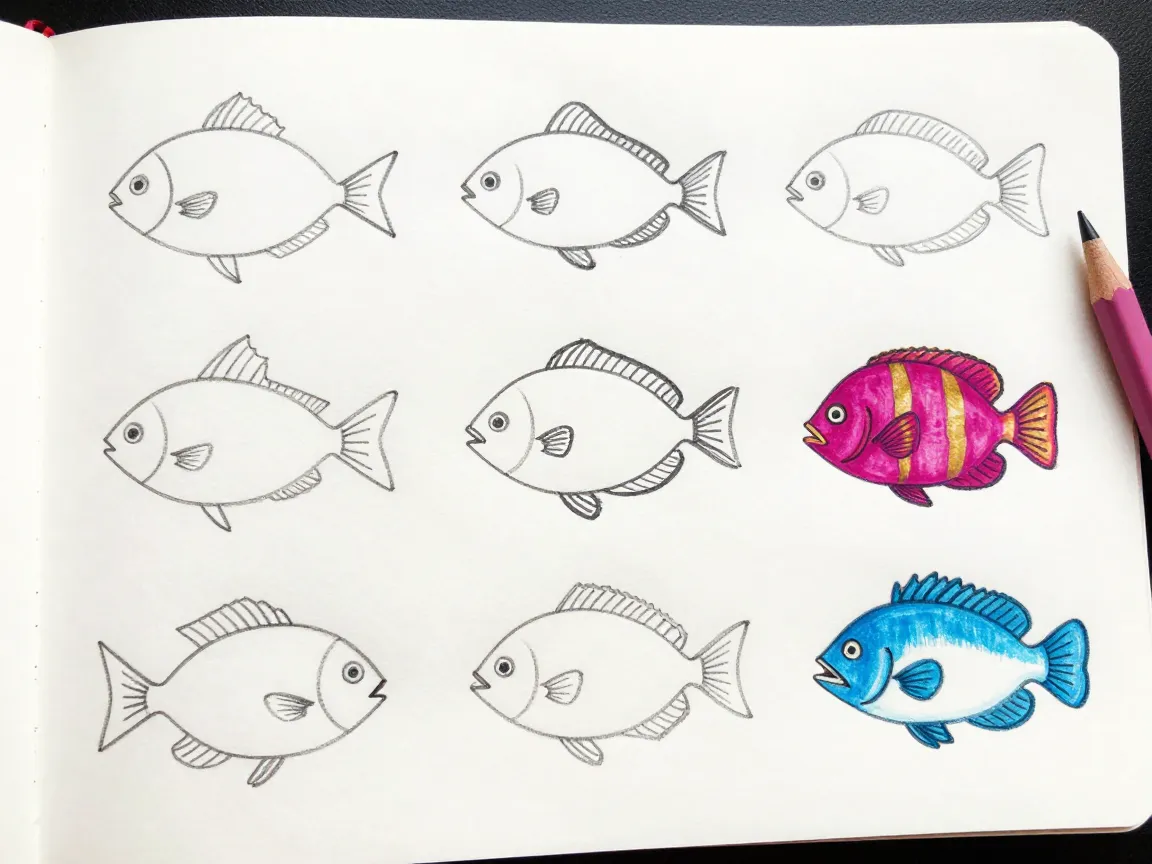
Every fish drawing begins with a core body shape, and for most tropical species that shape is a modified ellipse. This is not a simplification, it is a structural truth that professional illustrators exploit constantly. Starting from an ellipse makes tropical fish one of the most accessible drawing subjects available, which explains why they appear so frequently in beginner-focused tutorial sets and large idea lists aimed at artists who feel stuck.
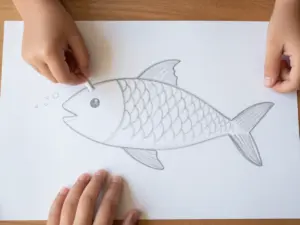
The sequence is straightforward. Draw a horizontal ellipse proportioned to the species being referenced. For a stocky angelfish body, the ellipse is nearly circular; for a slender surgeonfish, it stretches wider. From that anchor, add a triangular tail by drawing two lines from the rear edge of the ellipse to a single meeting point, then adjust for fork depth and lobe width. Fins come next: a tall dorsal fin arching from the spine, pectoral fins placed roughly one-third back from the nose, and smaller anal and pelvic fins along the belly. The head is simply the front quarter of the ellipse refined with a more angular mouth and a circular eye placement.
What makes this method so effective for sketchbook practice is the low commitment of each individual drawing. A complete ellipse-based fish can be sketched in under three minutes, which means an artist can fill a double-page spread with eight or ten variations before beginning to add color. Those variations train the hand to understand how changing the ellipse proportions, taller, flatter, wider, narrower, immediately produces the feeling of a different species. A very tall, compressed ellipse starts to suggest a butterflyfish or a discus; a low, elongated one reads as a wrasse or a small tuna.
Once the line drawings are satisfying, the color phase begins. At this stage, the temptation is to stay safe with realistic hues. Resist it. The ellipse-based method works best when it is used to experiment with unlikely color schemes, a surgeonfish rendered in magenta and gold, a grouper painted in cobalt and white, because the simple underlying structure can carry bold color without looking chaotic. This combination of structural discipline and color freedom is precisely what makes tropical fish drawing such a productive sketchbook habit for artists at every level.
3. Three Hero Species for Mastering Distinct Silhouettes
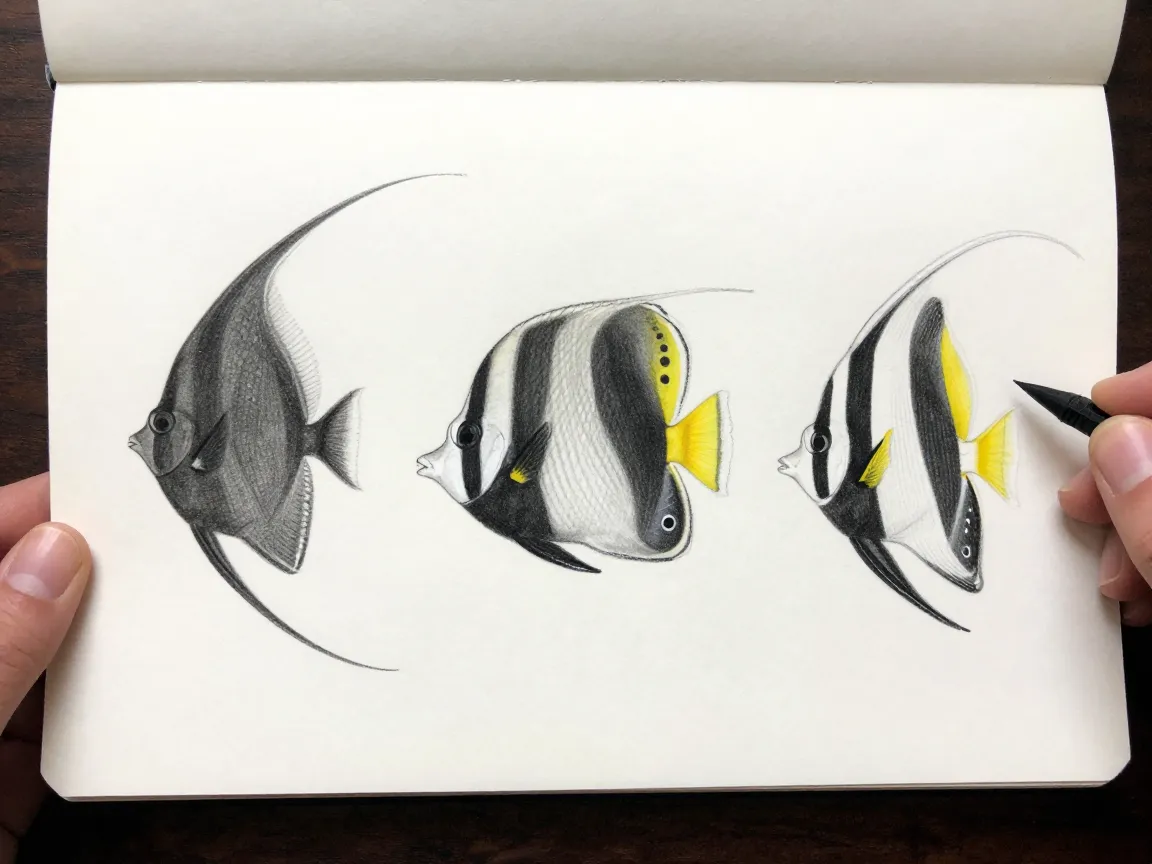
The angelfish, the coralfish (commonly called the butterflyfish), and the Moorish idol represent three fundamentally different silhouette types within the tropical fish family. Drawing all three in a single session is one of the most efficient ways to train the eye to read fish anatomy quickly and translate it accurately onto the page.
The freshwater or marine angelfish has a tall, laterally compressed disc body with dramatically elongated dorsal and anal fins that trail into elegant points. Its silhouette is immediately recognizable as diamond-like, and capturing that compression accurately requires understanding that the fish’s height from dorsal tip to anal fin tip is often greater than its length from snout to tail. Drawing the angelfish teaches proportion control and the specific challenge of rendering elongated fins without making them look stiff or artificial.
The butterflyfish presents a contrasting problem. Its body is also disc-shaped but far more circular, and its defining feature is the bold graphic pattern, contrasting bands, eye-spots, and sharp color blocks, that covers an otherwise simple form. Drawing butterflyfish well is fundamentally a pattern and symmetry exercise. The bands on each side of the body must mirror each other precisely, and the false eye-spot near the tail must be positioned convincingly to function as a visual decoy, which means its size and placement relative to the actual eye matters enormously for the drawing to feel accurate.
The Moorish idol is the most demanding of the three. Its body is narrow and compressed like the angelfish, but its defining feature is a dramatic white, black, and yellow banding pattern combined with an extraordinarily elongated dorsal filament that can extend well above the body in flowing curves. Getting that filament right, finding the arc that feels naturally fluid rather than pasted on, requires several attempts. Artists who work through all three species in one session typically notice by the third drawing that their line confidence has measurably improved, because each fish demands a different quality of mark: sweeping curves for the angelfish fins, controlled straight lines for the butterflyfish bands, and a single confident stroke for the Moorish idol’s signature filament.
4. Mixed-Species Spread for Compositional Storytelling
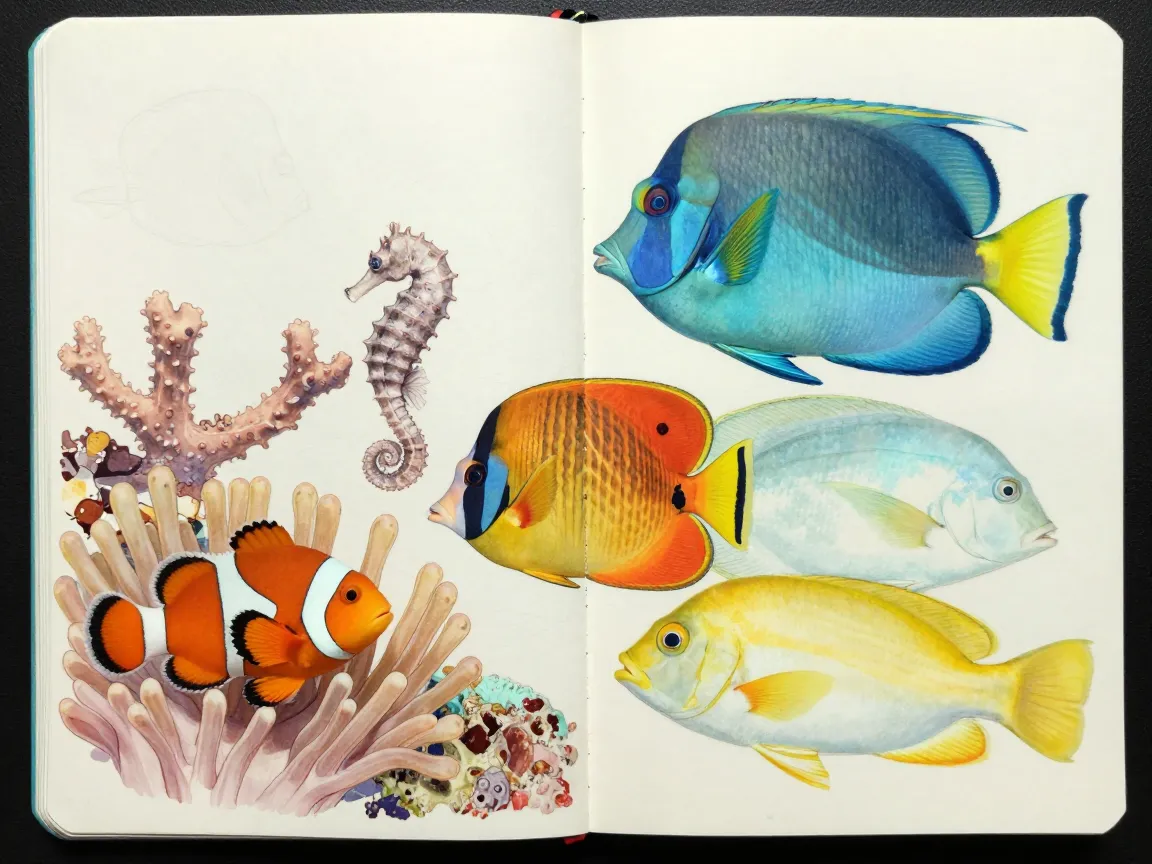
A sketchbook page that holds five or six different tropical species at once moves beyond individual study into something that feels like a complete work. Clownfish, butterflyfish, surgeonfish, and seahorses drawn together on a single spread create a visual ecology, a small, contained version of the reef itself, and the compositional decisions required to arrange them well develop skills that transfer directly to finished illustration.
The first compositional decision is scale. In a real reef, these species vary enormously in size, and honoring that variation on the page creates immediate visual interest. A large surgeonfish occupying the upper right, a medium butterflyfish mid-page, and a small clownfish tucked near a sketched anemone in the lower left establishes a natural hierarchy without any of the figures needing to be fully rendered. The eye moves through the page as it would scan a reef, large to small, prominent to hidden.
The second decision is overlap and layering. Letting fish partially obscure each other, as they would in an actual underwater environment, adds depth and prevents the page from looking like a specimen chart. A seahorse wrapped around a sketched coral branch, partly hidden by a larger fish’s tail, reads as genuinely embedded in a scene rather than placed on a white background. This is where sketchbook drawing diverges productively from scientific illustration: the goal is atmospheric truth rather than complete anatomical visibility.
Color strategy on a mixed-species spread rewards planning. Rather than coloring each fish independently, consider assigning a limited palette to the entire page, perhaps a triad of orange, turquoise, and yellow, and using those same hues across all species at varying saturations. The clownfish gets maximum orange saturation; the surgeonfish gets a blue-shifted teal; the seahorse gets the most muted version of the yellow. This approach unifies the spread visually while still making each species instantly identifiable. The result is a sketchbook page that functions as both practice record and composition study, two objectives served simultaneously.
5. Fantasy Tropical Fish for Exploring Imaginative Design
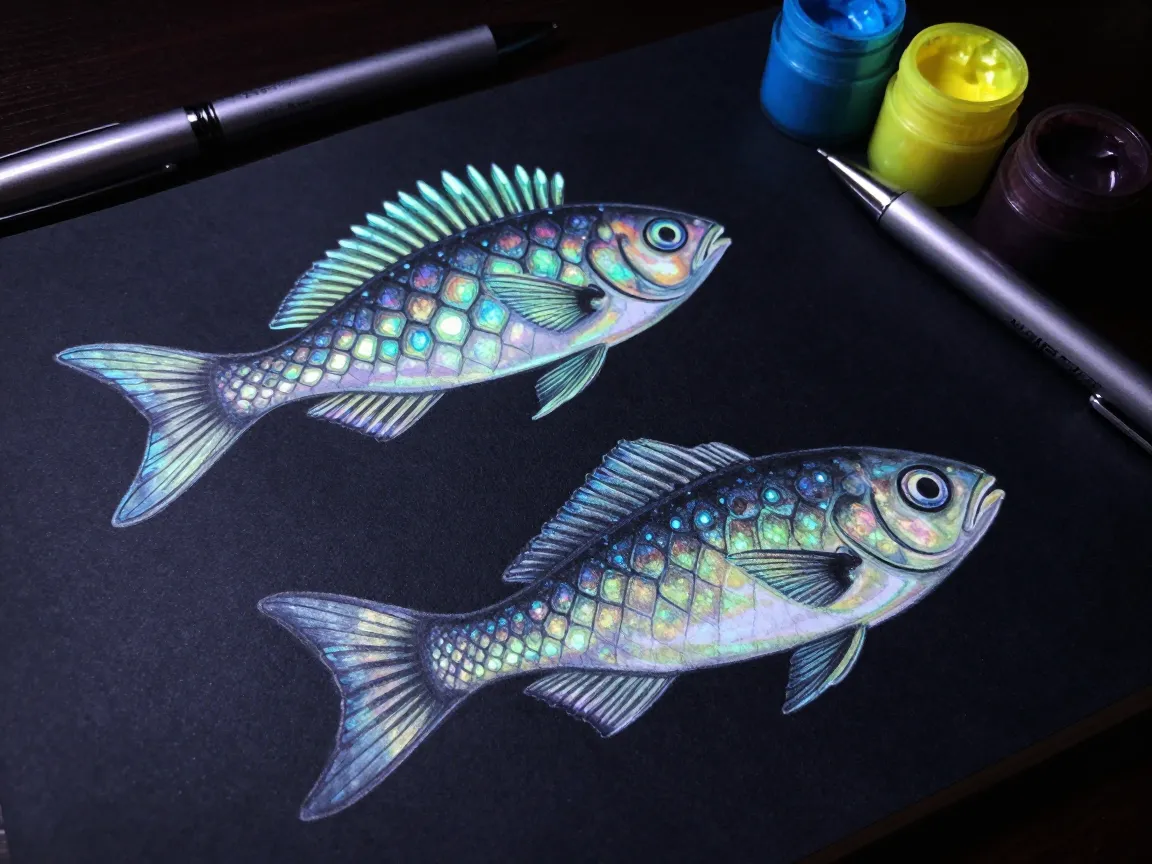
Tropical fish are so visually extreme in reality that the boundary between accurate observation and imaginative invention is thinner here than with almost any other animal. That permeability makes them ideal subjects for fantasy creature design, a creative exercise that is increasingly common in both professional concept art and educational drawing programs.
The entry point is familiar: begin with the ellipse-based structure from the second idea, then start modifying systematically. What happens if the dorsal fin is replaced with a row of bioluminescent spines? What if the tail fin branches into three separate lobes, each with a distinct pattern? What if the body carries markings borrowed from a completely different animal, the geometric hexagons of a giraffe translated into iridescent fish scales? Each modification generates a different creature, and the discipline of starting from a structurally plausible fish ensures that the final fantasy design retains biological credibility even when the specific features are entirely invented.
Pattern design is where fantasy tropical fish drawings become genuinely instructive. Real tropical fish patterns serve ecological functions, camouflage, mate attraction, species recognition, and designing fictional patterns with equivalent internal logic produces far more convincing results than scattering random marks across the body. An invented deep-water species might carry counterillumination markings, light on the belly and dark on the dorsal surface; a reef-dwelling fantasy fish might have high-contrast eye-spots at both ends of its body to confuse predators about which direction it will flee. These invented biological rationales give the design coherence that purely decorative pattern-making often lacks.
Fantasy tropical fish drawings also reward experimentation with unusual color media. Metallic gel pens on dark paper, neon watercolor on black cardstock, or iridescent gouache on a mid-tone ground all produce effects that complement the otherworldly quality of these invented creatures. The sketchbook becomes a worldbuilding document as much as a drawing practice record, and artists who work through several fantasy species often find that the design principles they developed feed directly back into more accurate observational work, sharpening both their structural instincts and their color confidence.
6. Tropical Fish as a Gateway to Ocean-Themed Page Systems
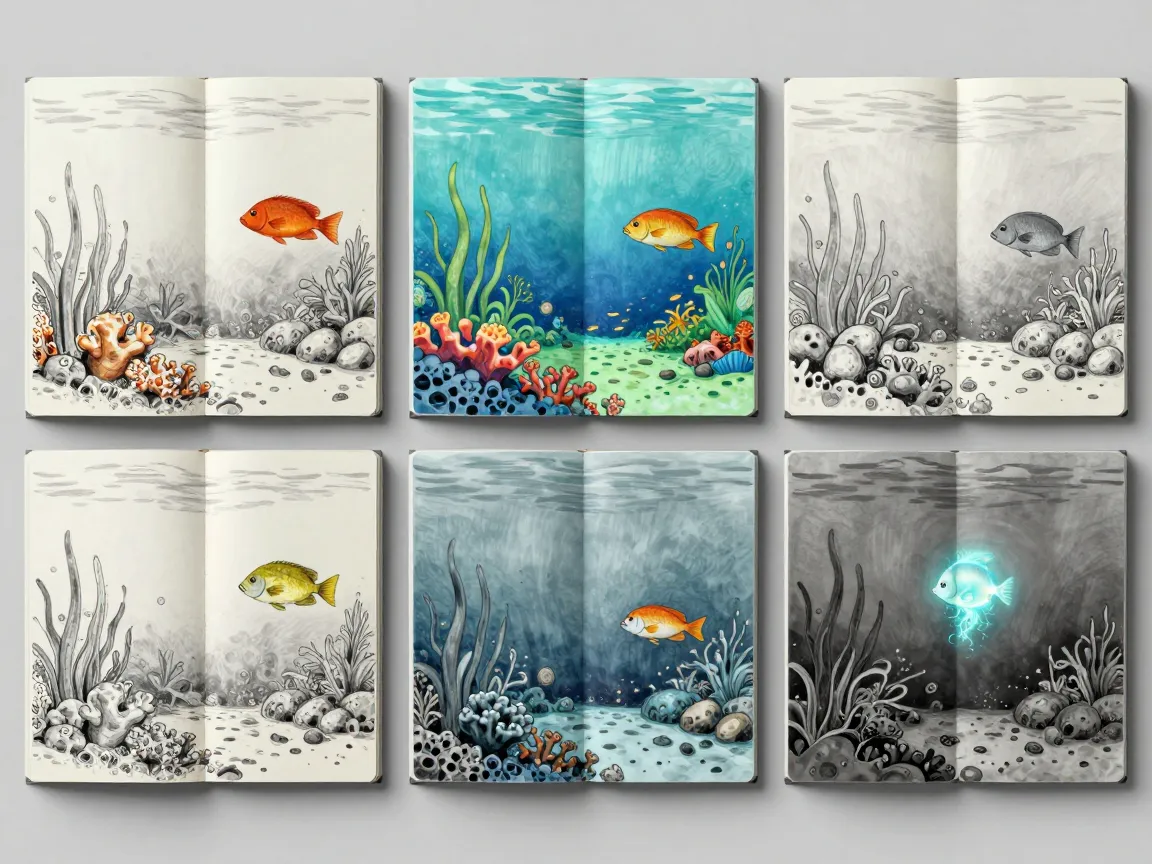
A single tropical fish drawing is a satisfying exercise. A connected series of them, organized around a coherent ocean theme, is a sketchbook system, and systems are what turn sporadic practice into visible skill development. Structured ocean drawing sets consistently position tropical fish as the fastest single element for adding a “splash of color” to an otherwise blue-and-grey underwater page, and that observation points toward a broader creative strategy.
The idea here is to use tropical fish as the color anchors within larger ocean-themed spreads that also include coral formations, sea plants, rocks, and water texture. The fish provide the saturated focal points; everything else can be rendered in quieter, more neutral tones. A spread built around this principle might show a loose coral reef structure sketched in warm grey ink, with three or four tropical fish positioned at compositional strong points and rendered in full saturated color. The contrast between the restrained background and the vivid fish creates a visual hierarchy that requires almost no additional compositional engineering.
Building a series of these spreads over several weeks produces a sketchbook section that reads as a coherent portfolio rather than a collection of unrelated studies. Each new spread can introduce a different ocean depth, shallow reef, mid-water column, deep-water zone, with the fish species and color palette shifting accordingly. Shallow reef pages carry the warmest, most saturated color; mid-water spreads shift toward cooler blues and greens with slightly less saturated fish; deep-water pages use near-monochromatic palettes punctuated by bioluminescent fantasy species from the previous exercise.
This systematic approach also solves one of the most common creative blocks: not knowing what to draw next. When a sketchbook has an internal logic, a series architecture, the next page writes itself. The tropical fish drawing practice becomes self-sustaining, each spread generating the visual context that makes the following spread both easier and more interesting. For artists who want their sketchbooks to serve as genuine creative development records rather than disconnected experiments, this ocean page-system approach is among the most practical structures available, and tropical fish are the most efficient tool for building it.
Conclusion
The six tropical fish drawing ideas explored here range from foundational skill-building exercises to expansive creative systems, but they share a common quality: each one uses the exceptional visual richness of tropical fish to develop abilities, color confidence, silhouette accuracy, pattern design, compositional thinking, that extend well beyond marine subject matter.
The most useful next step is to pick the idea that addresses the current skill gap most directly, complete one full sketchbook page with it this week, and treat the result as a data point rather than a finished artwork. What worked easily, what required more attempts than expected, and what surprised the eye are all more valuable than a polished outcome. That honest sketchbook record is exactly what these six tropical fish drawing ideas that bring color to your sketchbook are designed to produce.