Deep Sea Fishing Boat Drawing Ideas for Ocean Enthusiasts
Deep sea fishing vessels are among the most structurally interesting subjects in maritime art, angular hulls, towering flybridge platforms, outriggers stretching wide like mechanical wings, and the constant suggestion of open water. For ocean enthusiasts who want to put pencil to paper, these boats offer a rare combination of geometric challenge and visual drama. This guide presents 6 deep sea fishing boat drawing ideas for ocean enthusiasts, covering a range of styles and complexity levels so that both beginners and practiced hobbyists can find a starting point that fits their skills.
Disclosure: This post contains affiliate links. As an Amazon Associate, we earn from qualifying purchases, and at no extra cost to you.
Whether the goal is a simple coloring-page outline or a layered scene with big-game fish and rolling swells, the ideas below are organized to build confidence progressively. Each concept comes with practical guidance on composition, detail choices, and the kind of rendering style that makes the subject pop, from clean vector-style line art to loose watercolor washes.
1. The Classic Sportfishing Hull in Simple Outline
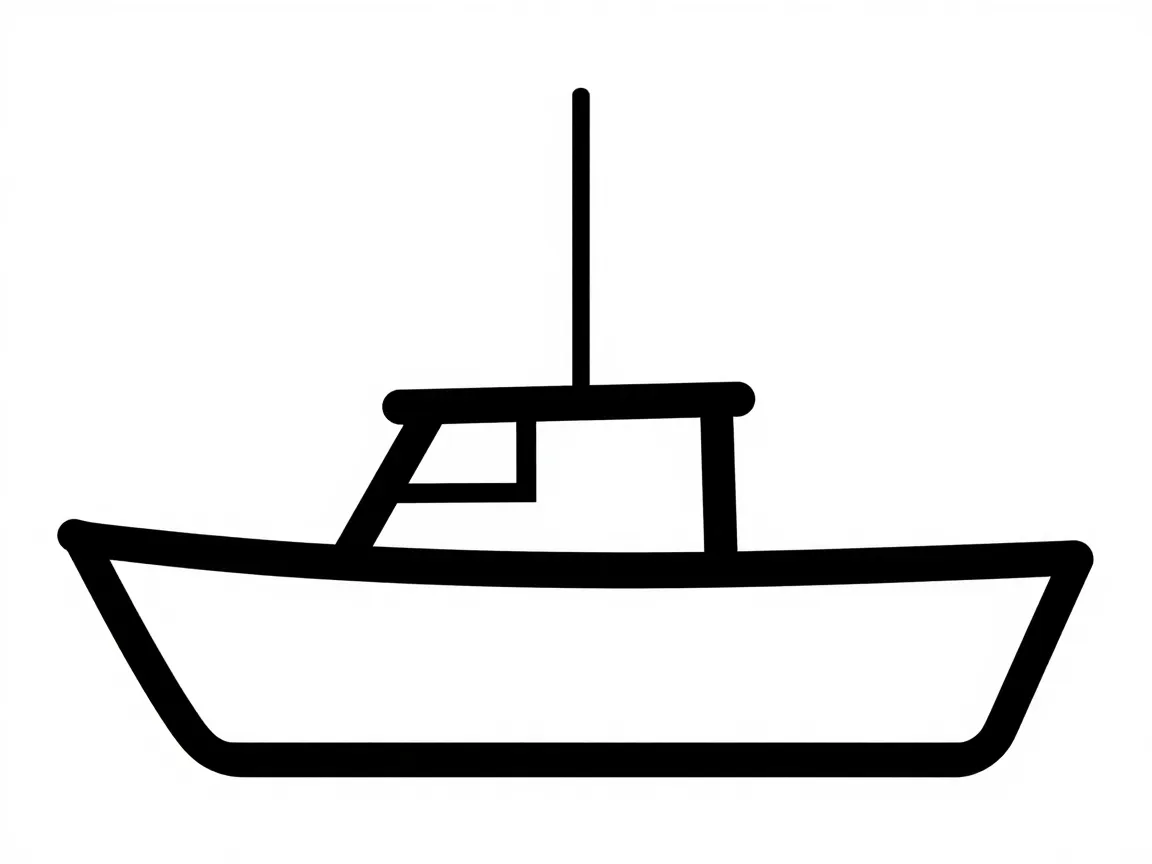
The best place to start any drawing series is with a shape the eye already recognizes. A classic sportfishing hull, broad beam, raised bow, and a low stern platform, translates immediately into a handful of clean geometric lines that even a beginner can manage in a single sitting.
Begin by drawing a long, shallow trapezoid for the main hull body. The bow end angles upward more steeply than the stern, which stays low and open to suggest the fighting deck. Add a rectangular cabin block roughly one-third of the way back from the bow, keeping it taller than it is wide. That single proportion decision signals “sportfishing boat” rather than a generic vessel. A short mast rising from the cabin roof completes the essential silhouette.
The power of this approach lies in restraint. Resisting the urge to add every porthole and cleat keeps the drawing readable and gives it the clean quality of a logo or sticker design, a style that remains highly popular in commercial illustration markets. This is also the ideal foundation for a coloring page, since bold outlines with minimal interior lines leave plenty of open areas for color fills. Kids, hobby sketchers, and graphic designers all use this basic form, which makes it one of the most versatile concepts in the list.
A useful follow-up challenge is to draw the same hull three times at slightly different angles, head-on, three-quarter view, and pure profile, to understand how the proportions shift with perspective. Even a beginner will notice how the cabin appears to shift backward in a head-on view, which is a quick lesson in foreshortening without needing formal instruction.
2. The Flybridge Tower and Outrigger Setup
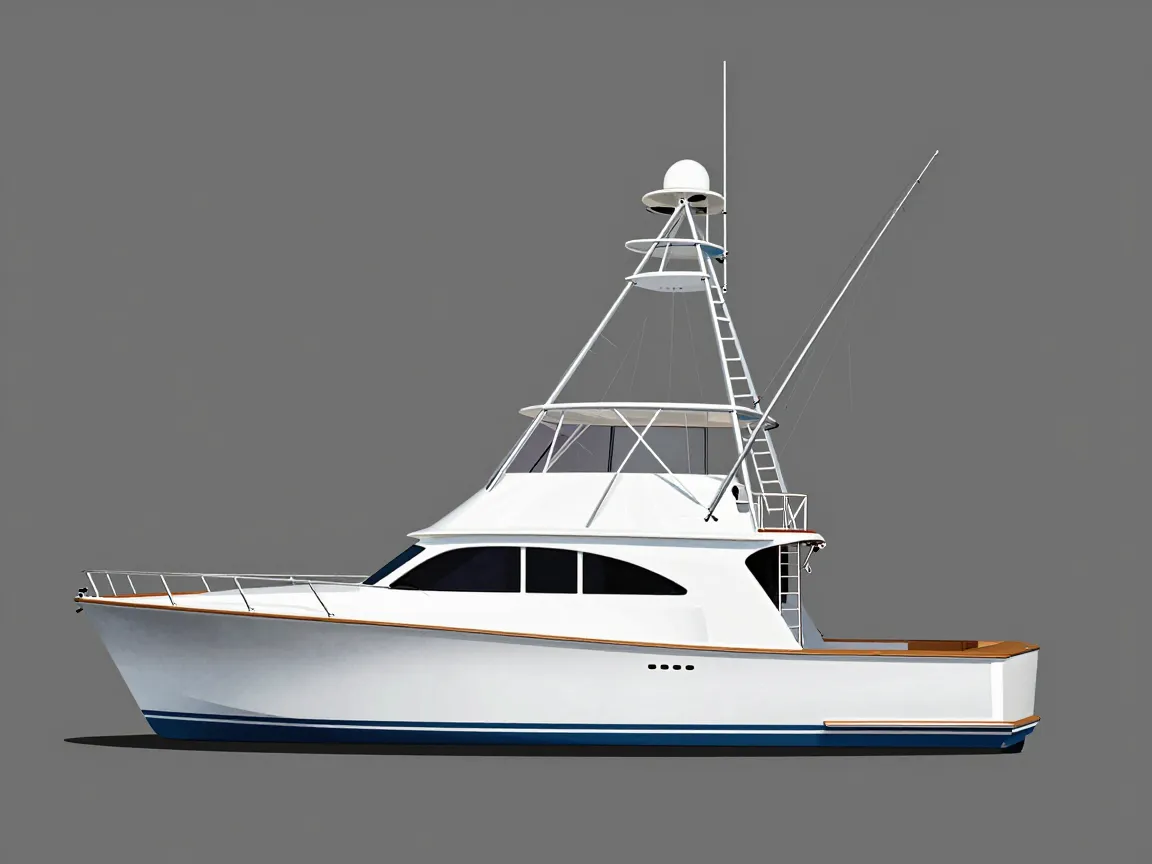
Once the basic hull is comfortable, the next logical step is the most architecturally distinctive feature of a deep sea sportfishing yacht: the elevated flybridge tower with its pair of outriggers. This element is what separates a sportfishing boat from every other vessel type in a drawing, and getting it right creates an immediately convincing maritime illustration.
The tower sits above and slightly aft of the main cabin. Draw it as a second, smaller rectangular platform connected to the cabin by a ladder structure on the rear face. The top of the tower should have a low railing indicated by a thin horizontal line and two short vertical posts at each corner. From the aft sides of the tower, the outriggers extend outward and slightly downward at roughly 45 degrees before angling up at the tips, a gentle S-curve rather than a straight stick. These arms give the finished drawing an energetic spread that fills horizontal space on the page and signals serious offshore capability.
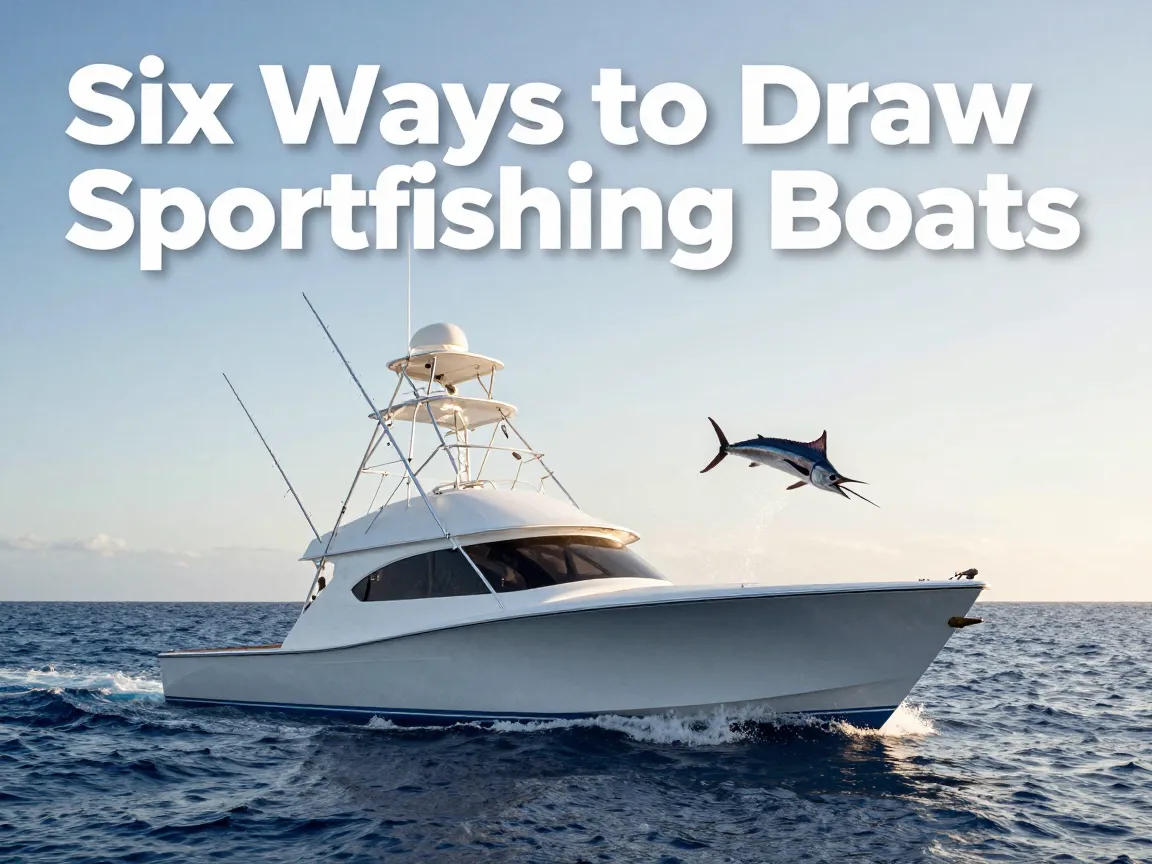
The antennae and communication gear clustered at the tower top are worth including even in a simplified version. A cluster of two or three vertical lines of varying heights, one straight, one with a small crossbar, reads as radar and radio equipment without requiring precise technical accuracy. A detailed sportfishing yacht featuring a tower and advanced antennae setup has become a recognizable visual shorthand in contemporary nautical illustration, appearing in vector art, embroidery designs, and sportfishing tournament logos alike.
Shading this structure rewards patience. The underside of the tower platform catches shadow, the ladder structure creates a grid of small rectangles, and the outriggers have thin cylindrical forms that benefit from a single highlight line along the top edge. Even a very simple shading pass using a 2B pencil transforms this drawing from a diagram into a credible illustration.
3. The Harbor Scene with a Moored Fishing Boat
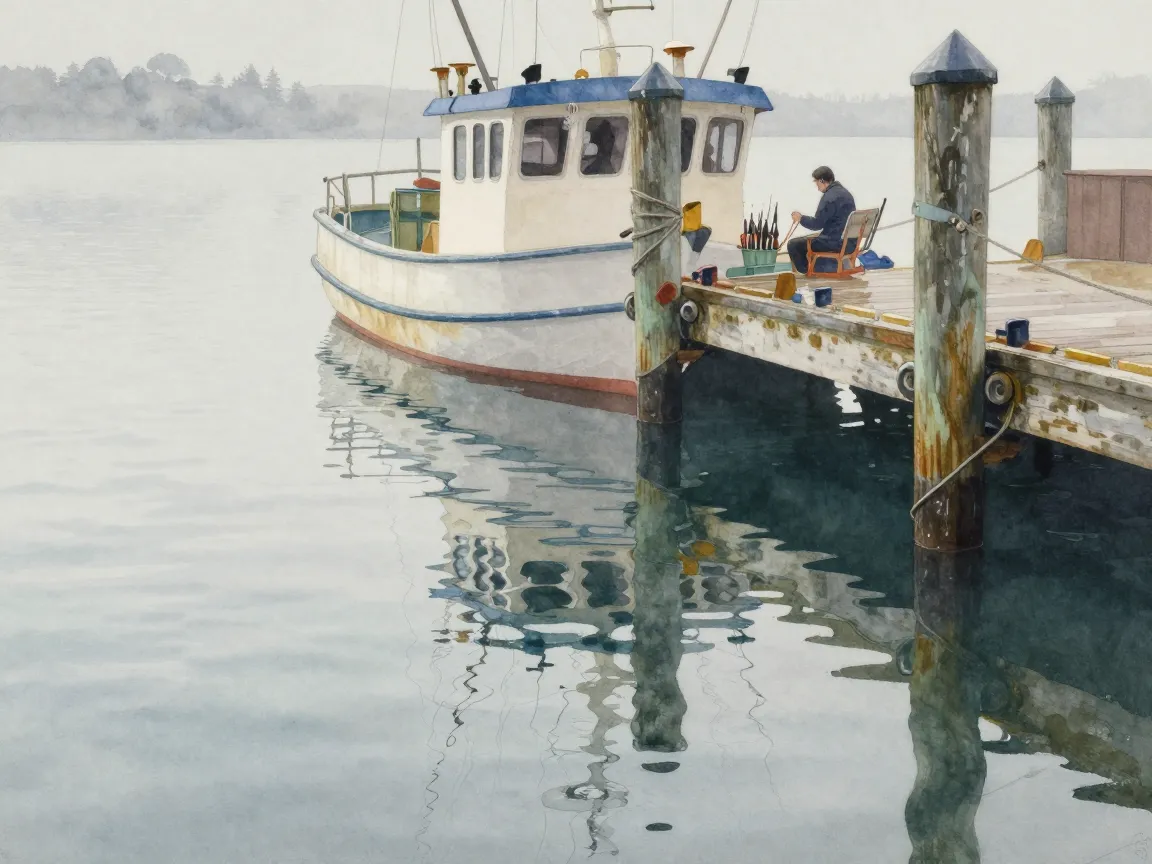
Not every compelling deep sea fishing boat drawing needs open water and dramatic action. A moored vessel tied to a dock or harbor wall offers a quieter, more grounded composition that actually demands more observational skill than an isolated profile sketch.
Position the boat parallel to the picture plane, partially overlapping a weathered dock edge. The dock itself, just a horizontal plank line with vertical piling posts descending into the water, provides a strong foreground anchor for the composition. The fishing boat sits behind the dock line, which immediately creates a sense of depth without requiring complex perspective construction. Dock lines (the ropes connecting boat to cleat) add diagonal tension that breaks the horizontal monotony of a docked vessel.
The water surface in a harbor drawing is an opportunity that should not be skipped. Still harbor water reflects the hull in a rippled, compressed version of the boat shape below the waterline. Drawing this reflection as a series of horizontal, slightly wavy parallel lines, darker nearest the hull, fading downward, adds atmosphere and grounds the vessel convincingly. This technique is achievable with basic hatching in pencil, a blue-gray wash in watercolor, or simple horizontal strokes in a digital application.
Harbor scenes also invite human elements. A figure checking tackle on the deck, a mooring line in the foreground, or a stack of bait coolers on the dock all tell a story about the purpose of the vessel without needing a caption. This concept works especially well as a watercolor subject because soft, wet-on-wet washes capture the light on calm water in a way that no other medium quite matches. Illustration galleries in 2026 continue to feature this exact subject, a fishing boat moored in a harbor, as a perennial favorite among ocean art enthusiasts.
4. The Big-Game Action Scene with a Leaping Marlin
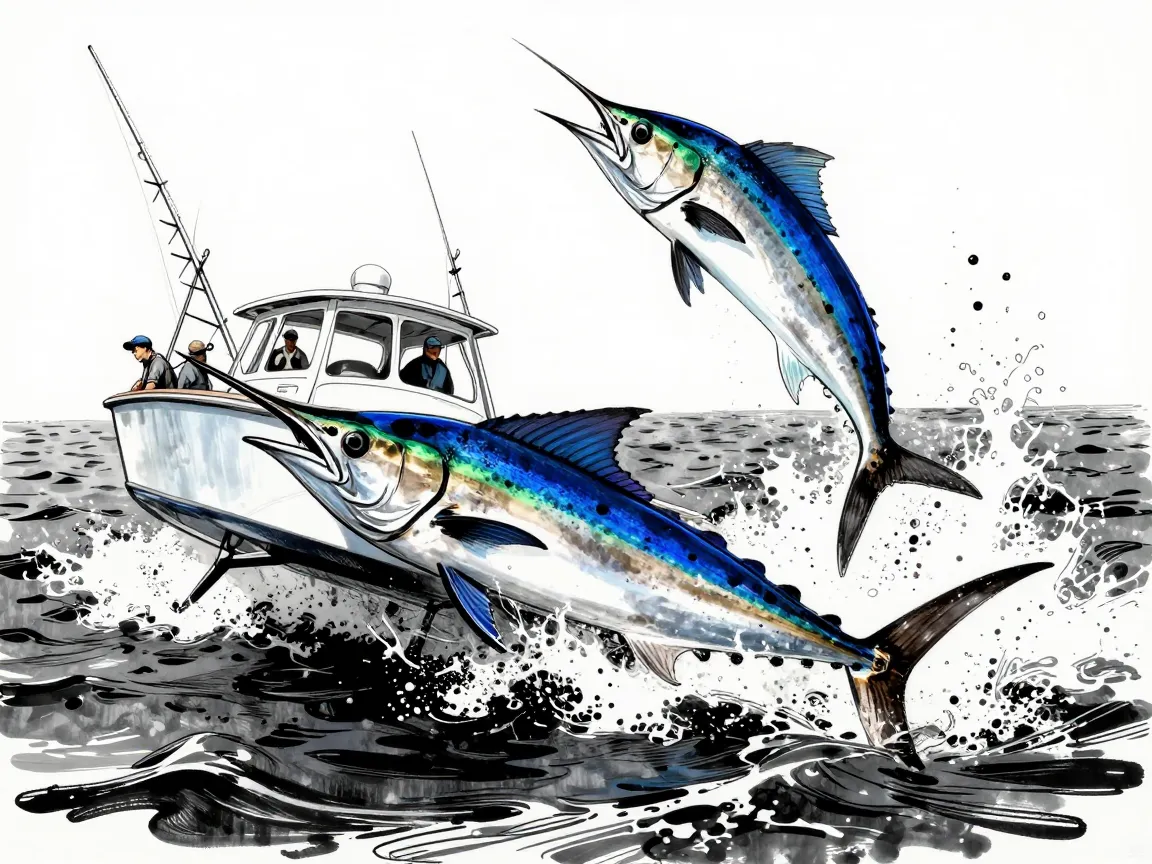
This is the composition that the deep sea fishing subject was arguably built for: a sportfishing boat at speed, outriggers deployed, while a large billfish, typically a marlin or sailfish, erupts from the water nearby. It is the most commercially prominent visual combination in the deep sea fishing illustration market, appearing consistently across clipart libraries, tournament posters, and boat decal designs.
The compositional key is the diagonal energy line. The boat should travel across the frame from left to right at a slight forward tilt (bow high, stern slightly lower), while the marlin leaps in the opposite diagonal, entering the frame from the lower right and arcing toward upper center. These two opposing diagonals create a natural tension that holds the viewer’s eye in a continuous circular path. The wake behind the stern adds a third motion line, completing the triangular composition.
The marlin itself need not be anatomically perfect to read correctly. The long bill, high dorsal fin, and deeply forked tail are the three identifying features. Keep the body streamlined and slightly curved as it clears the water surface. A burst of white spray at the entry point, rendered as irregular white shapes with a few loose radiating lines, signals where the fish broke the surface and adds kinetic energy to the whole scene.
Rendering style makes a significant difference in how this scene feels. A tight ink line drawing with black-and-white contrast reads as bold and graphic, well suited for logo or tattoo applications. A loose watercolor version with cobalt blue water and silver-green fish scales reads as an expressive maritime painting. Both approaches are actively used in the current illustration market, and choosing between them is itself a creative decision worth exploring across two or three attempts at the same scene.
5. The Gear-Forward Deck View from the Fighting Chair
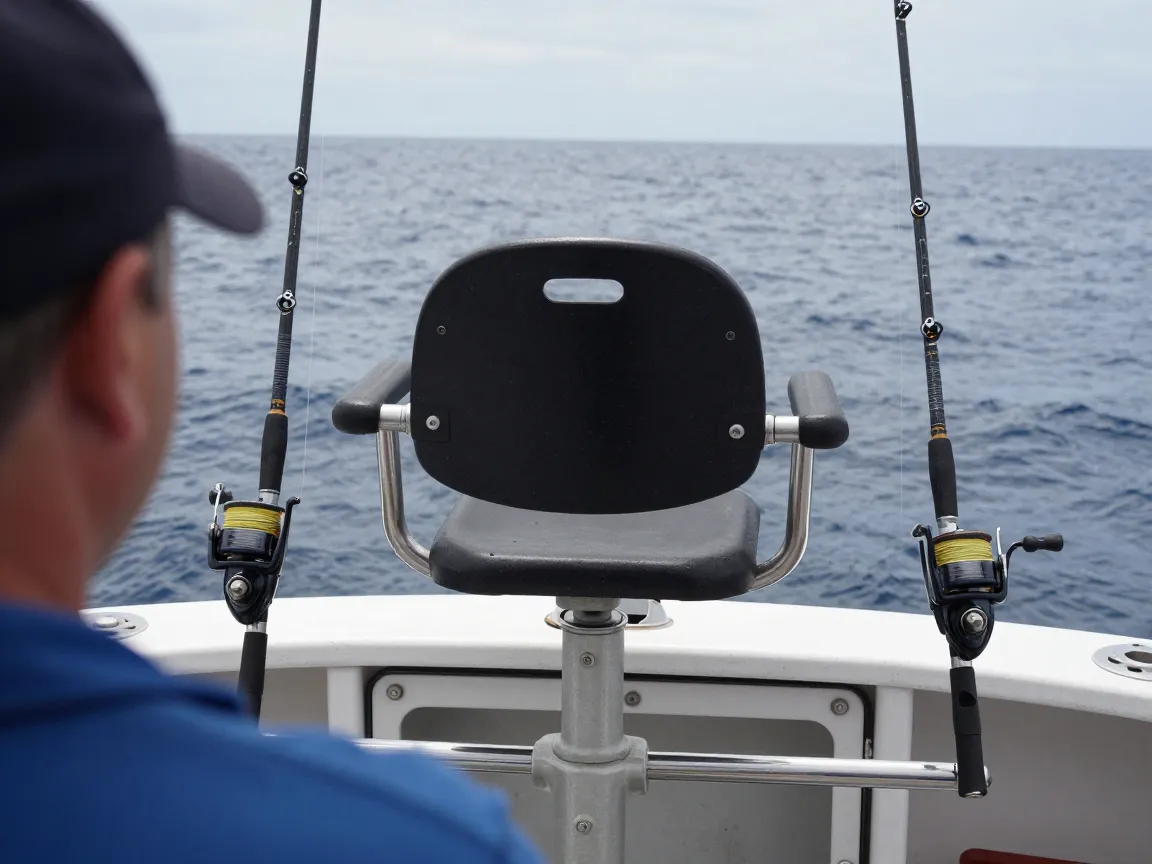
Shifting perspective entirely opens a new range of drawing possibilities. Rather than showing the full vessel from outside, this concept places the viewer on board the boat, looking aft from the cabin toward the fighting deck. This angle foregrounds the fishing gear, rod holders, outrigger bases, tackle boxes, the fighting chair itself, and turns functional equipment into the visual subject of the drawing.
The fighting chair is the compositional centerpiece. It sits in the middle of the transom area, a substantial piece of equipment with a curved seat, armrests, and a central rod gimbal between the front legs. Drawing it from a slight three-quarter angle above gives it volume and reveals the rod socket, which immediately communicates the boat’s purpose. Behind the chair, the transom door (the low gate at the stern that opens to allow a large fish to be brought aboard) provides a strong horizontal base line, and beyond it the open ocean stretches to the horizon.
This perspective draws attention to the rods and reel setups that are increasingly prominent in current deep sea fishing illustrations. Several heavy-action rods in angled rod holders frame the sides of the composition like pillars. Each rod is a simple tapered cylinder with a series of small ring guides along its length, straightforward to draw but visually rich when several appear together. The reels attached at the base of each rod are compact cylinders with a visible spool, handle arm, and drag knob; simplified versions with just a circle-within-a-circle read clearly even at small scale.
The ocean visible over the transom deserves careful treatment. A low horizon line pushes the sky into the upper quarter of the frame, emphasizing the openness of offshore water. A single dark swell or wave crest in the mid-distance provides scale. This is a composition that rewards artists who want to practice drawing manufactured objects in correct proportion to each other, and it produces a final image that feels genuinely immersive, the viewer is not watching the action from shore but participating in it.
6. The Stylized Vector or Tattoo-Style Fishing Boat Design
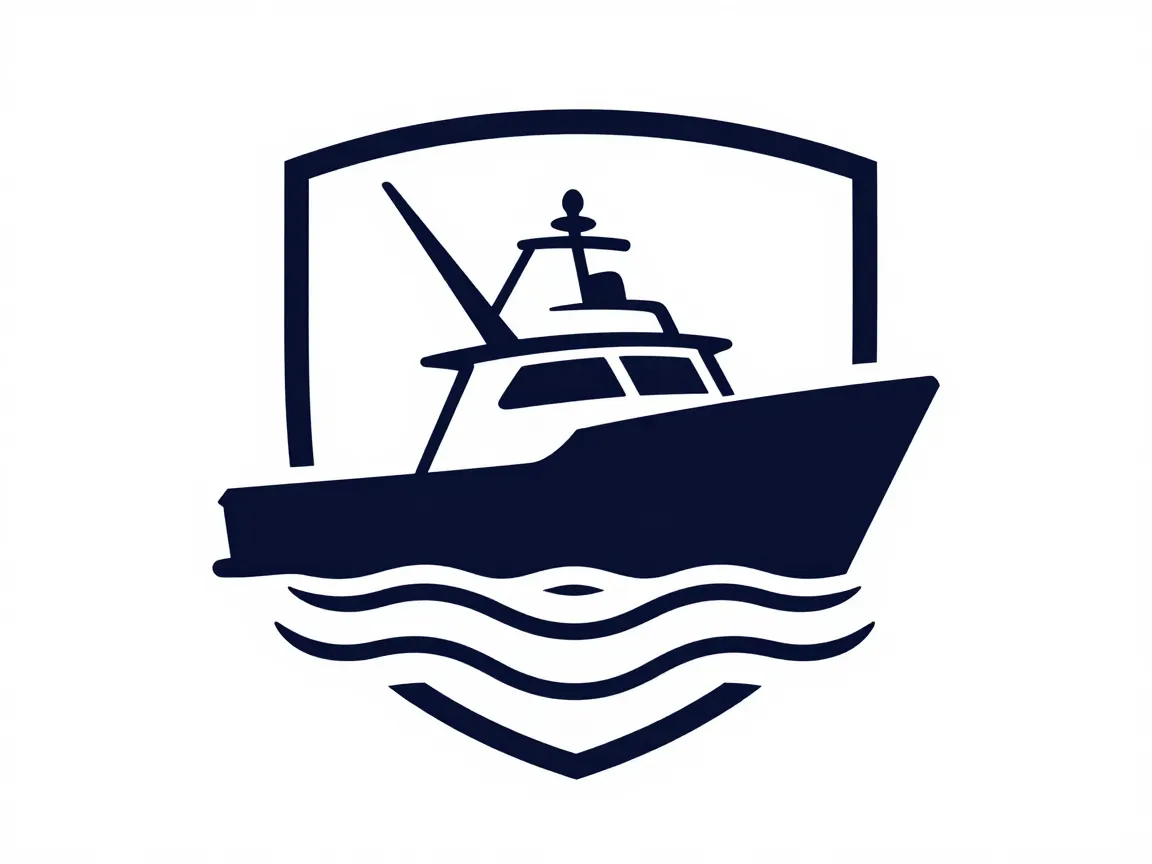
The final concept steps away from representational realism entirely and embraces a stylized, graphic treatment: the flat vector or tattoo-style fishing boat design. This approach prioritizes bold silhouettes, clean geometric shapes, and strong contrast over accurate detail, and it is one of the most commercially active illustration styles in the deep sea fishing subject area in 2026.
The defining characteristic of tattoo-style nautical art is the use of thick, uniform outlines combined with limited fill areas. The boat becomes an almost heraldic shape, the hull a solid dark wedge, the cabin a blocky form with minimal window detail, the outriggers rendered as bold tapered lines rather than cylinders. Waves are stylized into repeating arc shapes. The fish, if included, is reduced to its most iconic silhouette: marlin bill, dorsal spine, forked tail, with cross-hatching or dot-work fill on the body.
The design process for this style is essentially graphic rather than observational. Start by defining the outline of the entire boat as a single closed shape, without any interior detail. Then selectively add interior lines only where they define a structurally important division, the hull-to-cabin joint, the waterline, the outrigger base. Everything else is simplified or removed. The result should be legible at the size of a postage stamp and still read unmistakably as a sportfishing boat.
For artists working digitally, this style translates naturally into vector software, where bezier curves can be used to refine the hull outline to a mathematically smooth edge. For those working on paper, a fine-liner pen with a consistent 0.5mm tip over a rough pencil sketch produces a similar clean quality. This is also the style most commonly requested in logo and emblem commissions for fishing tournaments and charter boat companies, which means that mastering it has direct practical application beyond personal artwork.
Adding a banner, compass rose, or rope border element completes the heraldic feel and gives the finished design the structure of a badge or patch. These framing elements are as important to the composition as the boat itself, they convert a loose drawing into a contained design object, which is why they appear so consistently in professional nautical illustration across sticker, apparel, and digital asset markets.
Conclusion
The range of approaches covered in these 6 deep sea fishing boat drawing ideas for ocean enthusiasts reflects just how versatile this subject truly is. A clean hull outline, a tower-and-outrigger study, a harbor scene, a big-game action composition, a gear-focused deck view, and a stylized vector design each demand different skills and produce very different finished results, yet all of them are grounded in the same fundamental subject matter.
The single most useful next step is to pick the idea that matches the current skill level and work through it twice: once loosely to understand the proportions, and once more deliberately to refine the details. That second attempt almost always reveals something the first pass missed, and it is where real drawing improvement actually happens.