Duck Hunter Halloween Costume Ideas That Will Win Every Contest
Only about 17 percent of Halloween costume-wearers report winning a contest, according to costume industry surveys. The difference almost always comes down to commitment to a specific concept rather than a generic idea. These 6 duck hunter Halloween costume ideas that will win every contest work precisely because they go past the basic camo jacket that shows up at every party. Each one has a clear visual identity, props that read from across a room, and enough personality to hold up under party lighting.
Disclosure: This post contains affiliate links. As an Amazon Associate, we earn from qualifying purchases, and at no extra cost to you.
Key Takeaways
- Detail separates a forgettable costume from a first-place finish, props, headgear, and facial accessories carry most of the weight.
- The Duck Dynasty-inspired silhouette remains the dominant commercial template, but customization wins contests.
- Couples and group formats have a structural advantage in most contest formats because they photograph better and tell a story.
- Pet duck hunter costumes are a growing category with real novelty value at family and community events.
- Pun-based concepts score high with judges who value creativity over straight realism.
1. The “Serious Kid Duck Hunter” Family Costume
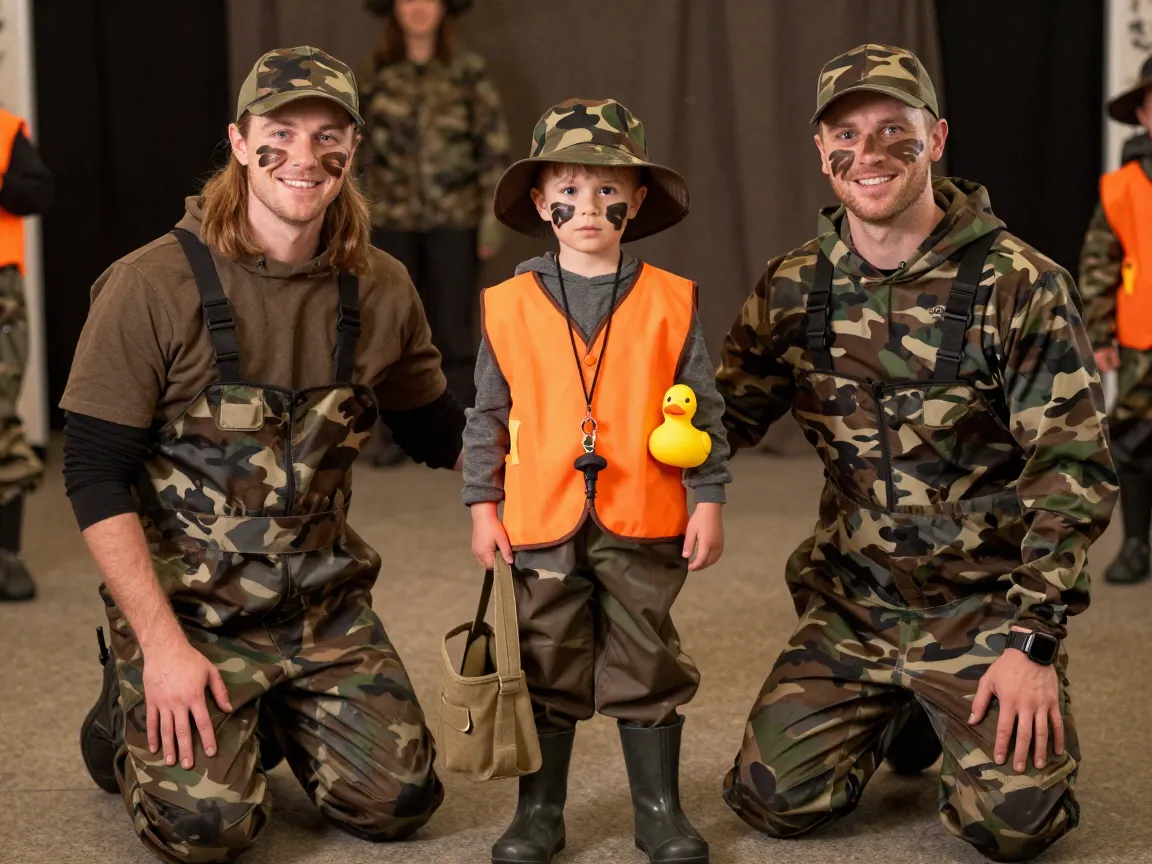
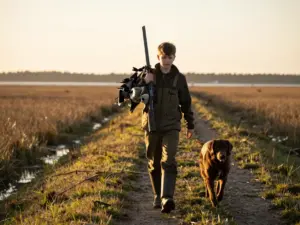
A child in full camo waders, an orange safety vest, and a small duck call lanyard sends a very specific message: this family came prepared. The “serious kid duck hunter” concept works because the size contrast alone creates instant comedy. Parents flanking the child in matching adult camo gear turns it into a coordinated family entry, which most contests score separately from individual categories.
The costume hinges on a few specific props. A foam or rubber decoy duck tucked under the child’s arm, a camo bucket hat sized down to fit, and a small canvas game bag are all available online for under fifteen dollars combined. The bucket hat is worth emphasizing because experienced costume builders consistently identify headgear as the single accessory most likely to push a costume from “okay” to “contest-ready.” Without it, the child just looks like they raided a sporting goods store.
For parents building this look, face paint matters more than the clothing layer. A simple two-color camo face paint pattern on the child takes about four minutes to apply and completely changes how the costume photographs. Keep the palette consistent with the clothing, brown and green, not the neon greasepaint sold near Halloween registers.
2. Duck Dynasty-Inspired Bearded Hunter
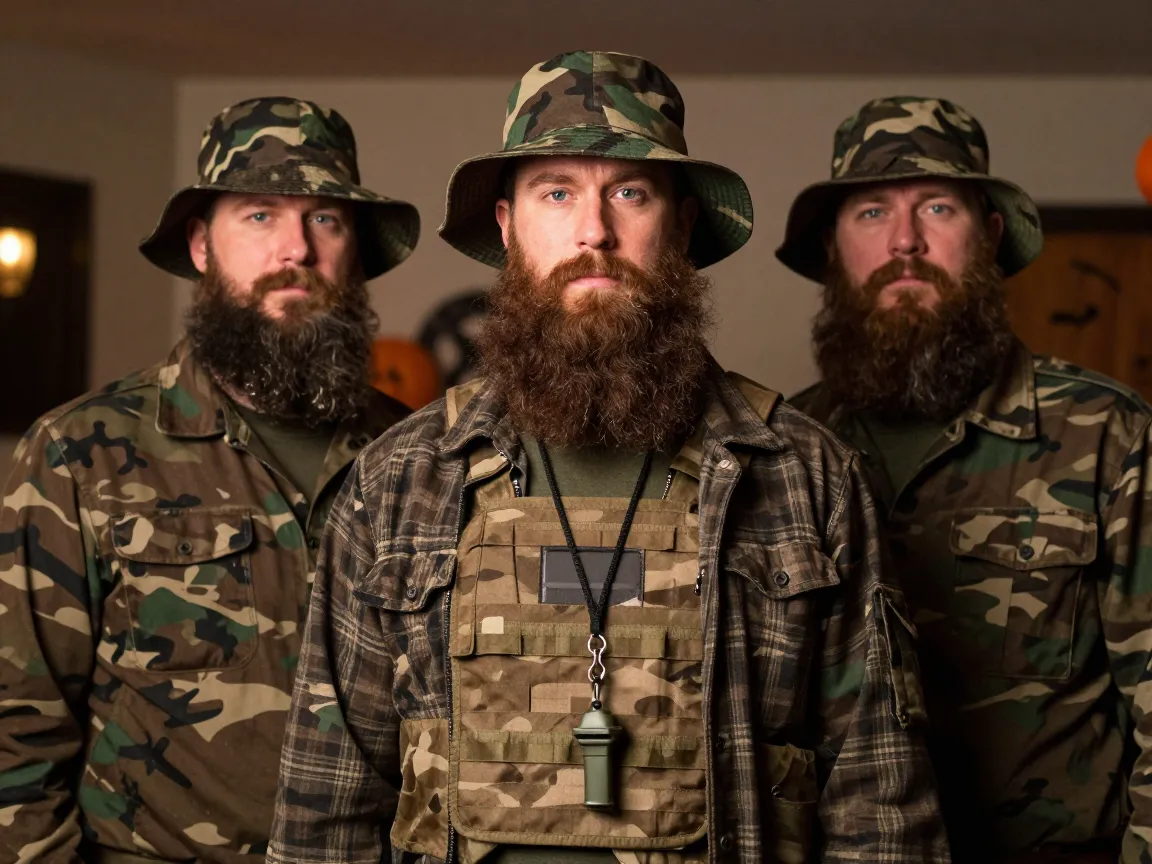
The Duck Dynasty television franchise ran from 2012 to 2017, but its visual shorthand, full camo, long beard, bucket hat, duck call, has outlasted the show and now functions as its own Halloween archetype. The look is immediately legible to a wide age range, which matters in contest judging where the audience usually includes people who have never seen the show.
The beard is the whole costume. A short brown beard with a camo jacket reads as “hunter.” A long, dense, dark beard paired with camo head-to-toe reads as “Duck Dynasty character,” and judges know exactly what they’re looking at. Costume retailers in 2026 sell the beard accessory separately for under twenty dollars, and several manufacturers now bundle it with a matching camo bucket hat. Buy the bundle. Matching the hat to the beard color removes the one detail that makes this costume look assembled rather than intentional.
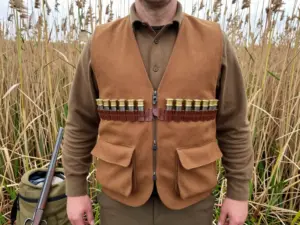
Add a duck call on a lanyard around the neck and a camouflage vest worn over a flannel shirt. The flannel layer is specific: it creates texture and depth that photographs well and signals “outdoors” rather than “military surplus,” which is an important distinction when you want the costume to read as hunter, not soldier. The costume takes about eight minutes to assemble on the night, which is a practical advantage when you’re also helping others get ready.
3. Hunter-and-Duck Couples Costume
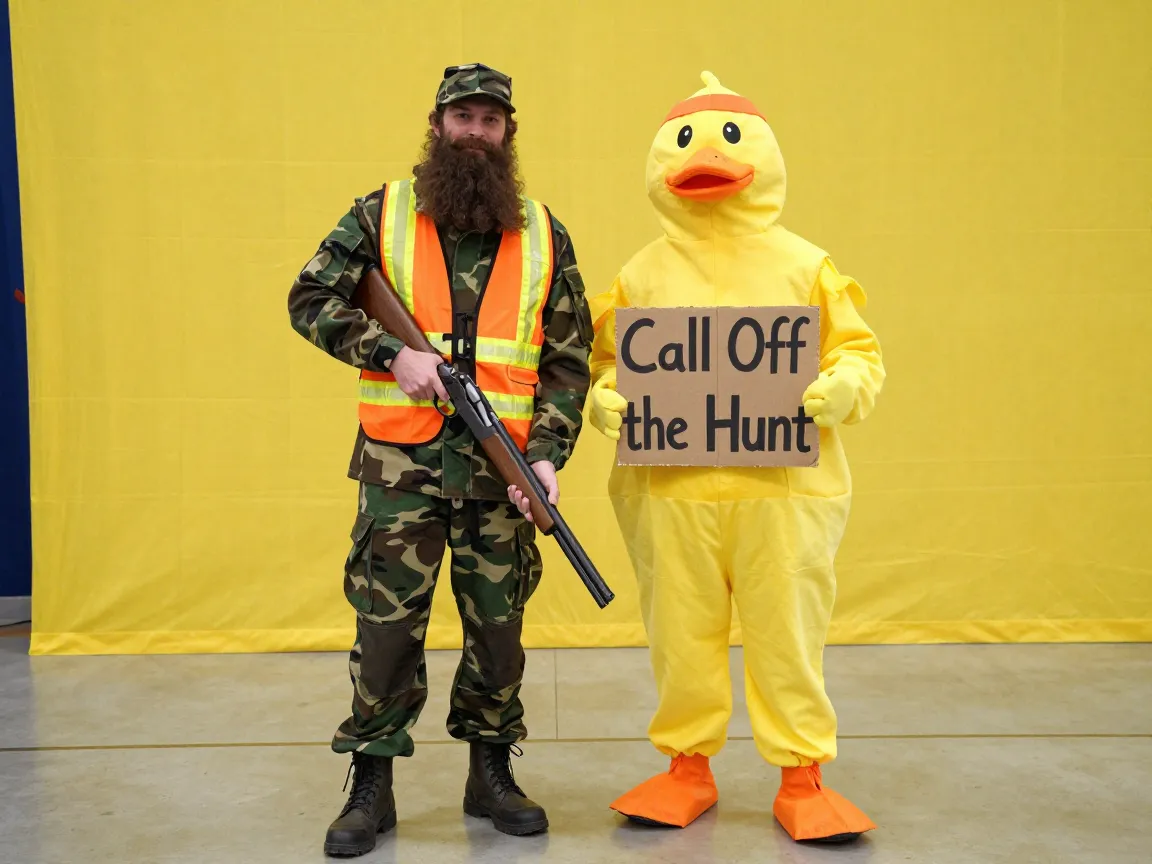
Couples categories at Halloween contests are frequently the most competitive because coordinated entries carry a built-in narrative. The hunter-and-duck pairing is one of the few couples concepts where the visual conflict is funny without requiring any explanation. One person is hunting; the other person is the target. The joke is obvious, legible, and hard to misread.
The duck half of this costume is what determines whether the entry wins or just places. A full yellow duck suit with an orange beak headband and orange shoe covers is the minimum. The upgrade that separates finalists from winners is the duck carrying a “protest sign”, a small cardboard sign reading something like “Call Off the Hunt” or “I Am Not in Season.” That prop transforms a good couples costume into a storytelling entry, which judges consistently reward.
The hunter half should lean into the contrast. Full Duck Dynasty-style camo, the long beard accessory, and a prop shotgun (foam or plastic, clearly unrealistic) makes the juxtaposition as sharp as possible. Both partners should coordinate their color palettes loosely, the hunter’s orange safety vest picks up the duck’s orange beak and foot covers, which creates visual cohesion in photos without making the contrast disappear.
This category is explicitly sold by multiple major online costume retailers in 2026, so the base pieces are easy to source. The sign prop is the one element you’ll need to make yourself, and it takes about ten minutes.
4. Full Group “Duck Hunt” Entry
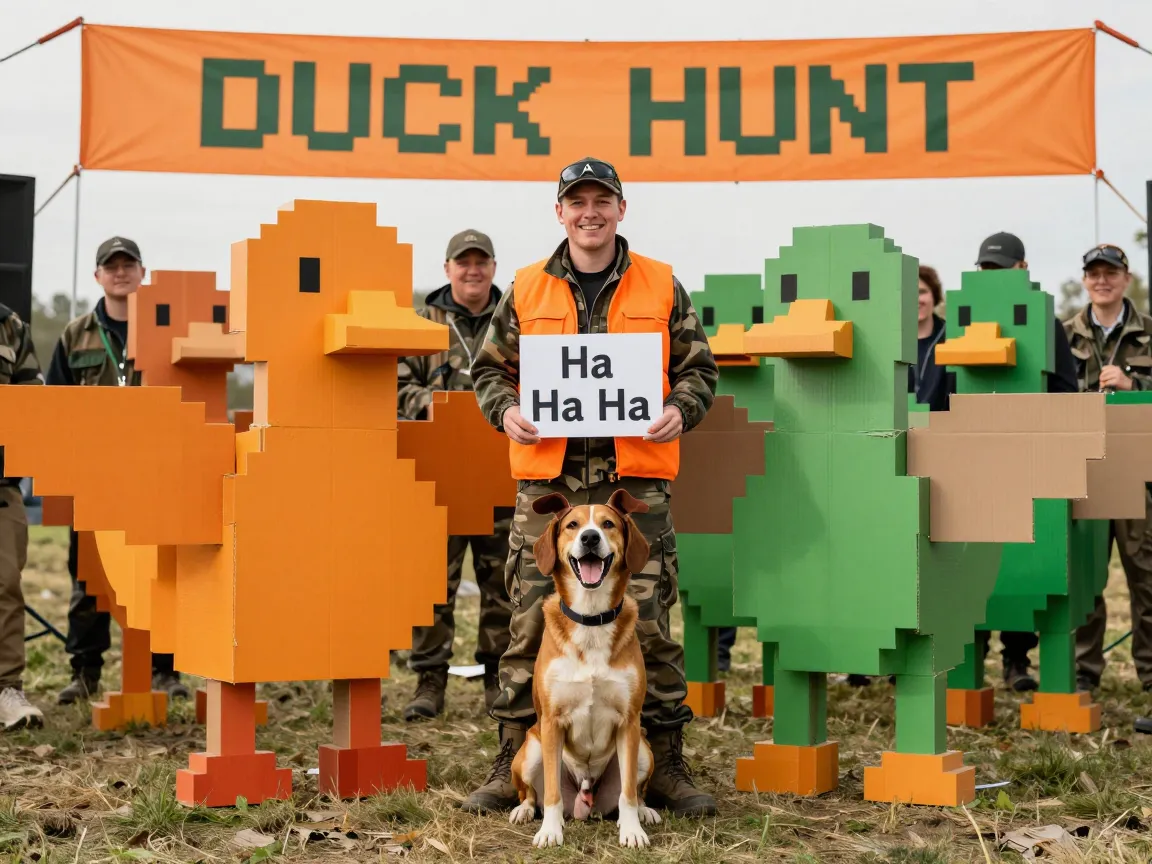
Referencing the Nintendo Duck Hunt game is a different concept from a straight hunting costume, and that distinction is worth taking seriously. Where the hunting costume says “outdoors,” the Duck Hunt group costume says “nostalgia”, and nostalgia tends to score well with judges who grew up in the 1980s and 1990s, a demographic that now includes most adult contest judges at community events.
The core group needs three costumes: one hunter in period-accurate attire (orange vest, camo, the works), one or two people dressed as the pixelated ducks from the game (orange and green body suits, or even cardboard cutout wings attached to a plain green outfit), and critically, a person dressed as the laughing dog. The dog costume is what identifies the entire group as Duck Hunt rather than a generic hunting party. A brown dog-ear headband, a brown outfit, and an exaggerated laugh expression, or a sign reading “Ha Ha Ha”, does the job.
Group entries require coordination on the night, which means assigning a point person to keep everyone together during judging. Contest judges typically see groups for about thirty seconds. Every member of the group needs to be in costume simultaneously, and the group needs a clear focal point. Put the dog in the center. The dog is the punchline.
A useful logistical note: cardboard prop elements (a giant pixelated duck cutout, a large “DUCK HUNT” banner in 8-bit-style font) help judges identify the reference immediately from a distance, which matters in crowded contest environments.
5. The Duck Pun Costume
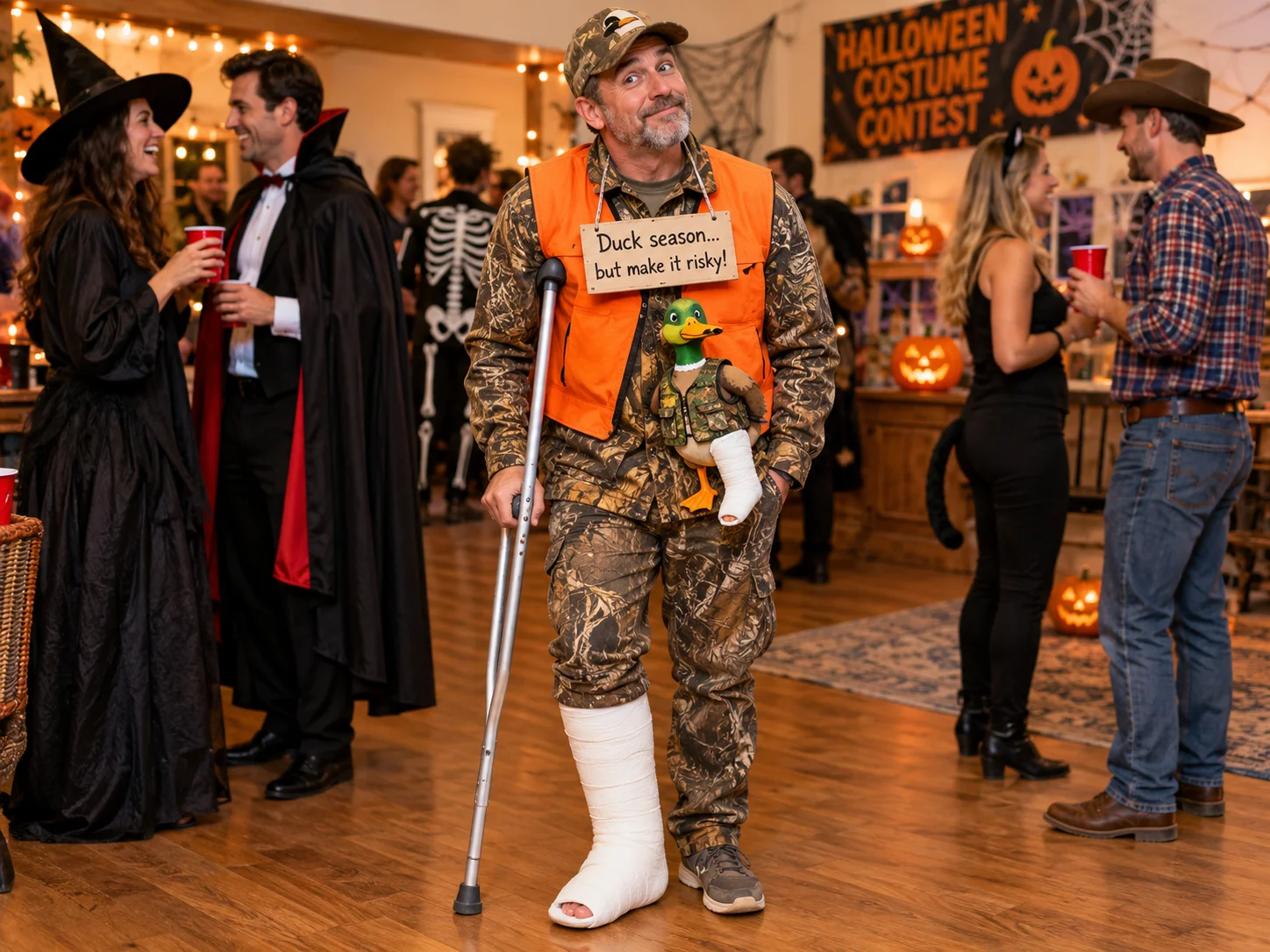
Pun-based costumes occupy a specific niche in contest judging: they rarely win for best traditional costume, but they almost always win creative categories, and many events score creativity separately. A duck-hunter pun concept requires exactly one clear idea executed with commitment.
“Duck, Duck, Goose” is the most commonly brainstormed pun in this category, but it’s been done enough times that it no longer surprises judges. A stronger option that community costume boards identified in 2024 is the “Lame Duck Hunter” concept: a standard duck hunter costume paired with a crutch and a cast on one leg, optionally with a small paper duck wearing a cast as well. The political phrase “lame duck” gives judges two readings simultaneously, hunting and political satire, which rewards attentiveness and tends to generate conversation.
Another underused option is “Duck and Cover”, a duck hunter costume combined with a Civil Defense-era hardhat and a prop radiation shelter brochure. The costume references both the hunting context and the Cold War phrase, and the layered reference tends to perform well with older judges while still reading as funny to anyone who doesn’t catch the second meaning.
The rule for pun costumes is that the pun must be explainable in one sentence. If you need a paragraph to justify it, the costume won’t land during the thirty seconds a judge spends with you. Write the explanation on a small placard worn around your neck. Judges appreciate the assist.
6. The Four-Legged Duck Hunter: Pet Costume Entry
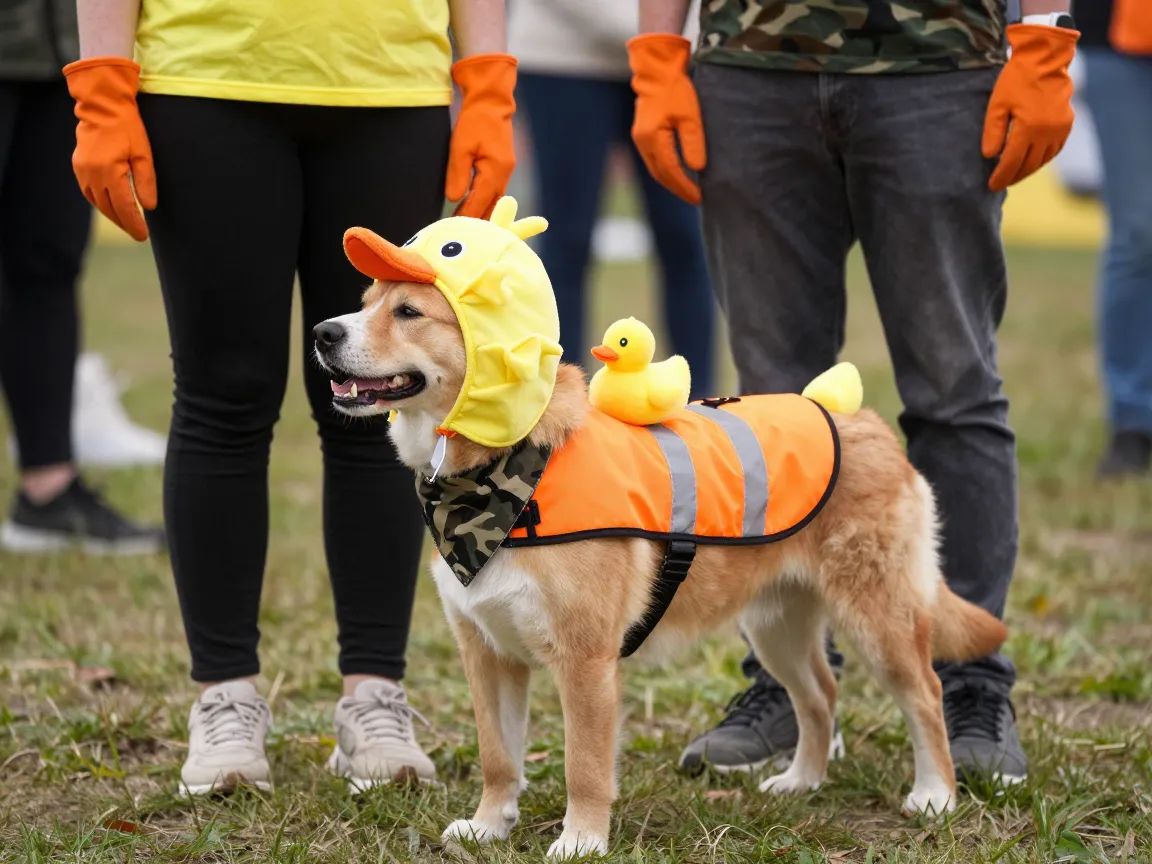
Pet Halloween costume competitions are growing at community events, parks, and pet stores. In 2026, several major pet retailers expanded their hunting-themed costume sections, and “four-legged duck hunter” is now an explicitly marketed category. The concept turns the natural predator-prey relationship between hunting dogs and ducks into a costume entry, a dog dressed as a duck hunter, complete with a tiny orange safety vest, a camo bandana, and a miniature foam duck duck clipped to the vest.
The orange vest is the load-bearing element. It’s visible from a distance, it reads as “hunter” immediately, and it fits most medium-to-large dogs without restricting movement. Avoid full-body wraps on dogs who dislike being dressed, a vest and bandana combination achieves the same visual effect with far less stress on the animal. Some owners add a small camo bucket hat attached with a clip, but only if the dog tolerates headwear calmly. A dog actively pawing at a hat undermines the costume.
The upgrade that wins contests is coordination between owner and pet. An owner dressed as a duck standing beside a dog dressed as a duck hunter creates the same visual irony as the couples costume above, but the species reversal adds a layer that reliably draws crowd reactions. The owner needs a yellow duck suit, orange beak headband, and orange gloves. The dog gets the orange vest and camo bandana. The pairing photographs extremely well, and in pet-inclusive contests, it tends to win both the pet category and the overall creative category simultaneously.
Quick Comparison
| Costume Idea | Best Contest Category | Key Prop | Build Time |
|---|---|---|---|
| Serious Kid Duck Hunter | Family | Duck decoy + bucket hat | 20 min |
| Duck Dynasty Bearded Hunter | Individual | Long beard accessory | 8 min |
| Hunter-and-Duck Couples | Couples | Duck protest sign | 15 min |
| Full Group Duck Hunt | Group | Laughing dog costume | 45 min |
| Duck Pun Costume | Creative/Humor | Pun placard | 30 min |
| Four-Legged Duck Hunter | Pet/Owner Duo | Orange dog vest | 15 min |
Conclusion
Each of these 6 duck hunter Halloween costume ideas that will win every contest shares one structural quality: a single visual detail that makes the concept legible from across a room. Before purchasing anything, identify which contest category you’re entering, individual, couples, group, or pet, and build backward from that. The quick comparison table above maps each idea to its strongest category. Start there, source the key prop first, and assemble the rest around it.