Cat Fishing Illustration Concepts That Are Purr-Fectly Adorable
Over 1,300 royalty-free cat-fishing illustrations are available on major stock platforms alone, and that number keeps growing. The sheer commercial volume signals something worth paying attention to: the cat-fishing illustration theme has moved well beyond a quirky niche into one of the most recognizable motifs in character art, merchandise design, and digital publishing. Whether the goal is a greeting card, a game asset, a coloring book page, or a custom print, the sight of a feline with a fishing rod triggers an almost universal warmth in viewers. These 6 Cat Fishing Illustration Concepts That Are Purr-Fectly Adorable break down the strongest, most distinct visual approaches within that theme, each one offering a genuinely different creative direction, a different emotional register, and a different set of practical applications for artists, designers, and art buyers in 2026.
Disclosure: This post contains affiliate links. As an Amazon Associate, we earn from qualifying purchases, and at no extra cost to you.
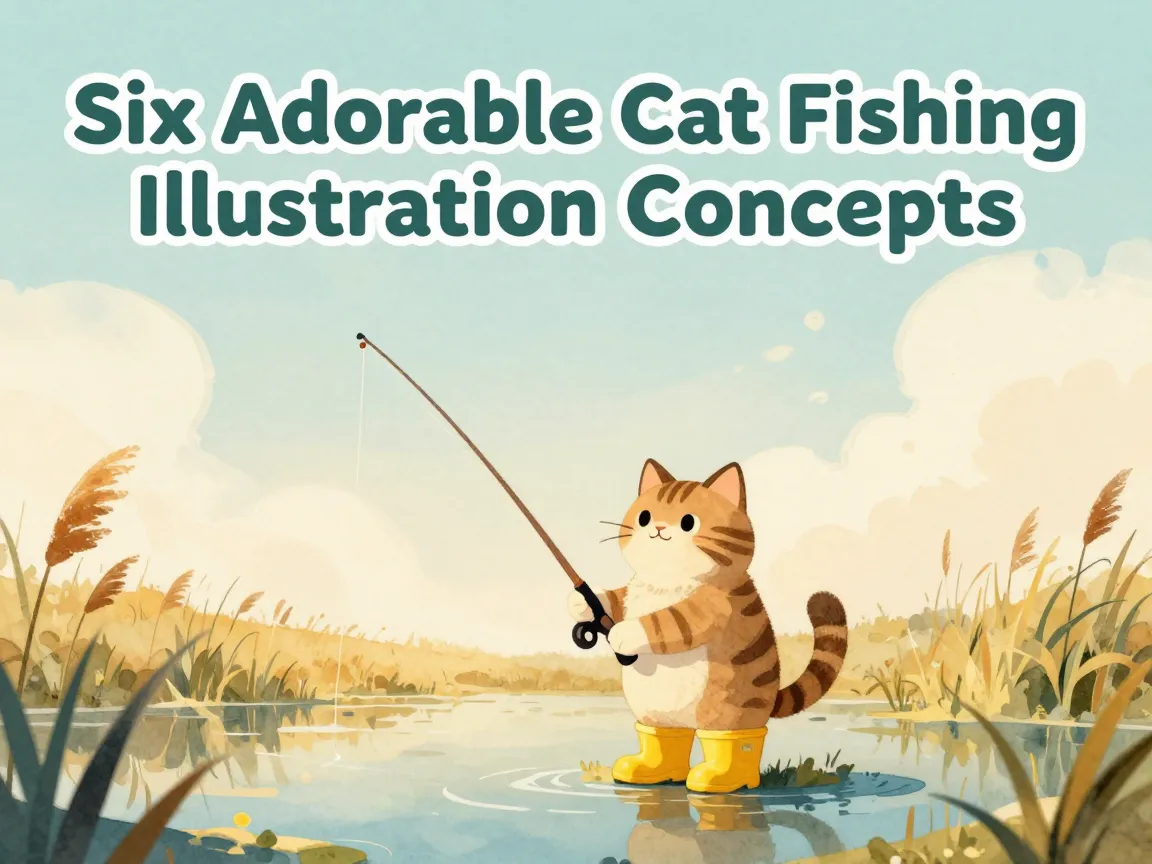
1. The Classic Rubber-Boot Fisher
Few compositions in cat illustration feel as immediately satisfying as the rubber-boot fisher. The concept places a rotund, wide-eyed cat in oversized waterproof boots, usually yellow or red, beside a calm pond or stream, fishing rod in paw, tail curled contentedly behind. The image works because the accessories are recognizable human objects rendered at a slight mismatch in scale, which creates gentle visual comedy without sacrificing warmth.
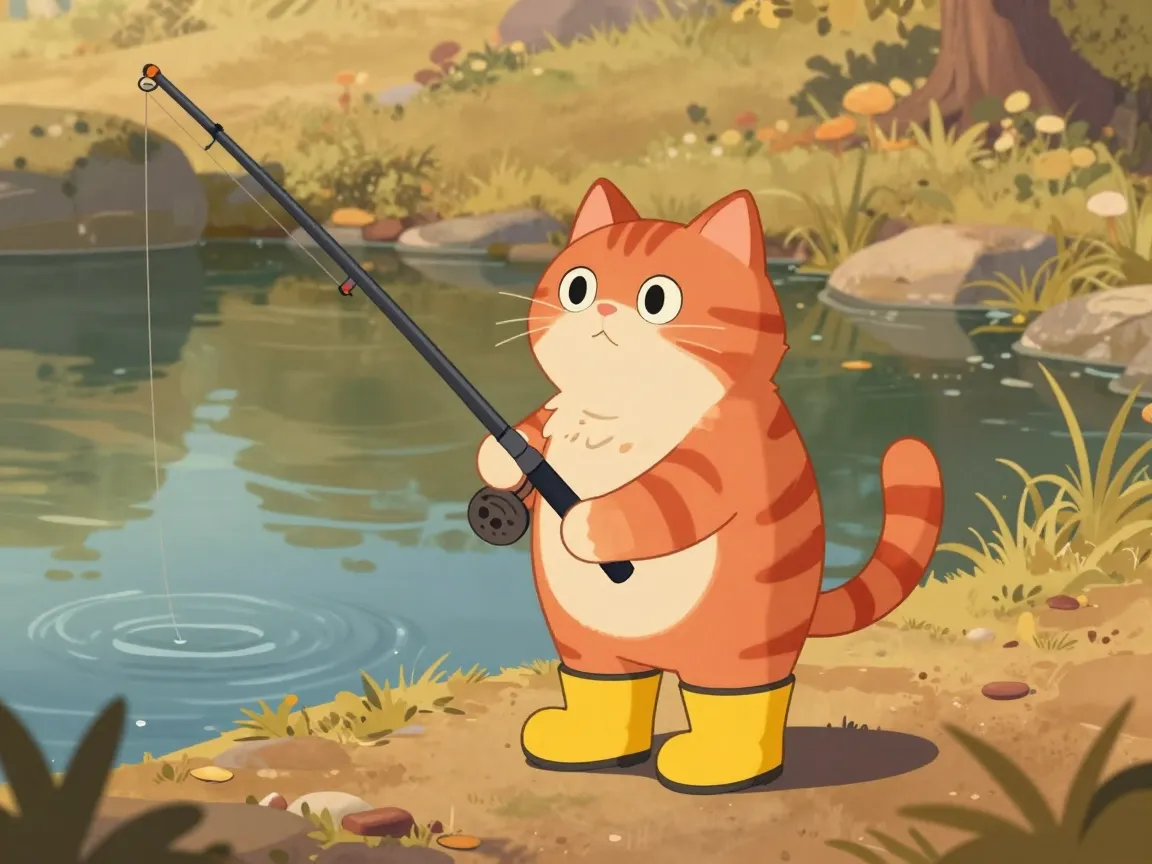
The design’s staying power owes a great deal to its versatility. A red tabby version reads as autumnal and cozy; swap the coloring to a blue-grey cat in green boots and the mood shifts toward a breezy spring afternoon. Stock art platforms list this exact concept under tags like “cat fisherman in rubber boots,” and the description consistently appears among the top results, a reliable indicator that buyers and searchers return to it repeatedly. The boots serve as an instant storytelling shorthand: they tell viewers this cat is prepared, serious about its hobby, and slightly ridiculous in the best possible way.
For designers, the rubber-boot fisher lends itself particularly well to merchandise that targets outdoor-hobby audiences who also happen to love cats. T-shirts, tote bags, enamel pins, and mugs all translate the design cleanly because the silhouette is strong enough to read at small sizes. The posture, typically a slight lean forward, rod angled toward the water, gives the composition a natural sense of anticipation that keeps the eye engaged even on a two-inch pin back.
One useful application tip: when adapting this concept for seasonal campaigns, changing only the boot color and background palette is often enough to signal a seasonal shift without redrawing the character from scratch. That efficiency makes the rubber-boot fisher a smart investment for any illustrator building a cohesive product line.
2. Kawaii Lilypad Fishing

The kawaii aesthetic brings its own grammar to the cat-fishing theme, and the lilypad setting is where that grammar finds its purest expression. In this concept, a simplified, almost spherical cat, minimal facial features, oversized head, tiny limbs, perches on an improbably large green lilypad, dangling a fishing rod into still blue water. The scale relationships are deliberately wrong: the lilypad is too big, the cat is too round, and the fish below the surface are often larger than physics would allow. That wrongness is the point.
Merchandise platforms such as Teepublic carry multiple listings built around this exact configuration, described in terms like “cute cat fishing on a lilypad” and tagged under kawaii lifestyle products. The popularity of those listings reflects a consumer appetite that is distinct from the broader cat-art market, buyers drawn to kawaii illustration tend to skew younger, favor pastel palettes, and are more likely to purchase apparel over home goods. Understanding that demographic distinction matters when deciding which illustration style to develop.
The emotional core of kawaii lilypad fishing is tranquility elevated into fantasy. The frog-pond setting is a universal symbol of peaceful solitude, and placing a soft cartoon cat in the middle of that setting amplifies the restfulness without adding any tension. Illustrators working in this mode often include small supporting details, a tiny dragonfly, a pebble ripple, a half-submerged lily flower, that reward close inspection without cluttering the primary read.
From a color standpoint, the concept handles pastel palettes exceptionally well. Mint greens, lavender shadows, and pale peach highlight the rounded forms naturally. For digital artists, this is one of the more forgiving concepts to execute in a limited palette, making it a strong candidate for social media illustration challenges or limited-print-run products where color count affects production cost.
3. Painterly Boat Scene at Golden Hour
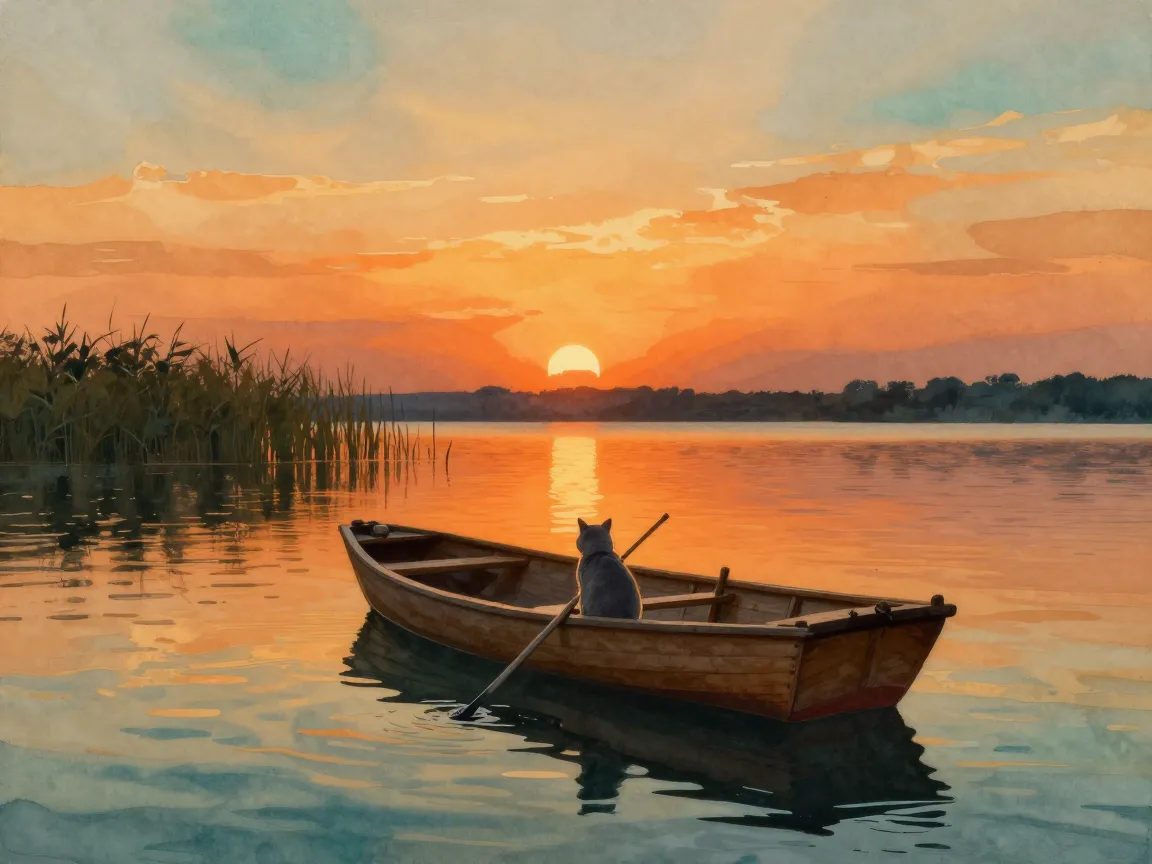
Moving away from cartoon simplicity, the painterly boat scene occupies the more atmospheric end of the cat-fishing illustration spectrum. Here, a realistically proportioned, or at least semi-realistic, cat sits in a wooden rowboat, rod trailing into amber-lit water as the sun descends behind distant reeds. The style draws on watercolor or gouache techniques, favoring loose edges, granulating washes, and the kind of luminous sky that makes viewers nostalgic for evenings they may never have actually lived.
This concept targets a different buyer entirely. Where the rubber-boot fisher and the kawaii lilypad cat appeal to playful, lighthearted sensibilities, the painterly boat scene speaks to adults who want cat art that can live on a gallery wall or inside a high-end coloring book without feeling juvenile. Publishers working in the cozy-coloring and art-therapy space, a category that has seen sustained retail activity through 2026, have leaned into exactly this register, commissioning illustrations that blend feline subjects with environments normally associated with landscape painting.
The golden-hour palette does specific emotional work. Warm orange and deep teal, the complementary contrast that dominates sunset scenes, creates visual richness with relatively few hues. A grey or white cat reads particularly well against that background because the cool-neutral fur pops against the warm water reflections. Artists should resist the temptation to over-render the cat’s features in this style; a looser, more impressionistic treatment of the face keeps the piece feeling painterly rather than awkwardly caught between realism and illustration.
For editorial and publishing applications, the boat scene offers strong horizontal compositions that suit book covers and wide-format prints. It is worth noting that the concept also adapts readily to digital painting workflows, the same visual logic that works in watercolor translates to textured brushes in Procreate or Photoshop, allowing illustrators to achieve a traditional feel through fully digital means.
4. Minimalist Line-Art Silhouette
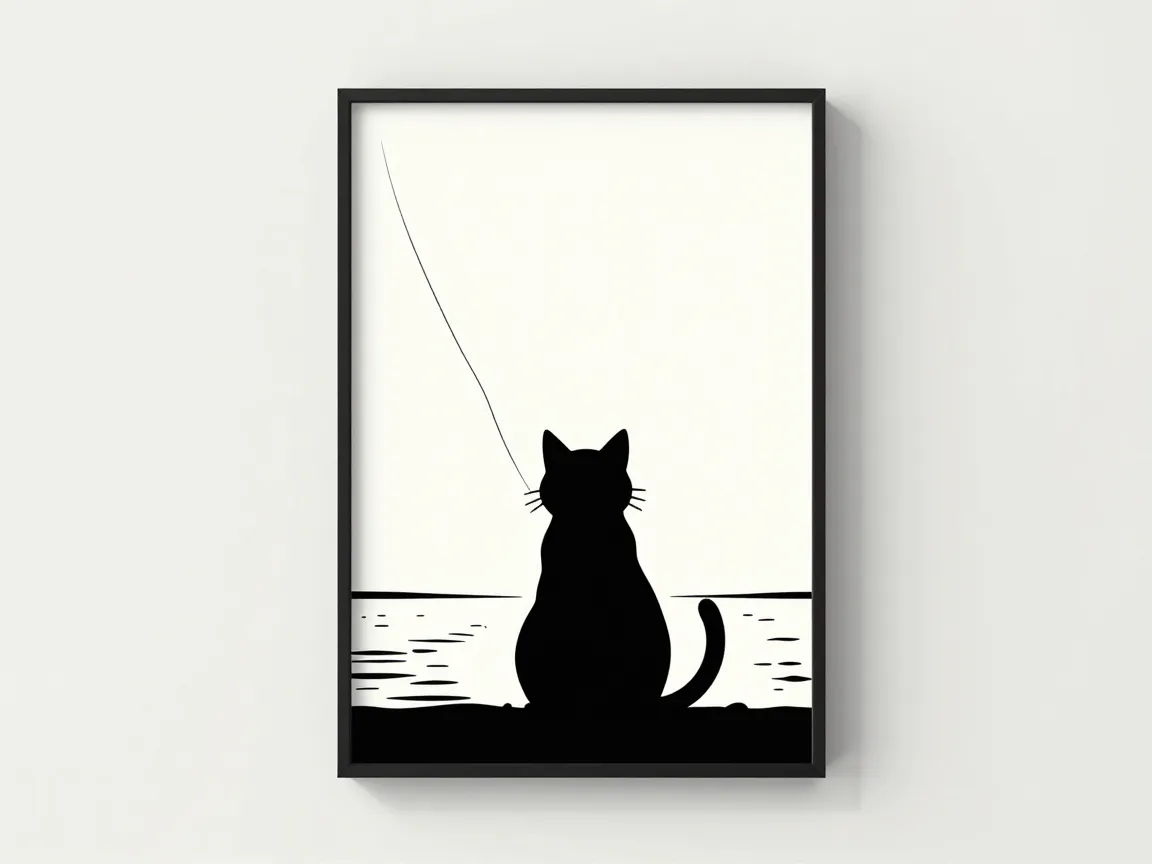
The minimalist approach strips the concept down to its geometric essence: a clean black silhouette of a seated cat, a single arcing fishing line, and a horizon. No color fill, no texture, no background detail beyond a suggestion of water. The concept works because it trusts the viewer to supply the warmth from the shape alone, a cat’s silhouette, with its pointed ears and curved tail, carries enough cultural and emotional association that ornamentation becomes optional.
This illustration style has found a natural home in home decor, particularly in the Scandinavian-influenced minimalist interior market. Framed prints, embroidered patches, and laser-cut wooden ornaments all use the silhouette format because it scales cleanly, reproduces crisply in black ink, and pairs with almost any color scheme in an existing room. The fishing pose adds directionality and purpose to what could otherwise be a static cat outline, giving the image a narrative quality despite its simplicity.
From a production standpoint, the line-art silhouette is one of the most adaptable formats in the entire cat-fishing family. The same vector path can be color-filled for one product, reversed to white on a dark background for another, and outlined in a metallic foil treatment for premium goods, all without redrawing the artwork. That flexibility is a significant commercial advantage for independent illustrators selling across multiple product categories.
The minimalist cat fishing concept also performs well in digital contexts where file size or rendering speed matters. App interfaces, icon sets, and simple game assets all benefit from artwork that communicates clearly at small sizes. The silhouette’s high contrast ratio means it remains legible even when displayed as a small thumbnail, an increasingly important quality in social-media-driven discovery environments.
5. Cozy Winter Ice-Fishing Scene

Seasonal variation is one of the most reliable ways to extend the commercial life of any illustration concept, and the winter ice-fishing scene demonstrates that principle in a particularly charming way. Here, a bundled-up cat, scarf wrapped multiple times around a thick neck, paw-warmer mittens, perhaps a pompom hat, sits beside a hole cut in illustrated ice, rod dropped patiently into the frozen water below. Snow falls softly. A thermos of something warm sits nearby.
The concept adds tactile warmth to the inherent whimsy of cat fishing. Cozy illustration, sometimes labeled “hygge art” in retail contexts, has sustained commercial momentum for several years, and placing a cat within that visual language taps into both markets simultaneously. Buyers who search for winter-themed illustration and buyers who search for cute cat art converge on this concept without either group needing to compromise.
Character design decisions matter considerably in this variation. The layered clothing provides an opportunity to showcase personality through fabric pattern, a plaid scarf suggests a classic outdoorsy character; a striped scarf with mismatched mittens implies an endearingly disorganized homebody. The ice hole itself functions as a framing device, drawing the eye downward into a small window of dark-blue water that contrasts sharply with the white snowfield, creating depth in an otherwise flat environment.
For illustrators building seasonal product lines, the ice-fishing cat pairs naturally with the rubber-boot summer version as part of a “four seasons fishing cat” series, a format that has proven popular in calendar design, greeting card sets, and wall-print collections. Offering the concept as a series rather than a standalone illustration generally commands a higher licensing rate and provides buyers with ready-made thematic coherence.
6. Celestial Star-Fishing on a Crescent Moon
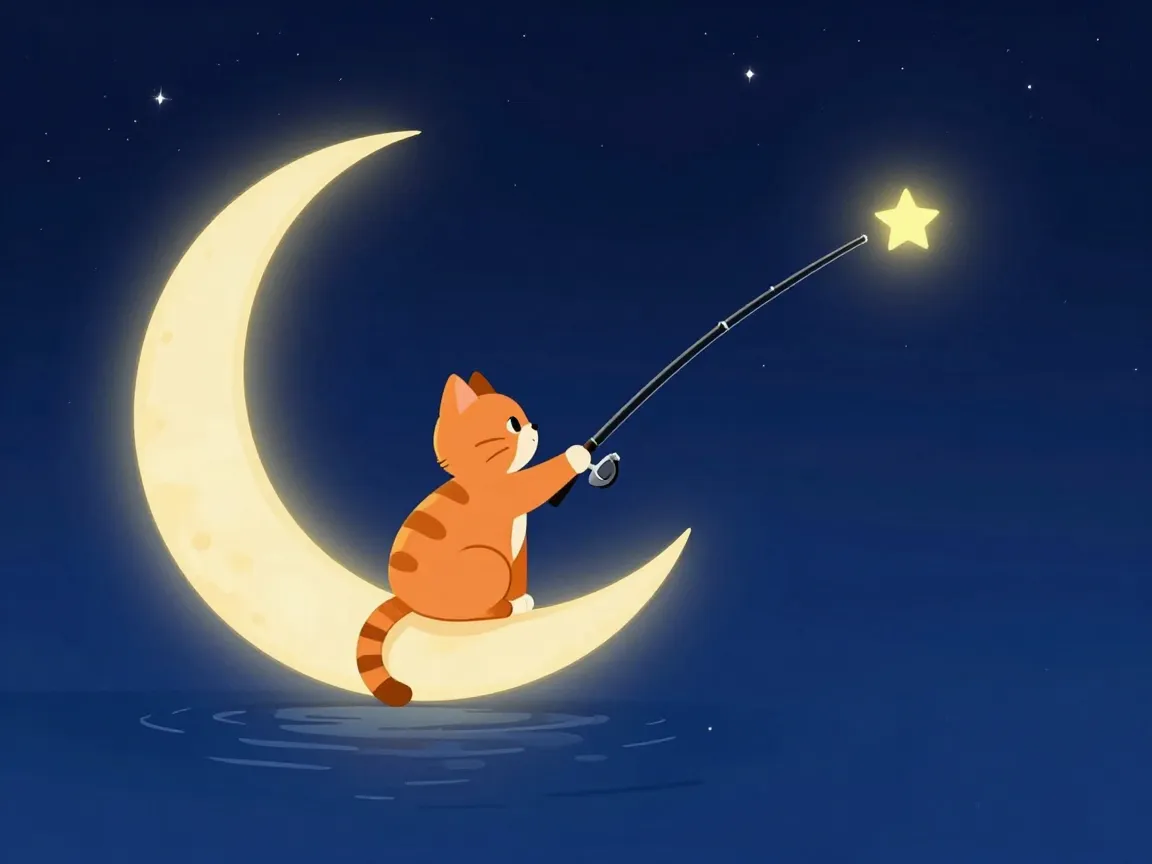
The most imaginative concept in this collection replaces water with the night sky and fish with glowing stars. A cat perches on the upturned tip of a crescent moon, fishing rod extended into a deep indigo cosmos, a luminous star caught on the line or hovering just below it. The concept borrows visual logic from the classic Dreamworks logo, the solitary figure fishing from a crescent, but recontextualizes it entirely through feline character and a sense of childlike wonder.
What makes this concept distinct from pure fantasy illustration is the coherence of its internal metaphor. Stars as fish, the moon as a dock, the cosmos as an infinite pond, these substitutions are legible and playful rather than arbitrary. Viewers understand the joke immediately, which creates a moment of shared delight that translates directly into commercial appeal. This is the concept most likely to generate impulse purchases, because it rewards the viewer for noticing the cleverness of the substitution.
The palette possibilities are some of the richest in the cat-fishing family. Deep navy and cobalt backgrounds allow for maximum luminosity in the star elements, while the cat can be colored in any warm tone, orange, cream, calico, to maintain visual contrast against the cool background. Illustrators working with this concept often use a rim-light effect on the cat’s fur to suggest the glow of nearby stars, a technique that adds three-dimensionality without complicating the overall composition.
Consumer products built around this concept skew toward the gift market: birthday cards, nursery prints, and “inspirational” merchandise where the act of fishing for stars carries a motivational reading alongside the whimsical one. That dual interpretive layer, it is both cute and vaguely aspirational, gives the celestial star-fishing concept unusual breadth across buyer demographics. It appeals to children’s-room decorators and to adults who maintain a deliberately dreamy aesthetic sensibility, two audiences that rarely overlap in illustration purchasing but do so here.
The concept has also moved into interactive media. A small but growing category of casual games uses the cat-fishing-for-stars premise as a central mechanic, suggesting that the visual idea carries enough narrative logic to sustain engagement beyond a single static image. For illustrators, this cross-media applicability is worth factoring into how characters within this concept are designed, a character with clean, scalable proportions and distinctive markings is more attractive to game studios than one that relies on fine-detail painterly effects that do not compress well into sprite sheets.
Conclusion
The 6 Cat Fishing Illustration Concepts That Are Purr-Fectly Adorable outlined here are not interchangeable, each one occupies a distinct emotional register, targets a recognizable buyer segment, and carries specific production considerations that affect commercial viability. The rubber-boot fisher delivers reliable merchandise appeal; the kawaii lilypad cat dominates the younger pastel-art market; the painterly boat scene earns its place in premium publishing and gallery-adjacent retail; the minimalist silhouette scales effortlessly across product categories; the winter ice-fishing variant extends a concept across seasons; and the celestial star-fishing illustration crosses demographic lines with its dual layers of whimsy and meaning.
The most useful next step for anyone working in this space is to map their existing audience against these six registers before choosing a direction. Understanding which emotional tone your buyers already respond to, cozy, kawaii, painterly, minimal, seasonal, or fantastical, will narrow the choice from six options to one or two strong candidates and prevent the common mistake of producing technically accomplished illustration in a style that lands in front of the wrong audience.