Father Son Fishing Photoshoot Ideas to Capture Lifelong Bonds
A 2024 Getty Images trend report found that searches for authentic father-child outdoor imagery grew by over 40 percent in a single year, with fishing scenes ranking among the top requested lifestyle categories. That number tells you something real: families want these moments recorded, and photographers who know how to frame them are in demand. These 6 father son fishing photoshoot ideas to capture lifelong bonds work because fishing gives the camera exactly what it needs, movement, texture, light on water, and two people who actually have something to do together instead of just standing still.
Disclosure: This post contains affiliate links. As an Amazon Associate, we earn from qualifying purchases, and at no extra cost to you.
Key Takeaways
- Golden hour on a shoreline produces the warmest natural light and the most flattering water reflections for portraits.
- Boat-based sessions require a mix of wide establishing shots and tight close-ups to tell a complete story.
- Skill-transfer moments, hands on a rod, eyes meeting, carry more emotional weight than posed smiles.
- Prep and pack-up rituals before and after fishing are consistently undershot and highly authentic.
- Three-generation compositions create legacy photographs that families display for decades.
- Seasonal timing, especially around Father’s Day in June, drives the strongest demand for this type of imagery.
1. Sunset Shoreline Bonding Portraits
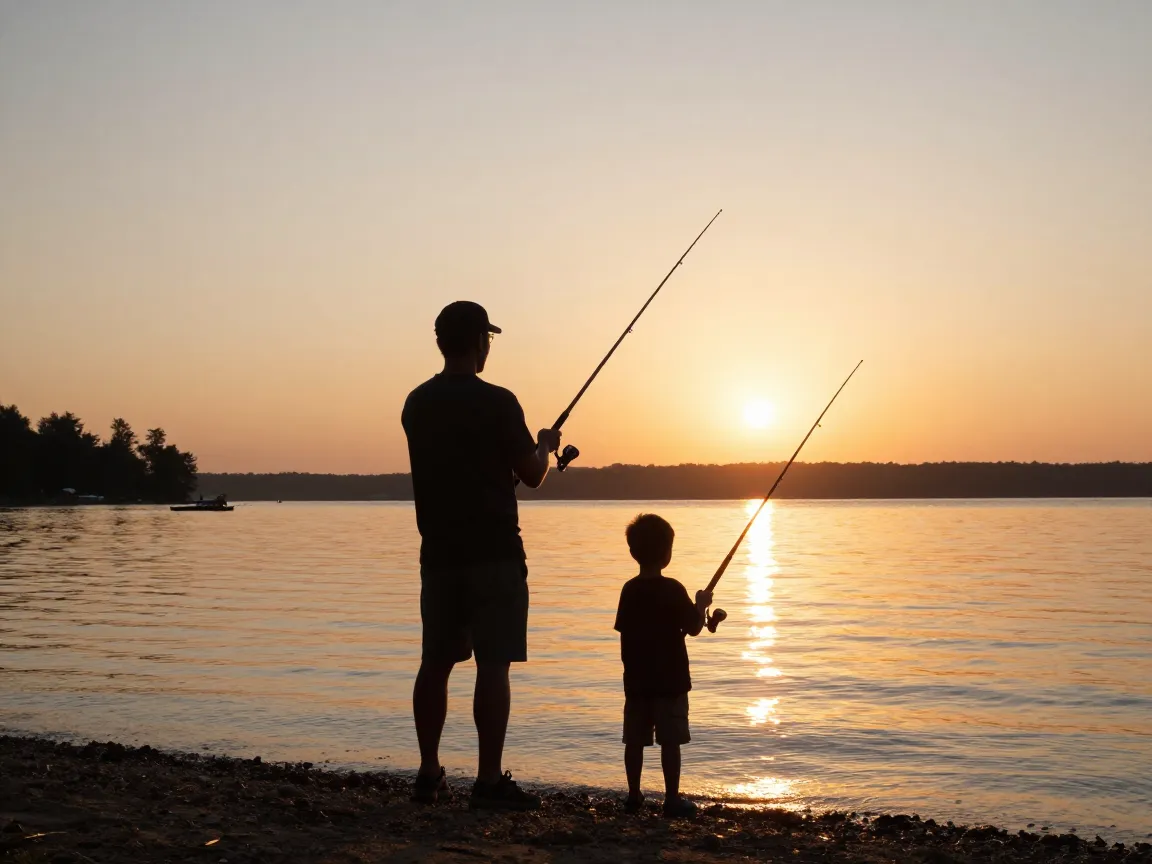
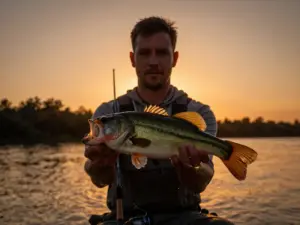
The last 45 minutes of daylight beside any body of water gives you light that studio strobes cannot replicate. The sun drops low, turns amber, and bounces off the surface in a way that wraps two subjects in matching warmth. For a father-son fishing portrait session, that window is the single best tool you have.
Position the pair facing the water rather than the camera. A 7-year-old with a rod that’s nearly as tall as he is, standing next to his father with both lines in the water, that composition is natural and requires no direction beyond “just fish.” The camera catches the relationship through body language: the slight lean toward each other, the father’s hand occasionally steadying the boy’s grip, the shared patience.
Silhouettes work particularly well here. Expose for the sky and let the figures go dark. A strong silhouette of two different-sized fishing rods raised at similar angles communicates generational connection in a single frame. Follow that with a shot where you expose for the faces and let the sky blow slightly, that version shows the detail of expressions and becomes the portrait the family hangs on the wall.
One practical constraint: shoreline access varies. Scout the location 30 minutes before the session to identify where the sun will hit the water surface and whether any dock, rock, or bend in the shoreline will give you a clean background. Busy recreational parks with boats in the background dilute the quiet mood this setup depends on.
2. Boat-Based Adventure Storytelling
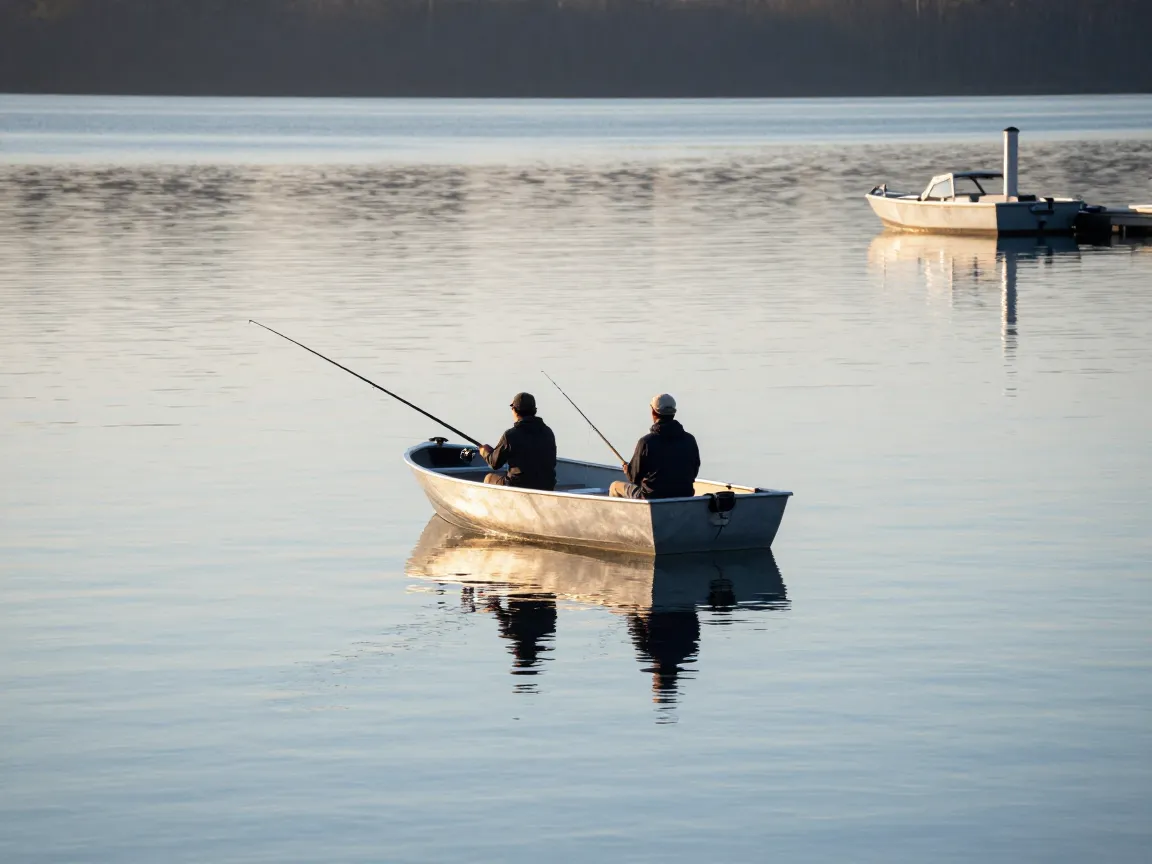
A small aluminum fishing boat, the kind you rent at a lake marina for $25 an hour, is a contained, camera-friendly environment that naturally frames two subjects together. There is nowhere else to go. That physical closeness creates a visual intimacy that open-shore sessions sometimes lack.
The storytelling approach here relies on sequence. Start wide: an establishing shot from shore or from a second small vessel showing the boat on open water, two figures, rods out, surrounded by the lake. That image sets the scene. Then move in. A telephoto at 200mm or longer lets you compress the background and isolate the pair without climbing into the boat yourself. You get candid expressions, a laugh, a point toward where the fish are, the son adjusting his hat, that posed sessions never produce.
Once you’re in the boat, work in close. The best boat-based fishing portraits are tight on faces and hands. A father threading bait while his son watches with focused attention, shot at f/2.8 from two feet away, is the kind of frame that gets printed large. Vary your angles: shoot down from behind a shoulder, shoot up from near the waterline (a wide-angle at 24mm exaggerates the sky and open water dramatically), and shoot flat across the boat to get both faces in profile.
Water reflections become a compositional element when you’re at this height. On calm mornings, the reflection of the boat and both figures on the lake surface can fill the lower half of the frame, turning a simple portrait into something genuinely striking.
3. Teaching Moments and Skill Transfer
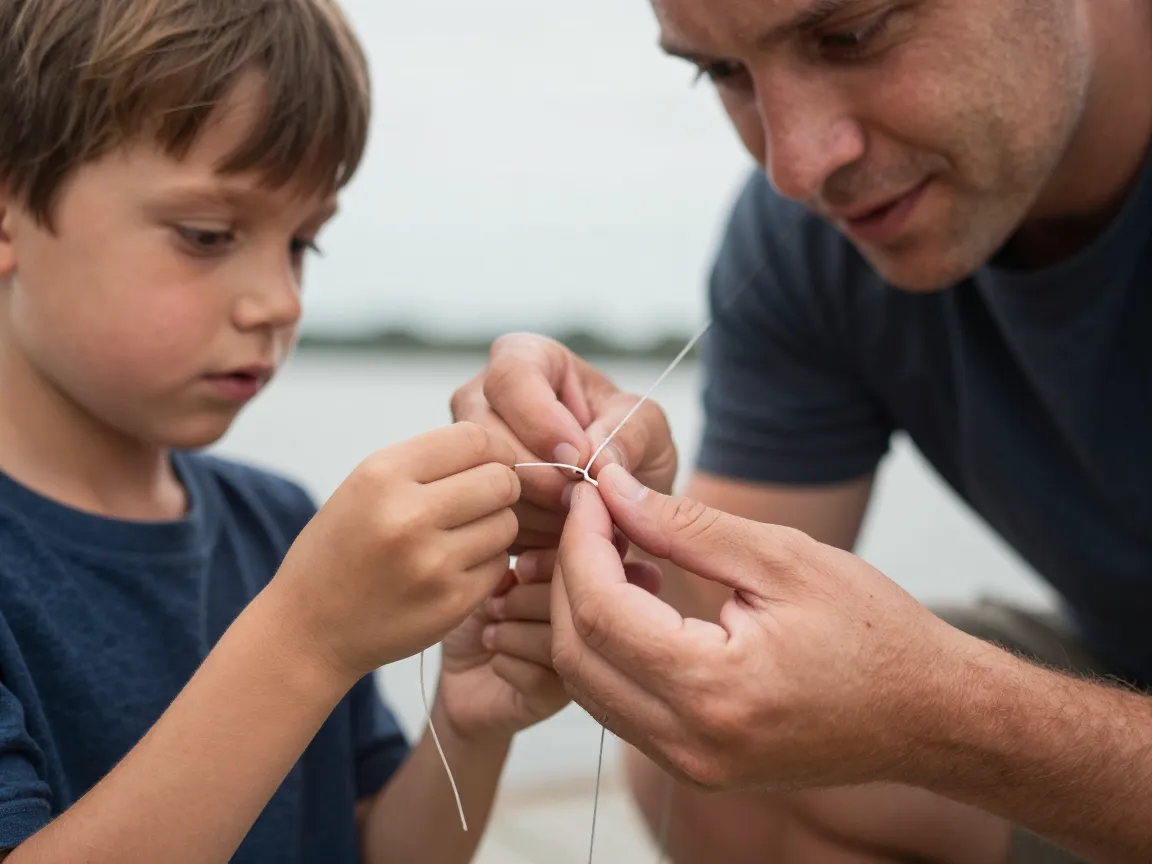
No other family photoshoot scenario gives you this naturally: one person showing another person exactly how to do something with their hands. The teaching moment is the core visual unit of a father-son fishing session, and it deserves its own dedicated setup.
Ask the father to teach his son something specific, tying a clinch knot, casting a baitcaster, reading the water for structure. The camera’s job is to stay out of the way and let that instruction happen. What you get is hand placement, eye contact, and the slight frustration or breakthrough expression on the boy’s face. Those frames are impossible to fake in a posed context.
Tight lens work matters here. A macro or short telephoto at 85-100mm focused on two sets of hands, one large, one small, both wrapped around the same fishing line is a photograph that earns its wall space without needing a face in it. Shoot several frames of this. Then pull back and get the full moment: the father crouching to the boy’s level, faces close, one pointing at the rod tip while the other watches the direction of the finger.
Eye contact between father and son, not at the camera, but between themselves, is the frame most photographers miss because they’re waiting for the subjects to look up. Don’t wait. The moment a child looks at his father to check if he’s doing it right is the moment worth catching. That expression is specific and unrepeatable.
4. Action Sequences: Casting, Reeling, and Trophy-Catch Celebration
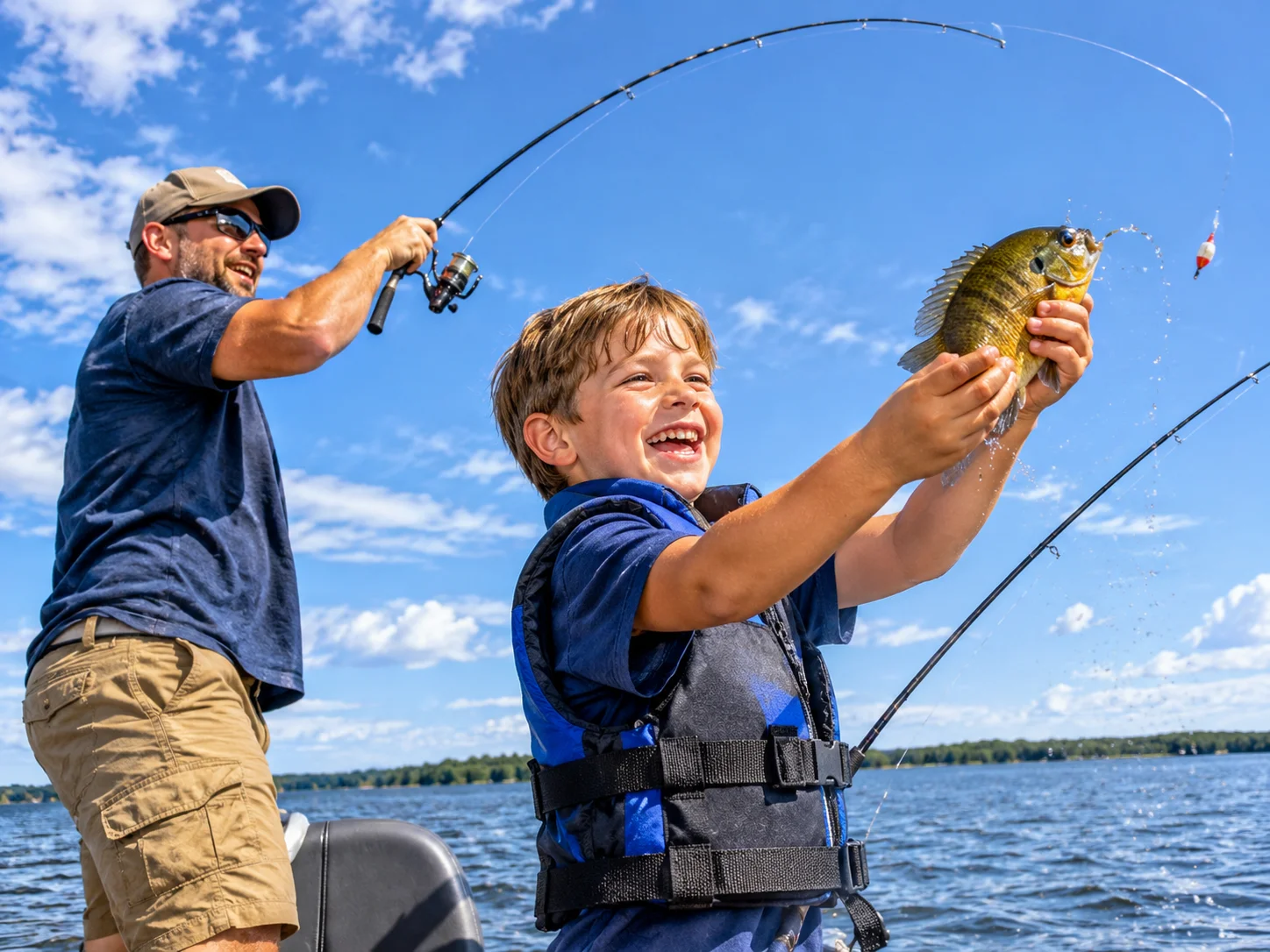
Fishing is not static, and the best fishing photoshoots treat it as the sport it is. Three action phases produce the strongest frames: the cast, the reel, and the catch.
The cast requires a fast shutter speed, 1/1000s minimum, to freeze the rod at full flex and the line in the air. Position yourself perpendicular to the caster so the arc of the rod reads clearly against the sky or water background. A father teaching a son to cast overhead gives you two rods in frame at different stages of the motion if you time the sequence correctly, or you can isolate each subject and edit the best frames into a diptych.
Reeling in is slower and more expressive. The concentration on a child’s face while cranking a reel, tongue slightly out, shoulders hunched, is one of the most recognizable and endearing expressions in outdoor family photography. Shoot in burst mode and choose the frame where the expression peaks.
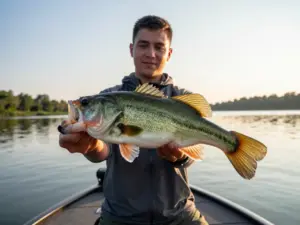
The trophy catch is the high-emotion moment every session should plan for. Even a small bluegill held up by a 6-year-old produces a genuine wide grin that no coaching can replicate. The key is to shoot the first five seconds after the fish comes out of the water, that’s when the surprise and pride are real. After that, the expression starts to perform for the camera. Get in close, shoot slightly from below so the fish and the face are both sharp, and make sure the father is visible in the background reacting. His response, laughing, clapping, pointing, doubles the emotional content of the frame.
5. Candid Preparation and Gear Rituals
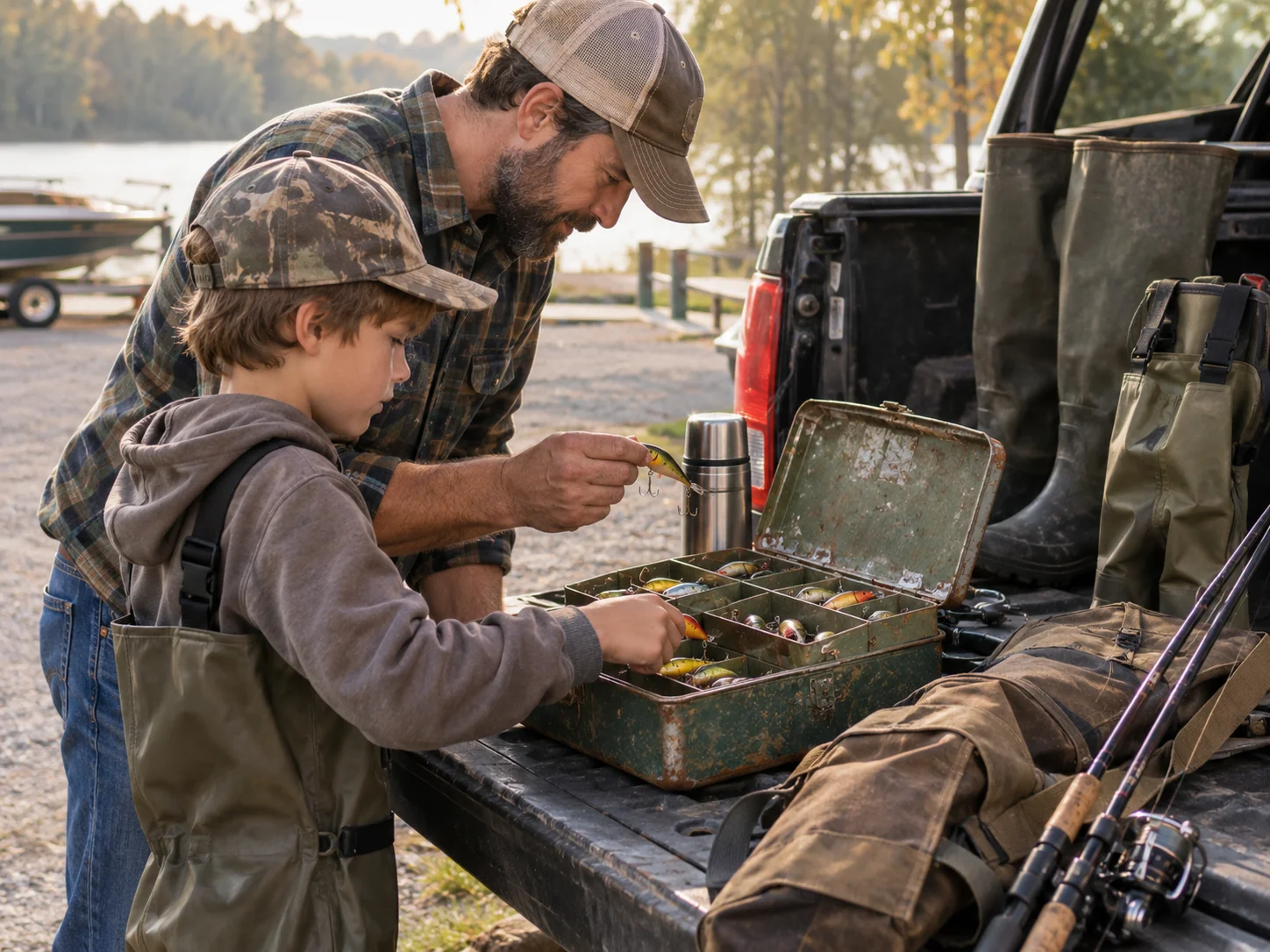
The drive to the lake, the tackle box laid open on the tailgate, the boots being pulled on, these pre-fishing rituals are almost always unshot, and they are some of the most authentic material a session can produce. Post-session rituals work too: rinsing gear, recounting the day, the quiet tiredness on the drive home.
Gear has strong visual texture. A vintage metal tackle box with compartments of lures in different colors, a worn rod bag, a pair of child-sized rubber waders next to full-size ones, these details tell the story of a shared hobby across two generations without anyone needing to perform for the camera. Shoot them flat-lay on a truck hood or picnic table, then shoot the father and son interacting with them in context.
The selection process is particularly good material. A father holds up two lures and lets the son pick. The son holds one up to examine it, squinting. That small decision-making moment, shot from the side at a natural height, is the kind of candid that gets used for Father’s Day cards and printed on mugs because it looks exactly like what it is: a real Sunday morning.
After the session, the quiet moments carry weight too. Two fishing rods leaned against a truck at dusk, two pairs of boots on a dock, or the same wide tackle box being closed and latched, these closing images function as a bookend to the action shots and give any photo series a natural narrative structure. Any photographer building a gallery for a family client should plan 15-20 minutes at either end of the main fishing session specifically for this material.
6. Multi-Generational Legacy Shots
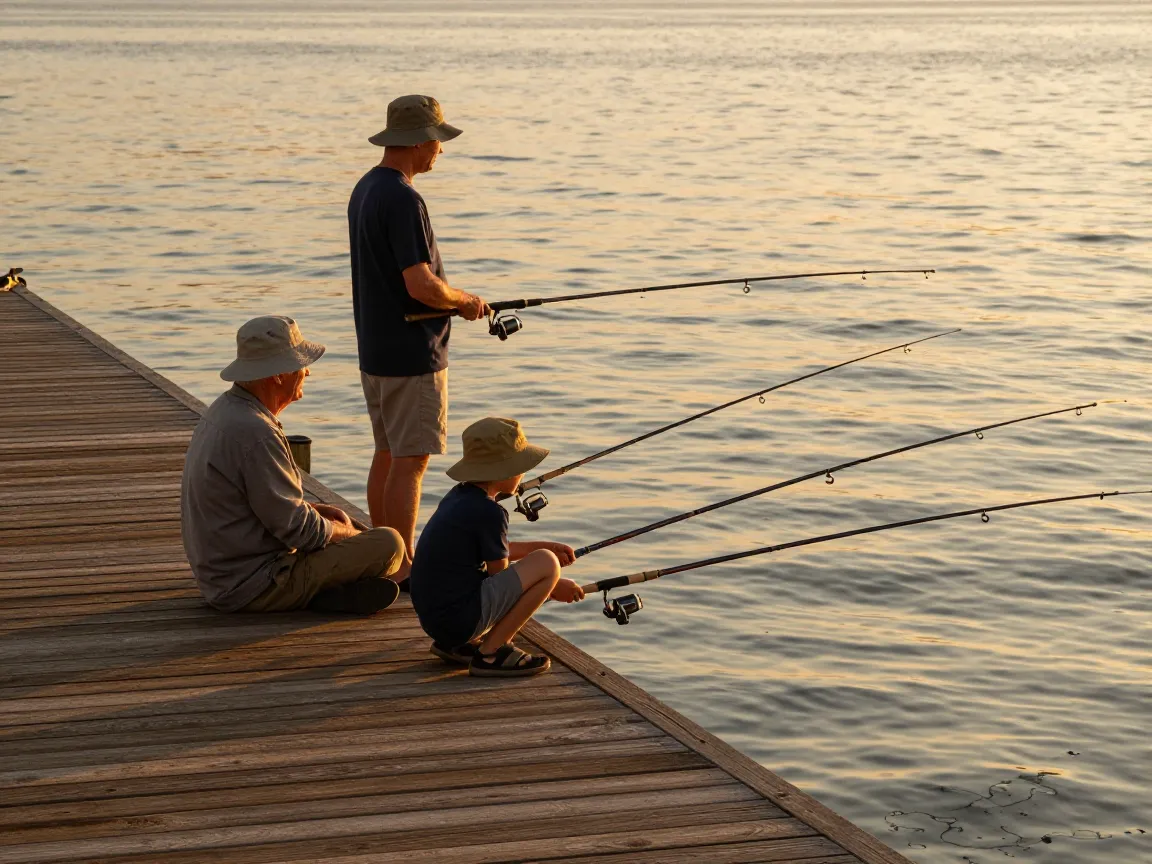
When a grandfather is available to join the session, the visual dynamic changes entirely. Three generations of the same family holding fishing rods on a dock, each at a different life stage, produces the kind of photograph families keep for 50 years.
The composition challenge is scale and spacing. A grandfather, a father, and a child standing in a straight line facing the water is the starting point, but it reads as static. A better arrangement puts the grandfather seated on the dock’s edge with a rod over the water, the father standing just behind, and the son crouching at the edge between them. That diagonal layering creates depth and shows physical relationships without requiring anyone to touch or pose artificially.
Matching gear tells the story faster than any caption. Three fishing rods of different lengths and ages, a grandfather’s cane pole, a father’s spinning rod, a child’s first Zebco, lined up side by side on a dock plank make an immediately legible three-generation image. Same with hats: if all three wear the same style of bucket hat, or the same fishing cap, that visual echo becomes the organizing element of the frame.
The emotional weight of a three-generation fishing photograph comes from what it implies about time. The grandfather teaching the father the same skill the father is now teaching the son, that chain is visible in a single frame when composed correctly. Stock photography libraries in 2026 show strong and growing upload volumes for exactly this type of image, reflecting broader cultural demand for legacy and continuity in family photography. For families who commission these sessions, the multi-generational shot is frequently the one they describe years later as the most meaningful image they own.
Quick Comparison
| Idea | Best Light Condition | Key Gear/Setting | Strongest For |
|---|---|---|---|
| 1. Sunset Shoreline Portraits | Golden hour, 45 min pre-sunset | 85mm, f/2.8, expose for sky | Portraits and prints |
| 2. Boat-Based Storytelling | Early morning calm water | 70-200mm from shore, 24mm wide in boat | Full narrative series |
| 3. Teaching Moments | Overcast or open shade | 85-100mm, f/2.8, focus on hands | Emotional close-ups |
| 4. Action Sequences | Any; bright for fast shutter | 1/1000s+, burst mode | Energy and celebration |
| 5. Gear and Prep Rituals | Soft morning light | 35mm or 50mm, natural table height | Authentic candid story |
| 6. Multi-Generational Legacy | Golden hour or overcast even light | Wide enough for three subjects | Heirloom photograph |
Conclusion
Of these six approaches, the teaching-moment setup, rod in both pairs of hands, faces close, real instruction happening, is the one most photographers overlook in favor of posed shoreline portraits. It produces the frames families return to most often because there’s no artifice in them. If you’re planning any father-son fishing session in 2026, build at least 20 minutes of your session time around a specific, real skill being passed from father to son and let the camera run. The other five ideas give you the range, but that one gives you the image they’ll keep.