Canvasback Duck Mount Styles Every Collector Will Love
Fewer than a dozen waterfowl species have held the same prestige in American hunting culture as the canvasback drake, and that status translates directly into what collectors expect from a finished mount. The red eye, the sloping wedge-shaped head, the clean white back, the deep chestnut neck, these field marks reward skilled taxidermy in ways that most species simply cannot match. Whether you’re commissioning your first piece or building a room around an existing collection, understanding the 6 Canvasback Duck Mount Styles Every Collector Will Love helps you match the right presentation to your space, your budget, and what you actually want to look at every day.
Disclosure: This post contains affiliate links. As an Amazon Associate, we earn from qualifying purchases, and at no extra cost to you.
Key Takeaways
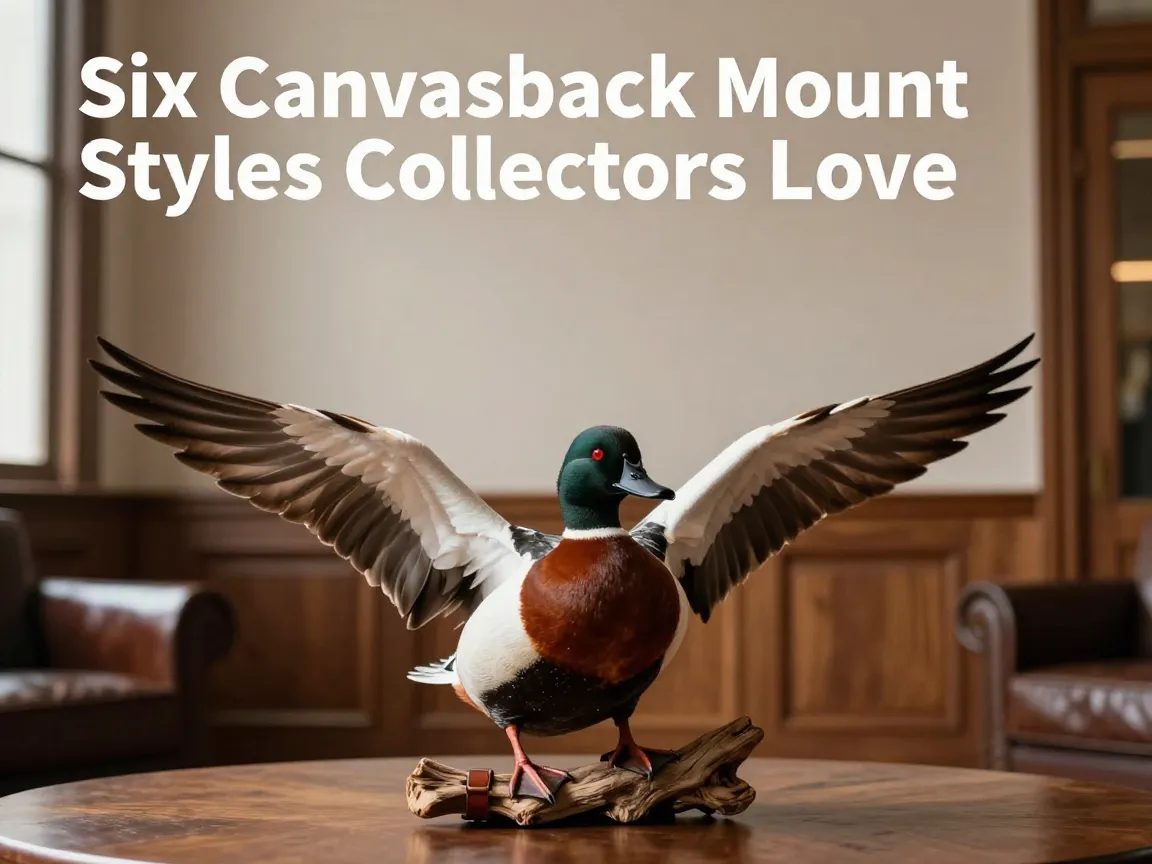
- Six distinct canvasback mount styles serve different display goals: standing alert, flying or landing, swimming water scene, dead mount, multi-bird group, and pedestal or driftwood display.
- Flying mounts and group compositions are the fastest-growing styles among serious collectors heading into 2027 and 2028.
- Custom body forms, pre-sculpted manikins, and artificial heads now make high-precision canvasback mounts reproducible at a commercial level.
- Prices in 2026 range from roughly 575 USD for custom commissioned work to around 1,795 USD for premium retail-ready finished pieces.
- Each style is a starting template, not a fixed product, pose, base material, and habitat scenery are all adjustable.
1. Standing Alert Mount on a Rocky or Clear-Water Base
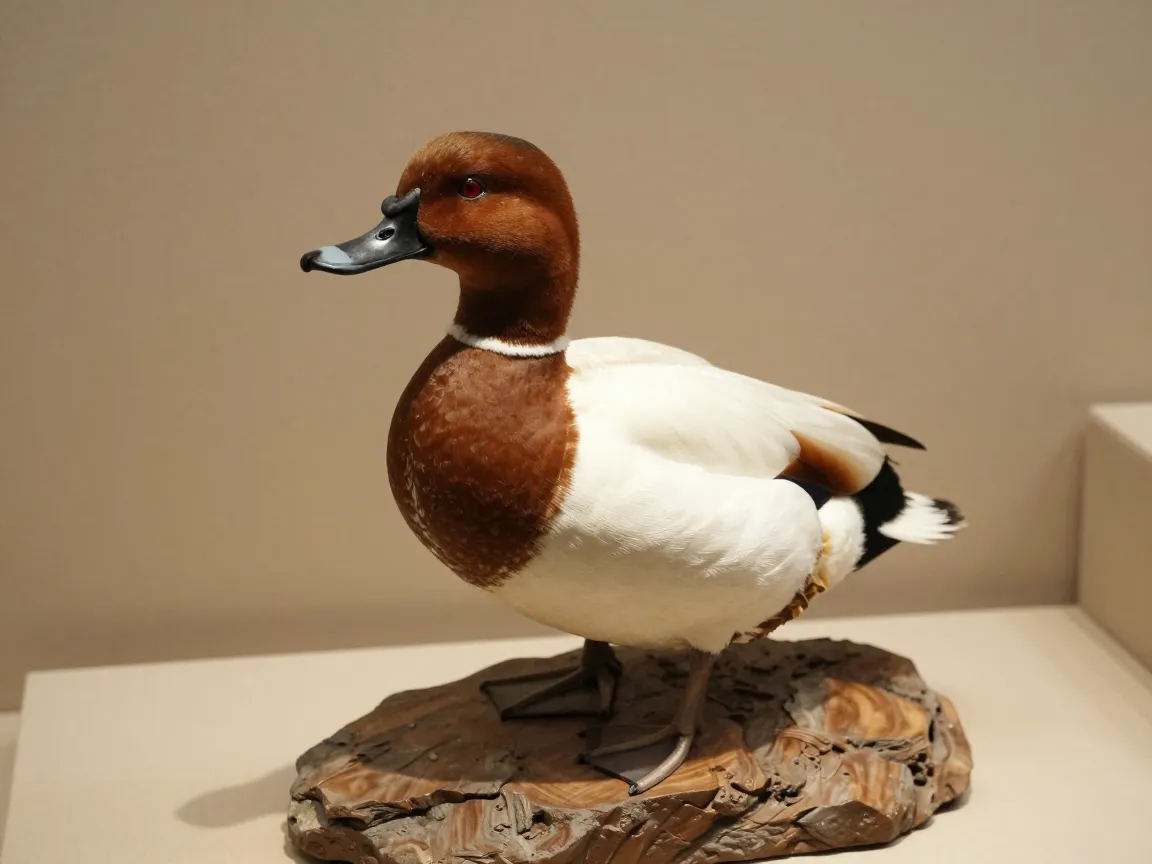
The standing mount is the entry point most collectors encounter first, and for canvasbacks it’s a particularly good fit. Because the species is a diving duck, its body sits low and compact, and the distinctive profile, that long sloped forehead flowing into the bill, reads clearly even when the bird is stationary. Taxidermists who specialize in waterfowl consistently recommend rocky or clear-water bases for canvasbacks and closely related redheads because those substrates let the head shape and body coloration do the work without visual competition from grass or foliage.
The range of standing poses available is wider than most buyers expect at first. Alert, relaxed, calling, and preening poses are all standard options from specialist studios in 2026, and each creates a different mood. An alert pose with the head raised and turned slightly projects energy and suits a room where the mount is the focal point. A preening pose works better in a quieter corner or on a low shelf where viewers approach at close range and can appreciate the feather detail. Base options typically include custom wood, driftwood, and sculpted habitat surfaces, so the finished piece can range from clean and minimal to densely naturalistic.
One practical note: the standing mount scales well for most interior spaces. Its footprint is modest, it doesn’t require ceiling clearance, and wall-hanging hardware is straightforward. For a first canvasback commission, it’s the lowest-risk choice if you’re still figuring out how the piece will fit into your room.
2. Flying and Cupped-Landing Mount
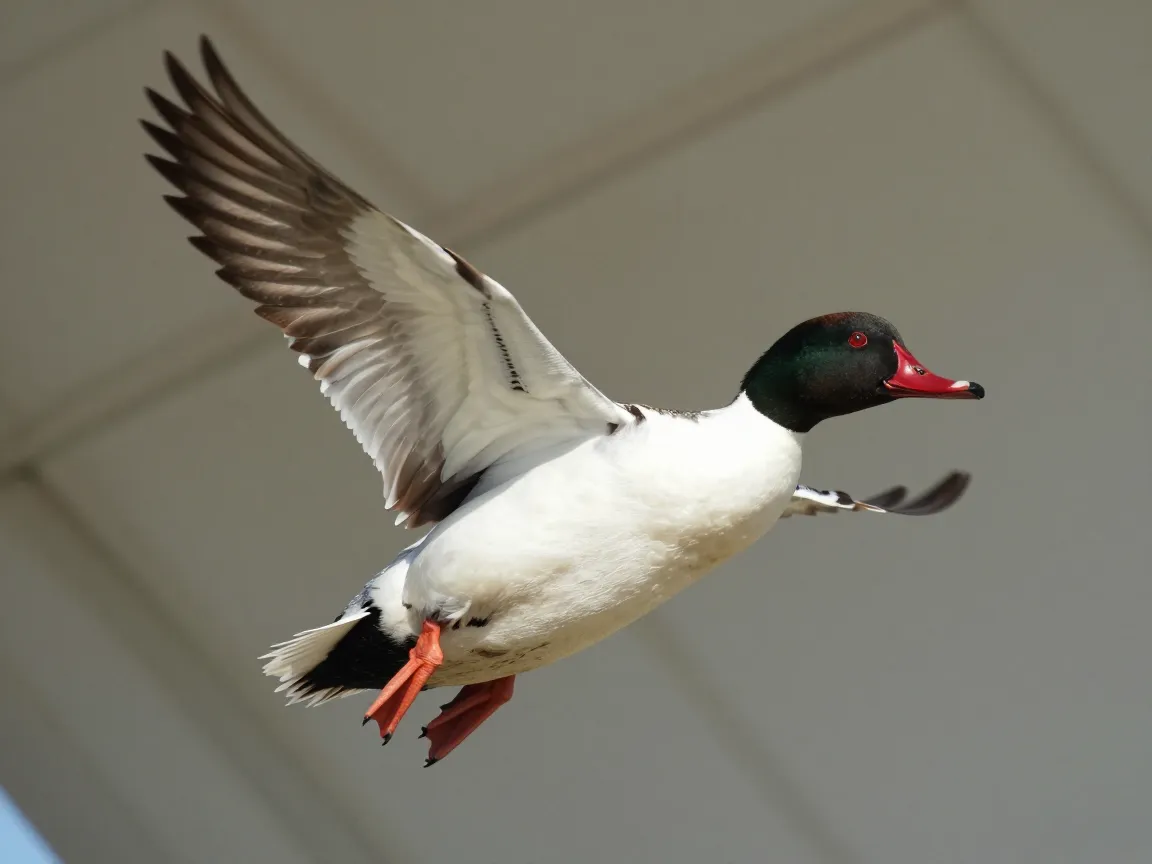
The canvasback in flight is a different animal entirely from the bird sitting on water. Wings at full spread show the contrast between that white back and the darker primaries. The cupped-wing landing pose captures the moment a drake is committed to dropping into a decoy spread, wings bowed forward, feet extended, body tilted back, and that combination of tension and motion is what makes flying mounts compelling rather than merely decorative.
Specialist taxidermists describe the canvasback as “the king of the divers,” and that phrase reflects a real truth about how the species performs in a flying mount. The wedge head is visible from across a room, the red eye catches light, and the clean white back creates a strong tonal break that keeps the bird readable even at a distance. Beyond the cupped-wing pose, landing approaches, climbing flushes, banking turns, and straight-away overhead poses are all available from studios that focus on waterfowl work. Wall-flush brackets and ceiling-hung mounts address the practical question of where these larger pieces actually go once they’re finished.
Birdman Studios’ canvasback gallery in 2026 lists specific flying configurations including wings-down, wings-back, belly-out, tilted cupped, and “coming over reeds” poses, which illustrates just how granular the customization can get. If you’re ordering a flying mount, the most important decision is whether the pose reads well from your primary viewing angle, a pose designed to be viewed from below works in a vaulted ceiling installation but loses impact when hung at eye level on a standard eight-foot wall.
3. Swimming and Full Water-Scene Mount
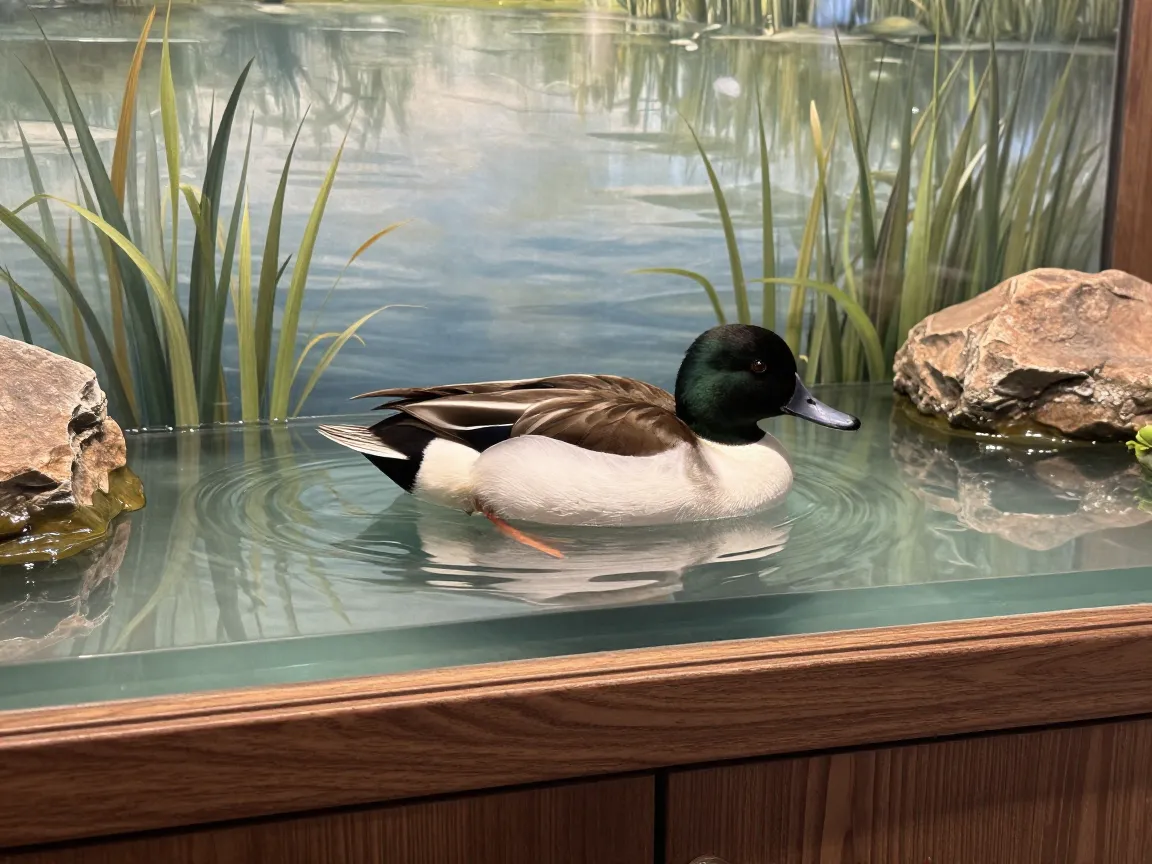
A swimming canvasback mount removes the pedestal entirely and places the bird on a sculpted representation of its actual environment. Water scenes can range from a simple glass-smooth surface suggesting calm open water to full habitat dioramas with painted backgrounds, emergent vegetation, and multiple water textures. The appeal for collectors is naturalism: the bird looks the way it looks on a November morning, riding low with the head slightly forward.
This style suits collectors who want a piece that tells a story about habitat rather than just displaying a specimen. The low, compact riding posture of a diving duck translates naturally to a sculpted water surface in a way it wouldn’t for a teal or a mallard, whose upright posture reads better in standing or flying poses. A retail example from The Taxidermy Store in late 2026 paired a canvasback drake in a swimming pose with a custom habitat rock and a walnut hardwood base, showing how the style bridges naturalistic taxidermy and furniture-quality cabinetry work.
Full water-scene dioramas do require more space than a standing mount, and they’re typically commissioned as centerpieces rather than accent pieces. If your room can support a display cabinet or a wide credenza, a water scene gives you something that no two-dimensional artwork can replicate.
4. Dead Mount in a Traditional Hanging or Laid-Out Pose
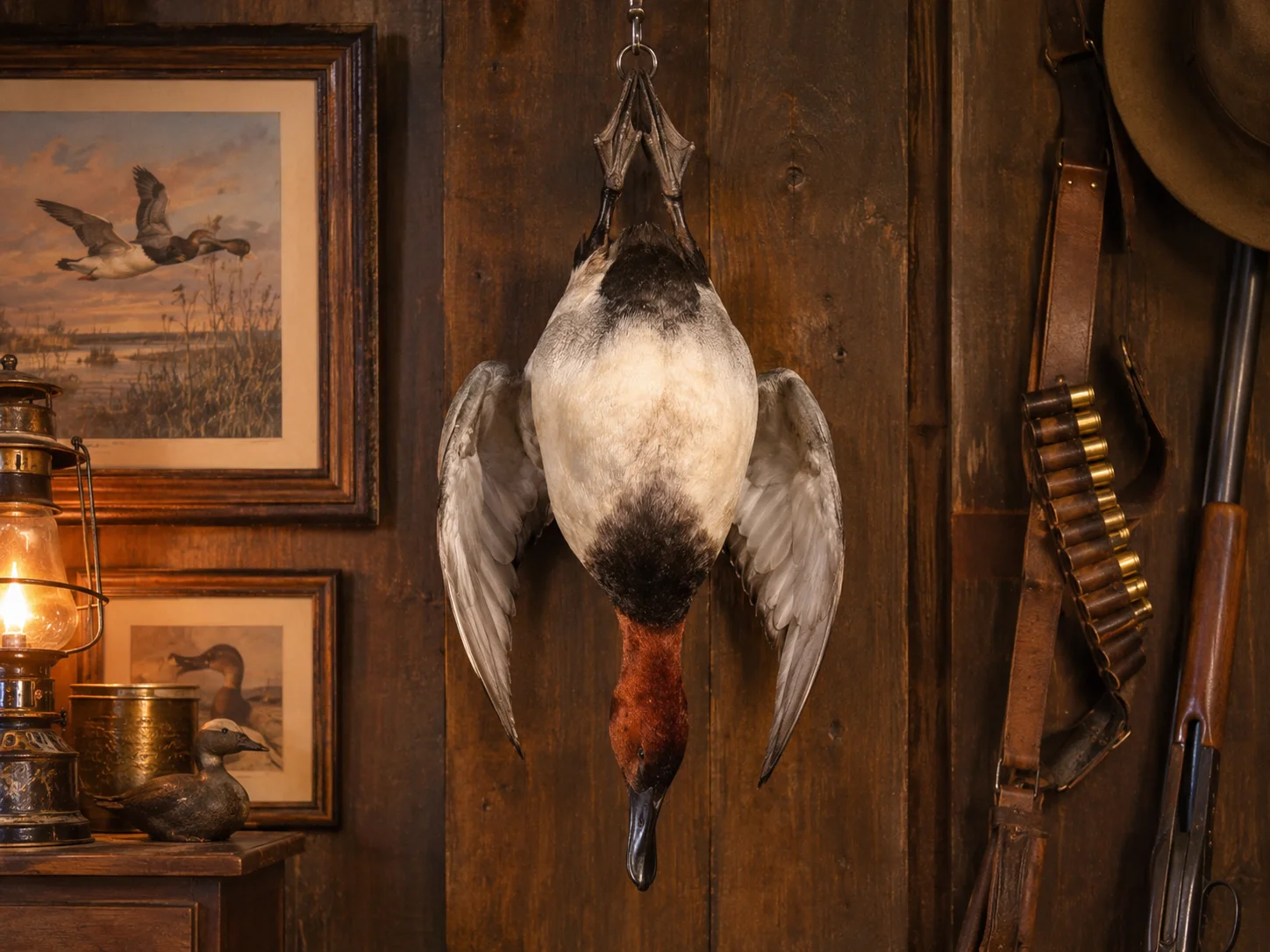
Dead mounts are the oldest canvasback presentation style and the one most closely tied to the hunting tradition. In a hanging pose, the bird is displayed as it would have been carried out of the blind, suspended by the feet or the neck, wings relaxed, head down. In a laid-out pose, it rests flat on a wood panel or plaque, often alongside other birds from the same hunt. Both approaches appear in classic trophy rooms and hunting camps, and both are still in active production in 2026.
Cypress Slough Taxidermy explicitly tags canvasback dead mounts as a current service category, and Stehling’s Taxidermy lists “Dead Mount Duck” among its eight primary duck mount options, describing it as a traditional hanging or laying style associated with that era of décor. The honest position on this style is that it has a specific audience. Collectors who want historical authenticity, hunters who are recreating the look of a mid-century sporting camp, and buyers who prefer the visual modesty of a laid-out bird over a dramatic posed mount are the natural market. It’s not a popular style in contemporary design-forward interiors, but that niche is real and consistent.
For canvasbacks specifically, the dead mount benefits from the same plumage strengths that make other styles work: the color contrast between the chestnut head and the white body is visible even in a low, relaxed pose. A well-prepared dead mount of a drake canvasback carries more visual weight than the same pose done with a lesser species.
5. Multi-Bird Group and Flying-Group Mount
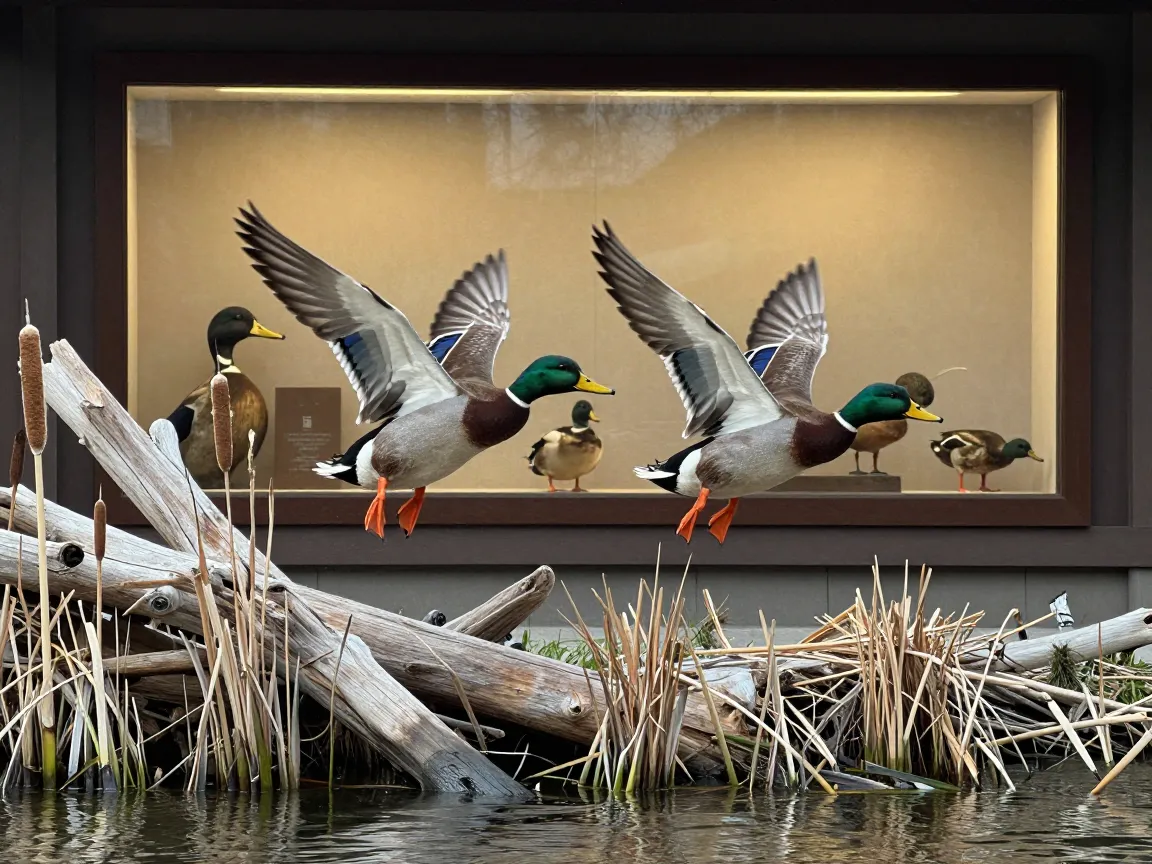
Group mounts are where canvasback taxidermy starts to function more like sculpture than natural history display. A pair of drakes in a cupped-wing landing approach, a trio over cattails, a drake and hen in a riverbed scene, these compositions let taxidermists work with motion, depth, and narrative in ways that a single-bird mount cannot achieve. The result is a piece that holds visual attention over time because there’s always another angle or interaction to notice.
WaterfowlTaxidermy lists “Flying Group Mounts” as a standard canvasback option in its November 2026 species gallery, and Birdman Studios’ canvasback catalog shows pair flying table mounts, pair flying driftwood mounts, trio group mounts, and pair scene mounts in riverbed and snow-cattails settings. That breadth of catalog options in 2026 suggests these aren’t rare custom orders, they’re a recognized style with proven collector demand. The practical constraint is scale. A pair in full flight needs more wall area and structural support than a single flying mount, and a trio diorama can require a purpose-built display case or a dedicated wall section.
Looking forward, multi-bird habitat scenes and group flight displays are the styles most likely to grow in collector interest through 2027 and 2028. As collectors accumulate individual mounts and start thinking about legacy pieces or room anchors, group compositions answer the question of what comes after the first few singles.
6. Pedestal, Driftwood, and Live-Edge Specialty Display Mount
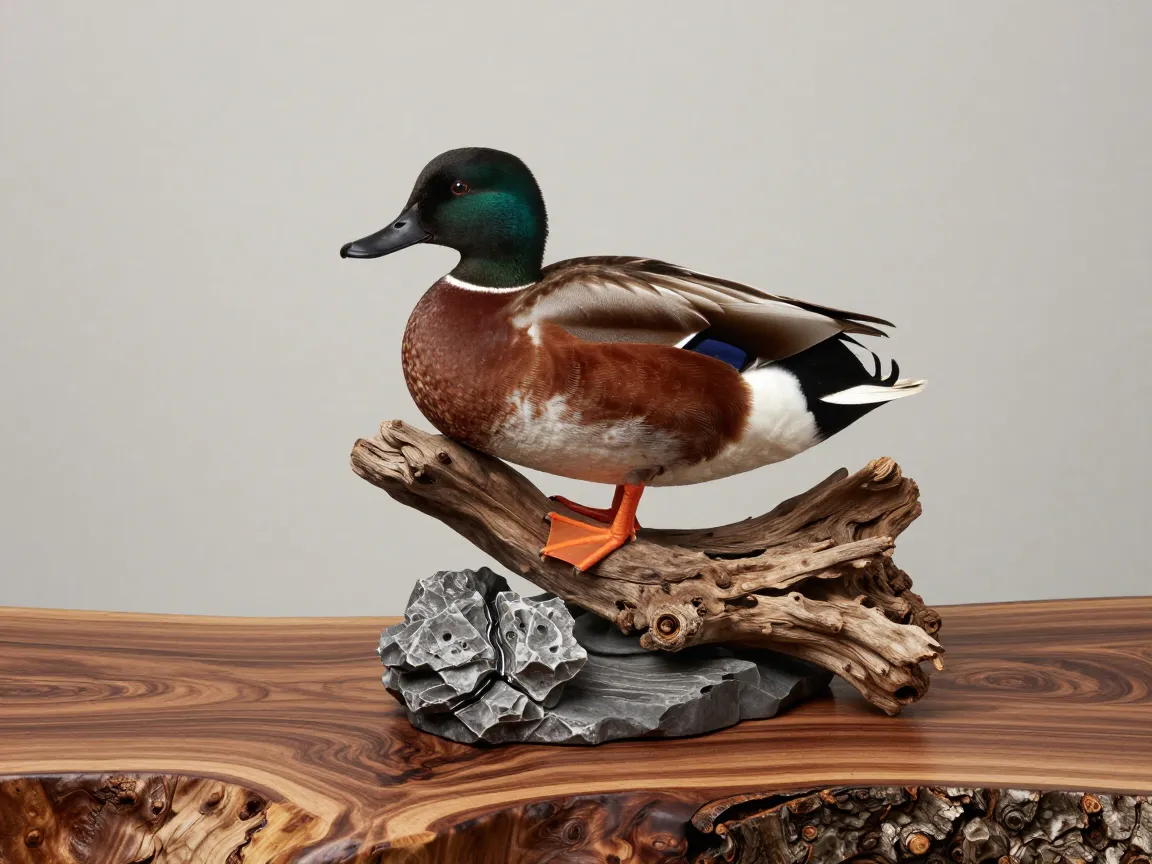
This category covers canvasback mounts whose primary identity comes from the base or mounting structure rather than the pose alone. A drake canvasback perched on a weathered piece of driftwood, displayed on a live-edge walnut slab, or set on a sculpted rock-and-water pedestal is fundamentally a different decorating object than the same bird on a standard oval wood base. The mount becomes something between a trophy and a piece of furniture, and it’s marketed accordingly.
Design marketplace listings in 2026 show individual canvasback mounts on live-edge wood slabs priced around 695 USD, explicitly targeting interior-design buyers rather than hunters. Birdman Studios offers canvasbacks on rock ledges, custom water-rock pedestals, and driftwood structures, with wall-flush variants for buyers who want the visual impact of a sculptural base without occupying floor or shelf space. The price point for this style varies more than any other category because the base material, premium hardwood slabs, specific driftwood pieces, hand-sculpted rock formations, drives cost as much as the taxidermy itself.
For collectors whose primary concern is how a piece integrates with existing furniture and décor, this is the style that rewards the most attention to base selection. A canvasback on a generic walnut oval and the same bird on a matched live-edge slab with natural bark edges are very different objects in a room, even if the mount itself is identical.
Quick Comparison
| Style | Best For | Typical Space Need | Base Complexity |
|---|---|---|---|
| 1. Standing alert | First mounts, smaller rooms | Low | Simple to habitat |
| 2. Flying / cupped landing | Feature walls, vaulted ceilings | Medium to high | Wall bracket or ceiling mount |
| 3. Swimming water scene | Centerpiece displays | Medium to high | Sculpted water, hardwood |
| 4. Dead mount | Traditional trophy rooms, hunting camps | Low | Plaque or hanging hardware |
| 5. Multi-bird group | Legacy pieces, room anchors | High | Driftwood, diorama, or bracket |
| 6. Pedestal / live-edge / driftwood | Design-forward interiors | Low to medium | Premium hardwood or sculptural base |
Conclusion
The 6 Canvasback Duck Mount Styles Every Collector Will Love aren’t competing alternatives so much as a toolkit for different spaces, intentions, and collecting stages. If you’re starting out, a standing mount on a quality base gives you a finished piece that works in almost any room. If you’re building toward a statement piece, a flying group mount or a full water-scene diorama offers the kind of visual complexity that holds up over years of looking at it. The most useful next step is to identify where in your space the mount will live before you decide on a pose, the answer to that question narrows your style options faster than any catalog can.