Survival Needs List Essentials to Pack Before Your Next Fishing Adventure
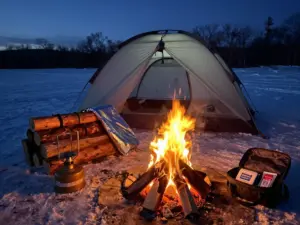
Every year, thousands of anglers head out for a day trip and don’t make it back before dark. Some run out of water. Some get caught in a sudden storm with no shelter. A few end up needing medical help on a remote shoreline with no way to signal for it. The gap between a bad day and a genuine emergency is usually a bag that wasn’t packed with the right priorities. The 6 survival needs list essentials to pack before your next fishing adventure aren’t about overpreparedness. They’re about closing that gap before you leave the trailhead.
Disclosure: This post contains affiliate links. As an Amazon Associate, we earn from qualifying purchases, and at no extra cost to you.
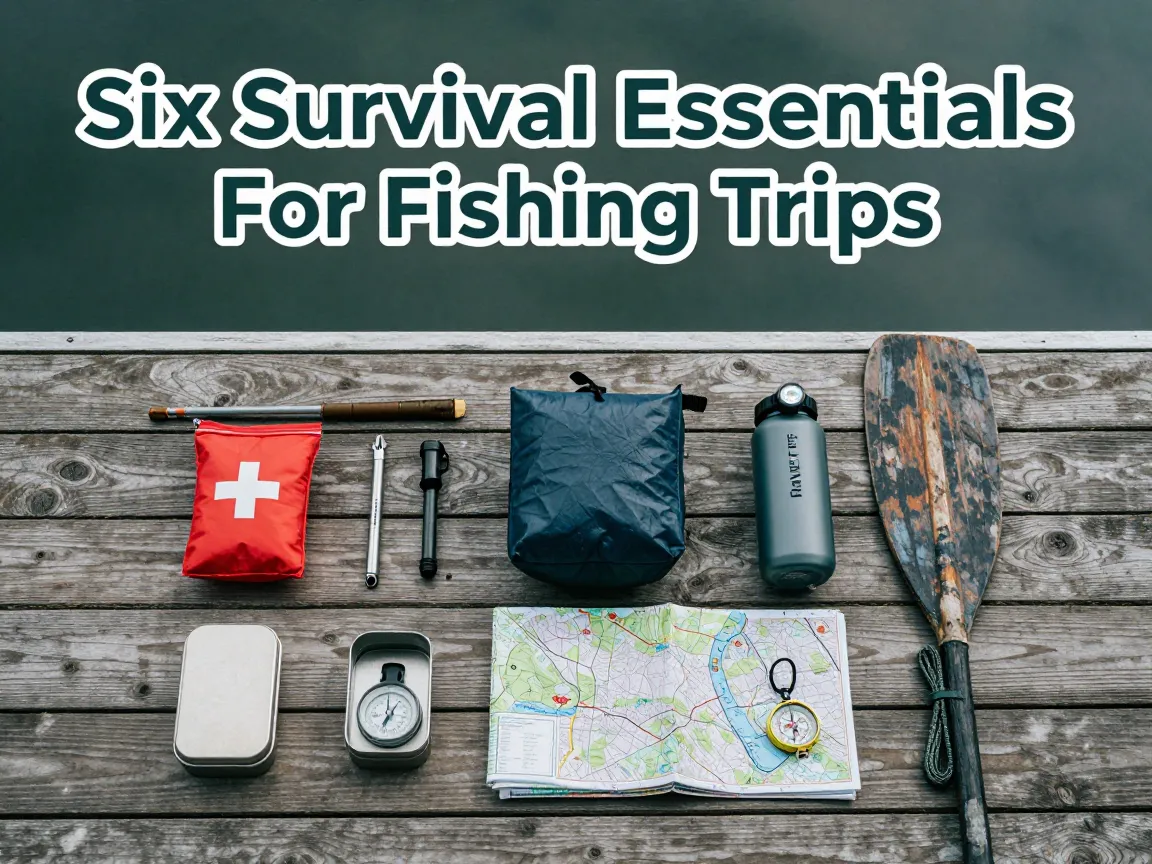
The framework below draws from wilderness survival categories used by organizations like REI and reflected in 2026 prepper and bushcraft guides. Six core needs map directly onto a fishing trip: water and hydration, shelter and warmth, fire and light, first aid and repair, navigation and communication, and fishing tackle as your food-procurement system. Each one has a right way to pack it for angling specifically.
Key Takeaways
- Six survival needs categories from current wilderness frameworks translate directly into a fishing-specific packing list.
- Modular packing, keeping a sealed emergency kit separate from your everyday tackle, ensures backup gear is available when it’s actually needed.
- Water treatment is not optional on day trips; dehydration and waterborne illness are top risks when a trip runs long.
- Multi-use tools like a knife, paracord, and pliers reduce total weight while covering multiple survival needs simultaneously.
- Late-2026 all-in-one tactical survival fishing kits now integrate tackle, fire, shelter, and navigation into a single MOLLE-compatible pack, making the grab-and-go option more practical than ever.
1. Water and Hydration Supplies
Standing next to a river or lake all day does not protect you from dehydration. It sounds counterintuitive, but anglers are among the most common victims of heat-related dehydration on day trips because the activity feels passive. You’re focused on the water in front of you, not the water you’re drinking.
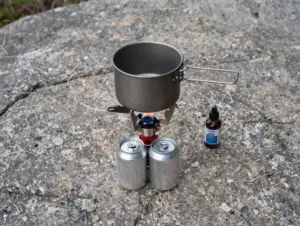
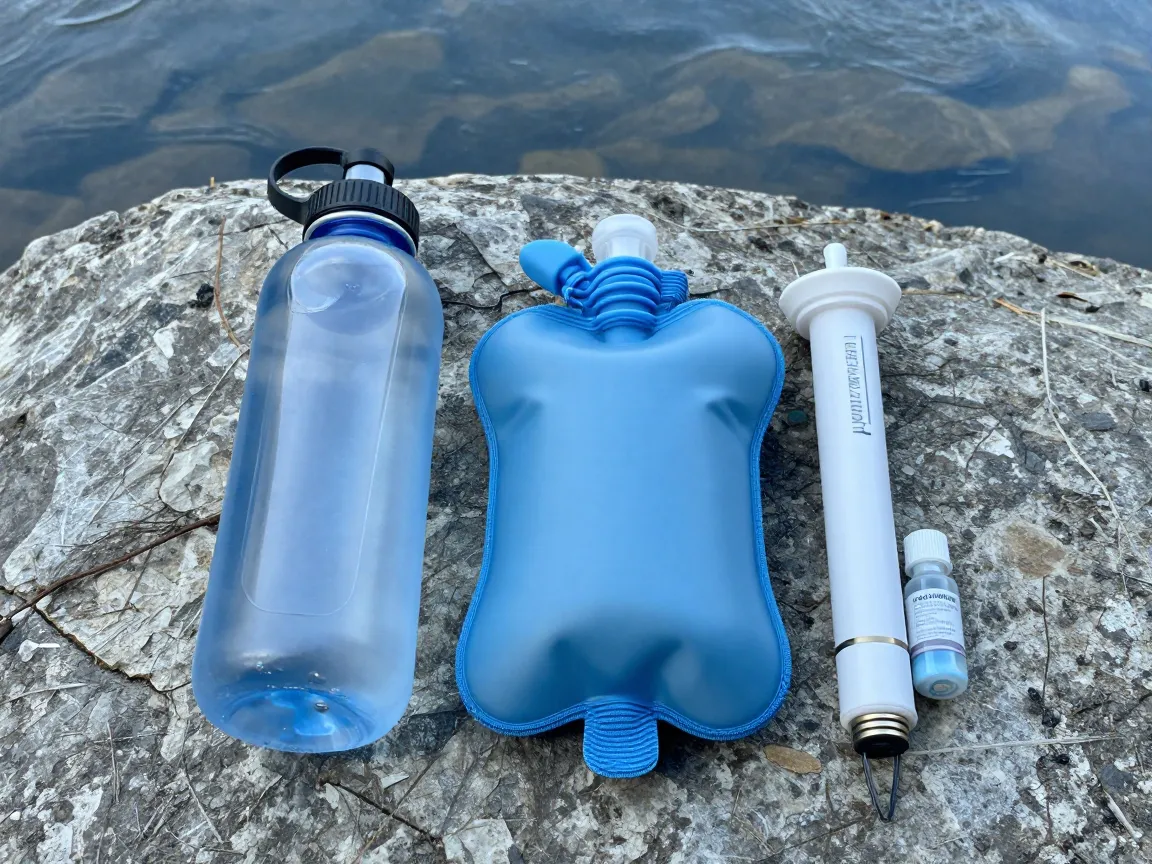
The practical standard for 2026 wilderness day trips is to carry both extra capacity and treatment capability. That means at least one hard-sided bottle plus a collapsible bladder for overflow, combined with a compact inline filter like a Sawyer Squeeze or a small supply of iodine or chlorine dioxide tablets as a chemical backup. Filters remove sediment and biological contaminants from surface water. Tablets handle situations where the filter clogs or is lost. Having both weighs under 200 grams combined and costs very little.
The specific risk on fishing trips that extends beyond ordinary hiking is time distortion. Anglers routinely stay on the water two to three hours longer than planned because the bite picks up at dusk. A one-liter bottle that was fine for a four-hour trip becomes a problem during a seven-hour one. Pack at least two liters of treated water before you leave, and carry the means to treat more from whatever surface water is available. Never drink directly from even a clear-looking stream without treatment.
A small point about cold-weather trips: chemical tablets slow down significantly below 10°C and require longer contact time, sometimes up to four hours for chlorine dioxide in near-freezing water. If you’re fishing in late autumn or early spring, a filter is more reliable than tablets alone.
2. Shelter and Thermal Protection
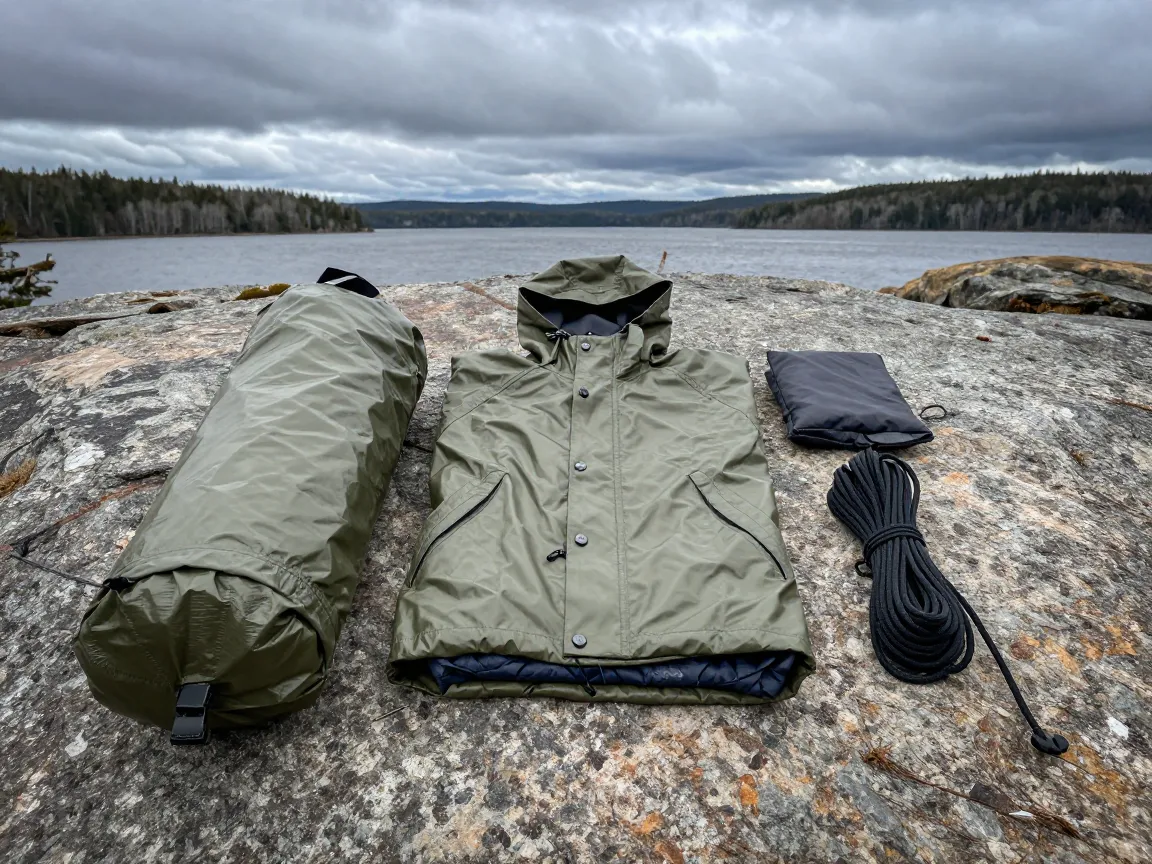
A change in weather on the water is fast. A front can drop temperatures by 10 degrees in under an hour on exposed lakes, and wet clothing in wind accelerates heat loss to a degree that surprises most people who’ve never experienced it. Hypothermia onset can begin at temperatures well above freezing when wet.
The minimum shelter kit for a fishing trip includes an emergency mylar bivy sack or a full-wrap emergency blanket, a lightweight rain shell, and at least one insulating mid-layer. These three items together can weigh under 500 grams. The bivy sack is the upgrade over a flat emergency blanket because it wraps around your body and traps air. A flat blanket in wind is difficult to hold in place. The bivy takes the wind variable away entirely.
Rain shells matter more than most anglers acknowledge. Waterproof-breathable shells from brands like Outdoor Research or Patagonia have come down significantly in weight and pack size, but even a basic silnylon rain jacket packs to the size of a baseball and costs less than forty dollars. The function is the same in an emergency.
Paracord is worth including under the shelter category, not just as a repair item. A length of 550 paracord, typically 15 to 30 meters, allows you to rig an improvised lean-to with the rain shell as a roof if you need to stay overnight. The same cord supports fish drying, gear repairs, and lashing a broken rod. Expert survival fishing guides increasingly list paracord as a force multiplier precisely because it serves multiple needs with negligible added weight.
The specific scenario worth planning for is an ankle sprain two miles from the trailhead at 5 PM. You’re not in immediate danger, but you’re not hiking out in the dark on rough ground. Having the bivy and a mid-layer means waiting until first light is uncomfortable but not life-threatening.
3. Fire Starting and Illumination
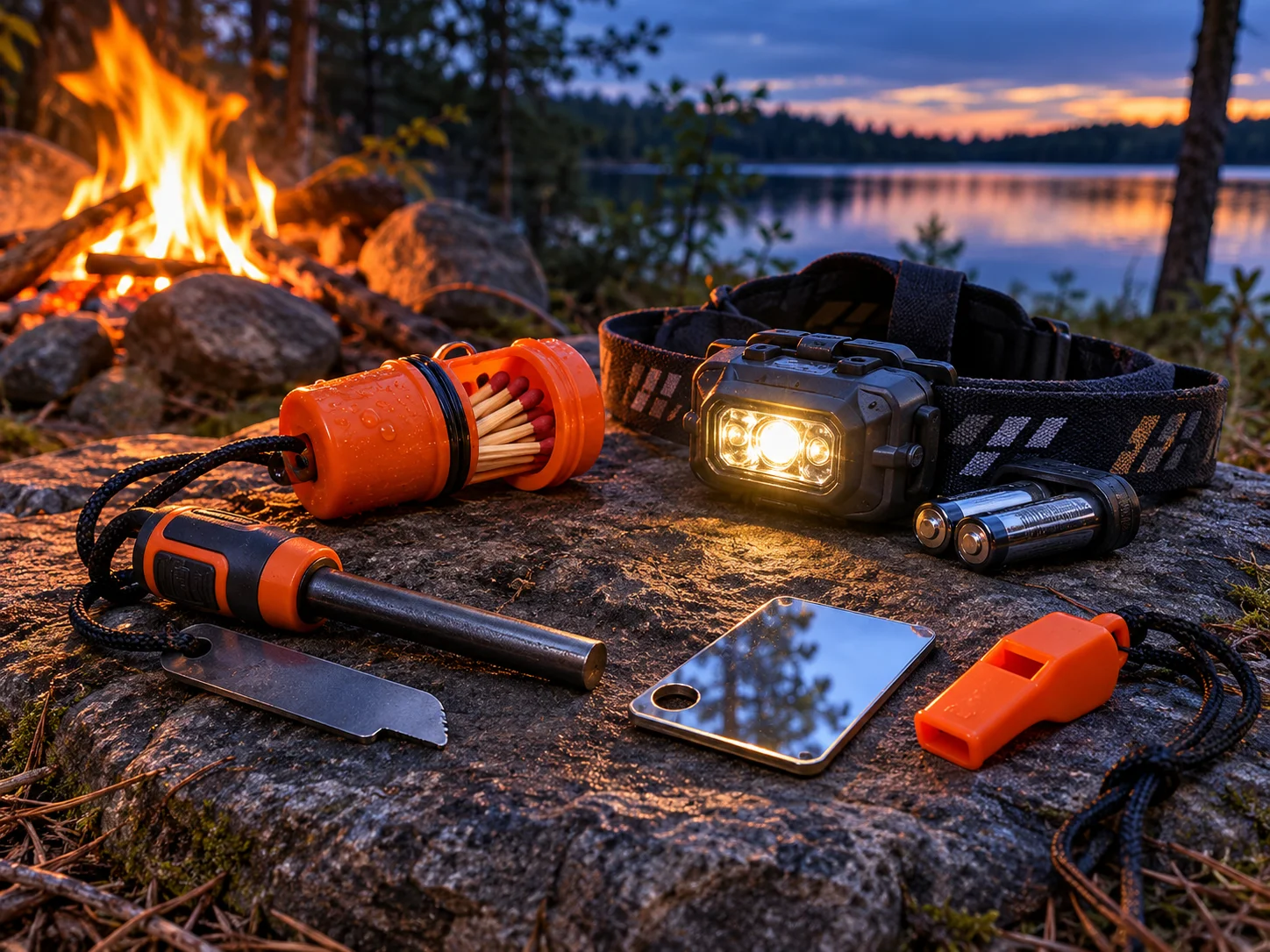
These two items are grouped together in many wilderness frameworks because they address the same underlying problem: an unplanned night outdoors. Fire provides warmth and a psychological anchor. Light provides mobility and signaling capability.
For fire, carry two redundant methods. The standard pairing is a ferrocerium rod and waterproof matches or a windproof lighter. A ferro rod works when wet and lasts for thousands of strikes; a cheap BIC lighter fails in rain and wind. The matches provide a bridge if the technique for the ferro rod takes more attempts than expected, which it often does for people who don’t practice regularly. Store the matches in a small waterproof case or a zip-lock bag inside your kit.
For light, a headlamp is functionally superior to a handheld flashlight on a fishing trip because it frees both hands for rigging, netting, and moving over uneven ground. Modern headlamps like the Black Diamond Spot or the Petzl Actik Core run on AAA batteries or rechargeable cells and produce enough lumens at close range for several hours of continuous use. Carry a fresh set of spare batteries in your kit regardless of how recently you charged or changed the ones in the lamp. Cold temperatures drain batteries faster than the specs suggest.
A compact signal mirror or a whistle belongs in this category as well. A whistle carries over distances that shouting cannot, and three short blasts is a universally recognized distress signal. The Fox 40 Micro weighs 8 grams. There is no good reason to leave it out.
4. First Aid and Repair Tools
Hook injuries are the most common fishing-related wounds, and most of them happen during casting or when handling fish with treble-hook lures. The standard first aid approach for a hook embedded past the barb is the string-yank method or the push-through-and-cut method. Both require clean hands, antiseptic, and proper bandaging afterward. Without a first aid kit, neither option is clean.
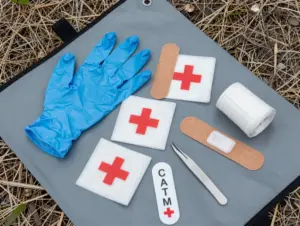
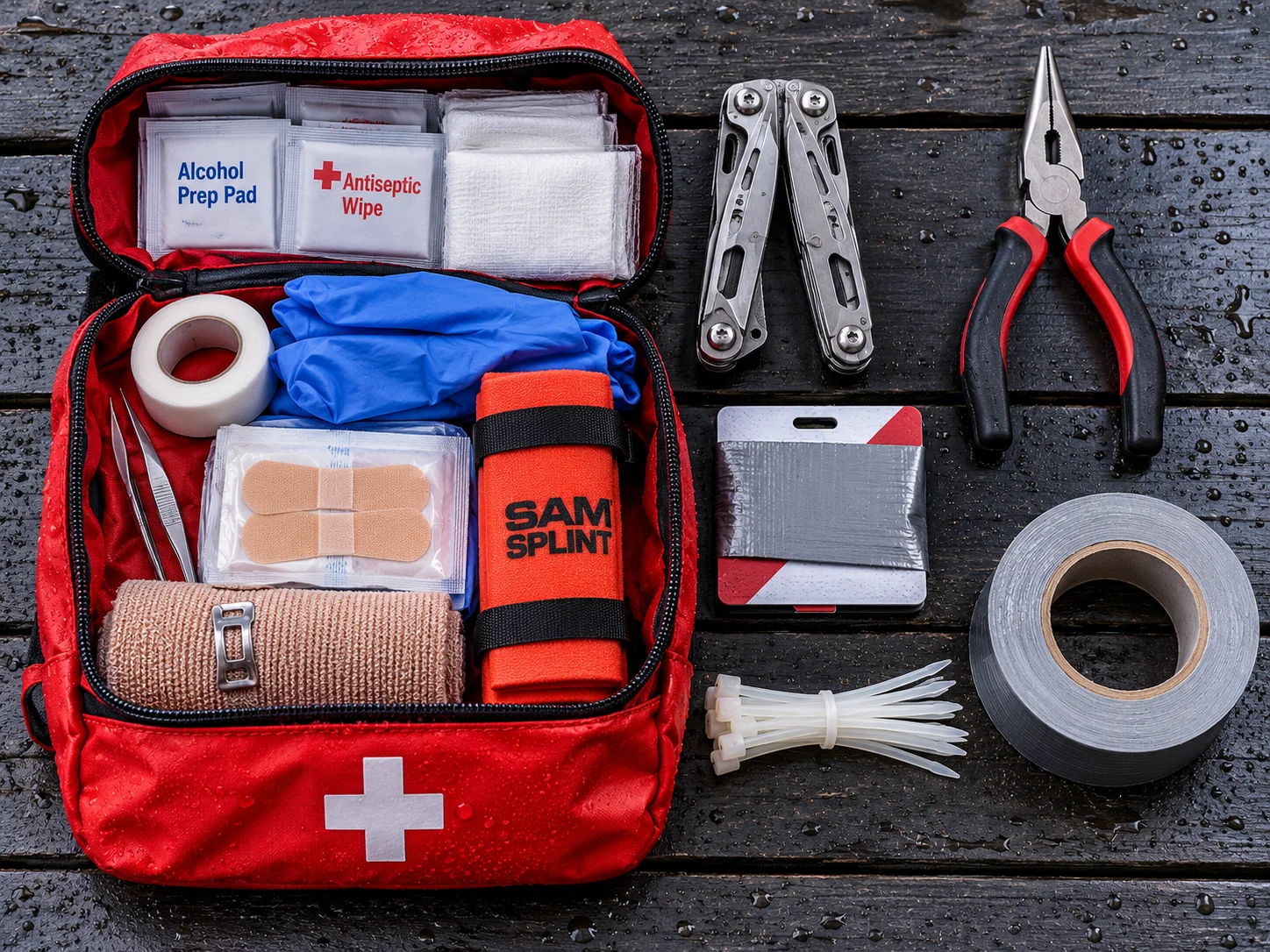
A fishing-specific first aid kit should include adhesive bandages in multiple sizes, gauze pads, medical tape, antiseptic wipes or a small bottle of isopropyl alcohol, nitrile gloves, tweezers or needle-nose pliers for hook removal, and a closure strip or butterfly bandage for deeper cuts. A small SAM splint and an elastic bandage cover sprain and fracture management. The whole setup fits in a soft pouch about the size of a paperback book.
Repair tools serve a different function but belong in the same category for weight and organizational reasons. The core set is a multi-tool (Leatherman Wave or similar), needle-nose fishing pliers, duct tape wrapped around a small card or the handle of the multi-tool to save space, and a sewing awl or a few zip ties. With these items, you can patch a torn rain shell, lash a cracked rod section, crimp split shots without a dedicated tool, and handle the hardware-level problems that happen when gear gets used hard in the field.
The modular packing approach matters specifically here. If your first aid kit and repair tools are buried in the bottom of a full fishing bag alongside tackle and snacks, they are hard to access under stress. A dedicated sealed pouch with a recognizable color, one that you do not open casually, means the contents are available and intact when you actually need them.
5. Navigation and Communication
Backcountry lakes and remote river sections can look nearly identical from different vantage points on the shoreline. Getting disoriented after following a trail that dead-ends at the water’s edge, or crossing to an island and finding the weather has changed, is a realistic scenario that experienced anglers still encounter.
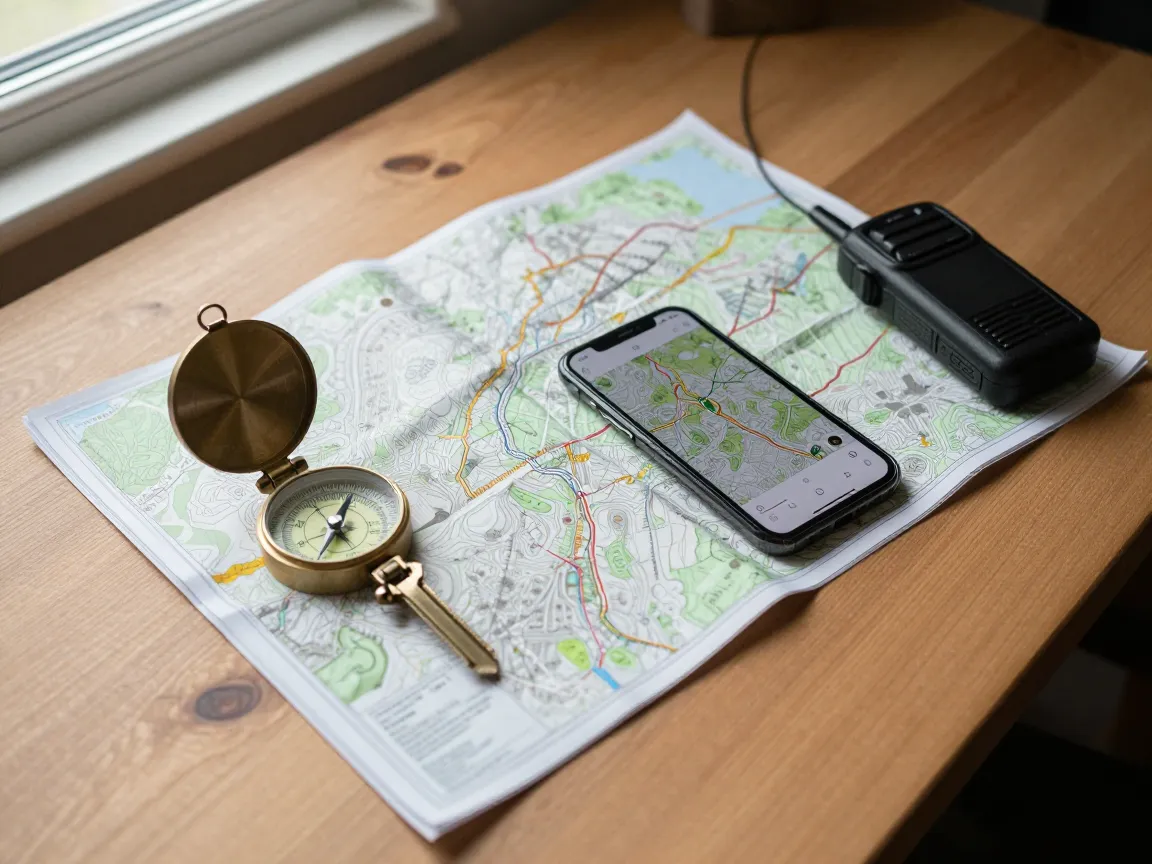
The 2026 standard recommendation for navigation is to carry both analog and digital tools. A laminated topographic map of the area and a baseplate compass together weigh almost nothing and work without a battery. A fully charged smartphone with the relevant area downloaded offline in an app like Gaia GPS or onX Hunt covers route-tracking and position logging during the trip. A dedicated GPS unit like a Garmin inReach Mini adds two-way satellite messaging and emergency SOS capability for remote locations where cell coverage is absent.
The specific item most anglers skip is the downloaded offline map. Cell service on remote shorelines is unreliable, and a phone with a live GPS chip but no cached map shows your position as a dot on a blank screen. Download the map before you leave the car.
For communication, a charged phone is the minimum. If you’re going beyond day-hike distance from a road, a personal locator beacon (PLB) or a satellite communicator is a serious option, not an overreaction. The ACR ResQLink 400 PLB costs about $250 and requires no subscription. It transmits your GPS coordinates to search-and-rescue satellites when activated. The cost per use over ten years of fishing trips is negligible relative to what it covers.
A whistle and a signal mirror round out communication at the low-tech end. Both work when electronics fail.
6. Fishing Tackle as a Survival Food Procurement System
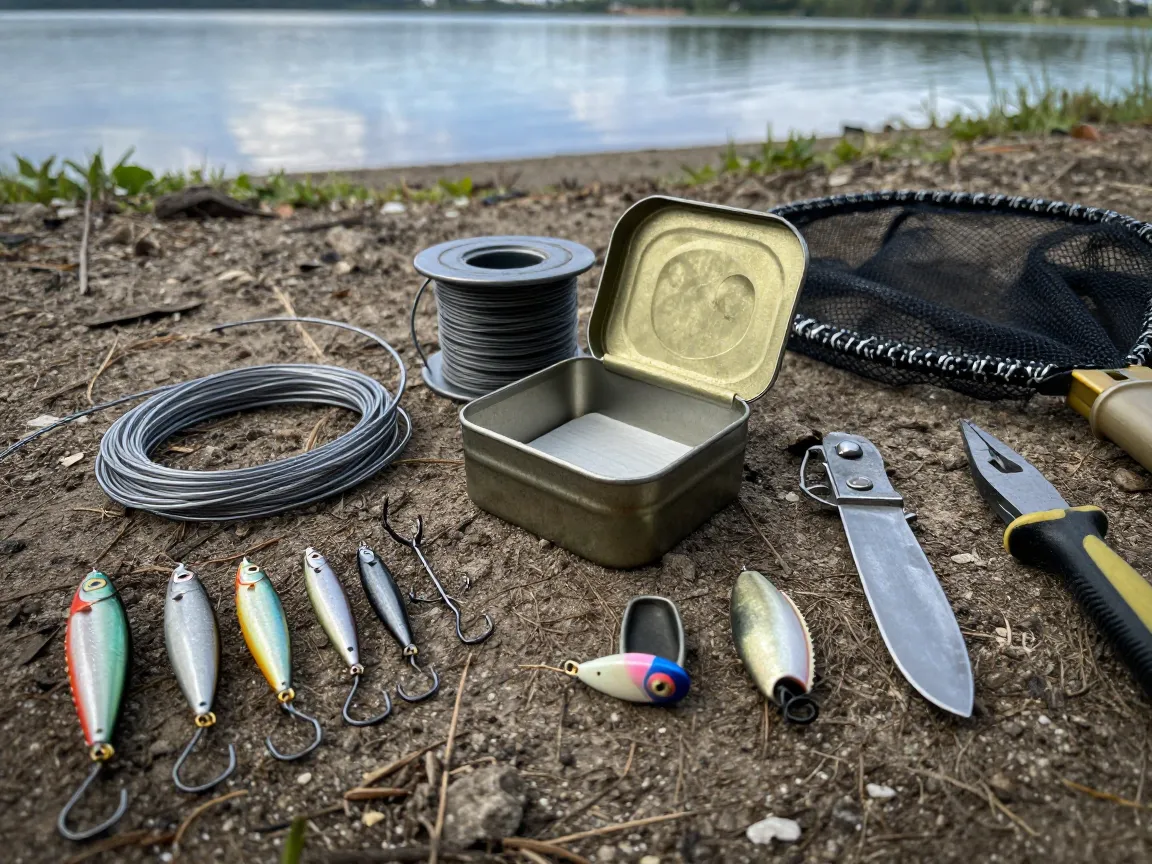
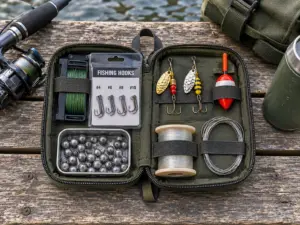
This entry approaches tackle from a specific angle: not what you bring to catch fish recreationally, but what you keep sealed and separate to ensure you can catch fish if the trip extends into an emergency overnight or multi-day situation. The two sets of gear should not be the same bag.
The survival fishing kit standard for 2026, reflected in kits like TruePrepper’s updated list, includes roughly 50 feet (about 15 meters) of 12-pound monofilament or braided line, an assortment of hooks in sizes 6 through 1/0, several split-shot sinkers, a few small jigs, and compact bobbers or toothpick floats. All of this fits into a small metal tin or a sealed pouch small enough to sit at the bottom of your pack without taking meaningful space. The key design principle is redundancy: multiple hook sizes, more line than you think you’ll need, and at least two different weight options.
The other component of the survival tackle kit is a handline spool or a finger reel. Without a rod, a handline lets you deploy line and retrieve fish directly. Practice with one before you need it; the technique is simple but takes a few minutes to learn. A short length of stronger line, 30 to 50 pounds, works as a trotline if you need to fish passively overnight.
Pliers and a knife belong in this category too, not just in first aid and repair. Pliers remove hooks from fish cleanly, crimp split shots, and cut wire. A fixed-blade knife handles fish cleaning, cordage cutting, and shelter preparation. Both items do enough cross-category work that packing one of each covers multiple survival needs simultaneously.
The landing net argument for survival fishing is straightforward: a small collapsible net reduces the chance of losing a fish at the moment of landing, which is the most common failure point in survival fishing situations where the angler may be using lighter tackle than ideal. It adds almost no weight and directly increases the yield from each fishing session.
Quick Comparison
| Survival Need | Core Item(s) | Backup or Redundancy | Typical Weight |
|---|---|---|---|
| Water and Hydration | Collapsible bottle plus inline filter | Chemical purification tablets | Under 200 g |
| Shelter and Warmth | Mylar bivy sack plus rain shell | Mid-layer insulation, 15 m paracord | Under 500 g |
| Fire and Light | Ferro rod plus headlamp | Waterproof matches, spare batteries | Under 150 g |
| First Aid and Repair | Dedicated first aid pouch plus multi-tool | Duct tape, zip ties, SAM splint | Under 400 g |
| Navigation and Communication | Topo map plus compass | Charged phone with offline map, whistle | Under 200 g |
| Fishing Tackle (Food) | Survival tin with hooks, line, sinkers | Handline spool, collapsible net | Under 150 g |
Conclusion
Every one of these six categories can fit into a pack that weighs under two kilograms total, leaving full room for your regular tackle, food, and water for the trip itself. The practical next step is to build the survival-specific portion as a sealed modular kit that you don’t open during normal use. Pack it once, check it once a season, and it’s always ready. That discipline, keeping the emergency gear separate and intact, is the difference between a kit that works and one that’s been picked apart over a dozen casual trips.