Ways To Create The Perfect Duck Hunting Scene In Your Home
Roughly 38 million Americans hunt or fish each year, yet most of their homes show no trace of it beyond a muddy boot rack near the back door. The gap between a passion that defines someone’s early mornings from September through January and the walls they stare at the rest of the year is surprisingly easy to close. These 6 ways to create the perfect duck hunting scene in your home range from a single statement piece to a fully layered room concept, and each one works whether you’re decorating a lakeside cabin, a finished basement man cave, or a living room that still needs to pass a spouse’s approval.
Disclosure: This post contains affiliate links. As an Amazon Associate, we earn from qualifying purchases, and at no extra cost to you.

Key Takeaways
- Scale matters most: a large mural or oversized canvas does more for a room than a cluster of small prints.
- Layered wood art creates physical depth that flat prints cannot replicate, making a wall feel like a window into a marsh.
- Realistic canvas art anchored in specific scenes, such as a dawn retrieve or a flooded timber hunt, reads as fine art rather than hunting kitsch.
- Metal silhouette work adapts easily to modern interiors without sacrificing the subject matter.
- Vintage and personalized pieces carry emotional weight that mass-market decor typically lacks.
- Color and material choices, specifically marsh greens, slate blues, raw wood, and iron, unify a duck hunting scene across an entire room.
1. Anchor the Room With a Large Duck Hunting Mural
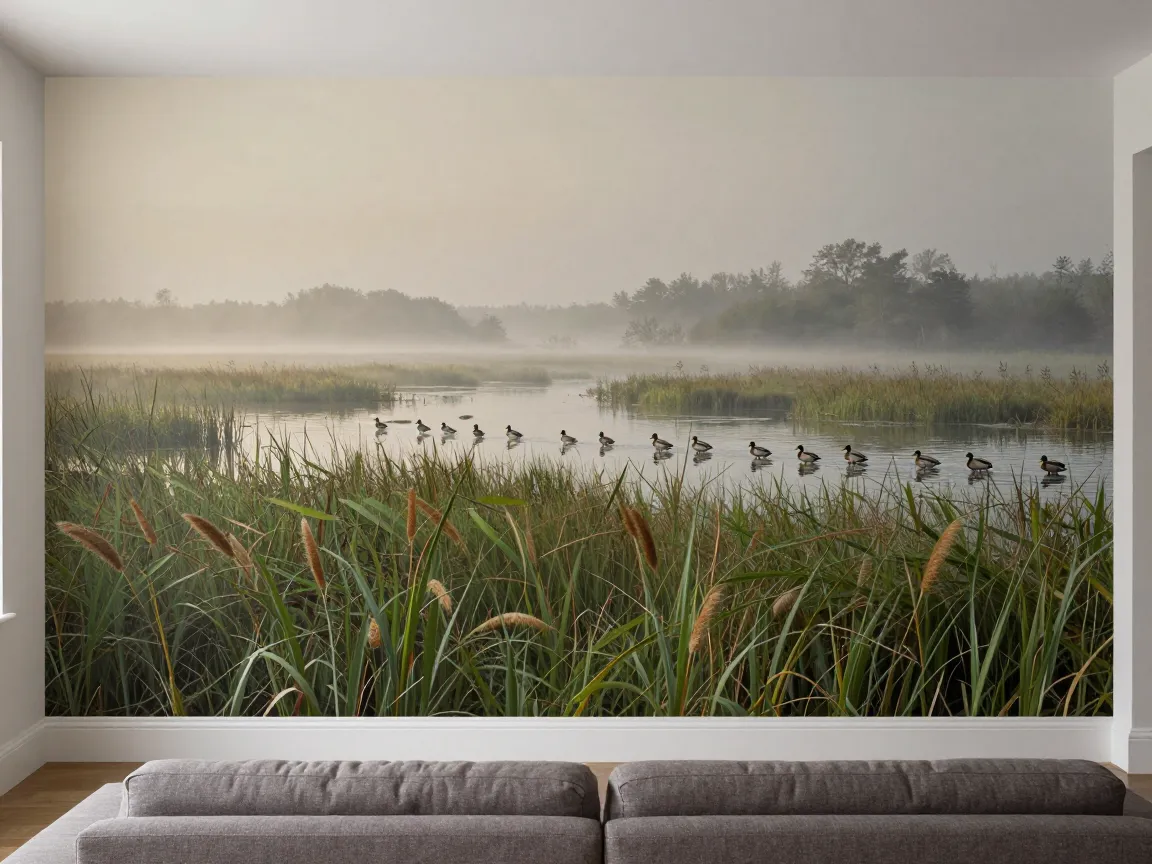
A single oversized mural changes the character of a room more decisively than any other wall treatment. When the subject is a marsh at first light, with mallards locked up over decoys and cattails bending in the foreground, it stops being decoration and starts functioning as a window. That distinction is worth pursuing.
The most effective murals for duck hunting spaces run at least eight feet wide and cover the full wall height. Narrower panels tend to read as posters rather than environments. Modern peel-and-stick mural papers have made installation a weekend project rather than a contractor job, and many specialty vendors now offer custom sizing so the image scales precisely to your wall dimensions without cropping out the birds mid-flight.
Placement matters. A mural behind a sofa in a great room works well because seating naturally faces it. In a cabin bedroom, the wall opposite the bed is the logical choice. Mudrooms and transitional spaces, those short hallways between a garage and a living area, are underrated locations because the hunting context is already established there by gear racks and boot trays. A mural in that space reinforces the theme without committing the main living area to it.
One constraint worth acknowledging: mural walls need breathing room. Avoid hanging other framed pieces on the same wall or within two feet on adjacent walls. The scene needs uninterrupted space to read as a scene.
2. Build Dimension With Layered Wood Wall Art
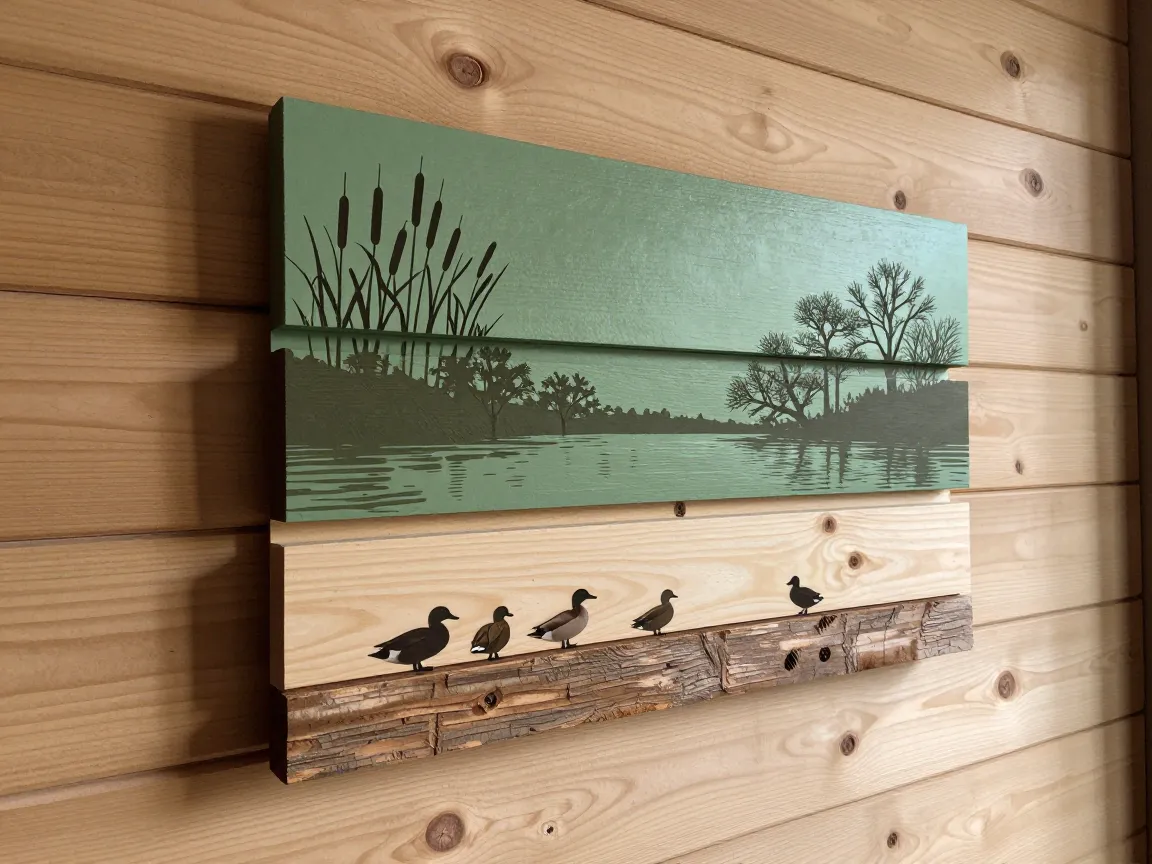
Flat art has a ceiling on how immersive it can feel. Layered wood wall art solves that by stacking separate cut panels, typically three to five layers, at slightly different depths so the marsh literally projects off the wall. A panel of silhouetted cattails sits closest to the wall. A middle layer carries the water line and a treeline of bare oaks. The front layer holds the ducks and perhaps the outline of a blind. The result is closer to a diorama than a picture.
This format appeals particularly to rooms that already have natural material textures: exposed brick, board-and-batten walls, or a stone fireplace surround. The raw wood of the art repeats those materials rather than fighting them. Baltic birch and reclaimed pine are common substrates, and the color treatment can range from natural wood tones to stained finishes in marsh greens and earth browns.
Sizing for layered pieces runs differently than for flat canvas. Because the dimensional effect is the point, a piece as small as 24 by 36 inches still reads well, making this the right format for smaller walls, like the space above a desk in a home office or the wall beside a staircase landing. It’s also the format most likely to generate a comment from a first-time visitor who doesn’t hunt, because the craftsmanship is immediately visible.
For a man cave or dedicated hunting room, consider commissioning a piece that references a specific location: the oxbow bend of a river you hunt regularly, or the flooded field where the best morning of last season happened. That specificity, even if no guest would recognize it, is what separates a room that feels curated from one that feels assembled.
3. Choose Realistic Canvas Art That Captures an Actual Hunt
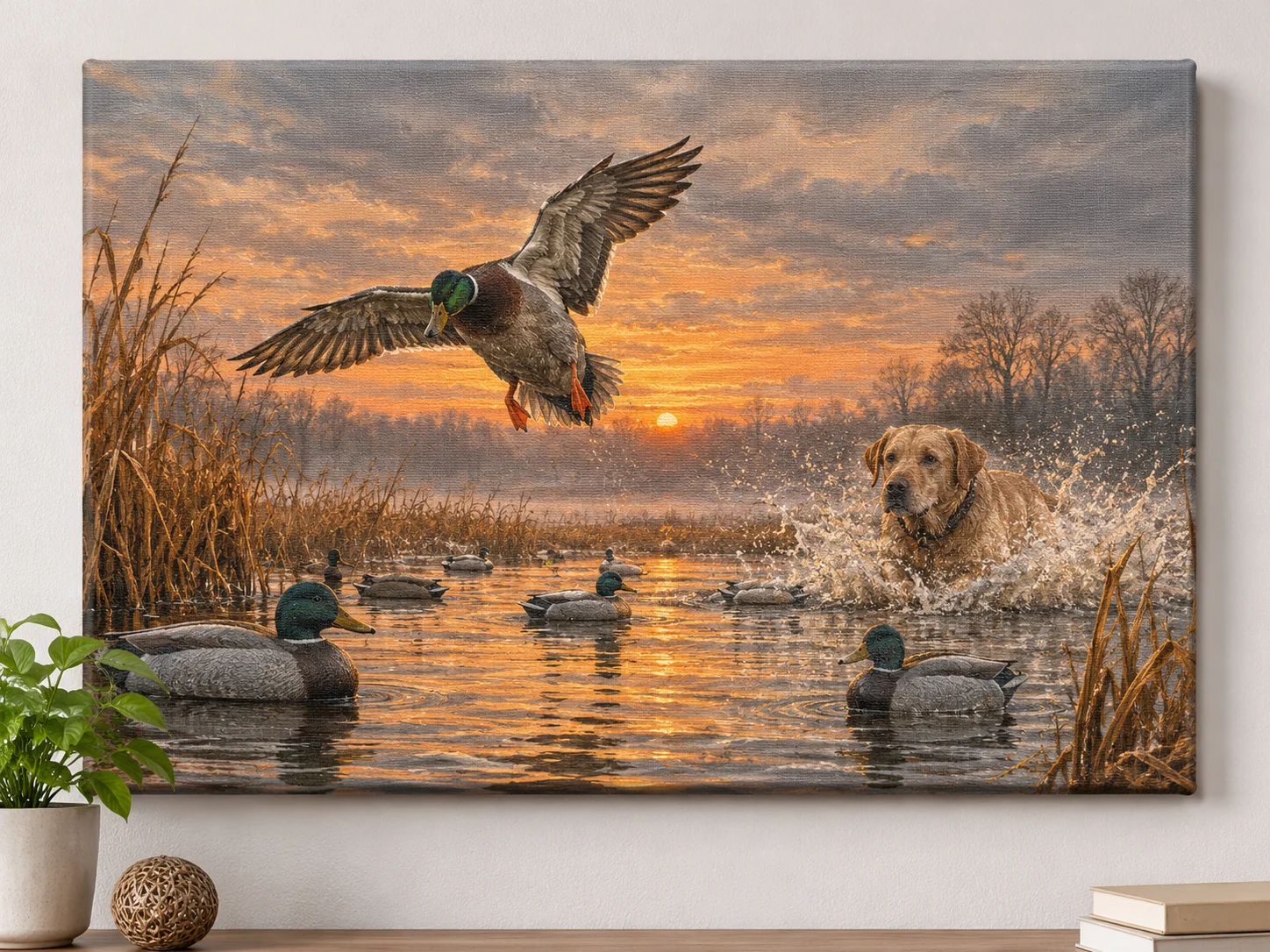
The word “realistic” is doing specific work here. It means art that captures the physics of a hunt: the angle of descent as a teal drops into decoys, the spray from a retriever re-entering the water, the particular gray-orange of a November sky at 6:15 a.m. This is different from stylized or illustrative duck art, which can be charming but tends to read as novelty rather than sporting heritage.
Artists like Dusty Crocker and David Maass built careers on exactly this kind of work, and their prints remain some of the most reproduced in hunting decor for a reason. The scenes carry narrative. A viewer who hunts recognizes the weight of a dog’s retrieve, the positioning of hunters in a blind, the species-specific behavior of a pintail versus a bluebill on approach. That recognition is what makes the art resonate rather than just decorate.
Canvas is the right substrate for this category. Stretched canvas on a wood frame holds texture and depth of color better than paper prints, and it doesn’t require glass, which eliminates glare problems in bright rooms. Standard gallery-wrap framing, where the image wraps around the sides of the stretcher bars, keeps the presentation clean and suits both traditional and contemporary rooms.
For nurseries or children’s rooms where the hunting theme is desired but graphic realism feels like too much, the same realistic style exists in softer treatments: a retriever pup asleep in a duck blind, or a pair of decoys resting on still water at dawn. These carry the thematic connection without the tension of a harvest scene.
4. Use Metal Silhouette Art for a Modern, Versatile Look
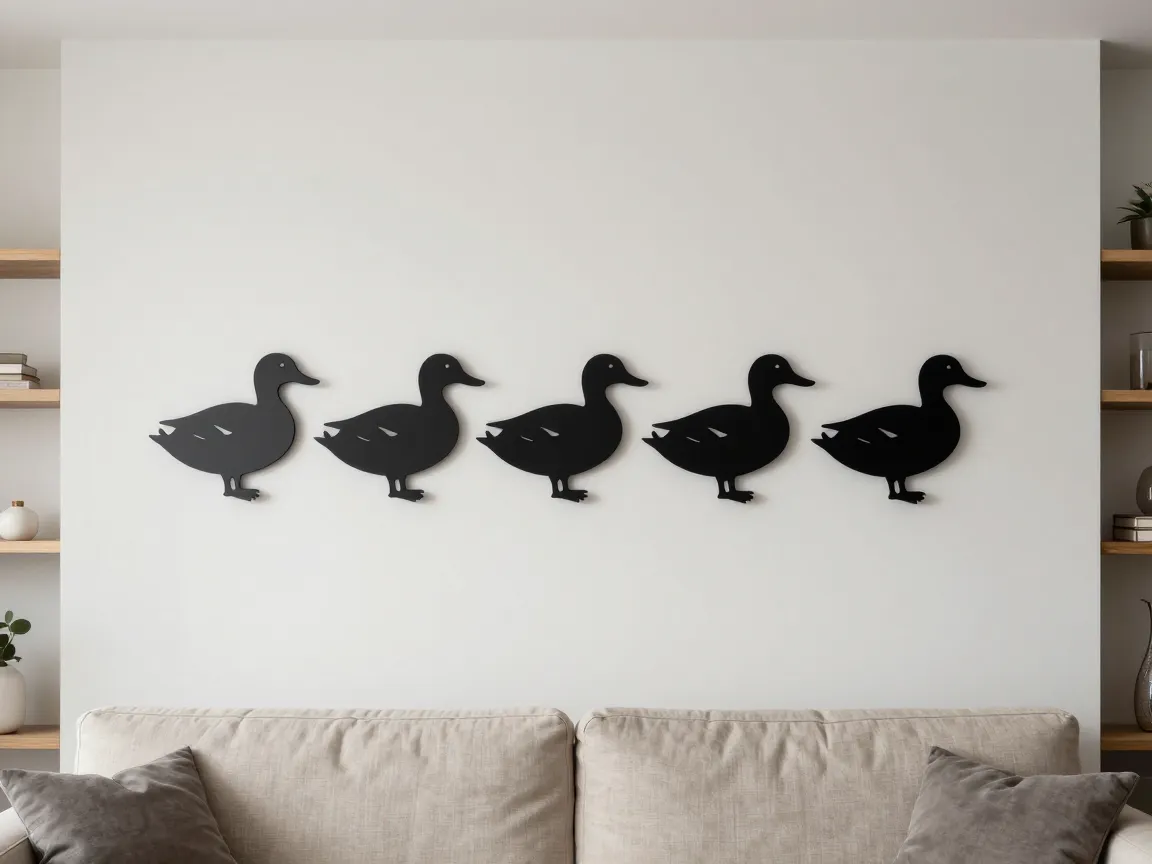
Powder-coated steel and laser-cut aluminum have opened a category of duck hunting wall art that works in spaces where traditional canvas would feel out of place. A silhouette of five mallards in a loose V-formation, cut from 14-gauge steel and mounted with standoff hardware, fits a modern farmhouse living room, an industrial-style man cave with exposed ductwork, or a mid-century cabin renovation with equal ease.
The appeal is restraint. Silhouette art communicates the subject, ducks in flight, without the color palette and narrative detail that require a room to commit to a hunting aesthetic everywhere. You can pair a 48-inch wide steel duck silhouette with neutral linen furniture and clean-lined shelving and the result reads as considered rather than themed.
Metal also handles exterior installation, which opens options for covered porches, mudrooms with outdoor exposure, and garage walls. Powder coating in flat black, oil-rubbed bronze, or a weathered copper finish all hold up against humidity and temperature swings that would destroy paper or canvas.
One practical note: standoff mounts, the small barrel-shaped hardware that holds the piece an inch off the wall, are worth using even when they’re optional. The shadow line created between the art and the wall adds dimension and prevents the piece from looking like it’s been pressed flat.
5. Bring in Retro and Vintage Hunting Imagery for Sporting Character
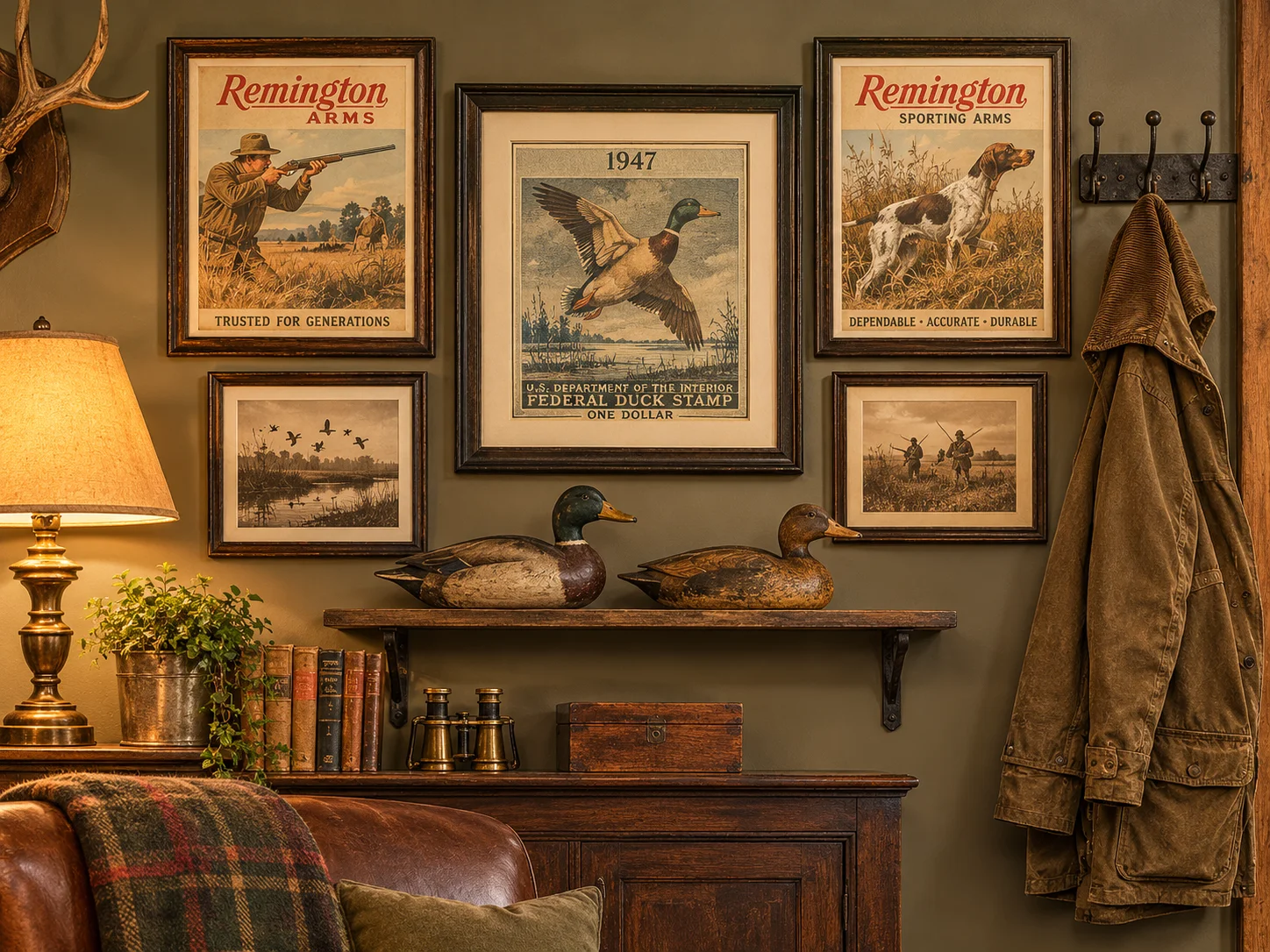
Federal Duck Stamps have been issued every year since 1934, and original stamps or high-quality reproductions framed in simple black frames carry more authentic sporting character than most contemporary reproductions. The same applies to vintage Remington Arms advertising lithographs from the 1930s and 1940s, old decoy manufacturers’ catalogs, and original waterfowl habitat stamps from individual states.
The nostalgic sporting aesthetic works because it implies history. A room decorated with a 1947 Federal Duck Stamp print, a pair of hollow-carved wooden decoys, and a vintage canvas hunting coat hung on an iron peg rack communicates that the occupant’s connection to waterfowl hunting runs deeper than last season’s Instagram posts. That density of reference is what creates atmosphere rather than decoration.
Sourcing genuine vintage pieces is straightforward through estate auctions, Ducks Unlimited chapter banquets, and specialty dealers like Guyette & Deeter, which runs dedicated sporting antiques auctions. Reproductions are available for most iconic imagery, and at display scale, the distinction matters less than the composition.
For a cohesive look, limit the color palette of vintage groupings. Cream, sienna, forest green, and navy recur across most pre-war sporting imagery and naturally coordinate with earth-tone interiors. Mixing too many frame styles and eras produces clutter; picking one era, say, pre-war lithographic illustration versus mid-century oil painting, and committing to it produces a gallery wall that reads as intentional.
6. Personalize the Scene With Custom and Gift-Oriented Pieces
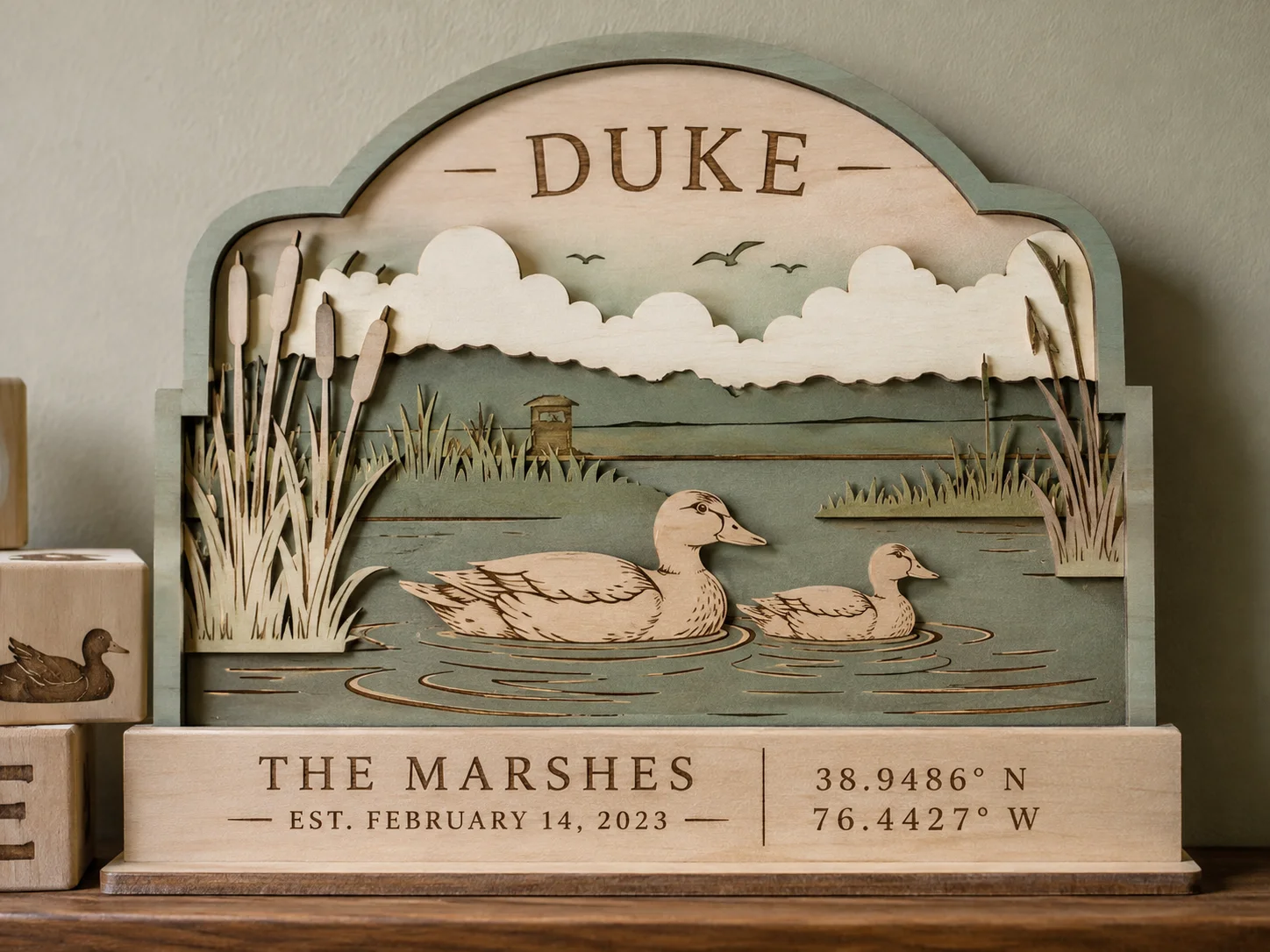
A custom piece anchors a duck hunting scene in a way no off-the-shelf art can replicate. Personalization can be as simple as a name and established date engraved into the base of a layered wood marsh piece, or as specific as commissioning a portrait of a hunter’s actual dog set against a marsh they can recognize.
The market for personalized hunting decor has expanded considerably alongside social commerce platforms, and what used to require a custom commission can now be ordered through Etsy shops that specialize in laser-engraved waterfowl art. Common personalization options include hunters’ names, coordinates of a favorite blind location, a dog’s name, or the season record (species, date, location) carved into the backing of a display piece.
Gift orientation is worth thinking through even when you’re buying for yourself. The pieces that hold long-term meaning in a room are the ones that commemorate something specific: a first duck, a last season with a dog who’s since passed, the first year hunting with a child. Generic art fills space. Commemorative art gives a room a story.
For families with young children, personalized duck hunting scenes adapt well to nurseries and kids’ rooms in formats that are safe and age-appropriate. A child’s name set into a laser-cut wood panel of ducks on a pond, finished in soft sage green and cream, translates the hunting tradition into the room without the aesthetic tension that fully realistic hunting scenes might create for a young child’s space.
One constraint: personalized pieces typically have longer lead times, often two to four weeks for custom laser work and six to eight weeks for commissioned paintings. Build that timeline into any room project or gift purchase.
Quick Comparison
| Approach | Best Room Fit | Approximate Scale | Suits Modern Interiors |
|---|---|---|---|
| Large mural | Cabin, great room, mudroom | Full accent wall | With the right image |
| Layered wood art | Man cave, office, staircase | 24″ x 36″ to 48″ x 60″ | Yes |
| Realistic canvas | Living room, bedroom, den | 24″ x 30″ to 36″ x 48″ | With neutral framing |
| Metal silhouette | Any room, covered porch | 18″ to 60″ wide | Yes |
| Vintage imagery | Cabin, study, trophy room | Gallery wall grouping | With restraint |
| Personalized piece | Any room, nursery | Varies by format | Yes |
Conclusion
The strongest duck hunting rooms don’t layer every idea at once. Start with one anchor piece, the mural or the oversized canvas, and let the remaining choices respond to it. A layered wood marsh piece on an adjacent wall, a metal silhouette above a doorway, and a single framed vintage duck stamp create enough depth without competing for attention. If anything in the room needs to explain itself, it’s probably one piece too many. Pick the format that fits the wall you’re trying to solve first, get it right, and the rest of the scene tends to follow.