Man Fishing Photography Poses That Tell a Better Story
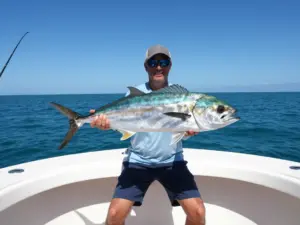
Most fishing photos look identical. One angler, two outstretched arms, a fish held at chest height, a squint into the sun. Multiply that by six people and you get six separate versions of the same forgettable image. The 6 man fishing photography poses that tell a better story work differently. They treat the group as a cast of characters, the water as a setting, and the catch as one moment inside a longer sequence.
Disclosure: This post contains affiliate links. As an Amazon Associate, we earn from qualifying purchases, and at no extra cost to you.
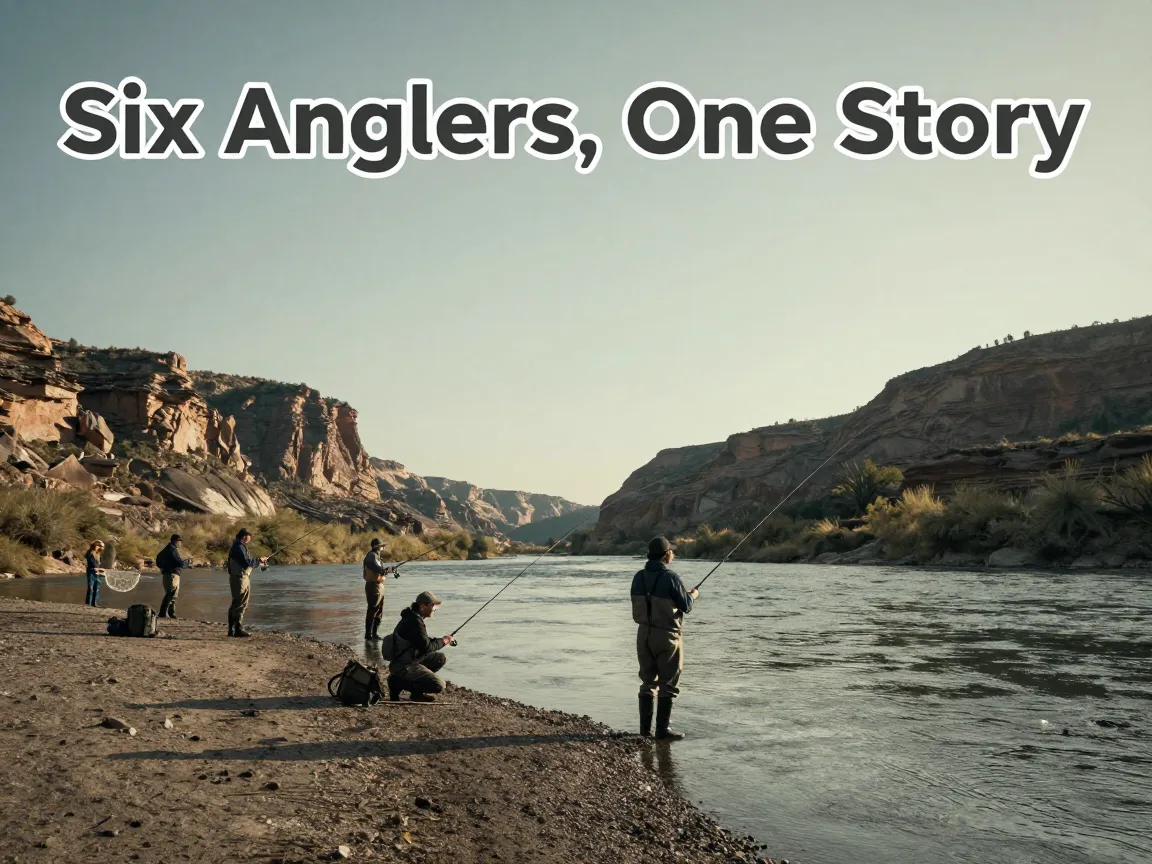
The shift from documentation to narrative does not require expensive gear. It requires knowing which poses activate story and which ones flatten it.
Key Takeaways
- Six anglers give you enough people to show distinct roles, reactions, and depth in a single frame.
- Story-first compositions place figures within the environment rather than in front of it.
- The best group fishing photos are built before and after the fish is landed, not only during it.
- Low angles, varied body positions, and natural eye lines replace the standard chest-high grip-and-grin.
- Lighting and fish handling technique affect both image quality and the ethical message the photo sends.
1. The Wide Environmental Team Shot
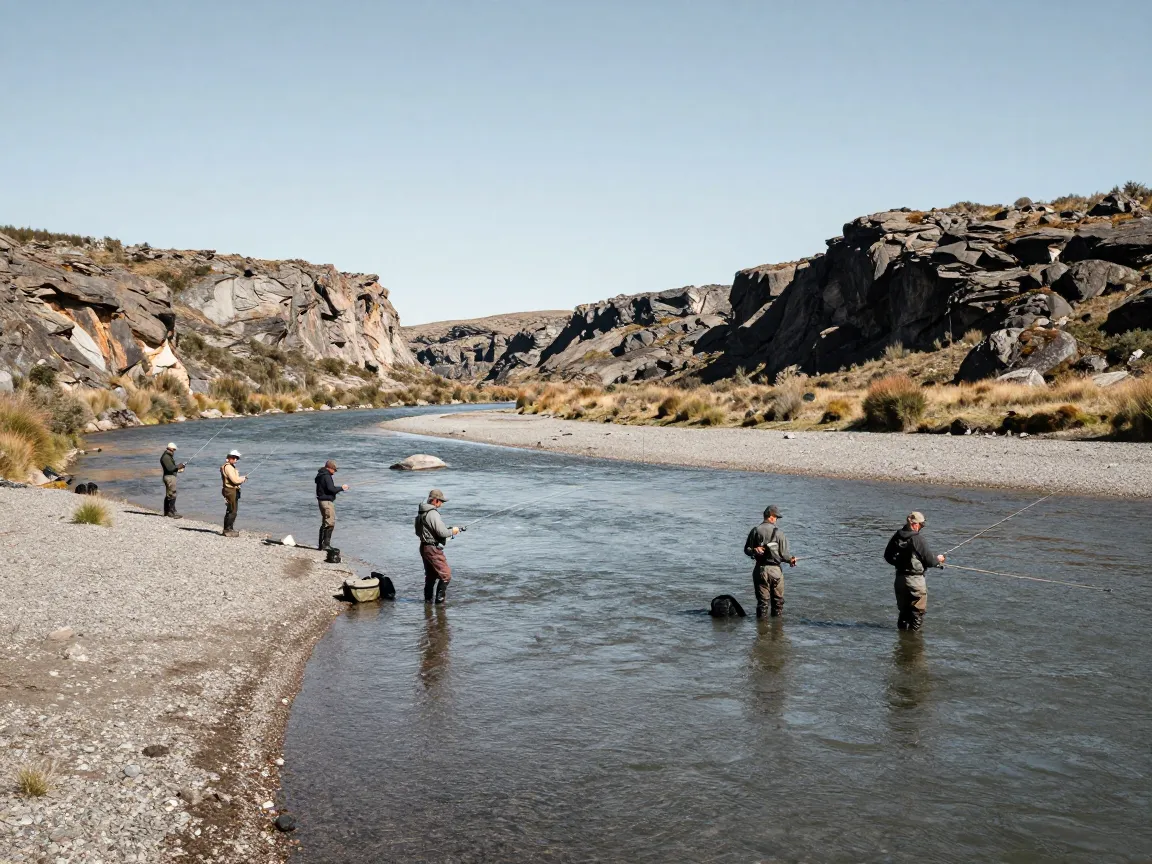
Six people spread across a riverbank or shoreline give a photographer a rare compositional tool: scale. When all six anglers are positioned at intervals along the water, rods in hand, moving or pausing with nets and packs visible, the landscape stops being a backdrop and becomes a character. The figures read as small against the terrain, which forces the viewer to understand where this outing is happening and how demanding it looks.
Rob Hammer’s fly-fishing work for outdoor brands in 2026 returns repeatedly to this approach. His Patagonia river projects frame anglers as elements within a canyon or valley, not subjects posed in front of one. The water surface, rock formations, and open sky carry as much visual weight as the people. Brands that want storytelling imagery, not just documentation, respond strongly to this style because it communicates the experience of being there, not only the fact of having caught something.
For a group of six, the practical setup is straightforward. Space the anglers unevenly rather than at regular intervals, which looks natural rather than arranged. Have two or three wade into shallower water while others stand on the bank. One person can be mid-cast, another can be watching the water, a third reaching into a pack. The camera position should be low and far enough back to include meaningful sky or terrain above the figures. A wide lens in the 16-24mm range on a full-frame body captures the full spread without distorting the nearest angler.
This pose works best at the start of a session or during travel between pools, when movement and gear are present and no one is frozen in a performance stance.
2. The Pre-Trip Gear and Conversation Cluster
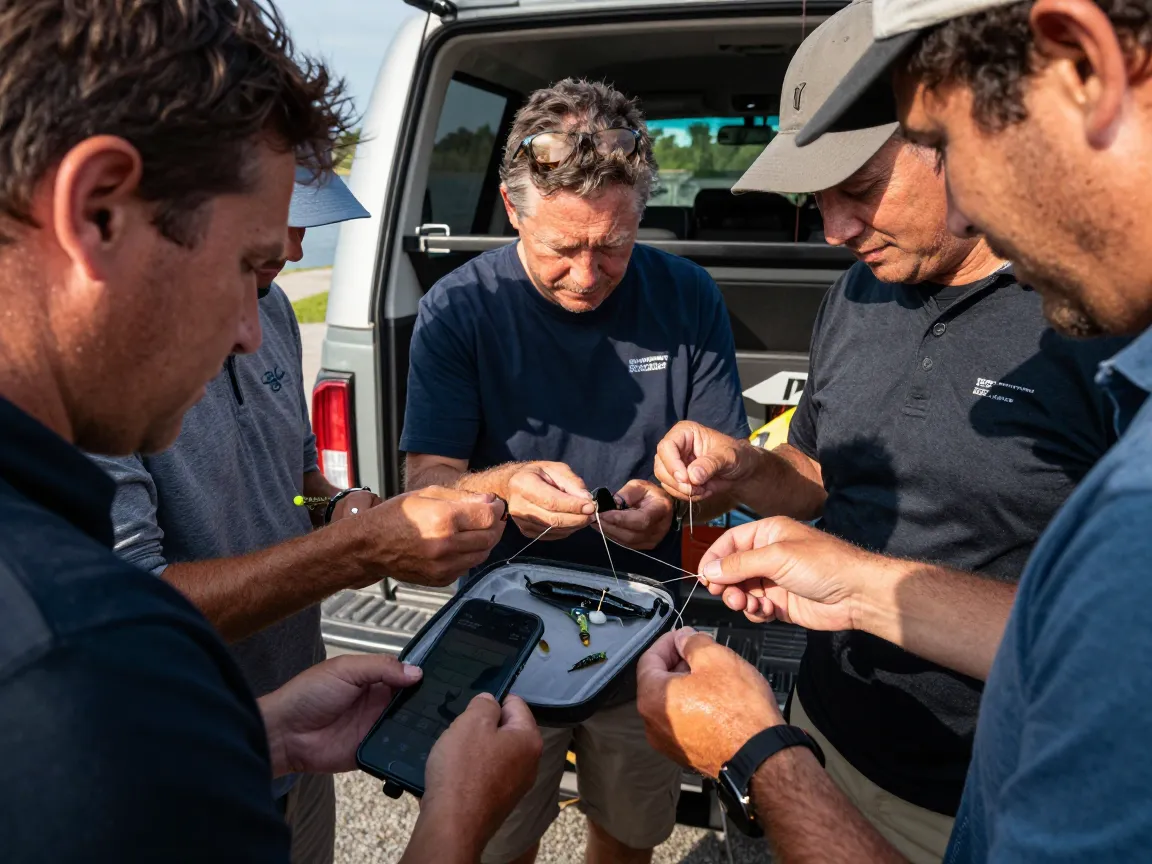
The story of a fishing day starts at the truck, the dock, or the launch. Six anglers huddled around a tackle box, trading flies, studying a fishfinder screen, or unfolding a river map creates an image that shows preparation, anticipation, and the social texture of the outing before a single line is in the water.
Outex’s November 2026 photography guide makes this point directly. Beginning with hands and faces, with the small transactions of rigging and planning, builds narrative investment in the people before any fish appears. For a group, this translates to a natural cluster shot where close-up frames of hands selecting lures exist alongside wider shots showing all six in conversation.
The body language in this pose should be inward, toward a shared focal point, not outward toward the camera. When anglers look at the flies, the map, or each other, their posture is authentic. When they look at the lens, the pose becomes a portrait, which is a different genre. Keep the focal point real: an open fly box, a phone screen showing water temperature, a knot being tied. The light at this stage of the morning is usually low and directional, which creates natural shadows across hands and faces that add depth without any additional setup.
A telephoto lens at 85-135mm compresses the group, showing the density of the cluster, and allows the photographer to stay far enough away that no one performs for the camera.
3. The Multi-Role Action Frame
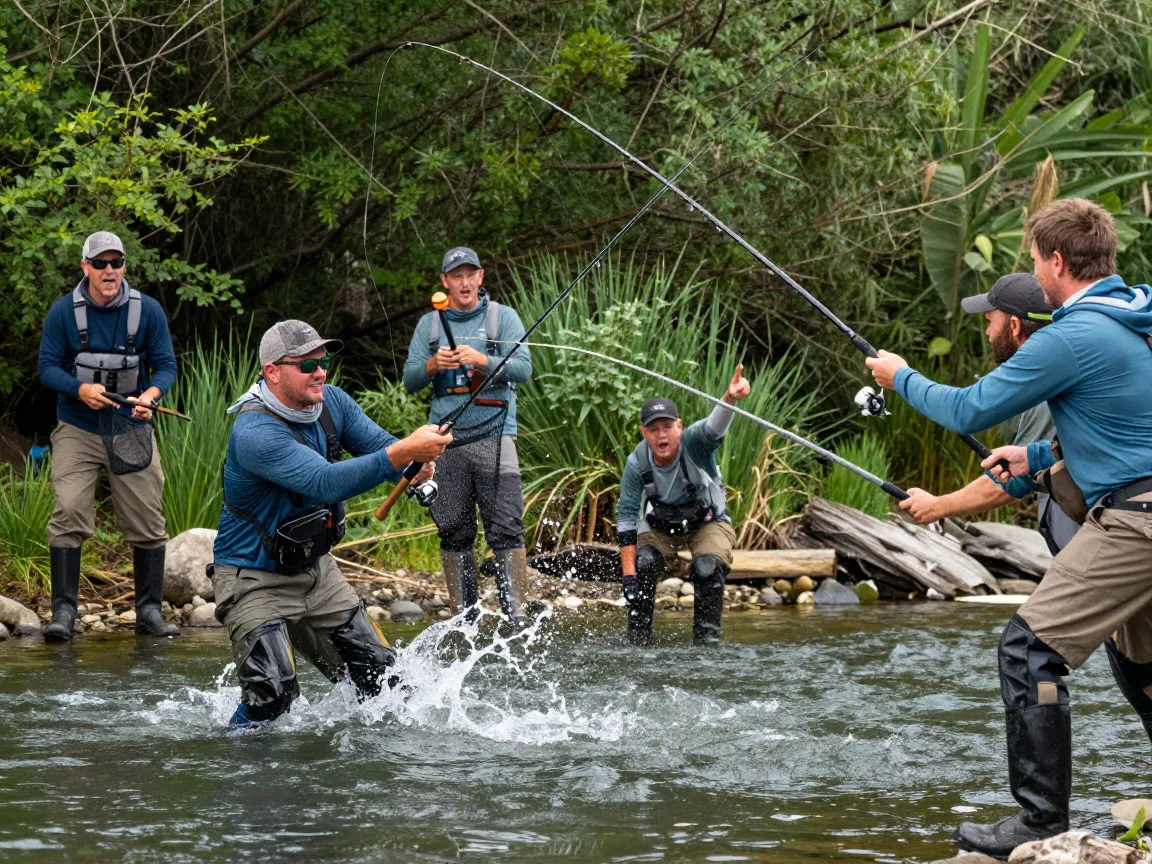
A six-person group is large enough to show the full chain of events that happens when a fish is hooked. One angler is fighting the fish, rod bent deeply and line tight. A second is moving into position with the net. A third is spotting from the bank, pointing and shouting. Two others have stopped casting and turned to watch. One is already reaching for a phone or camera.
This is a single frame that contains a complete narrative. The Steelhead Almanac’s 2026 river photography chapter calls the bent-rod, braced-stance shot one of the most dramatic in fishing imagery, and The Fisherman magazine specifically recommends sequencing through the full arc: setting the hook, fighting the fish, lifting it from the water, and releasing it. With six people present, all of those story beats can appear simultaneously across different bodies in the frame.
Capturing this pose requires anticipating the hook-up rather than reacting to it. When one angler is working a productive run, the photographer should position to show at least three or four people in the same frame and be ready to shoot at the moment of the strike. The camera should be set for continuous shooting with a shutter speed no slower than 1/800s to freeze the rod bend and the water spray. Autofocus tracking on the fighting angler keeps the primary subject sharp while the surrounding group stays readable in context.
The resulting image doesn’t need a fish to be visible. The bent rod, the tight faces, and the bodies moving toward one point tell the story without a single fin in frame.
4. The Fish-at-Water-Level Group Moment
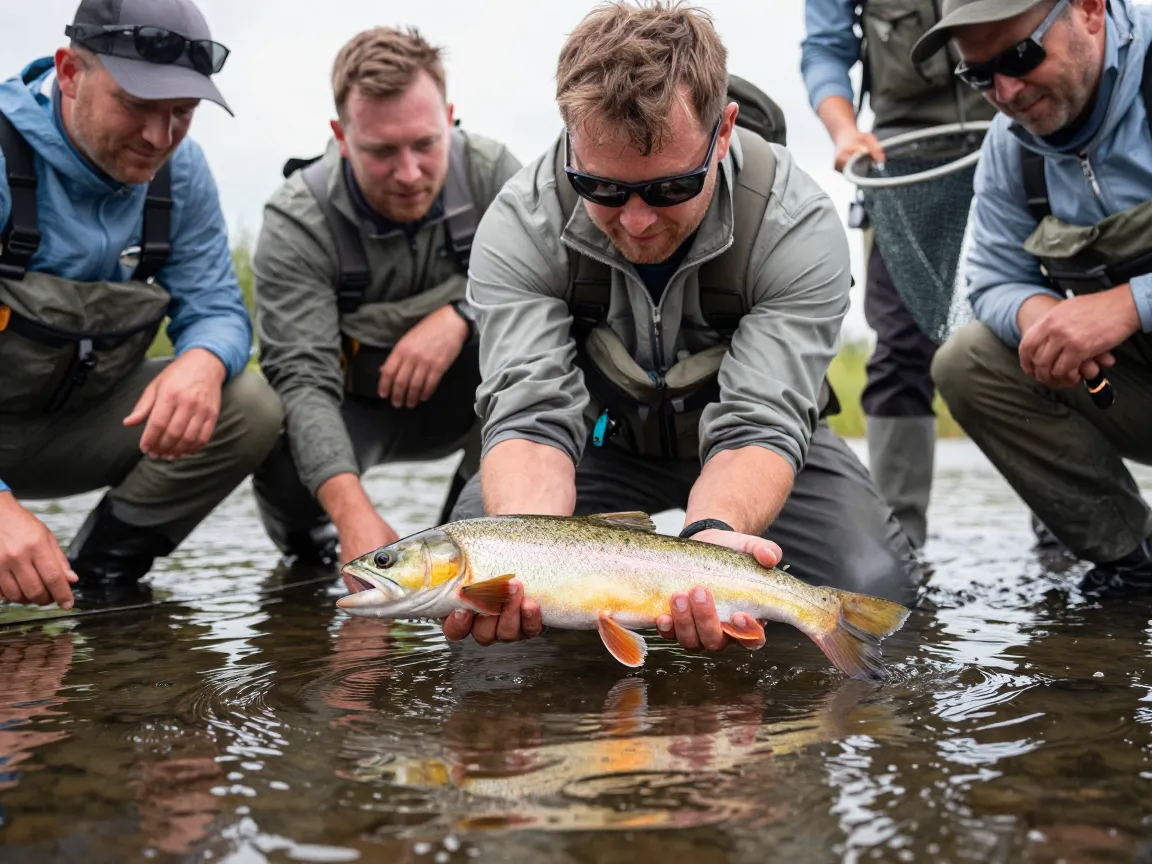
The single most cited improvement in contemporary fishing photography guidance is dropping the camera to water level. When one angler kneels at the river’s edge and holds the fish just above or at the waterline, with the camera positioned low so the fish and the water surface are nearly at the same plane, the image shifts from a trophy document to something that looks like it belongs in an outdoor magazine.
For a group of six, this pose assigns the kneeling angler the central role and uses the remaining five to build layers behind and to the side. Two others can crouch close, looking down at the fish. One can stand with a net visible. Others can remain in the water, slightly out of focus, suggesting the broader outing. The fish at water level stays sharp, the faces nearest to it are readable, and the scene has depth.
NOAA Fisheries’ 2025 smartphone guide and FishMap’s 2026 article both emphasize supporting the fish horizontally with two hands, keeping it near the water, and minimizing handling time. These are ethical guidelines that also produce better photos. A fish held properly with two hands underneath, body parallel to the water, is visually cleaner than one gripped around the middle. The hands read as careful rather than possessive.
One specific adjustment that improves every version of this pose: have the angler holding the fish angle it slightly away from their body, which reduces the visual bulk of the hands and shows more of the fish’s flank. NWA’s 2026 outdoor photography column recommends removing sunglasses before any close pose so the eyes of the angler read clearly, which matters most in this tight, face-near-fish composition.
5. The Before-and-After Trip Sequence
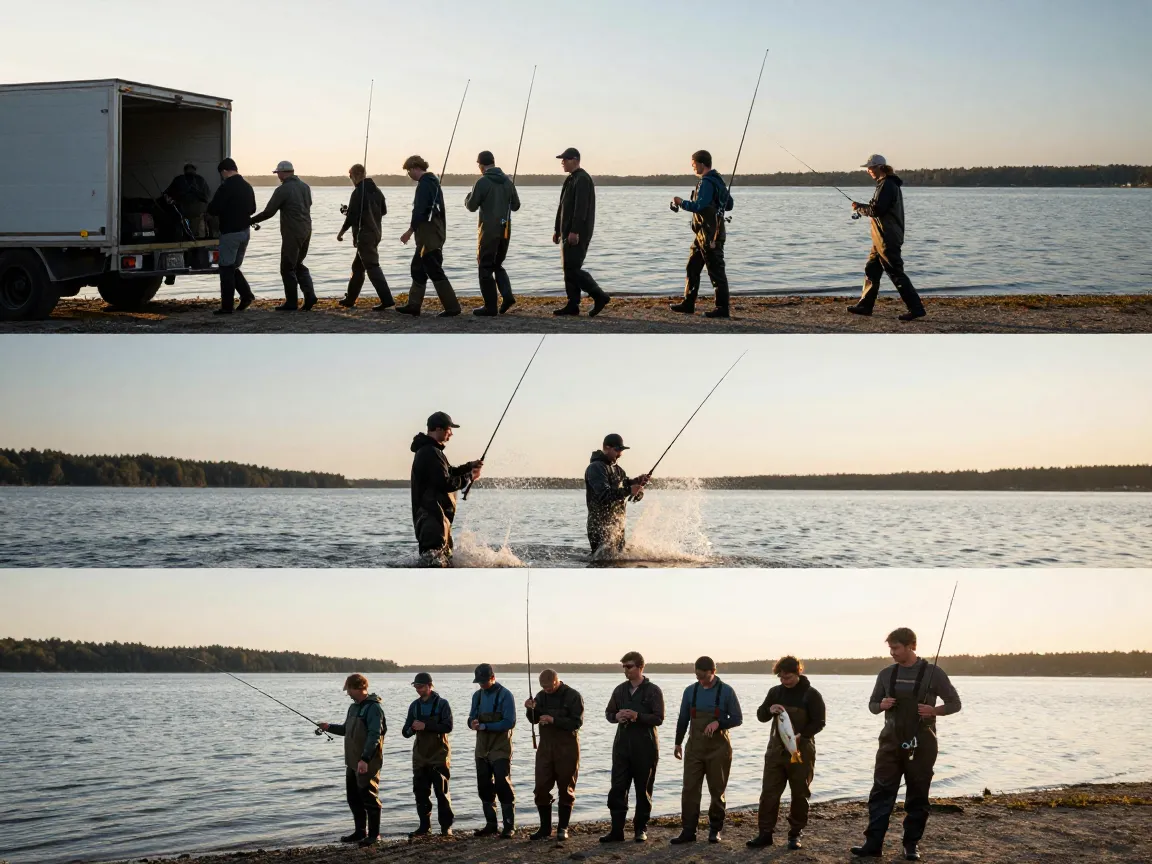
A single pose at the moment of the catch cannot carry the full weight of a day on the water. Guidesly’s February 2026 article on fishing photography introduces the concept of before-and-after storytelling: images from the start of the outing alongside the later catch, showing effort, changing light, and the arc from anticipation to result.
For six anglers, this approach generates a cohesive set rather than an isolated image. The sequence starts at first light, with the group unloading gear at the truck or walking toward the water, rods over shoulders, faces not yet fully awake. Mid-day frames show individual effort, water spray, and the landscape under full sun. End-of-day images show the group again, this time changed by hours of fishing, with wet waders, tired postures, and the fish that made the day.
The power of this approach is cumulative. No single frame in the sequence is asked to explain everything. The early-morning lineup shot doesn’t need a fish in it. The mid-day action frame doesn’t need everyone in it. The end-of-day group pose carries emotional weight because the viewer has seen what preceded it.
Practically, this means the designated photographer keeps shooting throughout the day rather than waiting for a catch. Wide establishing shots at dawn, candid moments of rigging and wading and eating lunch on the bank, and a final group pose with the last light of the afternoon add up to a story that six anglers will want to look at years later.
6. The Immersive Perspective Shot
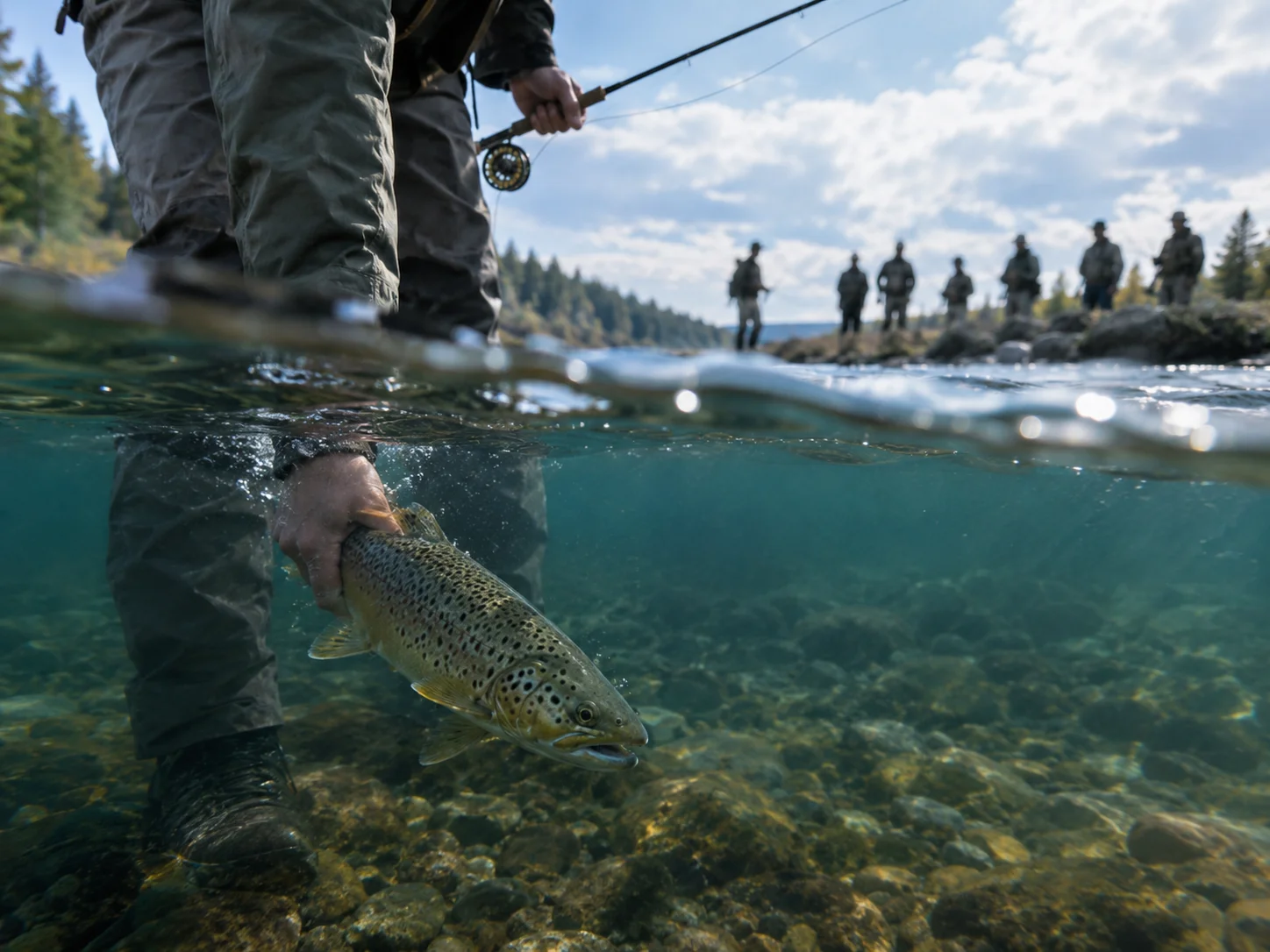
Fly-fishing photography in 2026 is moving toward immersive vantage points that show both the angler’s world and the fish’s. Hatch Magazine’s long-standing guide to underwater fishing photography, updated in 2026, describes sub-surface shots as expanding the story from a “one-sided yarn” to a full experience. As waterproof housings become more accessible, this approach is reaching group outings.
For six anglers, an immersive perspective shot doesn’t require everyone to appear. It requires one angler in the water and a camera angle that places the viewer inside the scene rather than watching from the bank. The camera at water surface level, half-submerged, captures the angler from the thighs down, the rod tip above, the fish being released below the surface, and the river extending behind. The remaining five anglers may appear as blurred silhouettes on the bank, which establishes the group scale without crowding the frame.
The other version of this pose is the over-the-shoulder or high overhead frame taken from above the group. Feather Craft’s 2026 Angler photo contest criteria describe judging by precision, perspective, and storytelling through visual angles. A drone or elevated camera position showing all six anglers in the water from above, their shadows and lines visible on the river bottom, is a composition that no ground-level shot can replicate. The scale of the river relative to the figures, and the visible structure of the stream below, are details that only an elevated or immersive angle reveals.
The practical constraint is that this pose requires either a waterproof housing for sub-surface work or a drone and a pilot who understands current airspace regulations. Where neither is available, a camera held at shin level and tilted slightly upward achieves a partial version of the low immersive angle, with the water surface in the frame and the anglers seen from below chest height.
Quick Comparison
| Pose | Group Size Used | Best Timing | Key Technical Need |
|---|---|---|---|
| 1. Wide environmental team shot | All six | Start or mid-session | Wide lens, elevated or distant position |
| 2. Pre-trip gear cluster | 3-6 | Before lines are in | 85-135mm, natural cluster focal point |
| 3. Multi-role action frame | 4-6 | During a hook-up | Continuous shooting, 1/800s or faster |
| 4. Fish at water level | 2-4 near fish | At the catch | Low camera, two-handed fish support |
| 5. Before-and-after sequence | Varies | All day | Consistent shooting throughout outing |
| 6. Immersive perspective | 1-2 primary, rest as context | Release or wading | Waterproof housing or drone |
Conclusion
These six poses work because they treat the group as a story rather than a list of people to include in the frame. The gap between a forgettable catch photo and an image worth printing is usually not equipment or location. It’s knowing which moment in the arc, which angle, and which arrangement of bodies around water and fish communicates something beyond “we were here.”
The most useful next step is to assign one person in your group the photographer role for the full day, not just for the catch. The images that arrive before and after the fish is in hand are the ones that make the catch photo mean something.