Groomsmen Fishing Photos Ideas for Unforgettable Wedding-Day Shots
Roughly 70 percent of couples who plan outdoor weddings now incorporate at least one hobby-themed photo session into their wedding-day timeline, according to wedding planning surveys from 2024 and 2025. Fishing has become one of the top three hobbies featured in those sessions, overtaking golf and cycling in popularity. These 6 Groomsmen Fishing Photos Ideas for Unforgettable Wedding-Day Shots give you a concrete playbook, whether you are a bride planning a surprise moment for your groom, a best man coordinating the crew, or a photographer looking for a proven shot list that actually delivers.
Disclosure: This post contains affiliate links. As an Amazon Associate, we earn from qualifying purchases, and at no extra cost to you.
The appeal is simple. Fishing photos feel genuine because they draw on something the groom and his crew already do together. The gear, the location, and the body language all carry years of shared history. A well-executed fishing portrait tells more about those relationships than a standard tuxedo lineup ever could.
Key Takeaways
- Natural light at golden hour (roughly 60 to 90 minutes before sunset) is the single biggest lever for elevating any outdoor group shot.
- Matching or coordinated fishing gear creates visual cohesion without looking staged.
- Build at least 45 minutes of buffer into the wedding-day timeline specifically for hobby-themed photos.
- Candid moments mixed with one or two posed formations give photographers a wider selection of usable images.
- Fishing-themed reception décor can extend the story beyond the ceremony and into the tablescape.
1. Waders and Toast Group Portrait
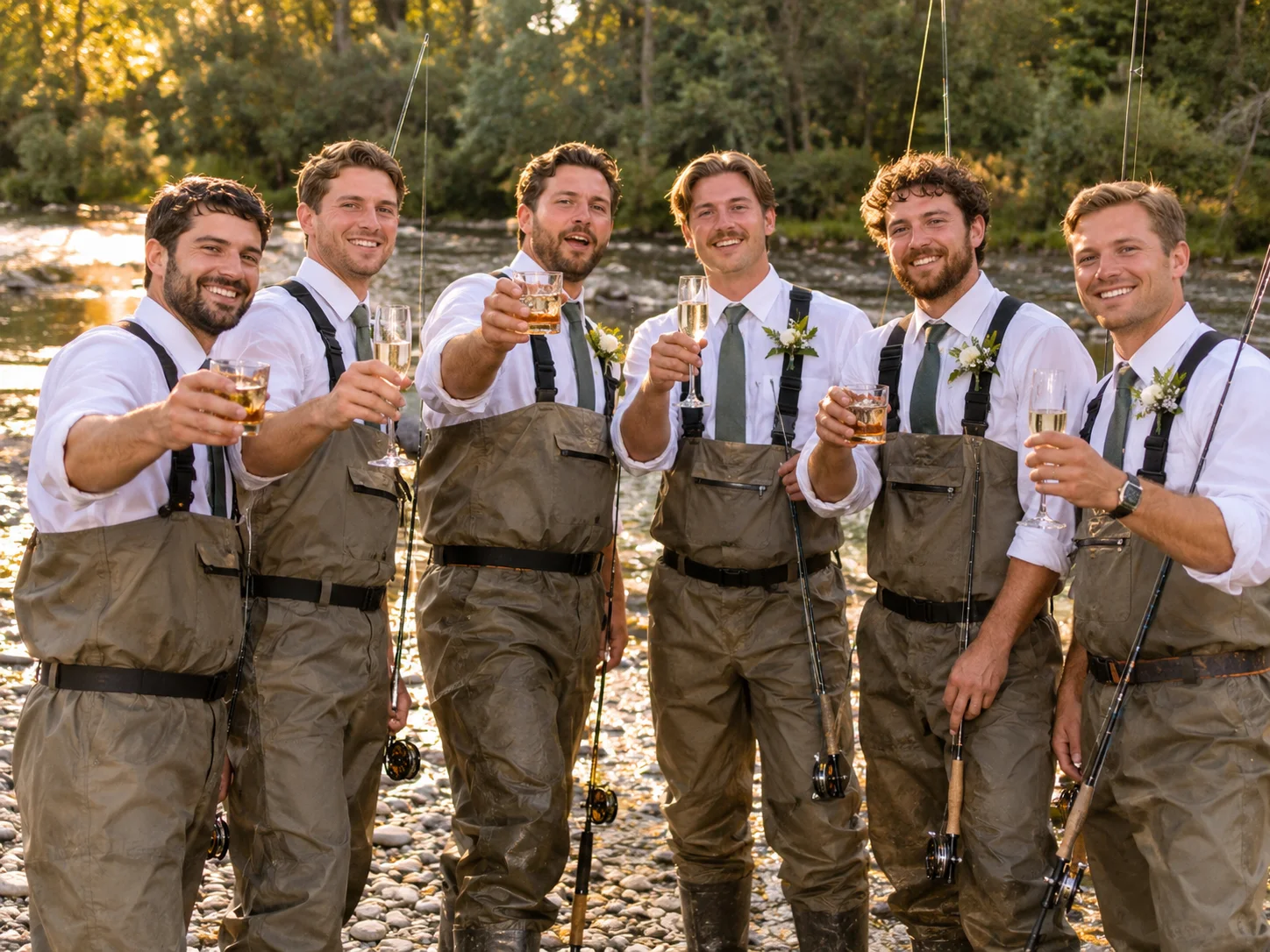
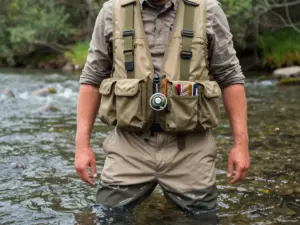
Few wedding photos have the same double-take effect as six men in full chest waders, dress shirts, and boutonnieres raising glasses for a toast beside a river. The contrast between formal wedding attire and functional fishing gear is sharp enough to stop a scroll and personal enough to hold attention.
The setup requires some coordination. Each groomsman wears his waders pulled up and secured, with dress shirt sleeves rolled to the elbow and a boutonniere pinned at the chest. Whiskey glasses or champagne flutes work equally well. The photographer positions the group at the water’s edge, ideally where natural light catches the surface behind them. One person delivers an actual toast line, which the photographer captures mid-speech. That live moment is what separates this image from a staged replica of it.
Practically speaking, you need the waders on-site at least 30 minutes before the shoot so everyone has time to change without rushing. A clear gravel bar, shallow creek bank, or the mouth of a boat launch all work. Avoid muddy shorelines that will slow down the wardrobe switch back to formal wear. This shot works best in the late afternoon window before the reception, when the schedule has a natural pause.
The resulting image also converts well for the wedding album cover and for large canvas prints, because the vertical elements (rods, raised glasses, posture) balance the horizontal sweep of the water behind the group.
2. Dock or Pier Lineup at Sunset
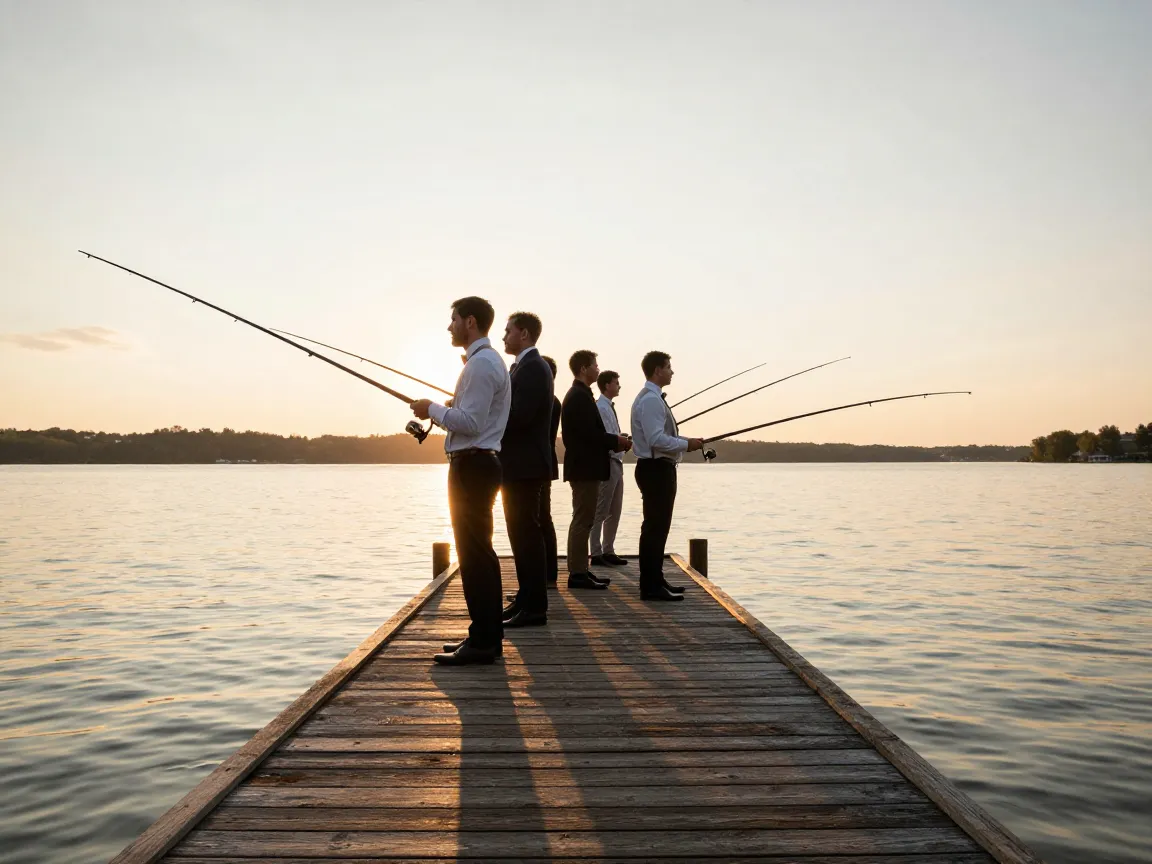
A dock lineup is structurally reliable for wedding photography because the dock itself solves the spacing problem. The planks create a natural baseline, and the railing or edge provides a visual anchor that keeps the group from looking scattered.
Position the groomsmen in a single-file or slight stagger along one side of the dock, all facing the same direction with rods extended outward over the water. The groom takes the front position. Golden-hour light from the west will catch the side of their faces and rim-light the fishing lines, which adds dimension without any artificial gear. The photographer shoots from a low angle at dock level to exaggerate the perspective and include the sky and water reflections.
Recent real-event examples from 2025 outdoor weddings in the Pacific Northwest and the American South show that this composition also works when the group is backlit, with the sun low behind them. That silhouette version trades facial detail for a dramatic, painterly outline of six figures with rods. If you want both versions, shoot the lit version first, then wait five minutes for the sun to drop and capture the silhouette. Two distinct images from one 15-minute window.
One constraint worth flagging: public docks may have foot traffic that interrupts the shot. Private lakefront venues eliminate this problem. If the ceremony or reception is at a venue with its own dock, block 20 minutes on the timeline and communicate it clearly to the venue coordinator in advance.
3. Waterside “Ready to Cast” Formation
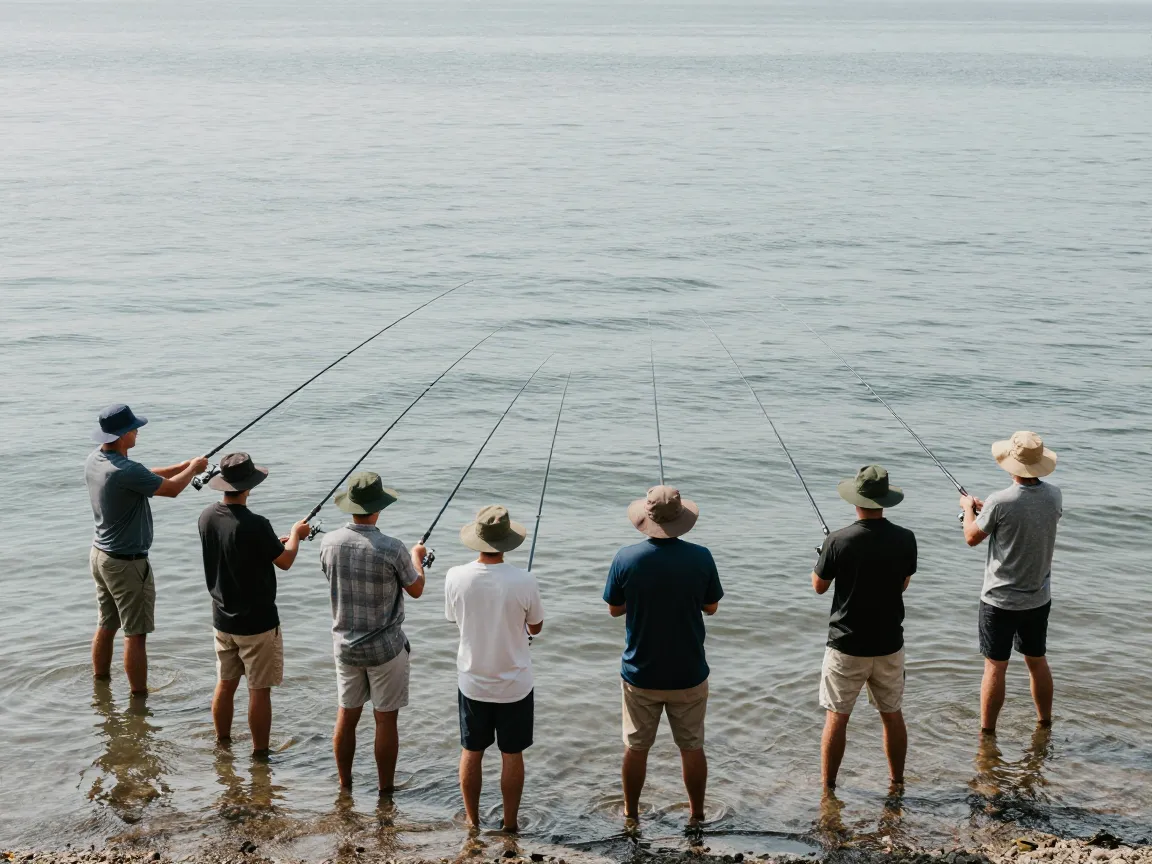
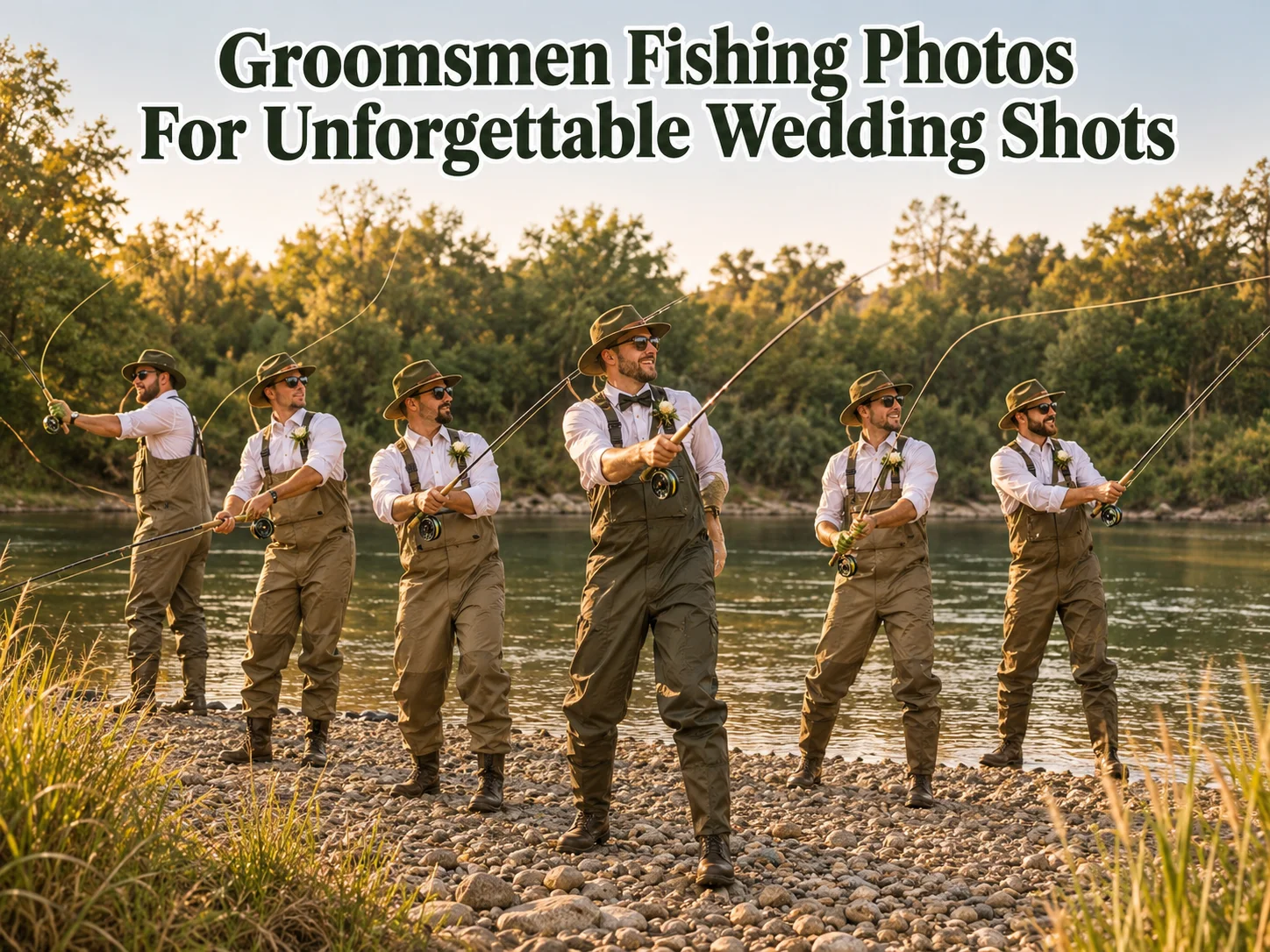
This setup is dynamic rather than static. Each groomsman holds a rod in a casting position, weight shifted forward, arm drawn back or extended mid-motion. The photographer fires a burst as the group executes a synchronized practice cast. No one actually hooks anything; the motion itself is the subject.
The formation that works best spatially is a loose arc facing the water, with two or three feet between each person so the rods do not cross in the frame. A wide-angle lens at roughly 24mm captures the full arc while keeping the water horizon visible. If the group includes six men at different heights, place taller groomsmen at the ends of the arc and shorter ones near the center. This creates a subtle bowl shape that draws the eye to the groom at the middle.
What makes this shot more than a simple action photo is the shared direction of attention. Everyone is looking at the water, not at the camera, which gives the image an observational, candid quality even though it is entirely staged. That psychological effect is worth deliberate attention. Tell the group to stay focused on where their line would land, not on the photographer. A single distracted glance toward the lens breaks the composition.
For gear coordination, matching rod brands or color-matched fishing hats in a single neutral tone (navy, olive, or tan) pull the group together visually without requiring identical outfits. Several outdoor apparel companies now offer groomsmen fishing hat bundles specifically for this purpose, which became a noticeable product category in 2025 and has expanded further into 2026 with engraved tackle-box sets and embroidered vest packages.
4. Truck, Boat, or Gear Flat Lay with the Crew
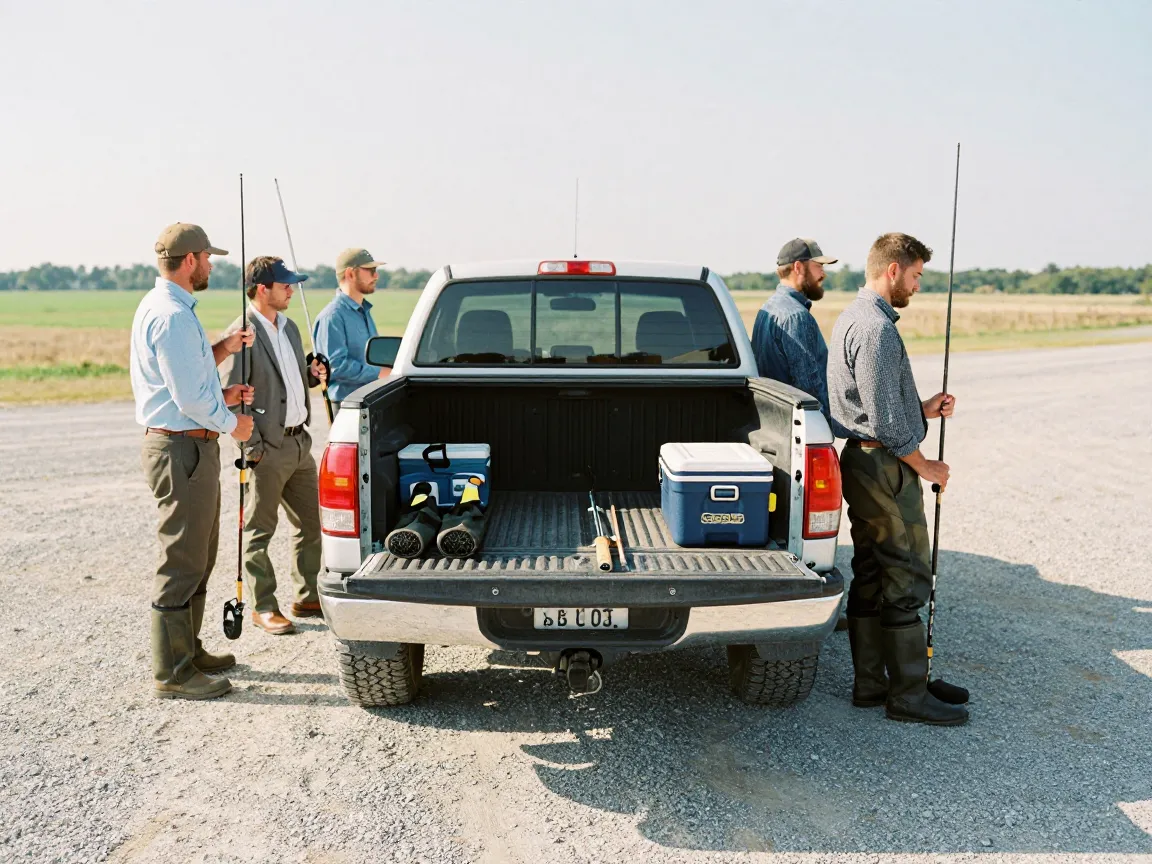
Not every fishing photo needs water in the background. The gear itself, laid out deliberately or arranged around a boat or truck tailgate, tells the same story with a different visual texture.
The truck version works like this: the groom’s pickup (ideally a beat-up working truck, not a showroom model) is backed up to a field or gravel lot. The tailgate is down and loaded with organized fishing tackle, waders, a cooler, and one or two personal items that belong to the groom, such as a specific rod brand he has used for years or a tackle box that was a gift. The groomsmen lean against the truck sides and tailgate. Some hold rods. The photographer shoots from a medium distance to include the whole truck and from directly overhead for a flat-lay of the tailgate contents.
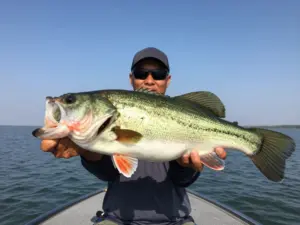
The boat version follows the same logic but with more visual drama. Five or six men seated inside a bass boat in formal wear, one holding an outboard throttle, is immediately legible as a joke and as a portrait. The humor is built in and does not require any additional staging. Keep it in shallow, calm water so safety is not a concern.
One scheduling note: the gear-and-vehicle shot is easier to fit into the pre-ceremony window because it does not depend on golden-hour light the way water shots do. Morning light on a truck or boat is flat and clean, which suits the editorial look well. This flexibility makes it a useful backup if the sunset window gets compressed by ceremony delays.
5. Reception-Side Speech in Fishing Gear
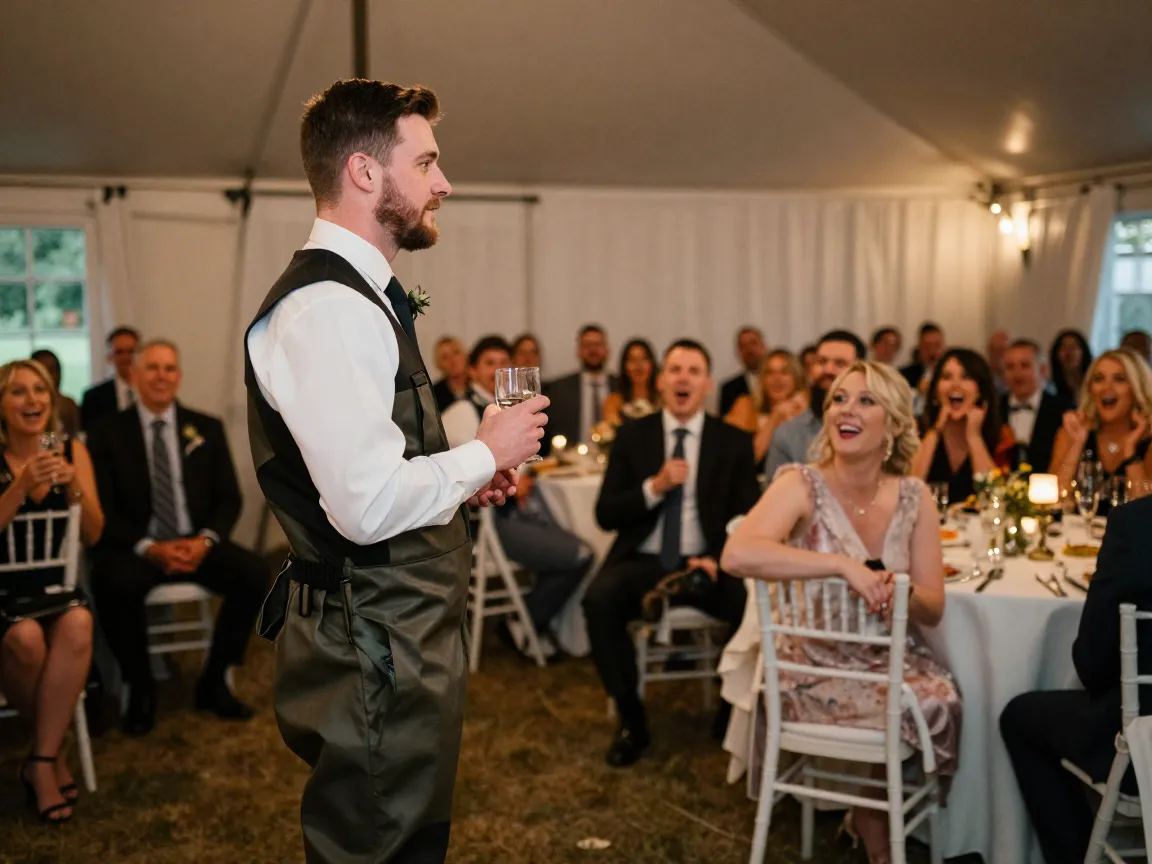
A costume change between the ceremony and the reception is not new, but doing it in full fishing gear is specific enough to register as a planned, meaningful detail rather than a stunt. One or more groomsmen change into waders or fishing vests for the best man speech, deliver their toast in costume, and change back before dinner service.
The photographic opportunity here is different from outdoor portraits. This is documentary wedding photography in a reception hall or tent, with ambient lighting, tables in the background, and genuine reaction shots from the crowd. Those reaction images, guests laughing or looking surprised, are some of the most emotionally honest photos from any wedding day.
To make it work, the person changing needs at least 10 minutes and a room adjacent to the reception space. The change also needs to be coordinated with the DJ or emcee so the speech timing is not disrupted. Brief the photographer in advance so they position themselves on the side where the costumed groomsman enters, capturing both the reveal and the crowd’s response from a single angle.
A related variation that works well for smaller weddings is a full-group change, where all six groomsmen deliver a group toast in matching fishing vests and hats. This is a heavier logistical lift but produces a more symmetrical, album-worthy frame.
6. Candid Crew at the Fishing-Themed Photo Table
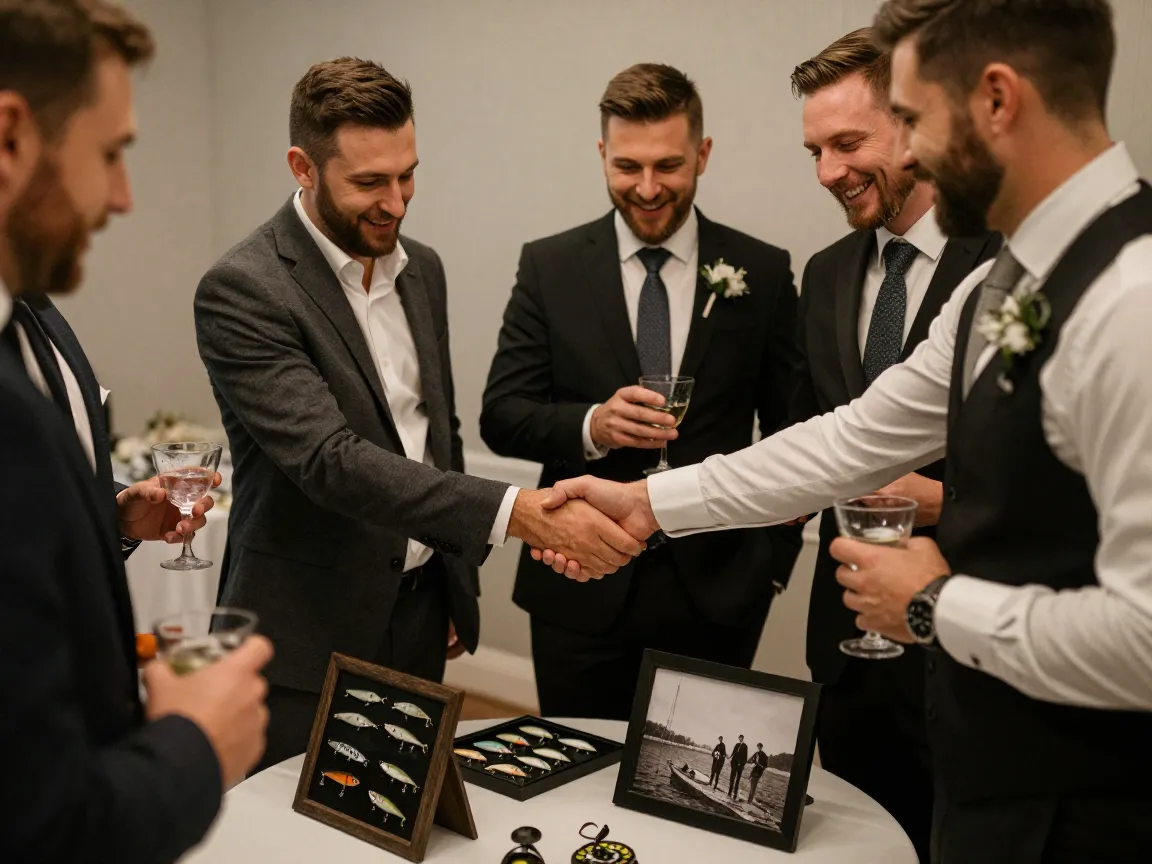
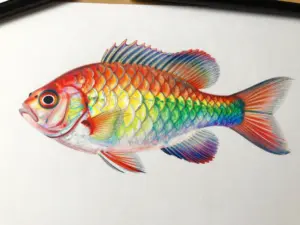
By 2025, fishing-themed reception décor had moved from novelty into an established category, with vendors offering framed fish illustrations, lure centerpieces, cast-iron fish bottle openers, and custom tackle-box favors. In 2026, the trend has extended to dedicated photo moments built around that décor, specifically a styled table where the groom and groomsmen gather for candid shots among the fishing elements.
The setup is straightforward. One reception table is styled with framed black-and-white fish prints, a spread of favorite lures on a small display tray, and a chalkboard sign with an inside reference known to the fishing crew. The groomsmen gather there naturally at some point during cocktail hour or early reception. The photographer shoots in an unobtrusive documentary style, catching handshakes, laughs, and moments of the group examining the lure display or pointing at the prints.
These images are quieter than the outdoor action shots but carry significant personal weight. They show the groom in context with the people he is closest to, surrounded by objects that represent a shared identity. For couples who want their wedding album to feel like a complete story rather than a highlights reel, this category of image fills a gap that posed outdoor portraits cannot.
One concrete suggestion: include one or two personal items in the display that belong specifically to the groom, such as his first fly-fishing reel or a photo of the crew from a memorable fishing trip. The photographer will gravitate toward those details, and the resulting close-up shots become standalone keepsakes separate from the group portraits.
Quick Comparison
| Shot | Best Time of Day | Gear Needed | Light Requirement | Prep Time |
|---|---|---|---|---|
| 1. Waders and Toast | Late afternoon | Waders, glasses | Natural, golden hour | 30 min |
| 2. Dock Lineup at Sunset | 60 min before sunset | Rods, dock access | Golden hour | 20 min |
| 3. Ready to Cast Formation | Late afternoon | Rods, coordinated hats | Natural outdoor | 15 min |
| 4. Truck, Boat, or Gear Shot | Morning or afternoon | Vehicle, tackle, boat | Flat natural light | 20 min |
| 5. Reception Speech in Gear | Reception, evening | Waders or vest | Indoor ambient | 10 min |
| 6. Photo Table with Décor | Cocktail hour | Styled table, props | Indoor ambient | Pre-set only |
Conclusion
These 6 Groomsmen Fishing Photos Ideas for Unforgettable Wedding-Day Shots cover the full arc of a wedding day, from pre-ceremony outdoor portraits to candid reception moments. The single most actionable next step is to build the specific shots you want into the written wedding-day timeline at least 60 days before the event, then share that document with both the photographer and the best man. When everyone knows exactly which shots are planned, what gear is needed, and when the natural light window opens, the photos happen with far less chaos and far better results.