Duck Hunting Senior Pictures Ideas for Boys Who Live for the Marsh
Senior portraits for most high school boys default to a blazer and a rented backdrop. But a boy who is up before 4 a.m. three days a week from October through January, who owns more camo than dress shirts, and who thinks of a Labrador as a working partner, that boy deserves something better. These 6 duck hunting senior pictures ideas for boys who live for the marsh treat the marsh itself as the studio and the hunt as the narrative.
Disclosure: This post contains affiliate links. As an Amazon Associate, we earn from qualifying purchases, and at no extra cost to you.
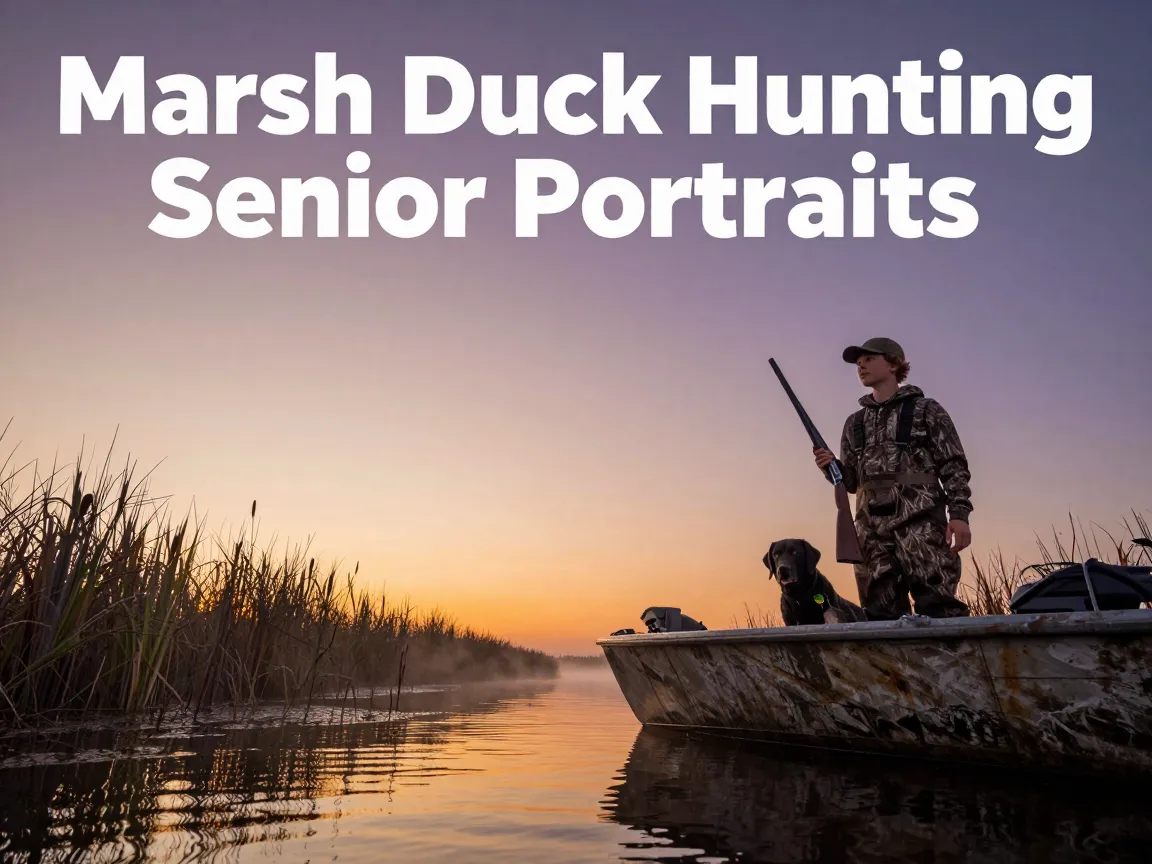
Each idea below is built around authenticity. Waterfowl photography authorities, including the documentation style championed by publications like Ducks Unlimited, consistently point to one principle: the best outdoor portraits capture something that actually happened, not something staged to look like it did. That standard applies directly to senior portraiture when the subject’s whole identity is tied to the water.
Key Takeaways
- Shoot during the actual season so light, foliage, and water conditions are real, not approximated.
- Pre-dawn and golden-hour windows give you the most dramatic natural light for marsh environments.
- Including a working dog shifts focus from a solo portrait to a relationship, which reads as more authentic.
- Gear and flat-lay detail shots give parents and senior boys a range of print sizes and formats to work with.
- Always handle firearms safely and follow state regulations for any image that includes a harvested bird or a shotgun.
1. Pre-Dawn Blind or Boat Silhouette With the Retriever
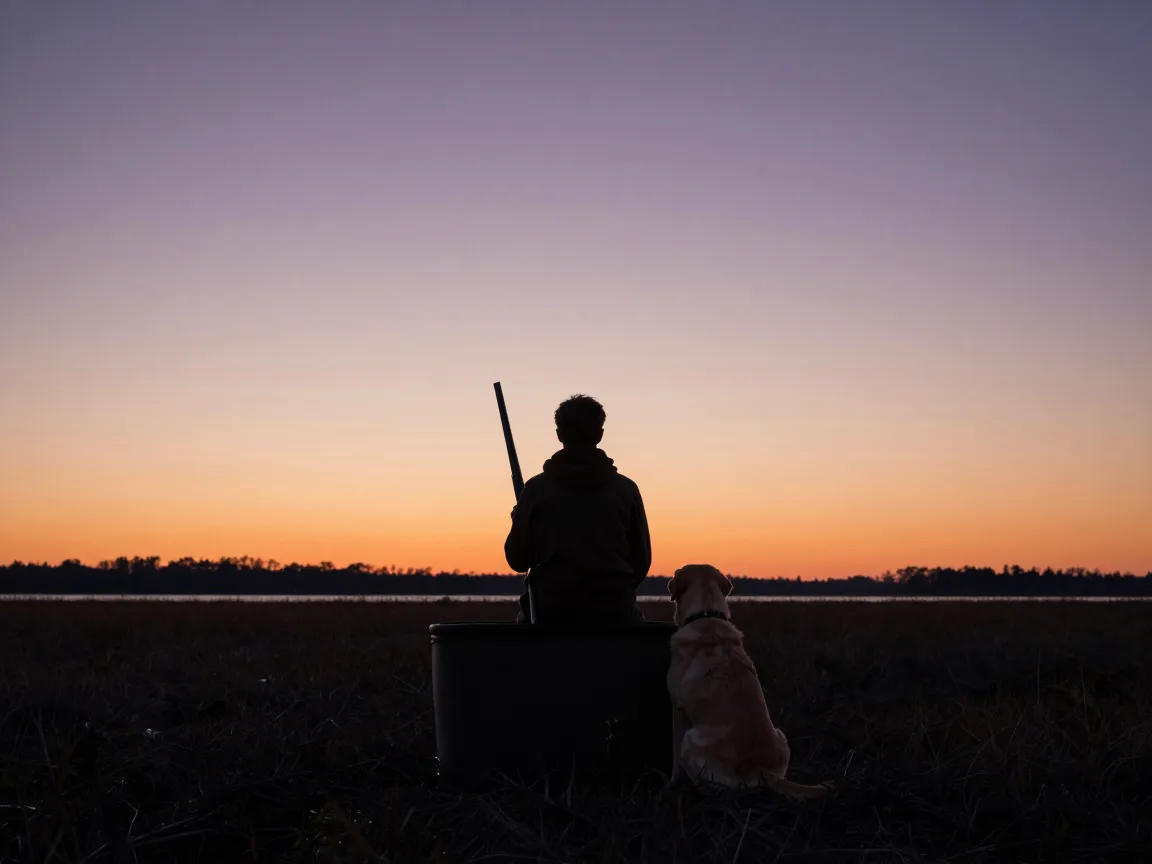
The window between 5:30 and 6:15 a.m. during teal or mallard season produces the kind of orange-and-purple sky that photographers spend money trying to recreate in a studio. A boy seated or standing at the edge of a blind, or positioned at the bow of a layout boat with his retriever at heel, turns that sky into a backdrop that no vinyl roll can match.
The silhouette approach works here because it removes the pressure of a perfect expression. The body language tells the whole story: a shotgun in hand, shoulders squared toward the horizon, dog sitting tight. No face required. The viewer fills in the rest, which is exactly what makes this composition emotionally resonant across large waterfowl image libraries and photo contests.
Practically, the photographer should position the subject between the camera and the lightest part of the sky, usually just above the tree line or horizon, and shoot in RAW to retain detail in the shadow areas. A 24-70mm lens gives enough range to work the composition without wading into the water. Plan to arrive 30 minutes before nautical twilight begins. Light at that stage changes fast, and you have about 12 minutes of usable color before the sky whites out.
One caveat: the dog needs to hold its stay while the shutter fires. If the retriever breaks on every frame, build in a 20-minute warm-up with basic obedience before the shoot starts. A dog that is calm in the blind naturally reinforces the story the portrait is trying to tell.
2. Wading Through the Marsh Action Shot
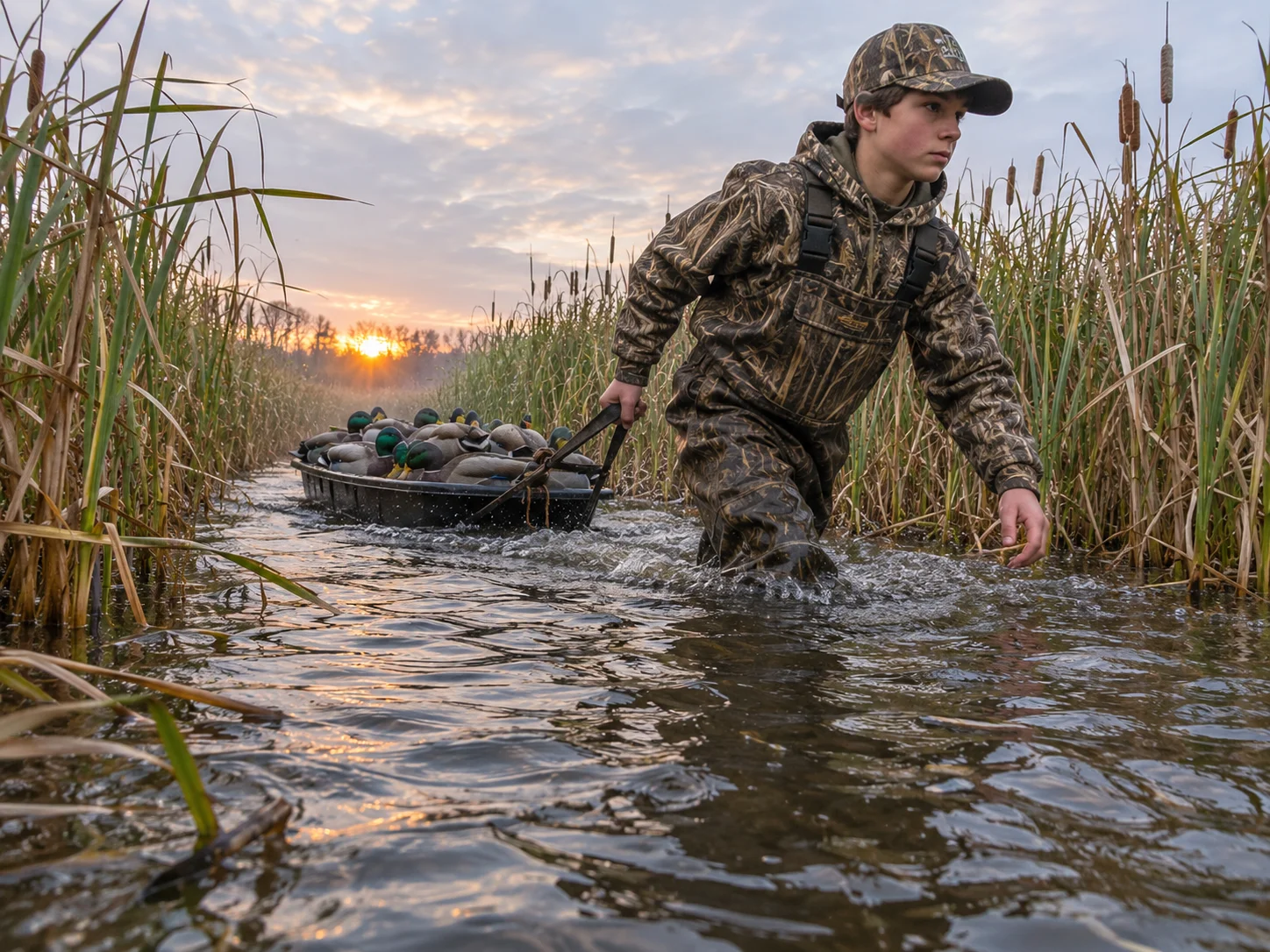
One of the most honest duck hunting images is also one of the simplest to set up: a boy moving through shin-deep water, pulling a sled full of decoys behind him, or dragging a canoe through a narrow cut in the cattails. The movement creates water disturbance, and water disturbance in low morning light produces texture that a static portrait simply cannot replicate.
Grand View Outdoors has consistently highlighted candid lifestyle moments as the backbone of waterfowl portraiture that actually sells. This idea applies that logic directly to senior portraits. The subject does not look at the camera. He looks where he is going. The result reads less like a posed photograph and more like a pulled frame from a hunting film, which is precisely the tone most marsh hunters prefer.
For composition, a wide angle of 24mm or 35mm placed low, almost at water level, exaggerates the foreground ripple and makes the subject feel large against the sky. If the photographer can lie prone on a dry dike or use a boat as a stable platform, the angle shift alone changes the photograph from ordinary to something a family will want to print at 20×30.
The practical consideration here is wader safety. The subject should know the bottom. Avoid locations with unknown drop-offs or significant current, and scout the wade path the afternoon before the shoot.
3. Dog-Focused Retrieve Shot With the Senior in the Background
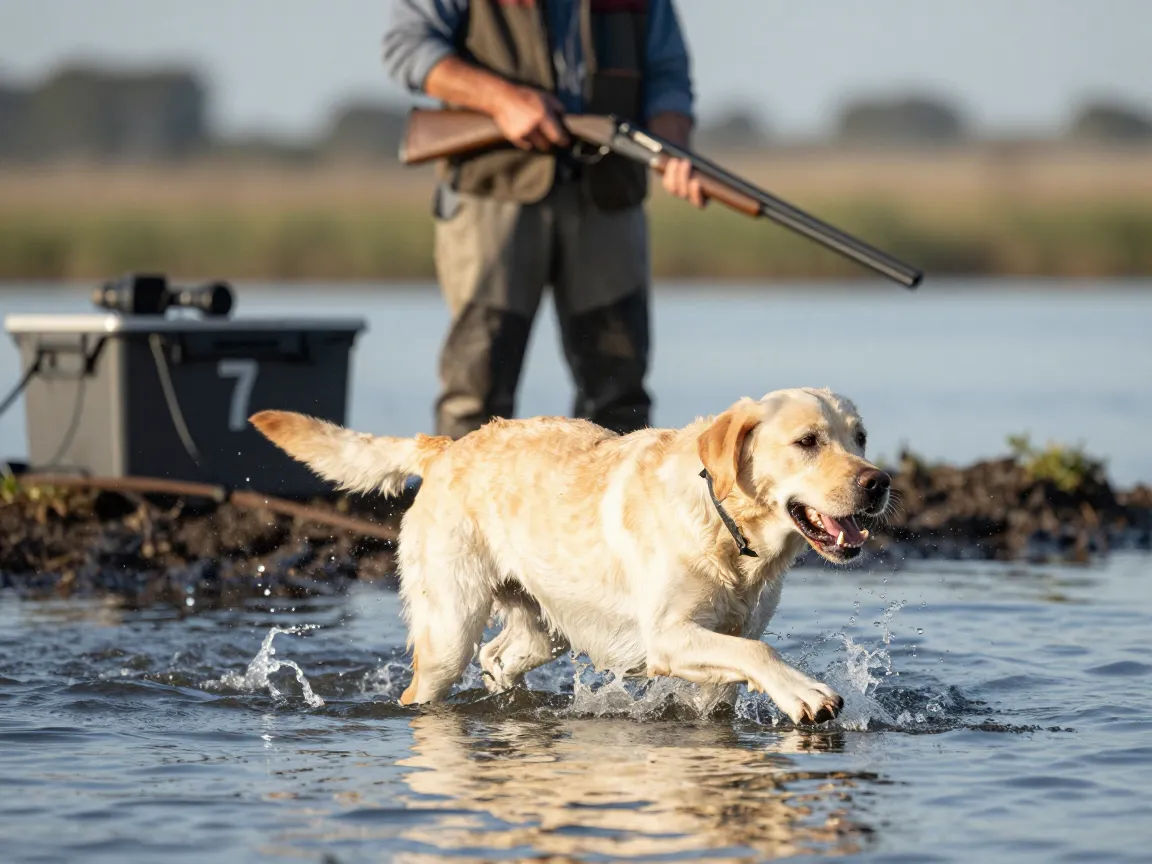
A Labrador hitting the water at full stride, mouth already open in anticipation of the bird, is one of the most dynamic images in all of hunting photography. Putting the senior hunter 15 to 20 yards behind the dog, partially out of focus but clearly identifiable, reframes the portrait around the relationship rather than the individual.
This matters for senior pictures specifically because it differentiates the image from every other outdoor portrait. The dog is not a prop. For most marsh hunters, the retriever is a hunting partner trained over two or three seasons. A photograph that communicates that relationship has a specificity that generic outdoor portraits lack entirely.
Technically, this requires a fast shutter speed of at least 1/1000s to freeze water spray and the dog’s movement. A telephoto lens in the 70-200mm range lets the photographer stay on the bank while the retrieve happens naturally in front of the blind or along a ditch edge. The senior should be positioned standing, shotgun broken and resting over a forearm, watching the retrieve. That posture is natural to any duck hunter and looks relaxed on camera.
One useful variation: shoot the same moment from behind the senior, so the frame shows his back and the dog returning toward him through the water. That composition keeps the focus on the dog’s motion while anchoring the portrait in the hunter’s perspective.
4. Gear and Decoy Flat-Lay With Truck or Boat Scene
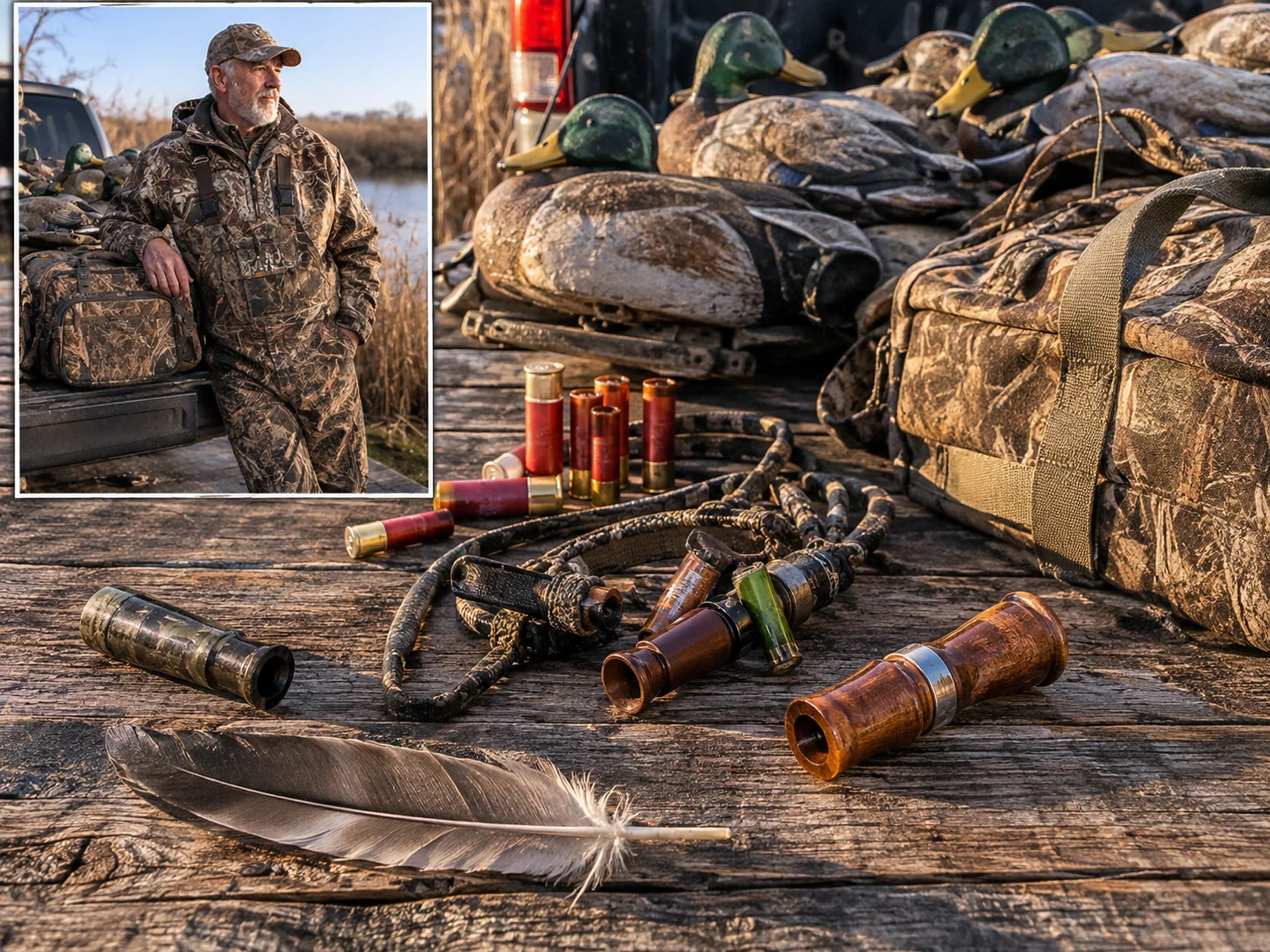
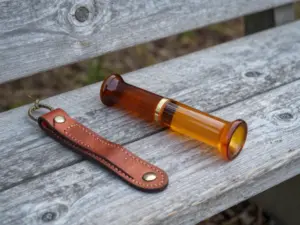
Duck hunters accumulate gear with a specificity that borders on ritual: the call that hangs around the neck, the particular brand of waders, shell loops worn smooth, decoys with paint touched up between seasons. A flat-lay photograph that arranges these objects on weathered dock boards or the tailgate of a truck captures an entire season’s worth of identity in a single frame.
This idea exists because senior portrait packages almost always include a vertical portrait for the yearbook, a large print for the wall, and smaller wallet-size prints for family. A flat-lay fills the wall-print format exceptionally well. It also gives parents a photograph that is not just of their son, but of the life he has built around the marsh, which many families find more moving than a traditional headshot.
The layout benefits from an intentional arrangement. Stack decoys in the background, keep the shotgun shells, calls, and license lanyard in the mid-ground, and place the duck call or a single primary feather in the foreground to draw the eye. Shoot from directly overhead at 50mm for a true flat-lay, or at a 45-degree angle to show depth. Natural morning light hitting the tailgate from the side will create the shadow texture that keeps the image from looking flat.
For the truck or boat scene, have the senior lean against the bed with gear staged around him rather than stacked unnaturally. Keep one hand resting on a decoy bag or sled. That casual posture matches what a hunter actually looks like after a morning of setup work.
5. Sunrise “Coffee and Call” Lifestyle Portrait in the Blind
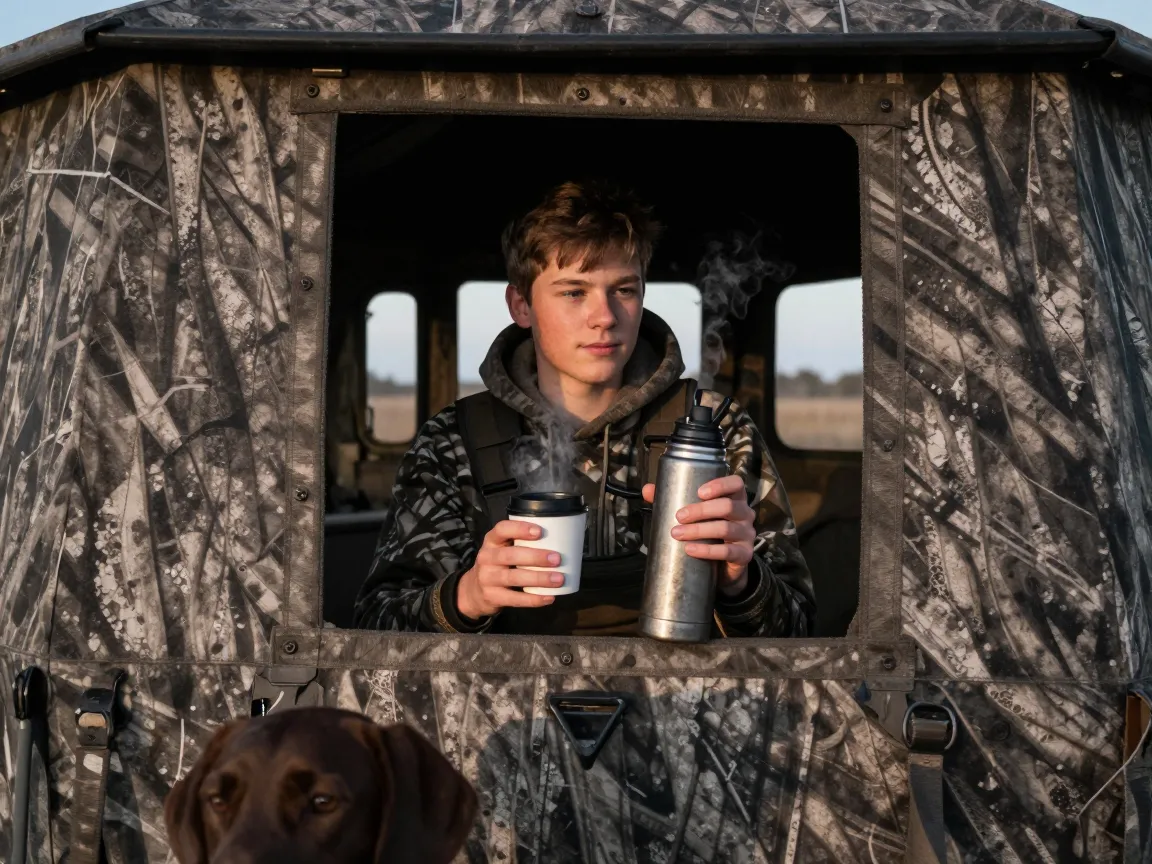
There is a specific hour on a slow morning in the blind, after the first flight has passed and before the next group works the decoys, when a duck hunter sits on a bucket, pours coffee from a battered thermos, and blows a few notes on a mallard call just to stay sharp. That moment is ordinary to anyone who hunts, and completely foreign to everyone who does not. That gap is what makes it a compelling senior portrait.
A lifestyle portrait inside the blind captures the subject in a context that most school portraits never get close to. The blind walls create natural framing. The light that filters through the gaps in the brush or the open face of the blind produces directional, moody illumination that photographers pay lighting designers to recreate indoors.
Shoot from outside the blind at blind-face level, positioning the subject slightly off-center, coffee in one hand and call in the other. The dog can be in the lower corner of the frame or just out of it. Expressions here should be relaxed and inward-looking, the kind of expression that belongs to someone who is exactly where he wants to be, which is the most honest thing a senior portrait can communicate.
For gear, a reflector opposite the open blind face will lift shadows on the subject’s face without introducing artificial light into the frame. Keep the ISO manageable for the available light; grain at ISO 1600 or above can work aesthetically in a marsh environment but should be intentional rather than a byproduct of underexposure.
This is also a strong candidate for a black-and-white conversion in post-processing. The textures of the blind, the steam rising from the cup, and the subject’s weathered camo layer print well in monochrome at a range of sizes.
6. Walk-Out Hero Shot With Strap of Ducks and Shotgun
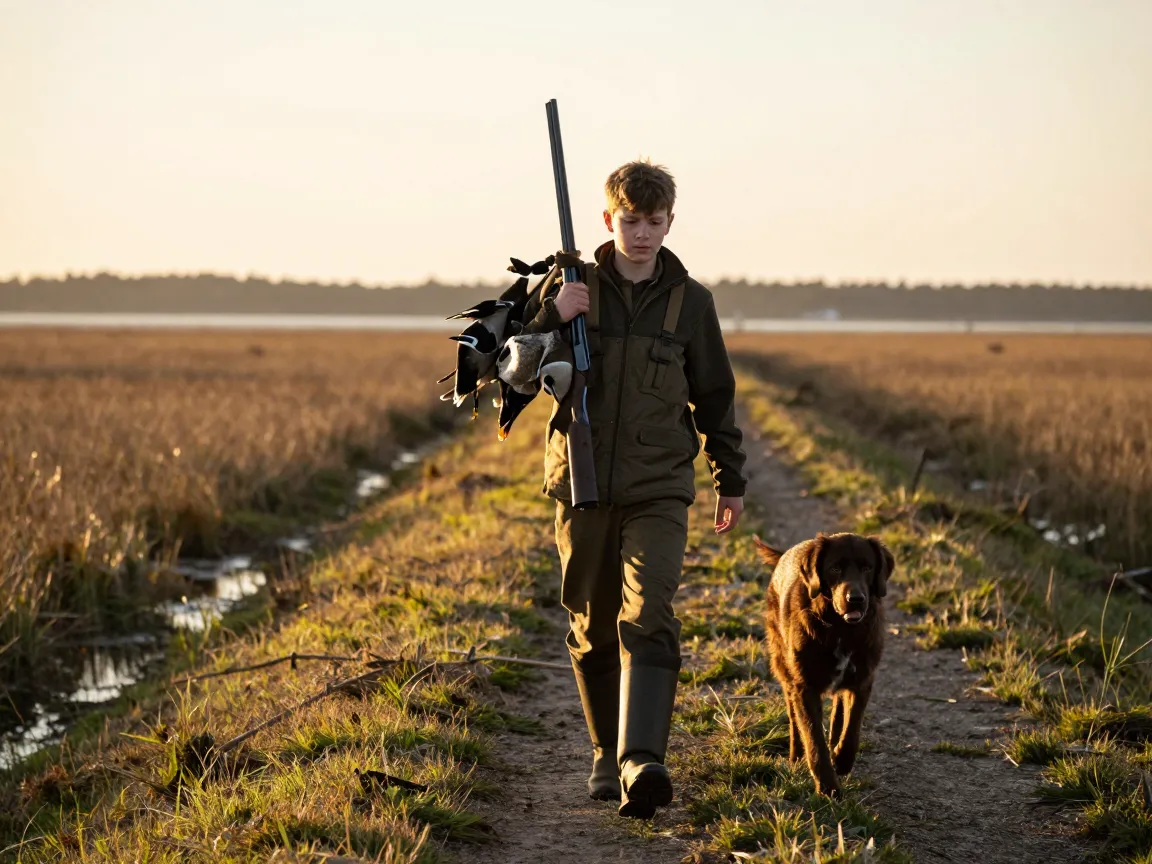
The most traditional waterfowl portrait is a hunter walking out of the marsh at the end of a successful morning, strap of ducks over one shoulder, shotgun carried safely at port arms or broken over the forearm, retriever at his side. Done with care for composition and ethics, it is also one of the most striking senior portrait formats available to a duck hunter.
The word “tastefully” comes up consistently in guidance around this type of image, and the standard is straightforward: birds should be carried naturally, not held up for display; the shotgun should be visually safe in its carry position; and the composition should emphasize the whole scene rather than the harvest. The resulting photograph is an honest document of the activity, not a trophy display, and that distinction matters both aesthetically and in terms of how the image reads to a broad audience.
Golden-hour light, the 20-minute window just after the sun clears the horizon, hits from a low angle and wraps around a subject walking toward the camera with a warmth that no other time of day replicates. Position the photographer low and slightly to the side of the subject’s path, shooting at f/2.8 or f/4 to separate the hunter from the marsh grass background. The dog walking at heel in this frame nearly always improves the composition, adding scale and narrative.
A secondary composition worth capturing in the same session: a close-up shot from behind the subject as he walks away from the camera, marsh grass on both sides of a dike path, light hitting the water in the distance. That version works as a yearbook quote page background or as a companion print to the face-on hero shot.
Before the session, confirm local regulations on transported harvested waterfowl and get written permission for the specific marsh location if it is not public land. These are not obstacles; they are professional standards that any reputable outdoor photographer already applies to their work.
Quick Comparison
| Idea | Best Light | Key Subject | Print Format |
|---|---|---|---|
| 1. Pre-Dawn Silhouette | Nautical twilight | Boy + dog + blind | Large wall print |
| 2. Wading Action Shot | Early morning | Boy in motion | Panoramic/wide |
| 3. Dog Retrieve | Early morning | Dog + hunter background | Square or standard |
| 4. Gear Flat-Lay | Overcast or side-lit morning | Equipment detail | Wall art or wallet |
| 5. Coffee and Call | Soft blind-filtered light | Lifestyle portrait | Standard + B&W |
| 6. Walk-Out Hero | Golden hour | Full figure exit | Standard portrait |
Conclusion
These 6 duck hunting senior pictures ideas for boys who live for the marsh share a common standard: they put the subject in the actual context of his life rather than approximating it with a rented prop or a Pinterest pose. Youth-focused waterfowl imagery is producing some of the most emotionally resonant content in outdoor photography in 2026, and senior portraits sit at the intersection of that trend and a family milestone that most people want to document well.
The most useful next step is to book the session during an actual hunting weekend rather than a separate day set up only for photography. The gear is already staged, the dog is already in working mode, and the subject is already moving through the marsh as he normally would. A photographer who can keep up with that pace and shoot opportunistically, rather than directing every frame, will walk away with images that no studio can replicate.