Deep Sea Fishing Photography: Capturing the Thrill of the Open Ocean
Shutterstock’s royalty-free library lists roughly 36,720 deep sea fishing photos as of mid-2026, yet the overwhelming majority show the same trophy hold at the dock. The best open-ocean fishing images look nothing like that. Deep Sea Fishing Photography: Capturing the Thrill of the Open Ocean is about one thing: freezing a moment that will not exist again in one second’s time, far from shore, on a moving platform, in salt air that fogs glass and corrodes metal. This guide covers the gear, angles, timing, and business reality that separate forgettable catch-and-smile frames from images that editorial directors and tournament sponsors actually use.
Disclosure: This post contains affiliate links. As an Amazon Associate, we earn from qualifying purchases, and at no extra cost to you.
Key Takeaways
- The highest-valued offshore fishing images capture motion and tension at the moment of the bite or the fight, not posed dock shots
- Cockpit-level, chase-boat, and aerial drone perspectives each produce distinct results and require different preparation
- Salt, spray, and constant boat movement demand specific waterproofing and stabilization choices before you leave the marina
- FAA Part 107-licensed drone operators now offer 4K aerial and hybrid photo-video packages as a standard part of serious tournament coverage
- Stock demand for deep-sea fishing imagery is large but split between pure action scenes and lifestyle or gear-focused close-ups, so knowing your market matters before you shoot
What the Best Offshore Fishing Images Actually Show
Robert Webb, an offshore sportfishing action specialist featured in Coastal Angler Magazine’s “Capturing Chaos” series throughout fall 2026, frames the core challenge this way: spray, overlapping lines, and a busy cockpit create visual disorder that most photographers try to minimize. Webb argues the opposite. Embracing that chaos, rather than waiting for it to settle, produces the frames that editors choose.
Marlin magazine’s 2026 Photo of the Year reinforces that position. Richard Rusak won the top award, with Zeb Taylor taking runner-up. The two images are stylistically different, which matters: Marlin’s judges recognized both a classic big-game perspective and a more experimental angle as top-tier work. The takeaway is that there is no single correct composition for deep sea fishing photography, but there is a consistent standard: the image has to convey what it felt like at that moment, not just what the fish looked like.
Stock libraries confirm this in commercial terms. The trending images in collections from Shutterstock and iStock are not static hold-ups. They are running shots of offshore boats bow-lifted at speed, rods poised at sunrise, and big-game fish like black marlin launching clear of the water near Cairns, Australia. Those are the frames that move.
1. Work the Cockpit Before You Touch the Camera
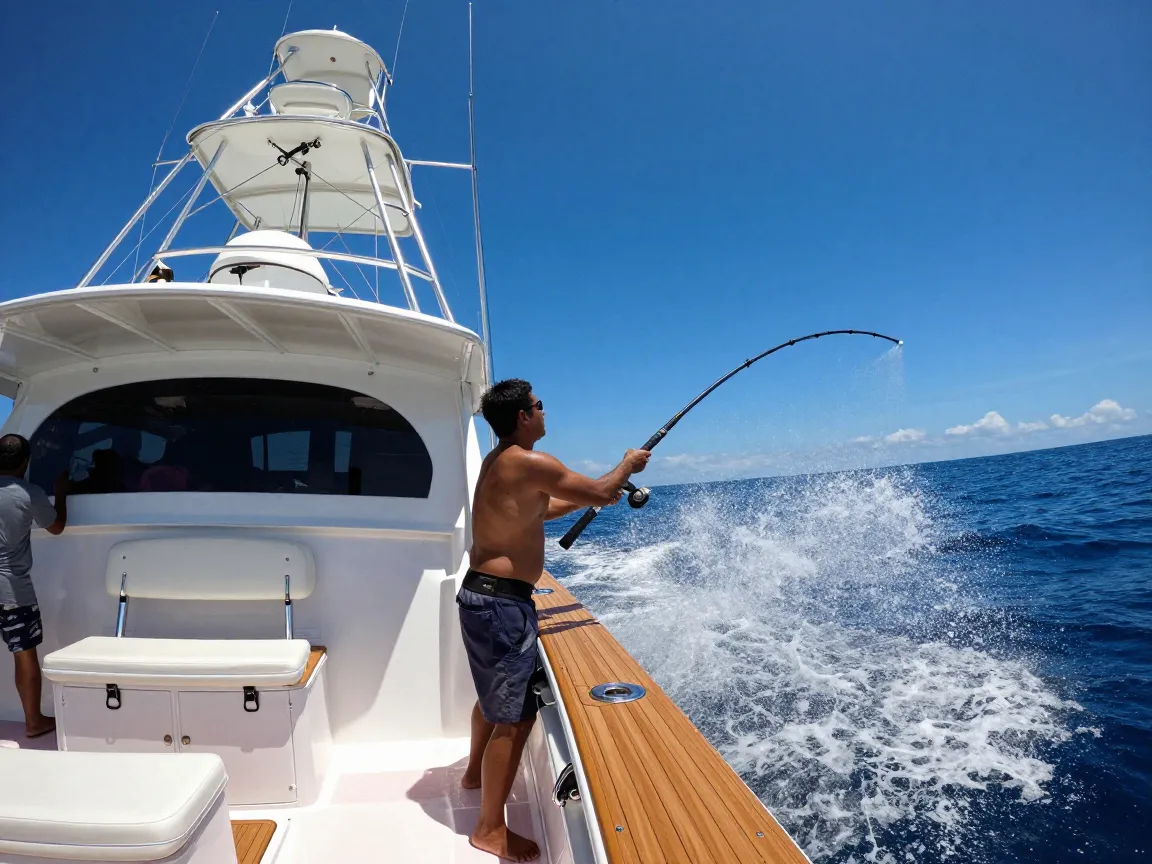
Every experienced offshore photographer who shoots from the boat itself will tell you: know the cockpit layout before the first fish comes to the boat. On a 40-foot sportfisher, the fighting chair, the outriggers, the tackle drawers, and the angler all occupy a space roughly the size of a large pickup bed. Add a mate working a gaff and a captain calling instructions from the bridge, and there is almost no room for a camera person who hasn’t planned where to stand.
Position matters for safety and for access to the best angles. Shooting from the covering board on the port or starboard side, low to the water, gives you an upward angle that puts the angler against sky and places the rod bend in the frame. Shooting from the ladder to the bridge gives elevation and context. Neither angle is better in absolute terms. The fish and the light determine which one to use on a given day.
AH360 Photography, a South Florida marine studio based in Pompano Beach, explicitly offers cockpit and chase-boat position coverage for the Hillsboro Inlet charter fleet, advertising their approach as capturing “the bite, the fight, and the release.” That three-part narrative structure is a useful editorial framework. The strike, the extended fight, and the release or weigh-in are three distinct chapters with distinct visual moods.
2. Understand What Aerial Drone Coverage Adds and What It Cannot Do
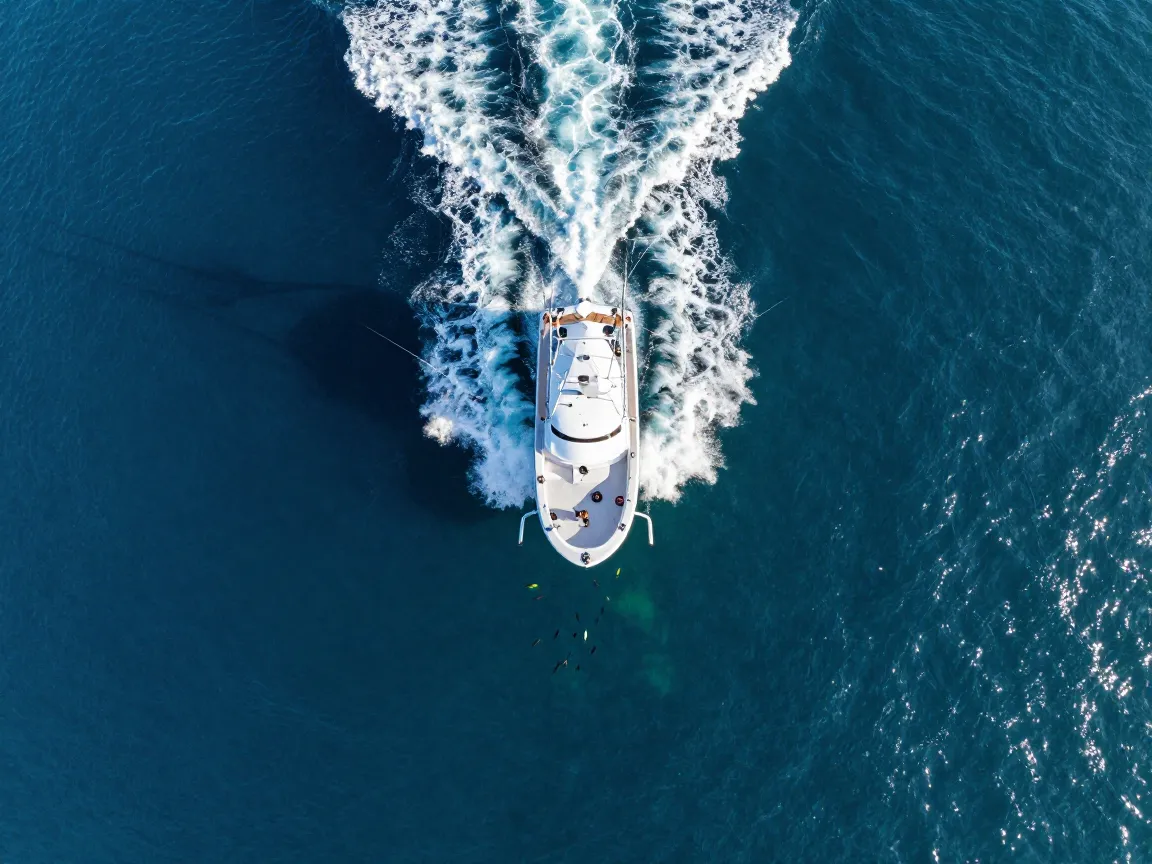
FAA Part 107 licensing is now standard language in serious marine photography portfolios. AH360 specifically promotes licensed drone operations for boats at sea and 4K aerial footage along the Pompano coast and Intracoastal waterways. The practical value of drone footage for offshore fishing coverage is genuine but limited by one physical reality: a drone working over open water at tournament speeds has a battery window of roughly 20 to 25 minutes per flight, and the boat is moving.
What aerial perspective does well is context. A top-down shot of a sportfishing boat working a temperature break or a color change in the water communicates something no cockpit image can: scale, isolation, and the boat’s relationship to the ocean itself. Drone stills of a bait school visible from altitude, with the boat positioned at the edge, produce editorial images that look like nothing else in deep-sea fishing photography.
What aerial perspective does poorly: the moment of the strike or the fight. The fish is below the surface, the action is on the deck, and the drone is 80 feet up. Use drone coverage for arrival sequences, running shots, and release moments that show the fish going back into the water from above. Use deck-level shooters for everything that happens during the fight.
3. Protect Your Equipment Before You Need To
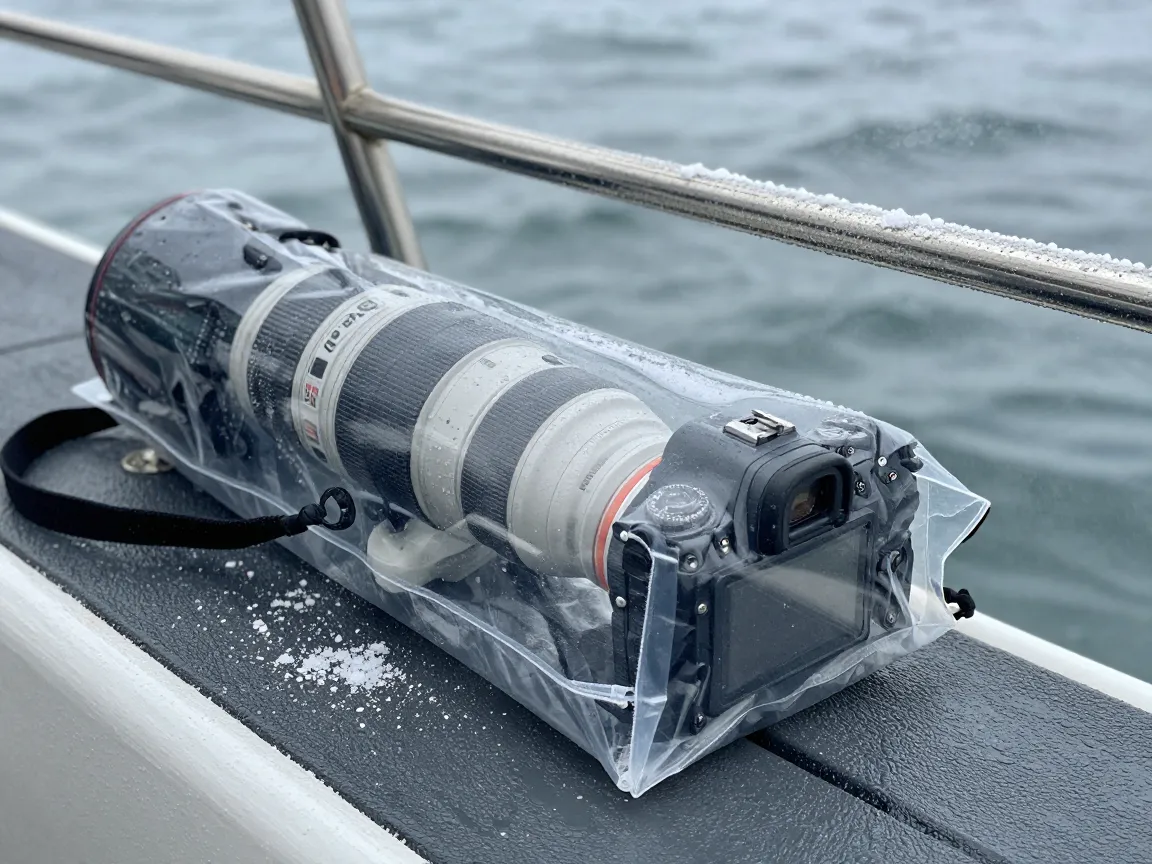
Salt is not like rain. A light spray on a camera that gets rinsed with fresh water and dried within an hour may cause no damage. The same spray that sits on a lens barrel while you are focused on a fish, dries in the sun, and gets rehydrated by the next wave will corrode metal contacts and cloud coatings within days. Offshore photography is a high-risk environment for camera gear, and the photographers who work it regularly treat waterproofing as non-negotiable.
Minimum protection for open-ocean work includes a housing rated to at least IP67 or a dedicated underwater housing for any camera used near the water. For cameras that stay on deck, a dry bag with a clear front panel works as an improvised solution between shots. Lens cloths that are damp with clean water, not dry, are better for wiping salt off front elements because dry cloths grind salt crystals across the coating.
Longer telephoto lenses, in the 300mm to 500mm range, let you stay far enough from the action to stay safe and still fill the frame with a jumping fish. The Sony 200-600mm f/5.6-6.3 G OSS and Canon’s 100-500mm L are both common choices among offshore action specialists because their optical stabilization compensates for boat movement during the shot. In rough conditions, shutter speeds below 1/1000s almost always produce blur from platform movement rather than subject motion.
4. Shoot the Story, Not Just the Fish
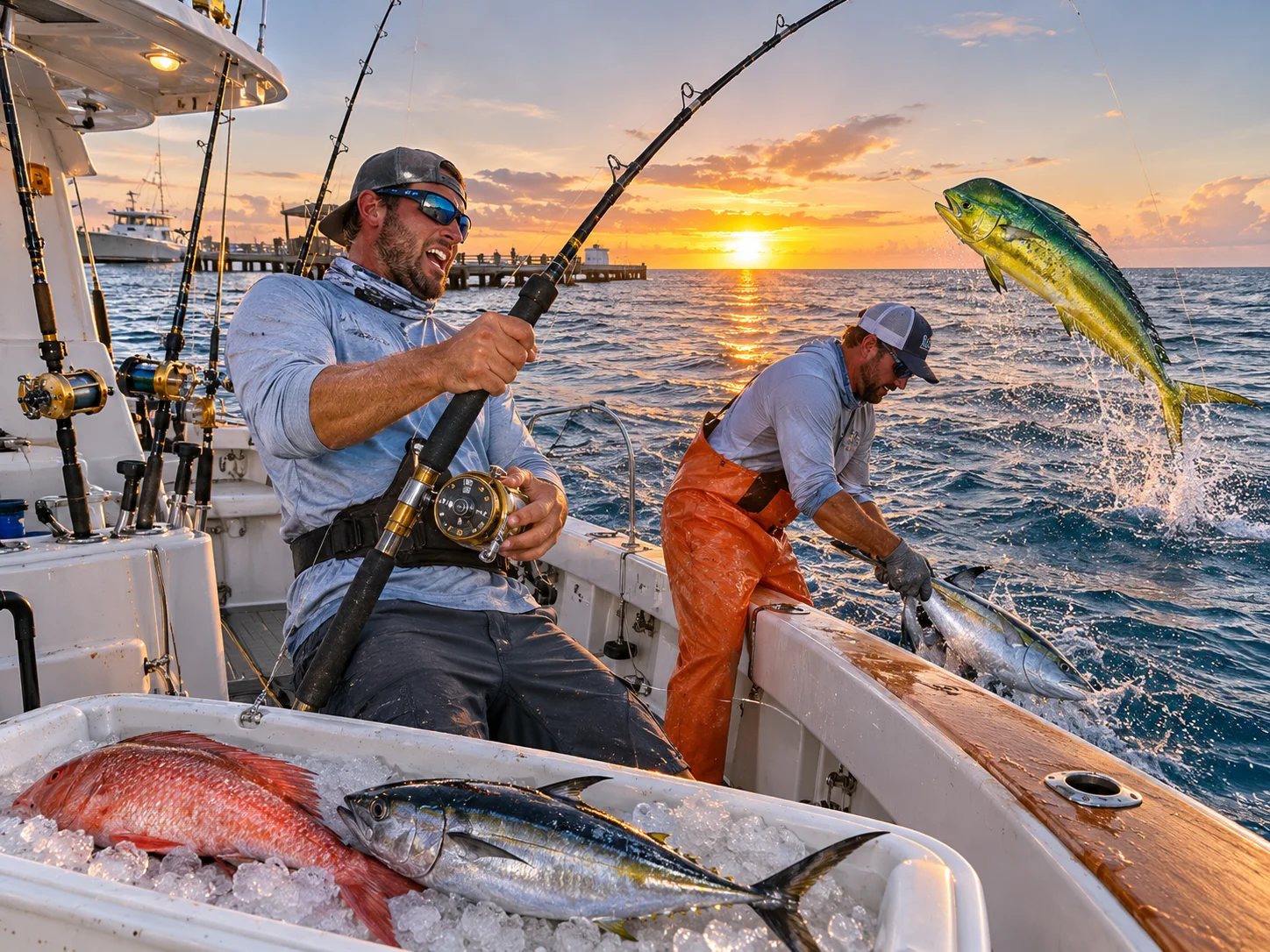
Texas Deep Sea Fishing Charters markets its catch gallery explicitly as a “personal deep sea photo gallery,” with captains helping guests photograph their catch during the trip and at the dock. The species list in that gallery covers red snapper, mahi-mahi, king mackerel, cobia, blacktip shark, swordfish, tuna, and tilefish. Each of those fish presents a different photographic challenge: a mahi-mahi in the air requires a fast shutter and anticipation; a swordfish at the gunwale in low light requires a different ISO strategy entirely.
The gallery framing matters beyond the single catch shot. AH360’s coverage model runs from pre-dawn departure through weigh-in, treating the full day as a visual narrative. That approach produces work with a different commercial and editorial value than a folder of fish portraits. The departure image, the working image of lines in the water at sunrise, the angler’s expression during the fight, the release, and the dock return together tell a story that a single hero frame cannot.
This matters commercially. Getty Images’ deep-sea fishing lure collection concentrates on close-ups of trolling lures, rods, and terminal tackle alongside lifestyle and angler portraits because tackle catalogues, travel brands, and editorial outlets all need images from different points in that story. Shooting the full narrative gives you a wider range of licensable images from a single trip.
5. Know the Lighting Windows and Work Around Weather
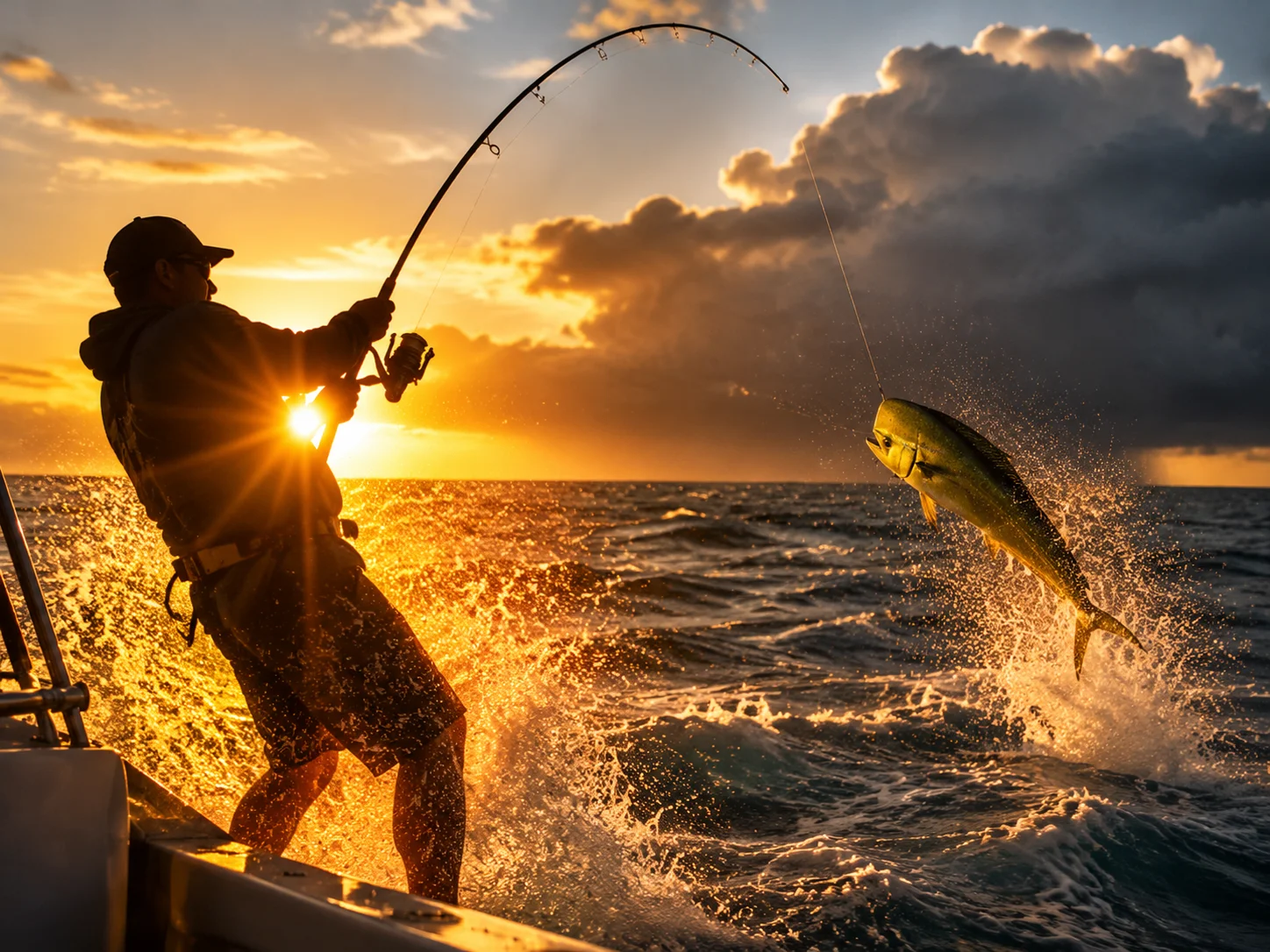
Offshore light behaves differently than nearshore or freshwater light. The absence of land to the horizon means that sunrises and sunsets produce longer, more saturated golden hours, but also that overcast days diffuse light across the entire dome of the sky rather than creating directional shadows. Both conditions are useful. Golden-hour backlight through salt spray creates the classic warm, dramatic offshore image. Overcast diffuses contrast and reveals fish color more accurately.
The practical constraint is that fish don’t schedule their bites around the light. A mahi-mahi eating a teaser at 11 AM in flat, overhead sun is still worth shooting. In that situation, position matters more than waiting: get the sun behind you or at a 45-degree angle to the subject, and expose for the fish rather than the sky.
Weather changes offshore faster than any forecast fully predicts, and changing weather produces the most dramatic backgrounds. Building storm cells behind a fighting angler, rain squalls on the horizon during a release, whitecapped seas under a clearing sky, all of these backgrounds separate offshore images from anything shot in a marina.
6. Understand the Commercial Market Before You License
The commercial market for Deep Sea Fishing Photography: Capturing the Thrill of the Open Ocean is larger and more segmented than it appears from the outside. Shutterstock’s roughly 36,720 deep-sea fishing images and iStock’s 2,100-plus collection represent the bulk of stock licensing demand. Getty’s niche concentration on lure close-ups alongside lifestyle images shows where editorial and catalogue clients actually spend their licensing budgets.
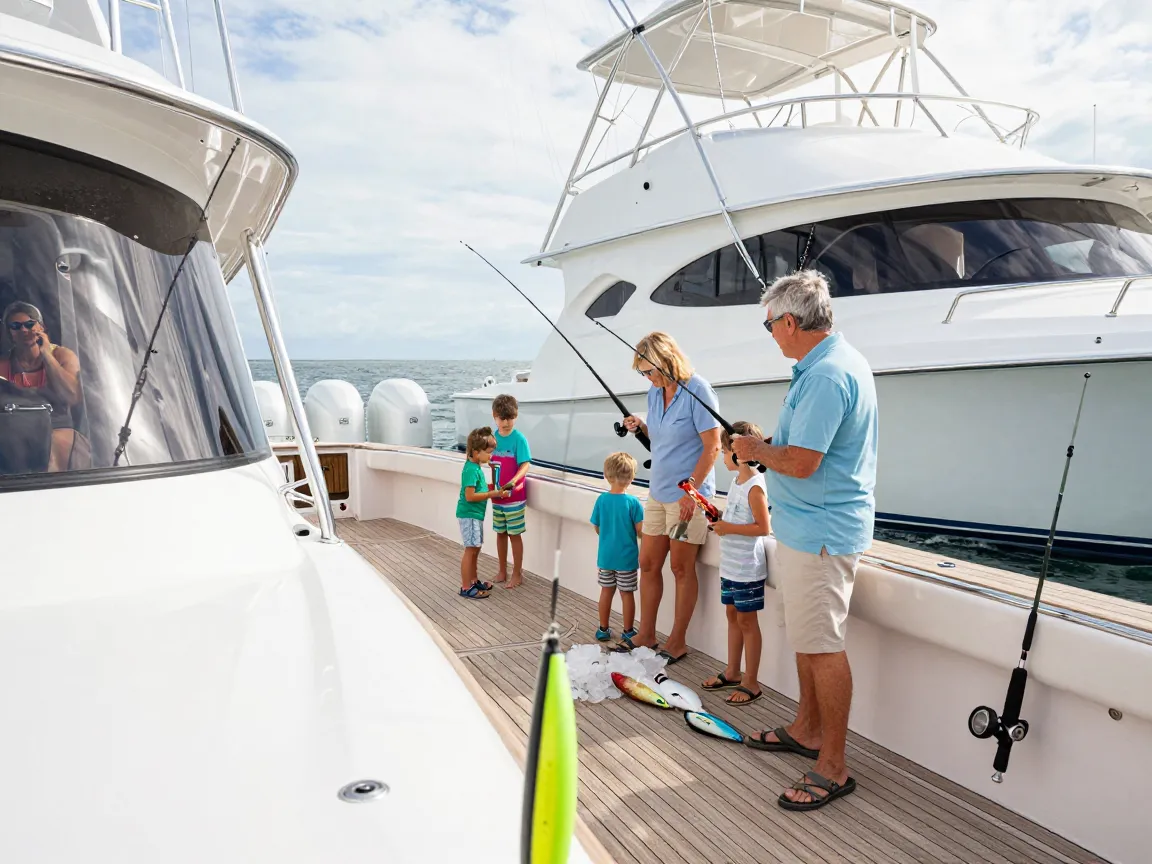
One visible trend across all major stock collections in 2026 is the shift away from purely tournament-centric, male-dominated imagery. Collections now prominently include women anglers, family groups with children, and multi-generational trips. That shift reflects what charter operators, travel brands, and fishing tourism marketers are actually buying. Shooting a full-day trip that includes multiple people, varied moments, and non-catch imagery gives you significantly more licensable variety than focusing exclusively on trophy fish.
AH360’s portfolio overlap between fishing photography and commercial yacht brokerage is worth noting. The studio’s brokerage imagery, which includes exterior running shots, interiors, and engine rooms, is credited in part for a United Yacht Sales transaction outcome, confirming that strong marine photography has measurable value beyond editorial use. Photographers who can deliver both action and brokerage-quality vessel imagery from a single charter day command higher day rates and more repeat work.
Conclusion
The standard for offshore fishing photography in 2026 is not the dock portrait. It’s the frame that makes a viewer feel the vibration in the deck and the weight of the rod. Getting there requires position planning before the lines go in, equipment protection before the spray hits, and an editorial mindset that treats the entire day as the subject rather than just the fish.
Three concrete next steps: First, plan your cockpit position with the captain and mate before departure. Know where you can stand safely during a fight without interfering with the crew. Second, if you’re covering a tournament or a charter that runs multiple trips, add a licensed drone operator to the team for at least one full-day shoot. The aerial perspective is not optional for competitive commercial work in 2026. Third, shoot the full narrative, from the pre-dawn lines to the weigh-in, and edit with stock and editorial buyers in mind. The market for deep-sea fishing imagery is large, but the highest-value work comes from photographers who understand what buyers actually need.