Smart Ways to Set Up a Fishing Gear Room in Your Home
Anglers in the United States spend an estimated $49 billion on fishing each year, yet most of that gear ends up tangled in garage corners, shoved into buckets, or scattered across closets. That’s not a storage problem. It’s a room-planning problem. The 6 smart ways to set up a fishing gear room in your home covered below treat the space as a system, not a dumping ground, and the difference shows up in how quickly you can walk out the door on a fishing morning.
Disclosure: This post contains affiliate links. As an Amazon Associate, we earn from qualifying purchases, and at no extra cost to you.
A well-designed gear room does two things: it cuts prep time before trips and extends the life of expensive reels, rods, and tackle by keeping them dry, organized, and off the floor. Neither goal requires a large budget or a dedicated room. A 10-foot wall in a garage or a half-converted spare closet can work if the layout follows a consistent logic.
1. Start with a Full Declutter Before Touching Any Shelving
No storage system improves a cluttered room. It just makes the clutter more permanent. The first step in any gear room project is pulling everything out, assessing what’s actually used, and cutting the inventory to what stays on the water.
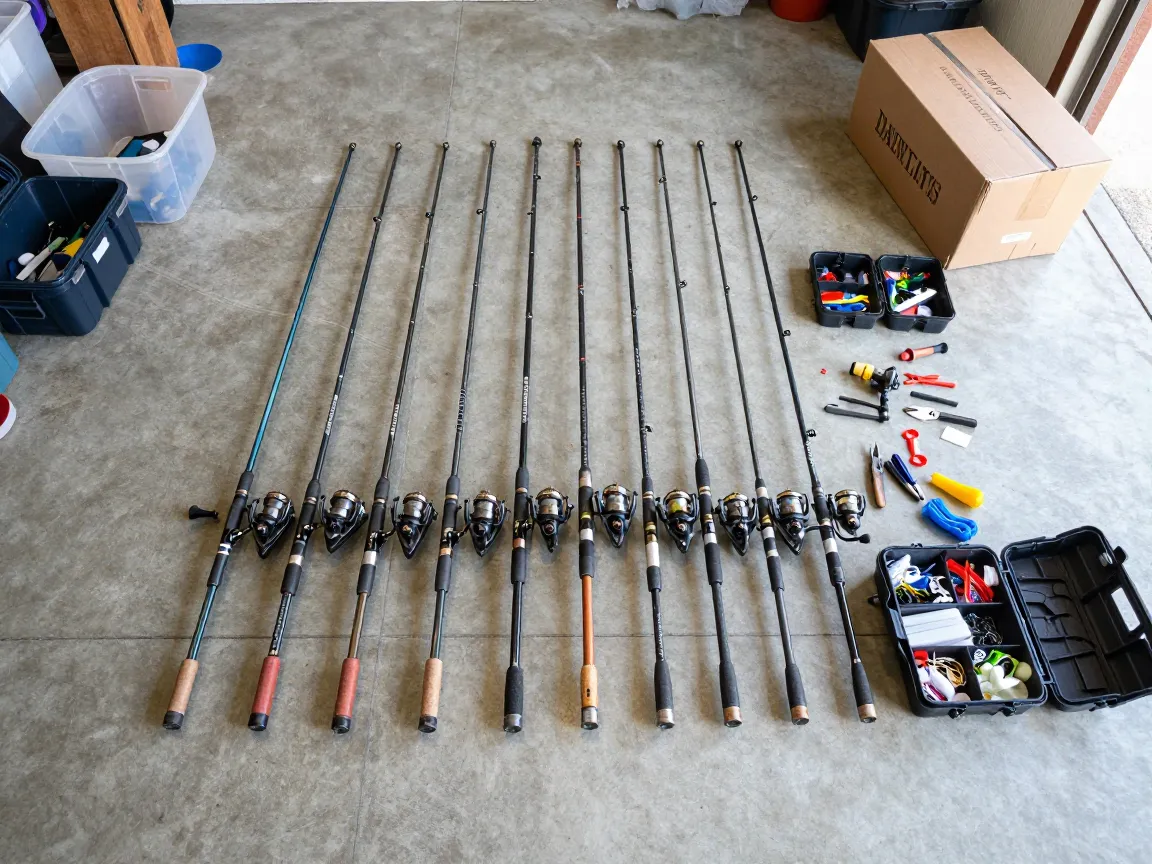
Bassmaster’s tackle-room guidance is direct on this: get every item off the floor and out of boxes before you design anything. Sorting on the floor forces honest decisions. A lure you haven’t tied on in three seasons is a candidate for donation or sale. A reel that needs service shouldn’t occupy prime shelf space, it needs a repair queue.
Once you’ve reduced the inventory, group items into broad categories: rods, reels, hard baits, soft plastics, terminal tackle, tools, and accessories. Those categories become the zones in the finished room. Skipping this step and buying shelving first is the most common mistake anglers make. The shelving ends up sized wrong, and the layout doesn’t match the actual gear collection.
A useful rule from BassResource: standardize your tackle boxes before you design shelving around them. If every hard-bait tray is the same footprint, the shelves that hold them can be uniform, and any box fits any slot. That interchangeability carries into your boat, your vehicle, and your room storage without repacking.
2. Build the Wall Around Pegboard and Modular Shelving
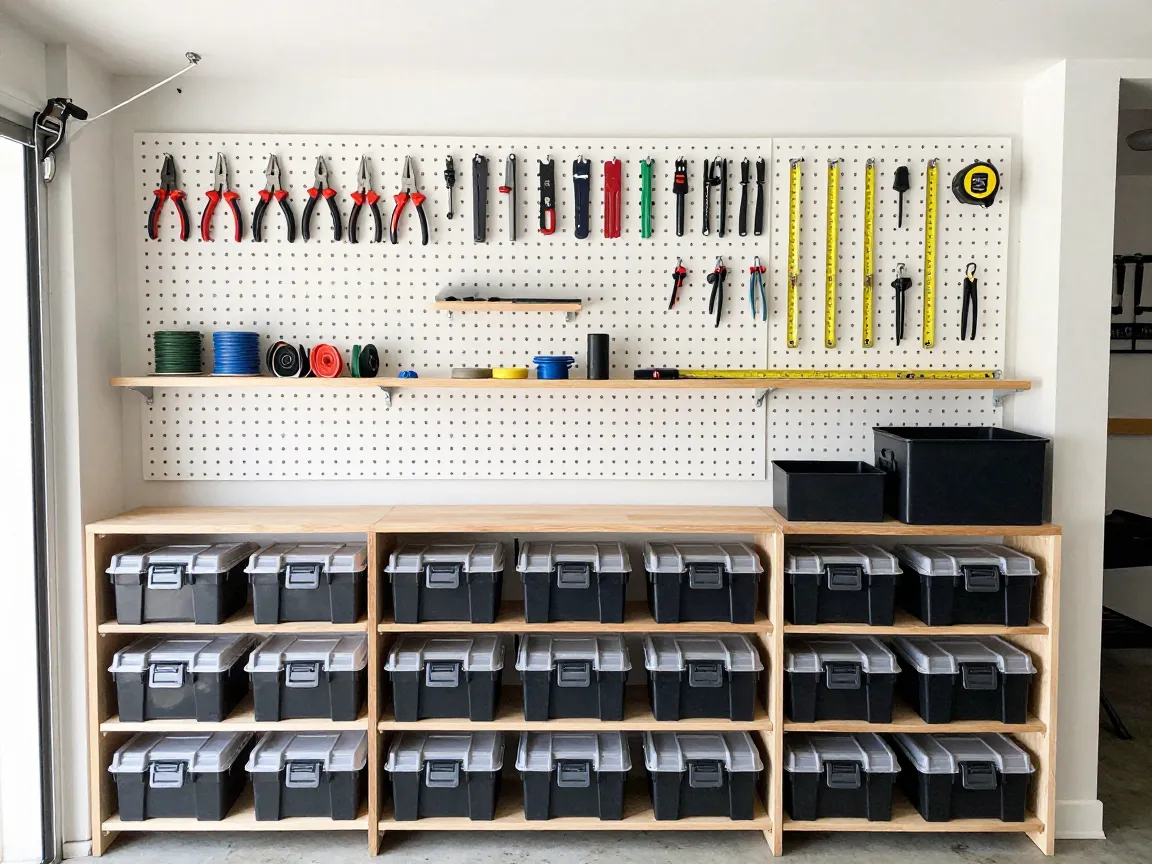
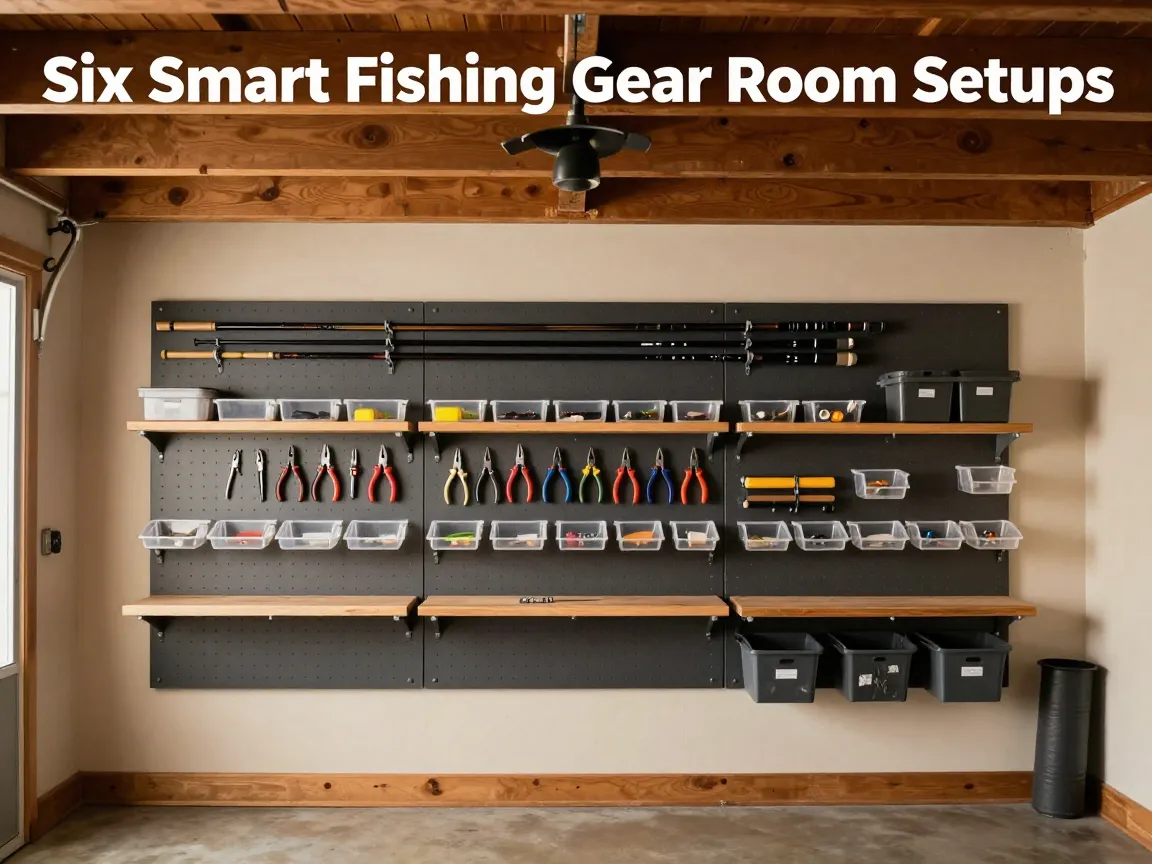
A blank wall is the most underused asset in a home gear room. Pegboard combined with open shelving turns it into the functional core of the space. The setup is inexpensive, fully adjustable, and forces everything into view, which is exactly how a working room should feel.
The goal is a layout that, in Bassmaster’s words, “looks like a store.” That framing is useful. Tackle shops organize by visibility and category, not by whatever fit in the bin last season. When you can see everything from the doorway, you stop buying duplicate lures and stop wasting time on pre-trip searches.
For shelving, choose one large and one small bin size that fit evenly on your shelf depth, then buy multiples of each. A hodgepodge of container shapes from different years of impulse purchases creates dead space and makes rearranging difficult. Modern tackle boxes like those with 17 movable dividers across a 13.75 x 8.5 inch footprint let you dial in compartment size per lure type while keeping the outer dimensions consistent across all your boxes.
Pegboard handles the items that don’t stack: pliers, line cutters, hook removers, lip grips, measuring tape. Hang them in the same spot every time, and you’ll stop pulling out drawers looking for tools you need in the first two minutes of a trip. Add short pegboard shelves for reels that aren’t in cases, and the wall becomes a complete prep station rather than decoration.
3. Use Ceiling and Overhead Space for Rod Storage
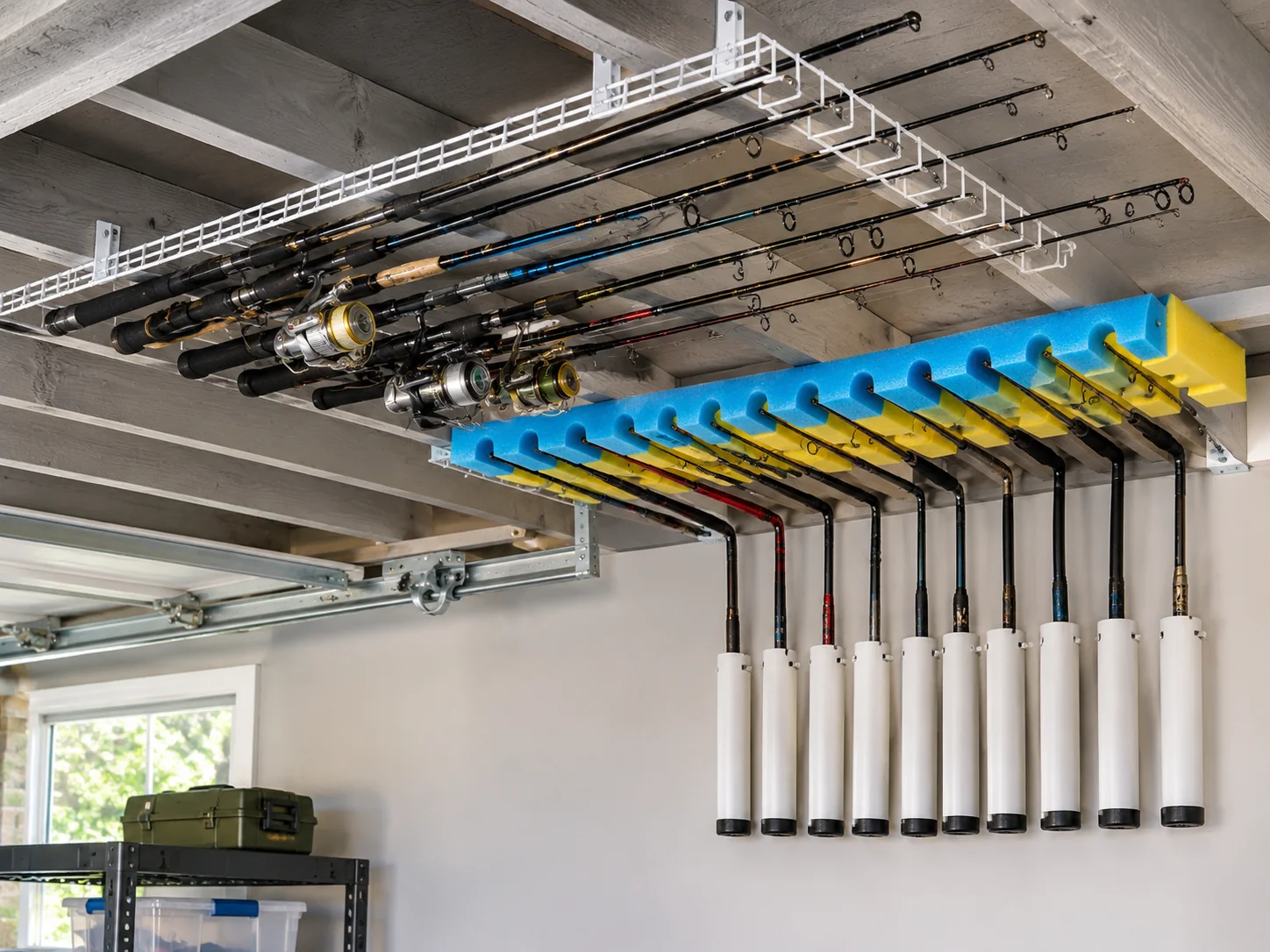
Rods are the hardest item to store well because they’re long, fragile at the tip, and awkward to lean against walls without bending or tangling. Ceiling-mounted storage solves all three problems and frees the wall area below for shelving that holds smaller items.
Family Handyman’s rod-storage guides describe two approaches that work well in a home gear room. The first uses short sections of wire shelving screwed directly to ceiling joists, creating a horizontal cradle system where rods rest out of the way above head height. The second is a DIY PVC and pool-noodle rack: a foam pool noodle is slotted and mounted to wall studs near the ceiling, rod tips rest in the slots, and the rod butts drop into sections of PVC pipe mounted below. The whole build costs under $20 in materials and holds a dozen rods without contact between them.
For anglers with more rods or who want a finished look, Bassmaster recommends ceiling-suspended shelving for rods stored in tubes, travel cases, or longer items you access only once or twice a season. That overhead zone handles the low-frequency gear so your eye-level and floor-level space stays clear for tackle you use every trip.
One caveat worth noting: horizontal rod storage is preferable to vertical for graphite rods stored long-term. Leaning rods upright in a corner under their own weight, especially if they rest against a wall at an angle, risks a slow bend at the blank over months. A ceiling rack removes that risk entirely.
4. Organize Tackle by Species, Weight, and Lure Type
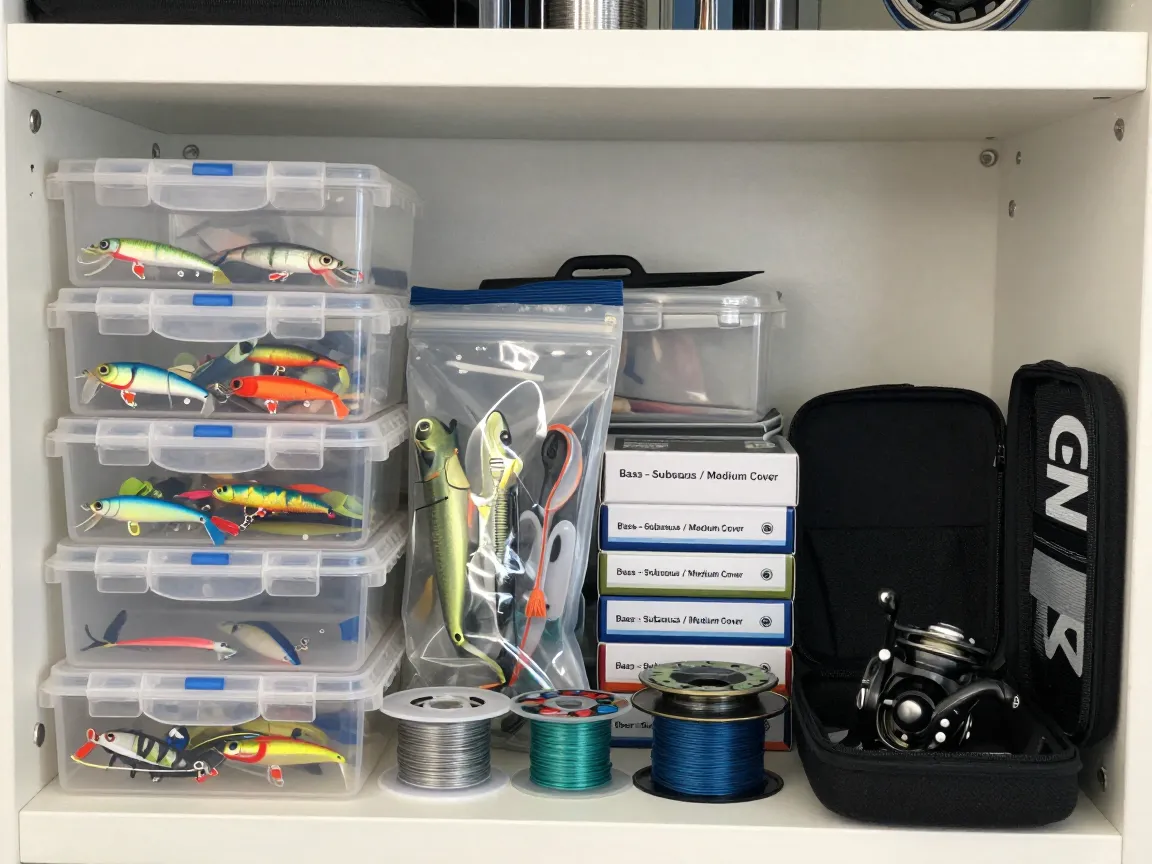
Random organization, where the most recent purchase lands on the nearest open shelf, looks fine in week one and becomes a time-wasting mess by week eight. A categorical system tied to how you actually fish is the difference between a room that functions and one that just stores.
Redfin’s 2026 home-organization guide recommends sorting containers by species, weight, and lure type, specifically to shorten preparation time. The logic is simple: when you know you’re fishing for bass on a lake with heavy cover, you should be able to pull the right box in under 30 seconds. That’s only possible if the label on the box matches the decision you made the night before the trip.
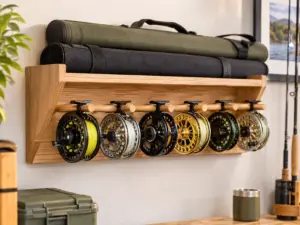
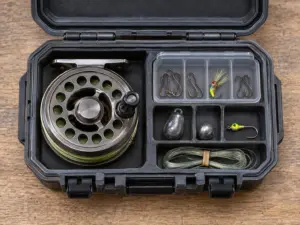
A practical two-tier system works well for most anglers. Transparent stacked boxes hold hard baits grouped by lure type: crankbaits in one, topwater in another, swimbaits in a third. Larger clear bags hold soft plastics, and because the bags are see-through, you don’t need to open them to confirm contents. Fly fishing gear earns its own section: fly boxes by pattern type or water, spare lines on labeled spools, and reels in soft cases stacked on a dedicated shelf.
The labeling convention matters more than the container brand. A label that reads “Bass – Subsurface / Medium Cover” tells you more in a 5 a.m. gear check than one that reads “Box 7.” Write labels that describe fishing situations, not abstract categories, and the room starts functioning like the organized pro shop that Bassmaster describes as the benchmark for a home tackle space.
5. Add a Modular, Portable Storage System for Trip Days
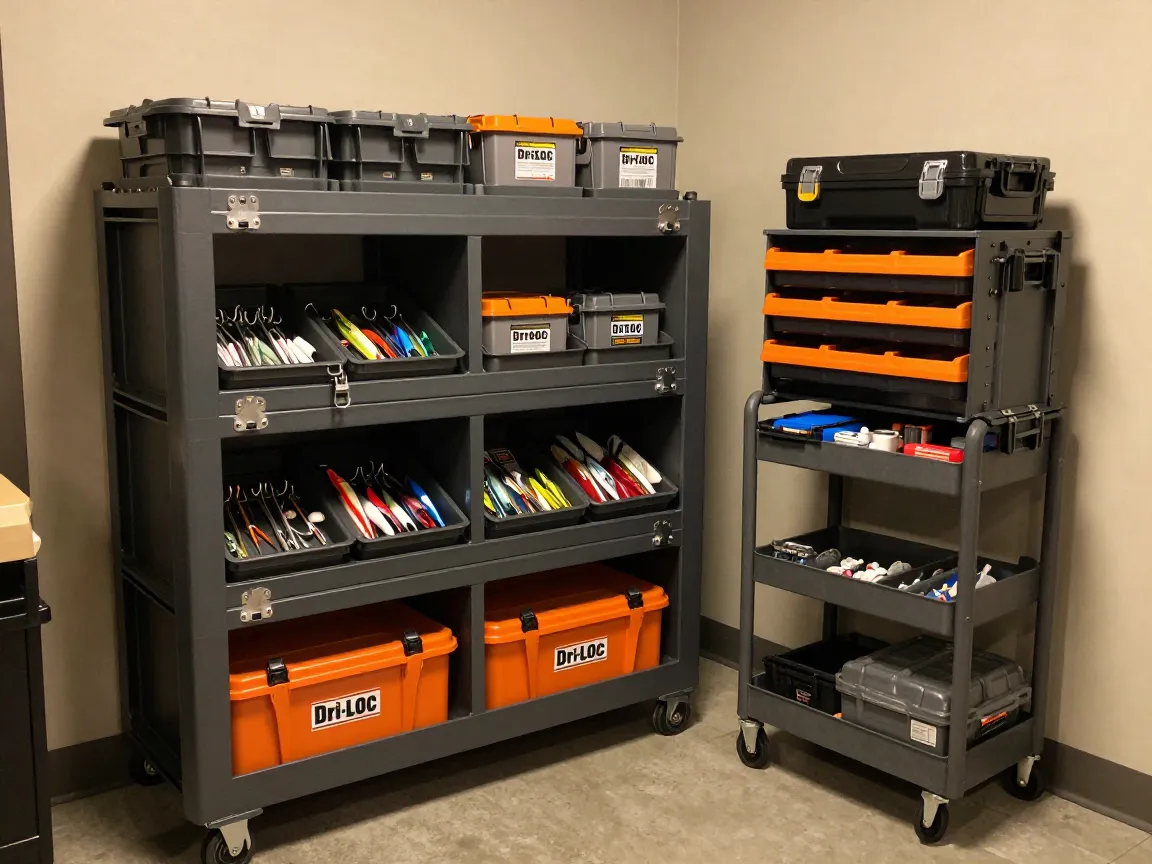
The gap between a home gear room and actual water time is a vehicle, a launch ramp, and a boat. A storage system that works only in your room but requires full repacking at the door doesn’t save time, it just shifts the chaos to your driveway at 5:30 a.m.
Plano’s GoNow modular system, launched in April 2026, is designed specifically to bridge that gap. The system combines adventure-ready boxes with accessories that clip together into a crate-style module, holding configurations like 3600 and 3700 stowaway trays, waterproof Dri-Loc boxes, and mixed hook, fly, and spin tackle storage. The larger box has an MSRP around $149.95. The module travels from gear room to vehicle to boat without repacking because the same container serves all three environments.
The Keter Stack-N-Roll, released in November 2026, takes a different approach suited to anglers who also carry tools, camping gear, or hunting supplies. It combines a rolling cart, toolbox, and small-parts organizer that lock together as a single vertical stack. In the gear room, it parks against a wall. On trip day, the whole column wheels out the door. That portability is the point: gear that moves as a unit doesn’t get left behind and doesn’t require the mental overhead of packing a list.
The practical rule is this: designate one section of your gear room as the “trip-ready zone.” Everything in that zone is already packed, clean, and ready to leave. Rolling and modular systems make that zone portable without additional effort.
6. Control Climate and Assign Overflow to an Outdoor Shed
The two things that ruin fishing gear fastest are moisture and temperature swings. A gear room that stays dry and reasonably stable in temperature extends the life of reels, braided lines, and soft plastics significantly. This isn’t a secondary concern, it determines the actual maintenance cost of the room over time.
October 2026 tackle-care guidance from gear-maintenance writers recommends keeping reels and tackle trays inside the house in a dry closet or basement shelf rather than in an uninsulated garage that cycles through temperature extremes. Reels should be dried thoroughly after each trip, stored with the drag backed off, and kept in soft cases or padded drawers when not in use. If the room runs damp, a basement scenario common in humid climates, placing desiccant packs inside closed tackle trays prevents corrosion on hooks and terminal tackle between trips.
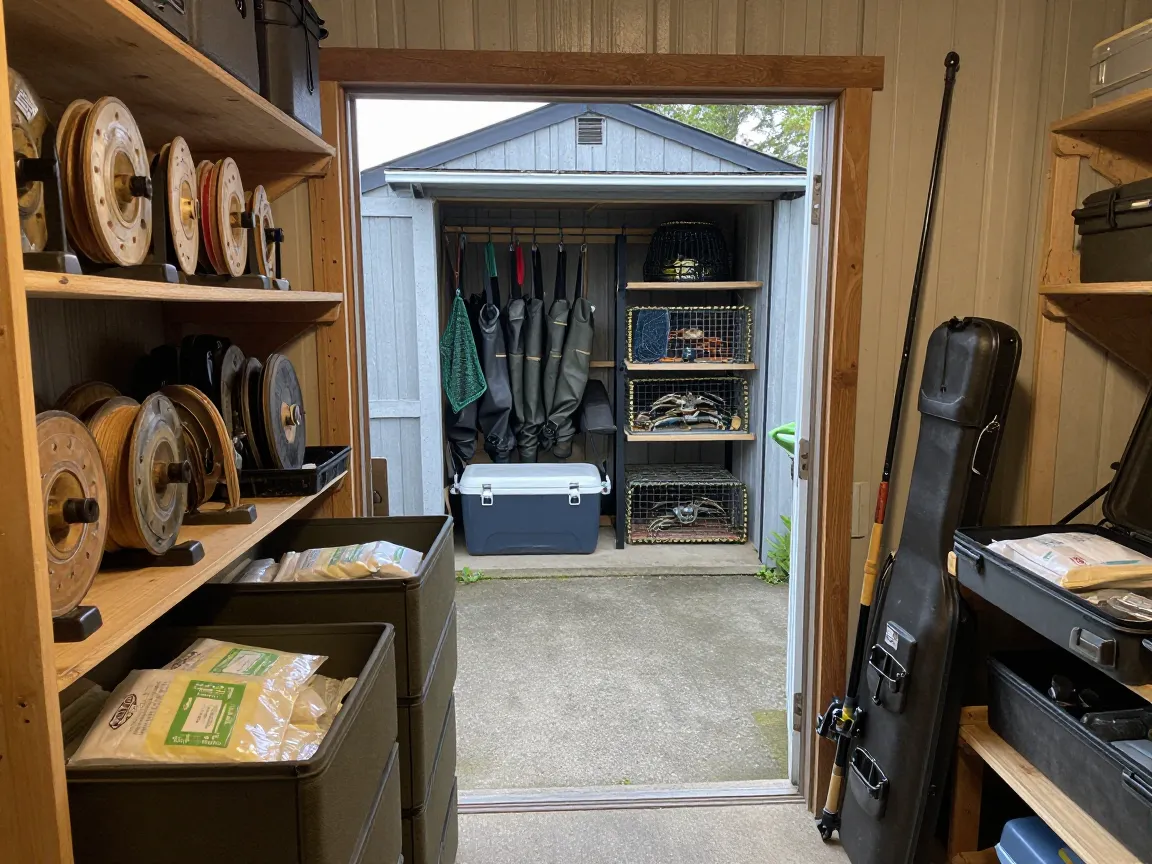
Bulky gear that doesn’t need climate control belongs outside the main room. Keter’s 2026 product line includes 9×7 ft and 15×7 ft outdoor sheds specifically marketed for fishing gear storage, with optional interior shelving kits for tackle boxes and rod racks. Waders, landing nets, coolers, crab traps, and large rod cases store well in a weather-resistant shed, freeing the indoor room for the gear that benefits from stable conditions.
This two-environment approach, indoor room for reels, electronics, and tackle; outdoor shed for bulky or weather-tolerant gear, is the most space-efficient layout for serious anglers with a full kit. It also keeps the indoor room tidy enough to actually work in, which matters when you’re rigging leaders or sorting fly boxes at a bench.
Conclusion
The core principle running through all 6 smart ways to set up a fishing gear room in your home is the same: design for how you actually fish, not for how the gear happened to accumulate. That means matching storage to gear type, keeping high-use items visible and accessible, protecting moisture-sensitive equipment, and building in portability for trip days.
If you’re starting from scratch, the most useful first move is spending an hour on the declutter before buying a single shelf bracket. What you remove from the room determines what the room actually needs to hold, and that decision shapes everything else.