Step-by-Step Fishing Boat Drawing Simple Tutorials for New Artists
Fewer than ten lines of pencil work separate a blank page from a recognizable fishing boat, and that gap is smaller than most beginners assume. Across 2026, free step-by-step boat drawing resources have multiplied dramatically, yet many new artists still feel overwhelmed by the sheer number of options. This guide cuts through the noise by curating the best 6 step-by-step fishing boat drawing simple tutorials for new artists, explaining what makes each one worth your time, what skills it builds, and exactly how to get the most out of it.
Disclosure: This post contains affiliate links. As an Amazon Associate, we earn from qualifying purchases, and at no extra cost to you.
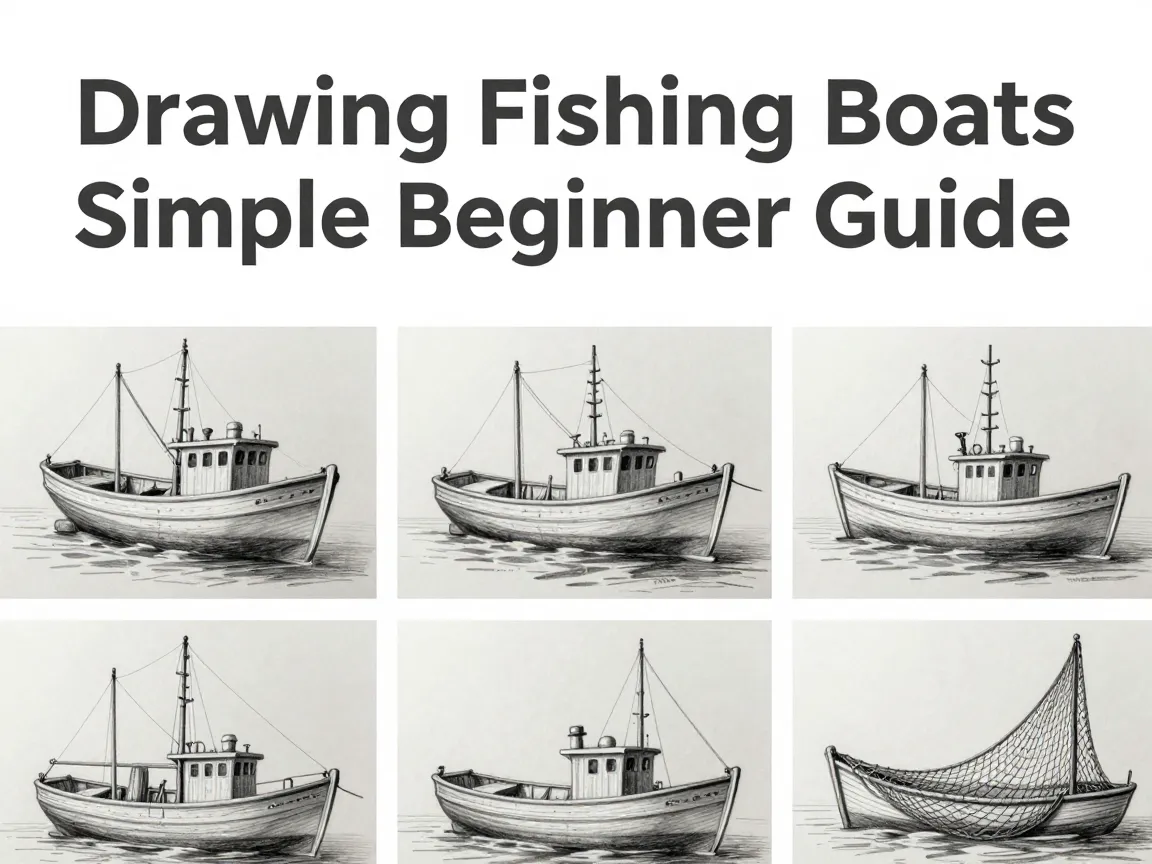
Whether the goal is a quick classroom activity, a personal sketchbook challenge, or a foundation for painting with acrylics or pastels, the six approaches below cover the full spectrum from ultra-simple cartoon style to structurally grounded design method. Each entry is treated as a standalone learning experience so readers can jump to the one that matches their current skill level and available time.
1. Monkeypen’s 21-Step Fishing Boat Breakdown
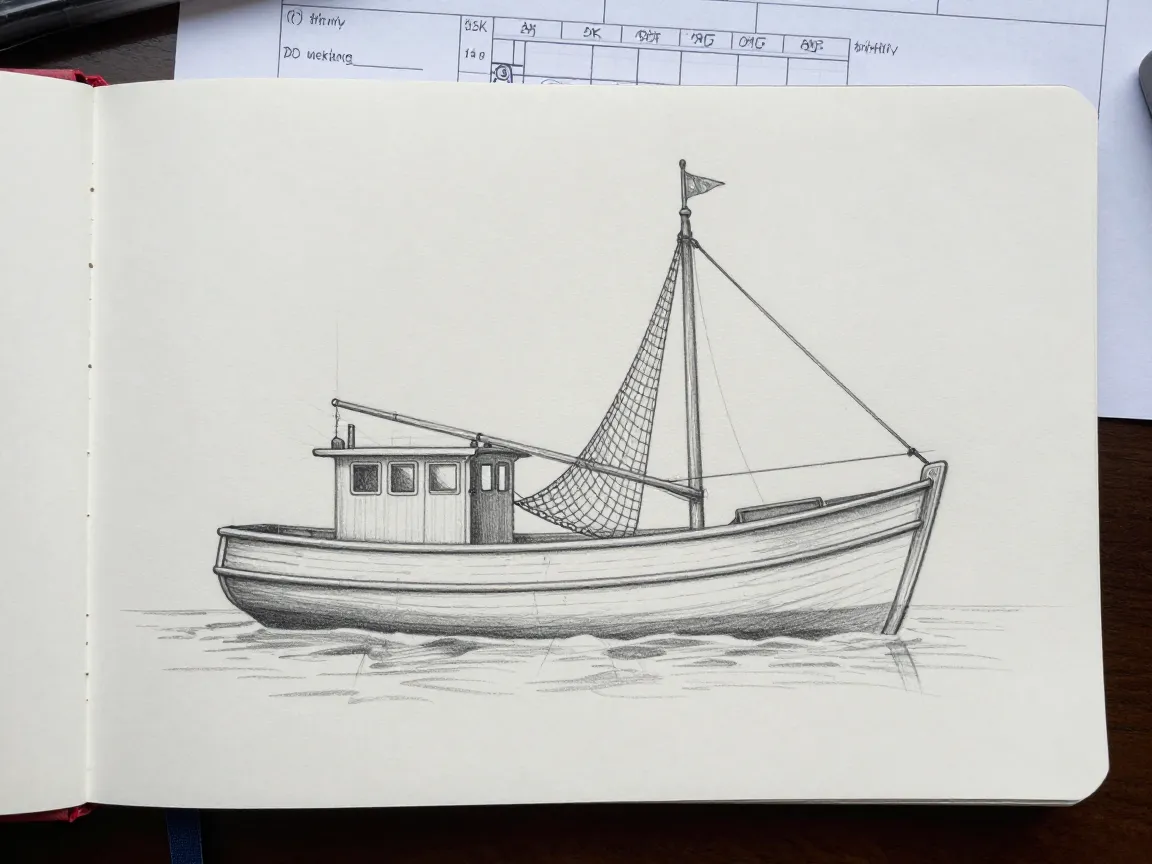
Monkeypen’s “How to Draw a Fishing Boat” tutorial is arguably the most thorough free fishing boat drawing resource available to beginners in 2026. Revised extensively in October of this year, it walks learners through 21 clearly numbered stages, beginning with a single gentle curve for the hull base and progressing all the way through nautical details such as nets, masts, ropes, planks, a flag, a hook, and surrounding water lines. Each step adds only one or two new elements, which prevents the drawing from ever feeling intimidating. The result is a finished vessel that looks impressively detailed despite being built entirely from curves, straight lines, and simple shapes.
What sets this tutorial apart is its dual audience. While it is framed as a resource for young artists and kids, the methodical 21-step structure actually serves adult beginners just as well. Breaking a complex subject into 21 digestible micro-tasks mirrors how professional illustrators approach a new subject: establish the base silhouette, build the structure, then layer in texture and narrative detail. Working through all 21 steps in order teaches patience and trains the eye to see a boat as a sequence of shapes rather than one intimidating whole.
A practical tip for getting maximum value from this tutorial: complete the drawing twice. On the first pass, follow each step strictly without skipping ahead. On the second pass, modify the proportions slightly, a taller mast, more water lines, a different flag design, to begin developing personal style. Free PDF worksheets accompany the online lesson, making it easy to print multiple copies for repeated practice without needing an internet connection each session.
2. Art Projects for Kids’ Nine-Step Seaside Scene
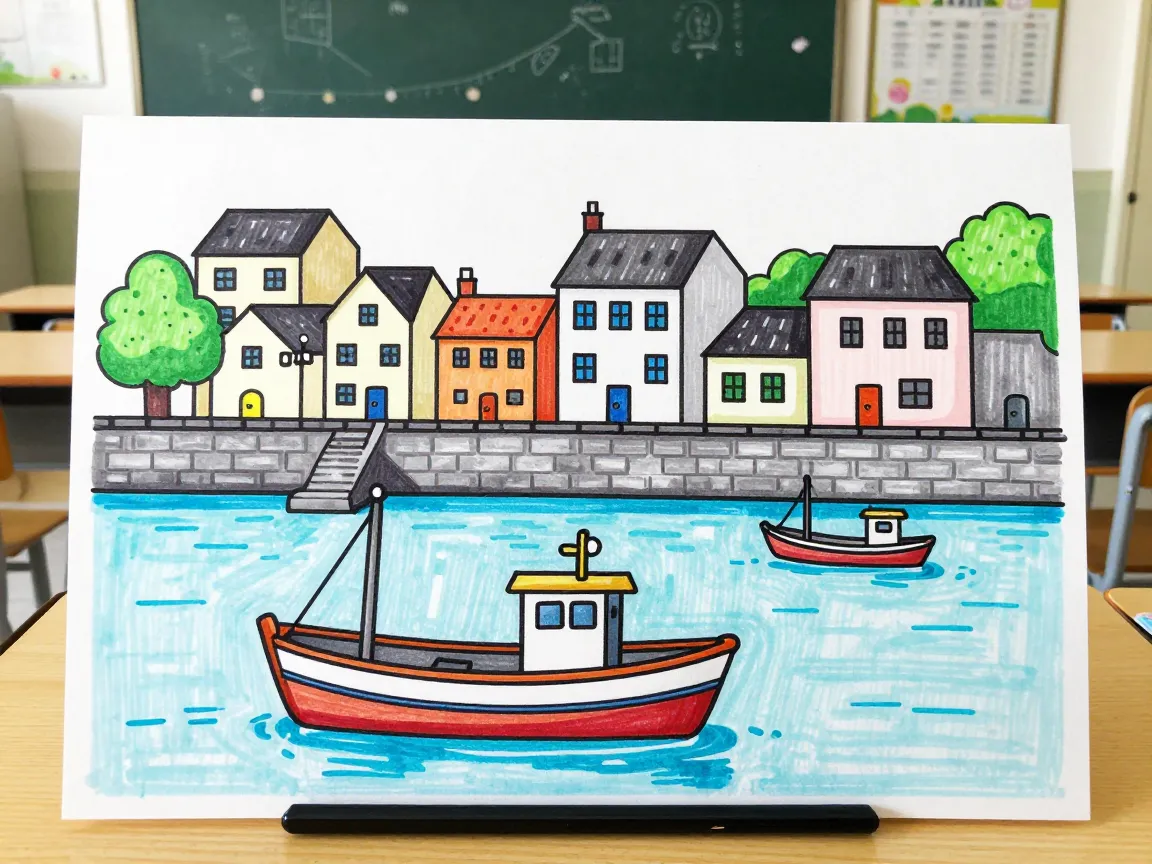
The Art Projects for Kids tutorial takes a refreshingly different angle by embedding the fishing boat inside a complete seaside town setting. Rather than drawing the vessel in isolation, learners build a waterfront backdrop first, a wall, a cluster of buildings, rooflines, doors, windows, and a chimney, before placing the fishing boat in the foreground with a smaller vessel visible in the background water. This contextual approach, refreshed in late 2026, is ideal for beginners who want to understand composition as well as boat construction from their very first drawing session.
Nine steps drive the entire sequence, making it faster than Monkeypen’s deeper breakdown while still covering the essentials. The tutorial also includes a coloring page and tracing guidance, which are especially useful for classroom environments where teachers need an activity that accommodates different ability levels. Students who struggle with freehand lines can trace first to build confidence, then attempt the same drawing independently on a fresh sheet.
The key learning insight from this tutorial is proportion and scale. Because the boat sits in front of a town, beginners must think about how large the vessel should be relative to the buildings. Getting that relationship right, even approximately, produces a drawing that immediately reads as a believable coastal scene. That spatial thinking skill transfers directly to any other drawing subject where foreground and background elements coexist.
3. HelloArtsy’s Nine-Stage Hull-and-Porthole Method
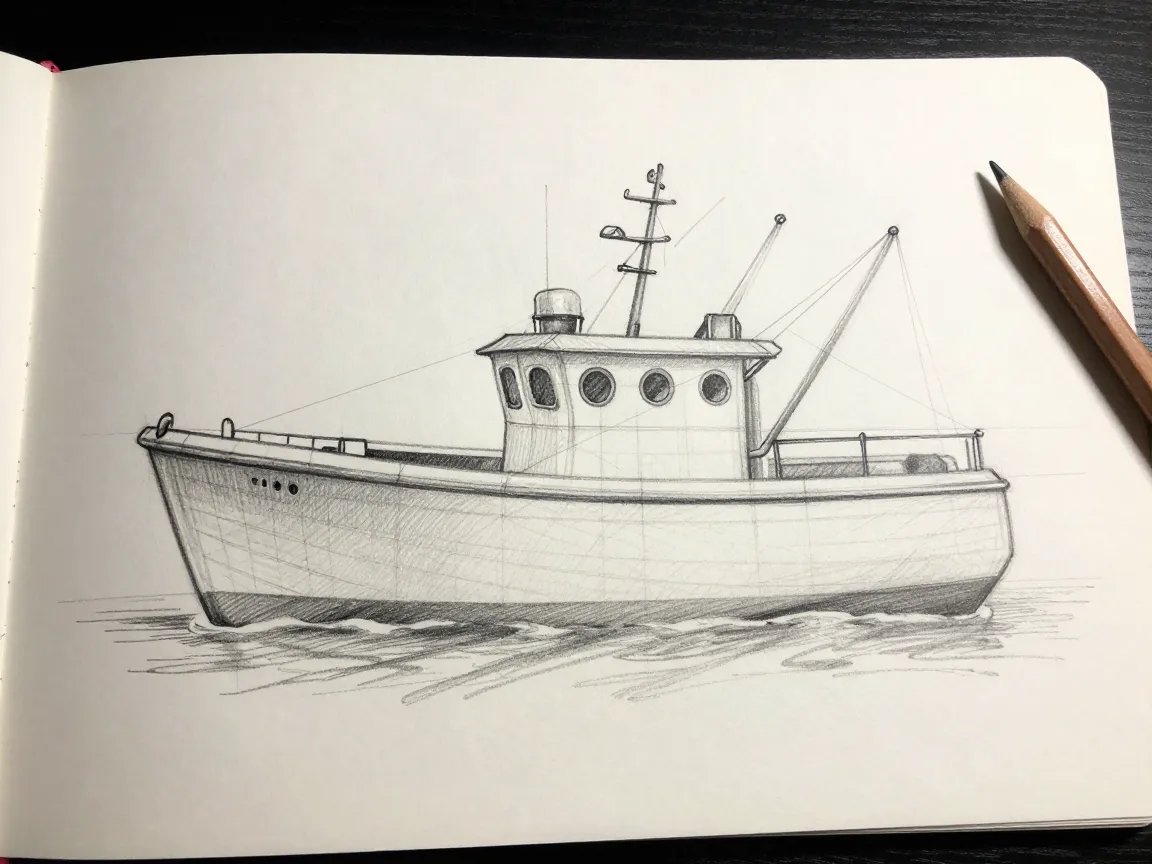
HelloArtsy’s tutorial is pitched at slightly older beginners, late-primary students, teenagers, and adults who want a bit more structural rigor without yet committing to a full design course. Its nine sequential stages focus closely on four elements that define a recognizable fishing vessel: the hull outline, the cabin, evenly spaced portholes, and the fishing net structure. The surrounding water is added last, grounding the finished drawing with minimal effort.
The porthole spacing exercise is particularly valuable for new artists. Beginners tend to place repeated elements unevenly, which immediately makes a drawing look unpolished. HelloArtsy guides learners to divide the hull side into equal segments before committing porthole positions to ink, a habit that improves drafting accuracy across all subjects, not only boats. It is a small technique with an outsized payoff.
This tutorial, last updated in late 2025, sits at the more detailed end of the approachable beginner range. The net structure in particular requires careful attention to intersecting diagonal lines. That challenge is worth embracing rather than skipping, because controlling diagonal line weight and spacing is one of the fastest ways to improve overall drawing quality. If the net feels difficult on the first attempt, draw just the net on a scrap piece of paper until the hand movement feels natural, then return to the full boat drawing.
4. HowToDrawForKids’ Mast, Wheelhouse, and Lifebuoy Tutorial
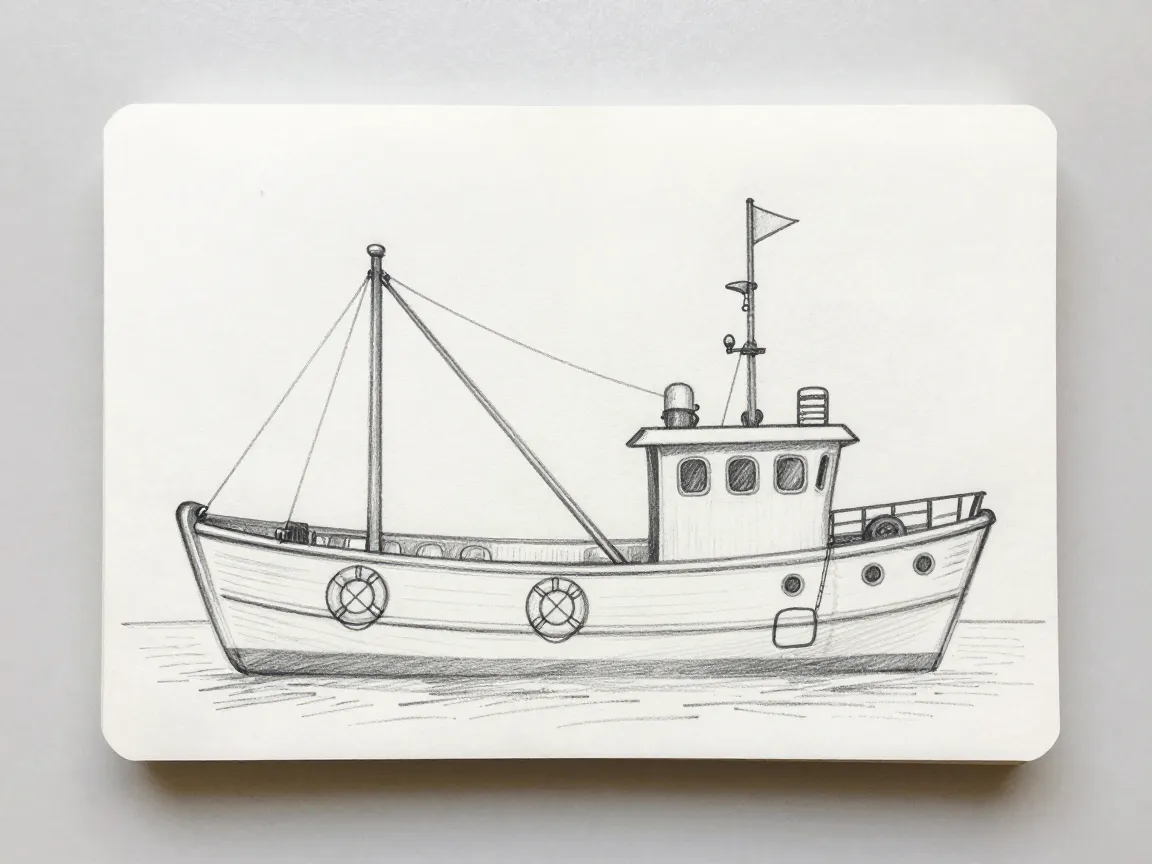
HowToDrawForKids offers a beginner-friendly approach that prioritizes nautical character over architectural detail. This tutorial emphasizes five defining elements of a working fishing boat: the hull, a tall mast with flag, a wheelhouse (the room where the captain steers), circular portholes, and lifebuoys marked with transverse lines. Learners use a mix of straight and curved lines throughout, which makes this an excellent exercise for developing line control across two fundamentally different stroke types in a single session.
The lifebuoy steps deserve special mention. Drawing a convincing circle freehand is one of the most common early frustrations for new artists, and the lifebuoy offers a forgiving, low-stakes context in which to practice it. The circle does not need to be mathematically perfect to read as a lifebuoy; a slightly irregular ring actually adds charm to a hand-drawn illustration. The transverse lines that cross the ring reinforce the concept of drawing through a form, a technique used constantly in figure drawing and industrial design sketching.
One smart way to extend this tutorial is to draw the finished boat from a slightly different viewpoint, a mild three-quarter angle instead of a flat side profile. The original lesson uses a pure side view, which is the easiest starting point, but attempting a subtle perspective shift afterward forces a beginner to think about which parts of the boat would be visible from a different angle. That conceptual leap, even if the result is imperfect, marks the transition from copying to understanding.
5. EmilyDrawing’s Cartoon-Style Boat for Confidence Building
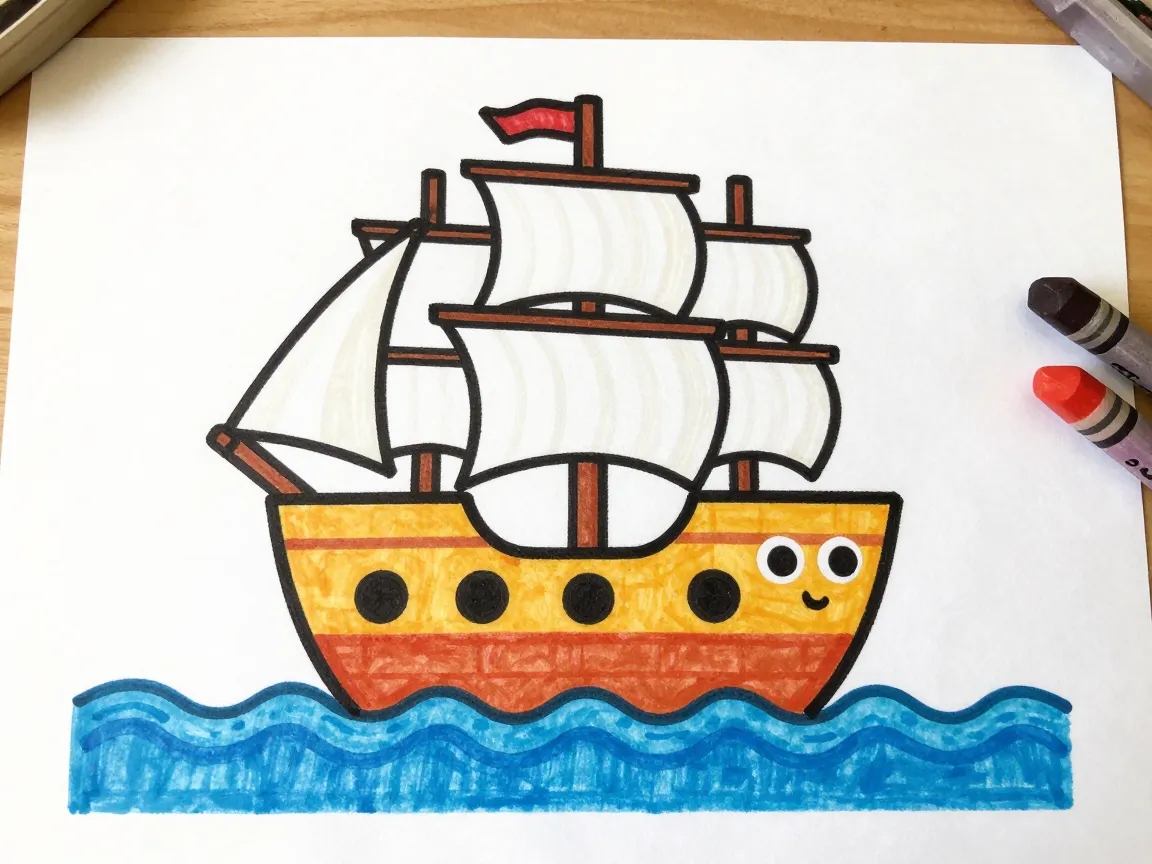
Before tackling a fully detailed fishing vessel, some beginners benefit enormously from a single session with a simplified, stylized boat that removes technical pressure entirely. EmilyDrawing’s March 2026 “How to Draw a Boat” tutorial is exactly that resource. It guides learners through a playful cartoon vessel featuring a mast, multiple sails, portholes, an expressive “face” on the bow, and scalloped cartoon waves, none of which require precise measurement or structural knowledge.
The face on the bow is intentionally whimsical, and that is the point. When a drawing has an expressive character, beginners tend to feel emotionally invested in finishing it rather than abandoning it at the first difficult step. That sense of investment and completion is psychologically important early in a drawing practice. Finishing drawings consistently, even very simple ones, builds the habit of perseverance that more challenging tutorials will eventually demand.
This tutorial functions best as a warm-up or first session before progressing to any of the more nautically accurate approaches in this list. Artists who complete the EmilyDrawing cartoon boat first typically approach the hull curves and mast placements in later tutorials with noticeably more confidence, because the shapes are no longer entirely unfamiliar. Think of it as a rehearsal that lowers the activation energy for every subsequent fishing boat drawing attempt.
6. Skyrye Design’s Hull-Shape Method for Structural Understanding
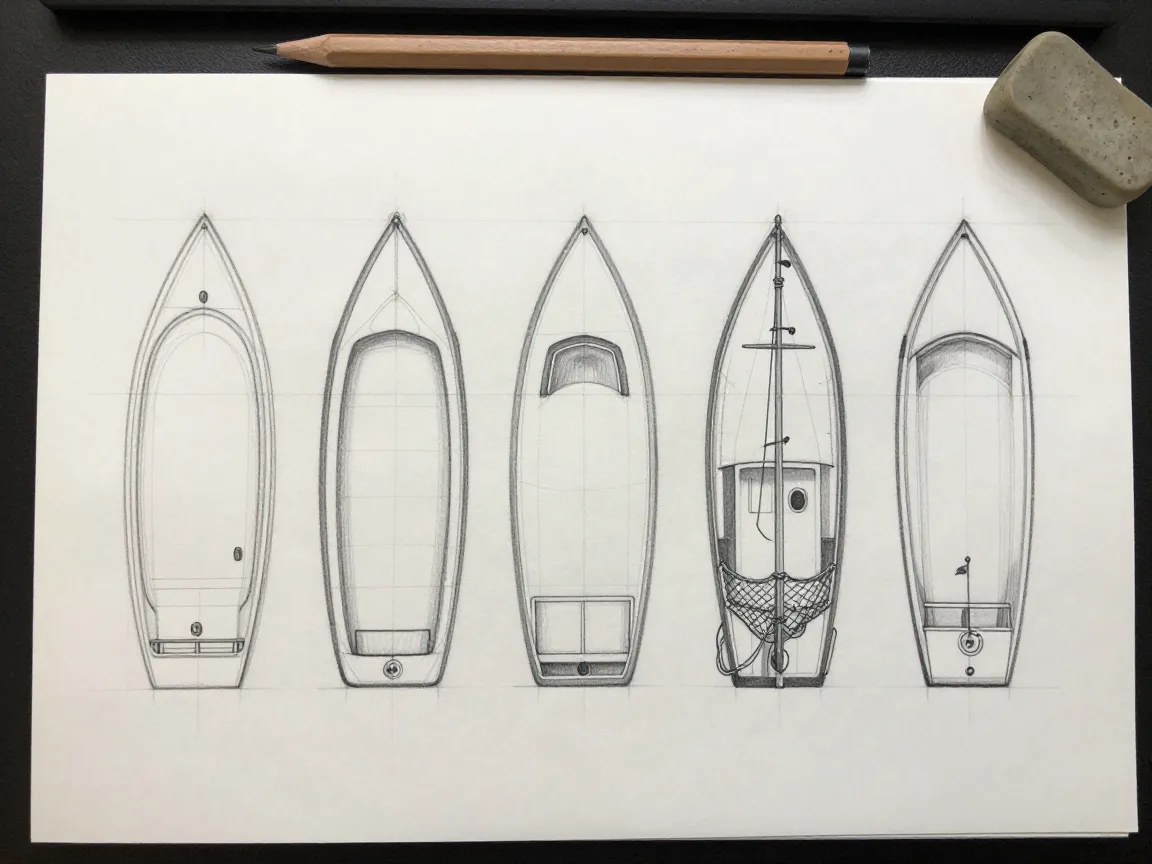
The final tutorial in this collection takes a deliberately different approach from every other entry. Skyrye Design’s 2026 “Boat Drawing: Hull Shapes and Step-by-Step Method,” updated in October 2026, is not a fishing-boat-specific lesson. Instead, it teaches how to understand and construct hull forms from basic geometric shapes, then adapt that knowledge to any type of watercraft, fishing boats included. That foundational focus makes it the most transferable skill in this list.
The tutorial walks through how different hull cross-sections produce different silhouettes, and how breaking the hull into a simple underlying shape first (often a flattened rectangular or trapezoidal form) creates a reliable scaffolding for every detail added afterward. This is the method professional boat illustrators and naval architects use when sketching, and understanding it removes the guesswork from hull proportion that frustrates many beginners on their second or third fishing boat drawing attempt.
Where other tutorials in this collection ask learners to follow specific steps toward a specific result, Skyrye Design’s method asks learners to understand a process. The practical exercise is to sketch five different hull silhouettes using the same underlying geometric foundation, varying only the bow angle, stern shape, and depth. Then apply the fishing boat details from any other tutorial in this list to the best of those five hulls. The result is a fishing boat drawing that feels genuinely owned by the artist rather than copied from a model.
Combining this structural lesson with the detail vocabulary from Monkeypen’s 21-step guide, nets, ropes, portholes, flags, creates a complete toolkit for drawing fishing boats from imagination rather than reference alone. That capability is the natural endpoint of any beginner drawing journey, and arriving there after just six tutorials is a realistic and achievable goal.
Choosing the Right Starting Point
The six tutorials above are not equally suited to every beginner, and sequence matters. New artists who have rarely drawn anything before will find EmilyDrawing’s cartoon tutorial the gentlest on-ramp, followed by HowToDrawForKids’ mast-and-wheelhouse approach. Intermediate beginners who already feel comfortable with basic shapes will get the most value from starting with HelloArtsy or Art Projects for Kids before moving into Monkeypen’s 21-step deep dive. Anyone who wants to eventually draw boats from imagination rather than reference should work through Skyrye Design’s hull-shape method sooner rather than later, even if it feels more abstract at first.
Across all six tutorials, a few habits will accelerate improvement regardless of which one is attempted first. Drawing slowly and deliberately produces better results than rushing through steps. Using a light pencil line for construction marks, the base hull curve, the porthole positions, the mast centerline, and then darkening only the final lines preserves the ability to correct mistakes without erasing heavily. And keeping every practice sheet, even the failed attempts, creates a visible record of progress that is genuinely motivating over weeks and months.
The progression from beginner fishing boat drawings to painted compositions is shorter than it might appear. Painting tutorials from Will Kemp Art School and similar resources frequently describe the underlying boat drawing as “really simple,” which is accurate once the structural vocabulary covered in these six tutorials has been internalized. The drawing phase is the foundation; color, light, and composition come afterward.
Conclusion
The 6 step-by-step fishing boat drawing simple tutorials for new artists covered here span the full range from playful cartoon practice to structurally rigorous hull study. Each one builds a different set of skills: line control, composition, proportion, detail layering, and design thinking. The single most useful next step for any reader is to pick the tutorial that matches the current skill level and complete it in full today, then return to this list to choose the logical next progression. One completed drawing, however imperfect, is worth more than ten tutorials read and never attempted.