Easy Fish Drawing for Kids Ideas That Spark Creativity
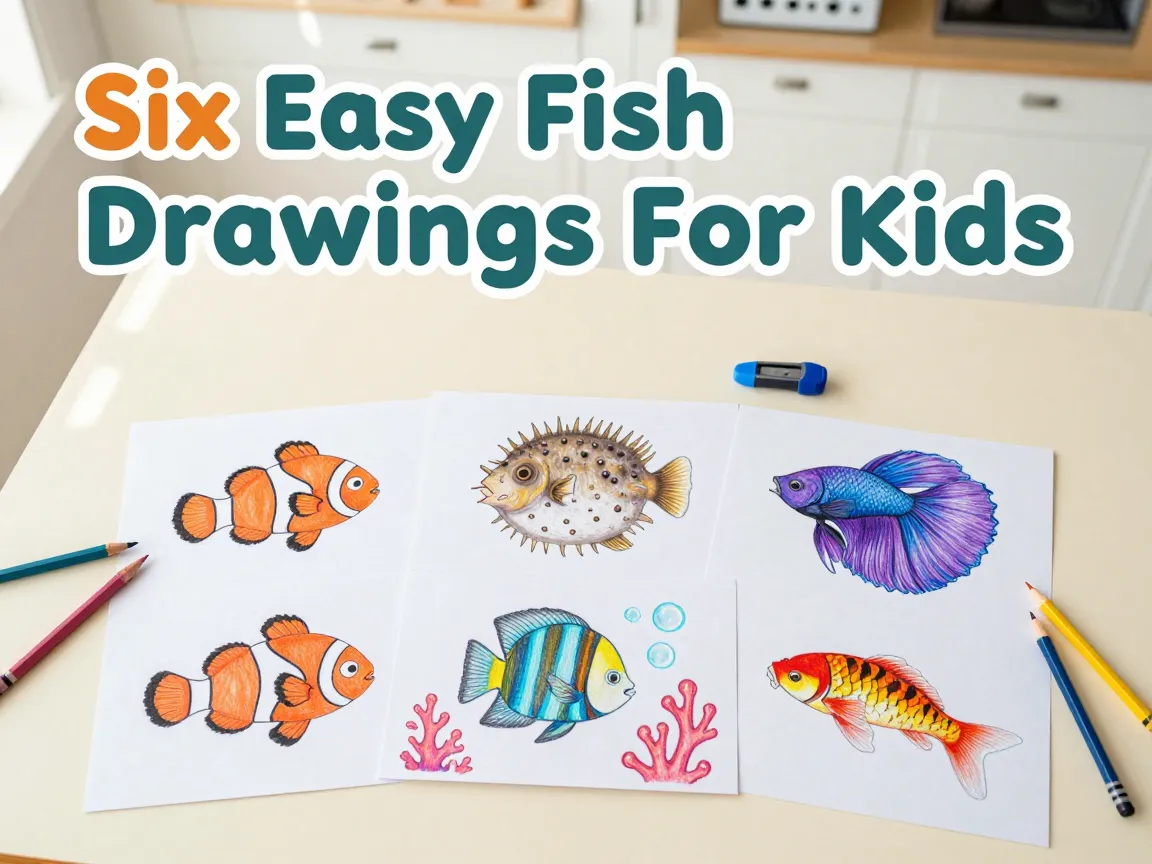
Children who cannot yet draw a convincing human face can almost always draw a fish, and that early success matters more than most parents realize. The fish is one of the most forgiving subjects in beginner art: a rounded body, a simple tail, and a single dot for an eye are enough to make something recognizable and satisfying. The 6 easy fish drawing for kids ideas that spark creativity collected here build on that natural confidence, taking a child from their very first oval all the way to full underwater scenes packed with color, pattern, and personality. Each approach is distinct, progressively layered, and designed to keep the pencil moving without frustration.
Disclosure: This post contains affiliate links. As an Amazon Associate, we earn from qualifying purchases, and at no extra cost to you.
1. The Classic Oval-Body Fish
The oval-body fish is the starting point that nearly every art instructor and kid-friendly tutorial returns to because it works every single time. A child draws a large oval, roughly the size of an egg, tilted slightly on its side. At one narrow end, a backward “C” curve creates an open mouth. At the other end, two lines fan outward and connect at a point to form a simple tail. That is the entire skeleton of the drawing, and it takes about sixty seconds.
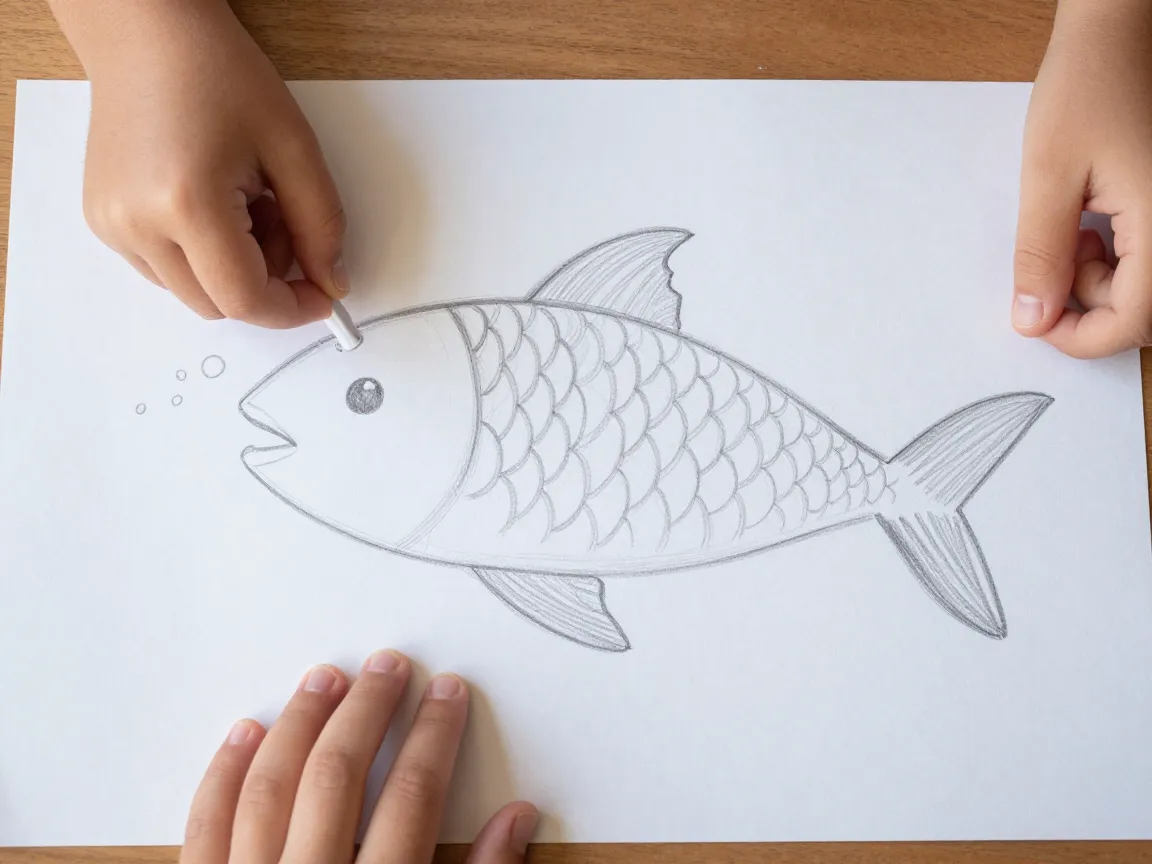
What makes this approach so effective is the sequence. Once the oval and tail exist, every detail that follows is optional and additive. A small circle near the mouth becomes the eye. A short curved triangle on the top of the body becomes the dorsal fin. A smaller matching shape on the belly creates balance. Children who stop right there still have a complete fish. Children who want to continue can add scales using overlapping curved lines along the body, or draw a row of bubbles drifting upward from the mouth. Because nothing in the base drawing can be “ruined” by the next step, kids stay relaxed and keep going rather than giving up.
The oval-body fish is also an excellent introduction to symmetry and proportion. When a child notices that the top fin and the belly fin need to be roughly the same size to look balanced, they are absorbing a real artistic principle without being lectured about it. Parents and teachers can reinforce this naturally: “What do you think would happen if we made the tail bigger?” That one question turns a simple sketch into a conversation about design.
For younger children around ages five to seven, keeping the oval large, filling most of the page, makes every subsequent detail easier to add and more visually rewarding when finished. For older kids, a smaller, more precise oval challenges their fine motor control without changing the fundamental approach.
2. The Clownfish with Bold Stripe Patterns
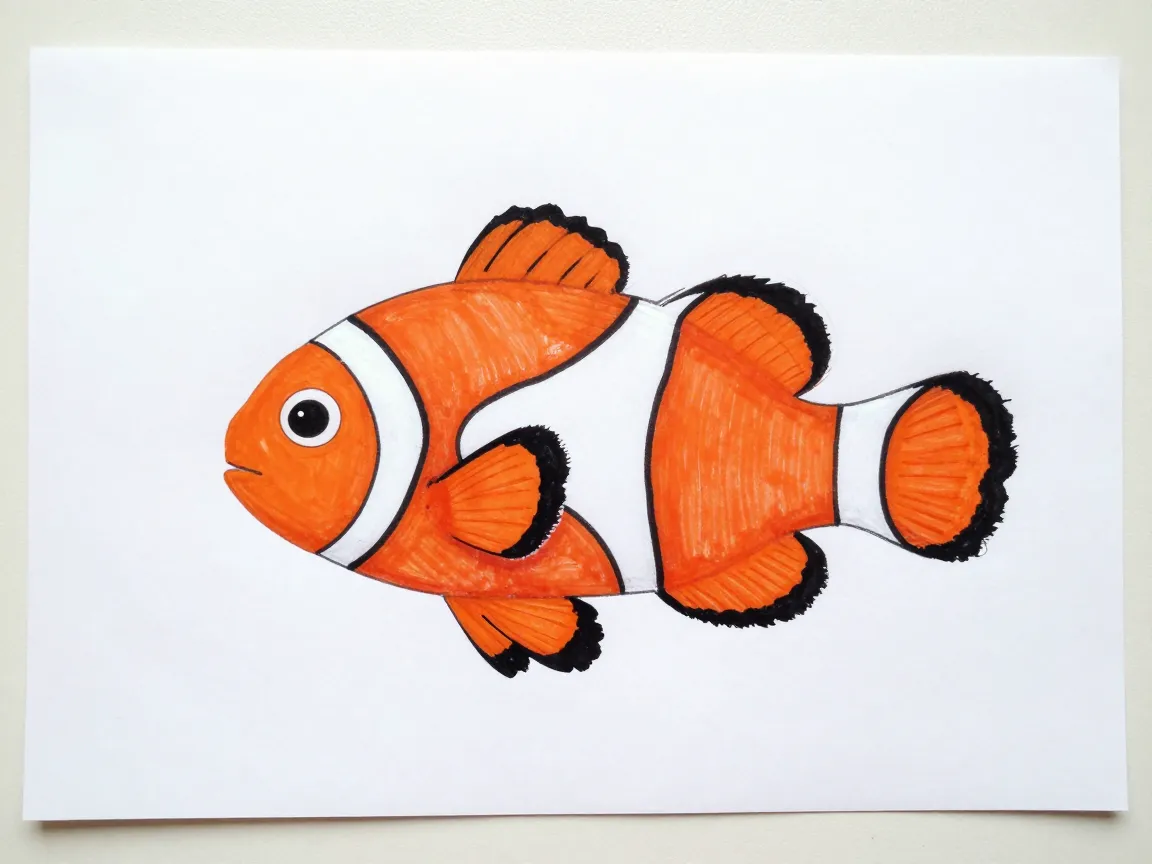
Once a child can draw the basic oval shape confidently, introducing a recognizable species raises the stakes in a motivating way. The clownfish is ideal for this step because its defining visual feature, three white stripes edged in black on an orange body, is bold, simple, and immediately recognizable to most children who have seen a certain famous animated film.
The body shape stays the same as the classic oval, but the fins become slightly more elaborate. Clownfish have several small rounded fins clustered toward the back of the body and a distinctive two-lobed tail. Children can approximate these without technical accuracy and still produce something that reads clearly as a clownfish. The white stripes are drawn as three thick bands crossing the body vertically, with a thin dark outline on each side. This is where the decorative work begins.
The stripe exercise teaches children to work inside a defined space while also personalizing it. Some kids will keep the stripes perfectly straight; others will give them wavy, zigzag, or dotted edges. Neither version is wrong, and the contrast between two children’s clownfish drawings using the identical base shape is a vivid illustration of individual style. Encouraging kids to vary the stripe edges rather than copying an exact template is a low-pressure way to introduce the idea that art is about choices.
Coloring the clownfish also introduces basic color theory without naming it. The orange body pops against white stripes because those colors sit far apart on the color wheel. If a child decides to draw a “fantasy” clownfish in purple and yellow, they will intuitively notice that the contrast either works or does not, and that observation is worth more than a formal lesson on complementary colors.
3. The Pufferfish Round-Body Variation
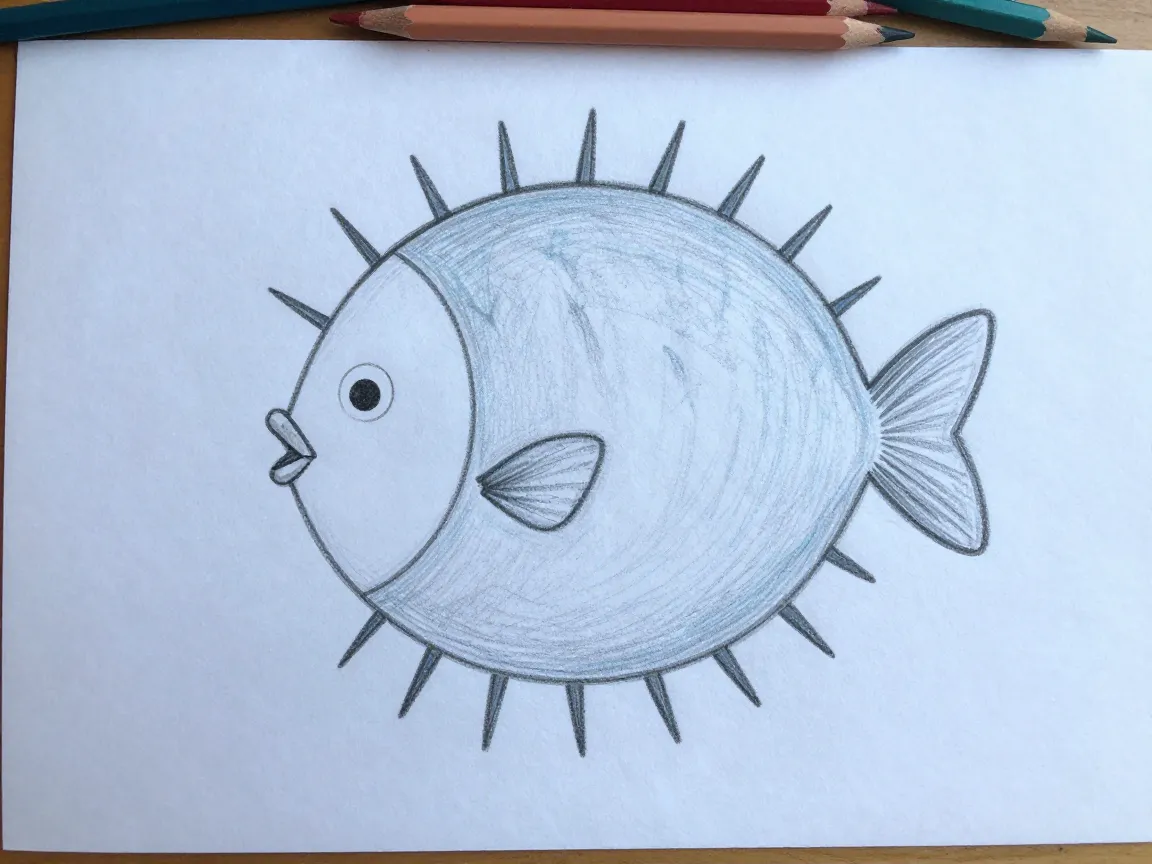
The pufferfish flips the standard fish shape entirely, which is part of its appeal. Instead of a horizontal oval, the child draws a large circle, as round as they can manage. The mouth pokes out from one side, the small tail from the other, and tiny fins hang below. The defining feature, the spines, are drawn as short straight lines radiating outward all around the body like the points of a starburst.
This variation is valuable precisely because it breaks the pattern. After drawing one or two oval-bodied fish, the brain can start to feel like there is only one way to draw a fish. The pufferfish demonstrates that fish come in dramatically different shapes and that the same basic construction logic, start with the main body shape, then add fins, tail, eye, and details, applies to all of them. That conceptual flexibility is a genuinely important creative skill, not just a drawing technique.
For children who struggle with drawing smooth ovals, the pufferfish is also quietly therapeutic. A slightly lumpy circle actually looks more like a pufferfish than a perfect one would. The irregularity becomes a feature. Kids who have been discouraged by their ovals looking “wrong” often find that the pufferfish is the first time their natural hand wobble produces exactly the right result.
The spines can be customized extensively. Some children draw them all the same length for a tidy, spiky effect. Others vary the lengths to create a more dynamic, bristling silhouette. Adding small dot eyes and a pouty mouth gives the pufferfish a cartoonish expression that most children find irresistible, turning the drawing into a character rather than just an animal.
4. The Betta Fish with Flowing Fins
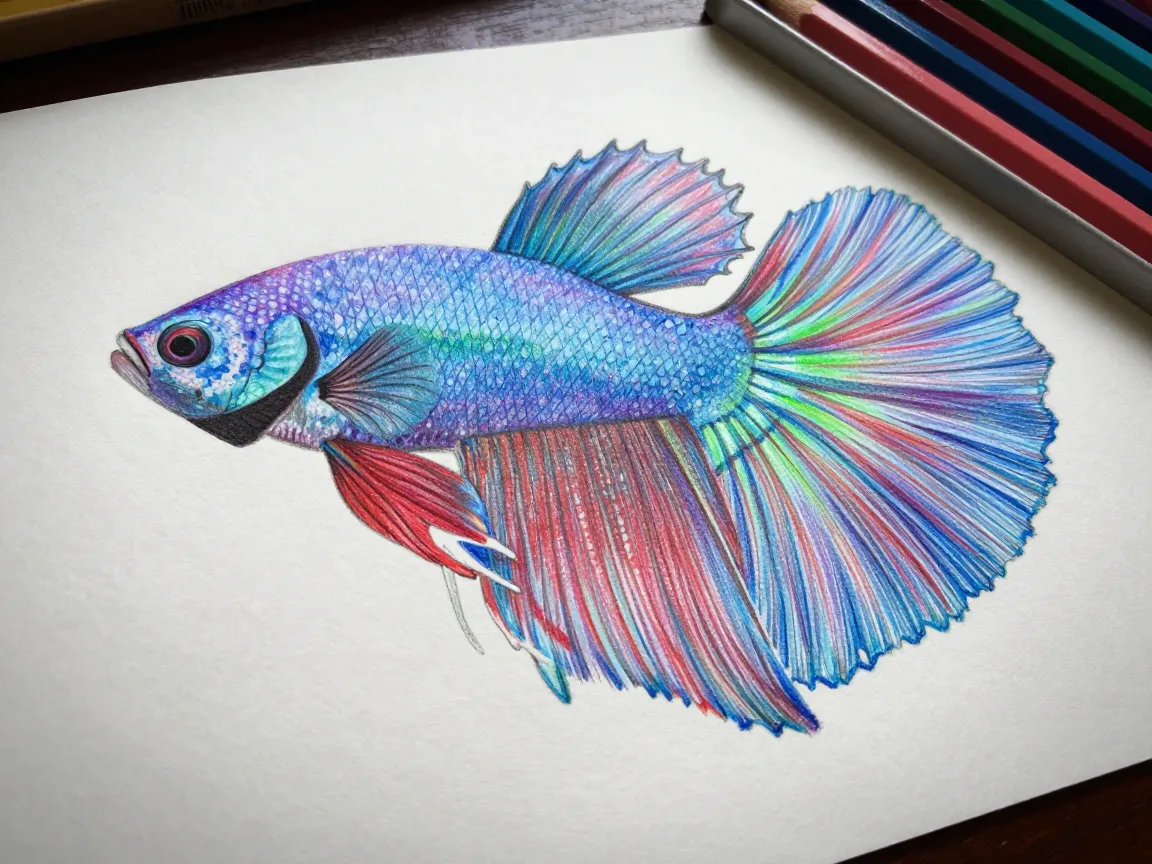
The betta fish, sometimes called the Siamese fighting fish, introduces children to the concept of fluid, expressive line work. Unlike the compact fins of a clownfish or pufferfish, a betta’s fins are long, trailing, and layered, more like flowing fabric than rigid structures. Drawing them requires a looser wrist and a willingness to let lines curve and overlap.
The body itself is relatively narrow compared to other fish, closer to a pointed teardrop than a round oval. Children draw this tapered shape first, then extend long, sweeping curves outward from the tail end, letting the lines drift apart to suggest the flowing tail fin. Additional long curves sweep downward from the belly. The result looks complex, but because the lines do not need to be precise, in fact, the more varied and flowing they are, the better the betta looks, most children find this drawing surprisingly achievable once they loosen their grip on the pencil.
The betta fish is a natural vehicle for exploring color blending and gradients. Real bettas are famous for their iridescent, multicolored fins that shift between blues, purples, reds, and greens. Inviting children to color the fins with two or more colors blending into each other introduces them to shading and transition without requiring advanced technique. Using colored pencils applied lightly and layered gradually is enough to create a visually impressive result.
This drawing also rewards children who enjoy detail work. After establishing the main fin shapes, kids can add thin parallel lines running along each fin to suggest texture, or small dots and speckles to mimic the fish’s natural patterning. These details take time but are inherently meditative, making the betta fish drawing one of the better options for older children who want a more sustained creative project.
5. The Tropical Fish in a Mini Underwater Scene
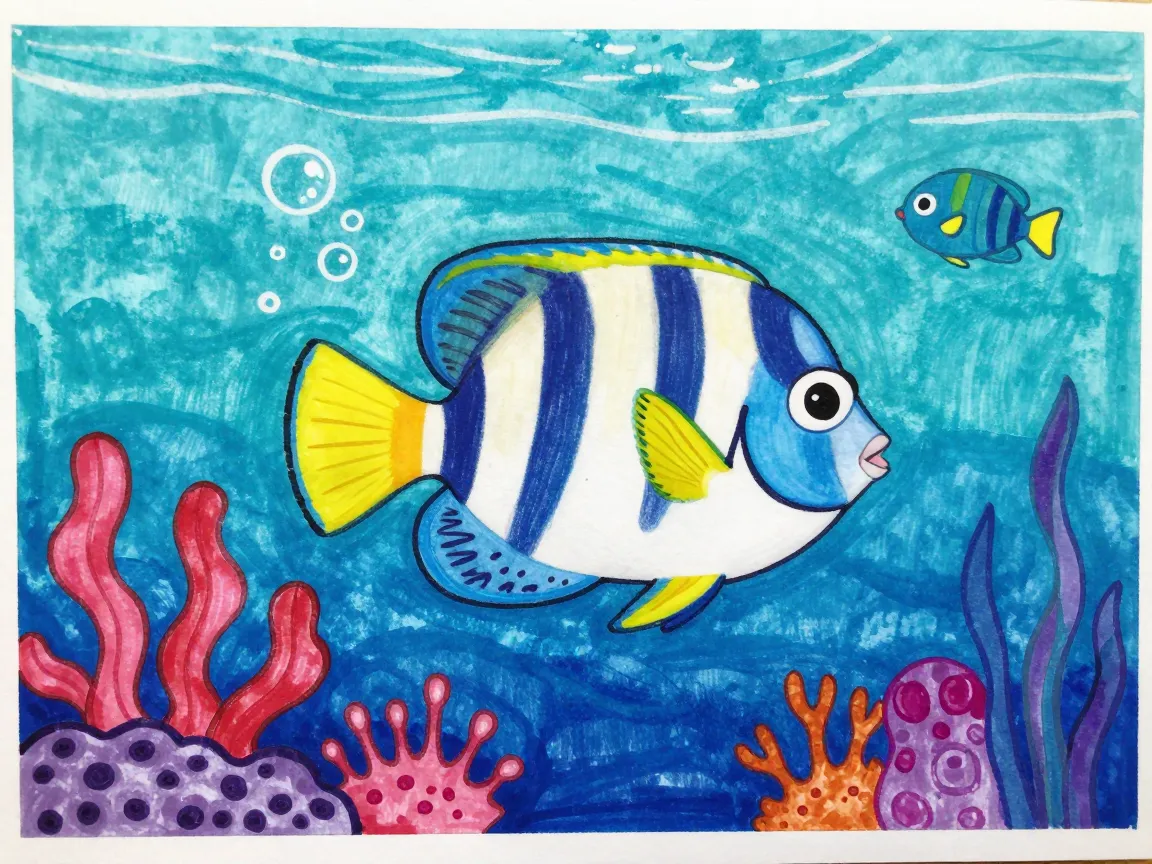
A single fish on a blank page is a drawing. A fish surrounded by coral, seaweed, bubbles, and perhaps a second smaller fish is a world. This fifth idea shifts the focus from the fish itself to the environment around it, which opens an entirely different set of creative decisions.
The tropical fish at the center of the scene uses the standard oval-body construction but can be decorated more elaborately than usual because the surrounding scene provides visual context that makes even simple fish decorations look intentional. Fan-shaped tails, small rounded fins, and horizontal stripes across the body are all quick to draw and immediately read as “tropical” when surrounded by coral shapes and sea plants.
Building the underwater scene teaches composition in an accessible way. Children instinctively begin to understand foreground and background when they notice that objects at the bottom of the page feel like they are “in front” of objects higher up. Seaweed and coral shapes go at the bottom. Bubbles, drawn as small circles of varying sizes, rise toward the top. A second fish, smaller, to suggest distance, can appear in a corner. These spatial relationships are the foundation of pictorial depth, introduced through play rather than instruction.
The scene format also allows children to revisit and extend the drawing across multiple sessions, which builds a different kind of creative stamina than finishing a single drawing in one sitting. A child who draws the main fish on Monday and returns to add coral and a second fish on Wednesday is practicing the habit of returning to a creative work to develop it further, a habit that serves artists, writers, and thinkers throughout their lives.
Parents and teachers working with this idea should resist the urge to direct the scene too specifically. Suggesting “maybe add some seaweed” is helpful; insisting on where the seaweed goes is not. The goal is for the child to make choices about a world they are building, and that sense of authorship is exactly what turns a drawing exercise into a genuinely creative act.
6. The Koi Fish with Decorative Surface Patterns
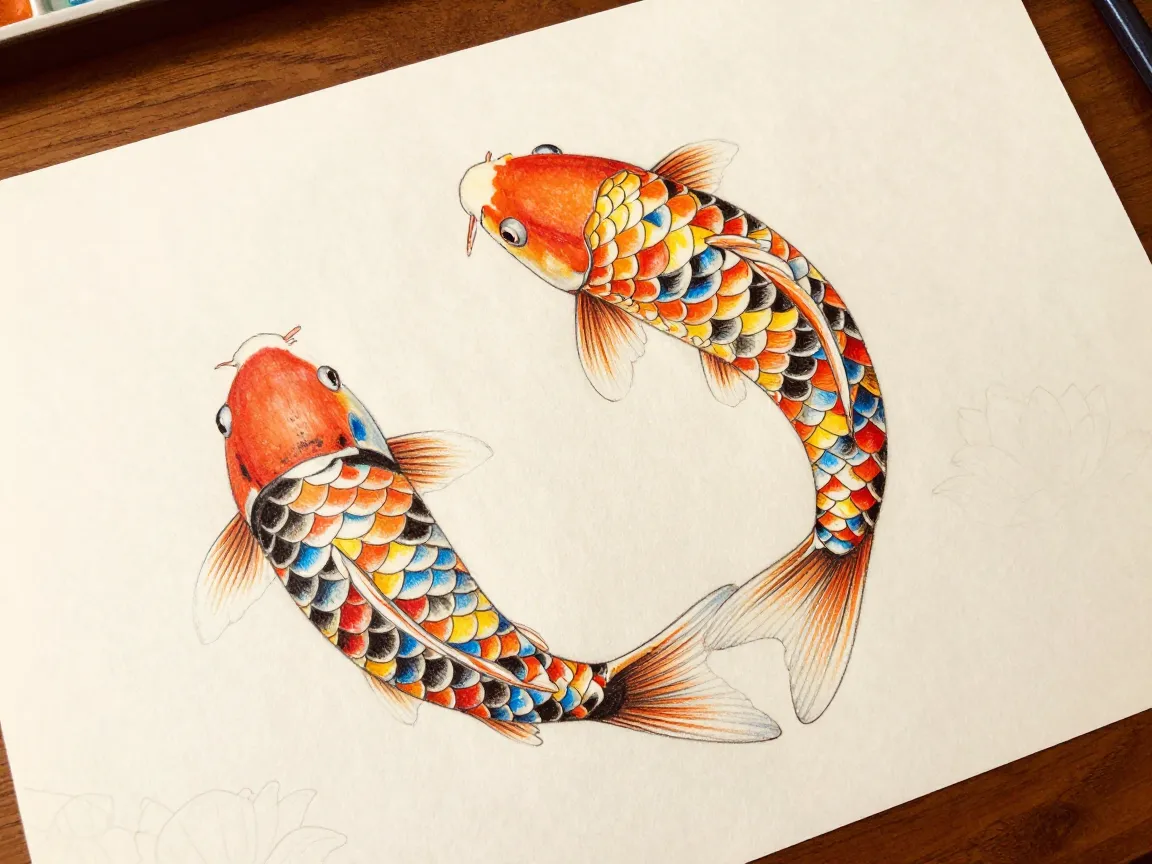
The koi fish is the most stylized and decorative of the six ideas, and it is well-suited to children who have already worked through two or three of the earlier variations. Koi are associated with elaborate decorative art traditions, particularly in Japanese and Chinese visual culture, which gives children a window into how the same animal can be represented very differently across artistic traditions.
The koi body is a long, gently curved oval, almost like a stretched teardrop. The tail is wide and fan-shaped, often split into two lobes that curve away from each other. Long, flowing side fins trail beneath the body, similar in spirit to the betta’s fins but more structured. Distinct circular scales cover the entire body, each one slightly overlapping the one above it like fish-scale roof tiles, which is an observation that children almost universally find fascinating.
The defining creative opportunity in a koi drawing is the surface pattern. Real koi come in orange, white, black, red, yellow, and blue, often in dramatic patches and blotches across the body. Children can design their own pattern using whatever combination of colors appeals to them, filling in alternating scales or laying down large color patches that cross multiple scales at once. There is no incorrect arrangement, which makes this drawing one of the most purely expressive of the six.
Adding a stylized water setting reinforces the decorative quality. Rather than a realistic underwater scene, children can draw simplified wave shapes around the fish or lotus flower outlines near the edges of the page. These elements do not require realistic detail, stylized, slightly abstract versions look better with the koi’s own decorative character. This is a useful moment to discuss with children how some art styles deliberately avoid realism in favor of pattern and elegance, introducing them to the idea that there are many different ways to be a skilled artist.
The koi drawing also scales well with ability. A five-year-old can draw the curved body and fill it with two or three large color patches and have a finished, satisfying piece. An eight-year-old can render individual scales in overlapping rows, mix colors within each scale, and add detailed fins, spending an hour or more on a single drawing. That range makes the koi the most versatile subject in this collection.
Conclusion
The six ideas in this collection, the classic oval-body fish, the striped clownfish, the round pufferfish, the flowing-finned betta, the tropical fish in an underwater scene, and the decorative koi, are not just drawing tutorials. Each one builds a distinct skill: confidence in basic shapes, working within patterns, using body shape to vary character, expressive line work, compositional thinking, and decorative design. The consistent thread across all of them is the same principle that experienced children’s art educators return to repeatedly: establish a simple, forgiving base shape first, then invite the child to add pattern, color, and context on their own terms.
The most practical next step is to gather a few sheets of blank paper and a set of colored pencils or markers and start with idea one. Resist the impulse to demonstrate the “right” way before the child has had a chance to try their own interpretation. The drawing that surprises you will almost certainly be the one the child made without being told exactly how.