Primitive Survival Skills That Still Work When Modern Gear Fails
Every year, search-and-rescue teams respond to thousands of wilderness emergencies in the United States alone, and a striking proportion involve people whose equipment stopped working before their situation did. A dead GPS, a torn tent, a wet fire-starter kit, these are not edge cases. The 6 primitive survival skills that still work when modern gear fails are not curiosities from bushcraft YouTube channels. They are functional techniques with an unbroken track record stretching back tens of thousands of years, and they cannot run out of batteries.
Disclosure: This post contains affiliate links. As an Amazon Associate, we earn from qualifying purchases, and at no extra cost to you.
This article covers each of those six skills in enough practical detail that you can start training them, and it explains what makes each one reliable when the gear you packed stops being reliable.
Key Takeaways
- Friction fire (bow-drill method) is the most trainable primitive skill and the one most emphasized by formal survival schools worldwide.
- Shelter from natural materials kills your heat loss problem before it becomes fatal, and it requires no manufactured components.
- Water procurement using rock boiling, solar stills, and improvised filtration works without metal pots, filters, or purification tablets.
- Navigation by sun, shadow, and stars has reliably oriented travelers for millennia and requires no devices.
- Primitive trapping and foraging extend survival from days into months; snares work while you sleep.
- Natural wound care using honey, pine resin, and yarrow is documented in clinical literature and provides a viable stopgap when pharmaceuticals are gone.
1. Friction Fire with a Bow-Drill
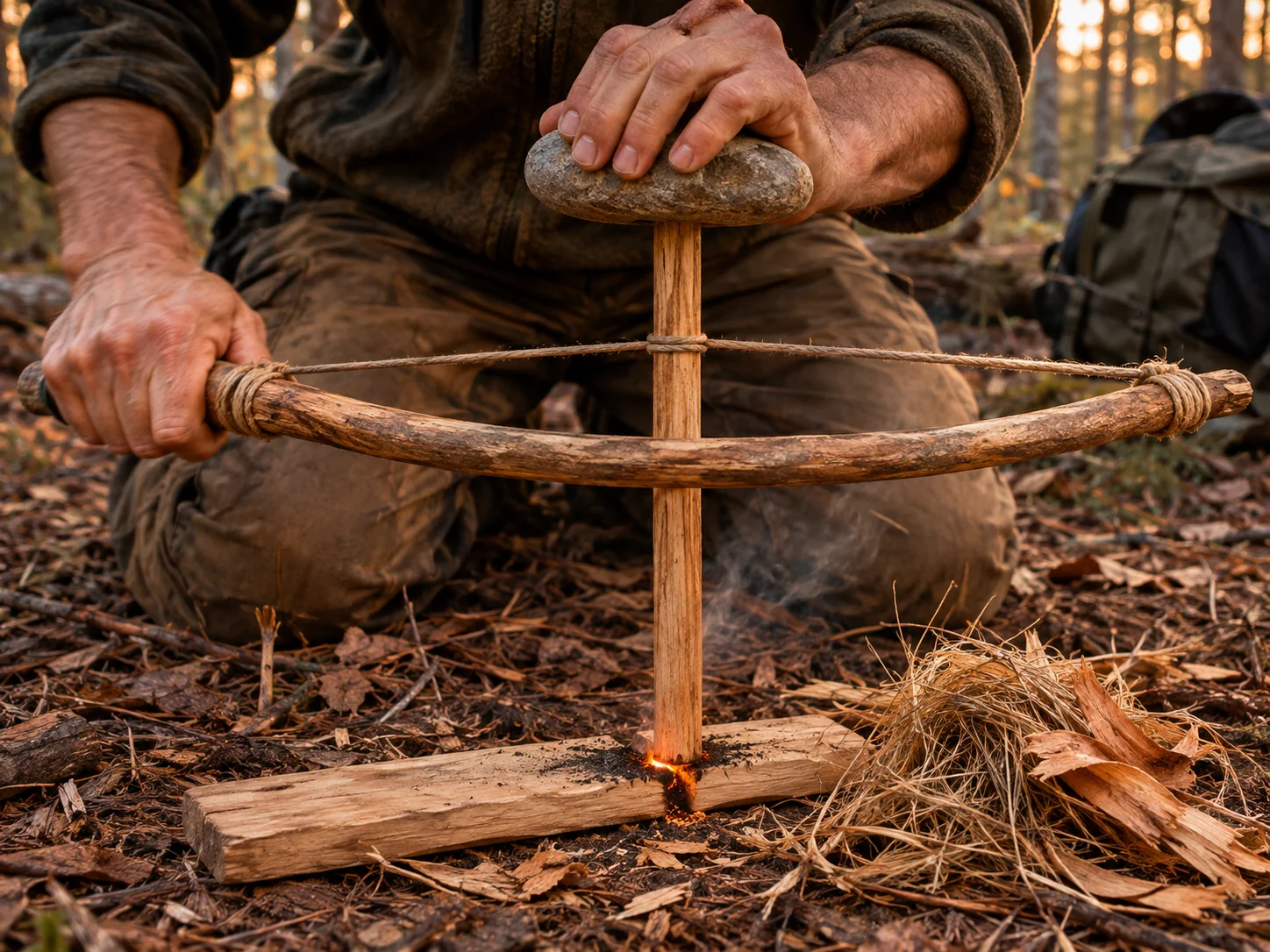
The bow-drill is not the fastest way to start a fire, but it is the most teachable friction-fire method and the one that works across the widest range of environments. Boulder Outdoor Survival School’s 7-Day Primitive Skills curriculum treats it as a foundational exercise, and programs from that school’s November 2026 SYD course to Matt Graham’s Primitive Skills Weekend in May 2026 all build fire-making from wood-on-wood friction before introducing anything else.
The setup has four components: a spindle (a straight, dry hardwood rod roughly 50 cm long), a fireboard (a flat piece of softer dry wood with a carved notch and socket), a bow (a curved stick strung with cordage), and a top-socket (a smooth rock or hard wood piece that holds the spindle’s top while you apply downward pressure). When you draw the bow back and forth, the spindle rotates rapidly against the fireboard, generating friction heat. Dark powder collects in the notch. If that powder reaches around 800°F, which it does with consistent technique, it forms a glowing coal. You tip the coal into a prepared tinder bundle of dry grass or shredded bark, fold the bundle closed, and blow gently until it flames.
The failure points are almost always moisture and poor wood selection. The fireboard and spindle must be drier than they look. Dry cedar, cottonwood root, willow, and mullein stalks are well-tested combinations. Practice matters more than wood species, though: Cincinnati Parks’ Primitive Survival Skills Series for Adults specifically teaches adults to coax fire from moving wood precisely because the technique requires calibrated muscle memory that only repetition builds. Put in four to six hours of supervised practice before you need this skill in an actual emergency.
2. Natural Shelter Construction
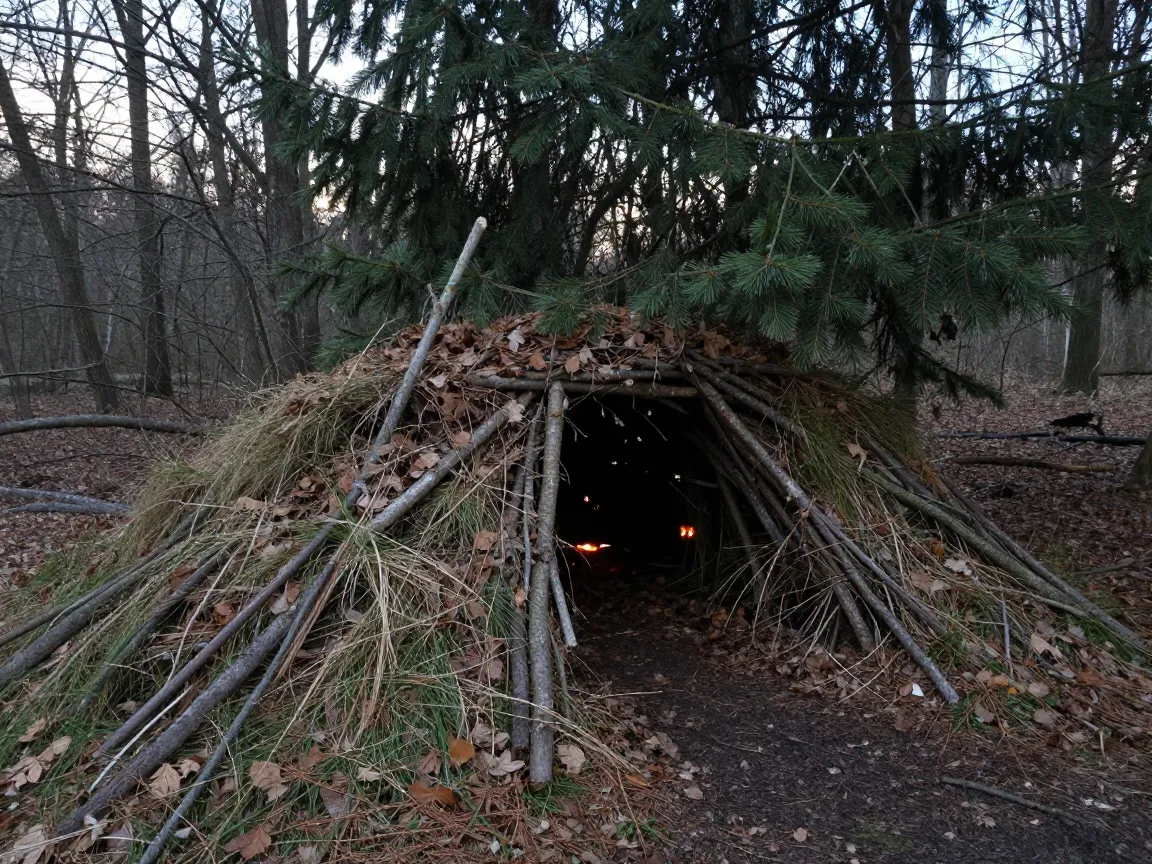
Hypothermia is the leading cause of death in wilderness survival situations, and it can begin at air temperatures well above freezing when wind or rain are involved. A debris hut, a body-sized mound of leaf litter and branches packed over a framework of sticks, provides workable insulation from both. The goal is a shelter just large enough for your body, with walls and a roof of dry leaves, pine needles, or grass piled at least 60 cm (two feet) thick on all sides.
The structural logic is simple. Dead air trapped inside organic material resists heat transfer. The smaller the internal space, the faster your body warms it. A common beginner error is building a shelter large enough to sit up in; that extra volume is never heated and becomes a liability. Boulder Outdoor Survival School’s field programs and several independently published wilderness survival guides from 2026 all stress that a properly built debris hut can keep a person alive at near-freezing temperatures with no sleeping bag and no fire.
Lean-tos serve better in fair weather or when fire is available, since they reflect radiant heat from a flame toward the occupant. Natural rock overhangs and dense conifer branches can extend either design when time is short. The practice skill here is speed: building a functional debris hut before dark requires at least one full practice run in a controlled environment. That run also teaches you how much dry leaf material the job actually takes, which is consistently more than beginners expect.
3. Water Procurement Without Filters or Purifiers
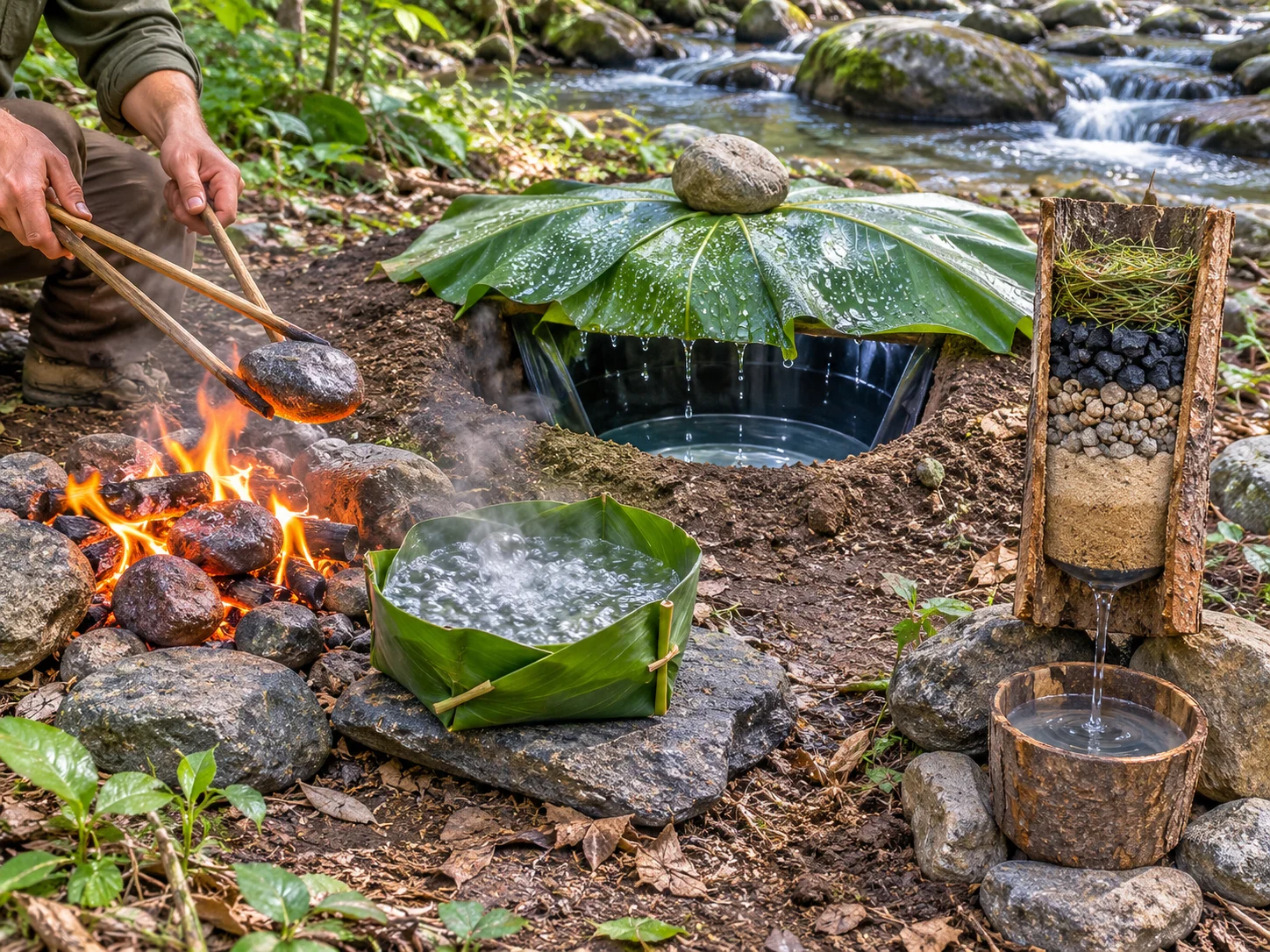
A person in a temperate climate can survive roughly three days without water, less in heat or high exertion. When a filter is broken, lost, or never packed, there are three primitive methods that work without manufactured components.
Rock boiling is the most reliable. You heat fist-sized stones directly in a fire for 20 to 30 minutes, then transfer them into a container of water using two sticks as tongs. A bark container, a large folded leaf, a dug-out clay bowl, or even a hollowed-out section of green wood holds the water while the stones heat it to a rolling boil. Sustain that boil for one minute at elevations below 2,000 meters, or three minutes above that, and you have water safe to drink. Guides updated through 2026 recommend the rock-boiling technique specifically because it functions without metal cookware.
A solar still extracts moisture from damp ground. Dig a bowl roughly 60 cm wide and 40 cm deep, place a container at the bottom, drape a sheet of plastic or large leaves over the opening, and weight the center so condensation drips into the container. Output is slow, typically under half a liter per day, so a solar still supplements other methods rather than replacing them.
Improvised filtration through layers of sand, gravel, grass, and crushed charcoal in a bark tube or perforated container removes suspended particles and some odor but does not kill pathogens. Use filtration before boiling, not instead of it. That sequence, filter, then boil, is exactly what field guides and prepper analyses published in 2025 and 2026 recommend for a gear-independent water system.
4. Navigation by Sun, Shadow, and Stars
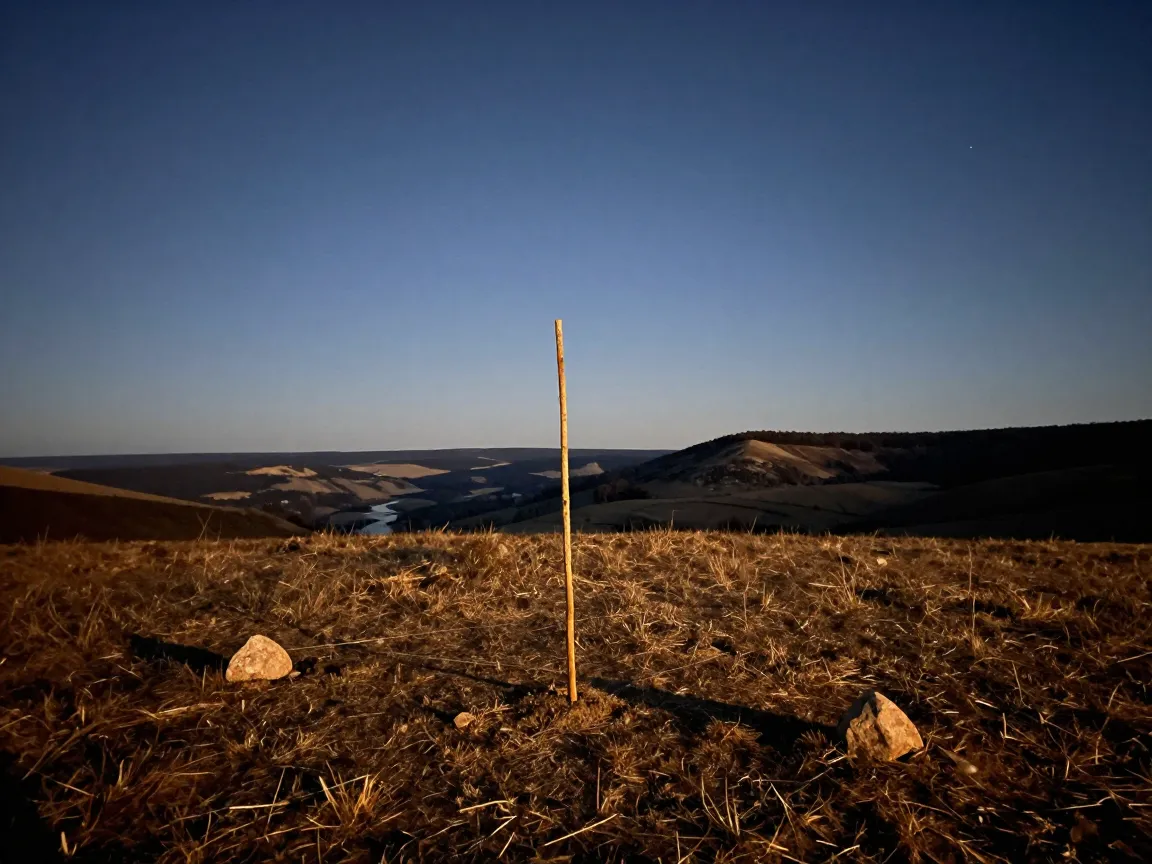
Before GPS and before the magnetic compass was widely available, humans crossed oceans, deserts, and mountain ranges using the sky and terrain. Those methods are still accurate. The shadow-stick technique works in any location where the sun casts a shadow. Push a straight stick into level ground, mark the tip of its shadow with a stone, wait 15 minutes, then mark the new shadow tip with a second stone. Draw a line between the two stones. That line runs approximately west to east, with the first mark toward west in the Northern Hemisphere. A line perpendicular to it gives you north-south.
At night, Polaris (the North Star) sits within one degree of true north for observers in the Northern Hemisphere. Finding it requires locating the Big Dipper and following the two stars at the outer edge of its bowl upward; Polaris is roughly five times that distance away. South of the equator, the Southern Cross provides the same function through a slightly more involved construction, but the principle is identical.
Terrain features complement both methods. Water drains downhill; following drainage consistently leads to larger water sources and, eventually, human habitation in most populated regions. Ridge lines, valleys, and cliff faces appear on topographic maps in predictable patterns, and memorizing the general topography of an area before entering it allows rough dead reckoning when sky conditions are overcast. Bushcraft curricula and wilderness survival guides consistently treat these techniques as the core navigation layer, with instruments treated as a convenience that augments rather than replaces them.
5. Primitive Trapping, Fishing, and Foraging
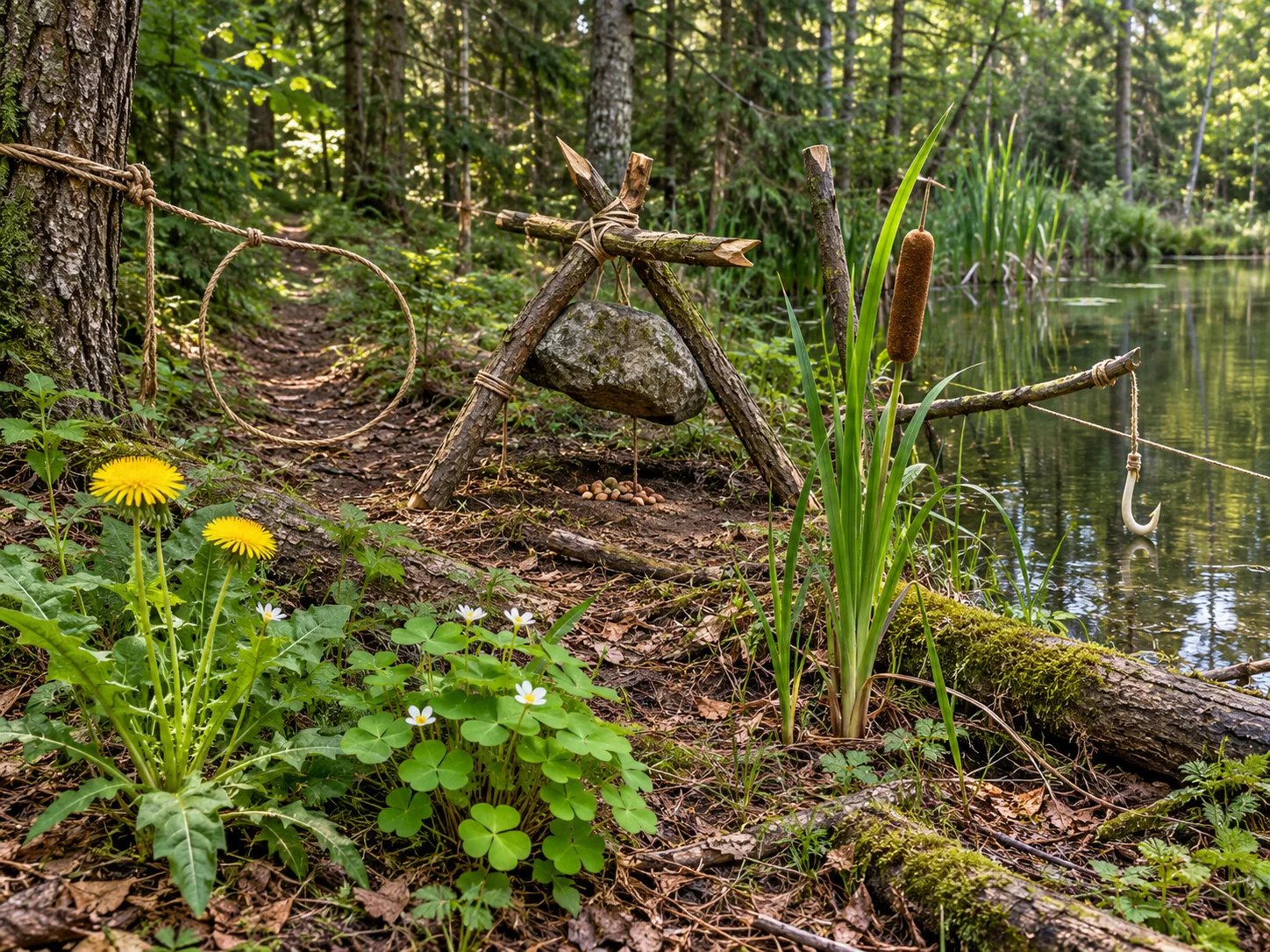
Caloric failure takes longer to kill than dehydration or hypothermia, but it progressively degrades judgment, physical strength, and immune function. For survival beyond a few days, food procurement shifts from optional to necessary. The advantage of primitive trapping is that it works continuously without active effort. A properly placed snare or figure-four deadfall can catch small game while you sleep, build shelter, or gather water.
The simple wire or cordage snare, looped to a fixed anchor along a game trail, is the most accessible trap for beginners. Figure-four deadfalls, which use three notched sticks arranged to hold a heavy rock above a bait point, require more preparation but catch larger animals. Gorge hooks, small sharpened bone or wood pieces tied to cordage, work in still water for fish, requiring only a baited line left unattended. Major survival schools and field guides published through 2026 describe these trapping systems as long-term survival requirements that can extend survivability by months in a prolonged crisis.
Foraging demands plant identification knowledge acquired before any emergency. Getting that wrong carries serious risk; some common edible plants closely resemble toxic species. The rule applied by most survival educators is to learn five to ten reliably identified, common plants for your region thoroughly before attempting broader foraging. For temperate North America, dandelion (all parts edible), cattail (shoots, pollen, and roots), and wood sorrel are low-confusion starting points. For fishing beyond gorge hooks, throwing sticks, spears with fire-hardened tips, and basket fish traps woven from flexible green branches all appear in formal primitive skills curricula as complementary techniques.
6. Basic Wound Care and Natural Antiseptics

A cut that gets infected in a remote setting is a survivable problem for about the first 24 hours. After that, the variables shift. Without access to antibiotics or sterile dressings, the primitive approach focuses on three priorities: thorough mechanical cleaning, infection suppression with natural antimicrobials, and keeping the wound closed and dry.
Mechanical cleaning means flushing the wound with clean (boiled and cooled) water under pressure. A folded leaf or bark shaped into a narrow spout generates enough pressure to remove debris and surface bacteria. This step matters more than any topical treatment. After cleaning, raw honey is the best-documented natural antimicrobial available without manufacturing. Its low water activity and hydrogen peroxide content suppress bacterial growth, and clinical wound care literature confirms its effectiveness against a range of bacteria including antibiotic-resistant strains. Apply directly and re-dress with clean plant material.
Pine resin, collected from wounds on pine trees where it has hardened, functions as a sealant and mild antiseptic when warmed until pliable and pressed over a wound. Yarrow (Achillea millefolium), a common wildflower in temperate regions, has demonstrated astringent and antimicrobial properties in peer-reviewed botanical pharmacology research; crushed fresh leaves applied directly to a wound were used for millennia for exactly this purpose and are reflected in both historical medical texts and modern ethnobotany literature. Prepper and bushcraft analyses from 2025 and 2026 frame these natural medicine techniques as a viable stopgap specifically because they remain available when medical supply chains are disrupted, not as replacements for professional care when professional care is accessible.
Quick Comparison
| Skill | Core Tool Required | Time to Learn Basics | Primary Survival Role |
|---|---|---|---|
| Bow-Drill Fire | Dry wood, cordage | 4-6 practice hours | Warmth, water purification, signaling |
| Debris Hut Shelter | Branches, leaf litter | 1-2 practice builds | Hypothermia prevention |
| Rock Boiling / Water | Stones, container | 1 practice session | Hydration without filters |
| Sun/Star Navigation | Straight stick | 2-3 practice sessions | Orientation and travel |
| Snares and Foraging | Cordage, plant ID | Weeks (plant ID) | Long-term caloric survival |
| Natural Wound Care | Honey, resin, yarrow | 1-2 practice sessions | Infection prevention |
Conclusion
The consistent thread across all 6 primitive survival skills that still work when modern gear fails is that none of them depend on a supply chain. Skills cannot be lost, run out, or recalled. They degrade only with disuse, which means the best time to practice bow-drill fire or debris-hut construction is before the situation that makes it necessary.
Start with fire and shelter. Those two skills cover the most common causes of death in wilderness emergencies. Add rock boiling next, since it pairs directly with fire. Then build navigation and trapping knowledge over months of deliberate practice. Formal courses, Boulder Outdoor Survival School’s multi-day programs, Matt Graham’s Primitive Skills Weekend, or municipal programs like the Cincinnati Parks series, compress that learning considerably and correct technique errors that self-study often misses. One structured weekend with a qualified instructor is worth more than a shelf of books on this subject.