Fishing Hook Knots That Keep Your Catch From Slipping Away
Anglers lose more fish to knot failure than to any other single equipment problem. A pull-test published in late 2026 by fishing educator Tom Rowland found that a plain clinch knot, the first knot most people ever learn, retains only 65.6% of a line’s rated strength on 12 lb fluorocarbon. The fish you lose at the net is usually not bad luck. It is a knot tied wrong, or the wrong knot for the line type.
Disclosure: This post contains affiliate links. As an Amazon Associate, we earn from qualifying purchases, and at no extra cost to you.
The 6 fishing hook knots that keep your catch from slipping away are not equally good at everything. Each one solves a specific problem: some dominate on monofilament, some are built for stiff fluorocarbon, some are the only right answer for a bait hook tied to braid. Knowing which knot to reach for, and why, is the difference between a solid 95% strength retention and a failure point hiding in your tackle.
Key Takeaways
- The Palomar knot tests at roughly 95-97% of line strength and is the strongest general-purpose hook knot across mono, fluorocarbon, and braid.
- The improved clinch knot is the right default for lures and standard hook attachments, holding around 90-95% of line strength on most setups.
- Snell knots are purpose-built for bait hooks, particularly circle and octopus patterns, because they force a straight-line pull that improves hook penetration.
- The San Diego Jam knot is the top pick specifically for stiff fluorocarbon leaders and heavier hooks, where other knots tend to slip.
- A non-slip loop knot lets lures swing freely rather than being choked by a fixed knot, which directly affects how the lure moves through the water.
- Wetting any knot before seating it is not optional, dry friction cuts line strength significantly regardless of which knot you’re tying.
1. Palomar Knot
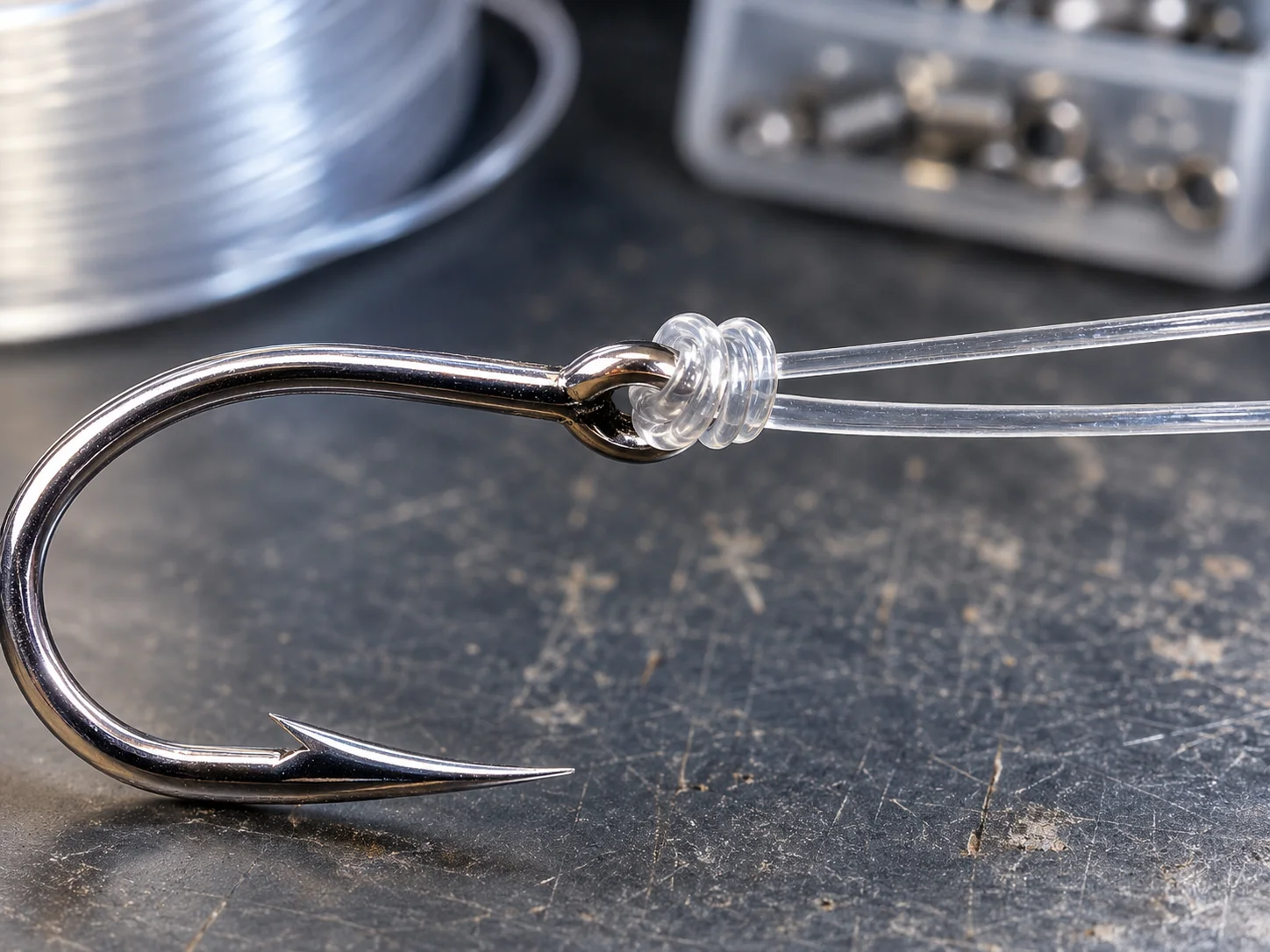
The Palomar is the benchmark that every other hook knot gets measured against. Rowland’s 2026 pull-test put it at 97% of actual line strength on 12 lb fluorocarbon, and multiple independent gear guides confirm similar numbers on monofilament. It is consistently the top performer in comparative testing, and it ties quickly once the motion is learned.
The mechanics explain the strength. You double the line before passing it through the hook eye, so the load is distributed across two strands rather than one. The overhand knot in the doubled line locks against the hook eye, and the loop passes over the hook point and seats snugly behind the eye. That geometry leaves almost no weak point for the knot to collapse under load.
Where the Palomar can frustrate you is with large lures or treble hooks. Passing the hook through the loop becomes awkward with bulky hardware. On braided line it performs very well, though the standard guidance from Salt Strong and similar sources is to wet the knot fully before seating, dry braid generates enough friction to nick itself during the cinch. For mono and fluorocarbon in the 6 lb to 20 lb range, the Palomar is the safest default choice if you only want to master one hook knot.
2. Improved Clinch Knot
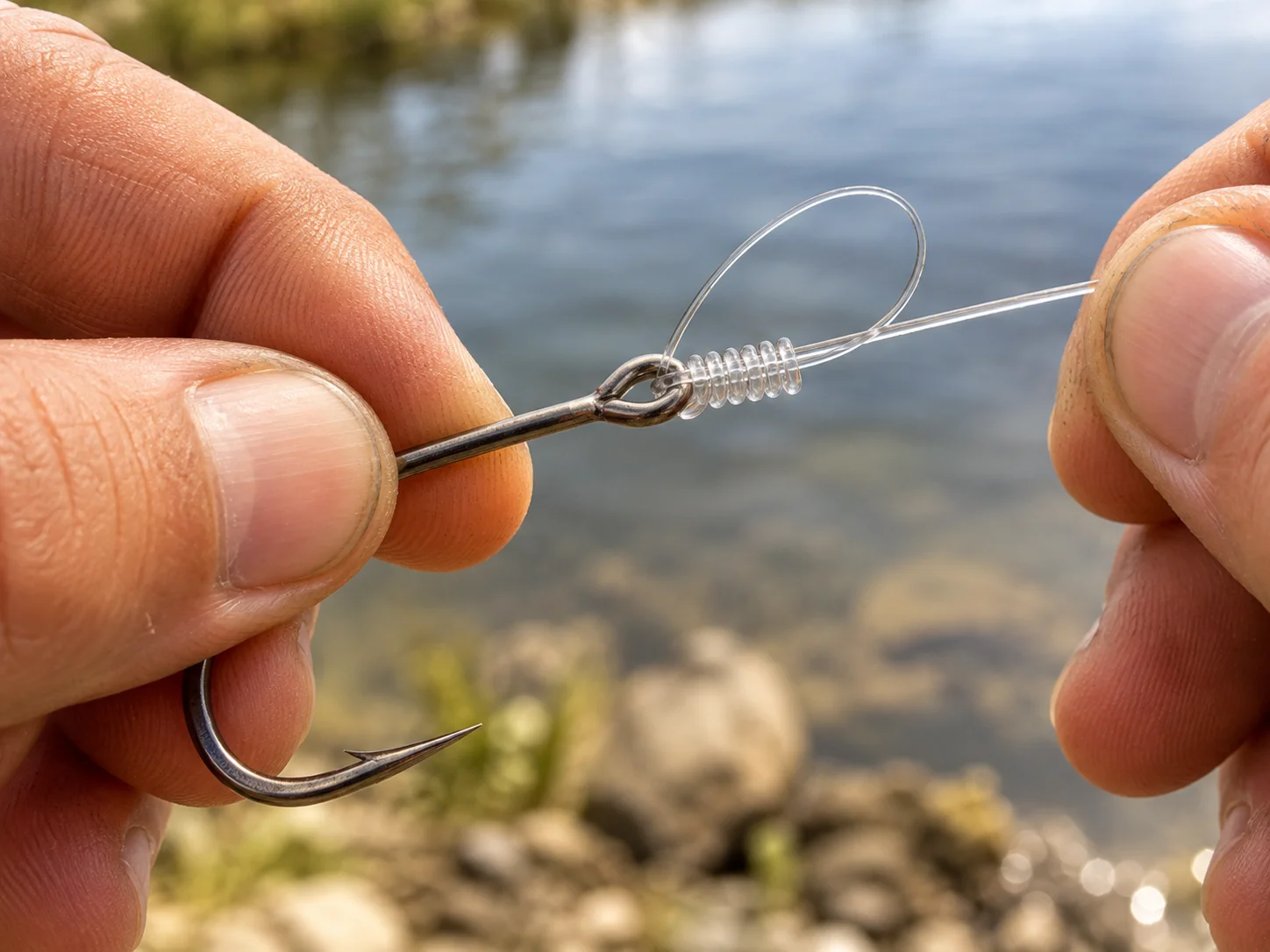
The improved clinch is probably the most widely taught hook knot in North America. State fishing education programs, the American Fishing Tackle Manufacturers Association materials, and virtually every introductory angling course lean on it as the first real knot a beginner should learn after the basic clinch. The improvement over the plain clinch is a single step: the tag end is passed back through the large loop before tightening. That one extra tuck changes retention from roughly 65% on a plain clinch to 90-95% on the improved version.
Rowland’s test showed 90.5% on 12 lb fluorocarbon, which places it second behind the Palomar. The practical advantage over the Palomar is versatility with hardware. The improved clinch works cleanly on swivels, snap clips, small jig heads, and thin-wire hooks where doubling the line through the eye is impractical or impossible. It is also faster to tie in cold or wet conditions because the motion is linear and uses only a single strand.
One real limitation: the improved clinch becomes less reliable above roughly 20 lb monofilament. The stiffer and heavier the line, the harder it is to get uniform wraps and a clean cinch without gaps. For heavy-duty applications, the San Diego Jam or Palomar is a better option. For everything in the light-to-medium range, crappie to bass, trout, panfish, inshore species on light tackle, the improved clinch is fast, reliable, and genuinely difficult to beat.
3. Uni Knot (Duncan Knot)
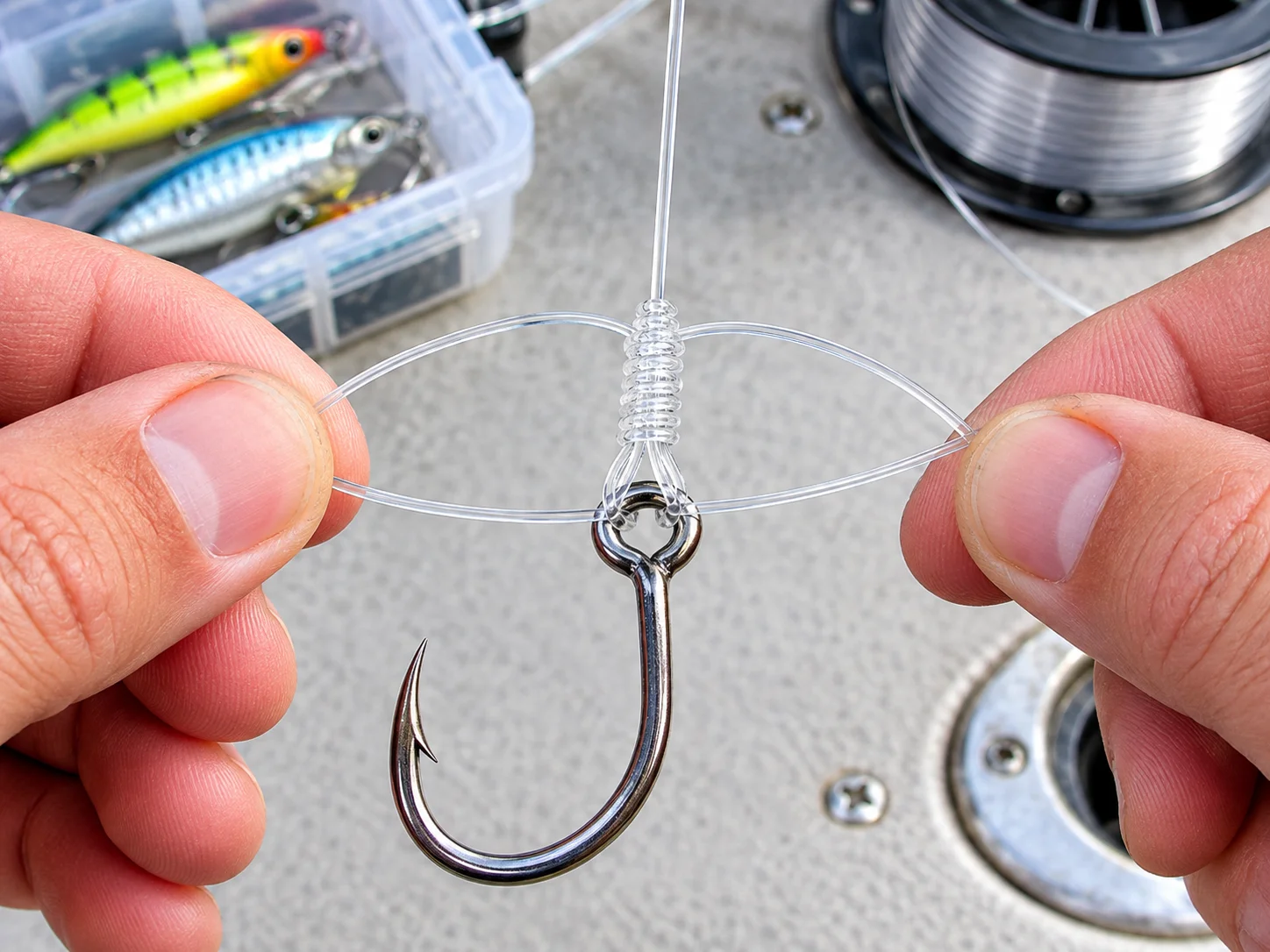
No single knot covers more situations than the uni. At its core it is a sliding loop that cinches down onto the hook eye, but the same tying sequence, with minor adjustments, works as a hook knot, a snell variant, a loop knot, and one half of a double-uni line-to-line connection. Anglers who want to minimize the number of knots they carry in memory without sacrificing range tend to default to the uni for that reason.
Strength-wise, it sits below the Palomar and improved clinch. Rowland’s test put it at 86.4% on 12 lb fluorocarbon. That is not a failure-level number, it means 86 lb of retained strength on 100 lb rated line, but it is worth knowing before you use it in situations where every percentage point matters, like targeting large fish on light line. For everyday freshwater and inshore saltwater fishing with monofilament or lighter fluorocarbon, 86% is a comfortable margin.
The uni’s distinctive feature is that you can adjust how tightly it seats before final tightening. This makes it useful when you want a small loop rather than a fixed clinch against the eye, particularly with live bait rigs where you want some movement at the connection point. Fishing.info, Outdoor Life, and Bear Essentials all include it in their core six hook knots specifically because of this flexibility. Anglers who fish a wide variety of rigs, different line types, hook sizes, and rigging styles across a single day, tend to find the uni more adaptable in practice than any other knot on this list.
4. Snell Knot
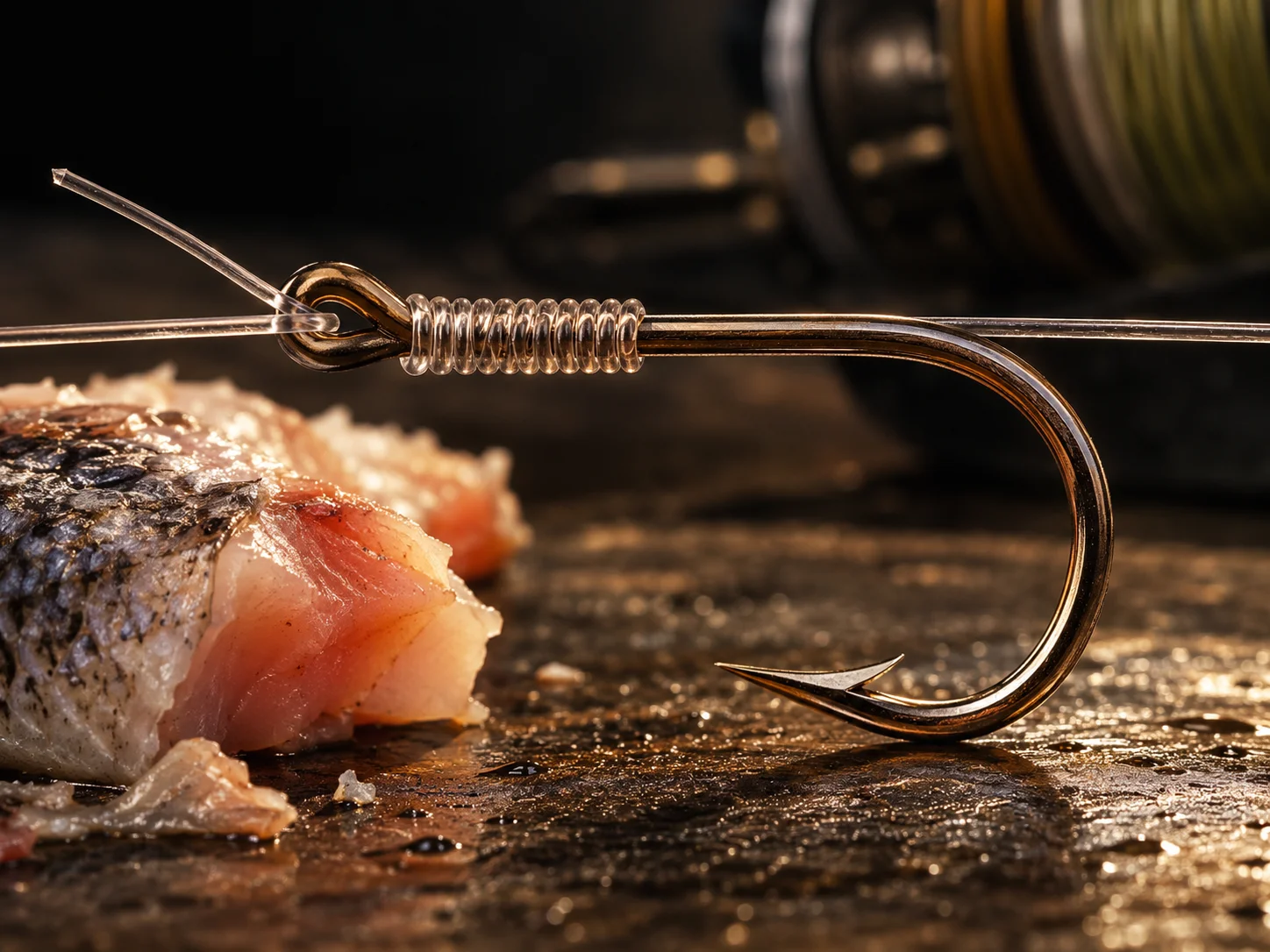
The snell knot works differently from every other knot here because the line does not pass through the hook eye in the conventional sense. Instead, the leader is threaded through the eye, then wrapped around the hook shank in a series of coils before the tag end is pulled back through the eye from the opposite direction. The result is a connection where the leader exits parallel to the hook shank rather than at an angle from the eye.
That geometry is the whole point. When you set the hook, the force travels in a straight line down the shank, which drives the point in cleanly rather than canting it sideways. Modern saltwater and bass fishing guides are increasingly direct about this: for circle hooks and octopus-style hooks used in bait fishing, a snell consistently produces a higher hookup ratio than a standard knot through the eye. The force alignment matters especially with circle hooks, which are designed to rotate into the corner of the mouth, and can only do that reliably when the line pull is parallel to the shank.
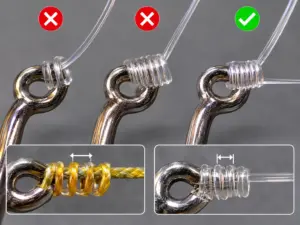
Standard snell technique requires some practice because the coils need to be tight and uniform. The common failure is loose or unevenly spaced wraps, which cause the knot to roll under load. A modified approach that many guides recommend is to use a uni knot wrapped around the shank rather than through the eye, which produces a similar straight-pull geometry with the more familiar uni tying motion. If you fish live or cut bait on any hook with a pronounced bend, adding the snell to your skill set directly translates to fewer missed fish.
5. San Diego Jam Knot
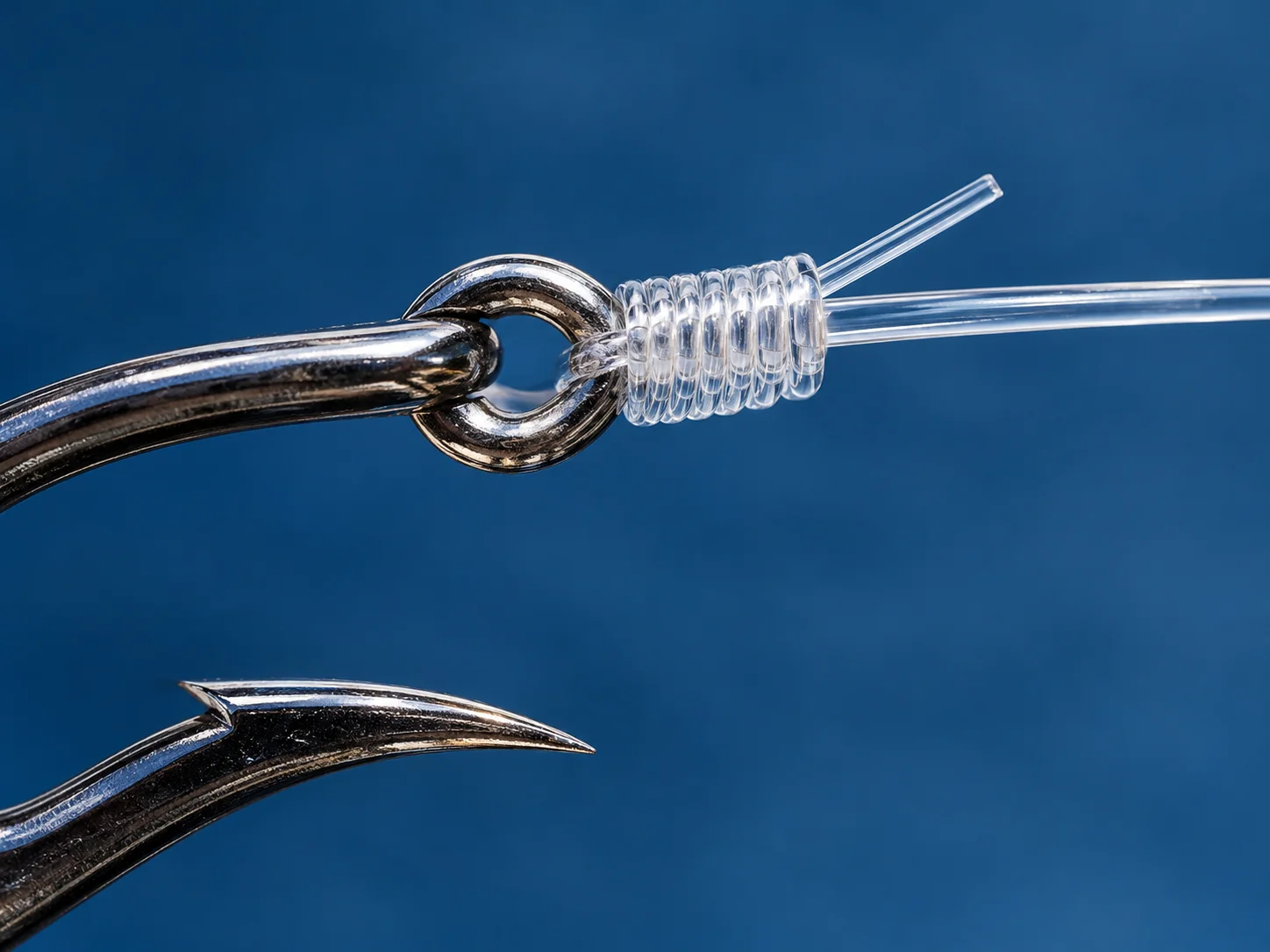
Fluorocarbon’s stiffness creates a problem for knots designed for supple monofilament. When a stiff line doesn’t lie down cleanly in the wraps, micro-gaps allow the knot to slip under load before it reaches the break point. The San Diego Jam was developed specifically to address that slippage on stiff lines and heavier leaders.
The tying sequence starts like an improved clinch, but instead of wrapping the tag end around the standing line toward the hook, you wrap it away from the hook. That reversal changes how the wraps compress when load is applied, they lock down more uniformly on fluorocarbon than the clinch-direction wraps do. Sources including Salt Strong and Outdoor Life now consistently rank it as the first choice for fluorocarbon hook and lure connections, particularly in the 15 lb to 50 lb range where other knots start to show slippage under hard strikes.
For offshore fishing with heavy fluorocarbon leaders, or for any setup where you’re connecting a large hook directly to a stiff leader, the San Diego Jam handles the material in a way that the improved clinch does not. The main learning curve is remembering the direction change in the wraps, tiers who are very accustomed to the improved clinch occasionally slip back into the wrong direction and produce a weaker knot without noticing. Tying it deliberately a few times until the backward-wrap direction becomes automatic solves this.
6. Non-Slip Loop Knot (Lefty Kreh Loop)
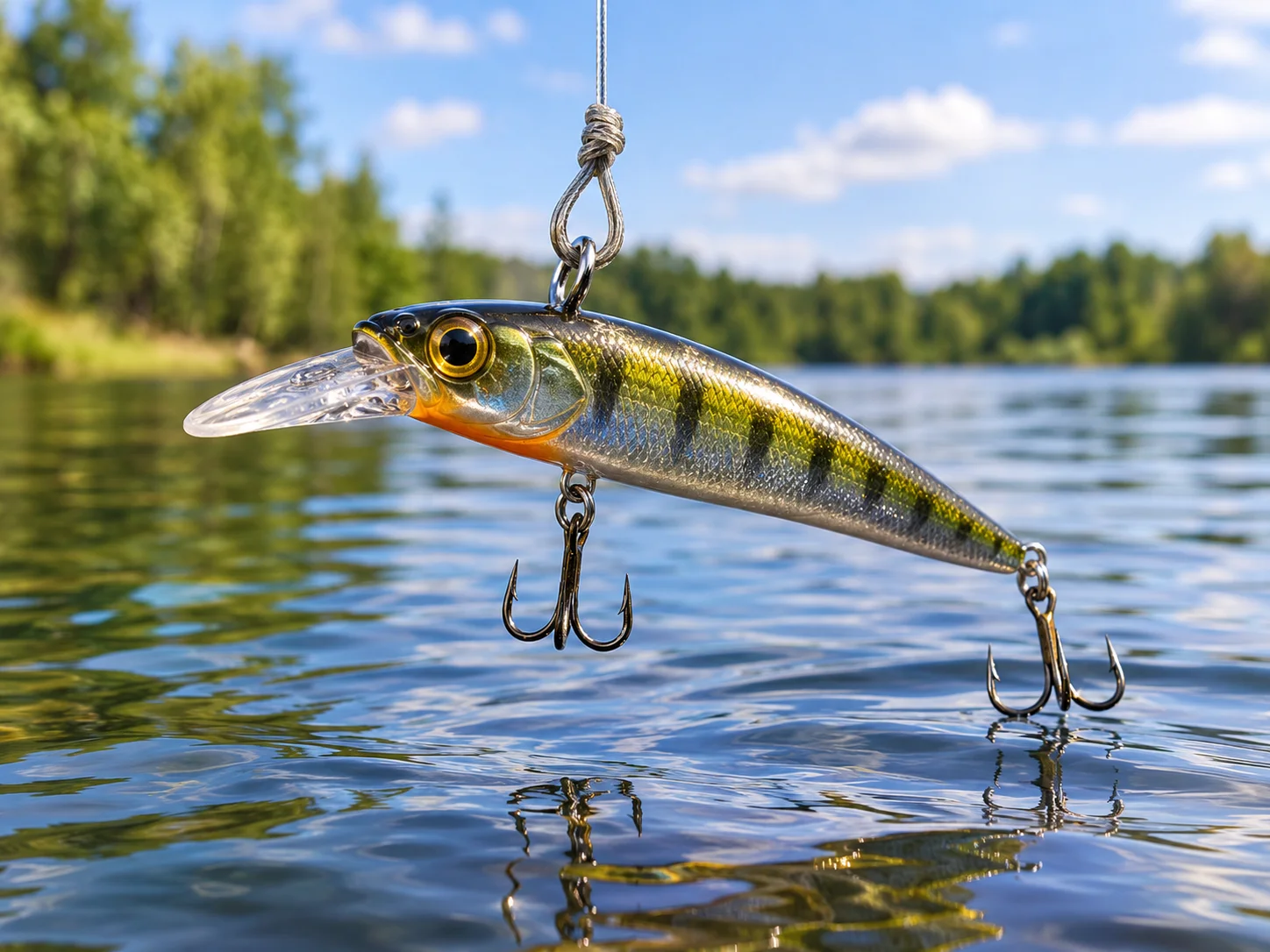
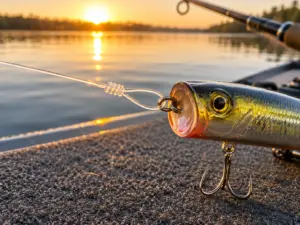
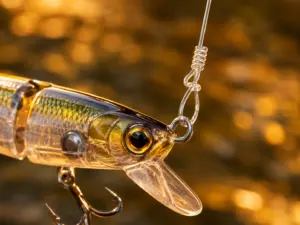
A fixed knot cinched tight against a lure’s split ring or attachment eye restricts the hardware’s range of motion. That restriction dampens the action, a suspending jerkbait that should hang and shimmy while paused ends up pivoting stiffly because the knot is choking the eye. The non-slip loop knot, also called the Lefty Kreh non-slip mono loop, solves this by forming a fixed-size loop that the lure hangs in freely.
Rowland’s pull-test placed it at 82.6% on 12 lb fluorocarbon, which is the lowest number among the six knots here. That matters in context. The non-slip loop is not a strength knot, it is a presentation knot. Its value is in what it lets a lure do, not in how close it gets to full line strength. For topwater lures, swimbaits, articulated flies, and jerkbaits, the difference between a free-swinging connection and a choked one is visible in the water. Fish that follow a lure and turn away without striking often respond to the same lure once it’s rigged on a loop knot.
The Rapala knot is a closely related alternative that many saltwater fly and plug fishermen use for the same reason. Both knots form the loop using an overhand knot as the base and tighten to a specific loop size before the final wraps are snugged down. The critical step, consistent across all sources that cover loop knots, is testing the finished loop size with the actual lure hardware before fishing, a loop that is too large gives up more strength than necessary, while one that is too small doesn’t swing freely.
Quick Comparison
| Knot | Best For | Approx. Strength Retention | Works on Braid |
|---|---|---|---|
| Palomar | General hook/lure, all line types | 95-97% | Yes |
| Improved Clinch | Light-medium hooks, lures, swivels | 90-95% | Marginal |
| Uni (Duncan) | Versatile rigs, live bait, line joins | ~86% | Yes |
| Snell | Bait hooks, circle, octopus patterns | Variable by method | Yes |
| San Diego Jam | Heavy fluoro leaders, large hooks | High (fluoro-specific) | Not recommended |
| Non-Slip Loop | Lures needing free action | ~83% | No |
Conclusion
Pick two knots from this list and get them to the point where you can tie them in low light without thinking. The Palomar covers the majority of fishing situations at the highest strength level. Add the snell if you fish bait on circle or octopus hooks, or the San Diego Jam if you use heavy fluorocarbon leaders. The others are worth learning when a specific situation calls for them, but the fish lost to knot failure are almost always lost to a poorly tied version of a knot the angler already knew, not to using the wrong knot. Practice matters more than variety.