Essentials for Hiking Every Fisherman Should Pack Before the Trail
Roughly one in three search-and-rescue operations in U.S. wilderness areas involves a day hiker who expected to be back by dark. Anglers who hike to remote fishing spots fall into this category more often than most people realize, because the destination, not the trail, tends to hold their attention. The 6 essentials for hiking every fisherman should pack before the trail exist precisely because a good fish finder and an empty pack are a bad combination. This guide breaks down each essential in full, with the specific gear choices and practical details that apply to trail anglers in 2026.
Disclosure: This post contains affiliate links. As an Amazon Associate, we earn from qualifying purchases, and at no extra cost to you.
Key Takeaways
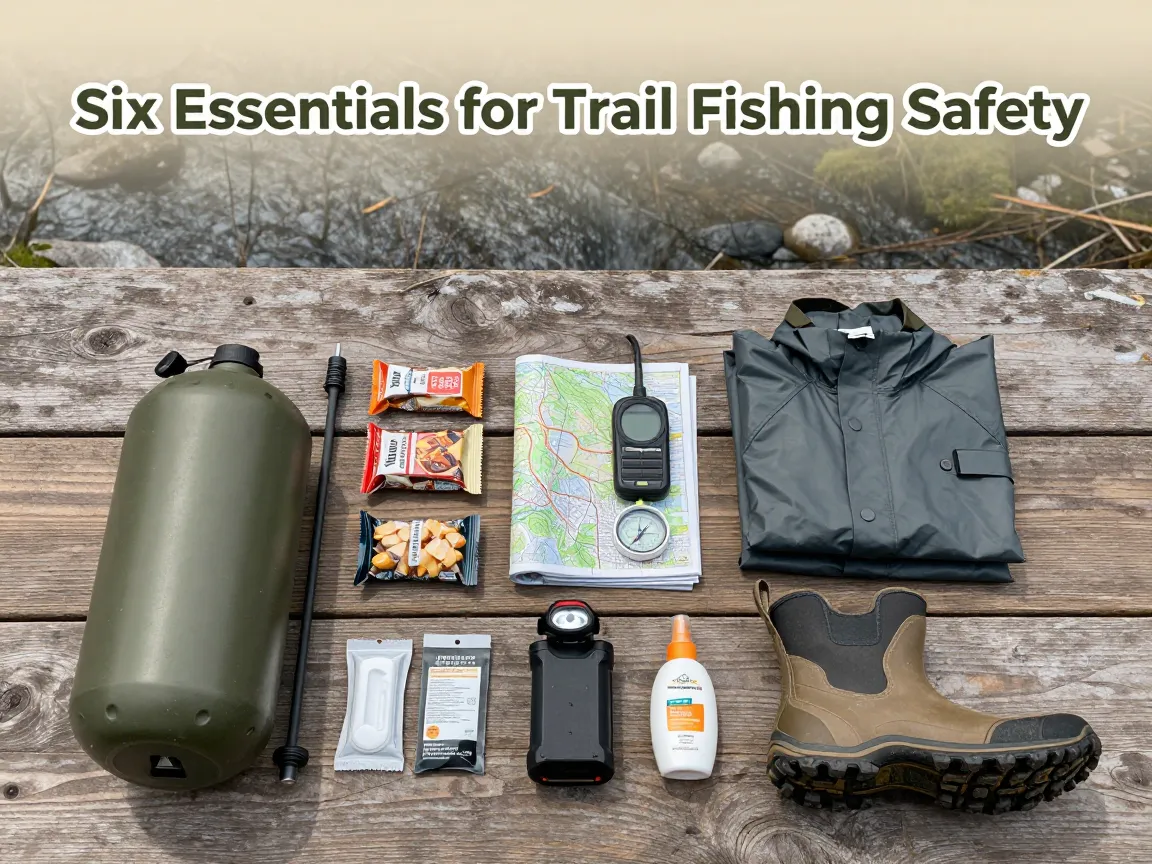
- Water and nutrition are safety items, not comforts, treat them as non-negotiable weight on any fishing hike.
- Combined analog-digital navigation with a satellite messenger now sets the baseline for backcountry communication.
- Layered, weather-appropriate clothing including wading-capable footwear is a single system, not two separate gear categories.
- A first-aid kit built for trail anglers must include blister and overuse-injury treatment, not just wound care.
- Illumination and power management work together, a headlamp without a backup battery is half a solution.
- Sun and insect protection near water are as essential as any item in the pack, especially on exposed riparian terrain.
1. Water Carry and Purification
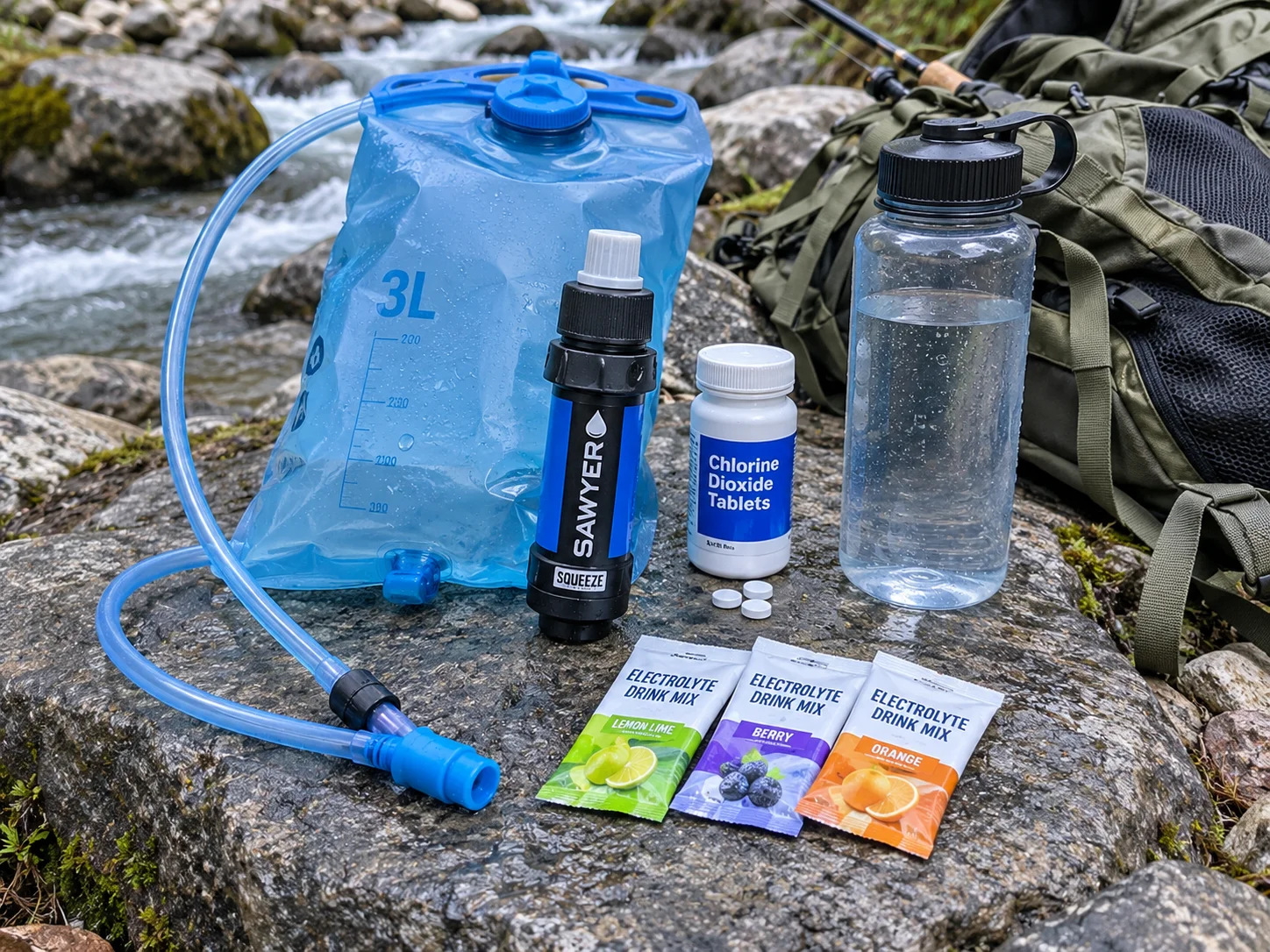
A 90-minute hike to a trailhead stream can burn through a liter of water before the first cast. Heat, elevation, and exertion raise that figure fast, and streams that look clean can carry Giardia, cryptosporidium, and agricultural runoff. Carrying water and carrying the means to purify more of it are two different tasks, and both belong in the pack.
The standard recommendation from wilderness medicine organizations is a minimum of half a liter per hour of moderate hiking, plus reserves for the time spent standing in moving water, which cools the body but also increases insensible fluid loss. A 3-liter hydration reservoir works well for the carry portion. For purification, a squeeze filter like the Sawyer Squeeze adds 3 ounces to the pack and processes up to 100,000 gallons over its lifespan, that’s a one-time purchase that covers years of trail fishing. Chemical tablets (chlorine dioxide, not iodine) serve as a backup if the filter clogs or freezes.
Electrolyte packets matter on longer routes. Plain water does not replace sodium and potassium lost through sweat, and hyponatremia, low blood sodium from drinking too much plain water while sweating, has sent anglers to emergency rooms after what they thought was a short day hike. A few Nuun or Liquid IV packets weigh almost nothing and address a real risk.
One useful habit: fill to full capacity at the trailhead even if the route passes water sources. Sources marked on maps from prior seasons may be dry, diverted, or contaminated from recent livestock activity.
2. Trail Nutrition and Energy Management
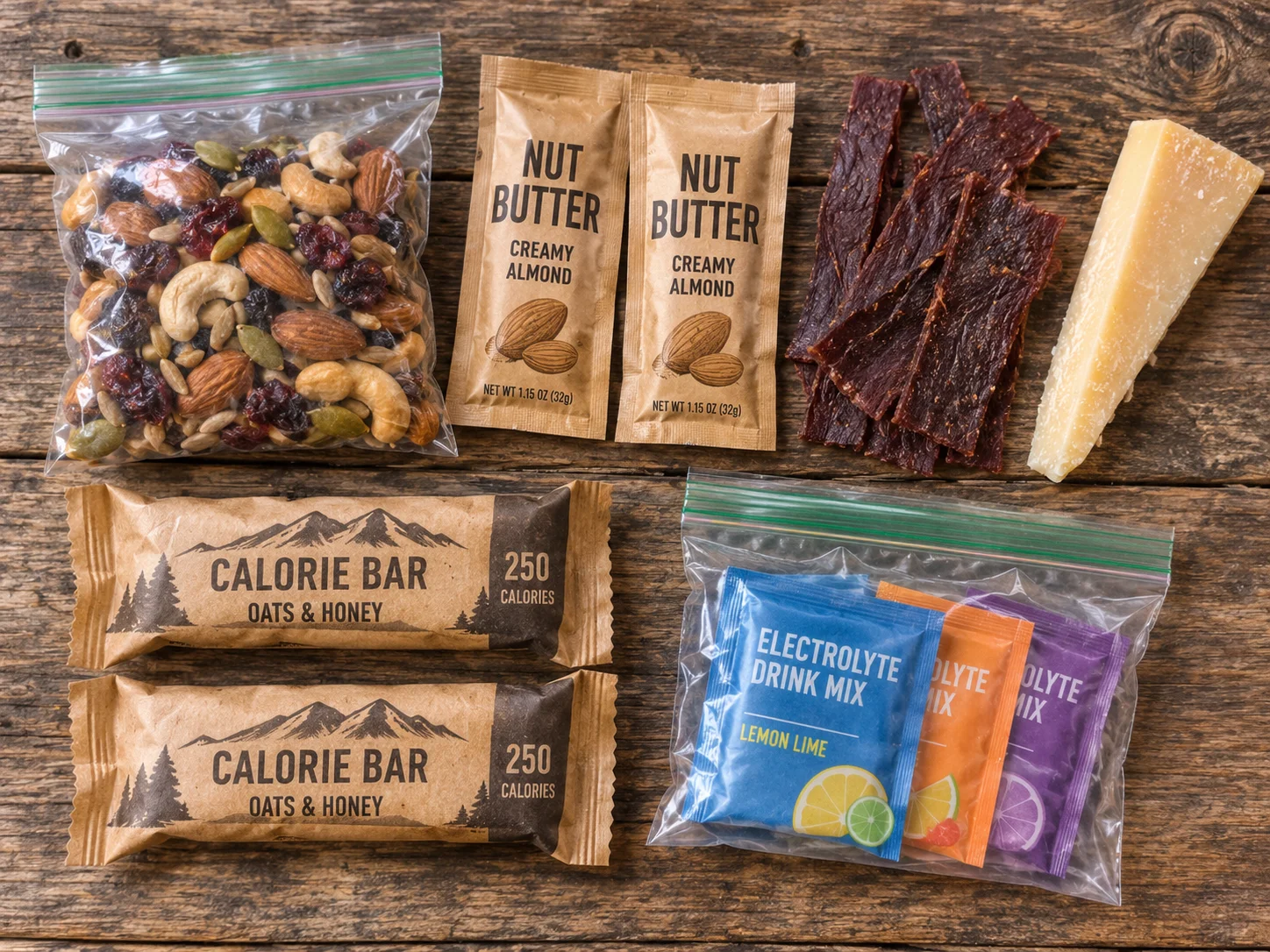
Fish don’t bite on a schedule. What starts as a three-hour hike to a known cutthroat pool can extend into a seven-hour day if the bite turns on late. Pack food for the day you might actually have, not the one you planned.
High-calorie, low-bulk food choices are the standard for backcountry hiking, and they translate directly to fishing hikes. Nuts, nut butters, jerky, hard cheese, and compressed bars like Clif Builder’s or RX Bars deliver roughly 200 calories per ounce and don’t require heat or water. A common planning figure is 1.5 to 2 pounds of food per person per full day in the backcountry. For a half-day trip with potential extension, 1,200 to 1,500 calories packed is a practical minimum.
The error most trail anglers make is treating food as an optional supplement. Caloric deficit affects decision-making, coordination, and body temperature regulation. A fisherman pushing upriver in failing light with low blood sugar is exactly the type of person who misjudges a crossing. Eating a small amount every 90 minutes, rather than waiting until hungry, maintains blood glucose more evenly than a single large meal at the turnaround point.
If you’re carrying a fishing license and a creel limit is on the table, do not plan your calorie return trip around the fish you might catch. Plan around what’s in your pack.
3. Navigation and Communication Tools
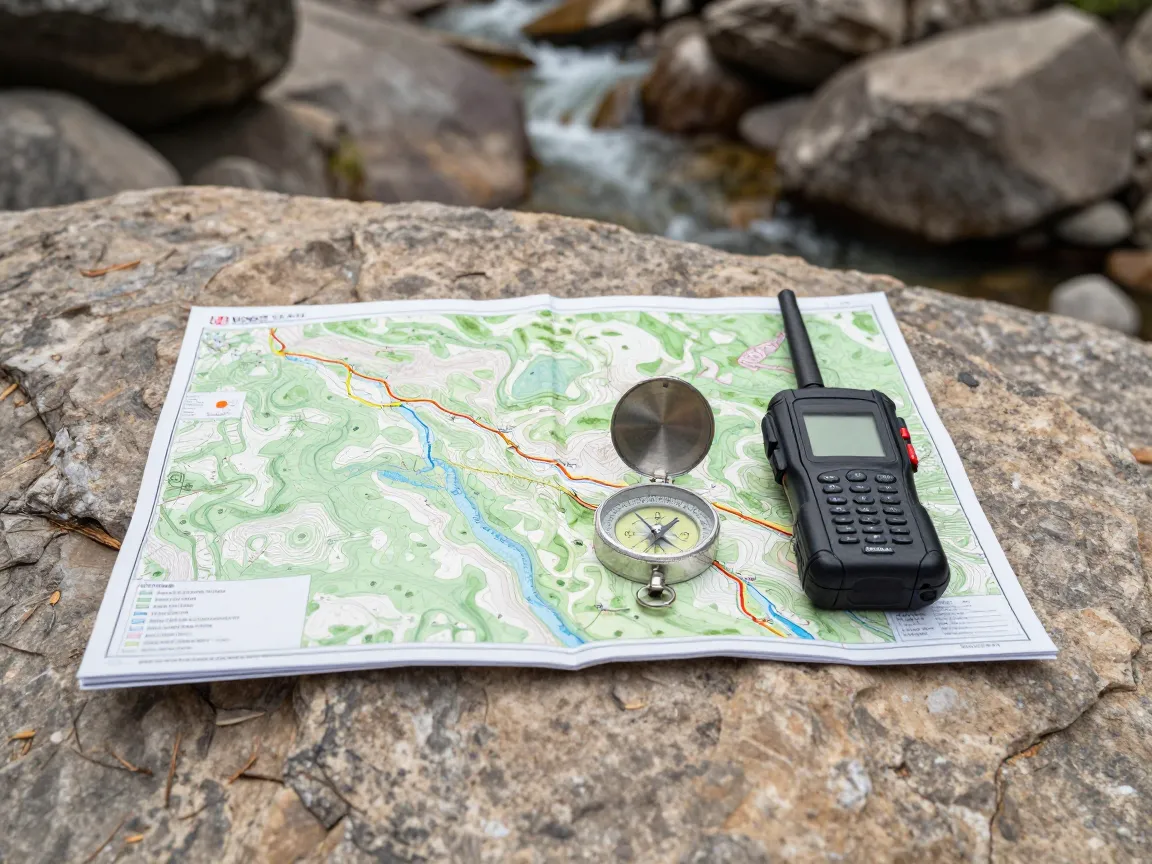
The shift away from phone-only navigation is well underway. Cell coverage in remote drainages and canyon watersheds is unreliable at best, and a wet phone in a shirt pocket is an emergency waiting to happen. The current standard for trail anglers is a layered system: a printed or laminated topographic map of the drainage, a compass, and a device that works without cell signal.
Garmin’s inReach Mini 2 and the SPOT X cover both GPS navigation and two-way satellite messaging. The inReach Mini 2 weighs 3.5 ounces and allows SOS activation that connects directly to the GEOS International Emergency Response Coordination Center, 24 hours a day. That’s not a luxury feature; it’s the difference between a delayed rescue and a timely one when a wading accident or a sprained ankle puts you off-trail after dark.
Topographic maps of the specific drainage serve a purpose GPS cannot fully replace. Device batteries die. Screens crack. A laminated USGS 7.5-minute quad map costs under $15 and shows terrain features, water sources, and elevation that help you read the land before you’re on it. Mark your planned route in advance and note at least one bail-out path.
Some fishing hikes in 2026 follow managed routes like the Fishermen’s Trail in Portugal or designated backcountry corridors in national forests where waypoints and trail conditions change seasonally. Downloading the most recent offline maps before each trip, rather than relying on a cached version from last season, closes a common gap.
4. Clothing, Footwear, and Weather Layering
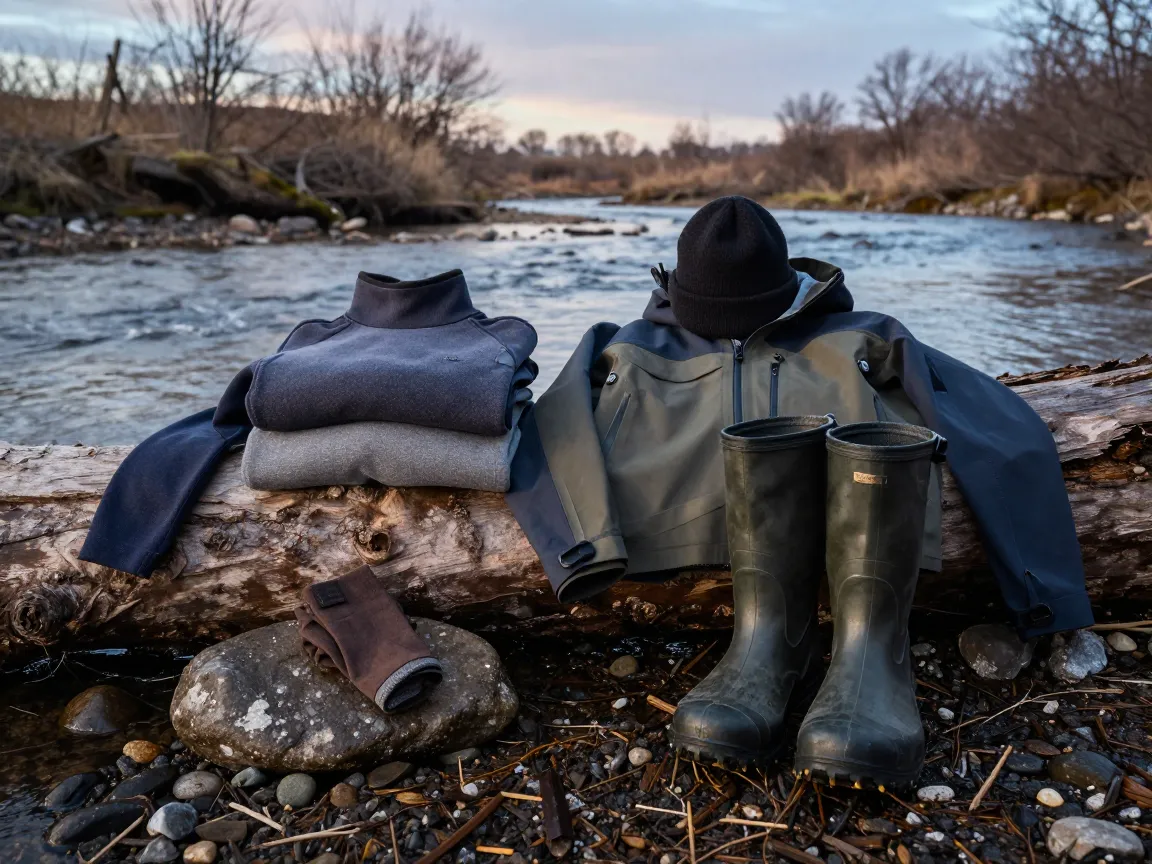
Standing in a cold stream for three hours while the weather changes overhead is a different physical experience from hiking the same number of miles on dry ground. Anglers face both conditions in the same outing. The layering system needs to address hiking sweat, water exposure, wind on exposed ridgelines, and the possibility of getting caught out after dark when temperatures drop.
A three-layer system is the practical standard: a moisture-wicking base layer (merino wool or synthetic, never cotton), a mid-layer fleece or insulating jacket that compresses to pack size, and a waterproof-breathable shell. Simms, Patagonia, and Sitka all produce shells with wading-compatible cuts in 2026, meaning the jacket moves with waders or wet pants rather than riding up. The shell should pack down to roughly the size of a water bottle.
Footwear deserves specific attention. Wading boots with felt or rubber soles designed for stream substrate are not ideal hiking boots, and hiking boots are not wading boots. Felt soles are banned in many U.S. states due to aquatic invasive species transport. The compromise that works for most trail fishing situations is a lightweight wading shoe with a rubber lug sole rated for both dry trail and wet rock, Korkers Buckskin and the Orvis Encounter Wading Boot are examples of this hybrid category.
Always pack a dry layer of socks and an insulating hat, regardless of forecast. Temperature near moving water is typically 5 to 10 degrees Fahrenheit cooler than conditions a mile from the stream, and afternoon thunderstorms at elevation build faster than most weather apps update.
5. First Aid, Foot Care, and Injury Prevention
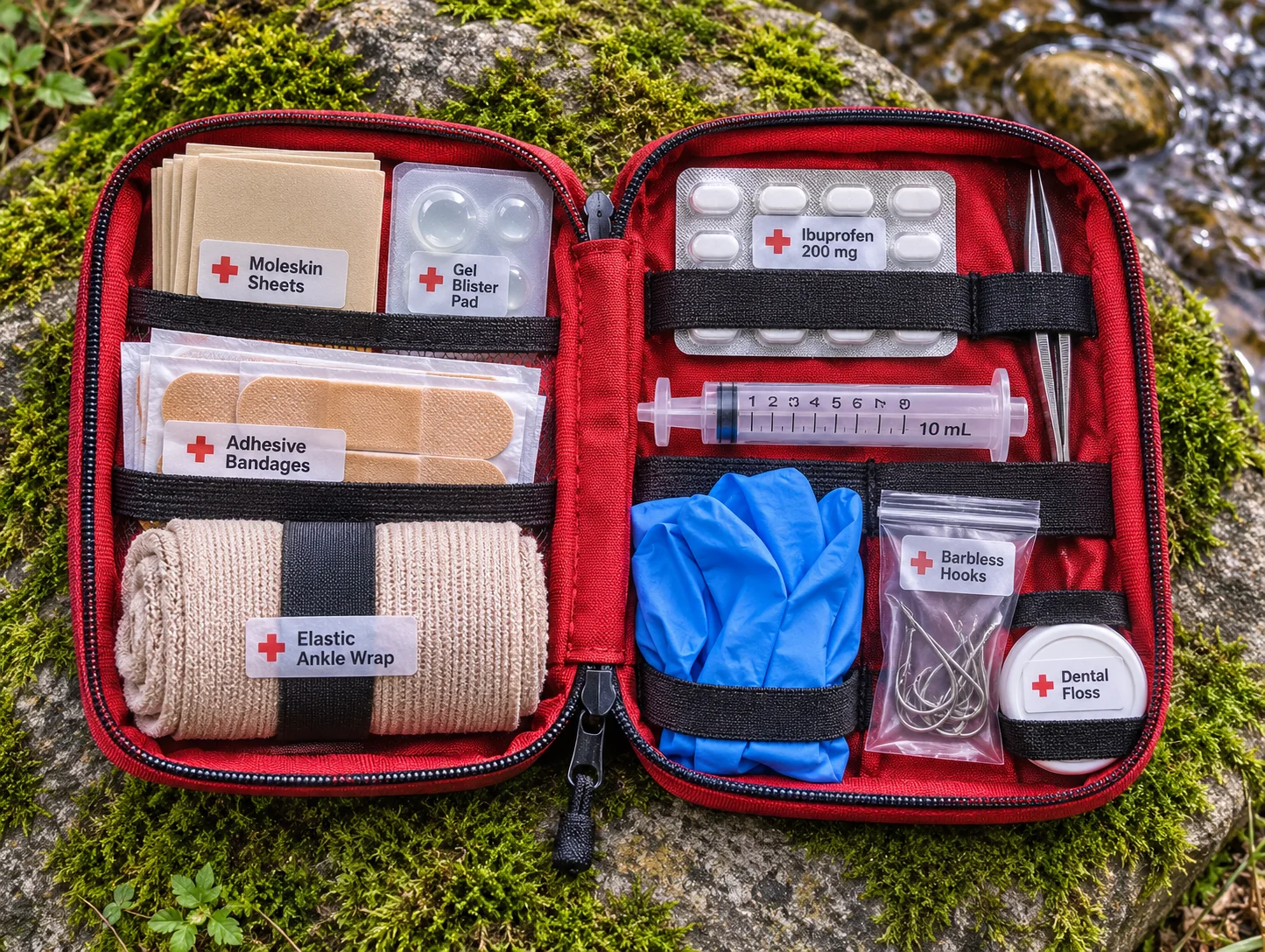
The injuries that stop fishing hikes are rarely dramatic. Blisters, twisted ankles, and knee pain from uneven terrain account for most trail-related medical events among anglers. A first-aid kit configured for trail fishing addresses these specifically, rather than just repackaging the contents of a car-kit.
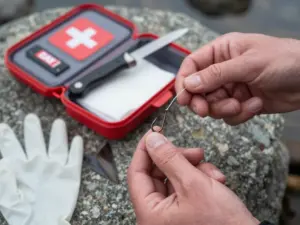
The Wilderness Medical Society recommends that any backcountry kit cover wound care, blister treatment, pain relief, and basic splinting for lower extremities. For trail anglers specifically, moleskin and a gel blister pad system (Compeed is the most field-tested brand) belong in the kit alongside standard adhesive bandages. Ankle ace wraps serve double duty as compression for a mild sprain and as a support wrap for the return hike. Add ibuprofen, not just acetaminophen, since ibuprofen’s anti-inflammatory effect is more useful for overuse swelling in knees and ankles.
Hook injuries are a specific risk. A barbless hook is safer to remove than a barbed one, and many catch-and-release regulations now require barbless hooks anyway. For barbed hooks embedded in skin, the string-yank technique (looping dental floss around the bend and pressing down on the eye while pulling the loop sharply) is the fastest field extraction method and causes less tissue damage than cutting the hook out. Know the technique before you need it.
Tick removal with fine-pointed tweezers, wound irrigation with a syringe (10 mL is sufficient volume and pressure), and nitrile gloves complete the kit. Total weight for a well-configured trail-angler first-aid kit runs about 8 ounces when packed deliberately.
6. Illumination, Power, and Sun and Insect Protection
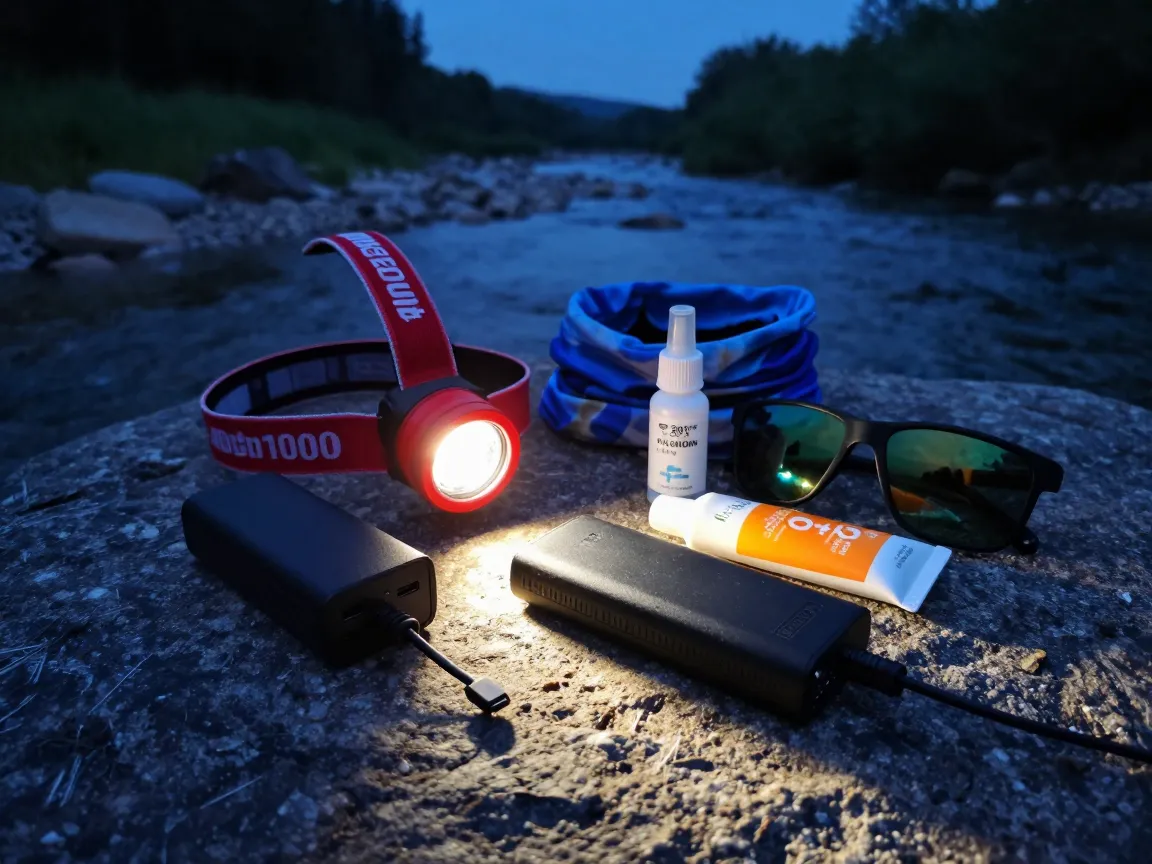
These three items look like separate categories but function as one grouped essential on any fishing hike, because they all relate to managing your exposure, to darkness, to UV radiation, and to insects that become a serious nuisance (and health risk) near water.
A headlamp is the illumination standard over handheld flashlights for the simple reason that it frees both hands, which matters for rigging tackle, navigating slippery banks, and tending to a minor injury. The Black Diamond Spot 400 produces 400 lumens on its high setting and runs approximately 200 hours on its low red-light mode, the red mode preserves night vision and doesn’t spook fish at dusk. Carry fresh batteries or a fully charged USB-C model. Add a 10,000 mAh power bank to maintain phone, GPS device, and headlamp charge across a multi-hour day. Anker’s PowerCore Slim 10K weighs 6.7 ounces and charges two devices simultaneously.
Sun protection near open water is a genuine safety issue. Water reflects UV radiation at rates up to 10% higher than dry land, meaning eight hours on a stream can deliver more cumulative UV exposure than the same time on a trail through forest. A broad-spectrum SPF 50 sunscreen applied before departure and reapplied at midday, along with a sun-protective buff or neck gaiter and UV-blocking sunglasses with side shields, reduces both burn risk and long-term eye damage from water glare.
Insect protection has a direct safety dimension in many U.S. fishing regions. West Nile Virus, Rocky Mountain Spotted Fever (tick-borne), and tularemia are present in riparian zones across the Mountain West and Southeast. DEET at 25-30% concentration or picaridin at 20% concentration are the two effective options approved by the CDC. Permethrin-treated clothing adds a second barrier, particularly on brush-heavy approach trails. Apply both before the hike starts, not after the first mosquito bite.
Quick Comparison
| Essential | Primary Item | Backup or Supplement | Approximate Weight |
|---|---|---|---|
| Water and Purification | 3L hydration reservoir | Sawyer Squeeze + chlorine dioxide tabs | 10 oz (filter kit) |
| Trail Nutrition | 1,500 cal dense food | Electrolyte packets | 14-20 oz |
| Navigation and Communication | USGS topo map + compass | Garmin inReach Mini 2 | 3.5 oz (device) |
| Clothing and Footwear | 3-layer system + hybrid wading boot | Dry socks + insulating hat | Varies |
| First Aid and Foot Care | Blister kit + ankle wrap + hook tools | Ibuprofen + irrigation syringe | 8 oz |
| Illumination and Protection | 400-lumen headlamp + 10K power bank | SPF 50 + 20% picaridin | 11 oz (combined) |
Conclusion
Every item on this list addresses a specific failure mode that actually stops fishing hikes, not a hypothetical worst case. The one step worth taking before your next trip is running your current pack against this list and identifying which category is thinnest. For most trail anglers, it’s navigation and communication, the phone-only approach is the most common gap and the one with the highest consequence. Add a satellite messenger and a printed topo map of your drainage before the season’s next outing. Everything else can be added gradually; that one cannot wait until you need it.