Vintage Fishing Pictures That Inspire Classic Angler Style
Roughly 13,000 “old fishing photo” images are listed on a single major stock platform in 2026, and that number has grown year over year. The demand is not sentimental. Photographers, stylists, and serious anglers are actively studying vintage fishing pictures to reconstruct authentic gear choices, clothing, and posture that modern fishing culture has largely abandoned. These 6 vintage fishing pictures that inspire classic angler style pull from the Library of Congress archives, antique tintype collections, tackle catalogs, and mid-century river scenes to show exactly what made those images so visually distinct, and what you can take from them today.
Disclosure: This post contains affiliate links. As an Amazon Associate, we earn from qualifying purchases, and at no extra cost to you.
Key Takeaways
- Late-19th-century tintypes show anglers in coat, tie, and dress hat using 10- to 12-foot rods, which is the clearest single visual template for recreating classic angler style.
- Wicker creels, landing nets, and Victorian-era accessories carry as much visual weight as the rod and reel in period-accurate angling photography.
- Mid-20th-century river-wading postures from scenes like fly fishing on the Ausable River circa 1960 define a recognizable mid-century angler silhouette that modern stylists still copy.
- Cross-cultural vintage fishing images from Istanbul’s Bosphorus and Russian riverbanks expand the reference vocabulary beyond North American fly-fishing tropes.
- Contemporary sport-fishing illustration, like Doug Schermer’s work for Bassmaster’s 2026 coverage, shows how classic visual cues translate directly into current angling iconography.
- Stock collections now quantify this aesthetic demand, making vintage fishing imagery one of the most commercially active categories in outdoor photography archives.
1. The Late-19th-Century Tintype Portrait
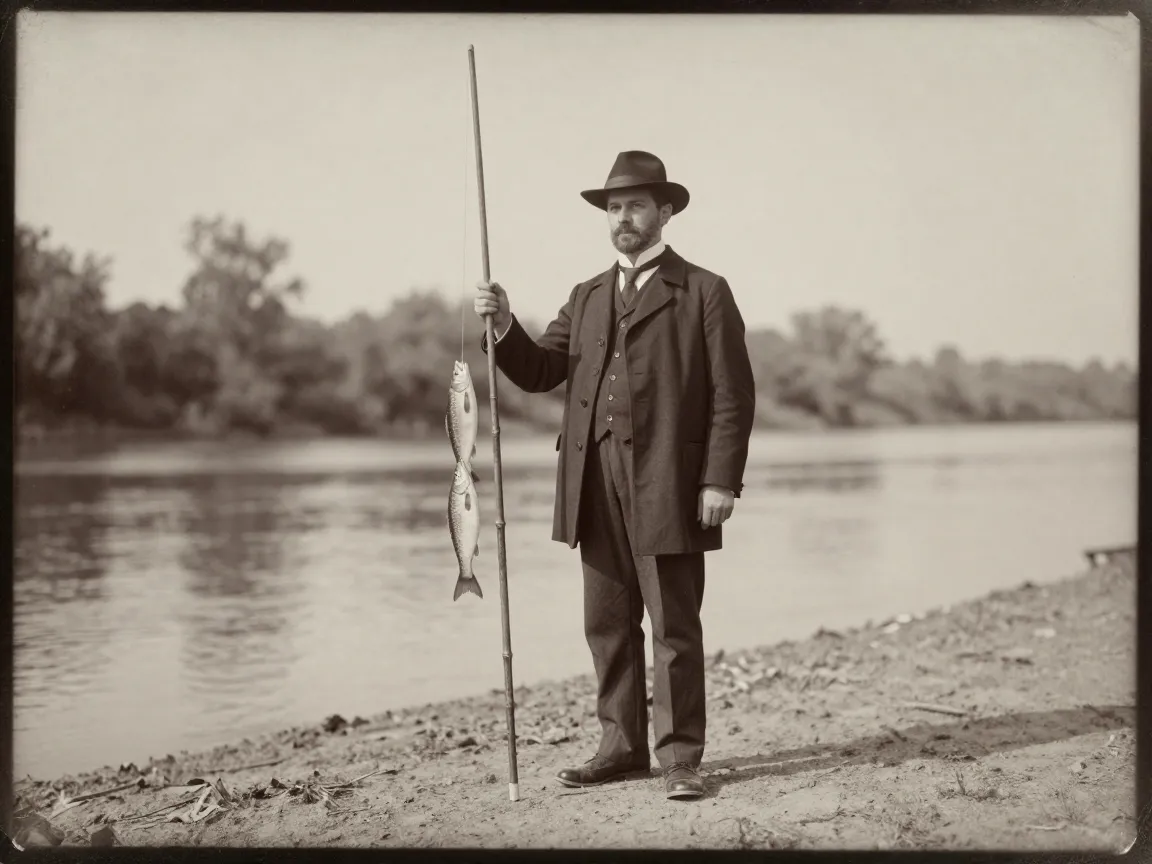
Antique tackle expert Jim Schottenham owns two to three dozen tintypes and 200 to 300 other antique angling images, and among that collection the late-19th-century tintype portrait stands out as the clearest visual statement of what classic angler style actually looked like. These photographs were typically shot on dry land or at the water’s edge, with the angler dressed in a full suit coat, necktie, and a stiff-brimmed dress hat. The rod was long, often 10 to 12 feet, made from split cane or bamboo, and held upright rather than cast at distance.
What the tintype portrait tells a modern stylist is specific. The clothing was not fishing gear in the contemporary sense. It was everyday formal wear brought to the riverbank without modification. There were no vests with zippered pockets, no technical fabrics, and no polarized lenses. The formality was not performative, it was the default dress code of the period, and photographs preserved it because a tintype sitting was itself a formal occasion.
The composition of these images is also instructive. Anglers posed with long strings or boards of fish displayed prominently, a tradition Schottenham notes directly. The fish were proof of skill, arranged to maximize visual count. That “hero shot” convention has never fully disappeared from angling photography, but the tintype version pairs it with a seriousness of dress that gives the image an authority modern grip-and-grin photos rarely achieve. If you want to recreate this look, the starting point is a long rod held vertically, formal above-the-waist clothing, and a catch displayed flat or on a board rather than held by the jaw.
2. The Library of Congress “Fish & Fishing” Archival Print
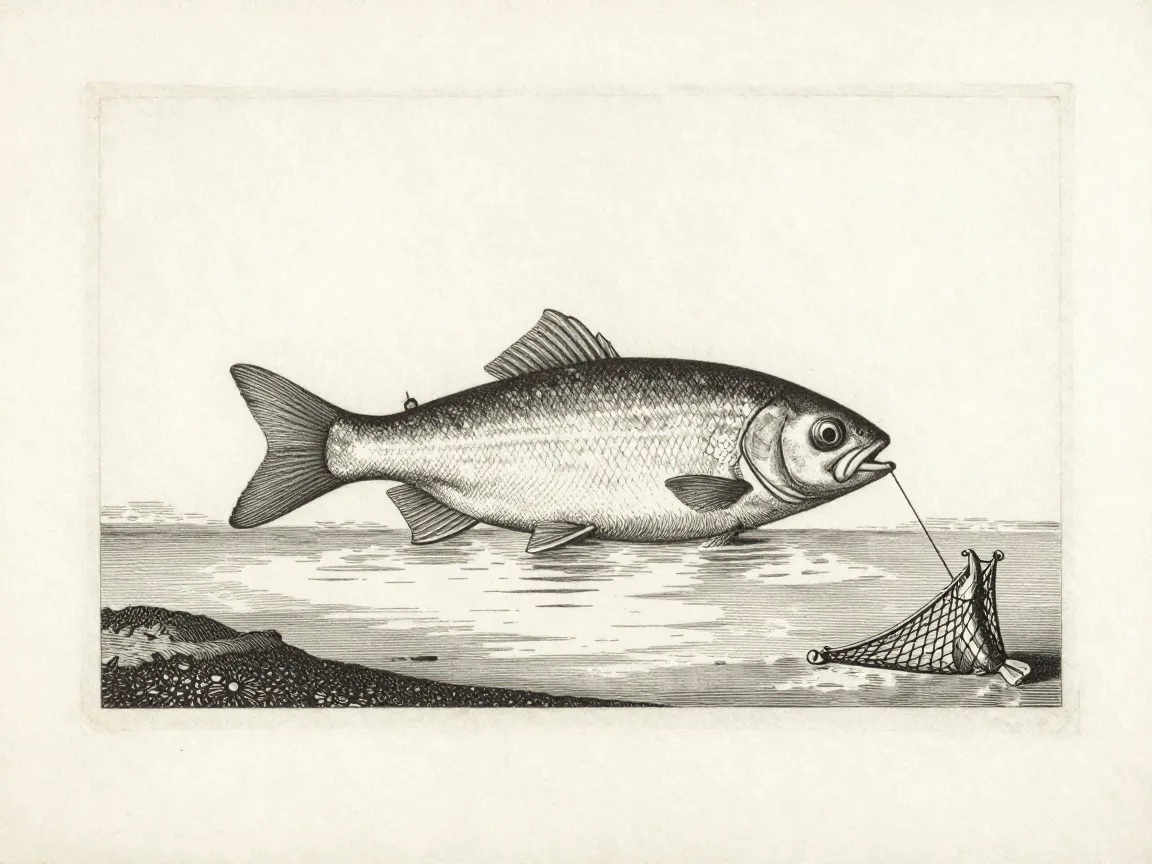
The Library of Congress “Fish & Fishing” free-to-use set contains fifty images and prints spanning the 16th through 21st centuries. Within that range, the 16th- and 17th-century scientific and decorative prints occupy a category of their own. These are not photographs of anglers but detailed engravings and woodcuts that defined how fish and fishing gear were visually documented before photography existed.
What makes these prints useful for anyone studying classic angler style is how precisely they record tackle. Rod joints, line guides, hook shapes, and net construction appear in these images with the kind of detail that manufacturers used as reference. The visual language is clean and declarative, no background clutter, no atmospheric weather effects, just the subject rendered accurately. That restraint influenced how angling was depicted in later centuries, including the composed, uncluttered portrait style that shows up in those 19th-century tintypes.
The prints also set a precedent for the nostalgic and authoritative tone that vintage fishing imagery still carries. A woodcut of a carp or a trout from 1580 reads as serious natural-history documentation, not as hobbyist content. When modern designers pull from this visual tradition for branding or editorial work, that tone transfers. The Library of Congress collection is free to use, which makes these prints one of the most accessible starting points for anyone building a visual reference library around classic angler aesthetics.
One useful application is to study the proportional relationship between angler, rod, and water in these prints. The human figure is often small relative to the landscape, which is the opposite of modern fishing photography’s tendency to center the angler’s face. That compositional choice gives vintage angling images a sense of scale and environment that feels genuinely different from contemporary work.
3. The Wicker Creel and Net Still Life
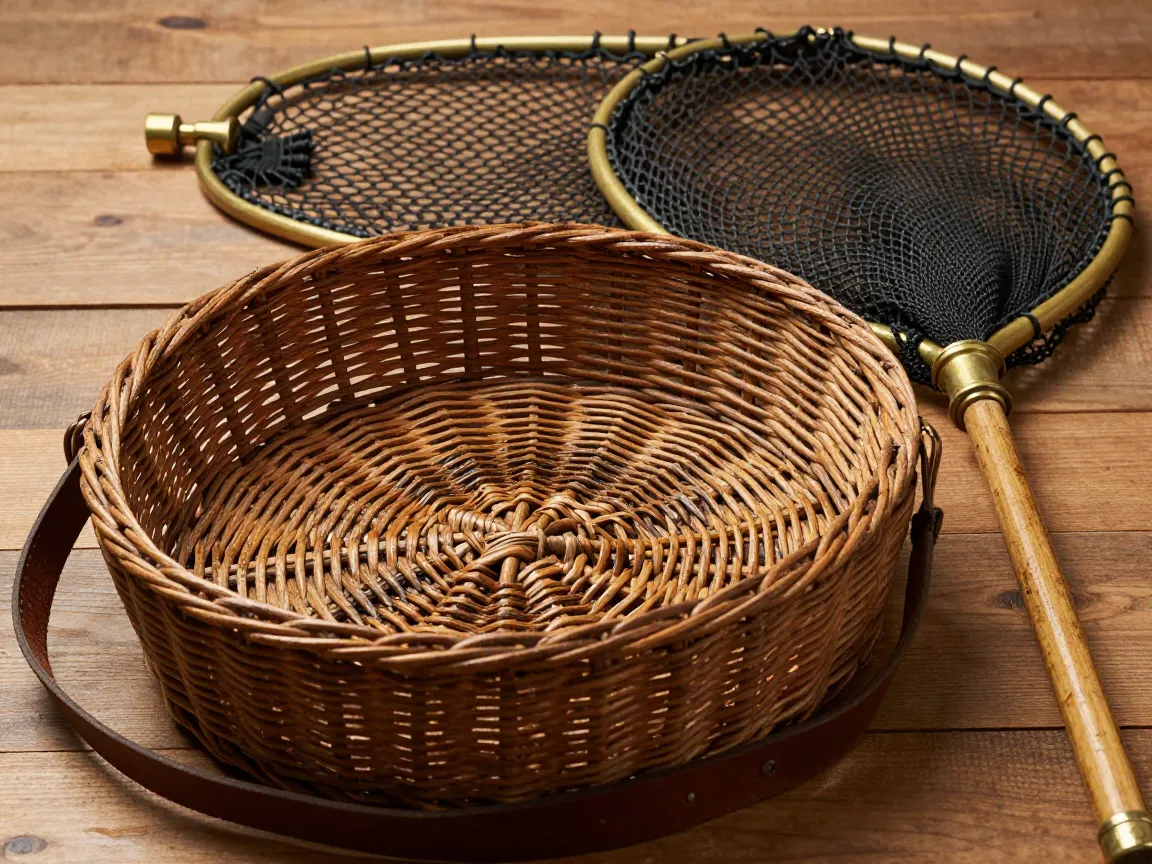
iStock’s curated set of over 260 “vintage fishing creel and net” images makes the case clearly: accessories are not secondary in classic angling photography. The wicker creel, landing net, and Victorian-era gear that appear in these images are often the dominant visual elements, with the rod and angler receding into the background.
A wicker creel is a woven basket worn on a strap over the shoulder, used to hold the day’s catch on ice or wet grass. In period photographs, it appears damp, stained, and battered in a way that communicates long use. That evidence of use is a key difference between staged vintage photography that misses the mark and images that feel genuinely period-accurate. A clean, dry wicker creel in a recreated photograph reads as a prop. One that shows wear and moisture reads as equipment.
The landing net matters for similar reasons. Victorian and Edwardian landing nets used wooden or cane frames with deep cotton mesh bags, and they were carried looped over the shoulder or attached to a creel strap. The net frame’s shape, often a D-shape or teardrop rather than the round wire frame common today, is immediately recognizable as period-specific. Including a correctly shaped net in a recreated image shifts the visual reading from “retro-themed” to “accurately historical.”
For photographers and stylists working in this space, the still-life format, where gear is arranged flat on a surface or hung on a wall rather than held by an angler, can be more effective than a posed portrait at communicating material authenticity. The texture of wicker, brass hardware, and oiled cane reads clearly in close lighting, and the arrangement itself becomes the subject.
4. Mid-Century River Wading on the Ausable
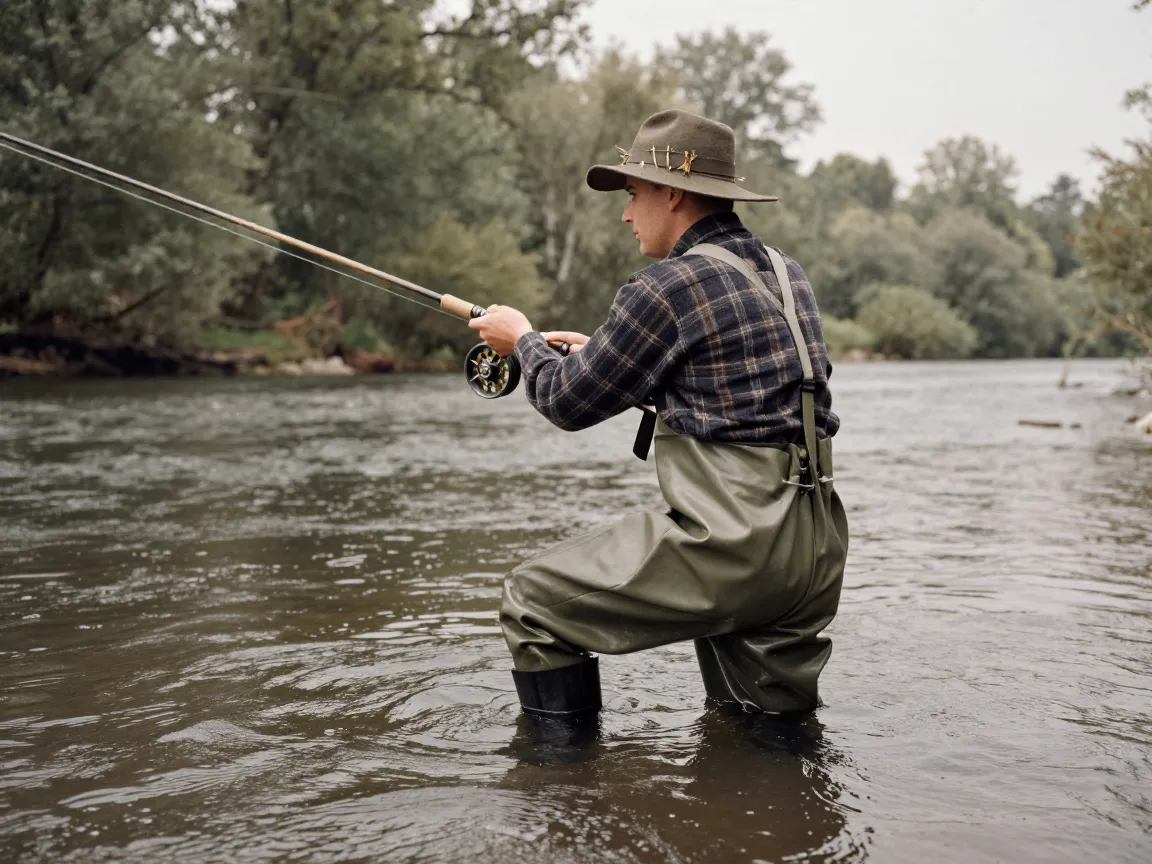
Getty Images holds a collection of 672 “vintage-fishing-reels” photos and illustrations, and within that archive the fly-fishing scenes from New York’s Ausable River circa 1960 define what mid-century angler style looked like in practice. These are not formal portraits. They are action images, or as close to action as mid-century sporting photography could manage, showing anglers standing knee-deep in moving water, rod held at a backcast angle, line in the air.
The clothing in these images is the most copied reference for mid-century angler style. Wool shirts, often in dark plaid or solid olive, paired with chest-high rubber waders and a felt-brimmed hat with a few flies stuck in the band. The reel visible in these images is typically a click-pawl design with a narrow spool, often a Pflueger Medalist or similar, mounted below the rod handle in the standard down-locking configuration. That reel position and profile is a recognizable period detail.
The posture in Ausable-era images is also worth studying. The angler stands facing across the current rather than downstream, weight distributed evenly on both feet, rod elbow close to the body. This stance comes from casting with heavy fiberglass or early graphite rods in moving water, and it looks different from the open, reaching posture visible in contemporary fly-fishing photography. The mid-century stance reads as deliberate and planted. It suggests experience with specific water rather than athleticism for its own sake.
Recreating this look requires getting the reel right. A wide-arbor modern reel mounted on a classic-style cane or fiberglass rod breaks the visual logic immediately. The narrow-spool, large-diameter click-pawl reel is the pivot point around which the rest of the mid-century aesthetic turns.
5. Cross-Cultural Vintage Scenes from the Bosphorus and Russian Riverbanks
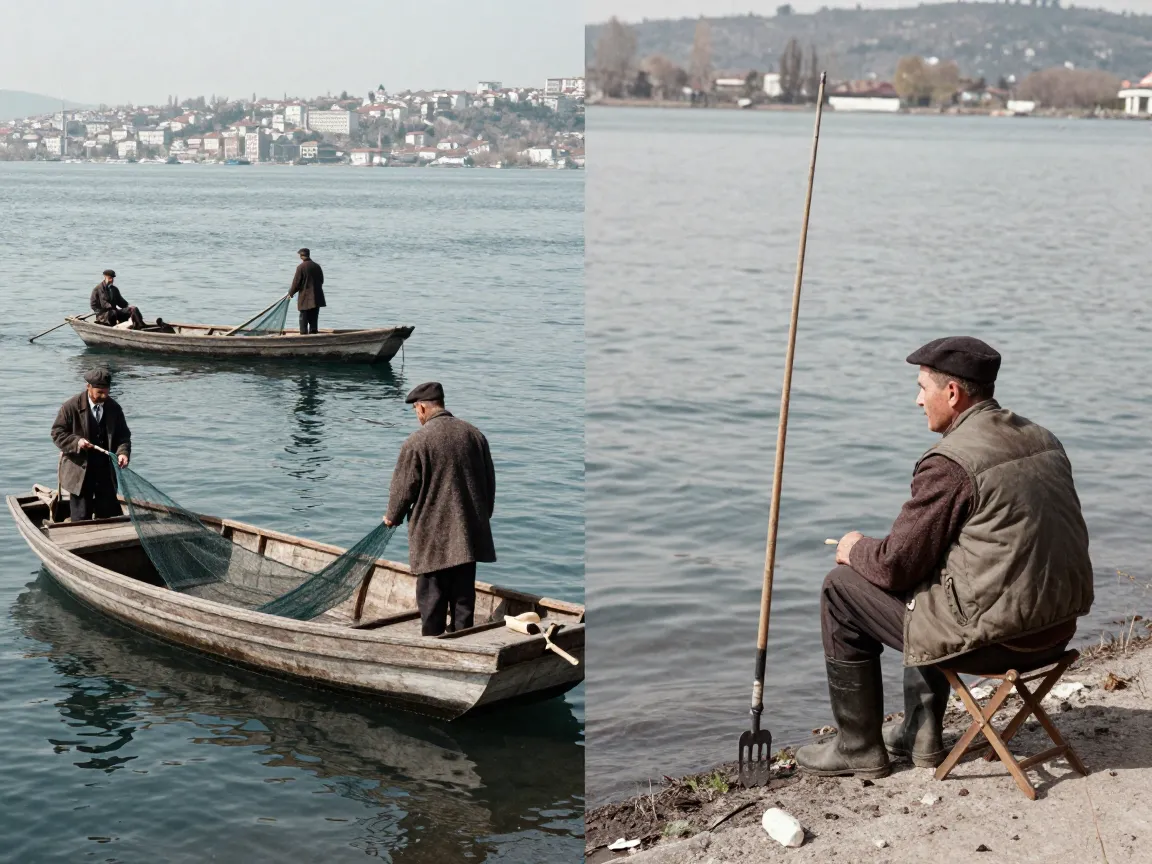
Stock collections categorized under “50s fishing” and “old fishing photo” include images well outside the North American fly-fishing tradition. Among the most visually distinct are 1950s photographs of “dalyan” fishing on Istanbul’s Bosphorus and candid 1980s riverbank scenes from Russia, both of which show how classic angler style varied across cultures while sharing certain structural features.
The Bosphorus dalyan images show net-based commercial fishing from wooden boats, with anglers wearing work clothes, heavy wool coats, and flat caps. The visual grammar is entirely different from the sporting-gentleman tradition of North American tintype photography, there is no formal dress, no rod, no single hero catch. The subject is collective labor, with nets, boats, and water dominating the frame. What these images share with the North American tradition is the same quality of material specificity: the nets are handmade, the boats are worn, and nothing in the image was placed there for aesthetic effect.
The 1980s Russian riverbank photographs show a similar quality of unaffected presence. An angler sitting on a folding stool at the edge of a slow river, rod propped on a forked stick, wearing a padded vest and rubber boots, is not composing himself for a photograph. The resulting image has a candor that most staged vintage-style photography cannot manufacture.
The practical value of these cross-cultural images is that they expand what “classic angler style” can mean. If the reference is always the North American gentleman angler with his bamboo rod and wicker creel, the aesthetic stays narrow and expensive to replicate. The flat cap, wool coat, and wooden boat of the Bosphorus fisherman, or the folding stool and forked stick of the Russian riverbank scene, offer entry points that are both visually compelling and far more accessible to recreate.
6. Contemporary Sport-Fishing Illustration Rooted in Classic Imagery
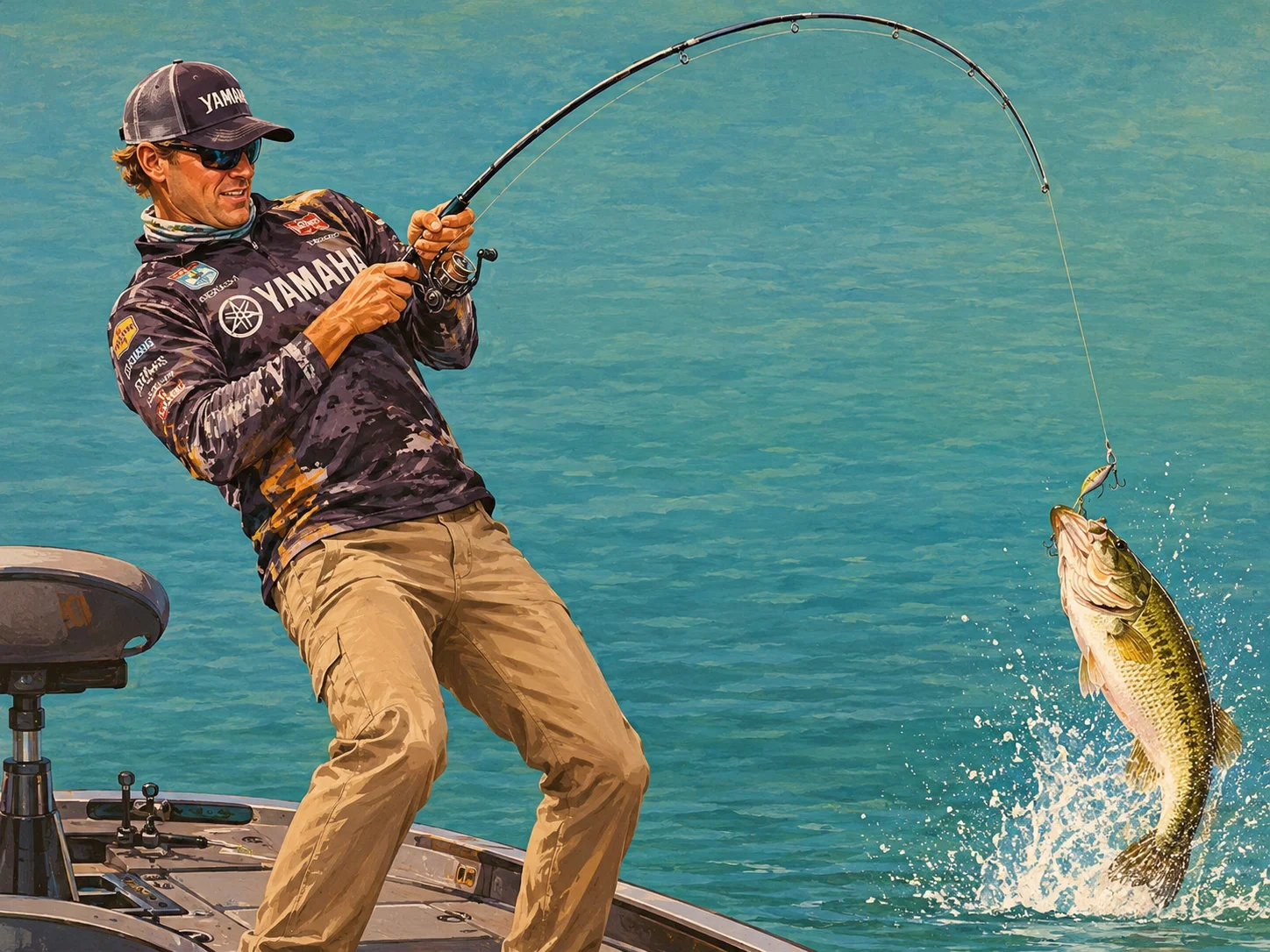
In 2026, Bassmaster published a feature titled “Classic-sized inspiration” with an illustration by Doug Schermer depicting the 2025 Bassmaster Classic champion. The image is a useful case study in how vintage angling aesthetics survive in current commercial illustration. Schermer’s work merges tournament-era detail, specific rod, lure, and bass species, with a compositional approach and color palette that references mid-century sporting illustration rather than modern sports photography.
The design cues that connect Schermer’s illustration to classic angling imagery are concrete. The figure is shown from a three-quarter angle with the rod bowed into a fish, a pose that appears in sporting prints going back to the 19th century. The water is rendered with flat color and tonal gradation rather than photorealistic texture, which reads as a deliberate reference to the gouache or oil illustration style common in mid-century outdoor magazines. The fish is detailed and anatomically accurate, echoing the scientific print tradition visible in the Library of Congress archives.
What this illustration demonstrates is that classic angler visual vocabulary is not fixed to a historical period. It’s a set of compositional and tonal choices that any image can employ regardless of the subject’s clothing or tackle. The Bassmaster illustration uses a modern tournament angler as its subject but organizes him according to conventions borrowed from 150 years of angling imagery.
For photographers and designers, this is the most flexible entry point in the list. You do not need period-accurate gear or archival clothing to make an image that reads as classically influenced. The choices that determine that reading are compositional: angle, posture, the relationship between figure and water, and the degree of environmental context visible in the frame. Study what Schermer did with a 2025 tournament winner, and the same logic applies to a weekend bass angler at a local reservoir.
Quick Comparison
| Image Type | Era | Key Visual Element | Style Application |
|---|---|---|---|
| Late-19th-century tintype | 1870s-1900s | Formal dress, long cane rod | Hero portrait recreation |
| Library of Congress archival print | 16th-21st century | Scientific accuracy, clean composition | Branding and editorial reference |
| Wicker creel and net still life | Victorian-Edwardian | Accessory texture and wear | Flat-lay and product photography |
| Mid-century Ausable River wading | 1950s-1960s | Wool shirt, narrow-spool reel, wading stance | Lifestyle and action recreation |
| Cross-cultural Bosphorus and Russia | 1950s-1980s | Work clothing, collective scenes, candid posture | Accessible retro styling |
| Contemporary classic illustration | 2025-2026 | Compositional and tonal vintage cues | Modern editorial and sport design |
Conclusion
The six images covered here each isolate a different element of classic angler style, from the formal dress of the 19th-century tintype to the compositional logic of a 2026 tournament illustration. No single image type covers everything, but together they map the full visual range of vintage angling aesthetics across gear, clothing, posture, composition, and culture.
The most direct next step is to build a reference folder using the Library of Congress “Fish & Fishing” free-to-use set as a foundation, then add tintype examples from antique tackle archives and mid-century stock images to cover the photographic periods. Once those references are in place, the specific details that make each era visually distinct, reel profile, net shape, rod length, clothing formality, casting stance, become much easier to identify and recreate accurately.