Star Fish Drawings That Capture the Beauty of the Ocean
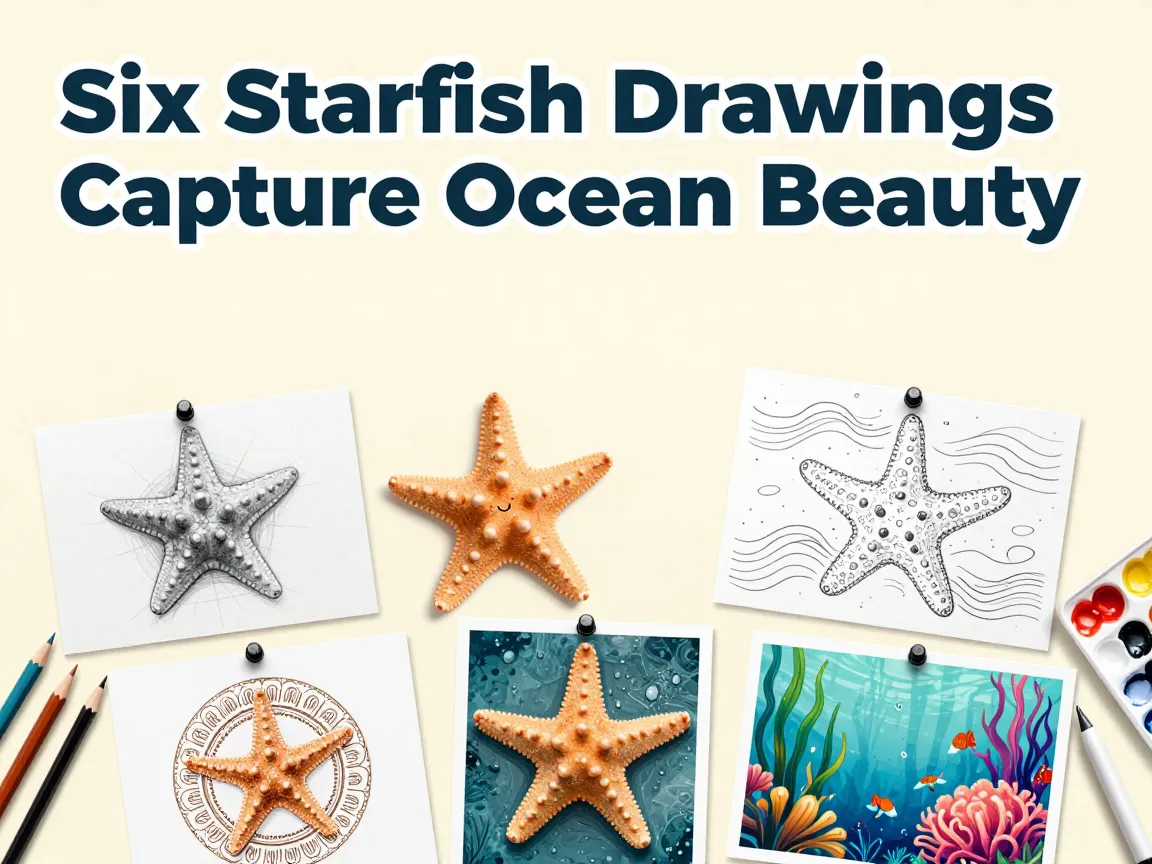
Roughly 700 species of sea stars inhabit the world’s oceans, yet artists return to the five-armed starfish again and again as one of the most satisfying subjects in marine illustration. From children sketching in notebooks to professionals layering digital textures in Procreate, the starfish occupies a unique position: simple enough for a first drawing lesson, complex enough to reward years of technique refinement. The 6 star fish drawings that capture the beauty of the ocean explored in this article span every skill level and style, offering a complete picture of how artists in 2026 are approaching this iconic ocean creature on paper, screen, and canvas.
Disclosure: This post contains affiliate links. As an Amazon Associate, we earn from qualifying purchases, and at no extra cost to you.
1. The Classic Five-Step Pencil Study
The foundation of almost every serious starfish drawing is a disciplined pencil study, and the approach most widely taught today breaks the subject into a logical sequence of steps. It begins with five radiating lines of roughly equal length drawn from a central point, establishing the skeletal framework that determines proportion and symmetry before a single outline is committed to paper. Those lines act as the spine of each arm, and the V-shaped gaps between them are just as important as the arms themselves because they define the characteristic star silhouette.
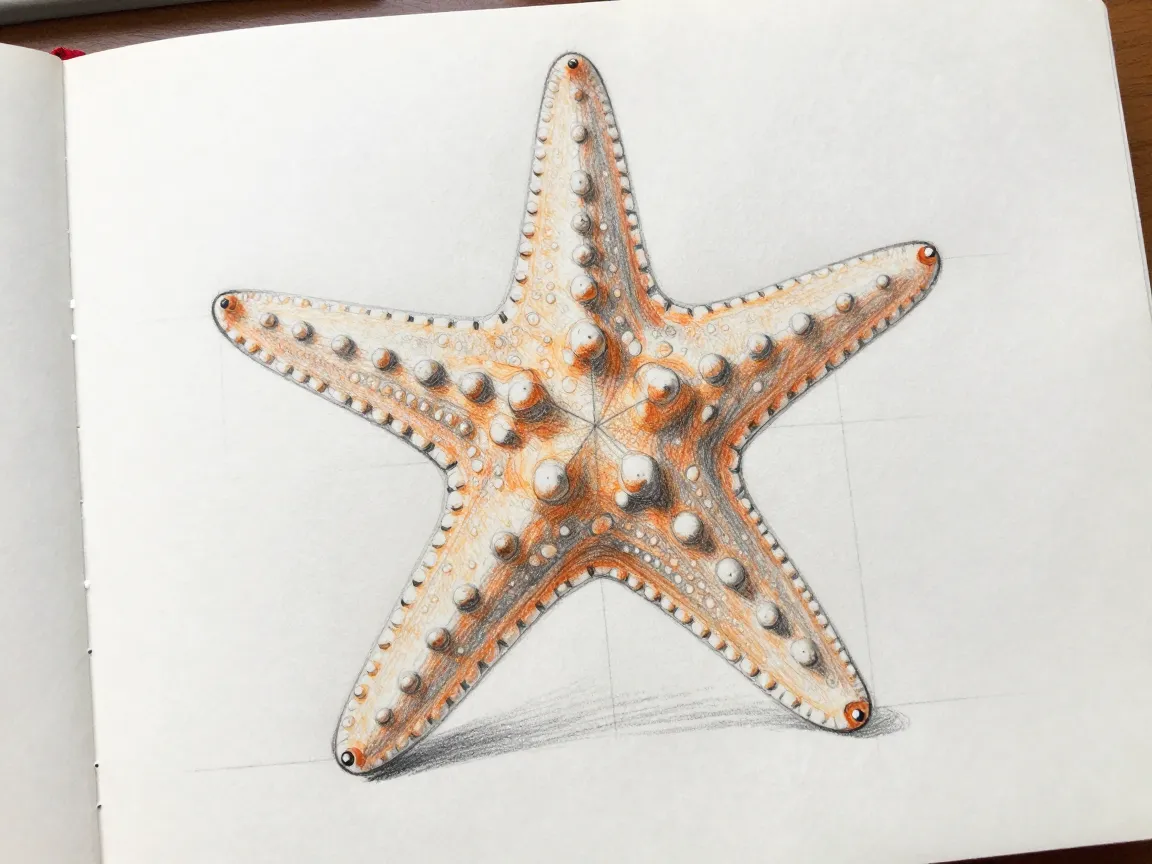
From that scaffold, an artist draws arched, tapering outlines around each arm guide, narrowing toward the tip and widening at the central body. The result at this stage looks almost botanical, like a drawing of a leaf repeated five times. Next comes detailing: circular or oval patterns arranged in rows down each arm to suggest the bumpy texture of a real starfish’s aboral surface, the side that faces upward in the water. These small shapes, repeated with slight variation in size, do more to suggest oceanic realism than any amount of shading at a later stage.
Inking over the pencil work and then erasing the guidelines reveals the true structure of the drawing for the first time. Shading applied with a soft pencil or fine-tipped ink brush along one side of each arm and in the crevices between circular patterns creates the dimensional quality that separates a flat illustration from something that appears to exist in three-dimensional space. For color work, warm ochres and burnt oranges are historically accurate for many Pacific species, while purples and deep reds reflect the range found in tidepools along North American coasts. This step-by-step pencil study remains the most referenced method in tutorials precisely because it teaches transferable skills: radial symmetry, surface texture, and controlled shading are all principles that apply far beyond starfish illustration.
2. The Cartoon Starfish for Young Artists
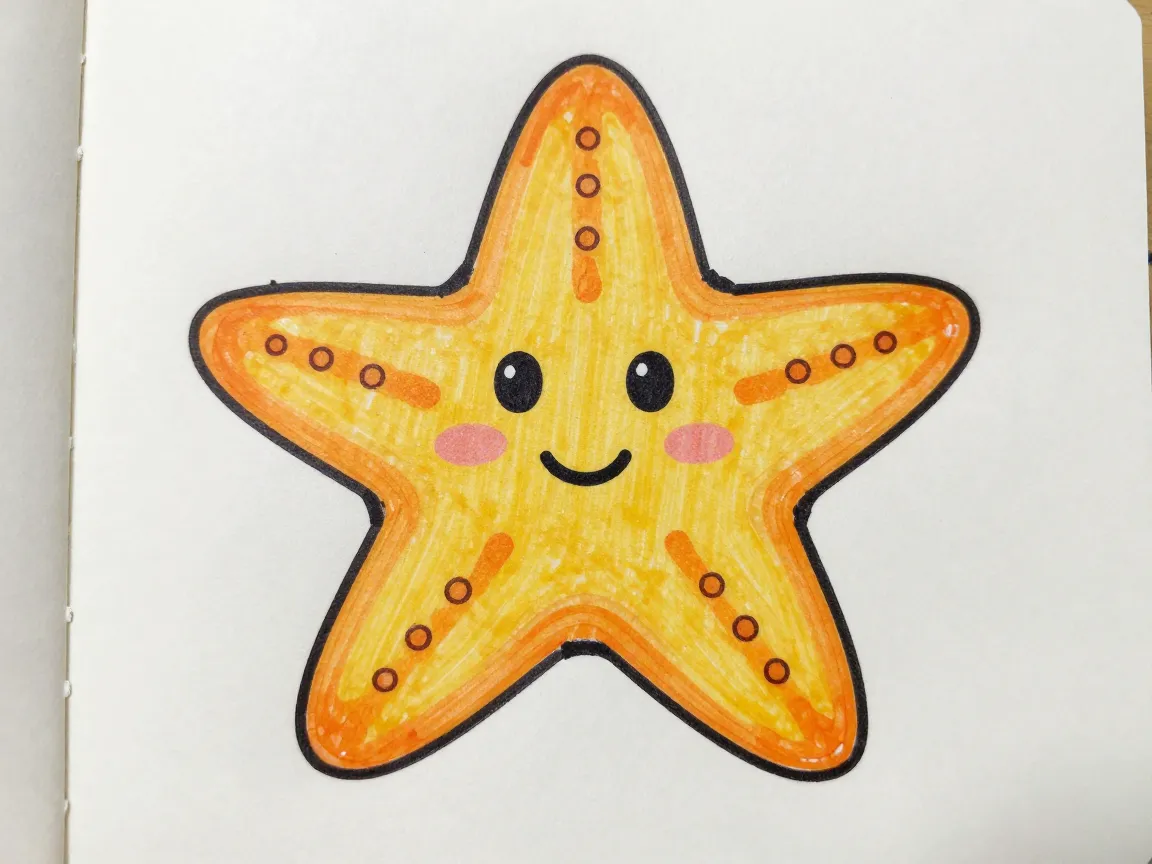
Not every drawing needs to pursue anatomical precision, and for young or beginner artists, a cartoon approach to the starfish delivers enormous satisfaction with far less technical demand. The cartoon method builds the creature from a rounded five-point star shape, keeping the arms chubby and wide rather than slender and tapering. Each arm ends in what experienced children’s art educators describe as a “mitten” tip: a soft, rounded terminus that communicates friendliness rather than the pointed geometry of a traditional star.
Construction follows a pencil-guidelines approach well suited to small hands. A rough star is sketched lightly first, then the outer edges are redrawn with smooth, confident curves. A simple happy face placed at the central body, with curved dots for eyes and a gentle arc for a mouth, transforms the shape from an organism into a character. Grouped dot patterns on each arm, arranged in clusters of three to five, add just enough surface detail to signal “starfish” without requiring the precise circular texture work of a realistic study.
The appeal of this style extends beyond classrooms. Bullet-journal artists and stationery designers in 2026 have adopted cartoon starfish as recurring motifs in ocean-themed layouts, using the soft rounded silhouette to anchor page spreads alongside wave doodles, shell sketches, and sea turtle outlines. The chubby five-armed shape reads immediately as ocean life even at very small scale, making it effective as a stamp-sized icon or a full-page illustration. For educators, the cartoon starfish also functions as a confidence-building exercise: a child who completes this drawing in a single session is primed to try more complex marine subjects next.
3. The Doodle-Style Ocean Starfish
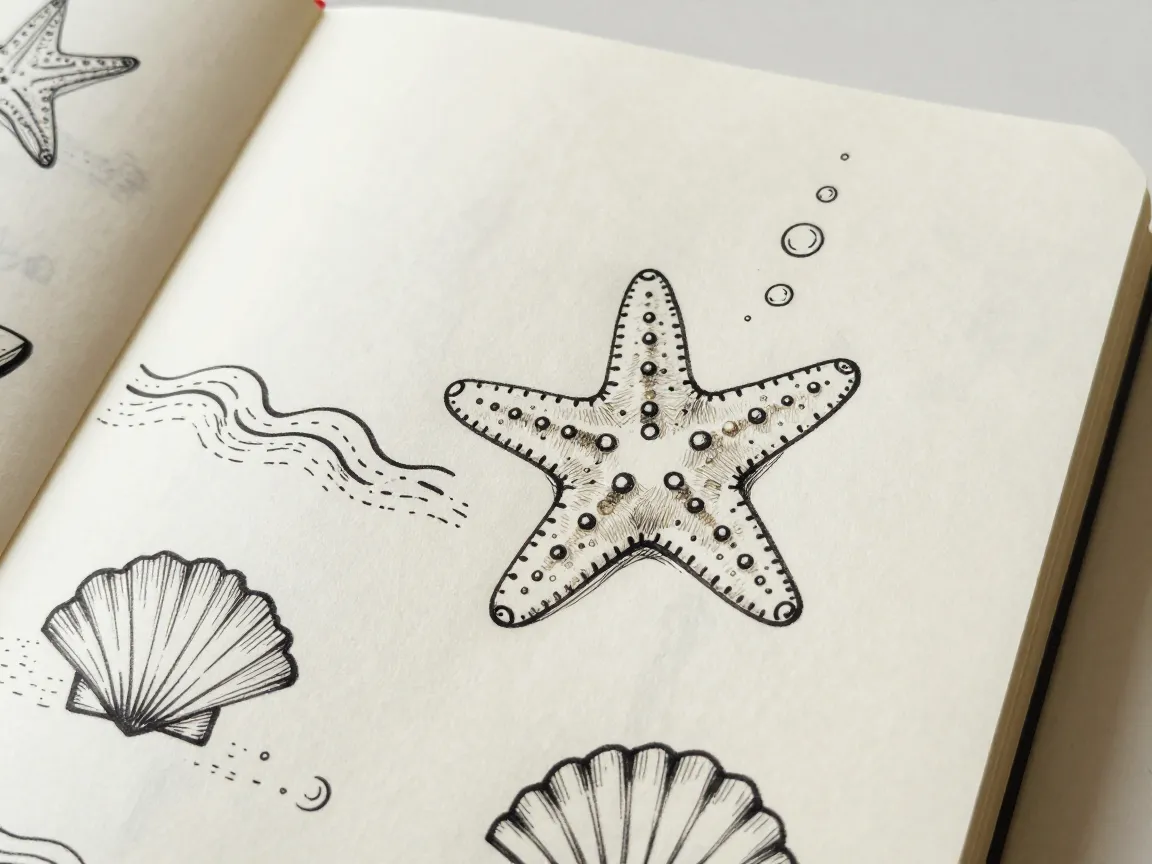
Between the structured pencil study and the character-focused cartoon sits a third approach that has gained significant traction among journal artists and casual illustrators: the doodle-style starfish. This version starts from the simplest possible shape, a classic five-point star with rounded rather than sharp tips, and builds outward through loose, spontaneous linework that prioritizes rhythm over accuracy.
What distinguishes the doodle style is its relationship to the surrounding page. A doodle-style starfish is rarely drawn in isolation. It appears nestled among waves rendered as overlapping arcs, beside scallop shells built from fan-shaped lines, or tucked under a row of bubbles climbing toward a journal page margin. The ocean context is implied rather than fully rendered, which means the starfish’s simple silhouette carries significant visual weight. Artists who work in this style tend to vary line weight subtly, pressing harder on outer contours and lighter on interior details, to give the final drawing a hand-crafted quality that distinguishes it from mechanical repetition.
The practical applications for doodle-style ocean drawings are broad. Stationery designers use them on greeting cards and gift wrap. Bullet-journal enthusiasts incorporate them into monthly spreads with coastal themes. The soft, friendly shapes also translate well to fabric design and ceramic surface decoration. In 2026, collections of “cute sea doodles” circulating in the design community often feature ten or more ocean creatures, with the rounded-tip starfish appearing consistently as one of the most versatile and recognizable shapes in the set. Learning this style requires no special materials: a fine-liner pen, a sketchbook, and a willingness to draw the same simple shape repeatedly until the linework becomes fluid and confident.
4. The Mandala and Decorative Ocean Composition
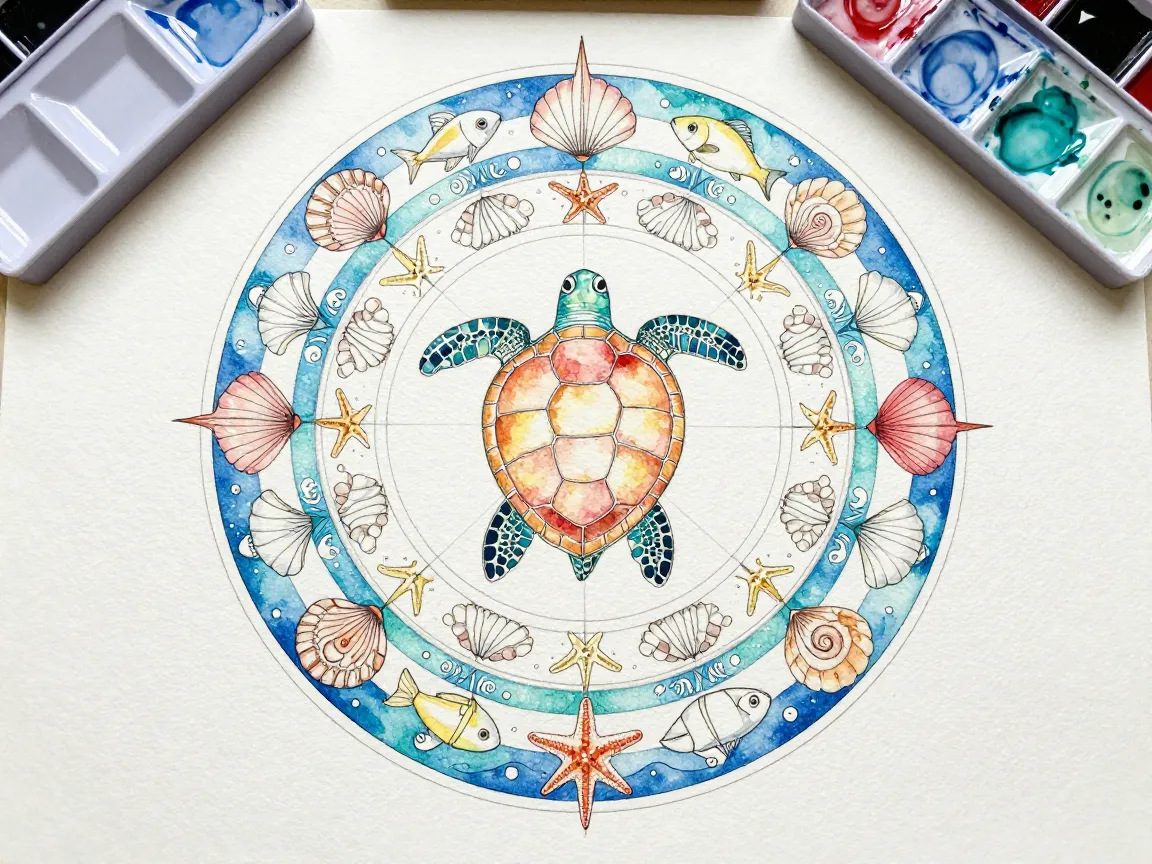
Some of the most visually complex starfish drawings produced today treat the creature not as a solitary subject but as one element within an elaborate decorative composition. The mandala format, in particular, has proven to be a natural fit for starfish because the creature’s own radial symmetry echoes the circular geometry of mandala design. In these compositions, a central motif, often a sea turtle or a large stylized coral formation, is surrounded by concentric rings of ocean imagery: scallop shells, fish, waves, spiral shells, and starfish arranged at regular intervals to create decorative rhythm.
The starfish’s role in these compositions is structural as much as illustrative. Placed at the cardinal or diagonal points of a circular arrangement, it anchors the eye and provides visual breaks between denser, more detailed elements. Its five arms can be oriented to radiate outward from the center, reinforcing the mandala’s spoke-like organization, or turned so that one arm points upward, creating a slight asymmetry that keeps the composition feeling organic rather than mechanical.
Artists working in this tradition typically begin with a compass and ruler to establish the concentric rings, then sketch the decorative elements freehand within each ring’s boundaries. Coloring large ocean mandalas with watercolor or digital brushes rewards patience: the sheer number of small shapes means that consistent color harmony, achieved through a limited palette of ocean blues, teals, sandy yellows, and coral pinks, is what prevents the composition from becoming visually noisy. Coloring books built around ocean mandala themes have expanded significantly in recent years, and the illustrated starfish within them now serves as a creative entry point for adult colorists discovering the meditative qualities of detailed marine illustration.
5. The Digital Starfish with Textured Rendering
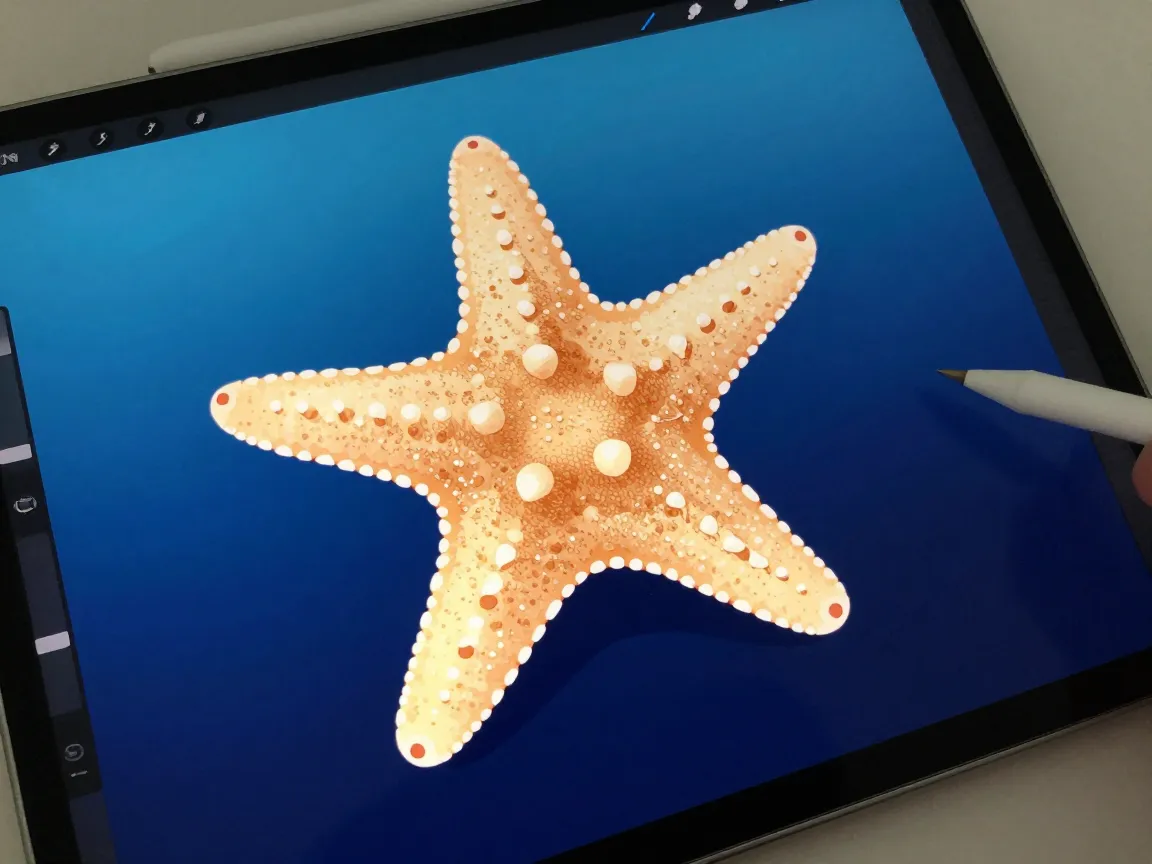
Digital illustration tools have changed how artists approach surface texture, and the starfish is one subject that benefits dramatically from the texturing capabilities available on modern platforms. In Procreate and similar applications, texture brushes can simulate the rough, granular surface of a real starfish with a few strokes, producing a tactile quality that takes considerably more effort to achieve with traditional media. The workflow typically begins with a clean vector-style outline that establishes arm shape and overall proportion, then layers of texture are built up beneath a multiply or overlay blending mode to suggest depth without obscuring the underlying form.
Highlights are as important as shadows in this approach. A soft white brush applied to the uppermost surface of each arm, particularly near the central body where light would naturally fall, gives the starfish a wet, just-out-of-the-water luminosity that connects the drawing to the ocean environment even when no background is present. When a background is included, deep-blue gradient washes or rendered coral formations situate the starfish convincingly in its natural habitat.
AI-assisted tools available in 2026 have introduced a new layer to this workflow. Parameter-driven platforms now allow artists to set arm count, surface texture type, line weight, and paper simulation before generating a starting image on a browser canvas. That generated draft can then be refined manually, with the artist adjusting curvature, adding specific textural details, or shifting the color temperature to suit a particular project. This combination of algorithmic starting point and hand-finished refinement is producing starfish illustrations that would have required hours of purely manual work just a few years ago. For professional illustrators working on tight deadlines, the approach represents a genuine shift in how ocean-themed artwork is produced at commercial quality.
6. The Ecosystem Scene: Starfish Among Marine Life
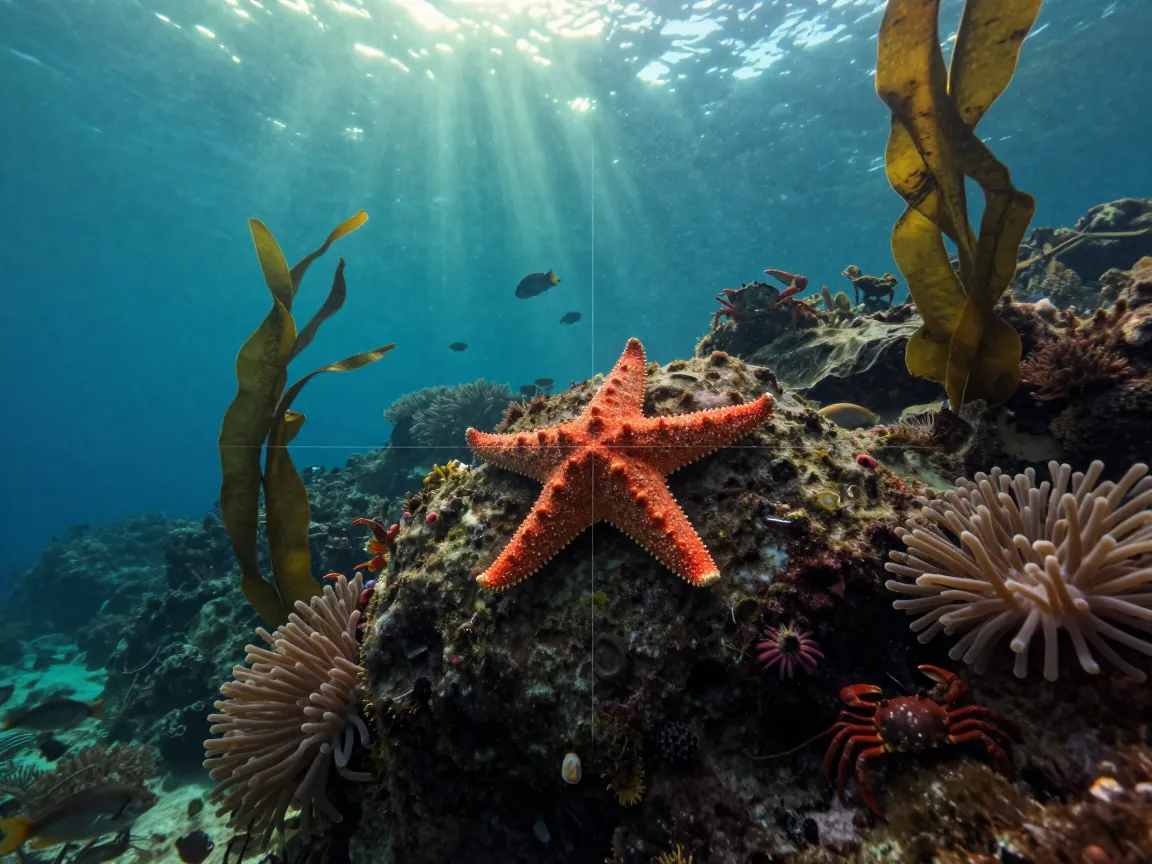
The most ambitious form of starfish illustration situates the creature within a fully realized underwater ecosystem, treating the starfish not as the sole subject but as one participant in a broader oceanic narrative. These scenes typically include multiple species rendered at proportionally accurate scales: fish moving in loose schools, sea anemones anchored to rocky outcroppings, kelp rising in sinuous vertical bands, crabs tucked into crevices, and starfish splayed across rock surfaces or coral formations. The cumulative effect is an image that communicates the ecological richness of the ocean rather than the anatomy of a single organism.
Composing a successful ecosystem scene requires decisions about visual hierarchy that simpler starfish drawings do not demand. If the starfish is meant to be the focal point, it should be positioned at or near the golden ratio intersection of the composition and rendered with more detail than the surrounding elements. If it is intended as a supporting element within a broader seascape, reduced detail and a slightly desaturated color treatment will keep it from competing with the primary subject. Professional design platforms showcase ocean illustrations where these hierarchy decisions are made confidently, and the result is imagery that feels like a coherent window into an underwater world rather than a collection of separately drawn marine objects.
The ecosystem approach is also where fine-art techniques intersect with marine illustration. Realistic whale drawings and large-scale seascape paintings have demonstrated that capturing the majestic quality of the ocean requires attention to light behavior underwater, the way blues shift to greens near the surface, the diffused quality of sunlight filtering through water, and the gradual loss of warm color tones at depth. Applied to scenes featuring starfish, these same principles produce illustrations where the creature’s warm orange or red tones glow against the cool surrounding water, creating the kind of natural color contrast that makes marine life art feel genuinely evocative rather than decorative. Artists seeking to master this style benefit from studying both marine biology references and the compositional techniques of established ocean painters, using the starfish as a touchstone subject for developing skills that eventually extend to the full breadth of underwater illustration.
Conclusion
The six approaches covered here, from the structured pencil study to the immersive ecosystem scene, demonstrate that a starfish drawing is never just a drawing of a starfish. Each method is a different answer to the question of what matters most: technical accuracy, accessibility, decorative harmony, textural richness, digital efficiency, or ecological storytelling. The most practical next step for any artist, at any level, is to choose the approach that matches the current project and practice it with a specific ocean context in mind, whether that is a child’s illustration class, a professional editorial brief, or a personal sketchbook filled with the quiet beauty of the sea.