Fly Fishing Art Ideas That Capture the Beauty of the Sport
Fewer than one in five Americans has ever cast a fly rod, yet fly fishing imagery fills gallery walls, studio collections, and limited-edition product lines at a scale that rivals far more mainstream outdoor pursuits. That gap between participant numbers and artistic output says something important: the sport generates a visual language powerful enough to captivate people who have never stood in a river. These 6 fly fishing art ideas that capture the beauty of the sport draw on that language in ways ranging from museum-quality wood engravings to live data-driven river paintings, giving artists, decorators, and anglers alike a framework for exploring what makes this discipline so enduringly compelling to look at.
Disclosure: This post contains affiliate links. As an Amazon Associate, we earn from qualifying purchases, and at no extra cost to you.
1. Literary-Inspired Wood Engravings and Narrative Prints
Fly fishing has an unusually rich literary heritage, and some of the most affecting art in the field emerges from the intersection of story and image. Wood engraving, an older printmaking technique that rewards slow, deliberate mark-making, is a natural fit for a sport defined by patience and precision. The result is imagery that feels both timeless and deeply connected to specific narratives, the kind of work that holds its meaning long after a trend-driven photograph has faded from relevance.
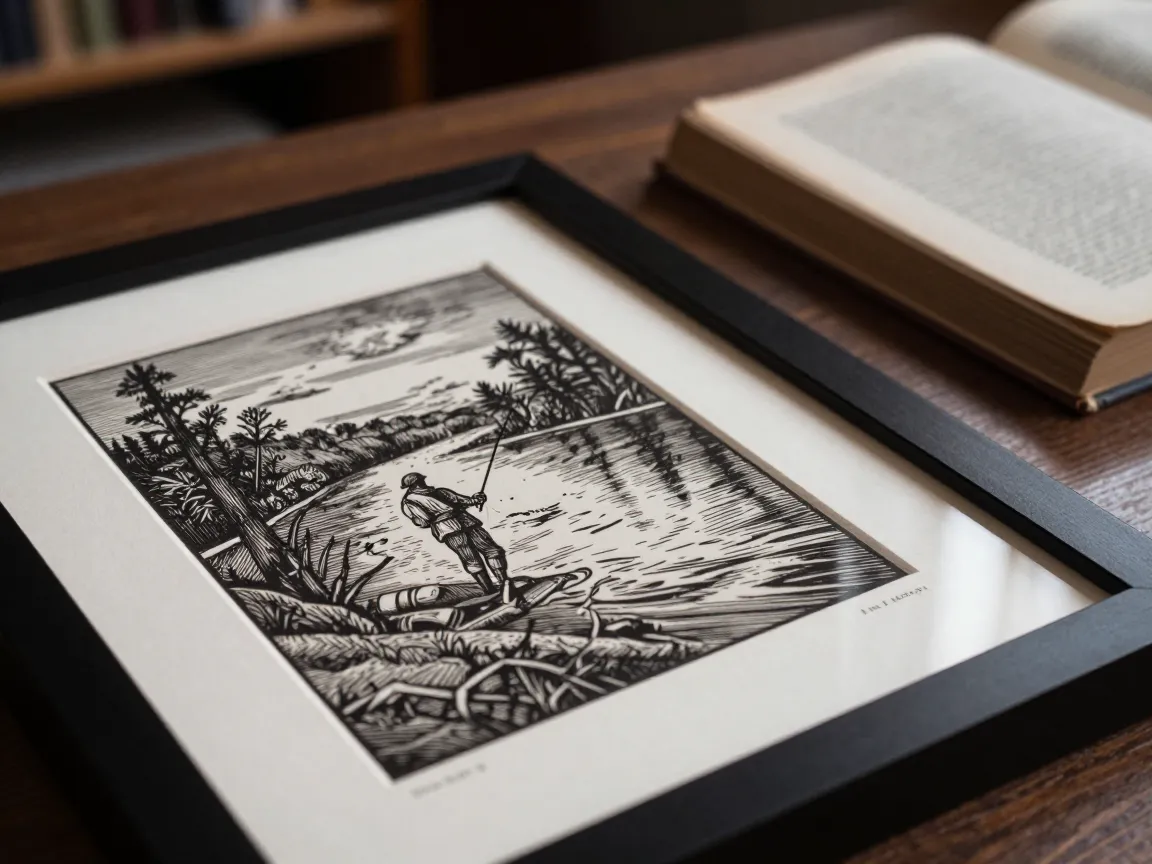
The institutional validation for this approach arrived in early 2026 with “The Art of the Angle,” an exhibit organized by the National Sporting Library and Museum and displayed at Travelers’ Rest State Park. The show assembled 34 wood engravings by Barry Moser, Wesley W. Bates, and Chris Wormell, each piece created to illustrate celebrated fly fishing texts: Norman Maclean’s “A River Runs Through It,” John Maclean’s “Home Waters,” and Ernest Hemingway’s “Big Two-Hearted River.” The engravings do not merely decorate the stories; they interpret them, translating the emotional texture of a cast or a river crossing into the dense, deliberate lines of the engraving tool.
For artists exploring this direction, the application is straightforward and rewarding. Choose a passage that describes a specific moment on the water, the first glimpse of a rising trout, the sound of a riffle at dusk, and build an image around that moment rather than a generic angling scene. The constraint of a literary source actually sharpens the work, forcing decisions about what matters visually. Contemporary prints inspired by “A River Runs Through It” continue to sell steadily, and the brown trout imagery associated with that story has become a recognizable visual shorthand for the entire tradition. Artists who work within that tradition, while bringing their own technique to it, tap into an audience that is simultaneously literary, nostalgic, and genuinely interested in fine craft.
2. Gear-as-Canvas: Original Artwork on Functional Equipment
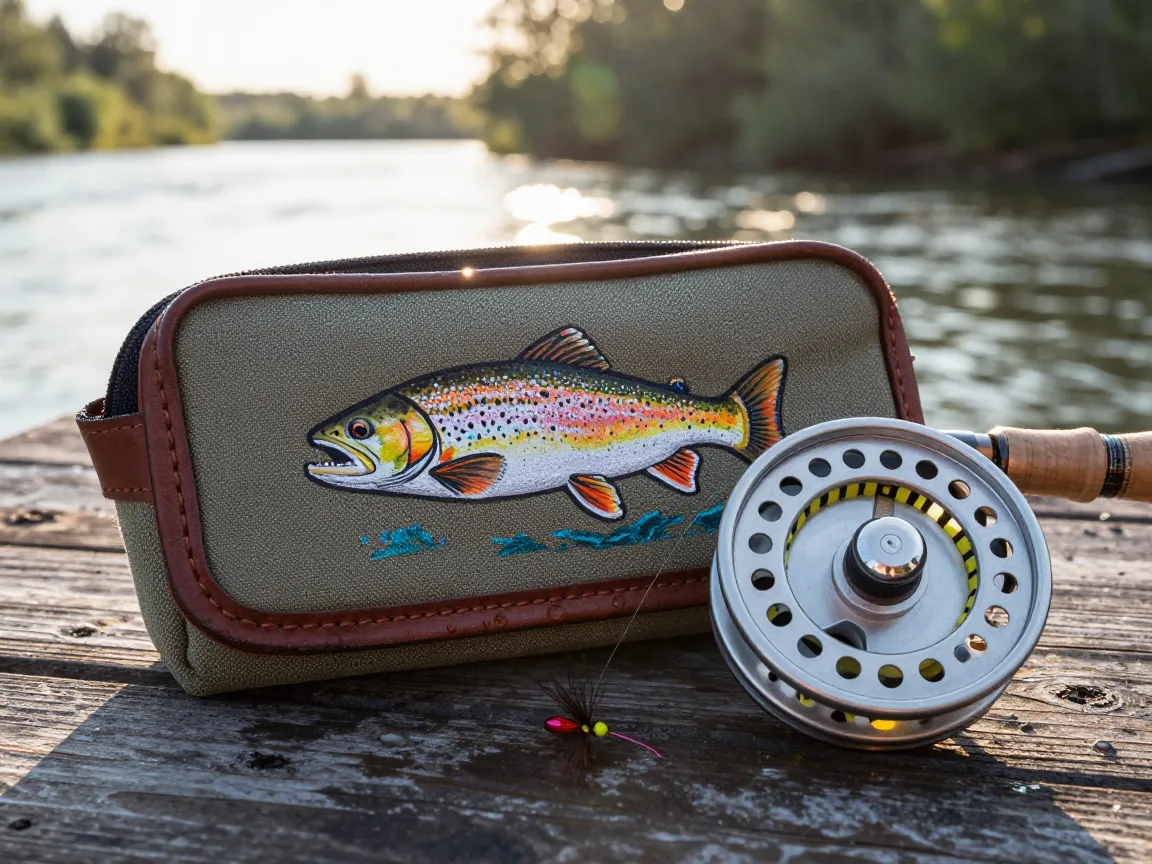
The idea that a fly reel or rod case is merely a protective vessel is an assumption worth questioning. Some of the most striking fly fishing art in 2026 has appeared not on gallery walls but on the objects anglers carry to the water. Turning functional gear into a surface for original painting or engraving creates a category of art that is intimate, portable, and used rather than simply displayed, which gives it a different and arguably deeper relationship with the sport it depicts.
Flylords demonstrated this potential with the release of three reel cases featuring original artwork by fly fishing artists Eric Hinkley, Drew Wilson of Silly Fish Art, and Eric Estrada. Each case carried imagery drawn from specific species, trout, bass, and tarpon, rendered in styles that reflected each artist’s distinct visual voice. The pieces are functional objects that happen to be beautiful, and the combination creates something a framed print cannot: an art experience that travels to the river and back, accumulating the minor scuffs and weather marks of actual use.
The conservation dimension adds another layer of meaning. A collaboration between Fly Fishers International, Ross Reels, and Airlite Rods produced the FFI Ross Cimarron reel with custom artwork by Casey Underwood. Beyond the visual appeal of the engraved design, the reel contributed thirty-five dollars per unit sold to FFI, linking the purchase of an art object directly to habitat protection. For anyone developing a fly fishing art project, this model offers a compelling template: partner with a gear maker, engage an artist whose style aligns with the brand’s ethos, and direct a portion of proceeds toward conservation work. The resulting object tells a story that a print on a wall simply cannot replicate, and buyers respond to that layered meaning.
3. Bronze and Three-Dimensional Sculpture
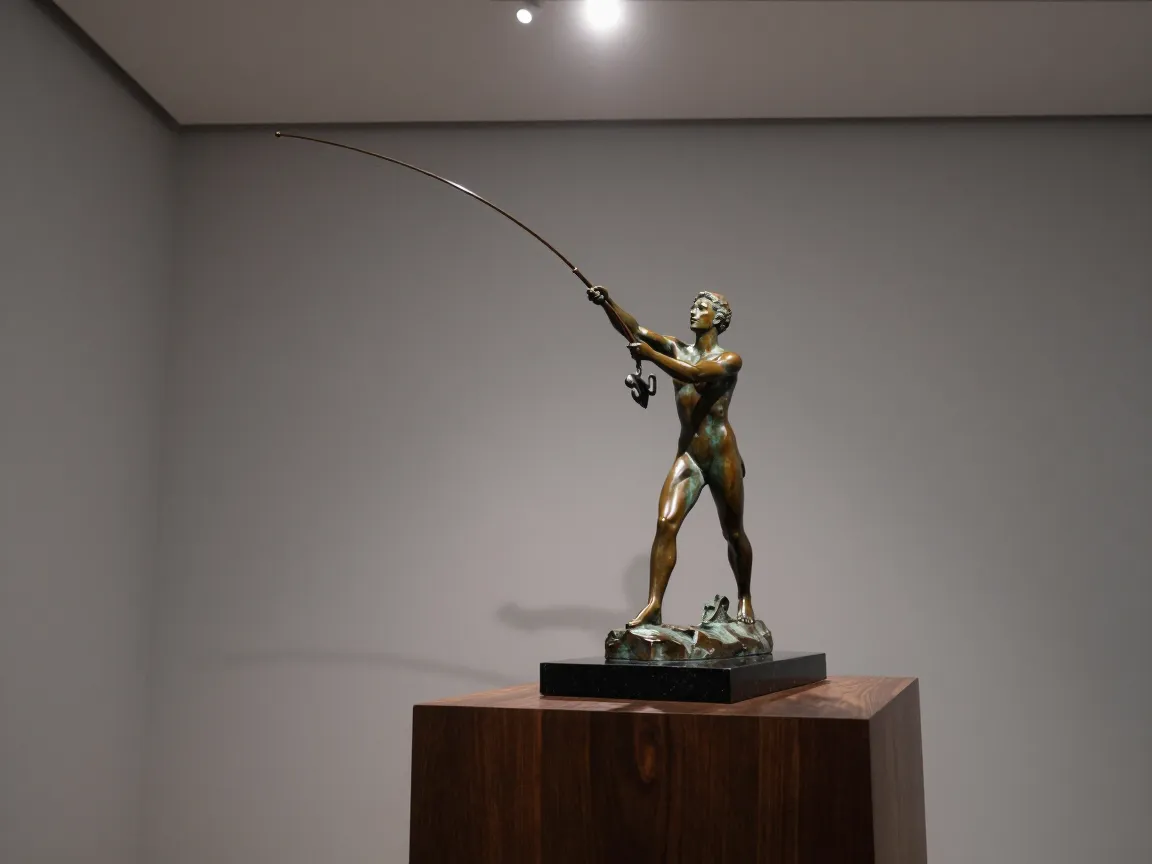
Wall art dominates most conversations about fly fishing decor, but the sport’s physical grace translates exceptionally well into three dimensions. The arc of a cast, the tension of a fish on the line, the precise posture of a wader in moving current, these are sculptural subjects first and pictorial ones second. Bronze, in particular, suits fly fishing imagery because its weight and permanence mirror the sport’s tradition, and because the material’s surface catches light in ways that animate movement even in a static object.
Margery Torrey’s “The Perfect Fly,” a 2026 bronze sculpture measuring roughly ten and a half inches tall by thirteen and a half inches wide, illustrates what fine-art three-dimensional work can accomplish in this space. Issued as edition two of twenty-five, the piece operates as both a collectible and a serious work of fine art, occupying the kind of thoughtful middle ground that attracts serious collectors without excluding passionate anglers who simply want something beautiful on a shelf. The limited edition structure matters: it signals intentionality, creates scarcity, and positions the work within an art market framework rather than a gift-shop one.
For artists considering this direction, the challenge and the opportunity lie in choosing a moment that is inherently sculptural. A trout suspended mid-leap, a hand releasing a fish back to a river, a single dry fly rendered at several times actual scale, all of these translate into forms that reward being viewed from multiple angles. Foundry costs and edition management require more planning than a print run, but the finished object occupies physical space in a way that commands attention and investment. At a time when large online marketplaces feature hundreds of independent fly fishing painters, three-dimensional work offers meaningful differentiation for the artist willing to work in that medium.
4. Mounted-Fly Compositions and Tactile Mixed Media
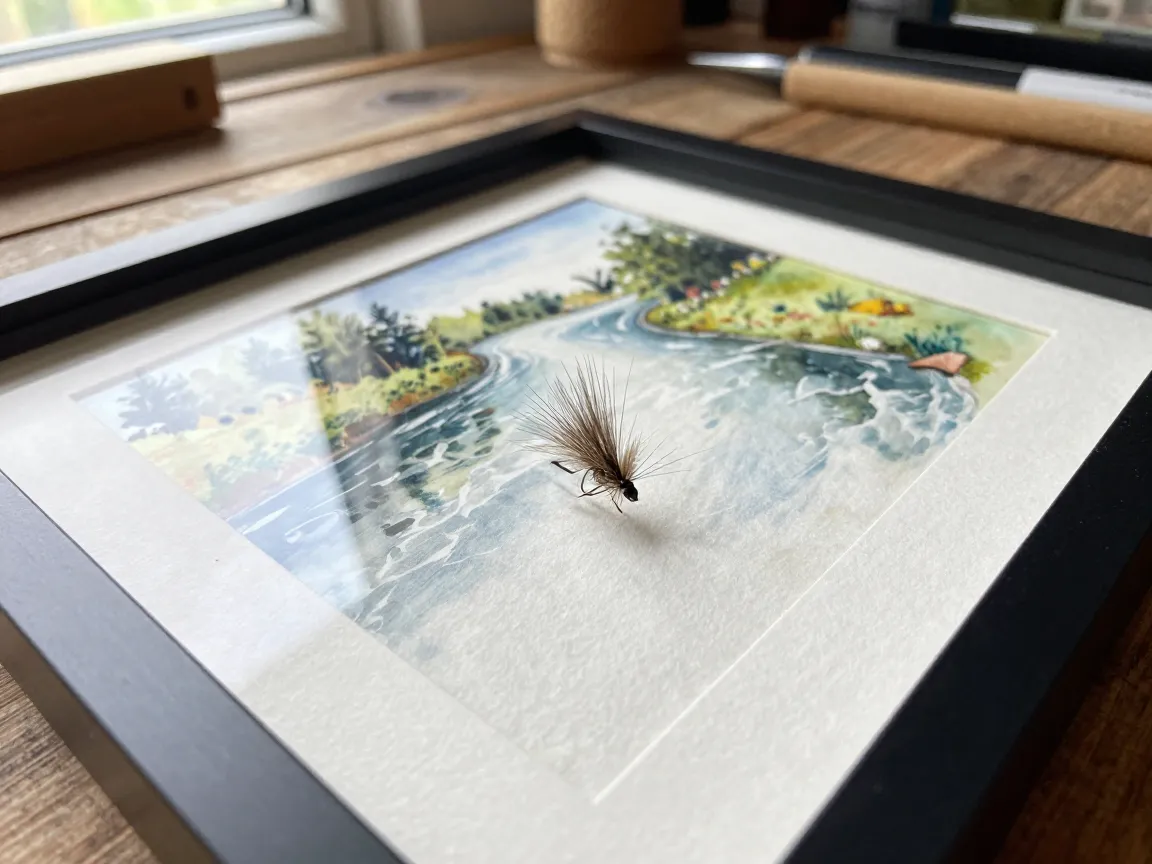
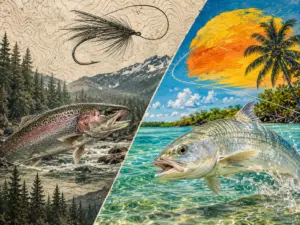
Fly tying is itself an art form, and some of the most original fly fishing artwork being produced in 2026 acknowledges that directly. Rather than treating the fly as a subject to be painted or photographed, mounted-fly compositions incorporate the actual tied fly, hackle, dubbing, wire rib, and all, into a framed piece that combines watercolor or illustrated backgrounds with physical, three-dimensional elements in the foreground. The result is artwork that rewards close inspection in a way a purely painted piece never could.
The appeal is both aesthetic and conceptual. Fly patterns carry their own history: the Elk Hair Caddis, the Royal Wulff, the Copper John. Each pattern was designed by a specific tier for a specific set of conditions, and that history is embedded in the materials and proportions of the fly itself. When a tied fly is mounted against a painted scene of the river where it would typically be fished, the work becomes a kind of compressed natural history, materials from the living world arranged with technical precision and displayed in the context of the landscape they come from.
Practically, artists and crafters working in this direction need to think carefully about framing and preservation. Natural materials used in fly tying can be vulnerable to light and humidity, so UV-protective glass and acid-free mounting boards are not optional extras but basic requirements for work that is meant to last. The good news is that this care in presentation reinforces the perceived value of the piece. Buyers who understand fly tying will immediately recognize the quality of a well-tied fly and appreciate that it has been treated with the same respect as a fine watercolor. For those new to the medium, the mounted fly acts as an entry point into a conversation about the sport’s deeper craft traditions.
5. Abstract and Data-Informed River Art
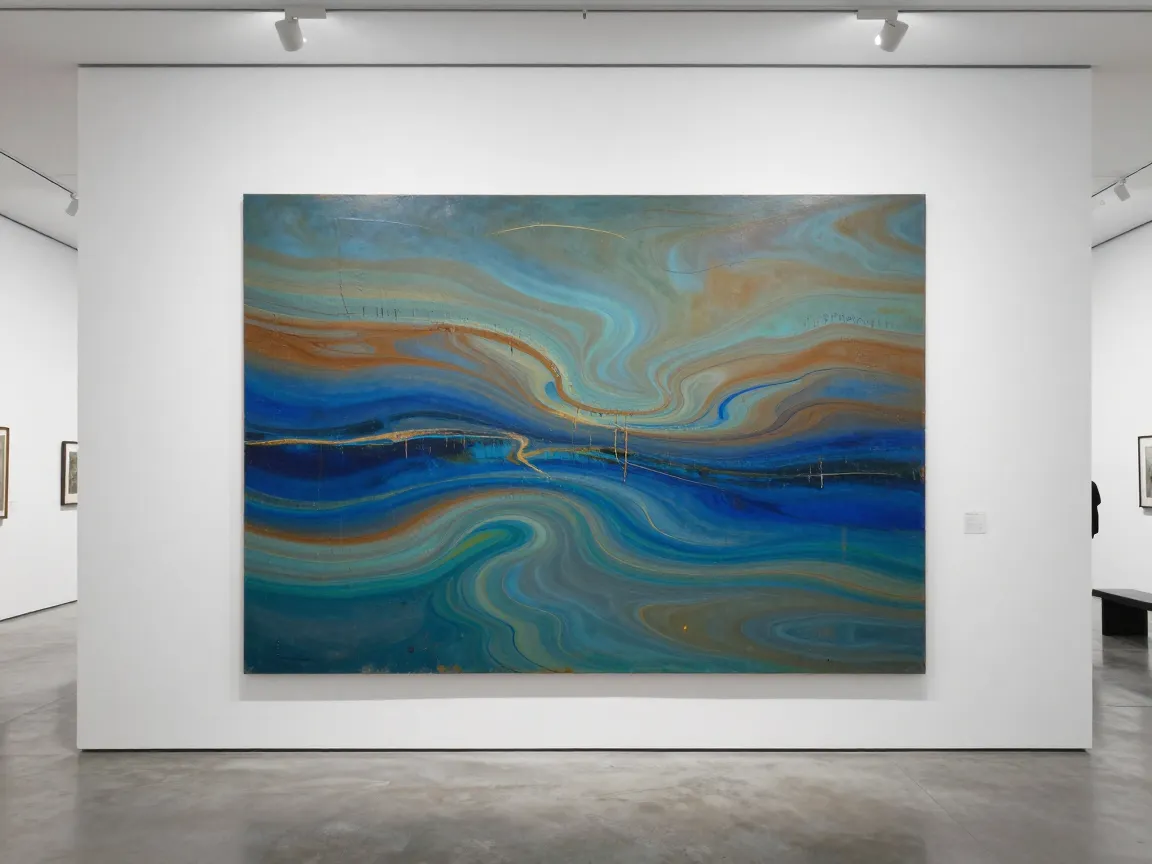
Not every piece of fly fishing artwork needs to include a recognizable fish or angler. Some of the most thought-provoking work emerging from the fly fishing community in 2026 takes its visual cues from the rivers themselves, their flow rates, their seasonal color changes, their topographic complexity, and translates that raw environmental data into abstract or semi-abstract compositions that are as much about science as they are about beauty.
At the twentieth Fly Fishing Film Tour in 2026, artist Willey presented live “river art” and “flow art” built on precise river data, using mixed media to mimic the movement and character of specific waterways. The work sits in productive territory between cartography and painting: informed enough by data to feel authoritative, expressive enough in its execution to function as art. A viewer who knows the river being depicted may recognize familiar features, a particular bend, a braided section, a temperature gradient, while a viewer with no prior knowledge simply experiences the work as color, movement, and texture.
This approach carries interesting possibilities for site-specific commissions. A lodge on a well-known trout stream might commission a large-format abstract piece based on that river’s hydrological data, creating something that is unique to that location and permanently connected to it. A conservation organization might use similar work to visualize water quality trends, making data legible and emotionally resonant in a way that a spreadsheet never could. Abstract river art also occupies a stylistic space that works well in contemporary interiors, where realistic wildlife paintings can sometimes feel out of place. The minimalist and abstract end of the fly fishing art spectrum has grown noticeably in 2026, and it represents a genuinely underserved market for artists with the technical curiosity to explore it.
6. Illustrated Educational Art and Instructional Guides
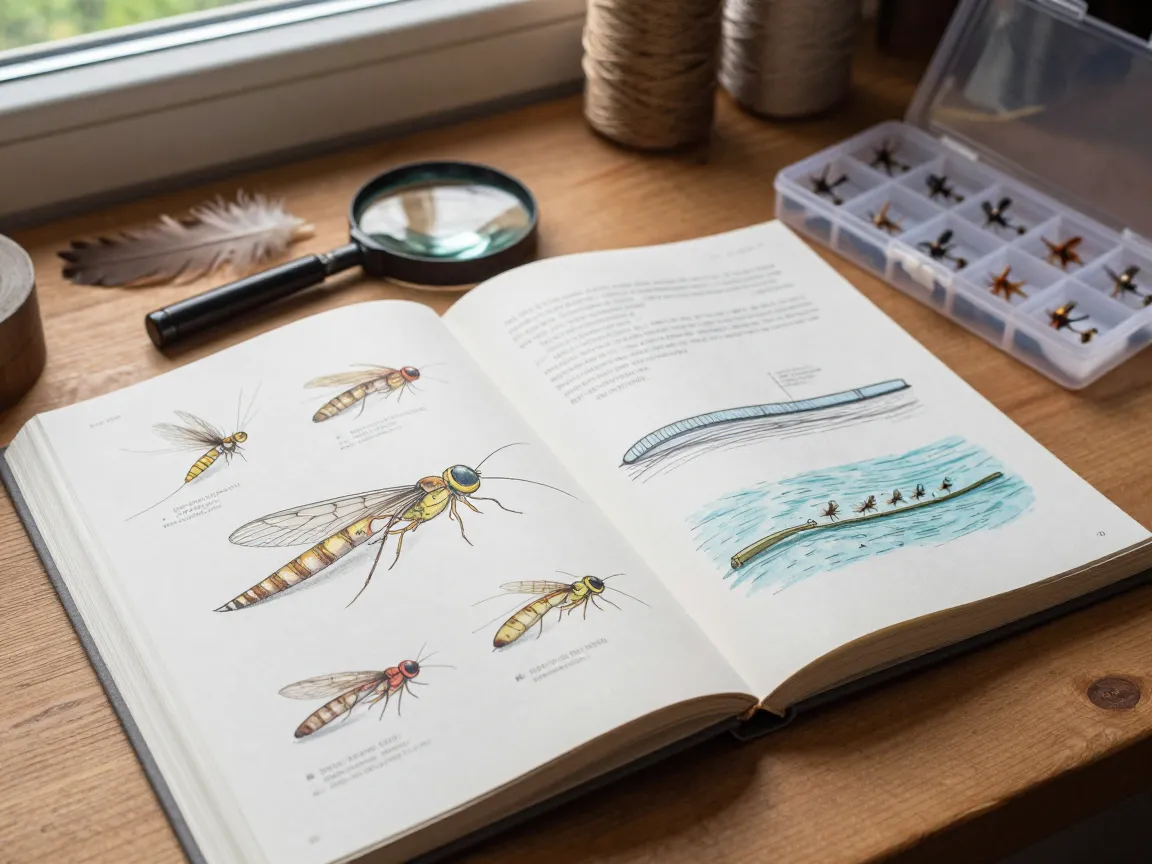
The final idea in these 6 fly fishing art ideas that capture the beauty of the sport is perhaps the most practical, but it is no less visually ambitious than the others. Educational illustration, the kind that explains the anatomy of an aquatic insect, the mechanics of a roll cast, or the identifying features of a wild brown trout, occupies a unique position in the visual culture of fly fishing because it must be both accurate and beautiful to do its job properly.
Steven Weinberg’s “The Fly Fishing Book: An Artful Guide to Angling,” highlighted by Trout Unlimited in 2026, makes the strongest possible case for this approach. The book uses original illustration and painting to explain gear selection, casting techniques, aquatic entomology, fish species identification, and the history of the sport. It treats art as the primary medium for transmitting knowledge rather than a secondary decoration for text-based instruction. The result is a work that functions as a reference guide for beginners and as a collectible object for experienced anglers, a combination that few purely photographic or text-based guides achieve.
For artists interested in this direction, the discipline required is specific and demanding. Educational illustration must be anatomically and technically accurate, which means working closely with knowledgeable anglers, entomologists, and guides during the development process. It also means making deliberate choices about style: a highly realistic rendering of a Blue-Winged Olive may be scientifically useful but visually dense, while a looser, more graphic interpretation may be more immediately appealing but less instructionally precise. The best educational fly fishing art finds the balance point between those two poles, creating images that reward both the curious beginner and the expert who already knows the subject. As illustrated field guides and artful instructional books continue to find audiences in 2026, this remains one of the most creatively rewarding and commercially viable corners of the entire genre.
Conclusion
The range covered by these six ideas, from museum-exhibited wood engravings to live data paintings, from bronze sculpture to illustrated instructional guides, reflects a creative field that is significantly broader and more ambitious than its niche status might suggest. Fly fishing art is not a single aesthetic; it is a set of values: precision, patience, the beauty of natural systems, and deep respect for craft. Any art form that embodies those values, regardless of medium or style, belongs in the conversation.
For anyone ready to act on one of these directions, the most useful next step is narrow rather than broad: choose one medium, identify one specific subject within that medium, a particular river, a single fly pattern, one moment in a classic text, and develop that subject with the same care and attention to detail that a skilled angler brings to a technical piece of water. The specificity is what transforms a decorative object into genuine art.