Fascinating Gyotaku Fish Printing Techniques to Try Today
A single fish impression, pressed onto rice paper with sumi ink more than a century ago, is now yielding measurable data about species that have since declined in population. That surprising fact captures exactly why gyotaku endures: it is simultaneously craft, fine art, conservation record, and scientific tool. The 6 Fascinating Gyotaku Fish Printing Techniques to Try Today explored in this guide range from the foundational methods practiced by Japanese fishermen to color innovations and digital extensions that are reshaping the form in 2026. Whether picking up a brayer for the first time or refining an existing studio practice, each technique here offers something genuinely distinct.
Disclosure: This post contains affiliate links. As an Amazon Associate, we earn from qualifying purchases, and at no extra cost to you.
What Is Gyotaku and Why It Still Matters
Gyotaku (pronounced gyo-TAH-koo) translates roughly as “fish rubbing” in Japanese. Fishermen developed the practice as a way to document remarkable catches before releasing or consuming them, a natural record that preserved size, species, and scale detail with striking accuracy. The resulting prints eventually migrated from dockside journals into galleries, classrooms, and conservation databases.
In 2026, the form sits at a compelling crossroads. High-profile features on working gyotaku artists have reframed the practice as serious fine art rather than a curiosity. Museum education departments have standardized lesson plans around it. Sport-fishing communities promote it as an ethical alternative to wall mounts, allowing a trophy fish to be recorded and released alive. Researchers are even mining historical gyotaku archives for biological data, measuring fin rays and body proportions to track how fish populations have changed over decades.
That breadth of relevance makes gyotaku an unusually rewarding practice to learn. The six techniques below represent the main families a practitioner encounters, covering both classical approaches and contemporary innovations.
1. Direct Gyotaku (Chokusetsu-ho)
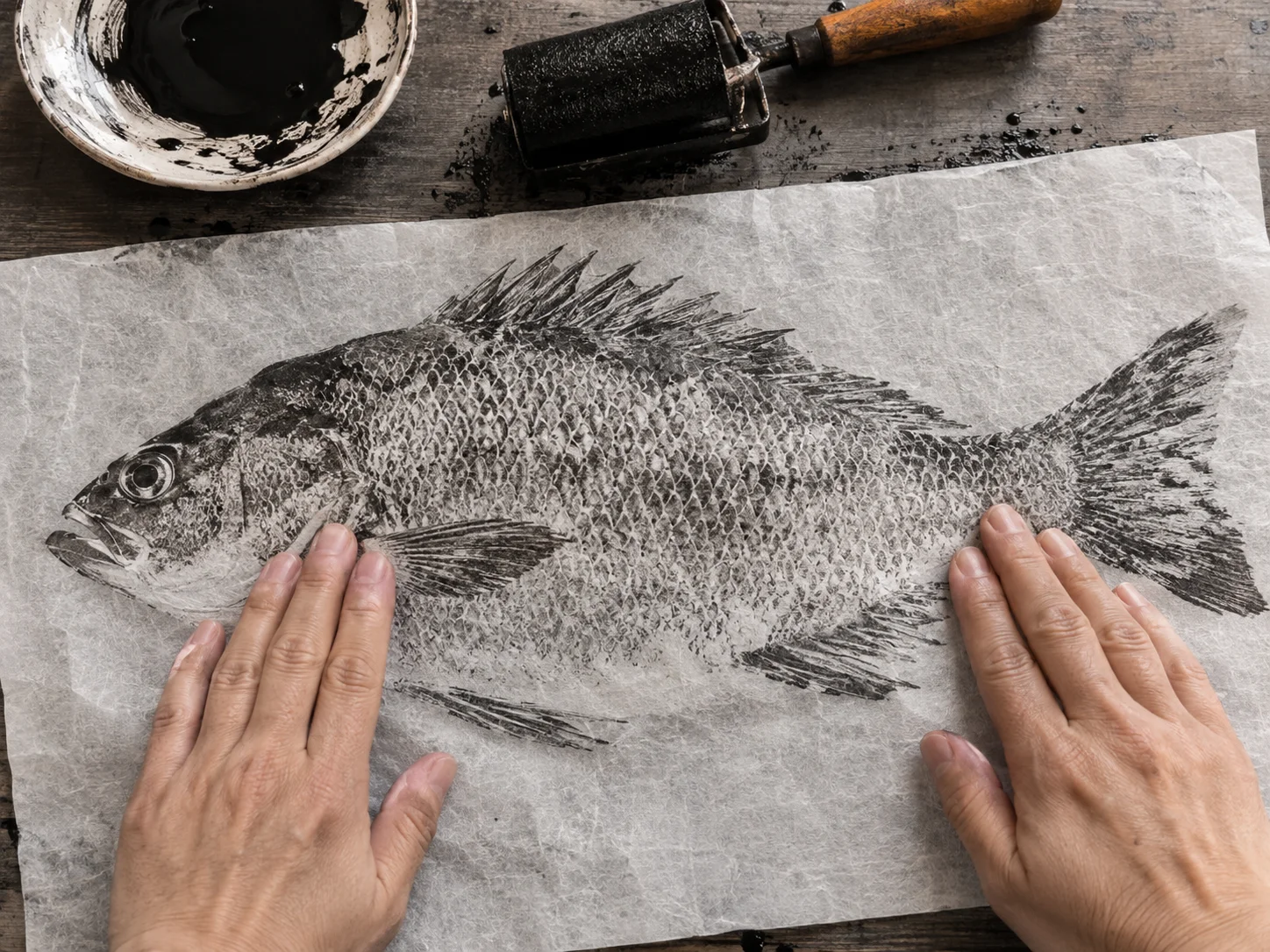
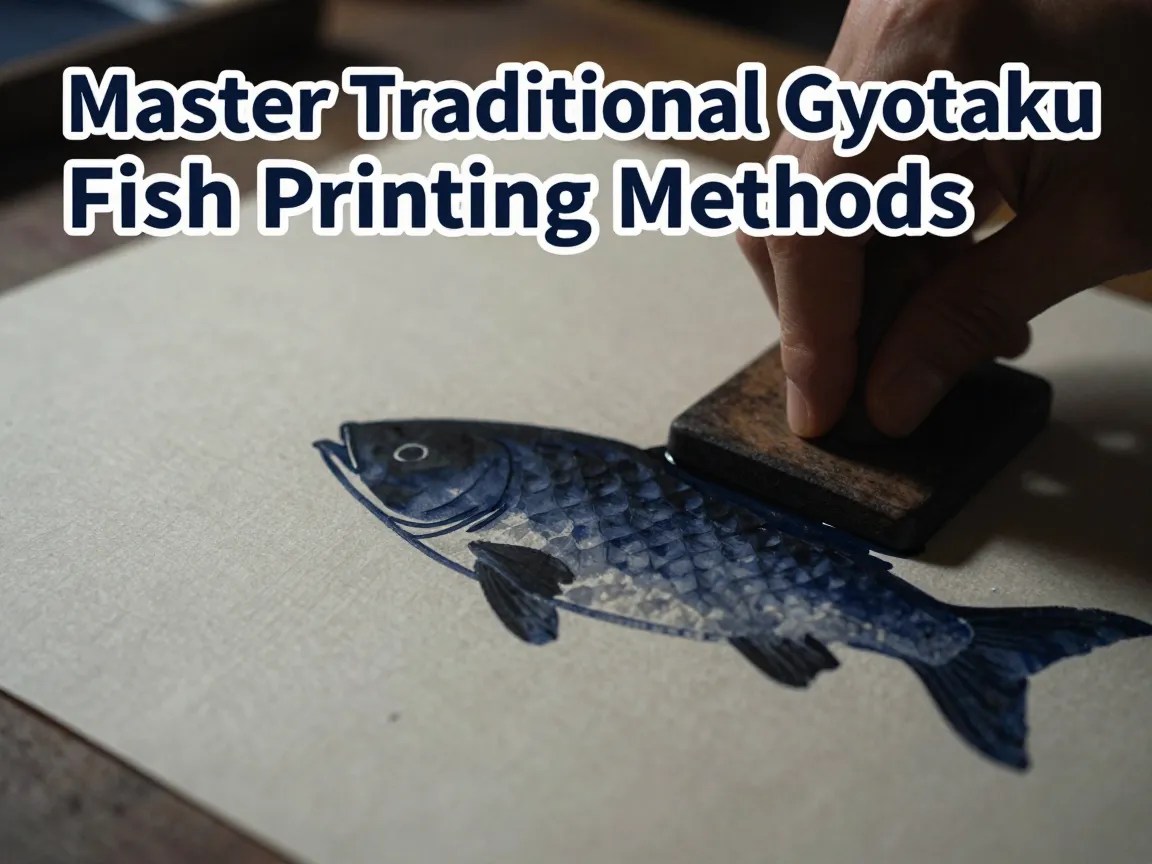
The direct method is where almost every beginner starts, and it rewards patience far more than it rewards speed. The fish is cleaned, dried thoroughly, a step that experienced practitioners treat as the most important in the entire process, and then inked directly on its surface. A brayer or soft brush applies a thin, even layer of sumi ink or water-based paint across the scales, fins, and tail. Paper is then laid over the fish and pressed by hand, working from the body outward toward the fins to push every scale impression into the sheet. The print is peeled back slowly, and the eye is painted in afterward as the only post-print addition.
The discipline required is real. Too much ink and the delicate scale patterns merge into muddy smears. Too little and the print lacks contrast. The drying stage before inking is equally critical: any residual moisture causes ink to bead and slide, destroying the texture detail that makes gyotaku prints so visually arresting. Contemporary guides consistently emphasize working in thin layers and allowing each layer to set before adding another.
Direct gyotaku produces a mirror image of the fish and has an immediate, visceral quality that other methods lack. The slight irregularities, a fin edge that pressed unevenly, a tail that caught more ink on one side, become part of the aesthetic rather than flaws to correct. For sport anglers practicing catch-and-release gyotaku, this method works quickly enough that the fish can be returned to the water without prolonged stress.
2. Indirect Gyotaku (Kansetsu-ho)
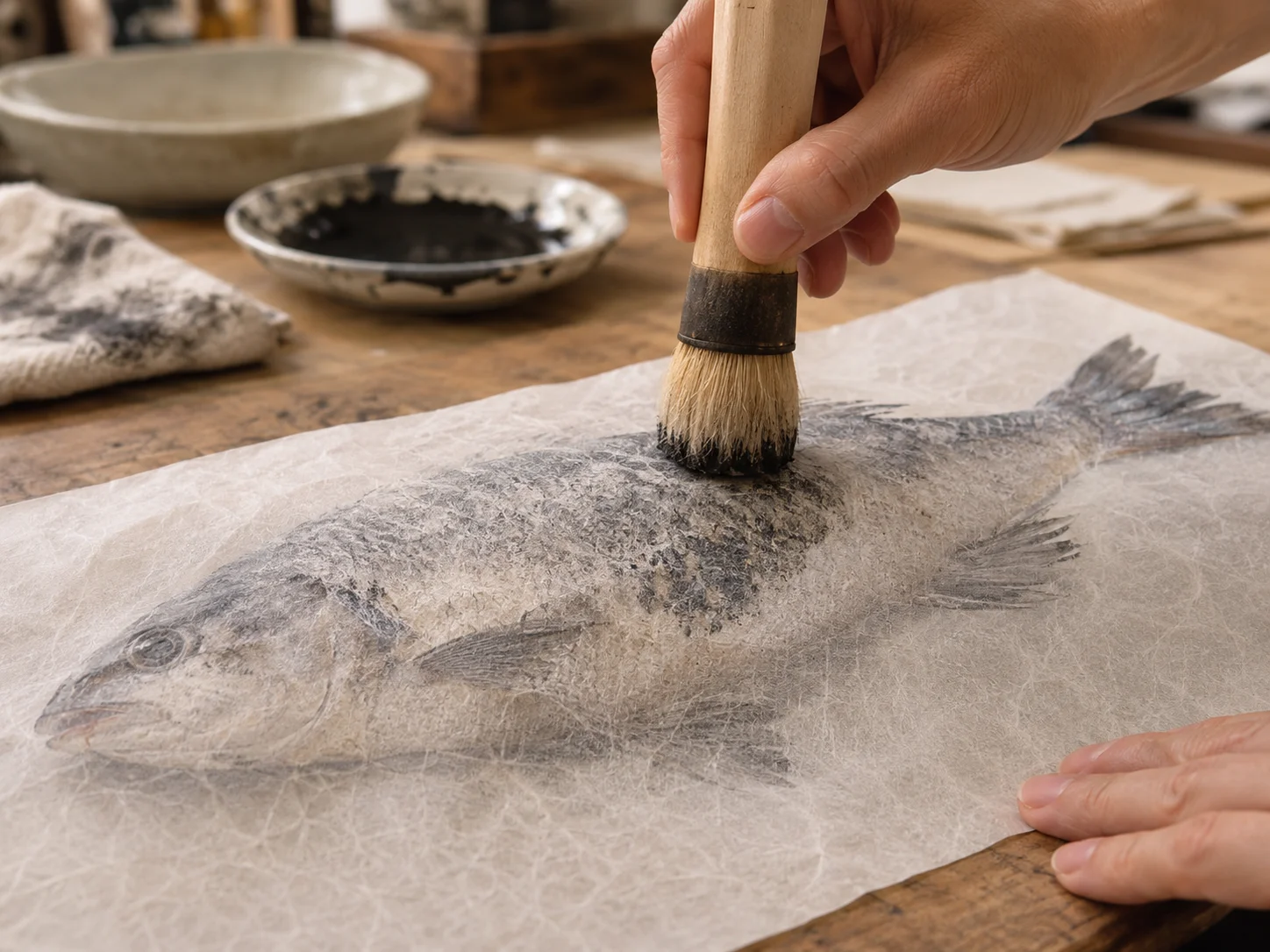
Where the direct method brings paper to the fish, the indirect method brings the fish’s surface to the paper through a translucent intermediary. A sheet of thin washi or rice paper is draped over the prepared fish, and pigment is applied through the paper using a soft, round dabbing brush called a tampo. The artist essentially paints through the paper rather than onto it, coaxing ink into the texture below.
The indirect technique demands considerably more skill and time, but the results justify both. Because the artist controls exactly where pigment is applied and how heavily, the final print can be extraordinarily detailed. Scale patterns, lateral line markings, and fin membrane structures all emerge with a clarity that the direct method rarely achieves. Many professional gyotaku artists who now exhibit in galleries rely on the indirect technique precisely because it allows the kind of controlled, cumulative mark-making associated with fine printmaking.
One particularly useful application of this approach is working with delicate or small specimens where pressing and peeling would damage fragile fins. Because the fish is never directly handled during the printing phase, the specimen stays intact. Indirect gyotaku also opens the door to multi-pass printing, returning to specific areas of the composition to build depth and tonal variation across the surface.
3. Layered Color Gyotaku
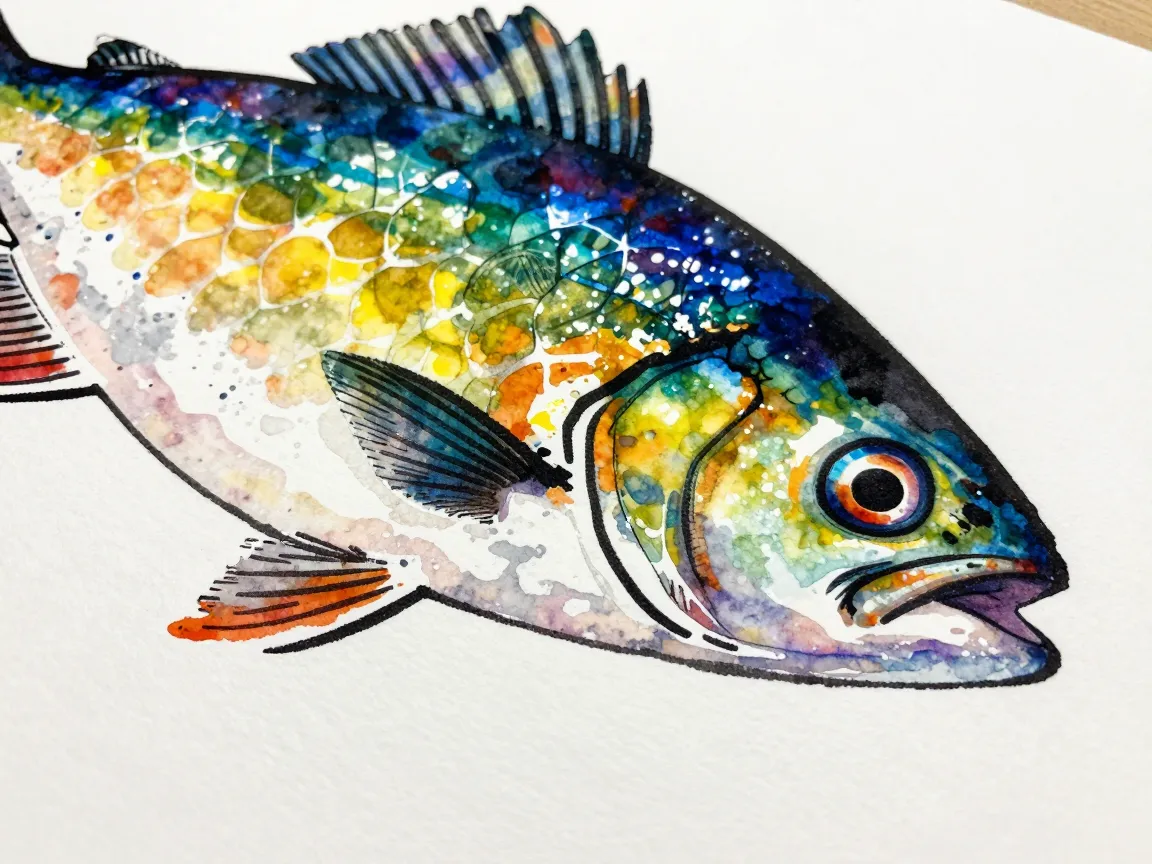
Color innovation is arguably the most significant development in gyotaku practice in 2026. While the classical form used monochrome sumi ink, contemporary practitioners now work with watercolor, diluted acrylic, and advanced water-soluble pigments to recreate the living colors of fish with striking realism. Layered color gyotaku treats the base print, typically produced by the direct or indirect method, as the first layer of a multi-stage composition.
The technique works by building color in transparent washes after the structural ink layer has dried. A striped bass might receive a silver-green base wash, followed by targeted applications of olive and gold along the dorsal surface, with a final pass of blue-black to deepen the lateral stripe. Each wash is allowed to dry fully before the next is applied. The result is a print that captures both the tactile precision of traditional gyotaku and the chromatic richness of observational painting.
What makes this approach technically demanding is color sequencing. Working light to dark is the standard logic, but different pigments interact in unpredictable ways on highly textured rice paper. Artists working in this space in 2026 have developed personal recipes for specific species, the iridescent scales of a rainbow trout, for example, may require a specific sequence of wet-on-dry washes that takes considerable experimentation to refine. The eye, painted last following classical convention, anchors the entire composition and is typically rendered with the greatest care of any element in the print.
4. Multi-Fish Composition Printing
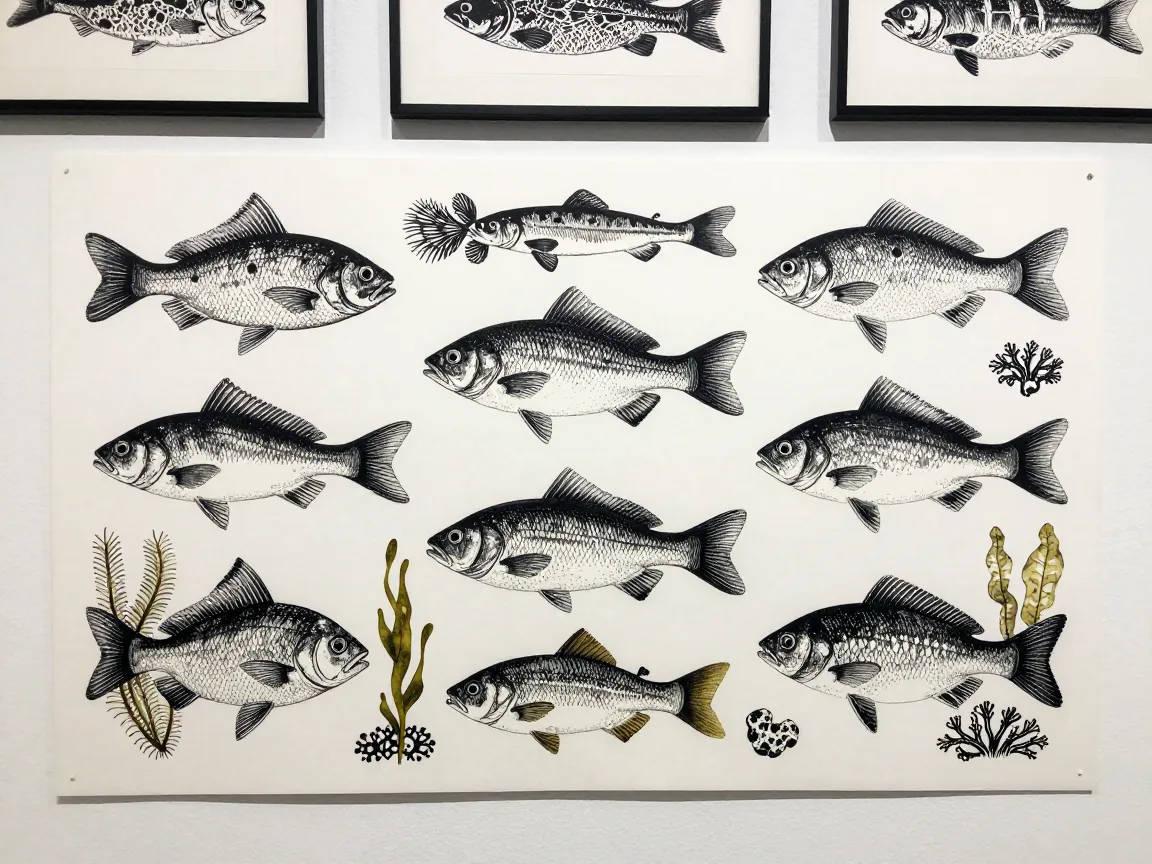
Single-specimen prints form the foundation of gyotaku, but multi-fish composition printing extends the practice into the territory of narrative pictorial art. In this approach, multiple fish, sometimes different species, are inked and printed across a single sheet in an arranged composition, often alongside printed seaweed, coral fragments, or other natural materials that create a complete underwater scene.
The logistical challenge is significant. Each fish must be inked and printed in a sequence that allows the composition to build coherently, without earlier impressions smearing or later ones being placed blind. Artists working at this scale often plan their compositions in advance using tracing-paper layouts, mapping where each specimen will fall on the final sheet before any ink touches paper.
The artistic payoff is considerable. A well-executed multi-fish composition print reads as both a document of individual specimens and as a fully realized image, the kind of work that earns exhibition-quality framing. This technique has been particularly prominent in the international spread of gyotaku beyond Japan, with artists incorporating regionally distinctive species alongside local aesthetic conventions. A print featuring native Pacific Northwest salmon alongside printed kelp fronds, for instance, carries both biological specificity and a strong sense of place that resonates with regional audiences in ways that purely decorative prints do not.
5. Art-Science Gyotaku for Documentation
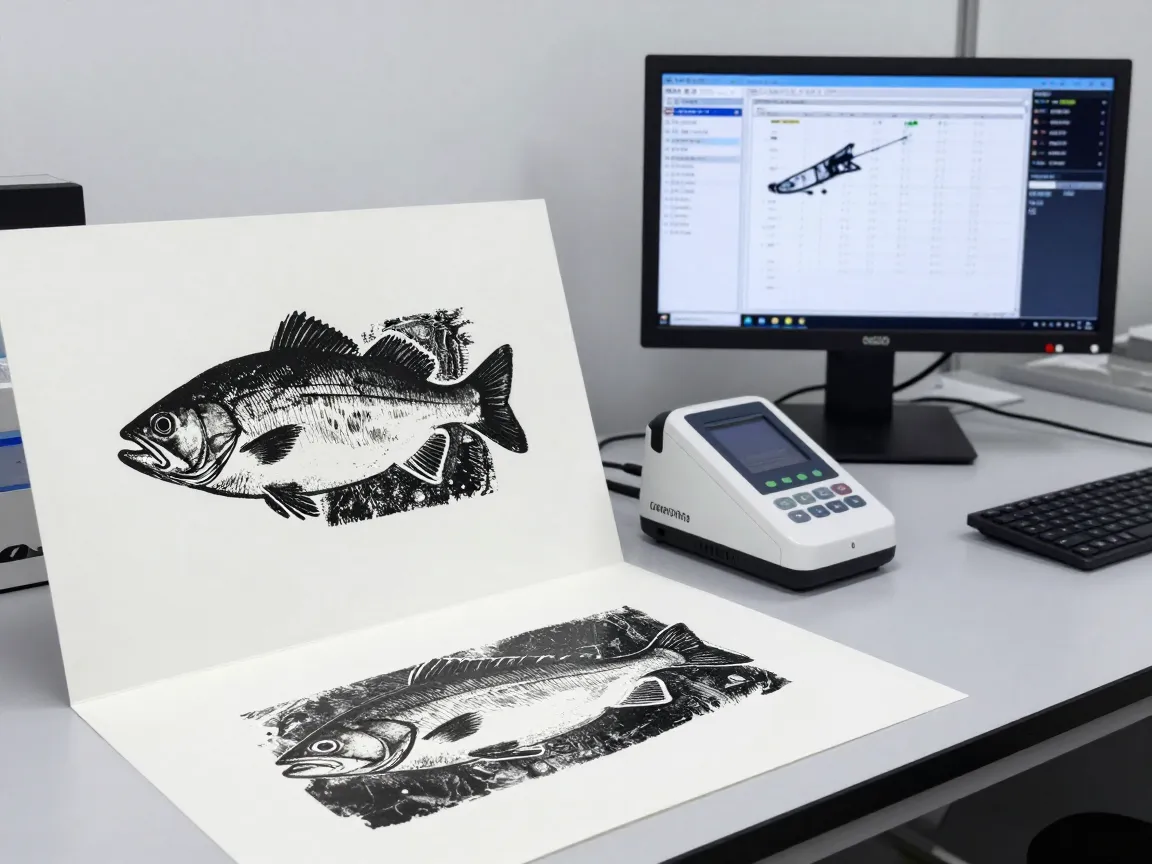
One of the most intellectually compelling uses of gyotaku in 2026 pairs traditional printing with modern scientific imaging. Museums, university biology departments, and conservation organizations have begun collaborating with gyotaku artists to create prints that function simultaneously as artworks and as precise morphological records. Historical gyotaku archives are being digitized and analyzed, with researchers measuring body proportions, fin ray counts, and scale patterns from prints that predate modern photographic documentation.
The practical technique in these collaborative projects typically favors the indirect method for its precision, but adds a documentation layer that classical practitioners did not use. Each specimen is measured and catalogued before printing. The resulting print is then scanned at high resolution and cross-referenced with photographic and genetic data. In some cases, gyotaku has revealed size changes in commercially important species over decades, data that would have been impossible to recover through any other archival method.
For practitioners interested in this direction, the technique requires a level of rigor beyond standard artistic practice. Ink consistency must be calibrated to minimize distortion of fin structures. Paper stretch must be accounted for when taking measurements from prints. And the fish must be positioned in a standardized lateral view to allow comparison across specimens and time periods. It is demanding work, but it represents a genuinely unique contribution that gyotaku can make to natural history that painting and photography cannot replicate.
6. Digital and Post-Fish Gyotaku
The newest and most conceptually adventurous branch of gyotaku practice involves moving beyond the physical specimen entirely. Digital and post-fish gyotaku encompasses several related approaches: scanning or photographing high-quality prints and manipulating them digitally to produce editions, using three-dimensional fish models to create textured stamps that function like a fish but are made from durable resin, and generating composite prints from multiple partial impressions of the same specimen.
The resin-cast or silicone-mold approach is particularly interesting because it decouples the technique from the ethical and logistical constraints of working with actual fish. A detailed cast taken from a trophy catch can be used to produce unlimited prints without requiring the fish to be repeatedly inked. This has obvious appeal in sport-fishing contexts where releasing the fish quickly is a priority, but it also allows artists to work with rare, fragile, or legally protected specimens that could not ethically be used in traditional gyotaku practice.
Digital extensions of gyotaku are still being defined in 2026, with artists experimenting with everything from AI-assisted color enhancement of scanned prints to entirely synthesized gyotaku-style compositions produced from photographic references. The purist community has predictable reservations about work that removes the physical fish from the process, but the most productive conversations in contemporary gyotaku circles treat digital and traditional methods as complementary rather than competing. A practitioner might produce a traditional direct-method print, scan it, digitally refine the color, and print an edition on archival paper, a workflow that respects the tactile origin of the work while leveraging modern production capabilities.
Shared Principles Across All Six Techniques
Despite their differences, all six gyotaku families share a core set of standards that experienced practitioners consistently emphasize. Thorough drying of the specimen before any ink is applied is non-negotiable regardless of method. Thin ink layers, built incrementally, produce more faithful impressions than a single heavy application. The eye is always painted or rendered last, functioning as the detail that animates the entire print. And paper selection, whether thin kozo washi for indirect work or slightly heavier sheets for direct printing, has a direct impact on how well the fish’s texture transfers.
These shared principles make it possible to move between techniques with a consistent foundation. A practitioner who understands why drying matters in direct gyotaku will immediately grasp why the same logic applies when dabbing pigment through rice paper in the indirect method. The techniques are distinct in execution but unified in their underlying demands for patience and preparation.
Conclusion
Gyotaku’s staying power across more than a century comes from exactly this combination: techniques that are accessible enough for a classroom afternoon yet deep enough to sustain a professional studio practice. The most useful next step for anyone drawn to these six approaches is to begin with direct gyotaku using a small, manageable specimen, a whole mackerel or a fresh-caught perch, and focus entirely on the drying and inking stages before worrying about artistic composition. Mastering those two fundamentals creates the foundation from which every other technique in this list becomes genuinely achievable.