Fishing Drawing Ideas That Will Inspire Your Next Masterpiece
Stock libraries alone hold well over 127,000 fishing drawing assets, yet artists across every skill level still search for fresh prompts that push their work beyond the generic rod-and-water cliché. That gap between abundance and genuine inspiration is exactly what this guide addresses. Whether the goal is to build a portfolio, design apparel, or simply fill a sketchbook with meaningful work, these 6 fishing drawing ideas that will inspire your next masterpiece offer specific, actionable starting points grounded in current illustration practice and classical drawing technique.
Disclosure: This post contains affiliate links. As an Amazon Associate, we earn from qualifying purchases, and at no extra cost to you.
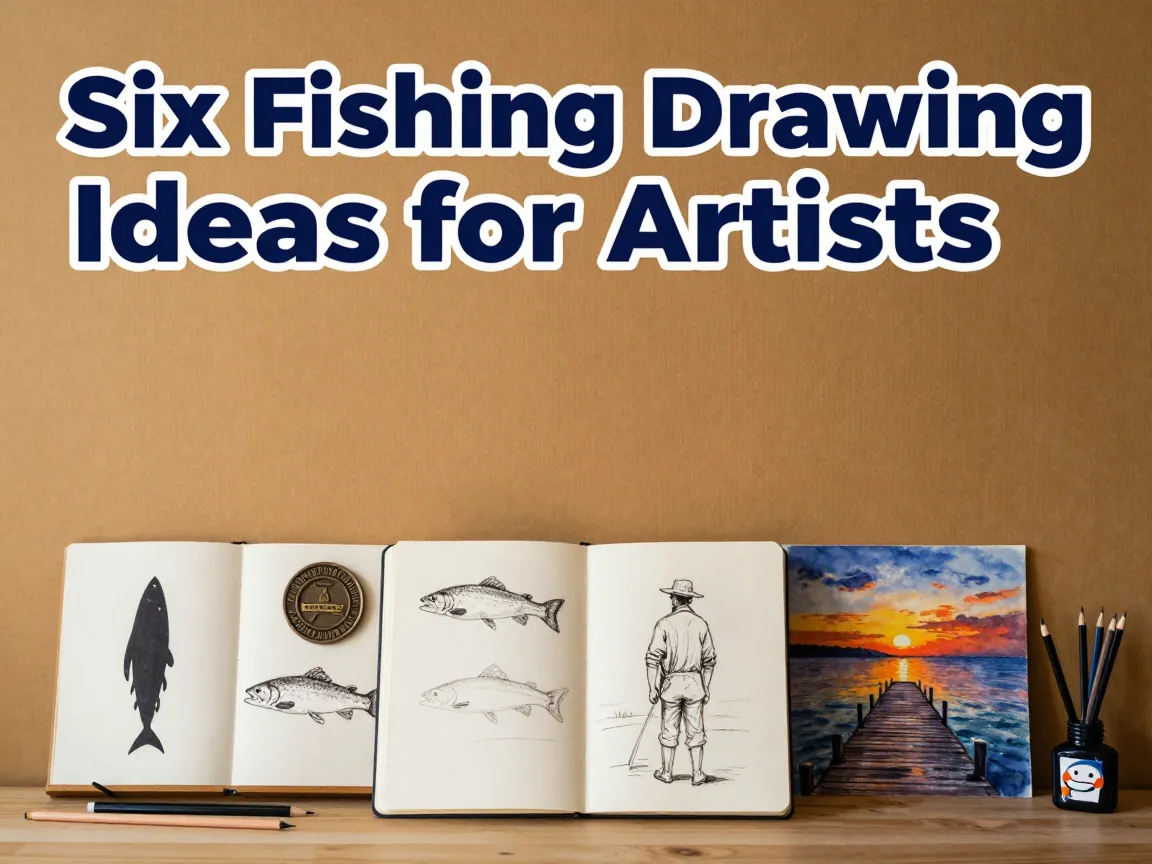
Each idea below goes beyond a vague theme. It delivers a concrete scene, a recommended approach, and a natural direction for follow-up work, so the momentum from one drawing carries directly into the next.
1. The Silhouette Angler at Dawn
Few compositions communicate solitude and patience as powerfully as a single figure cast against an early morning sky. The silhouette approach strips the scene down to its most expressive element: shape against light. For this idea, place a standing or wading angler in the lower third of the frame, rod extended in a mid-cast arc, with the horizon line positioned high enough to let sky dominate. The contrast between the angler’s dark, flat form and a gradient sky ranging from deep indigo to warm amber creates instant visual drama with relatively simple mark-making.
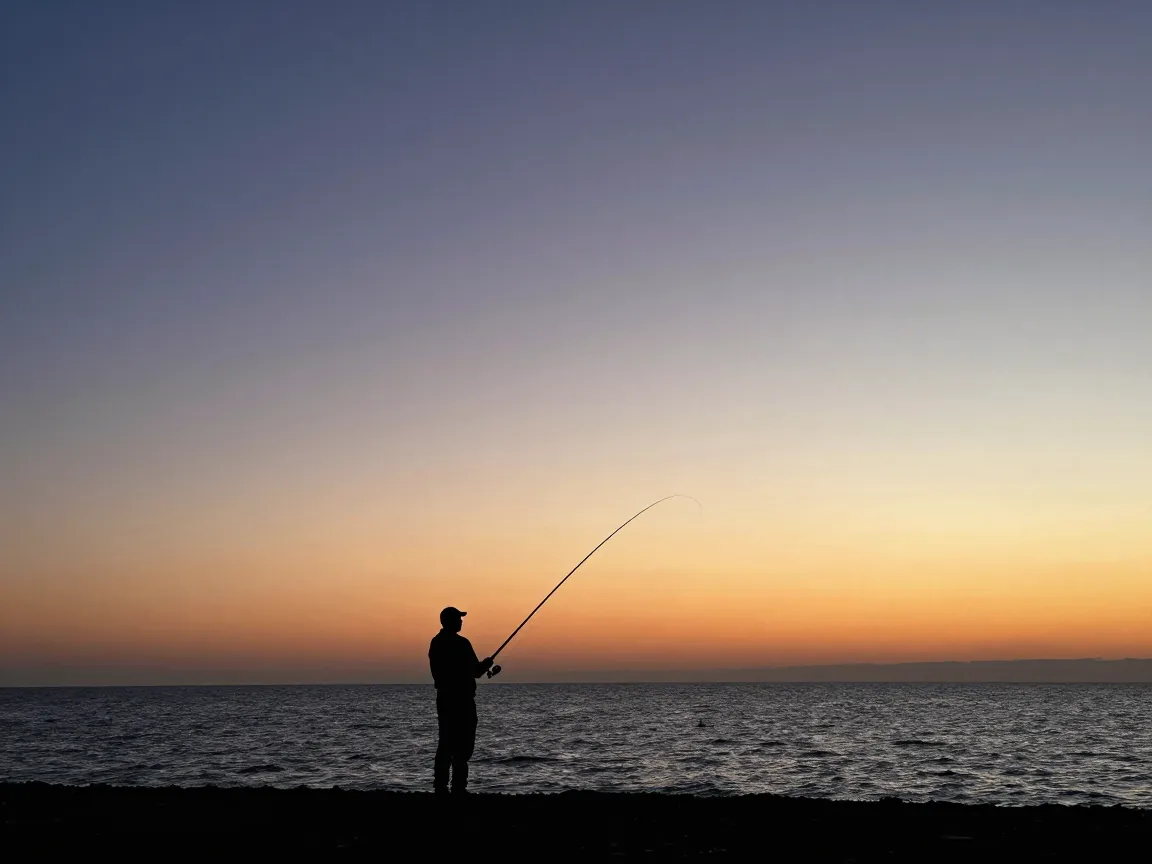
The practical appeal of this composition is its forgiving nature for beginners. Because the figure is entirely black or near-black, there is no need to worry about facial features, fabric folds, or anatomical precision. The focus shifts instead to the quality of the silhouette’s outline, which forces an artist to think carefully about the gesture and weight of the pose. A poorly balanced rod angle or a stiff arm position reads immediately against a clean sky, so this exercise trains observation skills efficiently.
For follow-up work, try varying the light source. A silhouette angler at dusk, with a low sun behind distant hills, shifts the mood from hopeful to reflective. A foggy morning version, where the silhouette fades softly into mist rather than a hard edge, introduces atmospheric perspective. Black ink on toned paper, or a simple two-layer watercolor wash, are both well-suited to this idea and require minimal materials to execute convincingly.
2. Detailed Underwater Trout Study
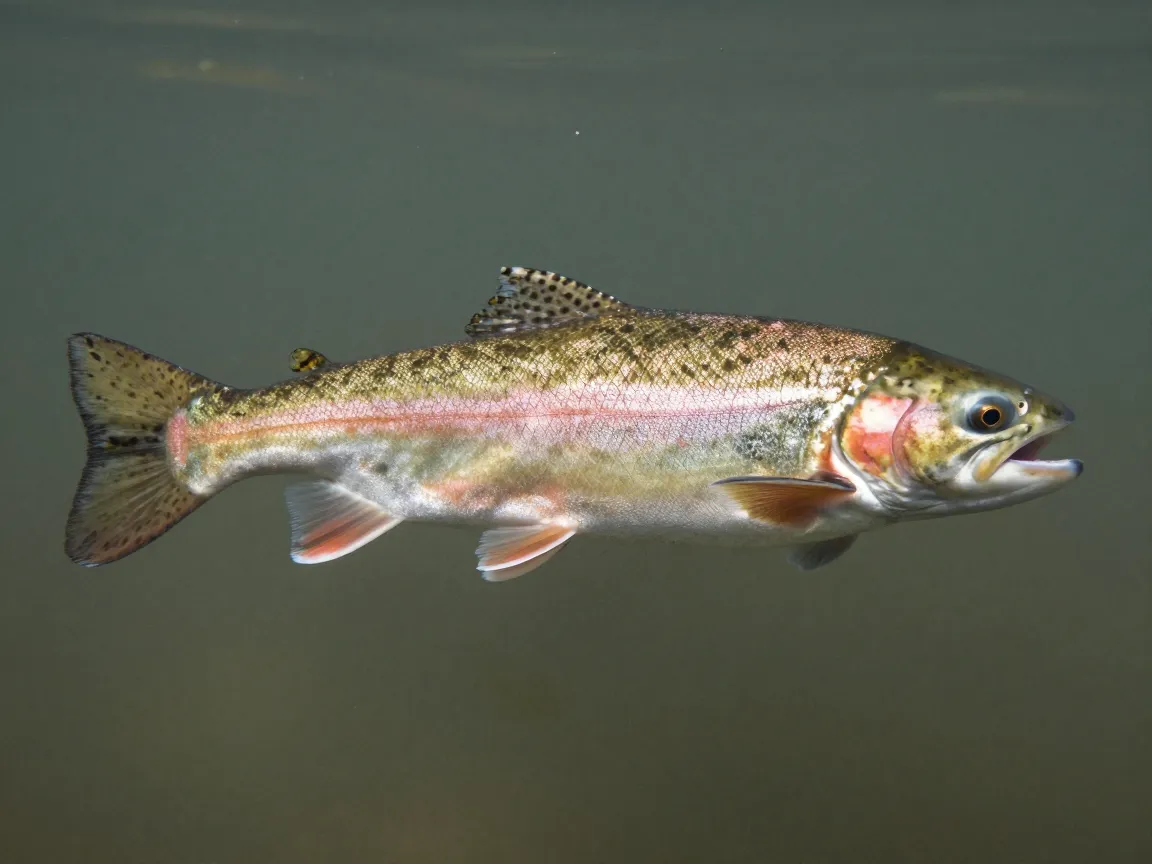
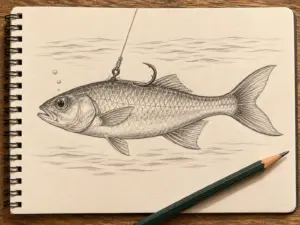
Realism-focused artists often overlook fish as a subject because fish seem ornamental rather than structurally interesting. That assumption is wrong. A rainbow trout, brown trout, or largemouth bass offers a genuinely complex anatomy: overlapping scales with their own reflective geometry, a lateral line that runs like a topographic seam from gill to tail, translucent fins that catch and diffuse light, and an iridescent skin that shifts from olive to pink depending on the viewing angle.
Approach this as a true observational study rather than a decorative illustration. Work from photographic reference or, where possible, an actual specimen. Begin with a light pencil outline that maps the major body proportions, paying close attention to where the dorsal fin originates and how far the pectoral fin extends relative to the eye. Then use hatching or stippling to build tonal depth, starting with the darkest areas near the spine and working toward the paler belly. Leave deliberate highlights along the lateral line to suggest the fish’s cylindrical volume.
The commercial relevance of this kind of detailed study is worth noting. Realistic fish drawings appear consistently in fly-fishing publications, nature illustration markets, and limited-edition print collections. Completing several species studies back to back also builds a natural series, which is a stronger portfolio asset than isolated pieces. After the trout, a detailed study of a bluegill, a pike, or a steelhead offers enough visual contrast in body shape, scale pattern, and coloring to keep each piece feeling genuinely distinct.
3. Vintage Badge-Style Fishing Emblem
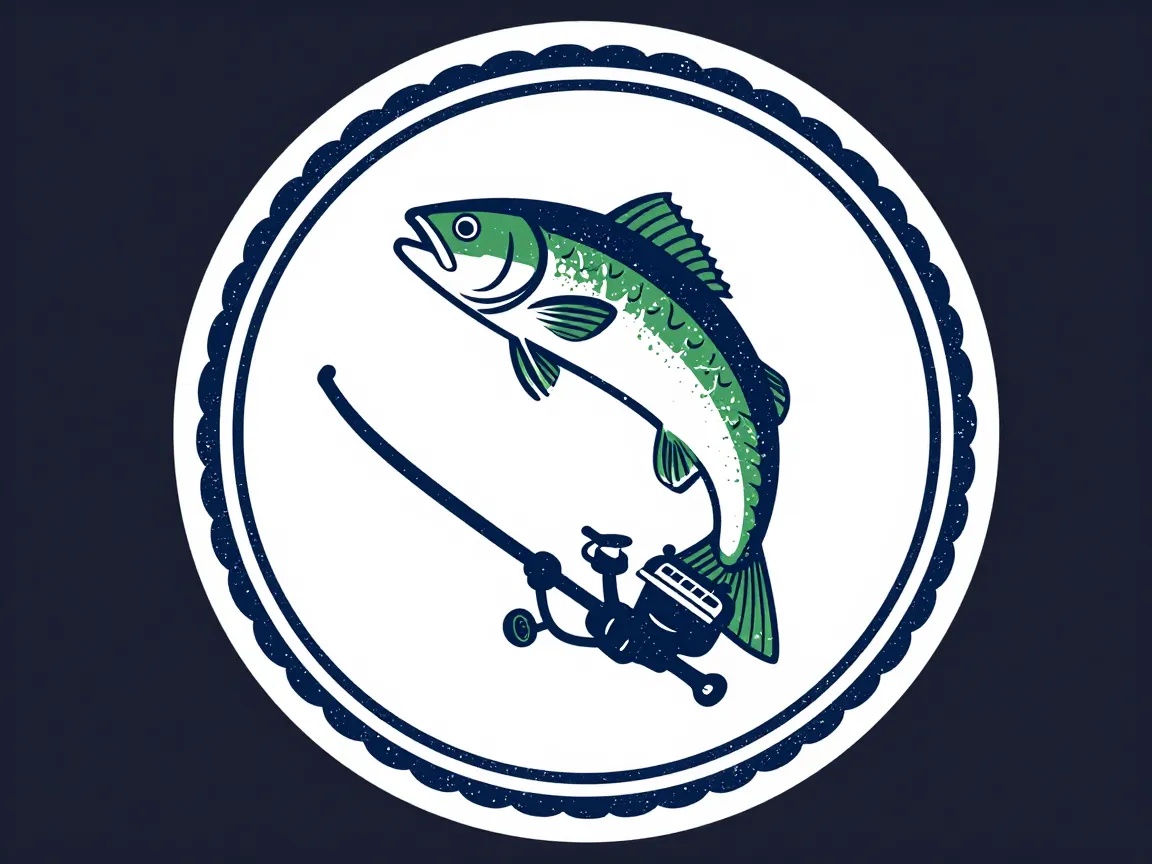
The vintage badge aesthetic has remained one of the most commercially durable directions in fishing illustration. Bass-fishing apparel, tackle-shop branding, tournament logos, and outdoor gear all draw heavily on this visual language: circular or shield-shaped borders, a central leaping fish or rod-and-reel motif, rope or chain decorative rings, distressed textures, and a limited two- or three-color palette typically anchored by deep navy, forest green, or burgundy.
What makes this idea particularly instructive as a drawing exercise is that it demands an understanding of composition at multiple scales simultaneously. The badge must read clearly as a small patch on a cap and as a full-size print on a T-shirt. That constraint teaches artists how to simplify a fish form into its most readable silhouette, how to balance negative space inside a tight geometric border, and how to integrate letterforms or banner shapes without overcrowding the design.
A practical starting point is to thumbnail at least six badge variations before committing to a final layout. Experiment with the fish facing left versus right, with the rod placed diagonally versus vertically, and with the border shape changing from a circle to an oval to a pennant. This thumbnail stage, which can be done loosely in pencil in under an hour, often reveals a superior composition that would not have been obvious from the first instinct. Once a layout is chosen, refining it in ink with controlled line weights gives the finished piece the crisp, authoritative quality that defines the best examples of the genre.
4. Gestural Fisherman Sketch in Ink
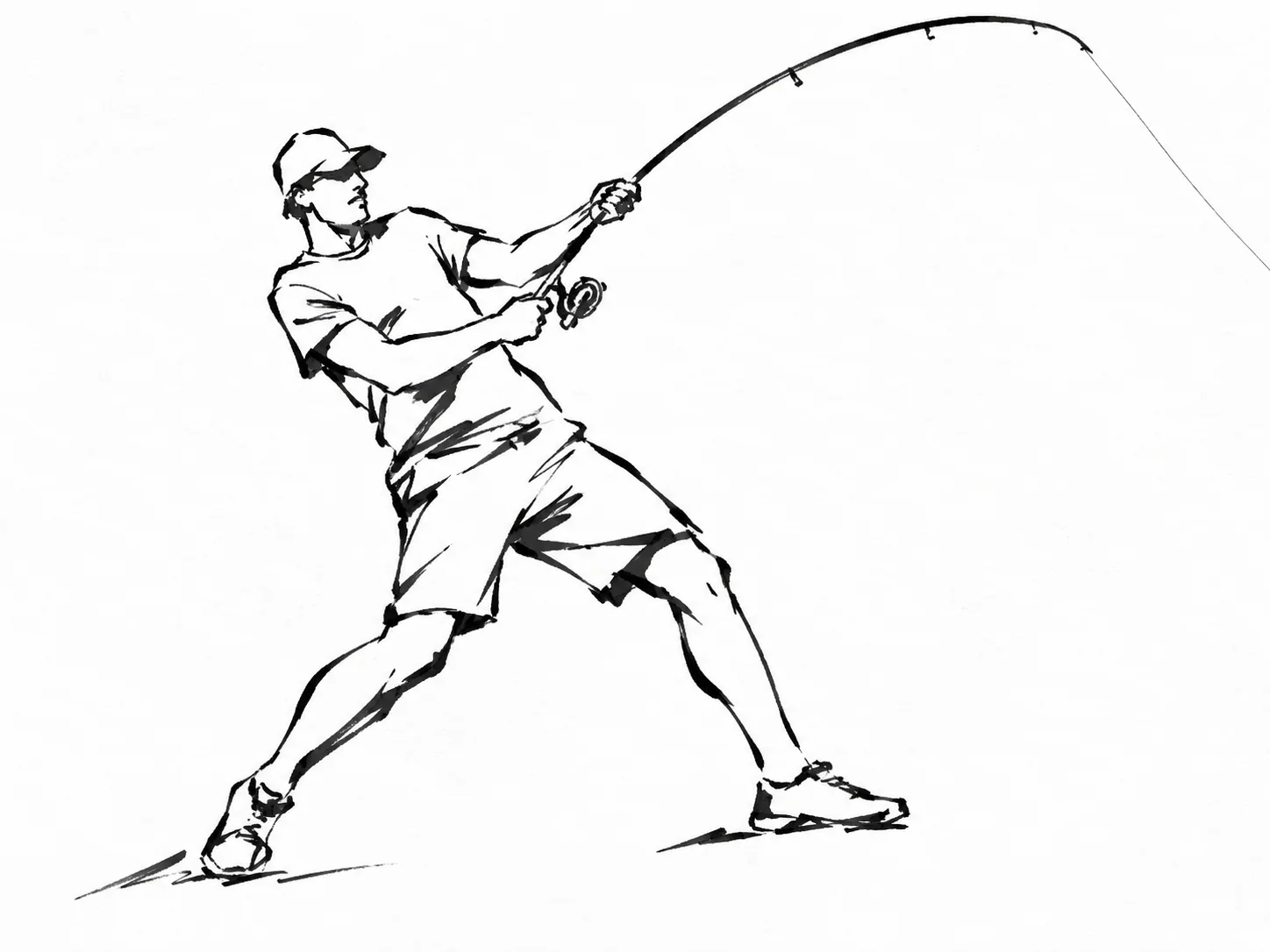
Speed and looseness are qualities that many artists train out of themselves in pursuit of technical precision. The gestural ink sketch reintroduces them deliberately. For this idea, the subject is a fisherman or angler in an active pose: hauling in a line, reaching for a net, bracing against a current, or hunching over a tackle box. The goal is to capture the pose in under ten minutes using flowing, unbroken ink lines, without erasing or overworking.
The constraint of ink is what makes the exercise valuable. Because ink cannot be erased, every line is a commitment, and that pressure builds decision-making speed and confidence in mark-making. Start with the longest, most defining line in the pose, often the curve of the spine or the angle of the casting arm, and build outward from there. Faces, hands, and clothing details can be suggested with two or three marks each rather than rendered fully. The drawing should convey weight and movement, not anatomical completeness.
Gestural studies also function as effective warm-up exercises before longer, more detailed projects. A session of ten gestural fisherman sketches, each from a different reference pose and each completed in roughly five minutes, sharpens the eye and loosens the hand in a way that benefits every subsequent piece. For artists exploring a fishing-themed sketchbook or editorial illustration series, back-view poses, kneeling figures, and profile silhouettes each tell a slightly different story and prevent the series from feeling repetitive.
5. Atmospheric Jetty or Boat Scene at Sunset
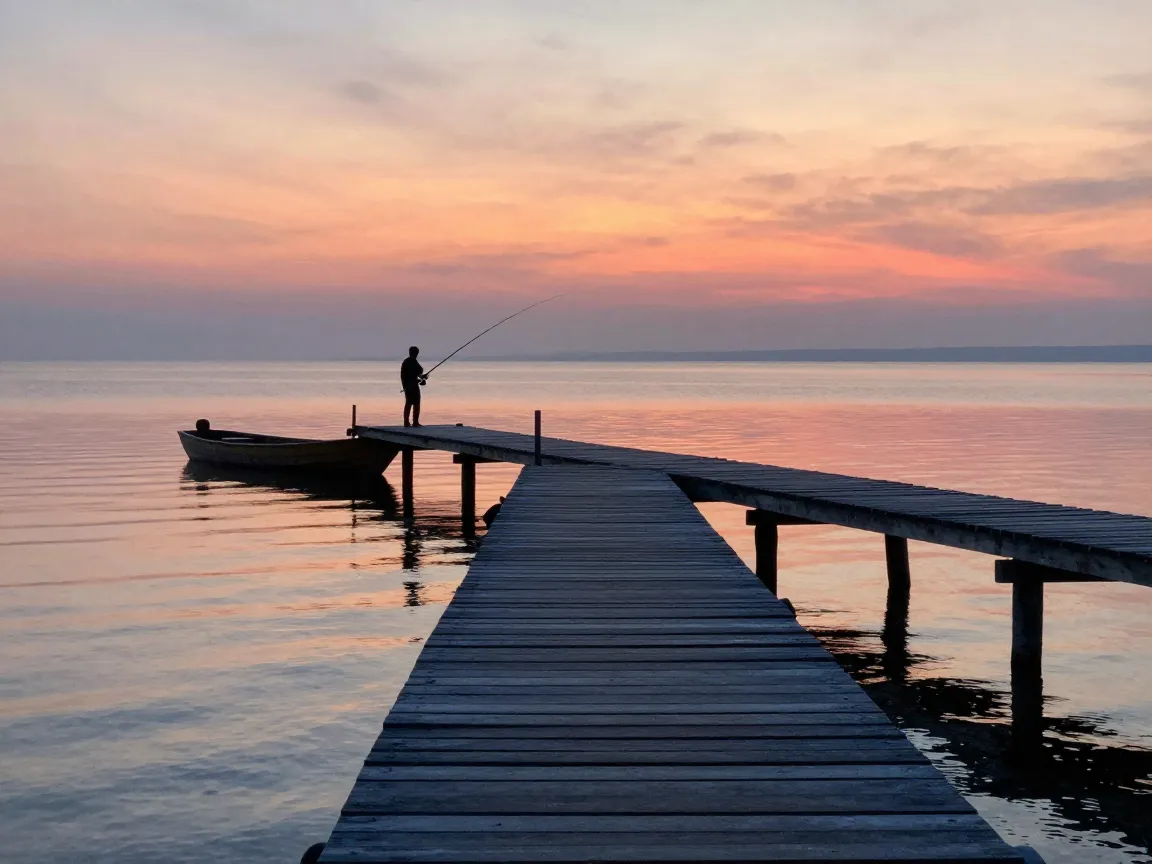
Narrative scene-building is where fishing drawing moves decisively beyond character study and into the territory of storytelling. A jetty stretching into calm evening water, a small wooden boat with a lone figure aboard, or two anglers on a dock watching the last light leave the sky, these compositions carry emotional weight because they situate the act of fishing within a larger sense of place and time.
The technical challenge in this idea lies in handling the relationship between warm foreground light and cool shadow. At sunset, the sky emits orange and pink tones that reflect on the water’s surface, while the undersides of boats, dock planks, and the angler’s clothing fall into blue-grey shadow. Getting that temperature contrast right, whether in watercolor, colored pencil, or digital media, is what separates a flat illustration from a convincing atmospheric scene. A common approach is to lay down the warm sky and water reflection first as broad washes, then introduce the cooler shadows as a second, overlapping layer, keeping the transition zone soft and blurred.
Composition choices matter as much as color in this scenario. Placing the jetty or boat off-center, with the remaining frame given over to sky and reflected water, creates a sense of open space that reinforces the quiet mood of an evening fishing scene. Adding a bent rod with a taut line suggests a moment of action within an otherwise still environment, introducing tension without disrupting the tranquil atmosphere. This kind of controlled narrative contrast, stillness broken by a single active element, is a technique worth practicing across multiple scene variations.
6. Stylized Fish Character for Apparel or Pattern Work
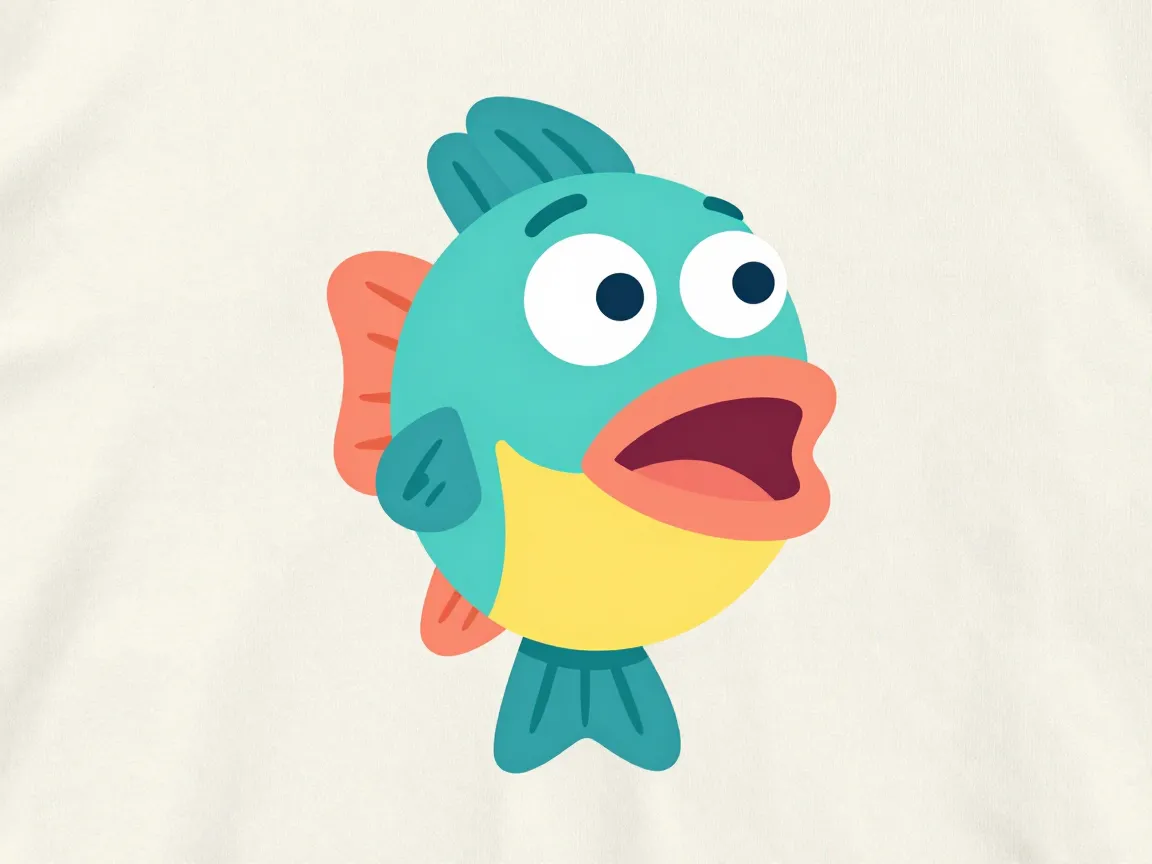
Not every fishing drawing needs to be rooted in realism or even in a recognizable outdoor scene. The stylized fish character, designed specifically for apparel graphics, surface patterns, or repeat textile work, represents a distinct and commercially active branch of fishing illustration. The design logic here prioritizes silhouette clarity, color accessibility, and scalability over anatomical accuracy.
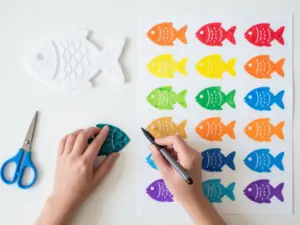
The character design approach typically begins by choosing a single fish species as the base, a wide-eyed cartoon bass, a friendly rounded trout, an expressive koi, or an angular geometric marlin, and then exaggerating its most distinctive feature. For a bass, that might be an oversized jaw. For a trout, it might be the spotted dorsal fin or the stripe of color along the flank. For a koi, the flowing tail and whisker-like barbels become the natural focal points. The exaggeration should feel deliberate and confident, not accidental, which is why preliminary sketching is essential before moving to a final inked or digital version.
Color palette choices for this kind of work benefit from restraint. Apparel printing often works best with two to four colors, so testing a design in a limited palette early in the process reveals whether the composition is strong enough to stand on its own without relying on color complexity. Soft turquoise, coral, and lemon yellow have emerged as a particularly popular combination for contemporary fish character work, providing visual warmth and accessibility without the heaviness of saturated primary colors. For pattern work, a single fish character can be rotated, mirrored, and scaled to create an all-over repeat that works equally well on fabric, wrapping paper, stationery, or ceramic tile, extending the value of a single well-executed drawing across an entire product line.
Conclusion
The range covered by these 6 fishing drawing ideas that will inspire your next masterpiece spans silhouette work, anatomical study, commercial badge design, gestural sketching, atmospheric scene-building, and character design for surface pattern, each with its own technical priorities and market applications. That breadth is intentional. Working across different formats and styles builds a more flexible skill set than repeating the same approach indefinitely.
The most practical next step is to pick one idea that addresses a specific gap in current work. If gesture and confidence with mark-making feel underdeveloped, start with the ink sketch series. If the goal is a commercial portfolio piece, the vintage badge or the stylized fish character offers a direct path to a market-ready result. Choosing the idea that stretches the weakest area of practice, rather than the one that feels most comfortable, is where the most meaningful growth happens.