Duck Hunter Nursery Ideas for Raising Your Little Waterfowl Fan
Roughly one in three American households includes at least one hunter, and among that group, waterfowl hunting has the kind of generational pull that starts well before a child is old enough to hold a call. Parents who want that identity reflected in their baby’s room have more options in 2026 than ever before, dedicated product collections, coordinated art sets, and trend reports naming “Outdoor Heritage with Mallard Ducks” as one of the defining nursery looks of the year. These 6 duck hunter nursery ideas for raising your little waterfowl fan pull from that movement and translate it into actionable, room-ready decisions.
Disclosure: This post contains affiliate links. As an Amazon Associate, we earn from qualifying purchases, and at no extra cost to you.
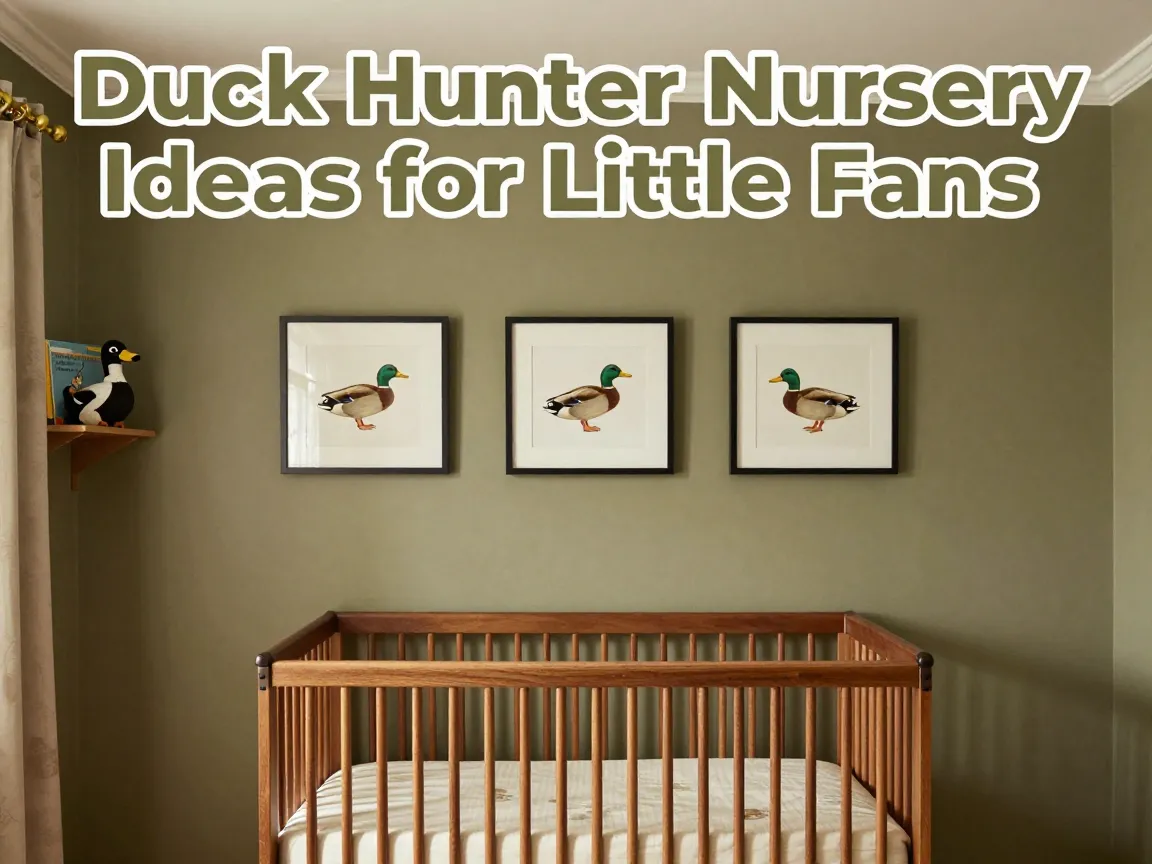
Key Takeaways
- Start with one anchor piece, a marsh print, name sign, or gallery set, and build the palette outward from there.
- Olive, dusty blue, cream, and walnut cover the full range from soft and airy to richly traditional.
- The Black Lab and mallard pairing is the most recognizable shorthand for a waterfowl-hunting nursery and works across art, textiles, and outfits.
- Personalized felt sets and storybooks add a layer of meaning that mass-produced prints can’t match.
- Camo textiles are best treated as an accent, not a base layer, so the room can grow with the child.
1. Build the Room Around One Anchor Piece and a Defined Color Palette
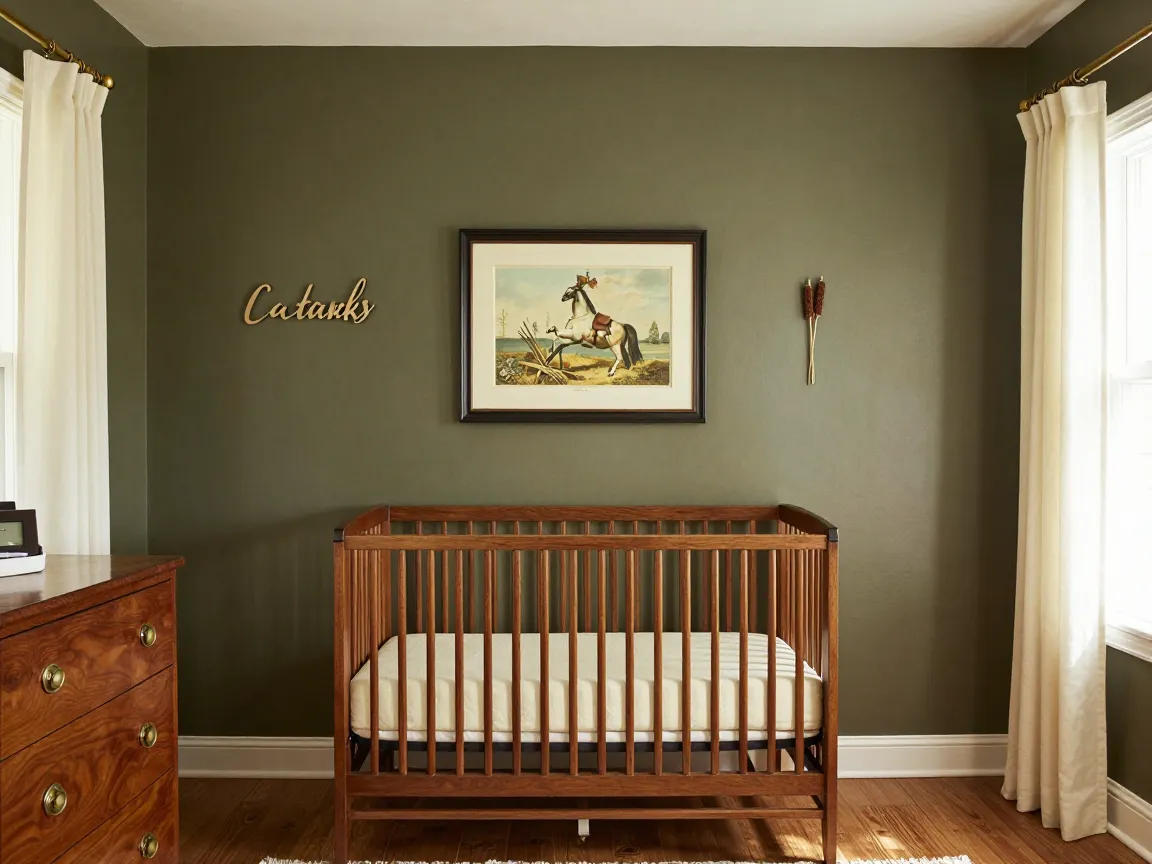
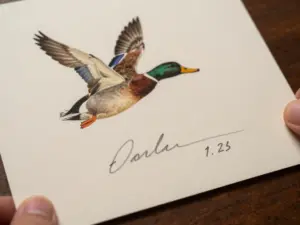
The most common mistake in themed nurseries is buying items that all fight each other for attention. A focused duck-hunting room starts with a single piece you’re genuinely attached to, a vintage marsh lithograph, a hand-lettered wooden nursery name sign with cattail accents, or a coordinated gallery set, and then every other purchase matches back to that piece rather than to a broad idea of “duck hunting.”
A November 2026 color guide dedicated to duck-hunting nurseries lays out three palettes worth using as your starting framework. The first is Olive, Walnut, and Cream: deep olive walls or an accent wall, walnut wood furniture, and cream textiles. It reads as a traditional American sporting room without feeling heavy. The second is Dusty Blue, Oatmeal, and Walnut: softer, more airy, and better suited to rooms with limited natural light. The third is Cream, Pale Oak, and Soft Olive: the lightest of the three, almost Scandinavian in its restraint, with the duck-hunting theme carried entirely by the art and hardware rather than the wall color.
Antique brass hardware on dressers and curtain rods ties all three palettes together and signals the aesthetic without requiring a single piece of camouflage in the room. If you’re painting first and buying art second, go with Dusty Blue or Soft Olive, both are forgiving enough to work with whatever prints you find over the next several months. Locking yourself into a very specific terracotta or forest green before you’ve chosen art makes coordination harder later.
2. Hang a Mallards-in-Flight Gallery Wall Above the Crib
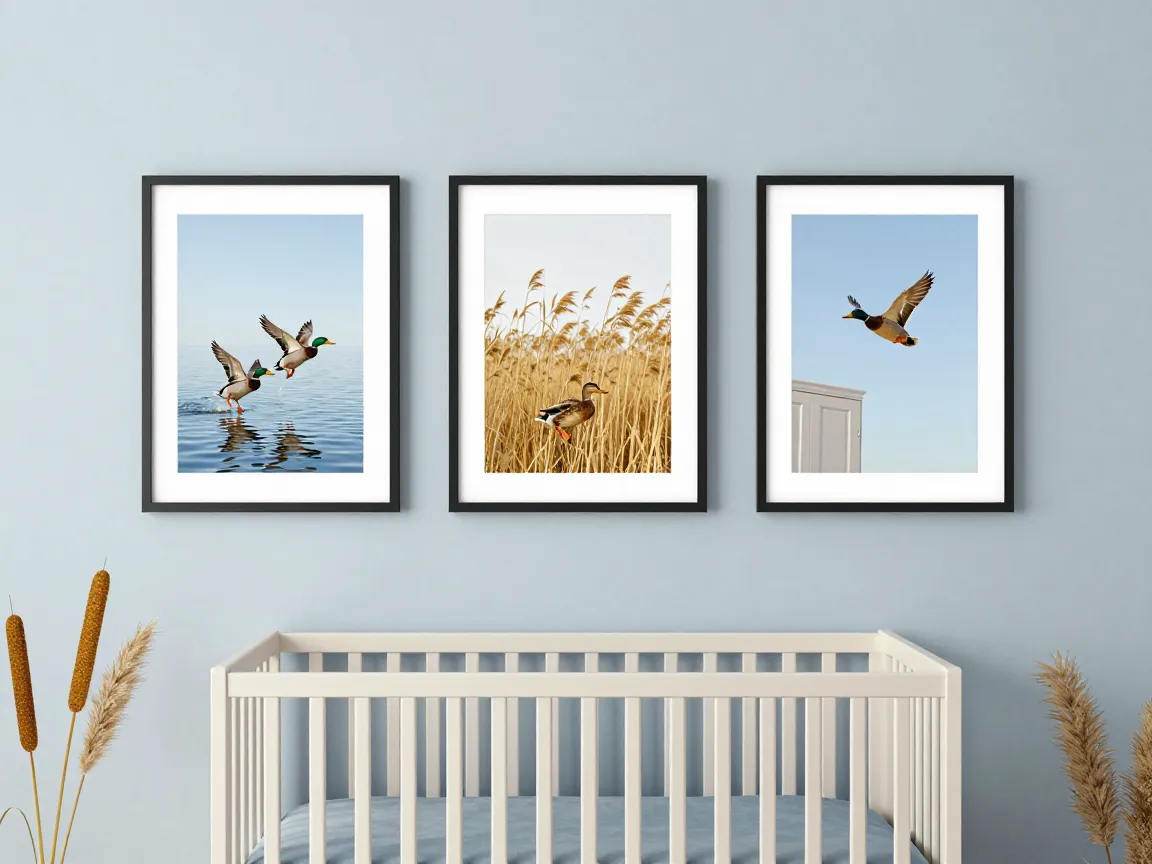
Three coordinated prints arranged horizontally above the crib create movement and visual interest without cluttering the wall. The arrangement that works best features ducks at different stages of flight: one print of mallards lifting off the water, one of the same birds clearing golden reeds at mid-distance, and one of a single drake gliding across a pale blue sky. Orienting the ducks so they appear to fly toward the nursery door, rather than toward a corner, gives the composition a sense of direction that makes the wall feel intentional.
Frame consistency matters more than print similarity. Three prints in mismatched frames pull the eye to the frames rather than the art. Black, walnut, or antique brass frames all work; pick based on the hardware and furniture already in the room. Mat width should be uniform across all three pieces, and a narrow mat (about one inch) keeps the prints feeling light rather than formal.
This arrangement pairs well with the Dusty Blue palette from idea one because the sky tones in a standard mallard-in-flight print echo the wall color without being identical. If you go with Olive or Walnut walls, look for prints with warmer marsh tones, cattail gold, dried-grass tan, to create contrast with the wall rather than blending into it.
3. Choose a Soft Mallard Style for a Calmer, More Infant-Friendly Version
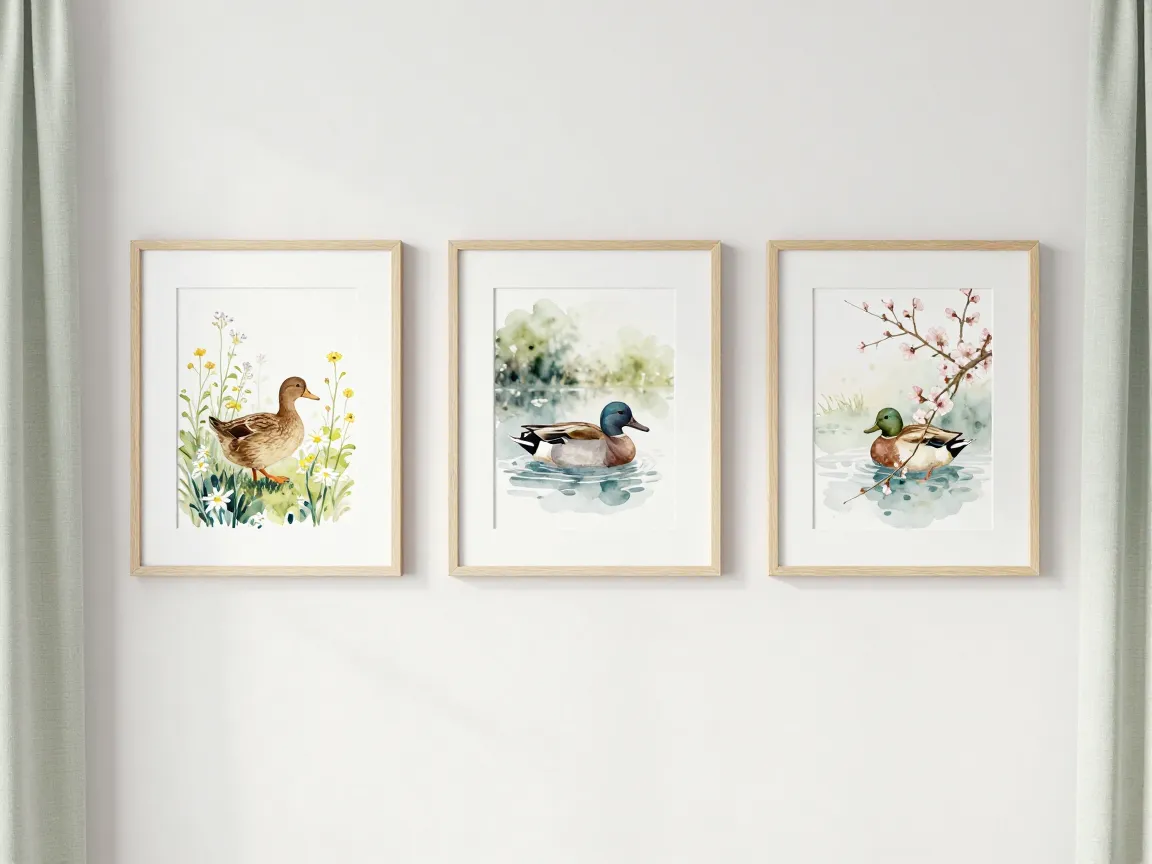
Not every duck-hunting nursery needs to look like a sporting lodge. For parents who want the waterfowl theme but also want a room that feels restful and gentle for a newborn, the soft mallard approach works well. This style keeps significant white space around each piece of art, favors hen mallards and blue-winged ducks over the classic greenhead-dominant compositions, and mixes in small botanical elements, wildflower clusters, still water reflections, reed grasses, to soften the hunting association without abandoning it.
Specific art subjects that fit this direction: a mallard hen walking through a meadow of mixed wildflowers, a blue-winged teal resting on glassy water with a soft-focus tree line behind it, and a drake mallard among blossoms with a watercolor wash treatment rather than a realistic rendering. The color palette shifts slightly toward pale sage and linen rather than the deeper olive and walnut of the more traditional look.
This approach is also more flexible as the child gets older. A room built around realistic drake-in-flight art reads as very specifically “duck hunting.” A room with softer botanical-and-bird art can evolve into a broader nature or outdoors theme without a full redecoration. That’s a practical consideration if you’re not certain the duck-hunting identity will stick as a primary bedroom theme past toddlerhood.
4. Use a Coordinated Product Collection to Shortcut the Matching Problem
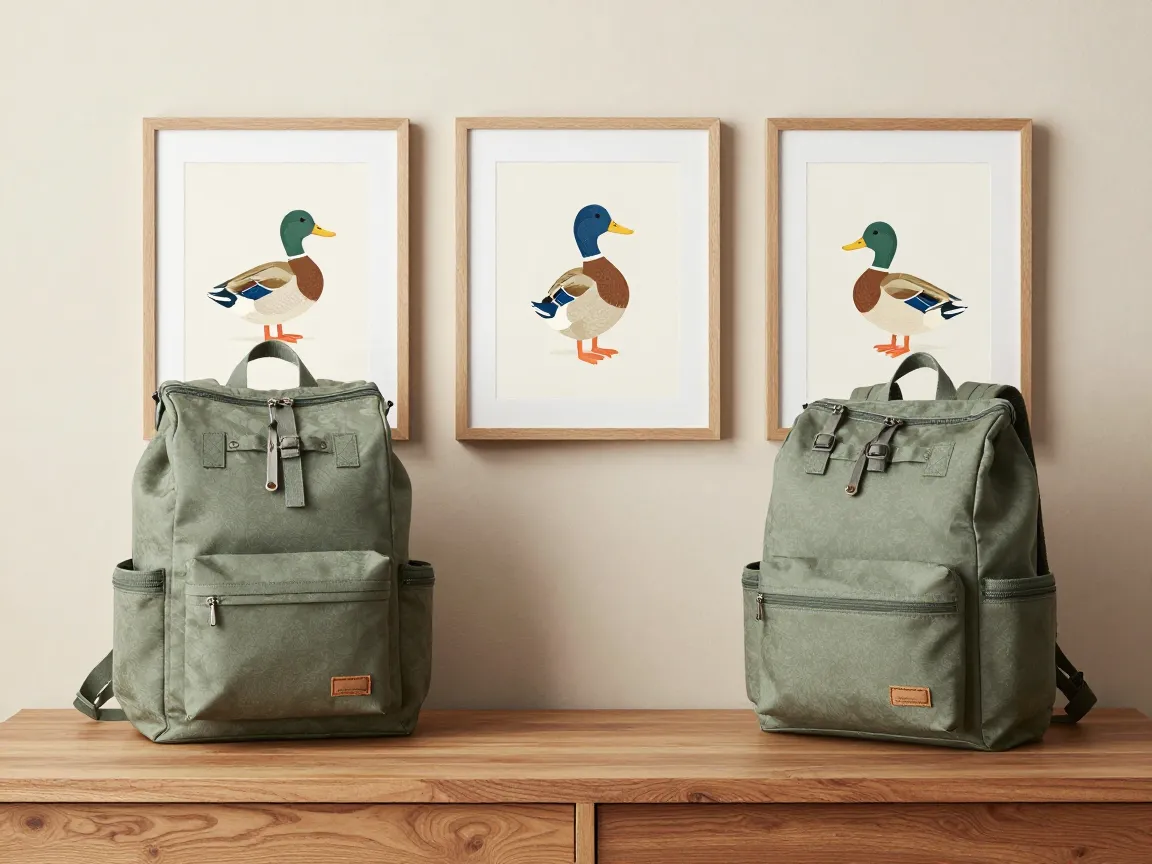
Finding pieces that work together without buying a matched bedroom set from a single retailer is one of the more time-consuming parts of building any themed nursery. In 2026, coordinated duck-hunting collections have started to appear at specialty retailers that solve this problem directly. The Mallard and Moss collection from Modified Tot, live since September 2026, is the clearest current example: it bundles a duck-hunting backpack diaper bag with a matching nursery art trio and other coordinated items so the core visual elements of the room share the same illustrative style, color family, and design sensibility.
The practical value here is real. When art, textiles, and functional items like a diaper bag share a palette and illustration style, the room achieves cohesion even if the furniture is neutral or inherited. The collection approach also removes the risk of two pieces sharing a similar subject, both a mallard in flight, say, but rendered so differently in scale and style that they read as mismatched rather than complementary.
If a full collection is outside the budget, buy the art trio from the collection and source textiles and furniture separately. The art sets the visual language of the room; everything else is backdrop.
5. Order a Personalized Felt Wall Set That Combines Multiple Species
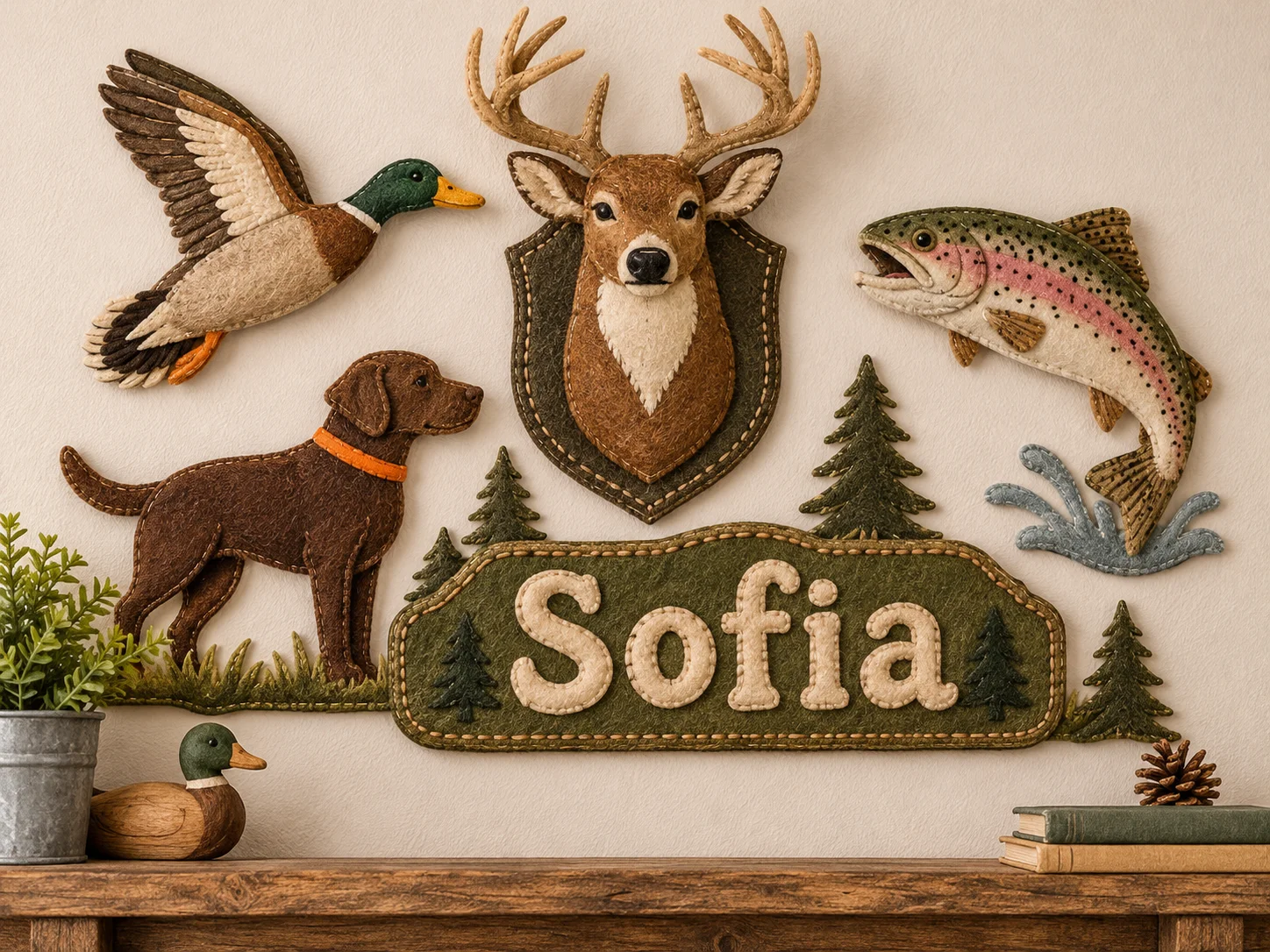
A mass-produced gallery print of a flying mallard is easy to find. A set of hand-stitched felt wall pieces with your child’s name woven into a trophy display alongside a flying mallard, a rack buck, a rainbow trout, and a hunting dog is a genuinely different object, the kind of thing that gets pointed out on nursery tours and stays on the wall past the nursery years.
Etsy Canada has at least one active listing as of late 2026 that offers exactly this configuration: a flying mallard duck, a trophy whitetail, a rainbow trout, a hunting dog silhouette, and a personalized name or initial plaque, all in coordinated felt and sold as a single set designed for a rustic hunting nursery. The handcrafted texture of felt reads differently on a wall than a framed paper print, it has dimension, and it photographs well in soft light without glare.
The multi-species approach also reflects how most duck hunters actually think about their time outdoors. Very few people who hunt ducks don’t also fish, deer hunt, or run a retriever. A nursery that acknowledges the whole picture rather than just the mallard feels more personal and less like a licensed product category. When ordering, confirm the seller’s current production timeline, personalized items on Etsy typically run two to four weeks from order to delivery, and that lead time matters if the nursery has a deadline.
6. Anchor the Gallery Wall With a Bold Phrase Print and Species Watercolors
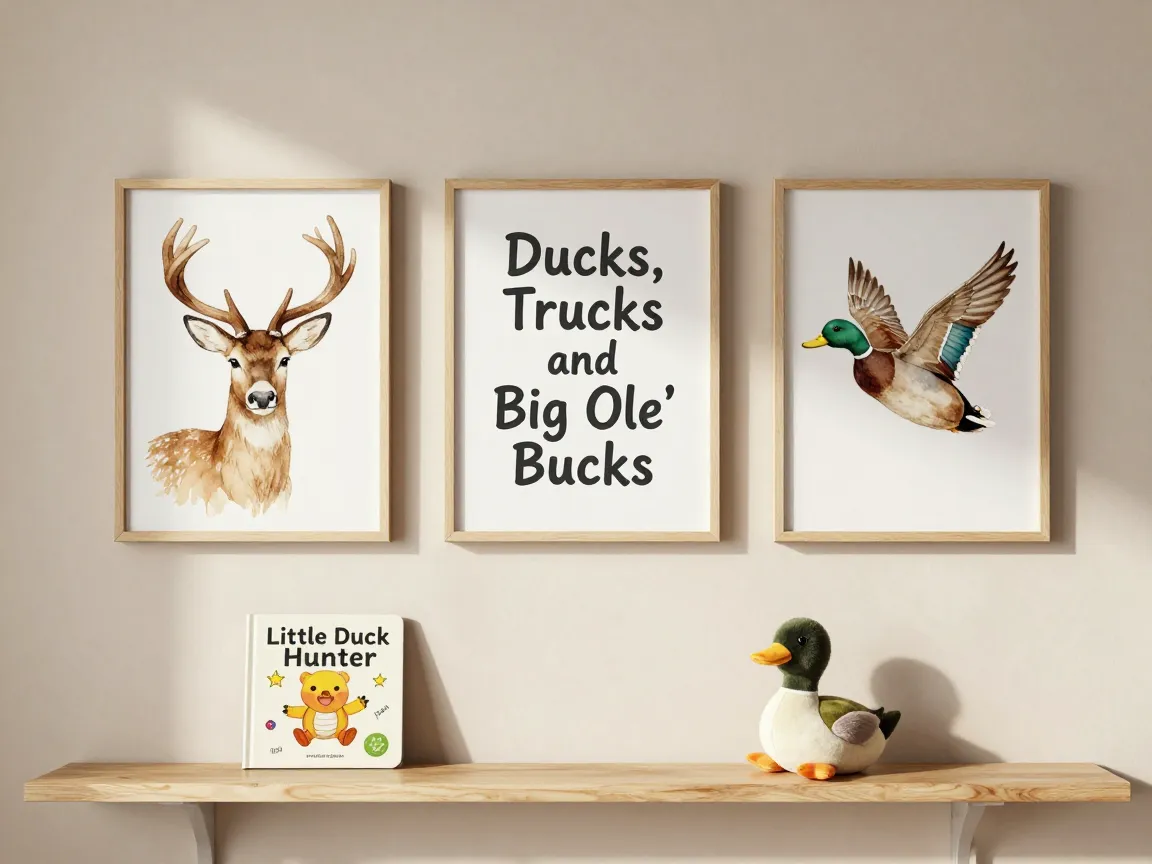
A single text print changes the energy of an art wall. Without it, three animal watercolors read as decoration. With one strong phrase print in the center or at the end of the arrangement, the same three pieces read as a point of view.
The pairing that appears most frequently in duck-hunting nursery searches in 2026 is a deer watercolor alongside a flying mallard watercolor, anchored by a “Ducks, Trucks and Big Ole’ Bucks” text print. That specific combination is available as a matched three-print set on Etsy (listed June 2026, updated through November 2026) and is explicitly pitched for boy hunting nursery and duck-hunting nursery contexts. The phrase is direct enough to signal the theme immediately but relaxed enough that it doesn’t feel forced as nursery art.
If that specific phrase doesn’t fit your tone, the same structural logic applies with other options: a “Born to Hunt” or “Future Duck Hunter” print in a matching watercolor style, placed between the two animal prints, accomplishes the same anchoring effect. The critical variable is that the text print and the animal prints share the same paper stock, color temperature, and illustration weight, a loose watercolor animal print next to a crisp vector-style text print will look mismatched regardless of how well the phrases coordinate.
For parents who want to take this further, the storybook layer adds another dimension. Personalized “Little Duck Hunter” lullaby books and custom duck-hunting storybooks with the child’s name are available as nursery gifts and bedtime reads. A small shelf or ledge below the gallery wall that holds one or two of these books alongside a mallard plushie gives the wall composition a three-dimensional lower tier and creates a natural focal point for story time.
Quick Comparison
| Idea | Best For | Key Visual Element | Effort Level |
|---|---|---|---|
| 1. Anchor piece and palette | Starting from scratch | Marsh print or name sign | Low, decisions first, buying second |
| 2. Mallards-in-flight gallery wall | Traditional waterfowl look | Three-print horizontal arrangement | Low, framing is the main task |
| 3. Soft mallard art | Infant-friendly or gender-neutral | Botanical duck art, white space | Low, art sourcing only |
| 4. Coordinated product collection | Busy parents, cohesion priority | Matched art trio and accessories | Very low, single retailer |
| 5. Personalized felt wall set | Heirloom feel, multi-species theme | Handcrafted felt with name plaque | Medium, lead time required |
| 6. Phrase print anchor wall | Bold, identity-forward look | Text print plus watercolor species art | Low to medium, style matching needed |
Conclusion
Of these six directions, the one that sets up everything else most reliably is idea one, picking the palette before anything else. Once you know whether you’re working in Olive and Walnut or Dusty Blue and Oatmeal, every subsequent purchase has a filter. If you’re starting today, choose the palette, buy one anchor art piece you genuinely like, and let the rest of the room fill in around it. The mallards-in-flight wall, the felt set, and the phrase print all look better against a background that was chosen with intention.