Smart Fishing Equipment Storage Ideas to Declutter Your Garage and Protect Your Gear
A single snapped rod tip can cost you a $200 blank. That is the kind of damage that happens when fishing gear gets piled in a corner between trips, and it is almost entirely preventable. These 6 smart fishing equipment storage ideas to declutter your garage and protect your gear are built around one principle: the right storage method does two jobs at once, it clears floor space and it actively protects the equipment from the conditions that destroy it. Work through these ideas in order of your budget and available wall space, and you will end the season with every rod, reel, and wader in the same condition it left the shop.
Disclosure: This post contains affiliate links. As an Amazon Associate, we earn from qualifying purchases, and at no extra cost to you.
1. Horizontal Wall and Ceiling Rod Holders
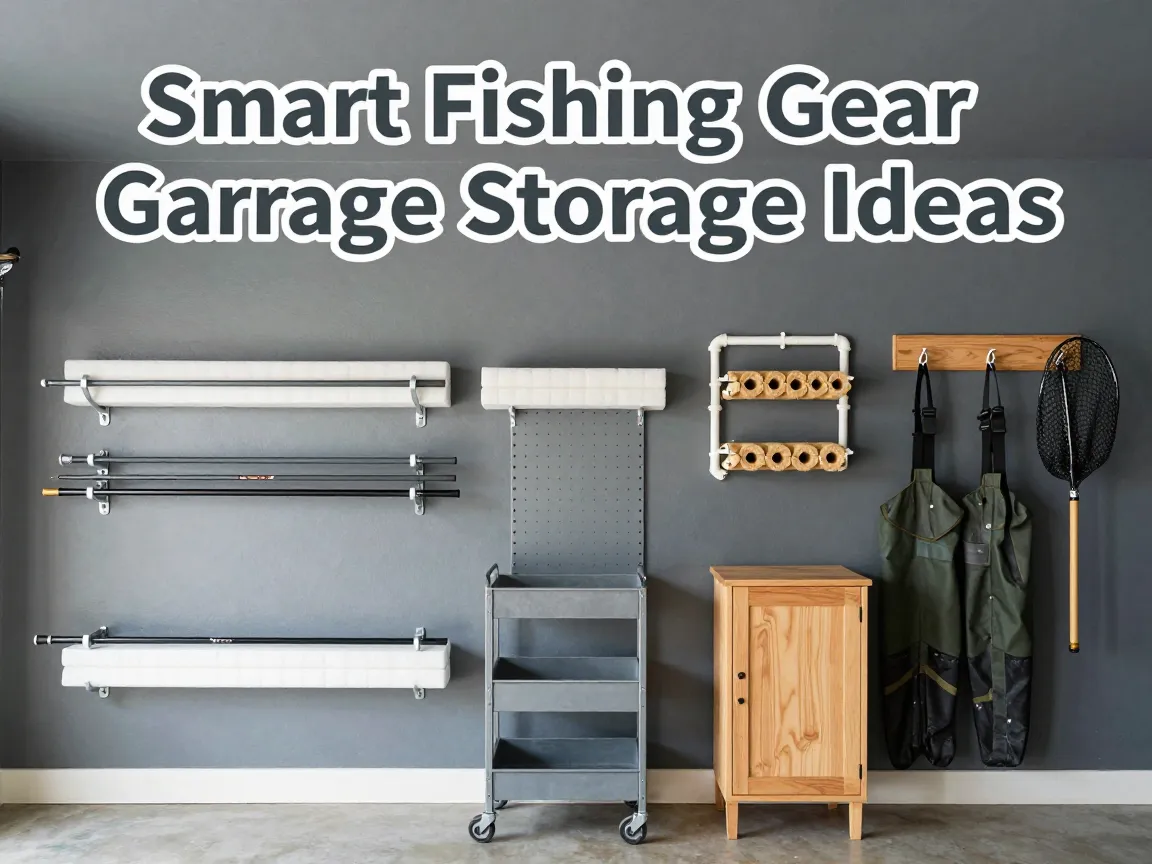
Rods stored vertically in a bucket or leaning against a wall are constantly at risk of tipping. Even one fall can crack a ferrule or bend a guide. Horizontal wall-mounted rod holders solve this by distributing the rod’s weight evenly along its blank, keeping guides aligned and tips away from foot traffic.
The mechanics are straightforward. Two foam-lined cradles, one near the handle and one roughly two-thirds up the blank, mount directly into wall studs. Most systems space cradles 24 inches apart to match standard stud spacing. Ceiling-mount versions work the same way in garages where wall real estate is already claimed by shelving. Both orientations keep rods out of the humidity cycle that affects floor-level storage, since warm, damp air tends to settle low.
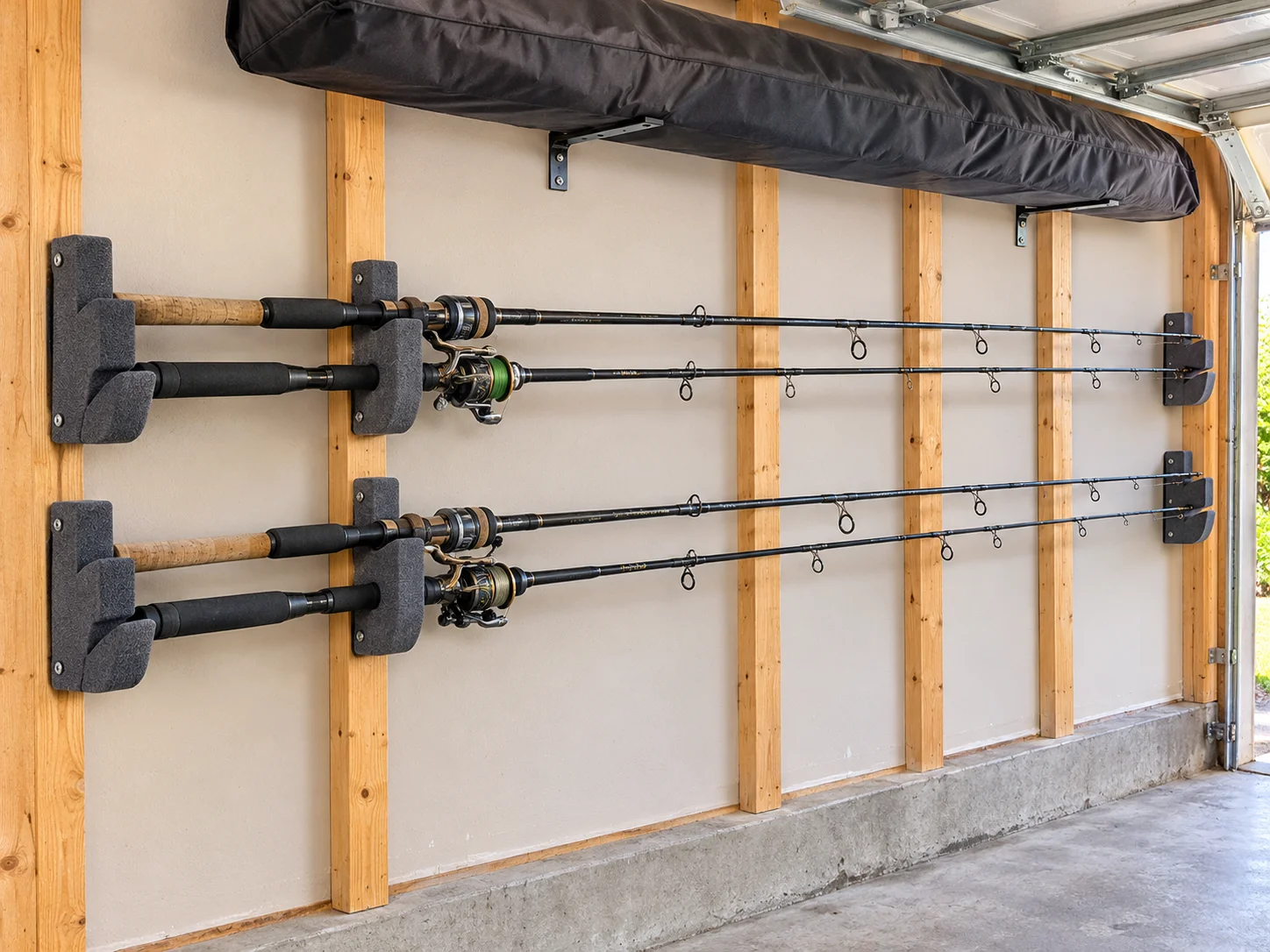
For a household with six to twelve rods, a staggered two-row wall system is worth considering. Mount one row at eye level and a second row six inches below, offset so each rod clears the one above it. This doubles capacity without adding a second set of hardware costs. Composite and graphite blanks do fine in this position long-term; fiberglass rods with heavier guides benefit from a third support cradle on blanks over 7 feet.
One real constraint: wall-mounted holders work poorly in garages that double as workshops where sawdust circulates. In that case, enclosed ceiling racks with a simple fabric cover over each row keep blanks clean between trips.
2. Compact Rotating Rod Racks for Floor Efficiency
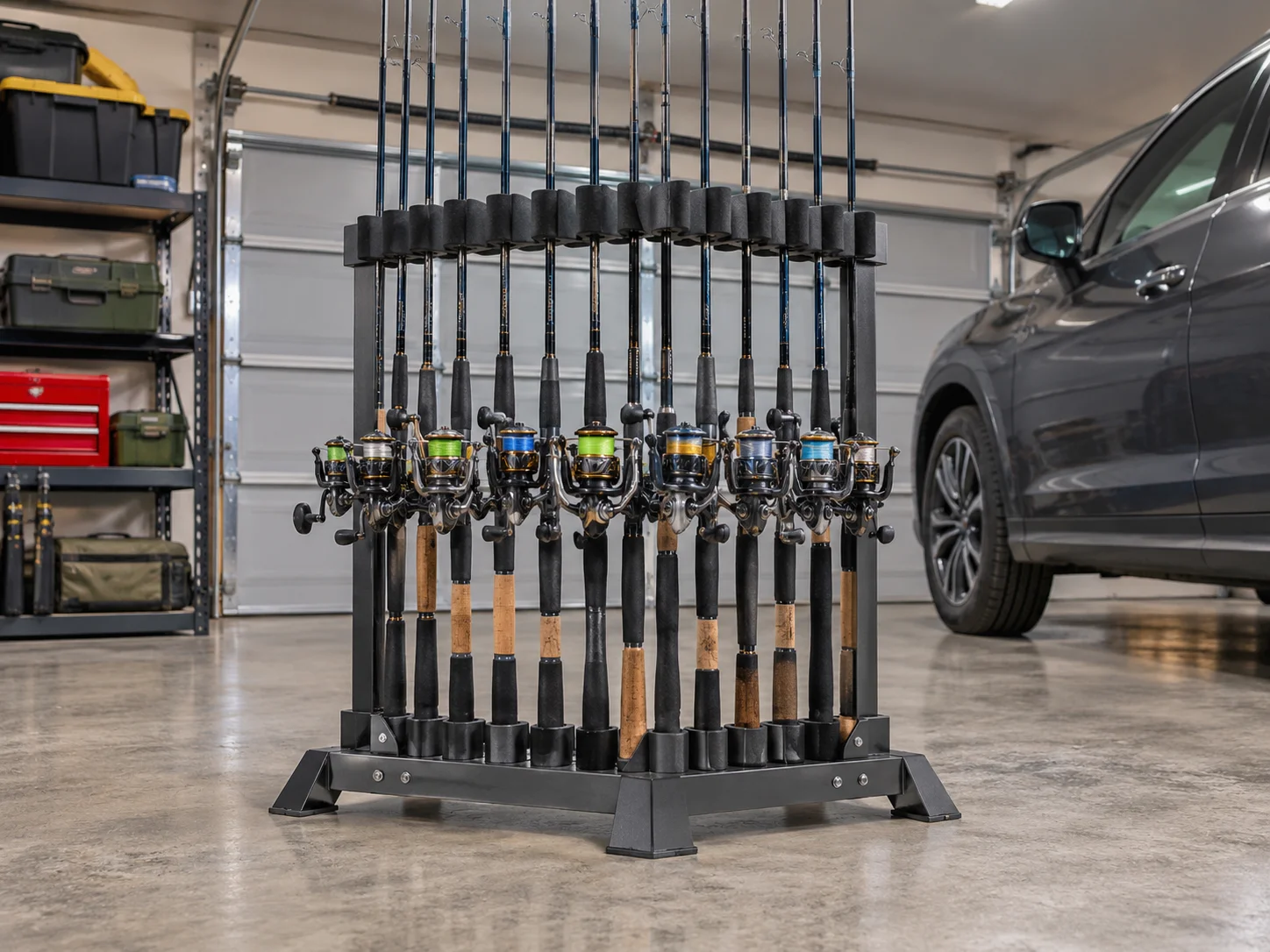
Floor space in a two-car garage averages around 400 square feet, but fishing gear has a way of consuming a disproportionate share of it. A rotating rod rack, essentially a freestanding carousel with individual rod slots, holds 16 to 36 rods in a footprint roughly the size of a bar stool.
The rotation is the practical advantage. Instead of pulling the whole rack away from a wall to reach a rod in the back row, you spin the carousel to bring any rod to the front. This matters most in tight garages where you are maneuvering around a vehicle. Quality racks use a heavy-gauge steel base with a low center of gravity so a bumped rack does not topple.
Foam-tipped slots protect rod guides at the top, while butt holders at the base keep each rod vertical and separated. Keeping rods separated prevents guide-to-guide contact, which is the most common cause of micro-scratches on expensive ceramic or titanium-framed guides. For saltwater gear especially, the separation also allows adequate airflow around reels if they are left attached to the rods between nearby fishing days.
The one limitation is ceiling height. Most rotating racks are designed for 9-foot rods, so surf rods or long fly rods over 10 feet will need horizontal wall storage instead. Rotating racks are best reserved for a primary freshwater collection where rod lengths stay under 8 feet 6 inches.
3. Mobile Rod Storage Carts with Pegboard and Drawers
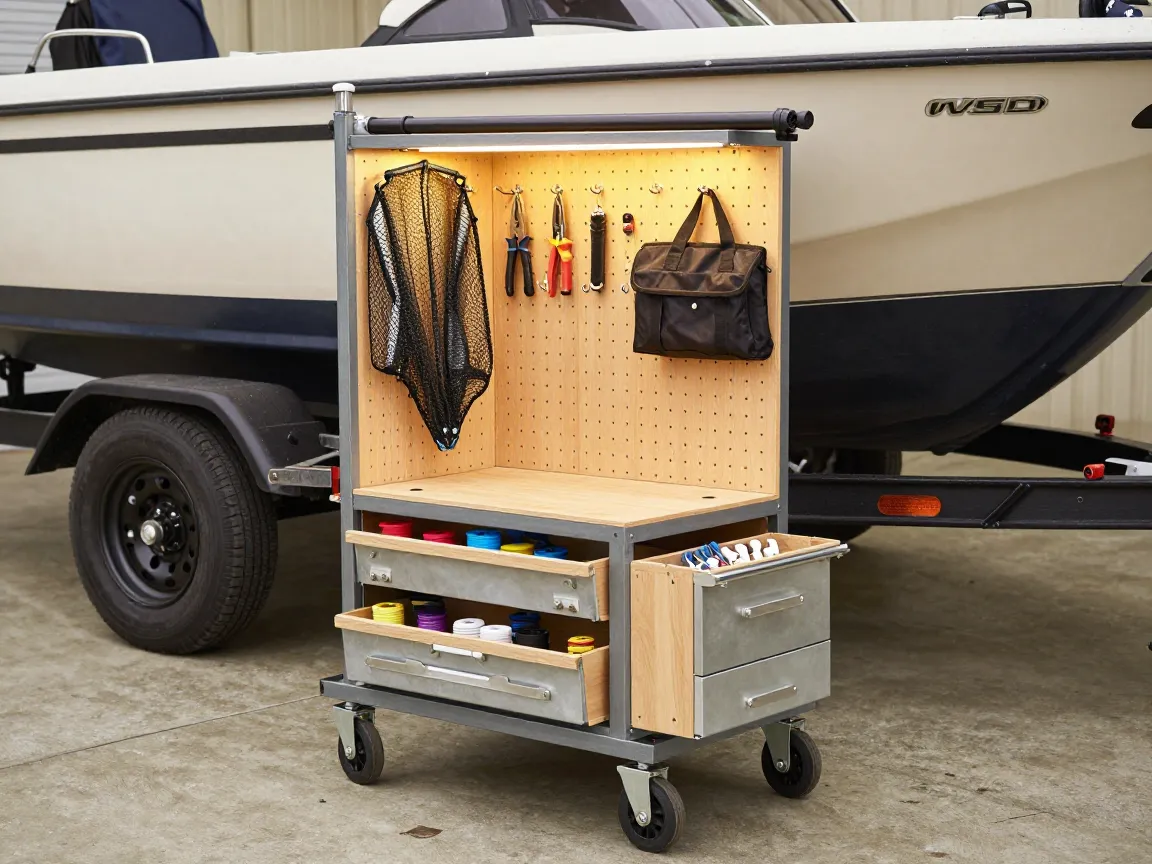
A mobile cart treats your fishing setup the way a mechanic treats tools, everything for a specific task in one place, on wheels, ready to move. A well-designed fishing cart combines vertical rod tubes or slots at the top, a pegboard panel on one side for hanging tools, and two to three drawers at the base for tackle organization.
The practical advantage over fixed storage is portability. If you park your boat trailer in the garage, you can roll the cart alongside it for loading and push it back against the wall when you are done. No carrying rods across the garage in awkward armfuls. Carts with locking caster wheels stay put on a sloped concrete floor, which matters in garages without a level slab.
Pegboard panels on carts accept standard hooks, so you can hang landing nets, pliers, lip grippers, and small tackle bags without adding more wall fixtures. The drawer space underneath works best for smaller items: spare spools, line, sinkers, and hooks sorted into labeled bins. Some carts include a tilt-out container section at drawer height, which is a faster way to access frequently used items than lifting a lid.
A cart with pegboard and drawers also scales well. Start with one cart for bass gear and add a second for fly fishing or saltwater tackle. Each cart becomes a dedicated station rather than a general dumping ground, which is the fastest way to stop the “I can’t find the hook remover” problem before every trip.
4. DIY PVC and Pool-Noodle Rod Organizers
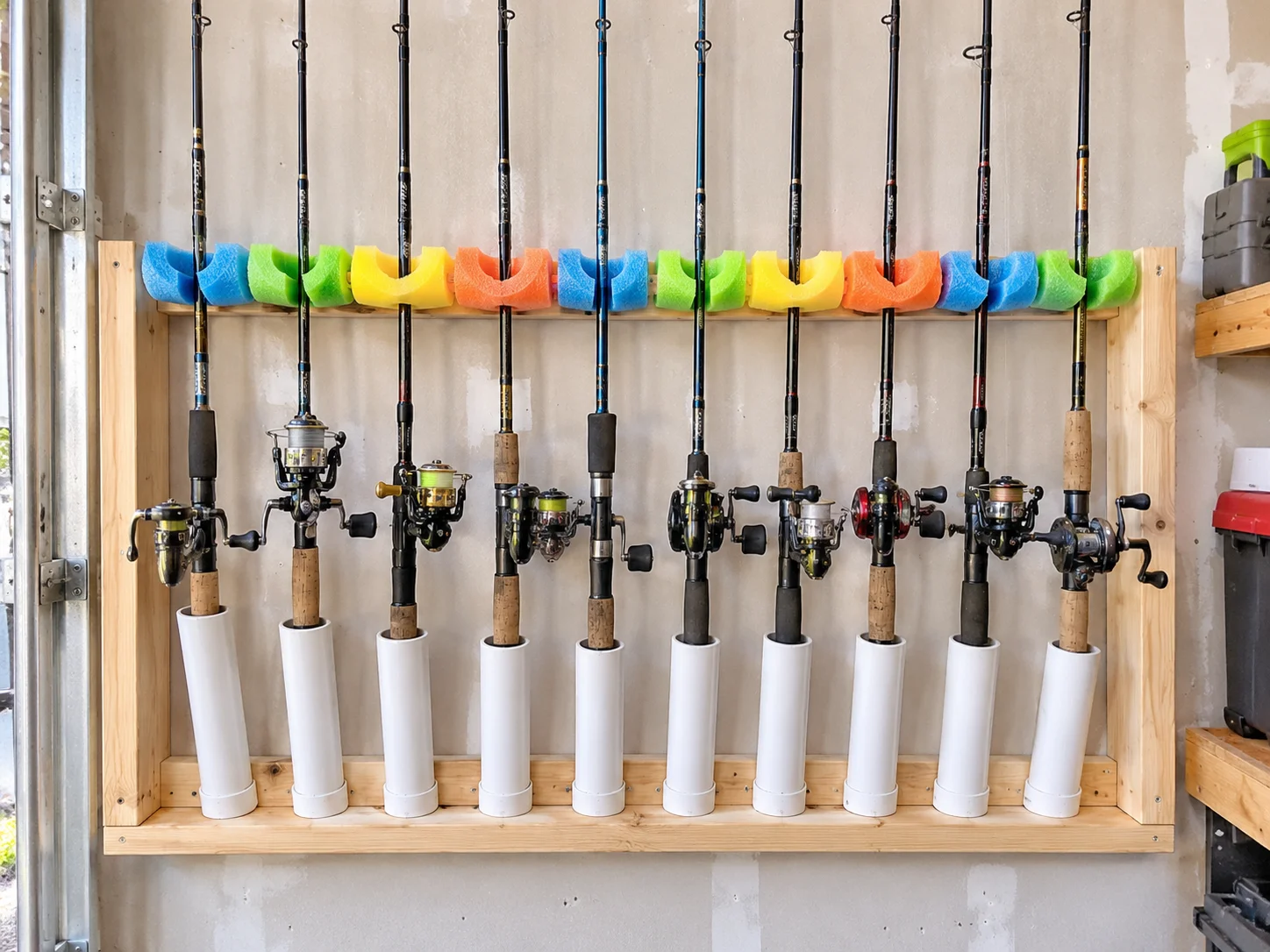
For anglers who do not want to spend $80 to $200 on a commercial rod holder, PVC pipe and pool noodles are legitimate materials, not second-rate compromises. A PVC rod rack uses standard 2-inch diameter pipe cut to 12-inch lengths, capped at the bottom, and mounted in a wooden frame or slotted into a wall bracket. Each tube holds one rod butt-down. For the top support, sections of pool noodle sliced lengthwise and tacked to a horizontal 2×4 create foam cradles that protect guides without any machining.
Total material cost for a 10-rod rack typically runs under $25 at a hardware store. The build takes two to three hours, and the result is a storage system customized to the exact width of your wall space. Standard commercial racks come in fixed widths; a PVC rack fits wherever you need it.
One design detail worth getting right: angle the PVC tubes at roughly 15 degrees from vertical rather than mounting them straight up. The slight tilt keeps rods from rattling out of the tubes during road vibration if the rack is mounted in a trailer or garage that is adjacent to a driveway. It also makes the whole rack look intentional rather than improvised.
Pool-noodle cradles work well for fly rods, which have smaller, more fragile guides than spinning or baitcasting rods. The soft foam eliminates any chance of guide contact with a hard surface. Replace noodle sections once per season, the foam compresses over time and loses its cushioning.
5. Enclosed Cabinets and Slatwall Systems for Full Garage Organization
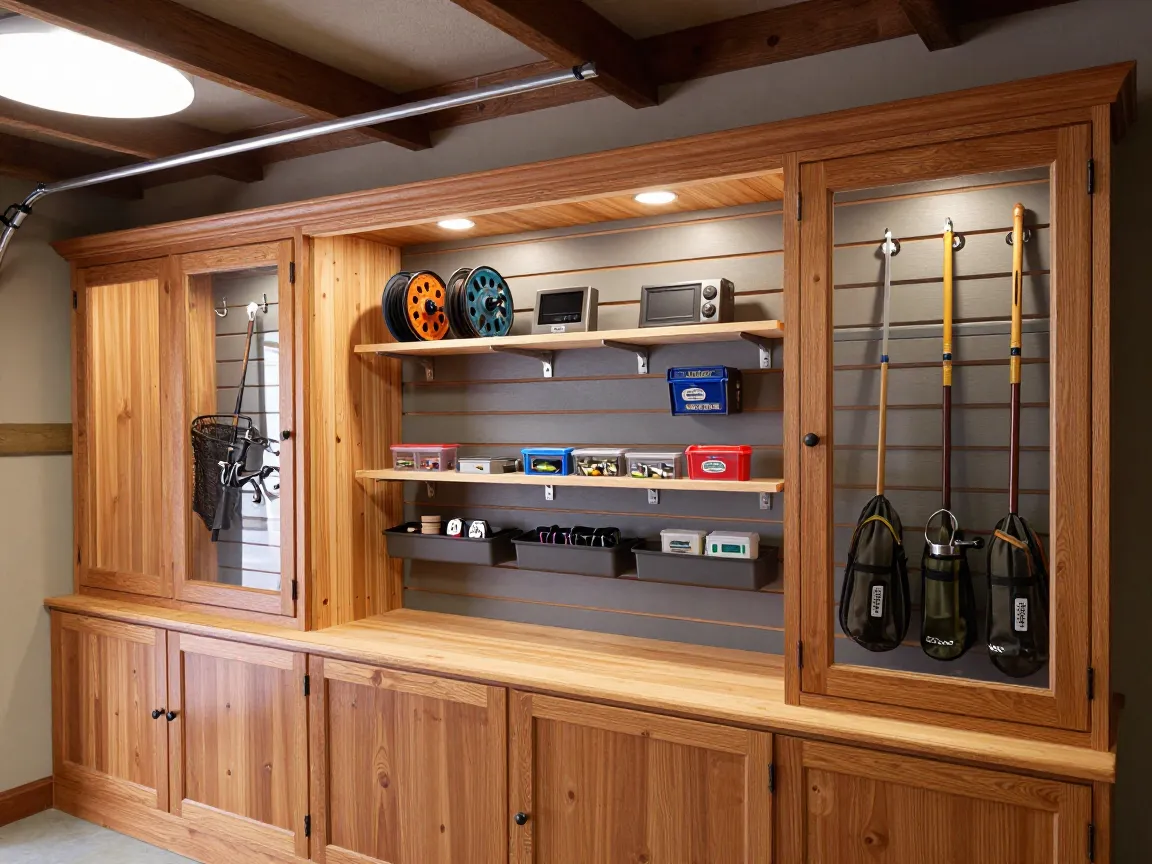
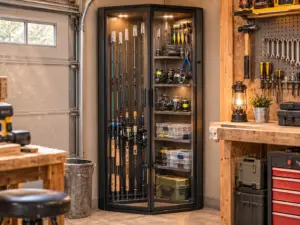
If you are treating the garage as a dedicated fishing space rather than general storage, an enclosed cabinet paired with a slatwall panel system gives the most protection per square foot. Enclosed cabinets with solid or glass-panel doors keep dust, insects, and stray moisture off reels and sensitive electronics like fish finders stored between seasons. Glass-door versions let you do a quick visual inventory without opening anything.
Slatwall panels mount flat against the wall and accept adjustable hooks, bins, and brackets in any configuration. Unlike pegboard, slatwall holds heavier items, net handles, wading staff, tackle bags, without the hook pull-out problem that pegboard creates when weight exceeds about five pounds per hook. A 4×8 slatwall sheet holds a full season’s worth of gear for two anglers when configured with a mix of rod holders, hook bins, and bag pegs.
The combination approach works like this: cabinets handle everything that needs dust or impact protection (reels, electronics, lure boxes), while the slatwall holds the daily-use items you need to grab quickly. This separation prevents the cabinet from becoming a catch-all and keeps the slatwall from getting overloaded with fragile gear.
Custom cabinet builds using plywood and adjustable shelving can be sized to fit under a workbench or stacked to ceiling height in an unused corner. Lining cabinet interiors with cedar strips is worth the extra step, cedar’s natural oils resist mildew and deter insects, both of which are real concerns for tackle stored through a humid summer.
6. Dedicated Hanging Systems for Waders, Nets, and Apparel
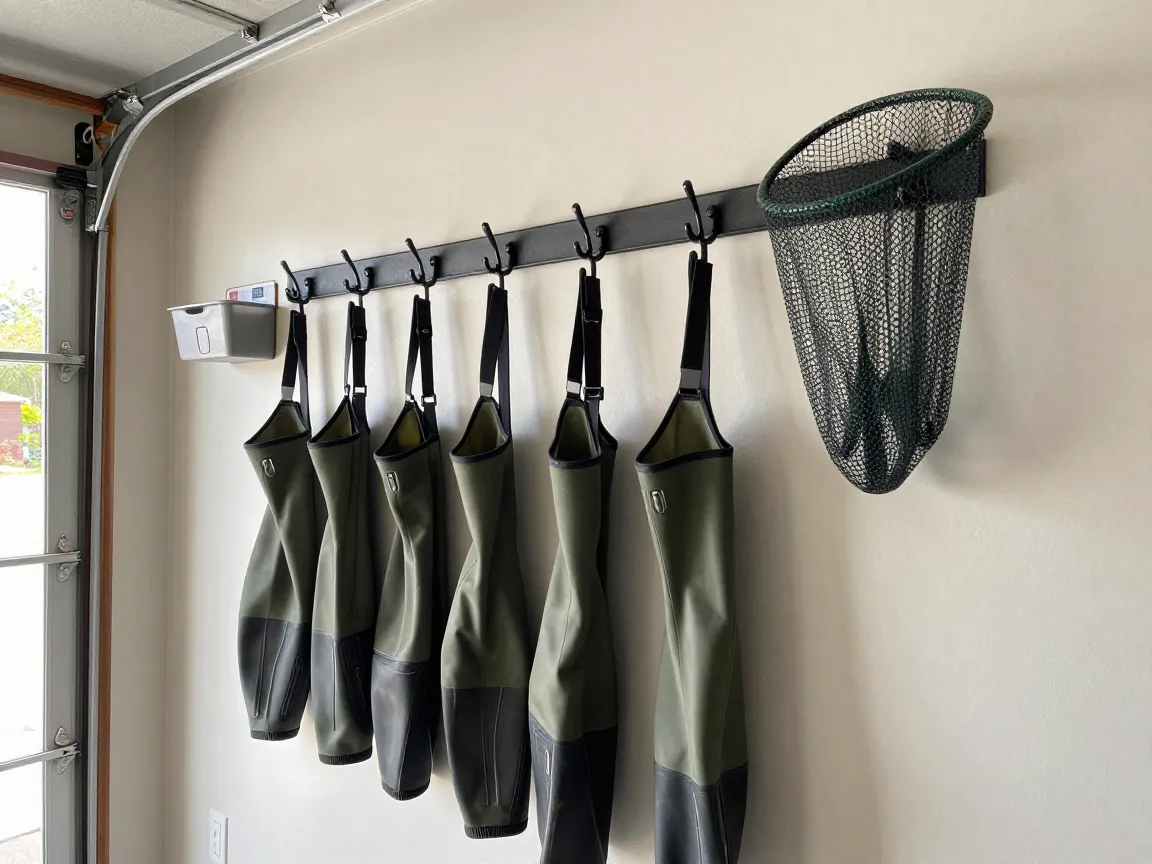
Waders stored folded on a shelf develop creases that eventually crack the waterproofing material. Neoprene breaks down faster when compressed; breathable fabrics like Gore-Tex and similar laminates delaminate at fold lines if stored flat under weight for months. The correct storage position for waders is hanging, booted-end up, in a space with airflow on all sides.
A dedicated hanging system does not need to be elaborate. A sturdy wall-mounted hook rail with oversized hooks, the type sold for holding bicycles, rated for 25 to 50 pounds each, works for waders, wading jackets, and landing nets. Spacing hooks 12 to 18 inches apart prevents fabrics from touching, which matters for drying after a day on the water. Wet waders pressed against another surface for more than a few hours begin to develop mildew inside the boot liner.
Landing nets are another item that rarely gets proper storage. Rubber-mesh nets left coiled on a shelf take a permanent set and lose their shape. A single large hook near the door, at shoulder height, keeps the net extended and accessible. For nets with telescoping or folding handles, a labeled bin on the slatwall is a better option than hanging, since the mechanical joints can stress if the net hangs from one end.
For households with multiple anglers sharing one garage, a labeled section of hook rail per person eliminates the morning scramble before a 5 a.m. trip. Use adhesive-backed label holders below each hook section so everyone knows at a glance which waders belong where. This is a small addition that saves a surprising amount of time over a full fishing season.
Conclusion
The single most effective starting point for most garages is the horizontal wall rod holder, it protects the most expensive items first and clears the most floor space per dollar spent. Once rods are off the floor and out of traffic, the other five storage ideas slot in around your actual workflow: a mobile cart for loading convenience, enclosed cabinets for off-season gear, hanging systems for waders. Pick the one that solves your most frequent frustration, build it properly, and the rest of the system follows naturally.