Jon Boat Fishing Setup Tips for Small-Water Anglers Chasing Big Results
Roughly 90 percent of freshwater fishing in North America happens on water under 500 acres, the farm ponds, state-managed electric-only reservoirs, creek backwaters, and oxbow lakes that rarely appear on a tournament trail but consistently hold quality fish. A jon boat is the ideal tool for all of it, yet most anglers underuse them by treating the hull as a bare platform rather than a purpose-built rig. These 6 jon boat fishing setup tips for small-water anglers chasing big results lay out exactly how to get from bare aluminum to a boat that works as hard as you do.
Disclosure: This post contains affiliate links. As an Amazon Associate, we earn from qualifying purchases, and at no extra cost to you.
The difference between a frustrating day and a productive one on small water almost always comes down to setup decisions made before you ever leave the ramp.
1. Build Your Casting Platform Around a Proper Beam Width
The floor plan is the first decision and it sets limits on everything else. Experienced stillwater anglers consistently point to a hull beam of 45 to 50 inches as the threshold for a stable standing platform. Below that width, two anglers casting simultaneously creates a wobble that blows presentations and, in skinny water, spooks fish. At 48 inches, a flat-bottom jon boat is genuinely rock-solid at rest. You can pivot, load a rod on a backcast, and reach for a net without the hull tilting noticeably.
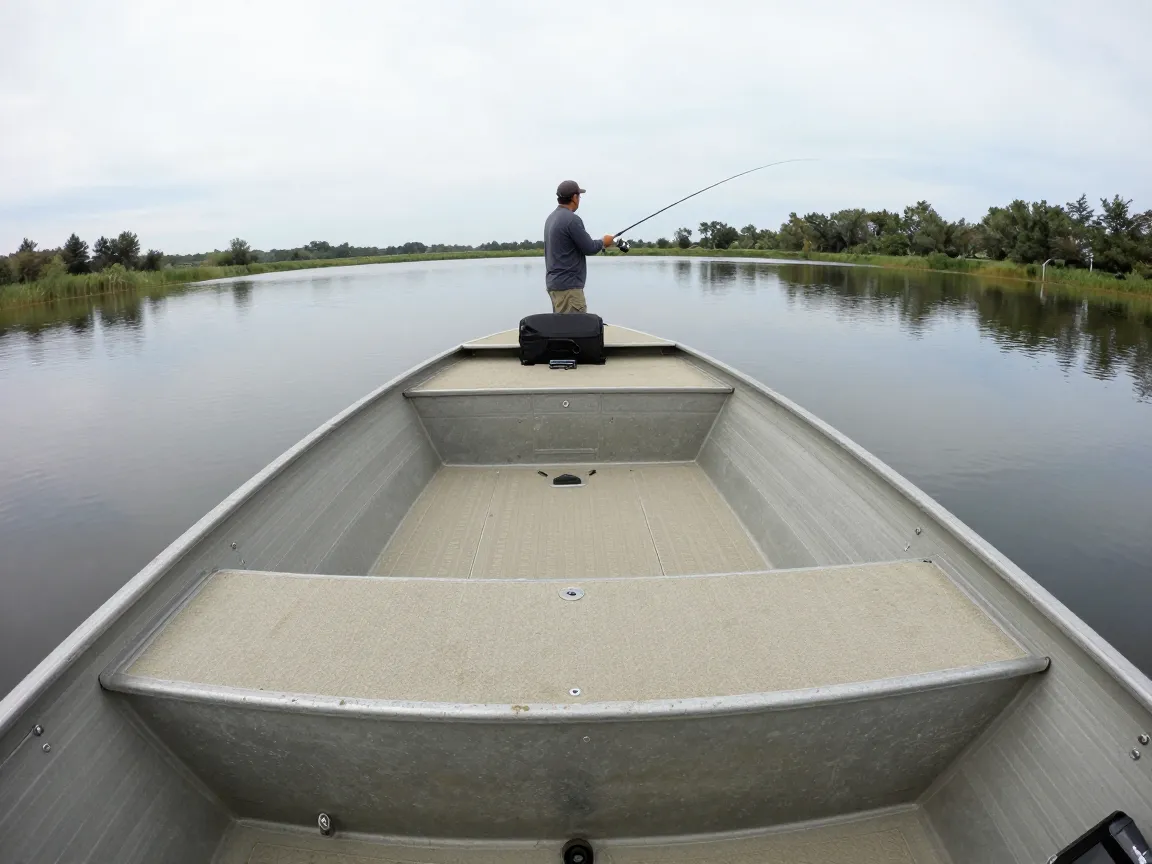
This matters more on small water than on open lake because you’re almost always fishing from a stationary position. A bass boat angler runs to a spot and relies on a deck-mounted trolling motor to hold course while casting. A jon boat angler on a 20-acre pond is typically anchored or staked in one spot for 20 to 40 minutes at a time, standing, casting, and landing fish from the same two or three square feet of deck. A narrow hull turns that routine into a balance exercise.
If you’re buying rather than outfitting an existing boat, prioritize beam before length. A 14-foot hull at 48 inches wide is a more functional fishing platform than a 16-footer at 42 inches. If you already own a narrower hull, add a bow deck extension or install a wide front casting platform to increase the usable surface area. That single structural addition changes the fishing experience more than any electronic upgrade will.
2. Distribute Weight Low and Along the Centerline
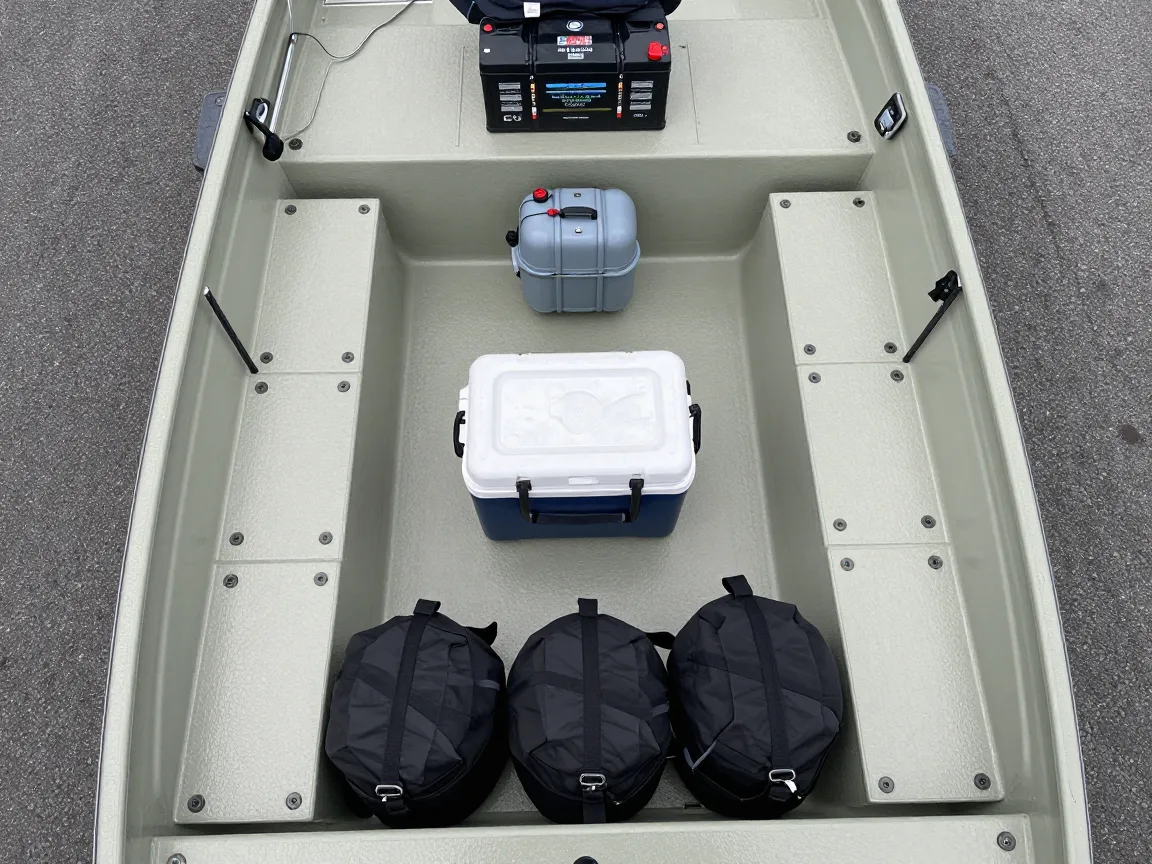
Stability on a flat-bottom hull is partly geometry and partly physics. The boat is widest at the waterline and has very little hull flare to resist rolling once weight shifts off center. That means where you put your gear matters as much as how much you bring.
Heavy items, group-27 batteries, fuel tanks, full coolers, oversized tackle bags, belong low in the hull and distributed along the keel line from bow to stern, not stacked at the transom or piled on one gunwale. A common mistake is mounting two batteries side by side at the stern to stay near the outboard or motor wiring. That concentrates 80 to 100 pounds at one end and raises the center of gravity enough to create noticeable stern squat and lateral sensitivity. Move one battery forward of amidships and the boat trims flatter and tracks better.
The same logic applies to coolers. A 50-quart cooler full of ice weighs close to 70 pounds. Sliding it against the port gunwale for convenience while fishing the starboard side creates a constant list. Set it centered between the seats and lash it down. When the layout forces you to place gear off-center, counter-balance it on the opposite side before you cast off.
Small water amplifies these problems because you’re constantly shifting your weight to reach structure, leaning over the bow to flip to a dock piling, moving to the stern to work a weedline. A well-distributed load means those normal fishing movements don’t destabilize the hull. A poorly distributed load means every shuffle triggers a wobble that you’re correcting instead of fishing.
3. Run a Two-Anchor System, Not One
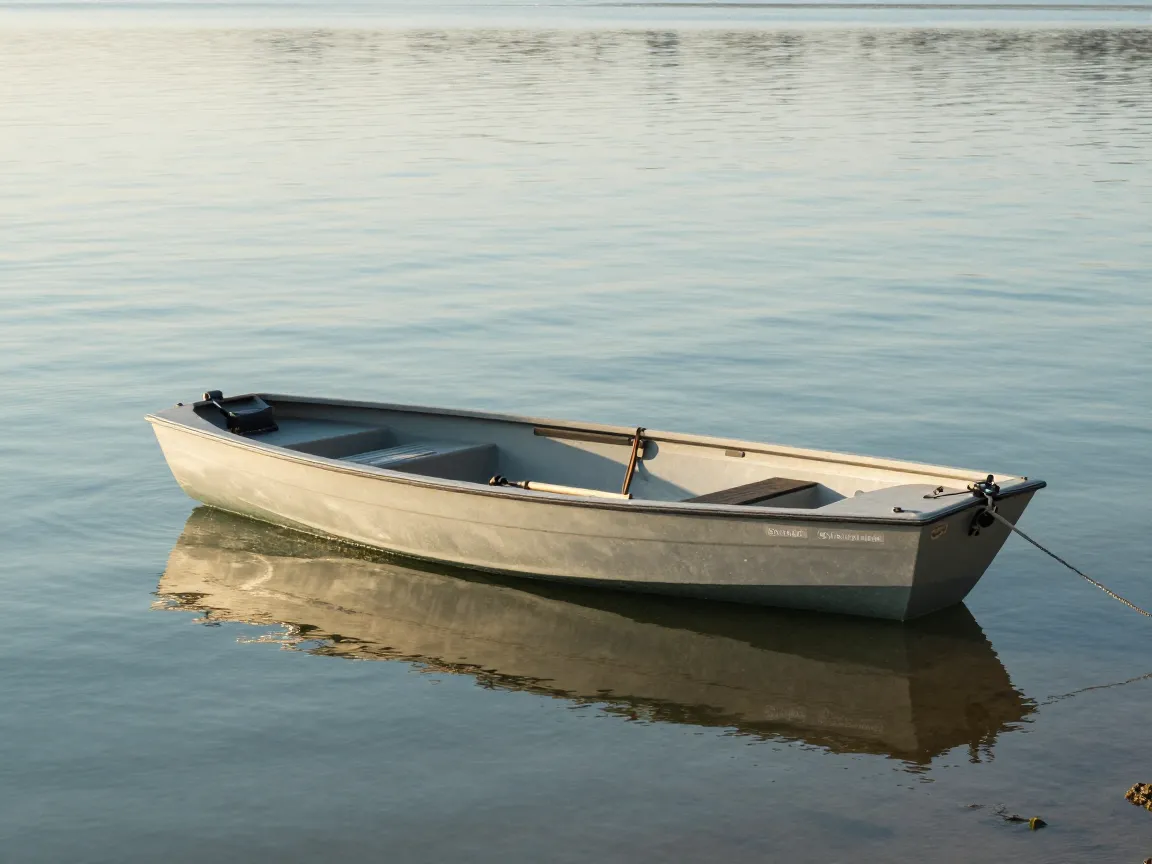
A single anchor on a jon boat almost always produces swing. Even a 10-degree arc is enough to drag a finesse presentation out of a strike zone in four feet of water. On a calm pond with no current, a bow anchor holds the nose but lets the stern rotate freely with any breeze. On a river backwater with slow current, a single stern anchor keeps you sideways to the flow but pointing changes constantly.
The fix is straightforward: run a bow anchor and a stern anchor simultaneously, or use a bow anchor paired with a stakeout pole at the stern. This locks the boat’s orientation so both anglers maintain their lanes without the hull rotating and crossing lines. Some small-water anglers take this a step further and mount anchor cleats in all four corners of the hull, giving them the option to swing the boat parallel to a weedline or perpendicular to a dock row depending on wind direction.
Positioning the boat sideways to the wind is worth practicing deliberately. With the beam facing into the breeze, bow and stern anglers each fish a downwind lane on their respective sides without the wind pushing presentations back across the hull. It also makes it easier to work two separate structure targets, one angler on the weed edge, one on open water, without tangling.
Stakeout poles are especially effective in water under four feet. A fiberglass push pole driven into soft bottom holds a jon boat more quietly than any anchor and can be repositioned in seconds. For ponds with hard clay or gravel bottoms, a 3.5-pound mushroom anchor on a 15-foot rope fore and aft is enough to hold a small hull in a 12-mph breeze.
4. Match Your Trolling Motor and Sonar to the Hull
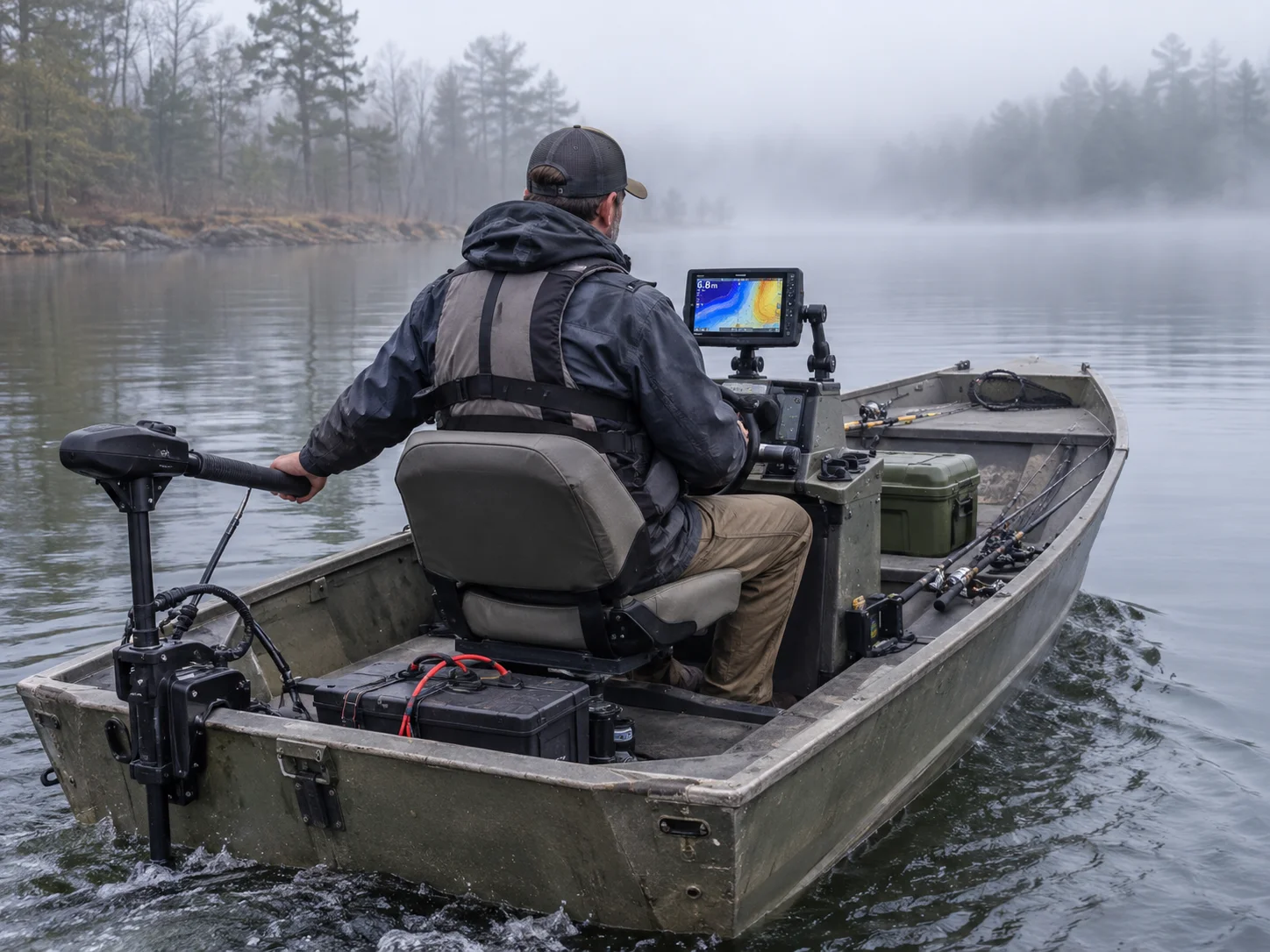
A hand-steered transom-mount trolling motor paired with a single deep-cycle marine battery and a compact fish finder is the right power and electronics package for most small-water jon boats. That’s not a budget compromise, it’s the correct tool for the application. A bow-mount foot-controlled motor adds 30 to 50 pounds to the nose of a small hull, and in tight quarters under 10 acres, the hands-free steering advantage disappears because you’re rarely moving more than 30 yards at a stretch.
Size the motor to the hull weight. A fully loaded 14-foot jon boat with two anglers, gear, and a battery typically runs 900 to 1,100 pounds. A 55-pound-thrust motor handles that load comfortably in calm conditions. Going larger adds weight and draws more from the battery without meaningful speed benefit on water where the legal electric limit is usually 5 mph anyway.
For electronics, a compact unit like the Humminbird Helix 5 or a comparable Garmin Striker model gives you bottom contour, depth, water temperature, and GPS waypoints in a package that weighs under two pounds and mounts on a standard RAM ball arm. The waypoint function alone justifies the cost: you can mark a submerged brush pile at 11 feet, a sharp depth break at the pond’s north end, and the ramp location, then navigate back to any of them in fog or low light. On small reservoirs where fog sits until mid-morning, that feature has real safety value.
Lithium iron phosphate (LiFePO4) batteries are worth the investment if you fish frequently. A 100Ah lithium battery weighs about 26 pounds compared to 60 pounds for a comparable lead-acid group-27. That 34-pound reduction on a small hull is significant, and lithium holds voltage more consistently through a full day of trolling, so motor performance doesn’t degrade as the battery drains.
5. Organize the Deck for Two Anglers Working Independently
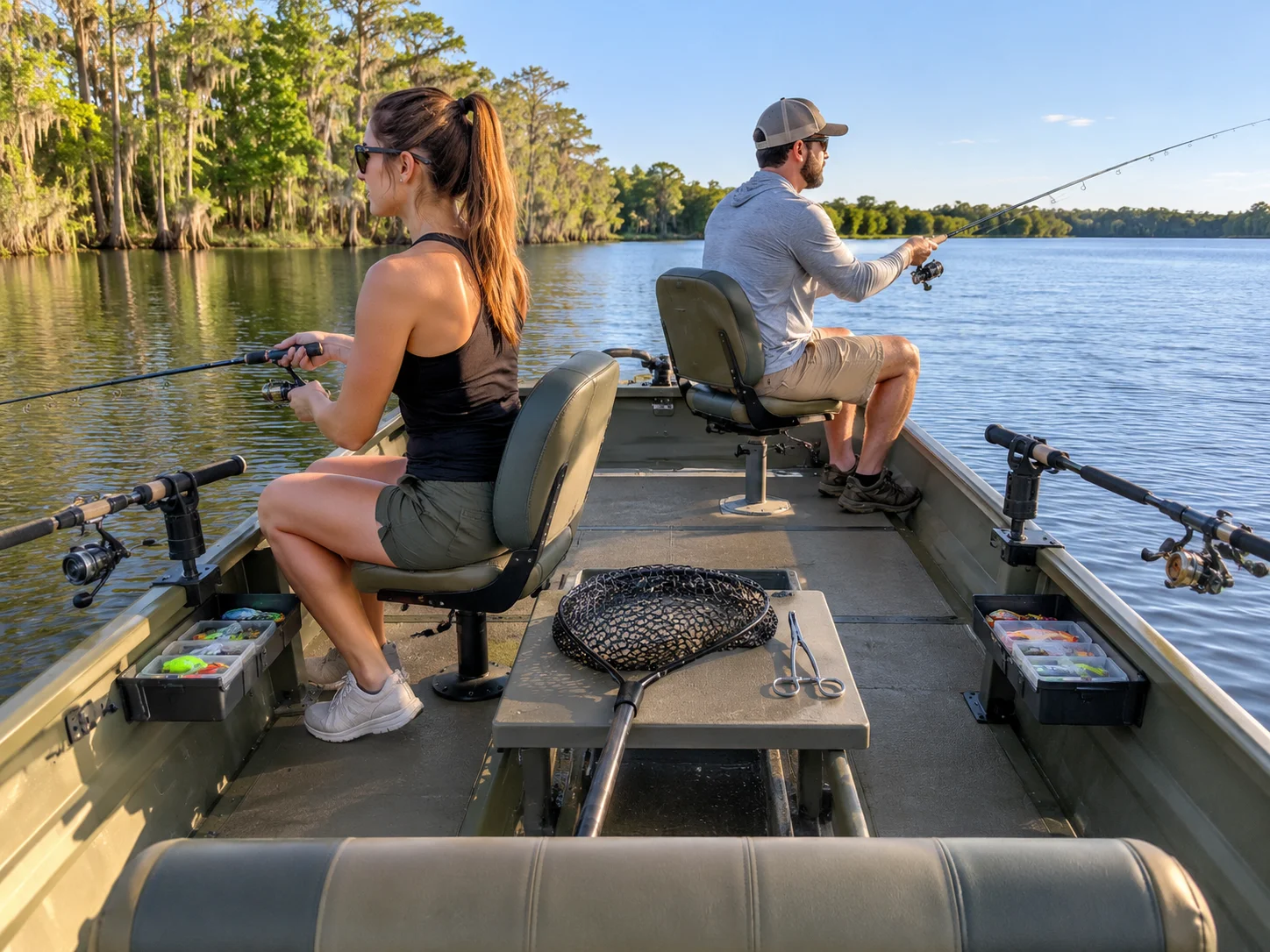
Deck clutter is the fastest way to turn a productive morning into a frustrating one. On a 14-foot jon boat with two people, every piece of gear that isn’t in a fixed position becomes an obstacle. Rod tips tangle when rods lean loose against the gunwale. Tackle bags slide and shift when the hull rocks. A net left on the floor gets stepped on during a critical moment.
The solution is a fixed organizational system built around three zones: the bow platform, the stern seat, and the shared middle. Rod holders mounted to the gunwales at both ends keep rods horizontal and out of the way when not in use. Each angler should have immediate access to two or three rods without stepping over anything. A swivel seat at the bow and a padded bench at the stern allow each person to work their water independently without facing each other or crossing the same walking path.
The middle zone, typically the center bench or a removable shelf between seats, works best as shared storage for items both anglers use: a rubber mesh net, forceps, a hook removal tool, spare leaders, and a fly or lure selection tray. Placing these centrally means neither angler has to interrupt the other to grab the net when a fish is on. That sounds minor until you’ve watched a good fish come unhooked while someone shuffled past to reach a net at the wrong end of the boat.
For tackle, shallow trays mounted low near the gunwale edge beat tackle bags stacked on the floor. They keep hooks, soft plastics, and jig heads visible without requiring you to dig through a bag while a fish is running. Many small-water jon boat anglers run one tray per person, mounted at wrist height, so the working end of the deck stays completely clear underfoot.
6. Add Proper Lighting, Safety Gear, and a Pre-Launch Routine
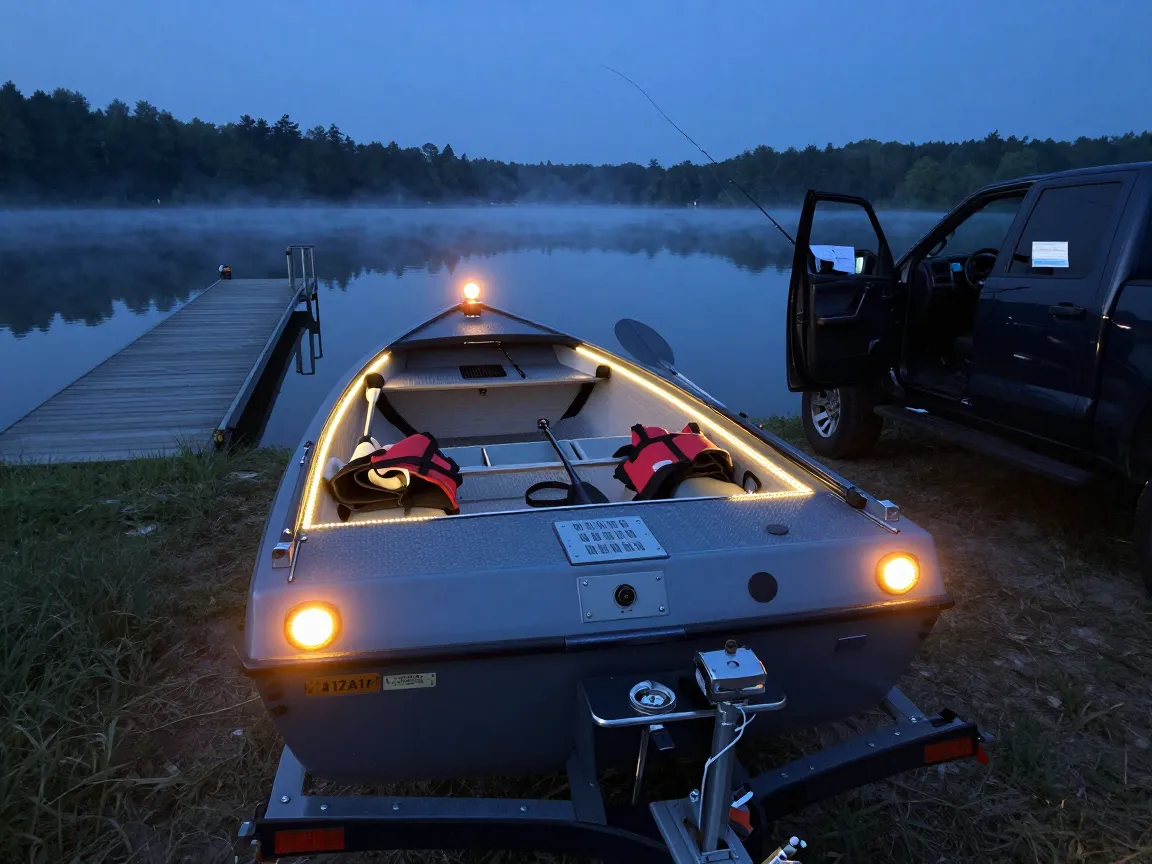
A jon boat’s compact size makes it easy to treat pre-launch checks as optional. That’s a mistake, and on small water it creates specific risks that larger-boat anglers don’t face. Many small ponds and electric-only reservoirs have no launch assistance, no cell service, and no other boaters nearby. If something goes wrong, you are the rescue.
Navigation lights are legally required on any vessel operated between sunset and sunrise, and that applies to a 12-foot jon boat on a farm pond the same as it does to a 25-foot bay boat on a coastal waterway. Bow and stern nav lights, plus a waterproof interior LED strip for rigging and unhooking fish at the livewell, satisfy most state regulations and cost under $60 installed. Run the wiring through the gunwale channel and use a simple fused switch panel to control them independently.
Before every launch, check the drain plug first, it’s the most frequently forgotten item and the fastest path to a sinking boat. Then verify that the battery connections are tight, all loose gear is secured or stowed, and each person on board has a properly sized Coast Guard-approved life jacket. Check the weather forecast for wind shifts and afternoon thunderstorm probability. Leave a trip plan with someone who isn’t going, the specific body of water, your expected launch and return times, and your vehicle description.
Carry a paddle or push pole on every trip regardless of your motor setup. If the trolling motor quits or the outboard won’t start, a paddle gets you back to the ramp. On electric-only lakes where outboards are prohibited, it’s your only backup. A 7-foot canoe paddle stowed along the port gunwale takes up almost no room and weighs two pounds. There is no reasonable argument for leaving it behind.
A 7-foot medium-heavy casting rod covers the most common small-water presentations, dock flipping, frog fishing over pads, Texas-rigged plastics in laydowns, and gives enough backbone to control fish in tight cover without requiring multiple specialty setups. Pairing that rod with a 7:1 gear-ratio reel and 30-pound braid lets you work heavier cover confidently from a compact platform where you can’t always chase a running fish.
Conclusion
The core principle running through all 6 of these jon boat fishing setup tips for small-water anglers chasing big results is the same: fit the rig to the water, not to a general idea of what a fishing boat should look like. Small water punishes heavy loads, loose gear, and poor positioning harder than any other environment. Get the beam, the weight distribution, and the anchoring right first, then layer in the electronics, deck organization, and safety gear. The fishing itself, working weedlines, dock edges, and submerged timber with a well-matched rod, becomes straightforward once the platform underneath you is solid.
The most useful next step is a 30-minute bench review of your current setup before the next trip. Walk through each of the six areas above, identify the one that’s weakest, and fix it before you launch.