Rainbow Trout Photo Secrets: Color, Contrast, and Clean Backgrounds
Over 20,000 rainbow trout images now populate a single major stock platform, yet only a fraction command serious attention from designers and educators. The gap between a forgettable fish photo and one that actually sells or teaches comes down to three things covered in the Rainbow Trout Photo Secrets: Color, Contrast, and Clean Backgrounds approach, color fidelity, contrast management, and background discipline. Miss any one of them and even a technically sharp image loses its value.
Disclosure: This post contains affiliate links. As an Amazon Associate, we earn from qualifying purchases, and at no extra cost to you.
Key Takeaways
- The rainbow trout’s iridescent pink lateral stripe, silver flanks, and dark spot pattern are the visual anchors every photo must protect
- Clean white or uniformly plain backgrounds have become a licensing standard on major stock platforms, not just a stylistic preference
- Strong contrast between fish and background drives usability across print, digital, apparel, and educational contexts
- Post-capture editing tools, including AI-assisted background removal and lighting adjustment, are now part of standard workflow on major platforms
- Authentic wild coloration differs from stocked fish; lighting and exposure choices must be calibrated to capture the real hue range
Understanding What Makes Rainbow Trout Photography Distinct
Rainbow trout are not a neutral subject. The fish carries three visually competing elements on a single body: a metallic silver base, a band of iridescent pink or red running laterally from gill to tail, and a dense scattering of black spots across the dorsal surface and fins. That combination rewards photographers who understand it and punishes those who treat the fish like any other freshwater species.
The pink stripe is the defining feature. It shifts from pale rose to deep magenta depending on the light angle, the fish’s health, and whether it was wild-caught or hatchery-raised. Wild fish from clear mountain streams typically show more saturated, complex coloration. Stocked fish often display flatter, less vivid hues, a point that identification specialists note explicitly when curating reference photo sets. This matters because if your lighting or white balance is off, a genuinely colorful wild fish can be rendered as dull as a hatchery specimen.
The spots add further complexity. They are not uniform; they cluster more densely toward the tail and can extend onto the adipose and caudal fins. Any background with busy texture competes directly with that spotting pattern and makes the fish harder to read at a glance. This is not an aesthetic argument, it is a functional one. Designers, educators, and licensors all need the pattern readable at reduced sizes and across different print and screen outputs.
The Six Core Secrets of Rainbow Trout Photography
The following six principles reflect the actual practices visible across commercial stock catalogs, vector illustration sets, conservation image galleries, and licensed art resources as of 2026. They are ordered from pre-shoot decisions through post-processing.
1. Isolate the Subject Against a Plain Background
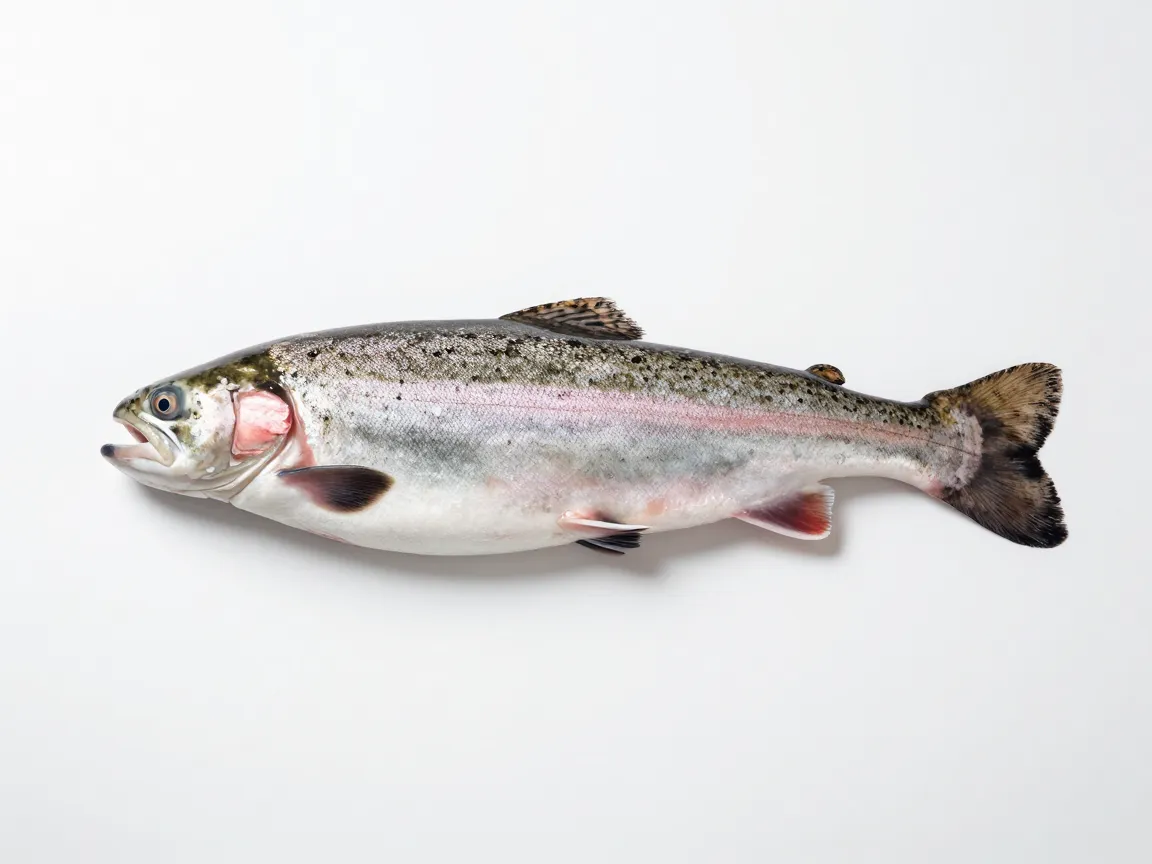
Studio shots described as “fresh whole rainbow trout fish isolated on a clean white background” now dominate the top-performing image categories on royalty-free platforms. White is the default because it reflects no competing color onto the fish’s flanks, allows clean extraction for compositing, and reproduces accurately across both print and digital. Pale grey or matte black can work in specific contexts, but white remains the standard for commercial licensing.
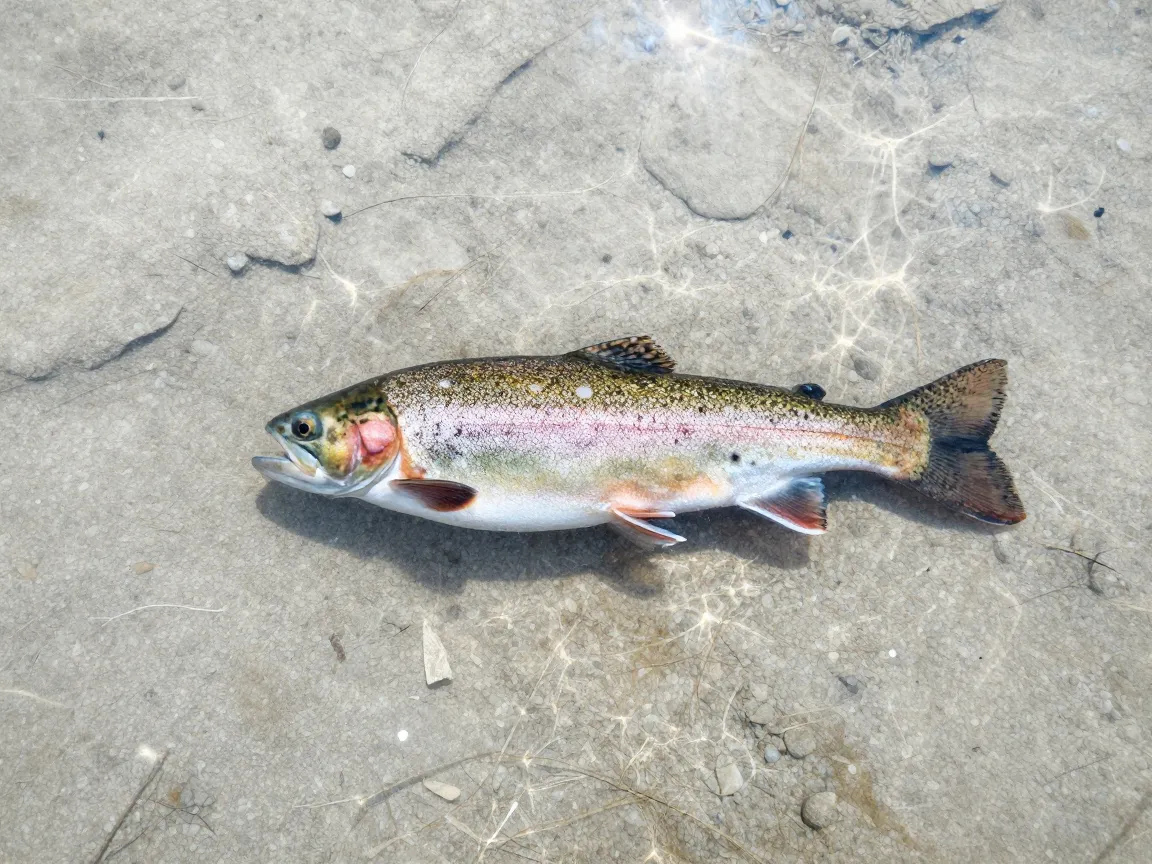
For field photography, the same principle applies differently. River shots that perform well tend to feature “clear crystal streams” where the water itself functions as a clean, light-toned background. Top-down hatchery or stream views where fish are “easily visible through the clean, shallow water” recreate the studio logic in a natural setting. The goal in both cases is the same, reduce background noise so the fish is the only object demanding attention.
2. Control the Pink Lateral Stripe Exposure
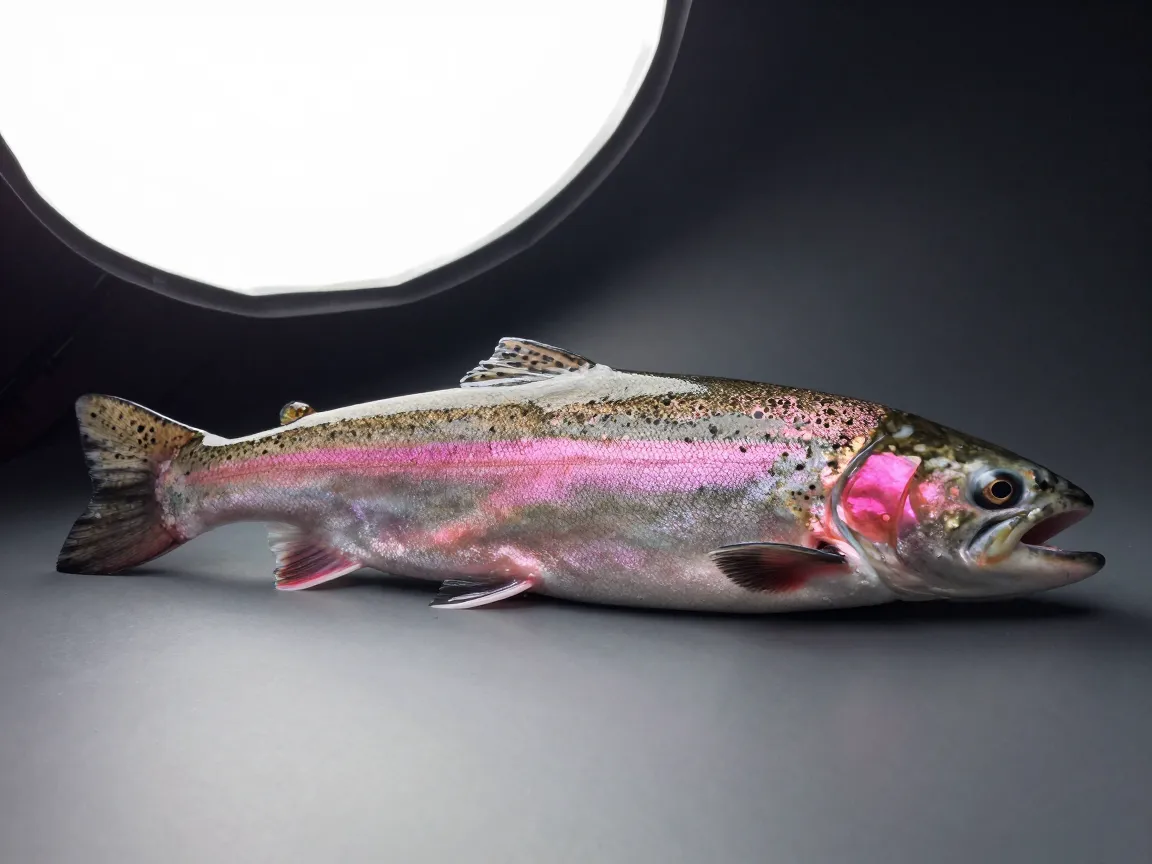
The stripe is the rainbow trout’s signature and also its most photographically difficult feature. It is iridescent, meaning it changes with light angle. Overexpose slightly and it bleaches to pale pink. Underexpose and it disappears into the silver body. A polarizing filter, used at a roughly 90-degree angle to the dominant light source, reduces specular glare on the flanks without flattening the stripe’s color.
For studio work, a large softbox placed at 30 to 45 degrees to the fish’s lateral surface produces even illumination that keeps the stripe readable. A second, weaker fill light on the opposite side prevents the belly from dropping into shadow, which can make the fish look narrower than it is and throws off proportion in educational imagery.
3. Preserve the Spot Pattern Through Contrast Management
Spot visibility depends on the contrast ratio between the dark dorsal pigment and the surrounding olive-to-silver skin. That ratio collapses when the background introduces mid-tones that sit between the spot color and the skin color. A white background keeps the fish’s internal contrast intact because it does not introduce competing mid-tones near the edge of the fish.
The same logic governs underwater photography. Clear, shallow water over a light-colored gravel bed acts like a natural diffusion panel, lighting the fish from below while keeping the background tone lighter than the spots. The result is a naturally high-contrast image that requires minimal post-processing to look clean.
4. Match Lighting to the Fish’s Actual Color, Not an Assumed Color
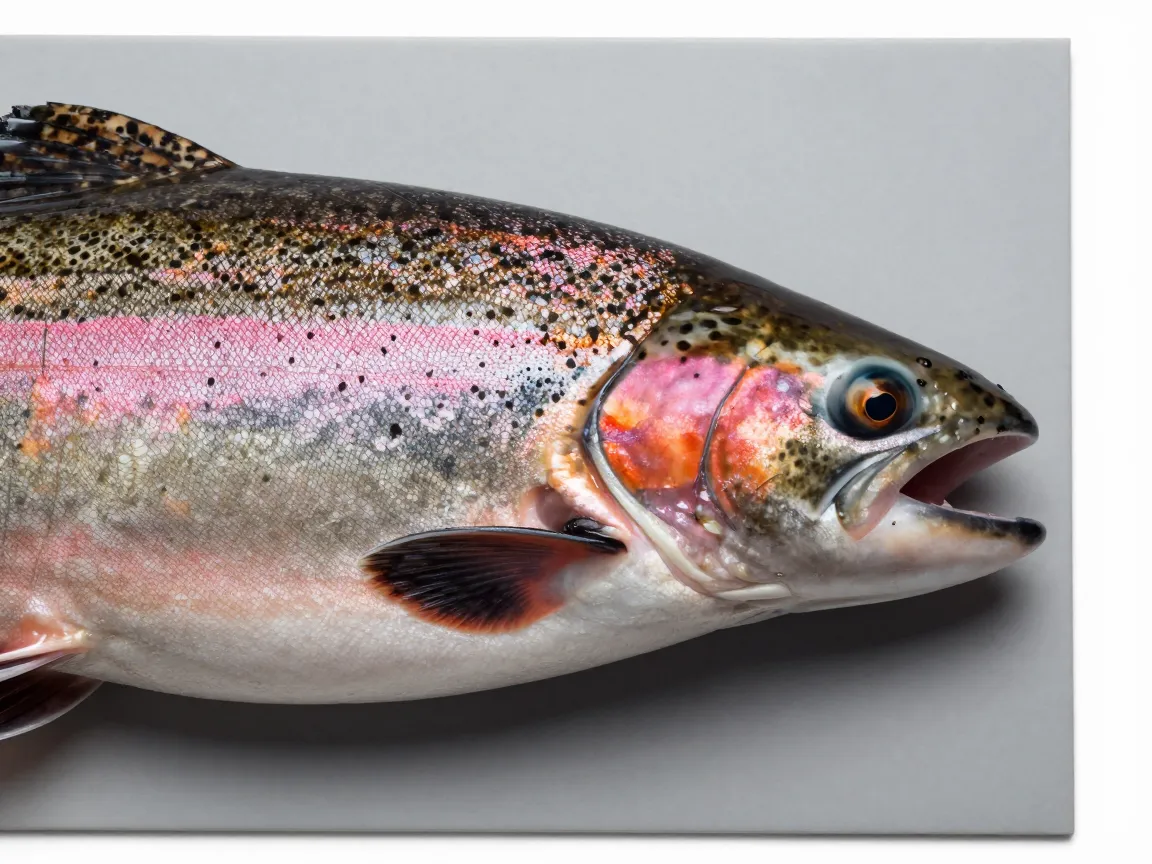
A common mistake in rainbow trout photography is setting white balance for “cool natural daylight” because the fish lives in cold streams. That choice pushes the pink stripe toward orange on warm-toned fish and toward grey on fish with low stripe saturation. The correct approach is to shoot in RAW and set a neutral grey card white balance, then adjust the hue of the stripe in post rather than baking a correction into the capture.
Wild fish from high-altitude, clear-water environments show color that “won’t be found on a stocked fish,” as fishery photographers note. If the assignment calls for documenting wild coloration, the exposure must protect highlight detail in the stripe even at the cost of slightly darker shadow areas. Retrieve the shadow detail in post; a blown stripe cannot be recovered.
5. Use Vector Silhouettes and Flat Illustrations for Small-Format Applications
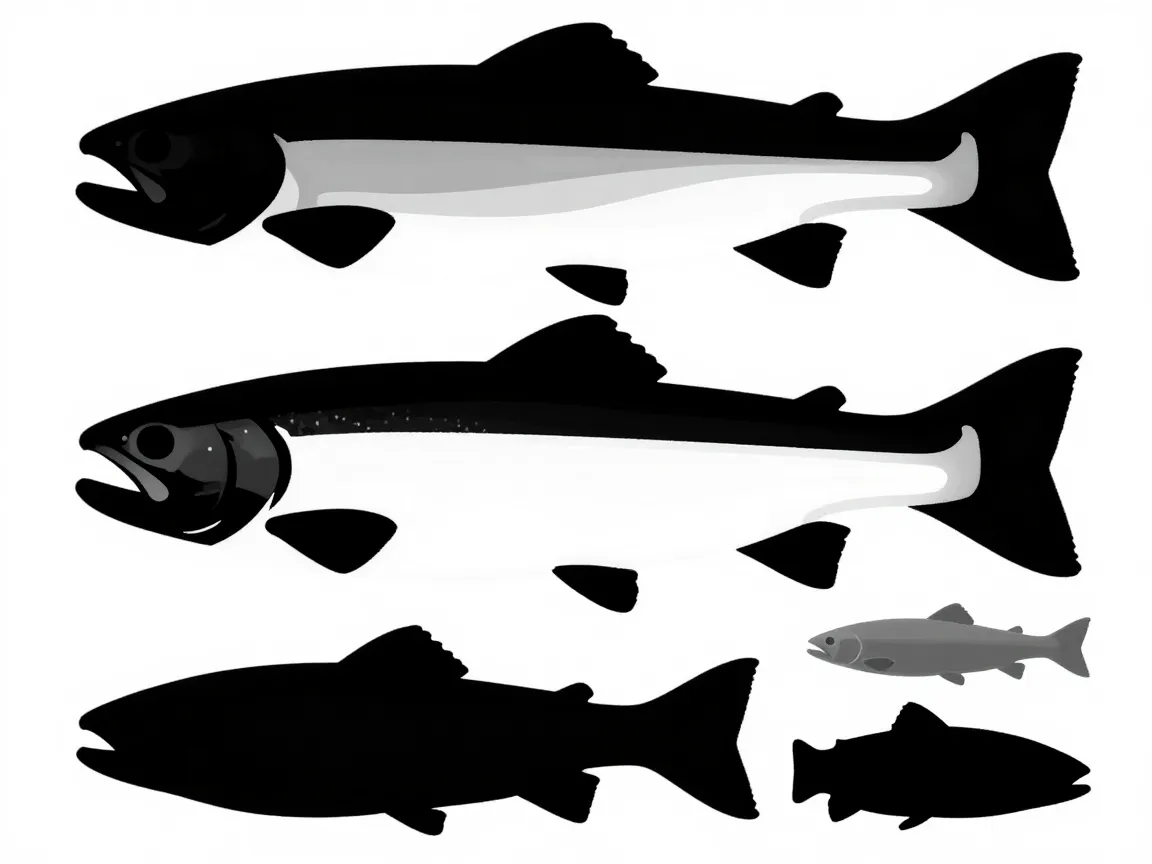
When the final output is a logo, apparel graphic, or small-format publication element, photographic detail becomes a liability rather than an asset. Vector silhouette sets of freshwater fish, including rainbow trout, are specifically described in design catalogs as “optimized for easy tracing” and built as “high-contrast freshwater fish vector silhouettes” that read clearly at badge or thumbnail size.
The practical rule is straightforward. At widths below roughly 200 pixels in digital output, or below about one inch in print, the stripe and spot pattern become indistinct. A clean, high-contrast outline that captures the trout’s distinctive body shape, the slightly forked tail, the pronounced adipose fin, the rounded snout, communicates species identity more effectively than a photographic crop at the same size.
6. Apply Post-Capture Editing to Refine Background and Color
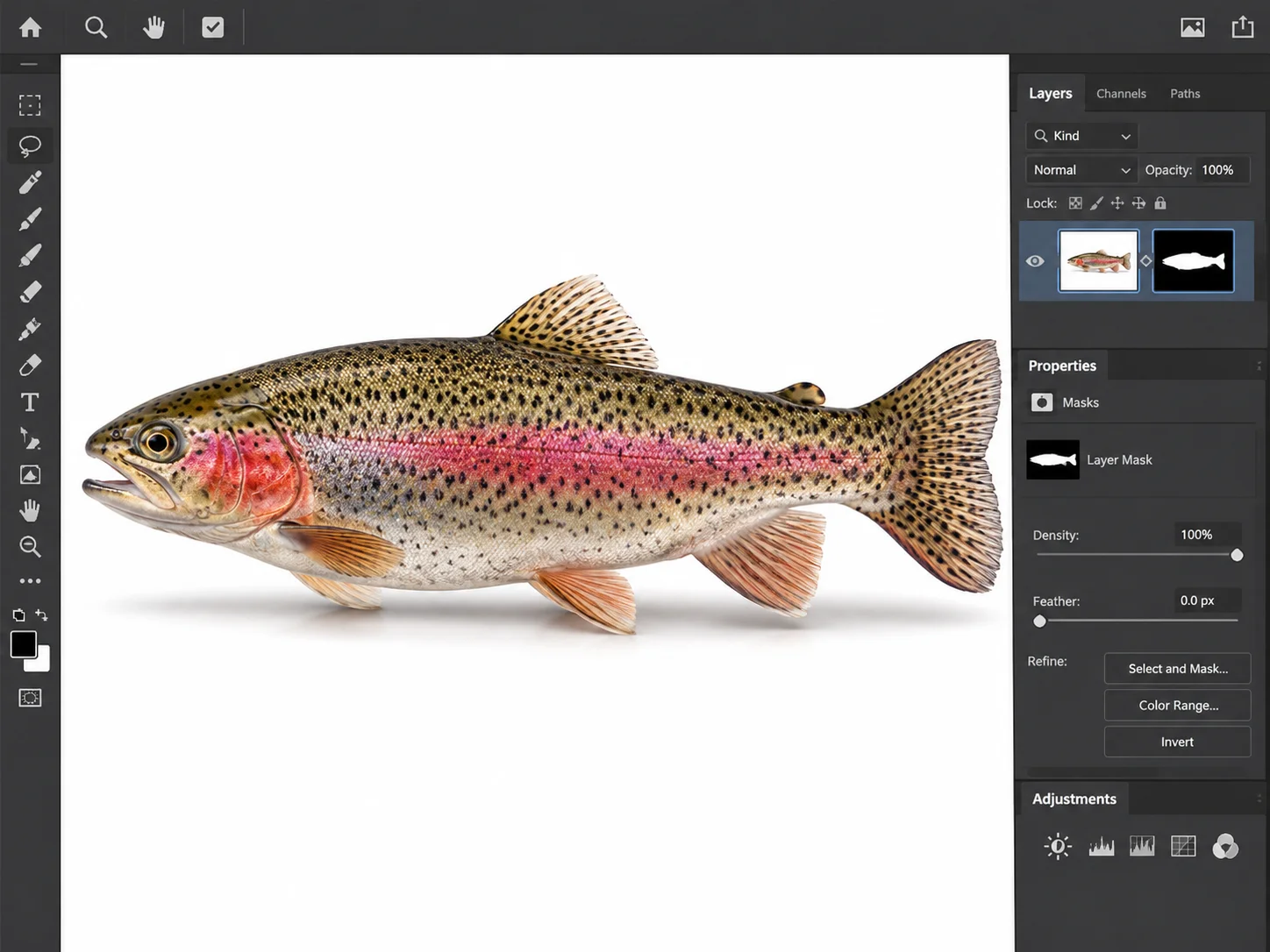
Major stock platforms now integrate AI-assisted tools directly into their rainbow trout product image workflows, including “change background,” “remove object,” and “change lighting” functions. These tools are listed alongside isolated trout images as standard features, not advanced options. For photographers supplying commercial catalogs, this means the expectation is that images arrive clean and that any residual background complexity can be resolved quickly.
For independent photographers, the practical workflow is to shoot on a plain background but allow some shadow detail to remain, a pure white smooth with one light creates a flat, directionless result. A subtle shadow anchors the fish visually. Then use a layer mask or the AI removal tool to lift the background to pure white while keeping the shadow, producing an image that feels grounded rather than floating.
Applying Rainbow Trout Photo Secrets: Color, Contrast, and Clean Backgrounds in the Field
Field photography introduces variables that studio work does not. Current and water depth change the apparent tone of the background. Clouds shift the color temperature in seconds. Fish do not hold still.
The photographers whose river images appear consistently in curated conservation galleries tend to work with two constraints in mind. First, they shoot only in streams where the substrate is light-colored and the water is shallow enough, typically under 60 centimeters, to transmit rather than absorb overhead light. Second, they position themselves so the fish is between the camera and the sky, not between the camera and a shadowed bank.
| Setting | Background Challenge | Best Approach |
|---|---|---|
| Studio white backdrop | Shadow spill onto white | Separate fish from backdrop by 30+ cm, light backdrop independently |
| Clear shallow stream | Current blur, shifting light | Shoot at peak overhead light, use fast shutter (1/500 s+) |
| River bank, fish in hand | Busy riparian background | Shoot against sky or still water surface, wide aperture (f/4 or wider) |
| Top-down hatchery or pool | Multiple fish, crowded frame | Wait for single fish to separate, shoot at 90 degrees to water surface |
| Product or culinary use | Moisture and reflections | Use polarizing filter, light from two 45-degree angles, remove reflections in post |
How the Rainbow Trout Photo Secrets: Color, Contrast, and Clean Backgrounds Standard Became the Industry Default
The convergence on clean backgrounds is recent but fast. A look at stock catalog curation timestamps shows updates to rainbow trout image collections running through mid- to late-2026, with descriptions consistently standardizing on isolation language. This is not a single platform decision, it tracks across commercial stock libraries, educational species galleries, and licensed vintage print archives simultaneously.
The underlying driver is usability, not aesthetics. A fish image on a white background requires no background cleanup before it can go into a product page, a school biology worksheet, an app interface, or a printed field guide. The same image on a cluttered river background requires editing time before each new use. At scale, across tens of thousands of images and hundreds of downstream uses, the clean background is simply a more efficient product.
Vintage chromolithograph prints of rainbow trout, now circulating as public-domain PNG cutouts, follow the same logic even though they predate digital publishing by a century. Those prints were always created on plain white paper so the fish could be reproduced in books without redrawing the surrounding page. The modern white-background studio shot is the same idea with a different production method.
Vector illustration sets extend this further. Freshwater fish silhouette collections designed for apparel and logo use distill the trout to its shape alone, optimized for a single high-contrast read at any size. The color and spot detail are stripped away, but the lateral body profile, the forked tail, and the adipose fin still identify the species unmistakably to anyone who has seen one.
Conclusion
The practical gap between a good rainbow trout image and one that earns licensing revenue, educational placement, or design application is narrower than most photographers assume. It comes down to protecting the pink lateral stripe through correct exposure, keeping the background tone outside the fish’s own tonal range, and delivering a clean isolation that downstream users can place without additional editing work.
Start with these steps before the next shoot. If working in a studio, separate the fish from the white backdrop by at least 30 centimeters and add a second, weaker light on the backdrop itself, it takes the grey shadow cast out of the equation. If shooting in the field, scout for stream locations with light-colored gravel beds and slow current in sections no deeper than half a meter. Shoot in RAW and set white balance from a grey card, not from the sky. For any application smaller than a business card or screen thumbnail, build a vector trace from your best photograph rather than cropping down.
The 2026 standard for rainbow trout imagery is clear and stable, white or uniformly plain background, iridescent stripe accurately rendered, spot pattern fully readable, and a file that drops into any layout without background cleanup. Meeting that standard is not difficult once the three variables of color, contrast, and background are managed deliberately from the moment the camera is set up.