Fly Fishing Tattoo Designs That Every Angler Will Love
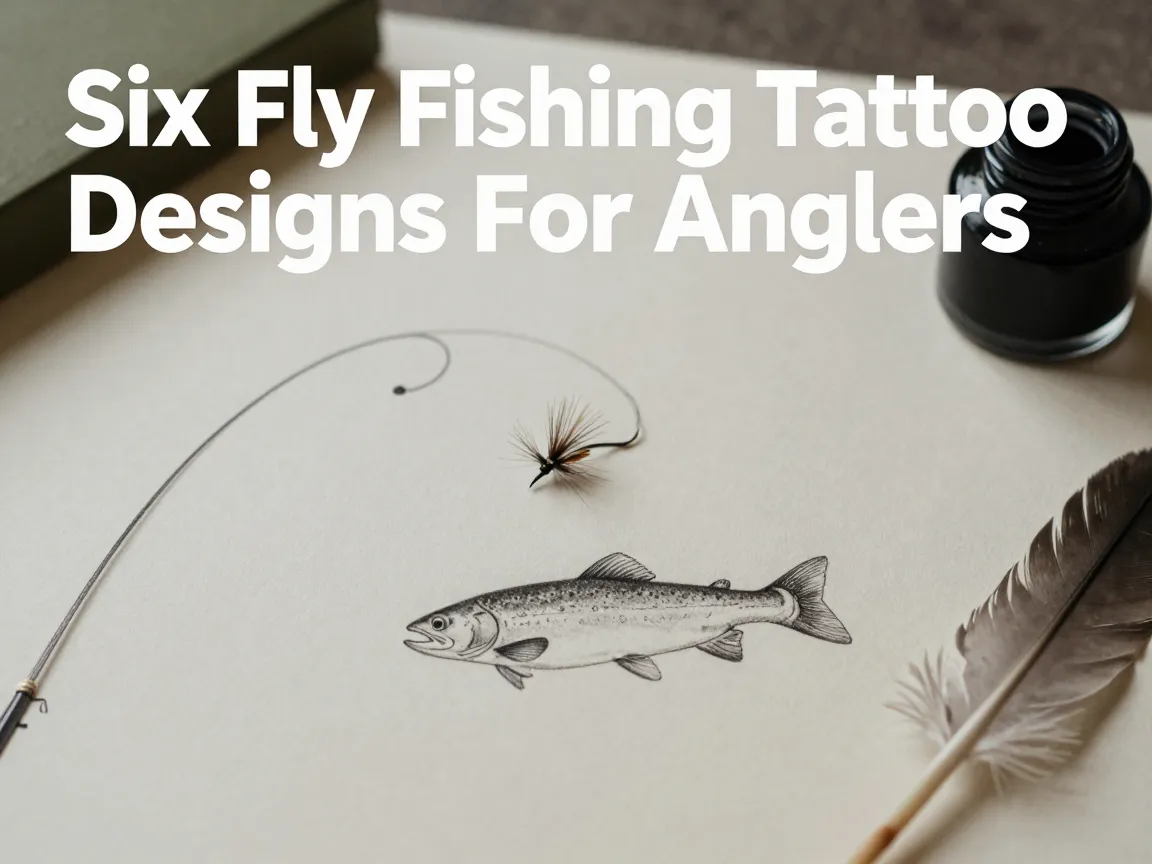
Tattoo databases now catalog more than 22,000 fishing-related designs, and the number keeps climbing, a clear sign that anglers are increasingly choosing to wear their passion permanently. Among all fishing-inspired body art, fly fishing imagery stands apart. The sport demands patience, precision, and an almost meditative connection to water and wild trout, and the best tattoos in this category capture exactly that feeling. The 6 fly fishing tattoo designs that every angler will love explored in this guide reflect what real fly fishers are actually choosing: motifs that balance technical craft, natural beauty, and deeply personal meaning. Whether the goal is a small wrist piece or a full sleeve, these six designs have earned their place as the most sought-after options in fly fishing body art today.
Disclosure: This post contains affiliate links. As an Amazon Associate, we earn from qualifying purchases, and at no extra cost to you.
1. The Detailed Dry Fly on the Inner Arm
Few tattoo concepts carry as much meaning for fly fishers as a faithfully rendered dry fly. A dry fly is not just fishing equipment, it is a small piece of handcraft, built from feathers, dubbing thread, elk hair, and carefully wound hackle. When translated into ink, every one of those elements becomes a subject for a skilled tattoo artist, and the results can be extraordinary.
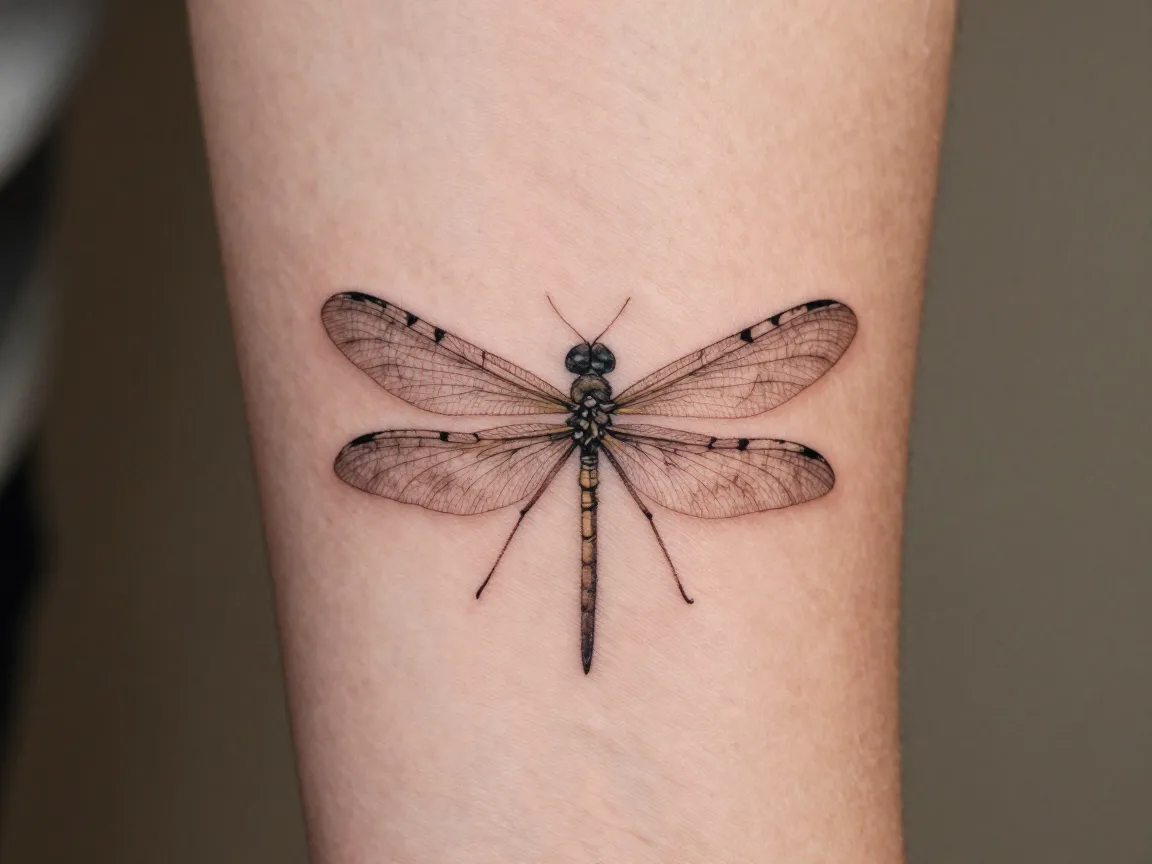
The inner arm is the preferred placement for this design for a good reason. The long, relatively flat surface gives an artist room to illustrate each fiber, each wrapped thread segment, and the delicate hook curve without crowding the image. Fine-line tattooing, a style that uses single-needle techniques to produce hair-thin strokes, suits this subject especially well. The result is a tattoo that reads almost like a botanical illustration: precise, quiet, and unmistakably tied to the craft of fly tying.
What makes this design resonate so strongly with fly fishers is the double identity it carries. The person wearing it is not just showing love for fishing; they are signaling that they understand the making side of the sport. Tying a size-18 Parachute Adams or a Elk Hair Caddis requires the same focused attention that good casting does. A dry-fly tattoo acknowledges both disciplines at once. For anyone who has spent hours at a tying vise before ever reaching the river, that meaning is immediately felt, and easily recognized by other anglers who spot it.
When choosing a dry fly pattern for the design, specificity pays off. A Royal Wulff, a Blue-Winged Olive, or a classic Adams each has a distinctive silhouette and color profile. Naming the pattern to the tattoo artist and providing a reference photograph ensures the final piece is accurate enough to be recognizable rather than a generic impression of a fly. That specificity is part of what elevates this design from decoration to genuine personal statement.
2. The Classic Fly-Fishing Hook Motif
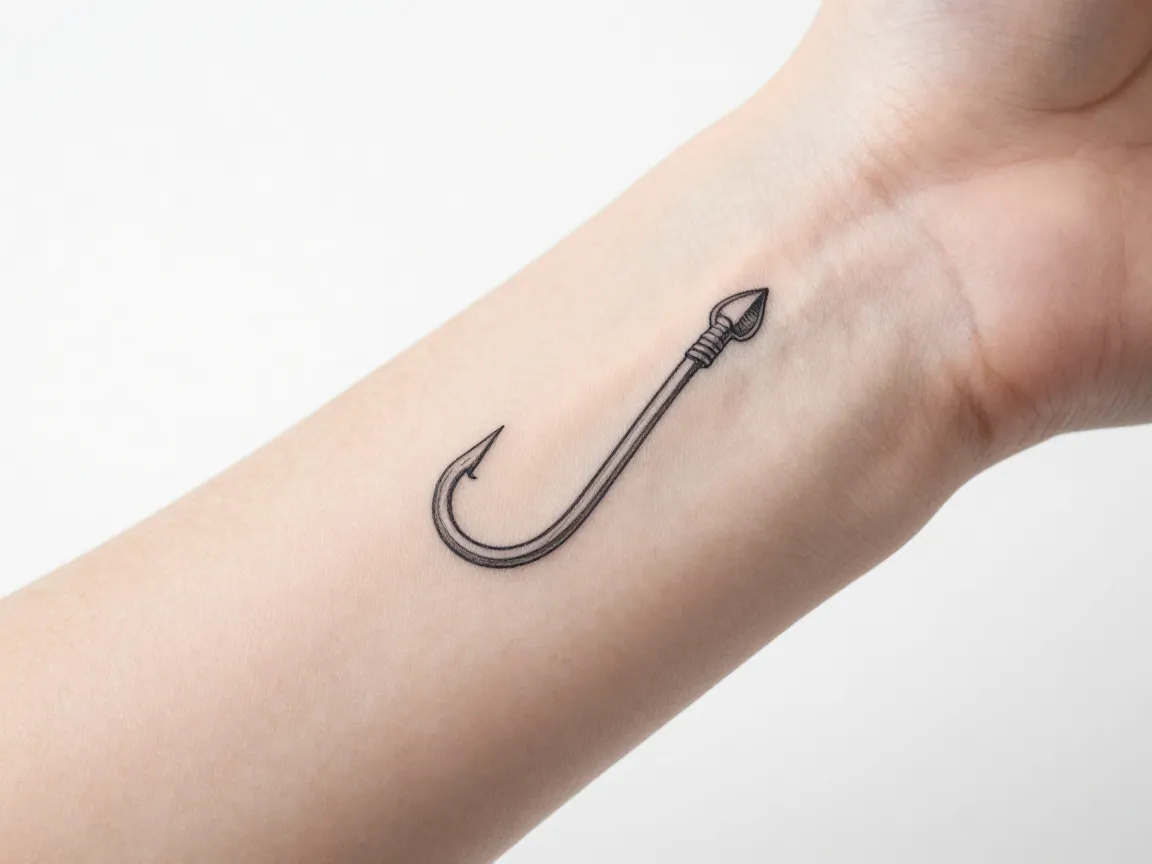
The bare hook, especially the elegant J-curve of a traditional fly hook, is one of the most versatile and enduringly popular designs in fly fishing body art. It is simple enough to work at almost any scale, from a half-inch wrist tattoo to a large back piece, and it carries a weight of symbolism that goes well beyond its visual simplicity.
A fly hook is the essential point of contact between angler and fish. Without it, the most precisely tied fly is useless. That fundamental role gives the hook an almost philosophical edge as a tattoo subject: it represents the moment things become real, the connection between effort and outcome. Some anglers pair a single hook with a short phrase or a set of coordinates marking a favorite stretch of river. Others prefer the hook completely alone, letting its curve speak without additional context.
Stylistically, hook motifs work in both minimalist fine-line and bold traditional American tattoo styles. A fine-line interpretation renders the hook with the precision of a technical drawing, showing the barb, the point, the bend, and the eye with quiet accuracy. A traditional-style hook, by contrast, uses thick outlines and solid color fills, giving the design a vintage quality that sits naturally alongside other classic tattoo imagery, fish, compasses, anchors. Either approach produces strong results depending on the wearer’s broader aesthetic.
One particularly effective variation is the fly-hook-with-fly combination: the hook is shown already dressed, with the wound hackle, tail fibers, and wing still attached. This hybrid merges two iconic fly fishing symbols into one image and works especially well as an upper-arm or calf piece where there is enough surface to show the detail without overcrowding the form.
3. The Leaping Trout Reaching for a Fly
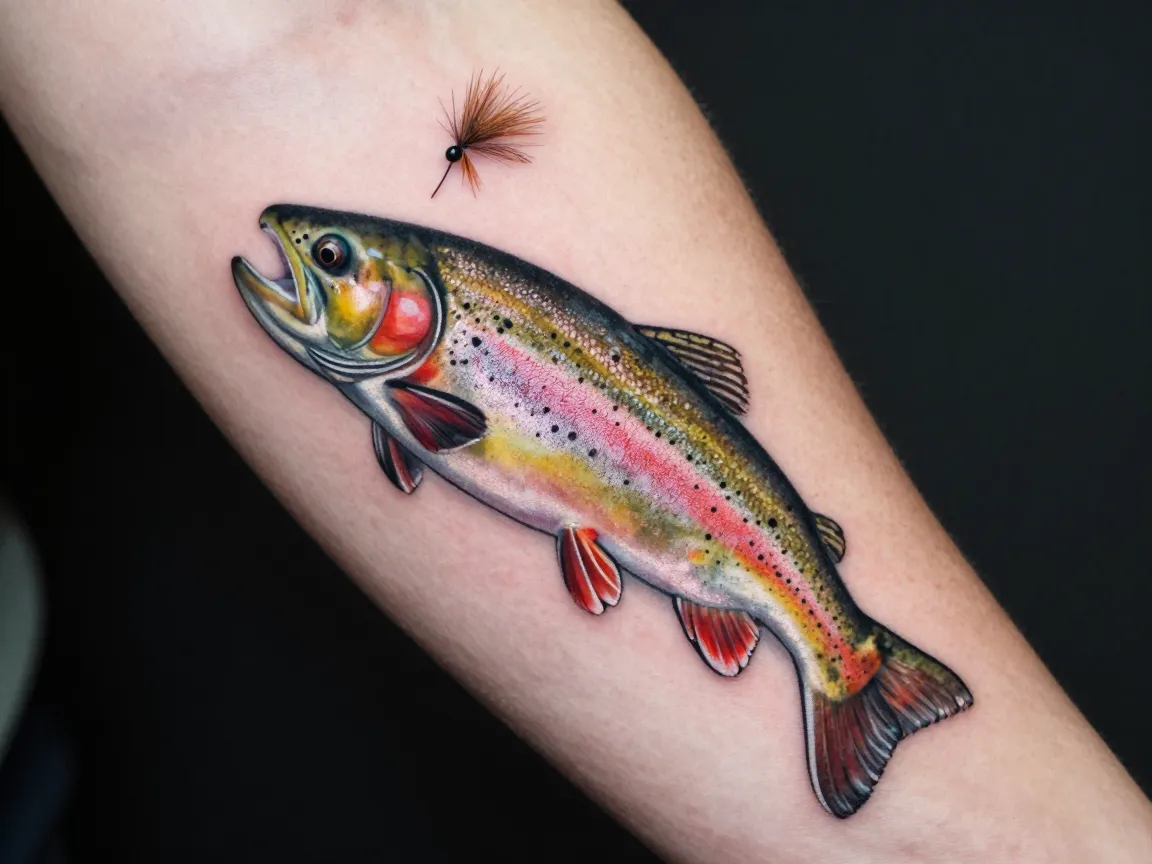
Of all the moments in fly fishing, few are as visually dramatic as a trout breaking the surface to take a dry fly. That instant, the fish fully airborne, the fly just above the water, the splash frozen in mid-motion, is the emotional peak of the sport, and as a tattoo it translates that feeling directly onto skin.
This is a composition-driven design, which means placement matters enormously. The natural arc of a leaping fish works best on body areas with a curved or elongated canvas: the upper arm, the calf, the ribcage, or the top of the foot. A skilled artist will position the fish so its leap follows the natural contour of the body, making the design feel like it belongs there rather than simply sitting on top. When this alignment is achieved well, the tattoo gains a sense of motion that static imagery rarely achieves.
Rainbow trout and brown trout are the two most common species choices for this design. A rainbow offers the artist a spectacular color palette, the pink-to-red lateral band, the olive back, the silver flanks dotted with black spots, that rewards a full-color approach. A brown trout, with its golden-brown sides, red and black spots with pale halos, and slightly more streamlined body shape, often works beautifully in a more muted, earthy palette or even in black-and-grey realism. The choice of species also sends a signal: rainbow trout are associated with western American rivers and New Zealand fisheries, while brown trout carry strong associations with British chalk streams and classic European fly fishing tradition.
The dry fly above the trout’s snout is a critical compositional element. It should be shown as a small but recognizable tied fly, not a vague blur, because that specificity is what tells the viewer this is a fly fishing tattoo rather than a generic fish piece. The gap between trout mouth and fly, often just a fraction of an inch in real life, becomes a charged space in the tattoo: full of anticipation, the entire tension of the sport compressed into one frozen frame.
4. The Full River Scene with Rod, Reel, and Water
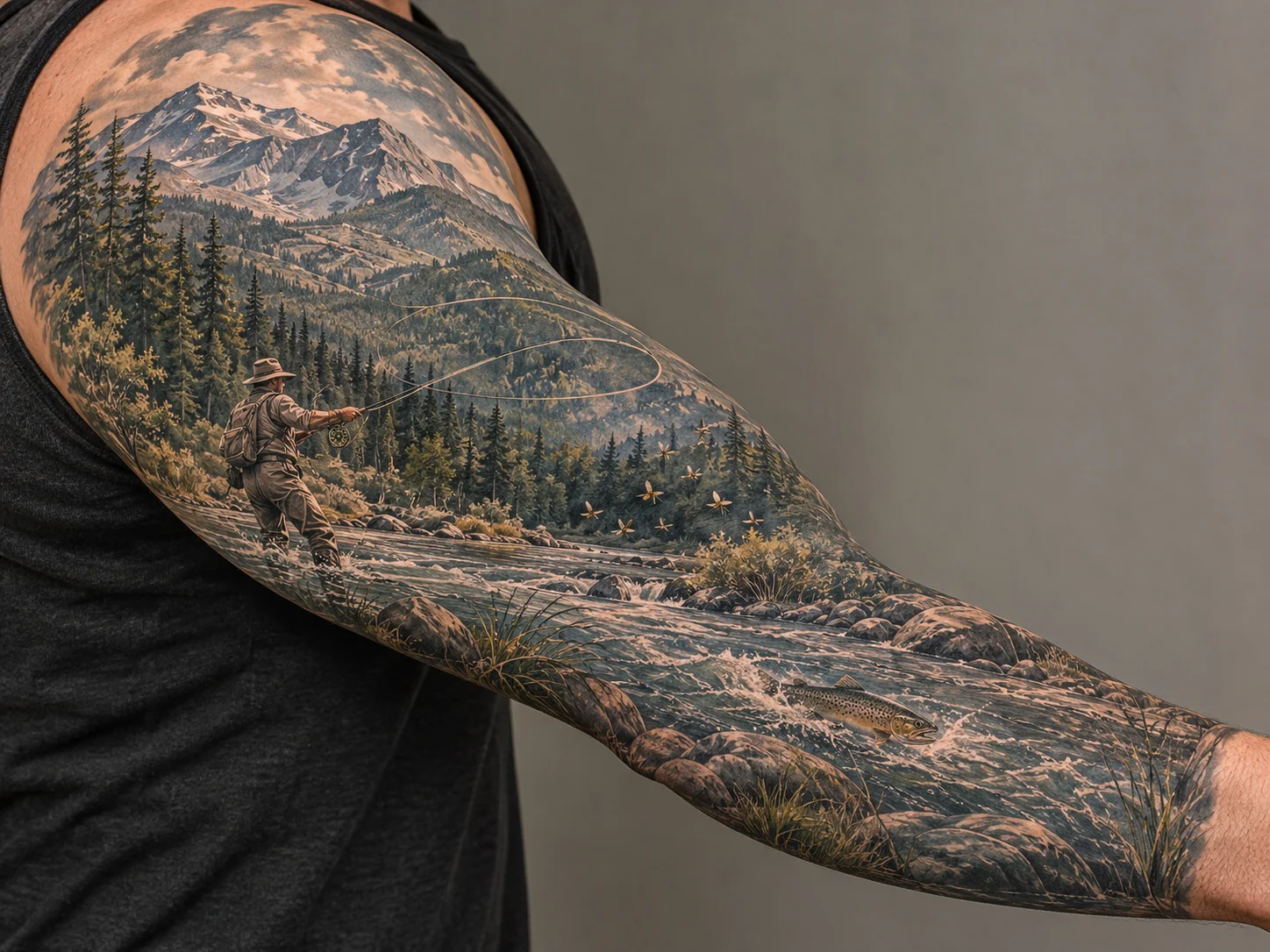
For anglers who want to tell a fuller story with their body art, the full river scene is the natural choice. Rather than isolating a single element, this design builds a complete environment: a figure or pair of waders casting a line, a river bending through a valley, mountains or forest in the background, and the arc of the fly line caught mid-cast above the water.
This kind of design demands space and usually works best as a sleeve, a chest piece, or a large back panel. The ambition of the concept scales well, a half-sleeve version might focus on the river and the rod with a stylized mountain ridge in the background, while a full-sleeve version can include detailed bankside vegetation, a hatch of flies above the water, and a fish holding in a visible current seam below the surface. Each added element rewards closer inspection without muddying the overall composition.
What sets the best versions of this design apart from mediocre ones is the handling of water. Moving water is notoriously difficult to tattoo convincingly. The most accomplished artists use a combination of negative space (leaving skin unpigmented to suggest light hitting a riffle), fine parallel lines suggesting current direction, and carefully placed darker tones for depth in pools and runs. When water is rendered with that kind of technical attention, the entire scene comes alive in a way that transforms the tattoo into something genuinely artistic rather than merely illustrative.
The fly rod itself is worth careful thought. Fly rods are long, slender, and built from graphite or cane, with a distinctive taper from handle to tip and the elegant loop of fly line extending from the guides. That line, mid-cast, forms a D-loop or a tight forward loop depending on the casting stroke shown, and an artist who understands the mechanics of fly casting will render it correctly. That accuracy means everything to a fly fisher viewing the finished work.
5. A Fly Rod Casting Over a Mountain Stream
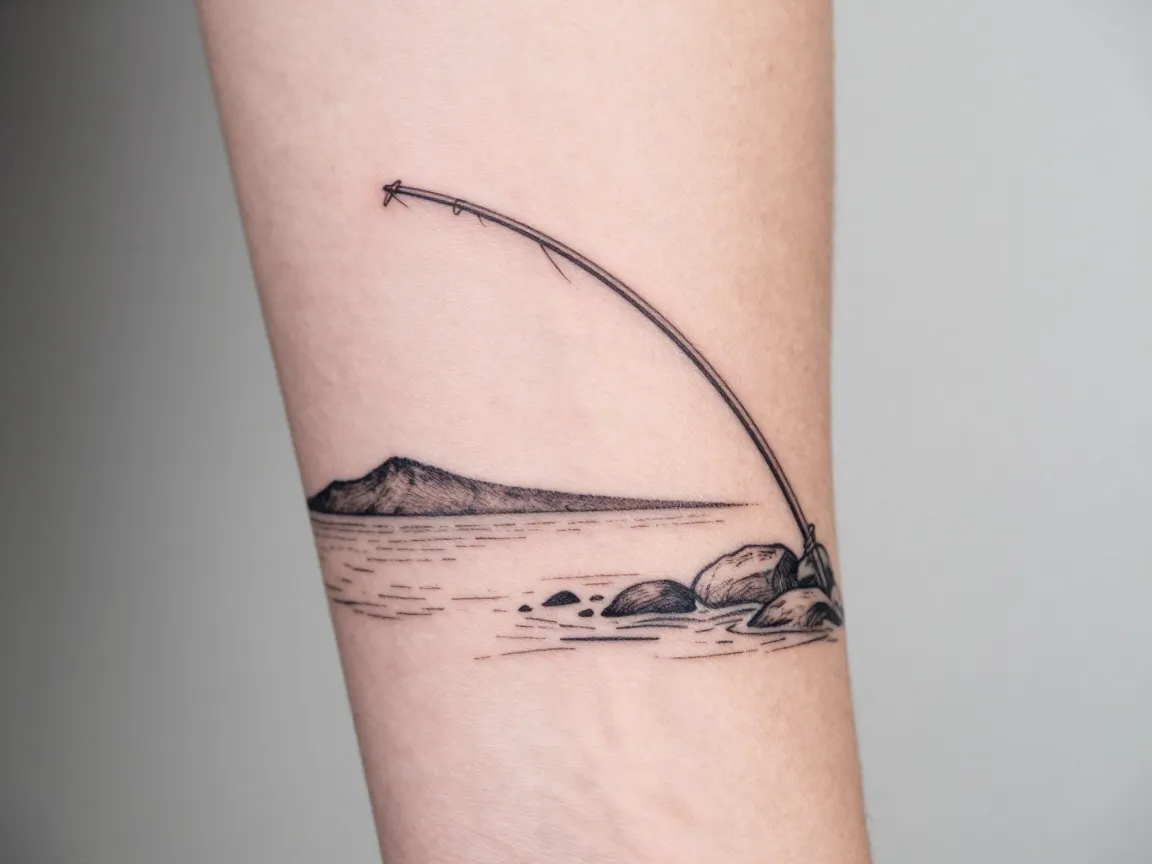
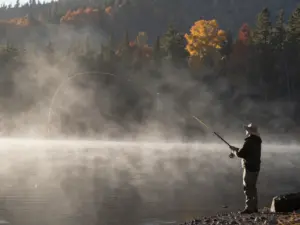
Stepping back slightly from the full scene design, the fly rod casting over a mountain stream focuses on a narrower but no less evocative image: the arc of the rod, the line unfurling overhead, and a suggestion of the water and landscape below. This design has become one of the defining images of modern fly fishing culture, appearing on everything from apparel to vehicle decals, but as a tattoo, it achieves a quieter, more personal quality.
The composition typically works as a vertical design, making it well suited to placement on the forearm, the shin, or the upper back between the shoulder blades. The rod occupies the upper portion of the image, curving naturally as it loads under the weight of the line. Below it, the stream is suggested rather than fully rendered, a few expressive lines conveying movement over rocks, perhaps a distant tree line or a ridge silhouetted against an open sky. The restraint of this approach is part of its appeal: it invites the viewer to fill in the landscape from their own experience.
For many anglers, this design functions as a memory marker as much as a celebration of the sport. The mountains in the background might represent a specific range, the Rockies, the Cascades, Patagonia’s Andes, and that specificity can be communicated through subtle details that only the wearer and their closest fishing companions will recognize. A particular bend in a hillside profile, a specific style of wooden bridge, the shape of a canyon wall: these small geographic references turn a general fly fishing image into a portrait of a place that shaped the angler’s relationship with the sport.
Blackwork and linework styles suit this design particularly well. Without color, the negative space of open sky and unrendered water becomes a compositional tool, keeping the image clean and graphic while still conveying depth. This also ages more gracefully than color work, maintaining its clarity over decades as the skin changes.
6. The Minimalist Fly or Hook Silhouette for Small Placements
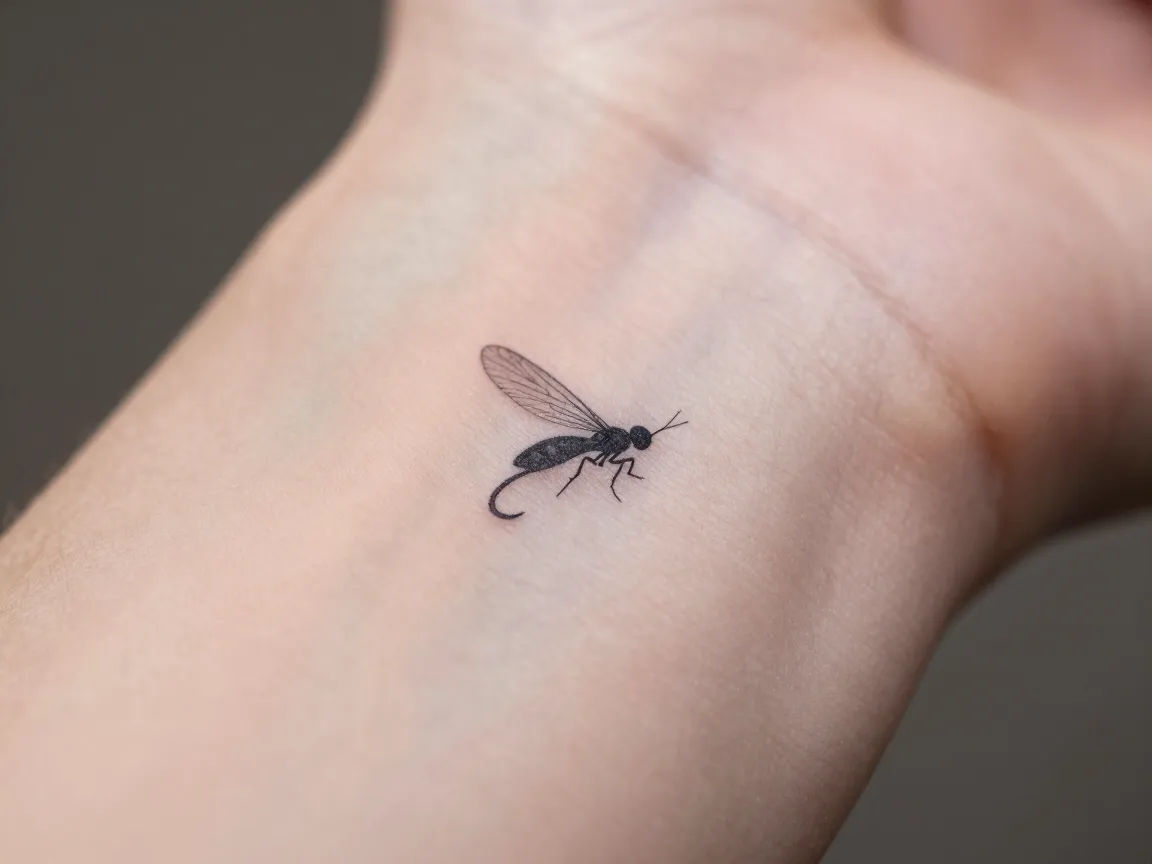
Not every fly fishing tattoo needs to be large or complex. For anglers who prefer understated body art, or who want a first tattoo that leaves room for future additions, a minimalist silhouette of a fly or hook is the most adaptable and enduringly satisfying option in this list.
The minimalist approach strips the subject down to its essential outline. A dry fly becomes a small, precise shape: the wing profile, the hook bend, the tail fibers, all rendered as a single continuous fine line or as a solid filled silhouette. A hook becomes an elegant curve with a point, nothing more. What gives these small pieces their power is not complexity but placement and proportion. A tiny fly pattern on the inside of the wrist, positioned so the hook curve mirrors the natural line of the pulse point, achieves a visual elegance that larger pieces sometimes overreach for.
Ankle placement is another popular choice for this style, particularly for women anglers. The ankle’s rounded shape pairs naturally with the circular arc of a hook or the rounded profile of an upright dry fly wing, and the relatively low visibility of the placement suits those who prefer to reveal the tattoo on their own terms rather than making it immediately visible in professional settings.
The minimalist silhouette also serves as an excellent test design for anglers considering a larger piece later. Many serious collectors of fly fishing body art begin with a small hook or fly silhouette, then build a sleeve or body panel around it over subsequent years. The small initial piece anchors the larger composition and carries the most personal meaning because it was chosen first, before the broader artistic vision was fully formed. That origin-point quality gives minimalist fly tattoos a sentimental weight that larger showpiece designs sometimes lack.
One important practical note: very small fine-line tattoos require an experienced artist who specializes in that scale. Lines that are too thin or placed too close together at small sizes can blur and bleed into one another within a few years as the ink settles. Choosing an artist with a proven portfolio of small-scale fine-line work is not optional for this style, it is essential to the design’s long-term integrity.
What to Consider Before Committing to Fly Fishing Ink
Choosing among the 6 fly fishing tattoo designs that every angler will love is ultimately a question of personal connection rather than trend-chasing. The designs that hold up best over decades are those tied to a specific memory, a particular river, a species the angler has pursued for years, or the quiet discipline of fly tying practiced through long winters. Generic fishing imagery fades in personal significance the moment the novelty wears off; a precisely rendered Royal Wulff or a correctly cast fly line never does.
Placement deserves as much thought as the design itself. The body areas most naturally suited to fly fishing imagery are the forearm and inner arm for detailed fly and hook work, the calf and upper arm for scene-based compositions, and the wrist or ankle for minimalist silhouettes. Curved body surfaces add natural motion to fish and casting designs, while flat surfaces suit the technical precision of a well-tied fly or a single hook.
Finding the right artist is non-negotiable. Fly fishing tattoos live or die on technical accuracy, an angler who knows the sport will immediately notice a fly pattern tied incorrectly or a fly rod with guides in the wrong position. Seeking out an artist who either has personal knowledge of fly fishing or is willing to study reference material carefully before starting the design is well worth the additional research time.
Conclusion
Fly fishing body art has moved well past novelty into genuine artistic territory. The six designs covered here, the detailed dry fly, the hook motif, the leaping trout, the full river scene, the rod-over-mountains composition, and the minimalist silhouette, represent the clearest expressions of what fly fishing means to those who practice it seriously. Each one offers a different balance of complexity, placement flexibility, and personal symbolism. The most useful next step is to gather reference images for the specific pattern, species, or river that holds the deepest meaning, and then find an artist whose existing portfolio demonstrates both technical precision and comfort with organic natural subjects. That combination is what transforms a fishing tattoo from a decoration into a permanent piece of personal history.