Fish Drawing Aesthetic Ideas for Stunning Aquatic Art
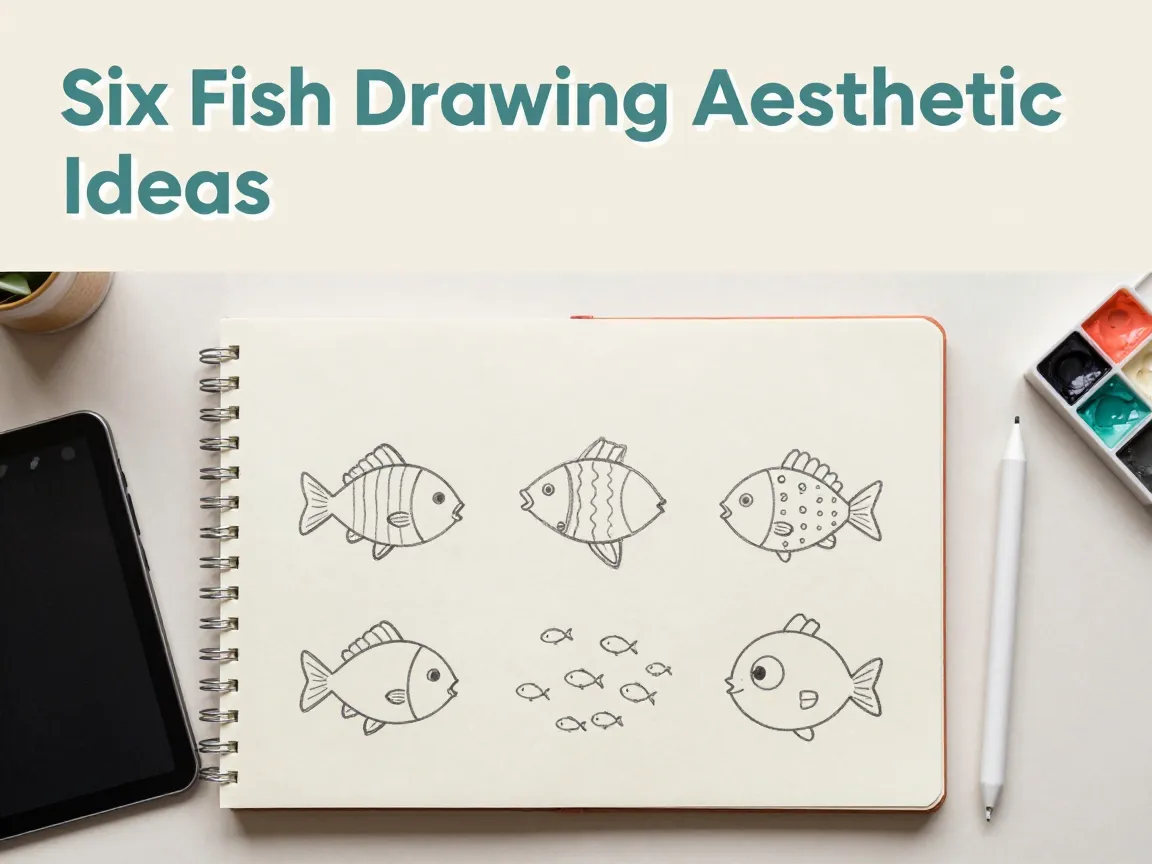
Over 25 distinct fish drawing motifs now appear in beginner-focused guides published in 2026 alone, goldfish, koi, betta, clownfish, pufferfish, and cartoon fish among them, yet most artists still reach for the same handful of techniques. That gap between available ideas and actual practice is exactly what exploring the full range of 6 fish drawing aesthetic ideas for stunning aquatic art can close. Whether the goal is a child’s first sketchbook page or a layered digital illustration, each aesthetic framework below offers a distinct visual language, a specific construction method, and a clear reason to choose it over the others.
Disclosure: This post contains affiliate links. As an Amazon Associate, we earn from qualifying purchases, and at no extra cost to you.
1. Minimalist Cartoon Fish for Playful, Accessible Scenes
The minimalist cartoon aesthetic is built on radical simplicity: two opposing curves form the body, a large circle anchors the eye, a slight upward curve becomes the smile, and a few scattered bubbles complete the composition. That is the entire toolkit. Tutorials aimed at children and early beginners, including widely followed step-by-step guides updated in late 2026, consistently return to this framework because it removes every obstacle between intention and result. The fish is recognizable after fewer than a dozen lines.
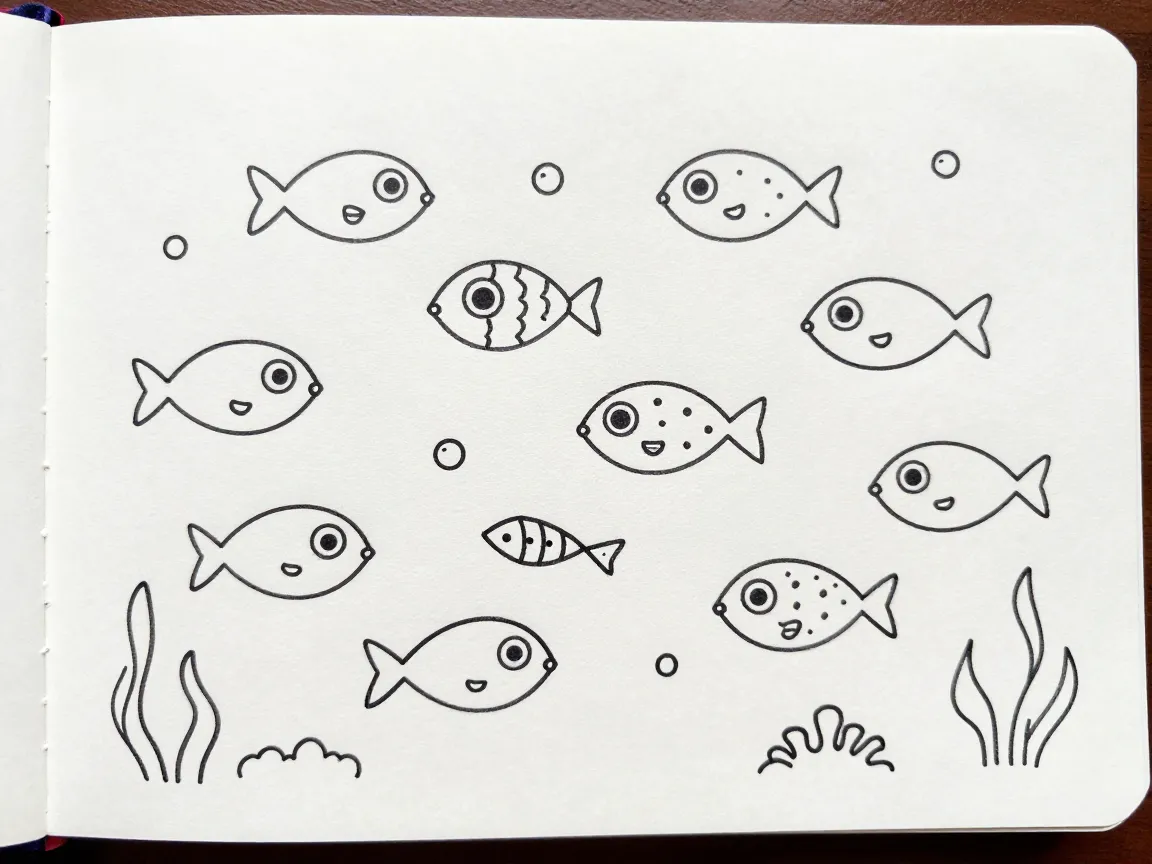
What makes this aesthetic genuinely powerful rather than merely easy is its scalability. A single minimalist fish on a blank page reads as a doodle. Twenty of them, varied slightly in size and stacked against a loosely drawn seaweed bed, become a decorative underwater scene. Adding a few geometric coral shapes in the background elevates the composition further without requiring any additional figure-drawing skill. The environment does the heavy lifting while the fish itself stays clean and uncluttered.
The practical constraint worth noting is proportion. The eye should be large enough to dominate roughly one-quarter of the face area, this single decision separates charming cartoon fish from flat, lifeless ones. Many tutorials specifically call out the size relationship between eye and body as the most common beginner mistake. Keep the mouth small and curved rather than wide and open, and the fish reads as content rather than alarmed. For artists working with young students or producing quick decorative prints, this aesthetic rewards speed and consistency more than any other style on this list.
2. Stylized Goldfish Realism with Layered Scale Detail
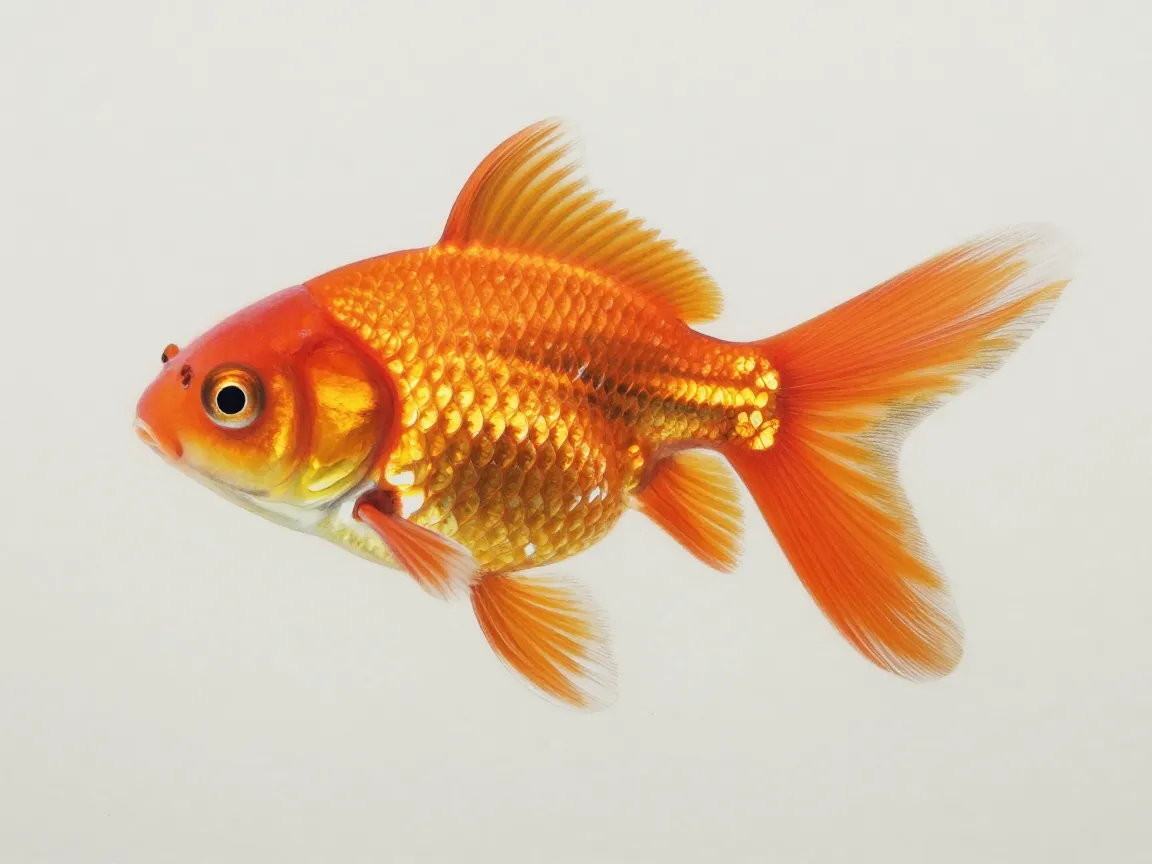
Goldfish realism occupies the productive middle ground between loose illustration and strict naturalism. A structured seven-step process defines the approach: establish the teardrop body outline first, then add the fanned, flowing tail, follow with the dorsal and pectoral fins, place the eye and mouth at their anatomically correct positions, build a layered scale pattern across the body, and close with careful directional shading. Each step depends on the previous one, which means skipping ahead creates proportional errors that are difficult to correct later.
The body shape is the foundation everything else rests on. A proper goldfish teardrop is widest just behind the gills, roughly one-third of the way along the body from the nose, and tapers smoothly toward the tail. Artists who start too thin at the front or too round overall end up with a shape that reads more as a carp or a generic oval fish. Spending extra time on the initial outline pays dividends through every subsequent layer.
Scale texture is where this aesthetic becomes visually stunning rather than merely accurate. Short, curved lines arranged in overlapping rows create a consistent scale rhythm. The key is directionality: each row should arc in the same direction, following the curve of the body rather than sitting flat across it. Light source placement, typically upper left in academic tutorials, determines which scales catch the highlight and which fall into shadow. Drawingforall’s academic approach emphasizes a primary directional axis running from snout to tail as a guide for all subsequent shading decisions. Used consistently, this technique gives the finished drawing the visual depth that separates it from a flat diagram. Goldfish are an ideal starting subject for this style because their flowing double tails offer natural opportunities for overlapping, translucent-looking fin layers that showcase shading skill.
3. Coral Reef-Inspired Beak Fish with Bold Color Blocking
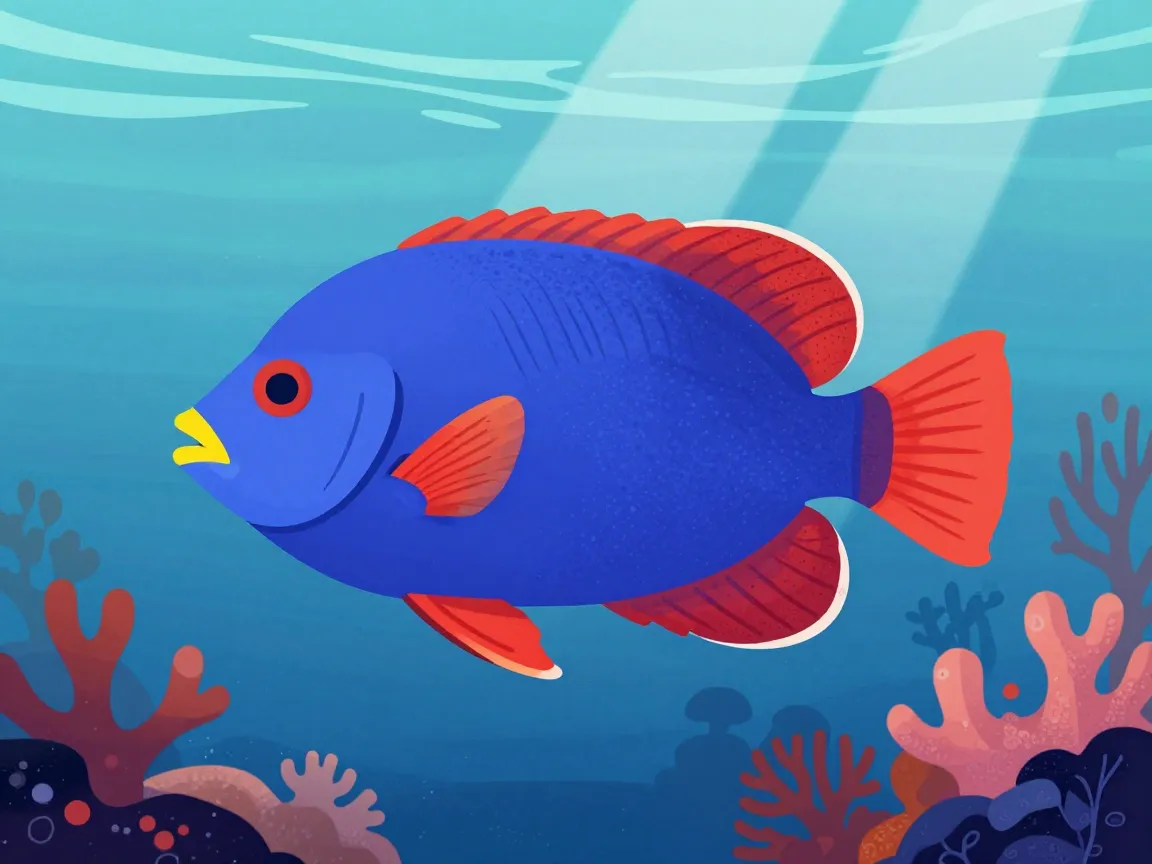
This aesthetic takes its visual cues from the vivid, angular shapes of tropical reef environments. The body starts not as a soft oval but as a modified square with one curved side, giving the fish a flatter, more architectural silhouette. A pointed beak-like mouth form extends from the front of this shape rather than sitting flush against a rounded nose. Multiple stacked fins, each slightly offset from the last, add vertical complexity along the dorsal line and underneath the body.
The defining quality of this style is what happens at the coloring stage. Design Bundles’ digital tutorial from November 2026 explicitly frames color and texture as an open invitation for creative experimentation rather than a step with a correct answer. Bold, high-contrast color blocks applied in flat fills, with minimal blending, create the visual language of modern aquatic illustration rather than naturalistic painting. A cobalt body paired with a crimson fin and a yellow beak reads immediately as reef-inspired without requiring any reference to a specific real-world species.
Texture overlays add the final layer of visual richness. Subtle crosshatching inside the color blocks, or a repeated small-scale dot pattern, mimics the complex surface texture of reef fish scales without demanding the precise control required by goldfish realism. This makes the coral reef aesthetic particularly well-suited to digital media, where texture brushes and pattern layers can be applied non-destructively. For artists building a portfolio of aquatic work, this style pairs naturally with background elements, coral branches, anemone shapes, light-ray gradients from above, that allow a single fish illustration to become an environmental composition.
4. Clustered Small-Fish Doodle Scenes for Decorative Art
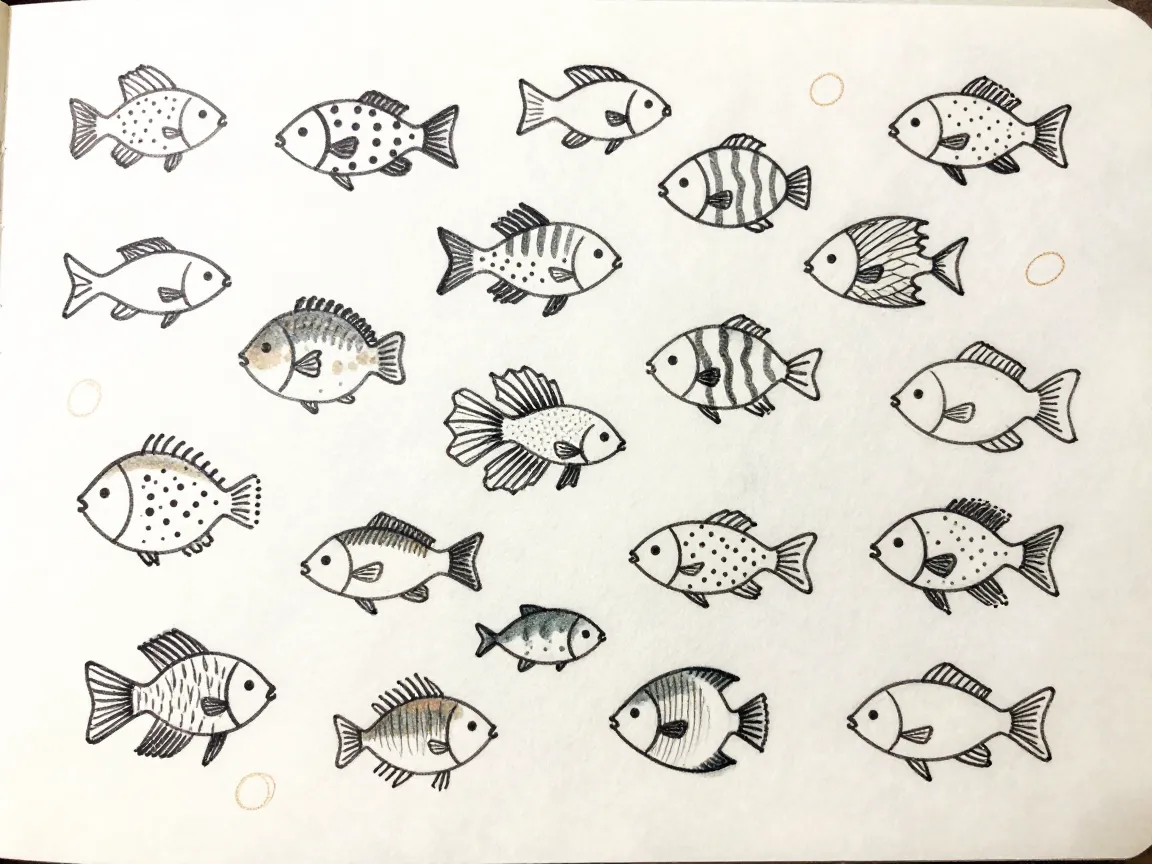
The clustered small-fish aesthetic abandons the idea that every individual fish needs to be refined. Instead, it leverages quantity, variety, and deliberate imperfection. Many overlapping ovals or slightly irregular body shapes, each no larger than a thumbnail, fill the page in loose formations. Tiny triangles serve as tails. Minimal detail, a dot eye, two or three scale lines, differentiates one fish from the next without slowing the drawing pace.
Christine Britton’s work on small fish drawing ideas makes the central argument clearly: imperfect ovals are not a failure of execution, they are the aesthetic. Slight wobbles in the body outline give each fish individuality within the school. Varied patterns inside the ovals, stripes on one, dots on another, diagonal hatch lines on a third, create visual rhythm across the cluster without requiring the artist to invent a new fish species each time. The composition as a whole reads as more sophisticated than any individual element within it.
The practical application for decorative art is significant. Clustered small-fish scenes work beautifully as repeat patterns for surface design, as background textures in mixed-media work, or as standalone sketchbook pages with a loose, journaling quality. Skyrye Design’s catalog of beginner fish ideas confirms the range of species that translate well into this format: round pufferfish bodies, elongated betta shapes, and compressed disc-like angelfish silhouettes each read differently within the same cluster, adding species diversity without compositional complexity. Lemon8 sketchbook creators working in this mode often begin sessions by practicing circles, ovals, and wavy lines as warm-up exercises, a reminder that the clustered aesthetic rewards fluency and speed over precision.
5. Anthropomorphic Big-Eye Fish for Emotionally Engaging Characters
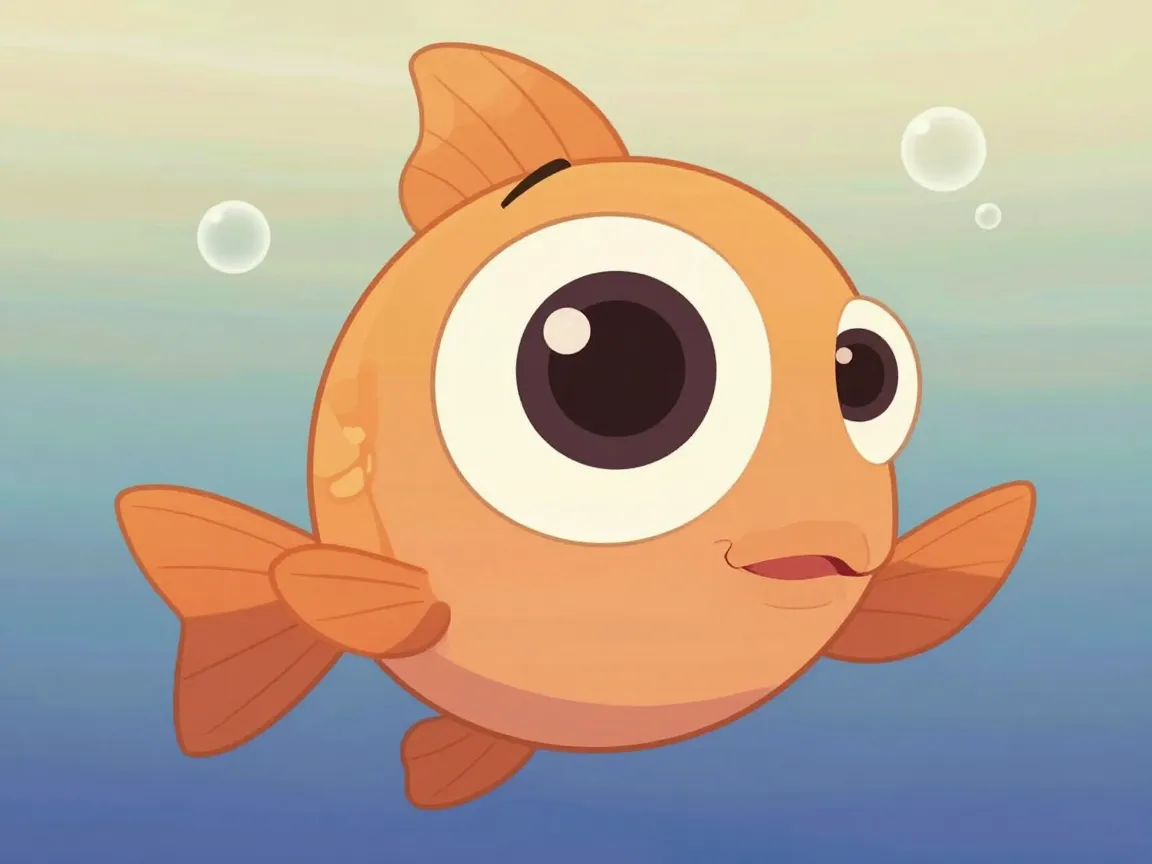
Anthropomorphic fish illustration assigns human or exaggerated emotional qualities to aquatic subjects through three primary tools: oversized eyes, expressive mouths, and stylized body language. The eye is the most critical element. In this aesthetic, the iris and pupil together should occupy a substantial portion of the face, far beyond any anatomically accurate proportion, because visual attention naturally locks onto large, forward-facing eyes and reads them as carrying emotional intent. A small highlight dot in the upper quadrant of the pupil transforms a flat circle into something that appears to be thinking.
Mouth expression works differently in fish characters than in human or mammal characters because fish lack the flexible jaw muscles that drive most human expression. The workaround is exaggeration and simplification: a slight upward arc reads as content, a wide downward arc reads as distressed, and an open circle reads as surprised. The body itself contributes through posture, a slight lean forward creates energy, a curved-down spine suggests sadness or exhaustion, and a wide-spread fin-and-tail position implies confidence or pride. Trendhunter’s analysis of anthropomorphic aquatic illustration identifies this combination of large eyes and readable body posture as the consistent mechanism behind emotionally engaging underwater character work.
This aesthetic has strong commercial relevance. Greeting cards, children’s book illustration, branded mascots, and animated character design all draw on anthropomorphic fish forms because they communicate instantly across age groups and language barriers. The technical entry point is relatively low, a beginner can achieve a readable anthropomorphic fish with a simple oval body and a well-proportioned eye, but the ceiling is high. Advanced practitioners add secondary details like expressive eyebrows (rendered as arched lines above the eye rather than on the brow), fin gestures that mirror human hand positions, and environmental storytelling through the fish’s relationship to surrounding objects.
6. Template-Based Digital Fish Illustration with AI-Assisted Workflows
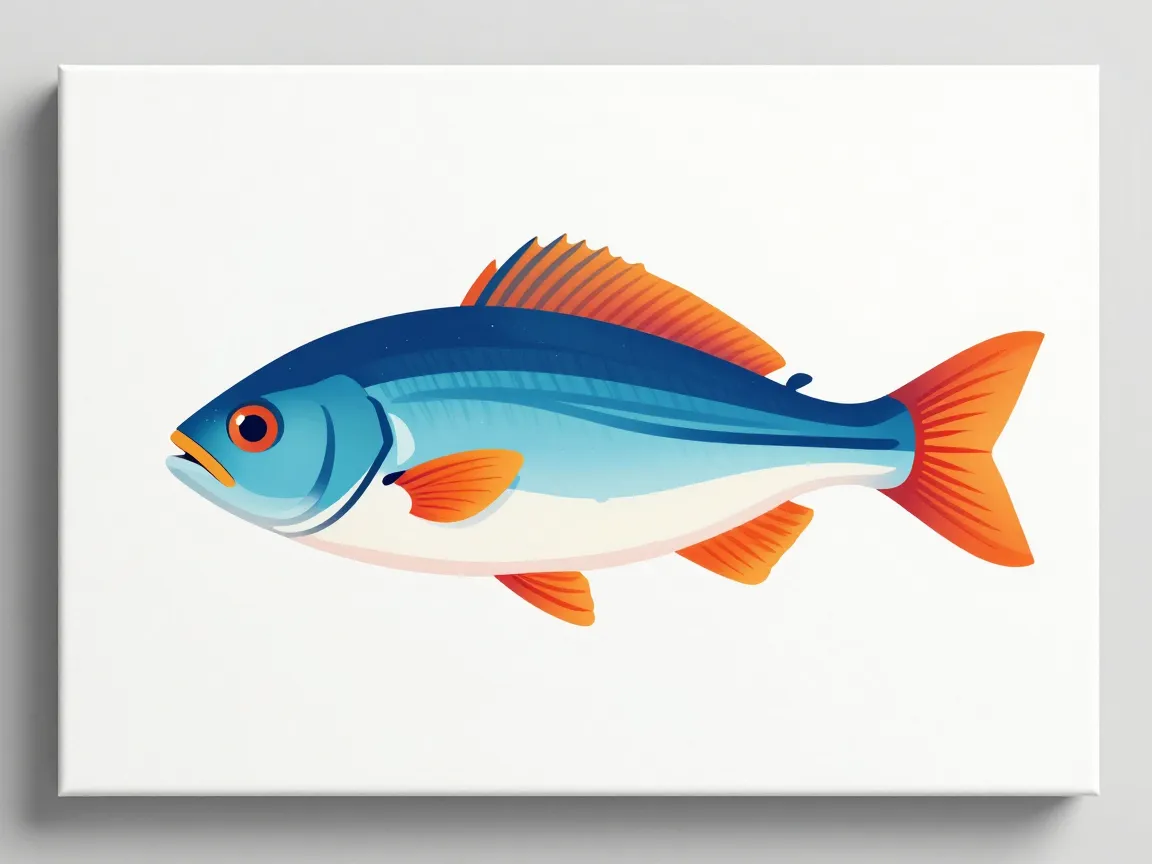
The newest aesthetic framework on this list is defined less by a visual style than by a production method. AI-assisted drawing platforms and customizable template libraries, including PlaygroundAI’s fish drawing templates updated in early November 2026 and Drawize’s community gallery featuring curated fish drawings from the same period, have created a workflow where artists begin with a pre-designed base composition and apply their own color choices, texture decisions, and stylistic adjustments on top.
The resulting aesthetic has recognizable qualities: clean, resolved proportions in the base sketch, bold color palette choices that reflect community trends visible in platform galleries, and a polished finish that benefits from digital tools like color fill algorithms and texture overlays. For artists who struggle with the initial construction phase of fish drawing, getting the body proportions and fin placement right before any detail work begins, template-based workflows eliminate the most common points of frustration. The creative energy goes into color, texture, and compositional refinement rather than foundational line correction.
The critical skill for artists working in this mode is knowing when to depart from the template. A base sketch provides structure, but the most compelling template-based fish illustrations are those where the artist’s individual decisions, an unexpected color combination, a background environment that creates narrative tension, a secondary character added in the margins, push beyond the original framework. Drawize’s community challenge format encourages exactly this kind of departure: the template establishes a common starting point, and the gallery of responses shows how wide the aesthetic variation can be from a shared foundation. Given the expansion of AI template libraries through late 2026, this workflow is positioned to become a standard entry point for digital aquatic illustration in the near future.
Foundational Techniques That Elevate Every Aesthetic
Regardless of which of the six aesthetic directions appeals most, three technical principles consistently appear in expert-level fish drawing guidance. First, a clear gesture or direction line drawn before any outline work establishes the fish’s energy and movement. This single axis, running from snout to tail tip, governs the curve of the spine, the angle of the fins, and the overall sense of whether the fish is gliding, darting, or hovering. Skipping it produces static, symmetrical drawings that feel posed rather than alive.
Second, a committed light source decision should precede any shading. Whether the light arrives from upper left, directly above, or through the water’s surface at an angle, every scale highlight, every fin shadow, and every eye reflection should be consistent with that single source. Mixing light directions within a single drawing is the most common intermediate-level error, and it undermines the visual credibility of otherwise technically accomplished work.
Third, scale texture should follow the body’s contour rather than lying flat across it. Short, curved lines that bend with the fish’s surface read as dimensional. Straight horizontal lines read as patterning. The difference in final quality is significant, and the additional effort required is minimal once the principle is understood.
Adding environmental context, bubbles rising from the fish’s mouth, loose seaweed anchored at the bottom of the frame, coral shapes in the middle distance, transforms an isolated fish study into a complete aquatic scene. Multiple tutorials from late 2026 aimed at both beginners and intermediate artists explicitly recommend building this environmental layer as the final step in any fish drawing session, noting that the supporting elements need not be detailed to be effective. A few curved lines for seaweed and three or four small circles for bubbles are sufficient to place the fish in a world.
Conclusion
The six aesthetics covered here, minimalist cartoon, goldfish realism, coral reef beak fish, clustered doodle scenes, anthropomorphic big-eye characters, and template-based digital illustration, represent genuinely different approaches to aquatic art, not variations on the same technique. The most useful next step is to pick one aesthetic that matches the current skill level and available tools, work through five or six fish drawings using only that approach, and then revisit the others with the perspective that focused practice provides. Depth in one style consistently produces better aquatic art than superficial contact with all six at once.